Tag: Theatre Review

All the latest breaking news on theatre in the UK. Browse THEGAYUK’s complete collection of news, articles and commentary on LGBT+ theatre in the UK.

  • THEATRE REVIEW | Safe, London Theatre

    THEATRE REVIEW | Safe, London Theatre

    ★★★ Safe, London Theatre

    The statistics about homelessness people are alarming. 25% of homeless and at risk youth in the UK identify as LGBT, a shockingly high proportion.  Alexis Gregory has made a verbatim theatre piece looking at the subject. He interviewed a group of young adults who had been at risk or homeless and created a powerful set of interwoven monologues.

    CREDIT: Jane Hobson
    CREDIT: Jane Hobson

    Alicia started stealing her family’s painkillers to self-medicate against her confusion and worries about her sexuality.  Spiralling into a cycle of alcohol addiction she hurtles towards homelessness and hits rock bottom. Jack is confused by his gender, growing up as a boy in a girl’s body, suffering anxiety attacks and verbal abuse from his family who refuse to call him by his correct gender or use the right pronouns. Samuel realises that he’s gay at a young age but his ultra-religious Nigerian parents aren’t sympathetic to his sexuality. When he’s outed by his sister he ends up facing a volley of abuse and barrage of prayers along with plans to send him to Africa to ‘cure’ him. Understandably he flees. Alicia (same name, different character) is rejected by her mother and ends up in children’s homes and foster care. Trapped in the wrong body she works as a rent boy to get cash to get by.

    The stories are a mix of pathos, humour and horror. Samuel’s story (told by the talented Michael Fatogun) is laden with wry humour and the vibrant wit of his character comes through. Riley Carter Millington is among the cast and plays Jack. Better known for his portrayal of Kyle Slater in ‘Eastenders’; Riley was the first transgendered actor to play a transgender character in a T.V. soap opera. It’s a strong cast and they’re gifted a beautiful script (or transcript, even). There’s a hint of music with alternating singers at the start of the show (Rudi Douglas did a spine-tingling acapella version of ‘Smalltown Boy’ on the show I saw). There’s also a series of thought provoking 15 minute curated talks each night after the hour-long performance.

    The interspersing of the monologues with interactions of other actors playing subsidiary roles stalls the action and reduces the impact a little but it’s otherwise pitch perfect.

    Troubling and painful as the stories can be there’s ultimately something redemptive about them too. The Albert Kennedy Trust’s work figures highly in their support of young LGBT people in crisis. This is a performance worth catching. There can’t be many LGBT people out there who don’t find something to identify with here, too. These are exceptional stories in one sense but not in another. These are ‘everyman/woman’ stories that are sure to resonate.

    Follow Chris Bridges on Twitter

  • THEATRE REVIEW | Breakfast At Tiffany’s – Sheffield Theatres and National Tour

    ★★ | Based on the classic novel by Truman Capote; which was famously immortalised on the big screen by the 1961 film, Breakfast at Tiffany’s tells the story of an unnamed writer’s obsession with his faux-socialite neighbour, Holly Golightly, as she optimistically flirts, romances and blags her way through life via a series of romantic interludes with a number of well to do men.

    Photo Credit – Sean Ebsworth Barnes

    Based more on the book than on the film, this adaptation by Richard Greenberg has its moments. Firstly, the script, whilst wordy, carries with it an essence of Capote’s work, with rhythmically delivered passages of lengthy text which maintain the feeling of a novella rather than a play. Returning the time frame to the original 1940’s setting, the costumes were both glamorous, and, in the case of Holly Golightly, numerous. The set design was beautifully done, sturdily constructed, versatile and filled with period detail; and the lighting design by Ben Cracknell effectively transported the audience between New York downpours and hazy summer days.

    Matt Barber (Downton Abbey) delivers his role as Fred with enthusiasm and an element of innocence as his character falls for his neighbour’s charms; despite the hint of Fred’s closeted homosexuality running through the piece. Georgia May Foote (Coronation Street) is functional and steady as Holly Golightly. Stepping into such an iconic role was always going to be a tough call for any actress and Foote holds her own, never really excelling, but never falling flat either, although she doesn’t quite pull off the charisma and allure of the character entirely.

    The difficulty with this production is that is it, sadly, just plain dull. Golightly comes across as a self-absorbed, egocentric and, quite frankly, dislikeable character, which makes you wonder just why anyone would become so infatuated with someone so narcissistic. The play is heavy, slow going and overlong, which lacks any of the whimsical lightness and charm of the film version; and whilst the play is more reliant on the novella than the film, comparisons are unavoidable. The pacing and momentum of the piece is patchy; it is clumsy at times, there are a number of unnecessarily loud and messy scenes filled with a variety of unlikeable characters; and the audience warmed more to the scene stealing cat, Bob, than most of the actors on stage.

    For those enamoured with the book, this is a relatively good adaptation, and they will not doubt find much to enjoy within this production, which is a grittier and darker adaptation in keeping with Capote’s writing. For those who are smitten with the film, and despite the publicity shots for the play which are tantalisingly reminiscent of the iconic imagery associated with the movie, there is likely to be some disappointment.

    Breakfast at Tiffany’s is on national tour (see www.breakfastattiffanys.co.uk/ for details) and is currently playing at Sheffield Lyceum Theatre (www.sheffieldtheatres.co.uk) until 22nd October 2016.


  • THEATRE REVIEW | Shopping and F*cking

    ★ | Shopping and F***ing

    What’s not to like about shopping and f***ing? They’re two fine occupations. The answer is a that there’s a hell of a lot not to like in this messy and deeply flawed adaptation of Mark Ravenhill’s 1996 play. This is a world where sex and consumerism are distinctly unfunny, painfully dull and are a chore to watch.

    The play concerns Mark, a heroin addict who’s just failed in rehab, his lover Robbie and their flatmate Lulu. Emotionally deadened and reduced to seeing everything through a lens of consumerism, they’ve lost the ability to connect emotionally. Cue the arrival of Gary, a teenage rent boy who’s the victim of sexual abuse and now wants to be owned and a messy situation with a drug dealer. Events only serve to deepen their jaded worldview.

    Thematically the play has become more, rather than less relevant in the 20 years since it was first staged at The Royal Court. The world feels more mechanical and glassy eyed with the rise in the usage of the Internet. The play should work as well as it did when it was first written. The problem here is that director Sean Holmes’ attempts at a clever staging have swamped the play to such a degree that it’s almost unwatchable and the script feels buried beneath a high sheen.

    The Lyric has been transformed into a TV studio with a change in seating, green screens and cameras. It’s like a 90’s late night crap TV show with bouncy fake enthusiasm crossed with a surreal shopping channel. Runners appear, there are interludes where the cast try to sell tat to the audience and breaks for shameless nostalgia fests with 90’s pop music, one where Robbie gets off his face on E. It feels sloppy and cheap and not in any intentional way. Back projections of porn, scenes of rimming with associated anal bleeding, characters vomiting on stage, karaoke, audience participation, nudity, on-stage sex, drug-use, splatters of body fluid: I’d list more of the multitude of things that this production has thrown clumsily on stage but I’m starting to get flashbacks of boredom.

    It feels sloppy and cheap and not in any intentional way. Back projections of porn, scenes of rimming with associated anal bleeding, characters vomiting on stage, karaoke, audience participation, nudity, on-stage sex, drug-use, splatters of body fluid: I’d list more of the multitude of things that this production has thrown clumsily on stage but I’m starting to get flashbacks of boredom.

    This could have worked and could have been an arch and witty adaptation that slammed home the message of the play and emphasised the caustic wit of the piece. Instead, it just feels juvenile and tiresome with nothing to compel you to watch. It’s about as dull as spending an hour and a half listening to Gary Barlow’s monotone voice (if you hadn’t noticed, the characters are named after Take That).

    Really disappointing work from The Lyric.

    Shopping and F*cking plays at The Lyric until the 5th November

    Follow Chris Bridges on Twitter
  • THEATRE REVIEW | Cats – Sheffield Lyceum and National Tour

    ★★★ |Cats

    Based on the poems of T.S. Elliot, Andrew Lloyd Webber’s seminal, record breaking musical tells the tale of the gathering of a tribe of cats for their annual “Jellicle Ball”, where they come together to celebrate who they are, and to be chosen by Old Deuteronomy to be the Jellicle Choice to be reborn. Exploding onto the stage in an abundance of colour, choreography and energy and featuring the songs Memory and Magical Mister Mistoffelees, Cats tells of the joys of being a feline and of being an individual.

    Photo Credit – Alessandro Pinna


    Cats production is impressive. There is no denying that the make-up and costumes are stunning, albeit the leotards are so tight it is not difficult to see which cats have been neutered. The set, based around a rubbish dump, is static and effective, as it spills out of the stage and into the auditorium, littering the edge of the proscenium arch and the aisles leading into the audience. The sound was crisp, clear and pitched at the perfect volume, with a good balance of orchestra and vocals, allowing for the actors clear diction to be heard with ease. The lighting was well thought out and the whole thing was professionally put together.

    In terms of performances, they were broadly difficult to fault. Featuring a cast of around 30 very talented actors and dancers, there were some inspired pieces of choreography, both in terms of the feline movement employed by the actors and the show-stopping ensemble pieces which were brilliant at times. The show, despite being first performed in 1981, didn’t feel dated at all, and had an air of freshness about it – it has certainly stood the test of time better than some of Lloyd-Webber’s other musicals from that era.

    However, as a show, Cats is a curious beast and even now, I am still not really sure what to make of it. Oddly, and despite its success, it was never a show which really appealed to me. Audiences have lapped up this show for the best part of 35 years, so I was keen to see what has carried this show for so long. There were a few issues with the uneven pacing of the piece throughout; although the second act fared much better than the first. Some of the lyrics and choreography were slightly repetitive and overused and the whole thing felt very surreal indeed. But once you had bought into the premise and suspended your disbelief, the show did hit some highs, and it became clear why Cats has been embraced by the theatre going public. On paper, the show really shouldn’t work; but in reality, it turned out to be nonsense, but really quite fun. Tap dancing cockroaches, cats dressed as dogs and acrobatics aplenty all fed into the slightly odd but absorbing spectacle.

    Despite its surreal quality, Cats turned out to be far more enjoyable than I could have anticipated. It did feel, as I left the theatre, like someone had force fed me cheese and heavily sedated me for two and half hours; but ultimately – and surprisingly for me, it won me over and did leave me feline good.

    Cats is currently at Sheffield Theatres (www.sheffieldtheatres.co.uk) until 15th October 2016 before rounding off its national tour at Milton Keynes and Wimbledon, before heading to Hungary, Dubai and Germany. For details visit www.catsthemusical.com/tour/


  • THEATRE REVIEW | Confessional

    THEATRE REVIEW | Confessional

    ★★ | Confessional

    CREDIT: Simon_Annand
    CREDIT: Simon_Annand

    If a play is ‘rarely performed’ or ‘an undiscovered gem’ then be wary. There’s often a good reason for that: it’s usually because it’s not a very good play. “Confessional” was an early draft of Tennessee Williams’ later 1972 play “Small Craft Warnings” and is a sprawling elegiac piece laden with dramatic speeches. It concerns a group of low life characters in a bar in a grotty seaside town. Its main point of interest is for scholars and connoisseurs of his work in that this is the first of Williams’ plays where he felt able to include openly gay characters.

    The bar is populated by the usual suspects that mark Williams’ later works: a drunken and angry woman, a swaggering stud who has a name for his penis, an alcoholic doctor and a washed up older gay man with a boy who’s he picked up at the roadside. They rant, cry, shout and ramble. It’s beautiful in parts and there are poetic moments but on the whole it feels a bit of a mess.

    Director Jack Silver has transposed the action from 1950s American to a pub in Southend in the present day with mixed results. The theatre has been transformed into a pub with the audience dotted around at tables and on banquettes with the actors roaming amongst them. Justin Williams’ set is pitch perfect. This is a pub that you’d probably walk in and walk out of again in a hurry. Sticky looking tables, beer and a burger offers and a sense of dilapidation: it’s a pub we’ve probably all been in and wished we hadn’t. The characters fit in well and you can imagine a pub like this being stalked by enraged beautician Leona yelling at her good for nothing going to seed Chav man Bill and her promiscuous weeping friend Violet.

    Where the concept flounders is the language. Characters talk in a style befitting of 1950s Southern California and use old-fashioned America language that doesn’t translate well to the present day. The Jukebox has mournful violin music that Leona plays on repeat. There’s something distinctly dated about their attitudes and stances too/ It often feels jarring and stylistically wrong.

    The play is still worth seeing for three reasons: the concept, the set and the acting. The cast are universally strong and there’s something magnetic about Lizzie Stanton and Gavin Brocker (and I don’t just mean his too tight clothing or references to his cock which he has named ‘Junior’). The set is a witty and authentic interpretation. The third factor is the concept of the actors having free range. There’s a script and a set and actors. The rest is the actors’ choice on the night. They stand where they want, cry or don’t cry and choose just how dark or how funny the play is on any given night. Surprisingly, this works and there’s a strong chemistry that comes across with a naturalistic feel to the piece in spite of the incongruous language. That’s quite a feat given such lacklustre raw material.


    Confessional plays at the Southwark Playhouse until the 29th October

  • THEATRE REVIEW | Boys In The Band

    THEATRE REVIEW | Boys In The Band

    ★★★★ | Boys In The Band

    1the-boys-in-the-band-mark-gatiss-jack-derges-cdarren-bell

    “There’s one thing to be said about masturbation: you certainly don’t have to look your best”

    What was shocking to American theatre audiences in 1968 (and cinema goers in 1970 when the film was made) isn’t going to be daring or titillating anymore. The only thing that’s shocking is that viewers less than 50 years ago would be so outraged by a play about a group of gay men having a party with a lasagne and salad instead of Crystal Meth.  So what does ‘The Boys in the Band’ have to offer to the contemporary viewer? The answer is that the issues facing the men are scarily pertinent, still. The play came under fire from some for its negative portrayal of gay men but there’s something chillingly familiar about these boys.

    Uptight materialist Michael (Ian Hallard) has a drink and spending problem, although he’s currently on the wagon from the booze. He’s hosting a birthday party in his New York apartment for waspish self-proclaimed ‘pock-marked fairy Jew’ Harold (played by Hallard’s real life husband Mark Gattiss). Camp and flamboyant Emery has hired a muscular hooker as a gift. Soon to be divorced father of two, Hank is trying to make his relationship work within the constraints of monogamy whilst his partner Larry’s has a distinct inability to keep it in his pants in a world where sex is freely available. Bernard is struggling with the casual racist jibes of his friends and bookish Donald (Daniel Boys) is undergoing analysis to help him come to terms with being gay.

    I don’t know about you but these are a lot like the people in my social circle. Issues with drugs and alcohol, poor self-esteem, self-hatred, shame, looking down on effeminate gays, cruising the saunas too much, open-relationships versus monogamy versus the compromise of the odd threesome here and there? The boys of 1968 might have had different drugs and clothes and lived in a more oppressive society but the songs remain the same.

    It’s a funny play, starting with a sit-com-like first act where a random heterosexual re-surfaces from Michael’s past and lands at the party like a fly in the ointment. There are one-liners that pack a punch and Gattiss is the master of the arch eyebrow movement and gives a seemingly effortless performance as Harold.  Act Two is darker and becomes a sub ‘Who’s Afraid of Virginia Woolf’ as the men get steadily more drunk and play a caustic party game. The climax is poignant and dark in equal measures and there are some deeply affecting moments.

    Despite the odd patch where the script is heavy-handed, shows its age and the occasional clunky plot device flails, overall this is a great play and a worthwhile revival with a triumphant staging from director Adam Penfold. Well worth a visit.

    After the run at The Park Theatre in London the play moves to Manchester from the 3rd to the 6th of November, Brighton from the 8th to the 12th and Leeds from the 14th to the 19th of November.


    Follow Chris Bridges on http://www.twitter.com/chrisb715Twitter

  • THEATRE REVIEW | Dead Sheep, The Birmingham Rep

    THEATRE REVIEW | Dead Sheep, The Birmingham Rep

    A history lesson with outstanding features.

    Deep Sheep
    CREDIT: The Birmingham Rep

    Drama based on the rise and fall of Thatcher has been in production ever since the year she lost power. By the very nature, ‘Thatch- iopic,’ as coined by my theatre colleague, can be bitty and could potentially reduce long-standing working relationships and battles to single scenes or moments.

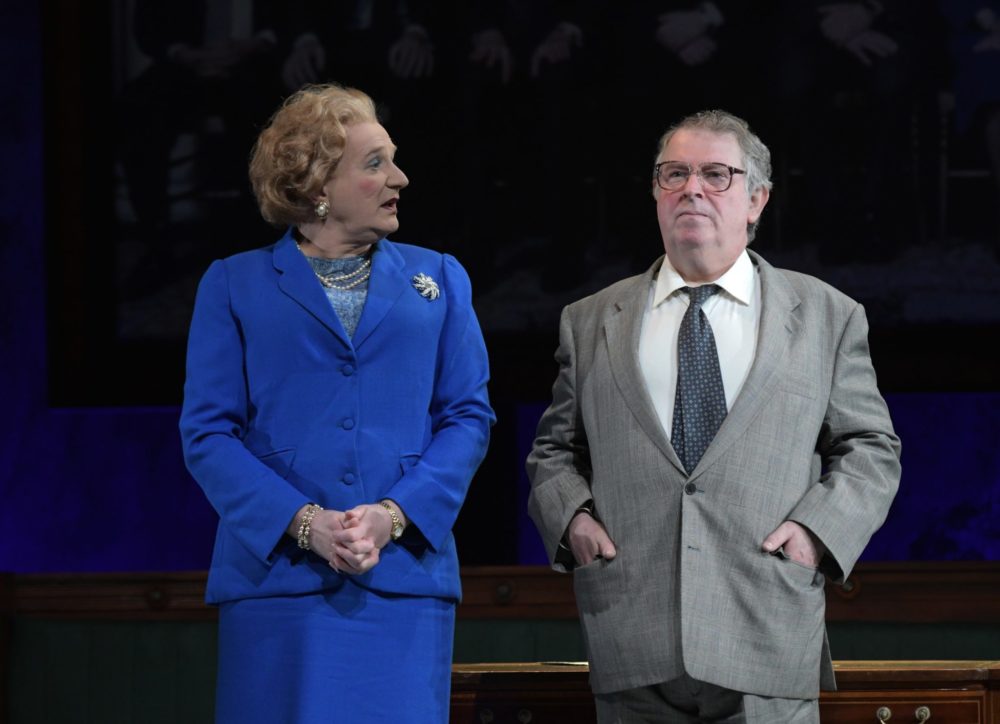
    Dead Sheep is a focused theatre piece in which the relationship between Margaret Thatcher (Steve Nallon), Geoffrey Howe (Paul Bradley, best known for playing Elliot Hope in Casualty), and his wife, Elspeth Howe (Carol Royle) take centre-stage. The triangle, where Howe finds himself in the middle of, is a tug-o-war that eviscerates Howe and forces him to choose one side. Torn between political loyalty and spouse angst, Bradley delivers a formidable and emotionally dynamic performance that was purposely understated to enhance the subtlety of the personality.
    The highlight and perhaps selling point was casting Margaret Thatcher as a man.

    Steven Nallon did an astounding job playing her, it was as if the Iron Lady herself was present before us with the line delivery as well as the movement, stunned and entertained the audience throughout. A couple of belly laughs were had.

    Three actors played narrators (Graham Seed, Christopher Villiers and John Wark) as well as politicians/minister in her cabinet. This entertained the spectators, but at times detracted from the action. Sometimes we just wanted to be shown the story as opposed to being told beforehand. It ruined the drama for us, in part.

    Overall, a successful and refreshing take on the ‘iron’ age of British politics, and as Jonathan Maitland (Writer) said: “But there is one corner the tractors seem to have missed.” What it was like for Geoffrey Howe at the right side of the force not to be reckoned with.

  • THEATRE REVIEW | No Man’s Land, London Wyndham’s Theatre

    THEATRE REVIEW | No Man’s Land, London Wyndham’s Theatre

    ★★★ | No Man’s Land takes place over an evening of drunkenness and a morning of sobriety, as Hirst, an upper class writer, and Spooner, a down on his luck poet, exchange stories, anecdotes and reminiscences over copious amounts of scotch; and subsequently, the following morning’s breakfast. Their stories of mutual experiences, acquaintances and relationships are tainted with the distinct flavour of one-upmanship as the pair debate what may or may not be a shared history in Harold Pinter’s absurdist play.

    Picture Credit Luke Fontana (PR Supplied)

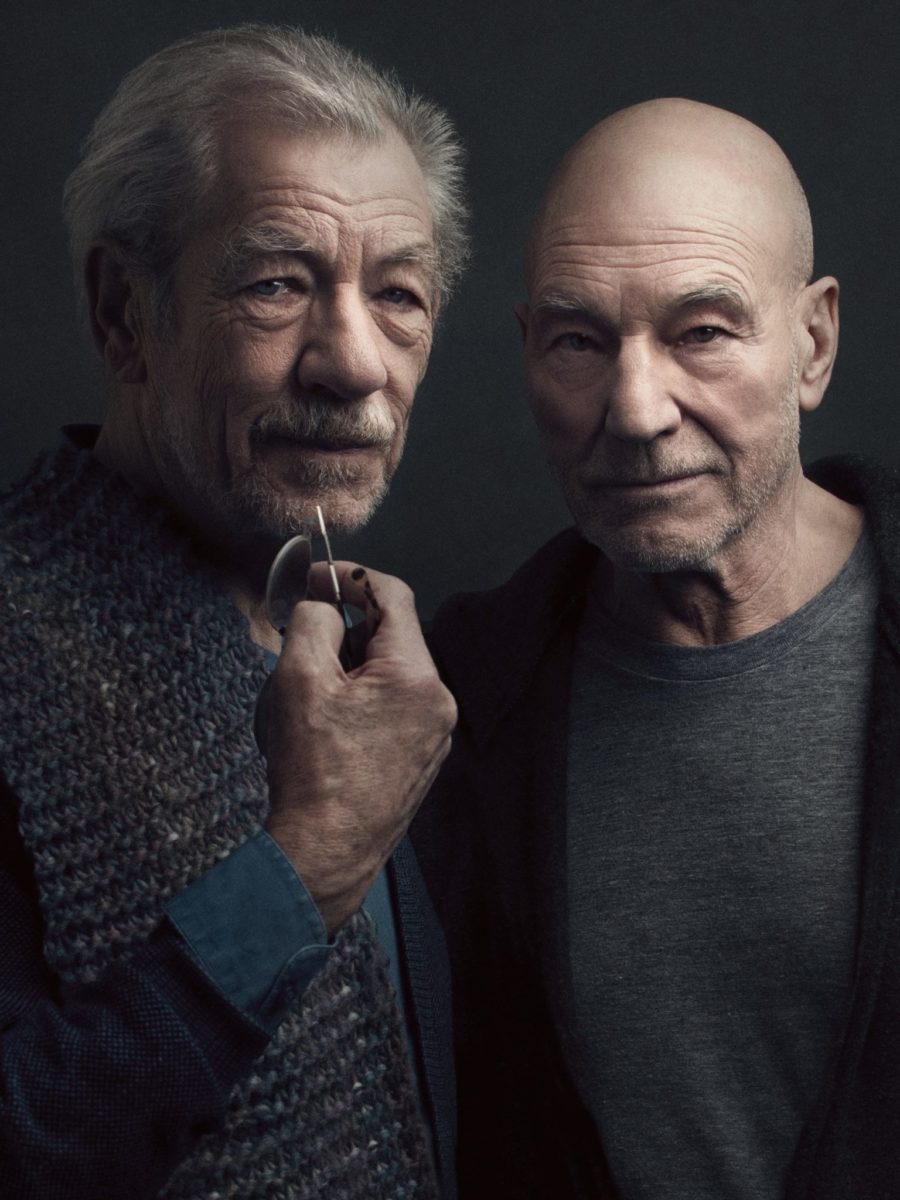
    No Man’s Land reunites Sir Ian McKellen and Patrick Stewart on the London Stage and it is not difficult to see why Pinter’s play resonates with the two lead actors, containing its long passages of complex prose to articulate their way through; and a pair of strong lead characters truly dominating the stage throughout the duration.

    With an abundance of strangely compelling verbal sparring between the two, McKellen’s magnetism and stage presence remains completely undeniable with a seemingly effortless performance which demonstrates why he is such an esteemed theatrical figure; whilst Stewart’s (appropriately) muted performance during the first act flowed into a more confident and surefooted second act, with the opportunity for him to revel in the demonstration of his craft. In the two supporting roles, Damien Molony and Owen Teal held their own as Foster and Briggs (a pair with a somewhat homoerotic undertone to their characters), stepping up to the challenge of sharing the stage with the two heavyweights. Sean Mathias’ direction gave a steady steer around Stephen Brimson Lewis’ quasi-symmetrical and somewhat charming set.

    The difficulty with the play is that the narrative is inaccessible to the Pinter novice. Pinter’s absurdist play is just that, never really explaining the set-up, the characters, their identities, or their motivations. Their role in each other’s lives remains unclear and the play leaves the audience to draw their own conclusions and reach their own interpretations. Discussions with others have produced a number of differing explanations and theories, with the post show chatter as varied as the scripted anecdotes portrayed on stage. On a personal level, a play with a straighter narrative and less deliberate obscurity would have been far more preferable. I couldn’t honestly say that I enjoyed the actual play itself; but that did not detract from the sheer joy and superb opportunity of seeing two of this country’s finest actors doing what they do best.

    No Man’s Land is more of an experience rather than a gentile evening in the West End. An intensively poetic and wordy script provides for a sometimes difficult and challenging watch for those not familiar with Pinter’s work, but whilst the play is not for everyone, the opportunity to see two titans of British theatre is well worth it, and not one to be passed by lightly.

    No Man’s Land is currently playing at the London Wyndham’s Theatre until 17th December 2016. Visit http://www.delfontmackintosh.co.uk/Tickets/NoMansLand/NoMansLand.asp for further details. Many thanks to Sheffield Theatres (www.sheffieldtheatres.co.uk) for facilitating this review.


  • THEATRE REVIEW | Kenny Morgan at the Arcola Theatre

    THEATRE REVIEW | Kenny Morgan at the Arcola Theatre

    ★★★★ | Kenny Morgan

    If you missed “Kenny Morgan” this summer then you have a second chance. The play is back for four weeks at The Arcola Theatre in Dalston and remains an evocative and beautiful treat of a play with a host of polished performances.

    Theatre review for kenny thomas
    CREDIT: Idil Sukan


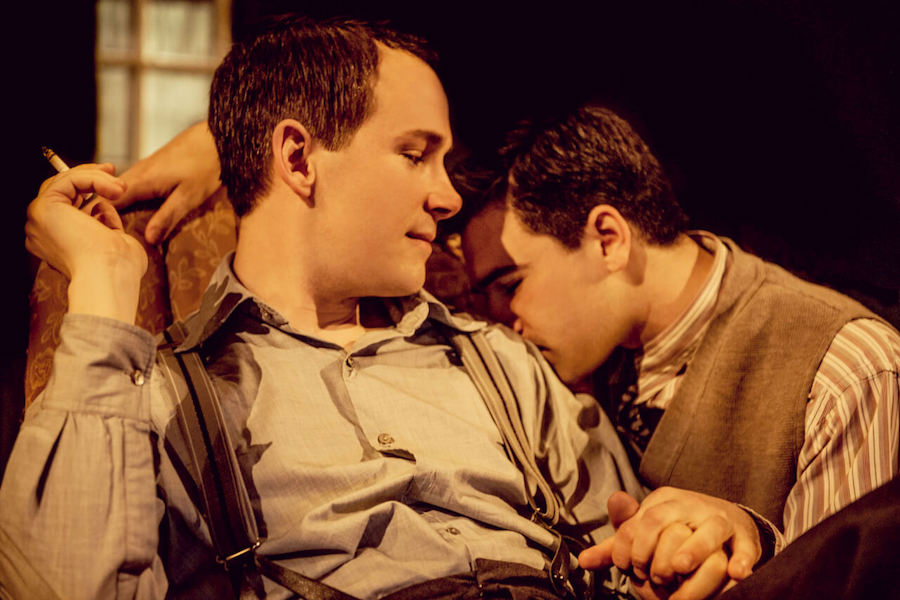
    Kenny Morgan was a young actor who had had a promising career in 1940’s British films. He had also had an on/off relationship for ten years with Terrence Rattigan, a high profile British playwright. In 1949 Kenny gassed himself to death in a down at heel Camden Town flat that he was sharing with a young actor who he’d left Rattigan for. Terrence Rattigan’s play “The Deep Blue Sea” echoes Kenny’s story to a degree but with gender switching to suit the times (and the Lord Chamberlain’s office).

    Set in a mould encrusted flat with gas pipes defining the space, this play depicts Kenny’s despair. Sounds grim but it’s not. It’s witty and warm as well as devastating. Paul Keating is superb as Morgan, delicately easing us into his despair and leaving the audience frustrated and helpless but never less than sympathetic. Mike Poulton’s script is tight and detailed and achieves a difficult task: retaining dramatic tension even when we know the inevitable ending. The dialogue and set feel wholly authentic, transporting the viewer to 1940s London along with its restrictions. There’s something claustrophobic and terrifying about Kenny’s world where being gay is illegal and can land you in prison, as can attempting suicide.

    Although Kenny is a different beast from most of us in contemporary Britain, there are plenty of parallels and as well as the beauty of the piece; this makes it well worth a visit. Who hasn’t felt heartbroken and despairing and been laid low by loving the wrong man? Kenny has fallen for a man who doesn’t even claim to love him, has stopped sleeping with him and is still sleeping with women and men behind his back. Not an unusual story. Neither is the story of his relationship with Rattigan. Unable to be out in public Rattigan maintained elaborate ruses to keep his homosexuality both from the public and from his family. I’m sure I’m not the only one who’s met men like that? Who hasn’t struggled to understand someone else’s depression or even their own? Although his misery is tangible, it’s difficult not to want to try to solve Kenny’s issues.

    The play isn’t as bleak as it sounds on paper. There are fine comedic moments and the pace is brisk. There are also touching moments of human kindness as the people around Kenny try their best to help. My recommendation is to just see this. You’re unlikely to see a finer play with a gay theme any time soon.

    Kenny Morgan plays at the Arcola Theatre until 15th October


    Follow Chris Bridges on Twitter

  • THEATRE REVIEW | Briefs

    THEATRE REVIEW | Briefs

    ★★★★ | Briefs

    PR Supplied
    PR Supplied

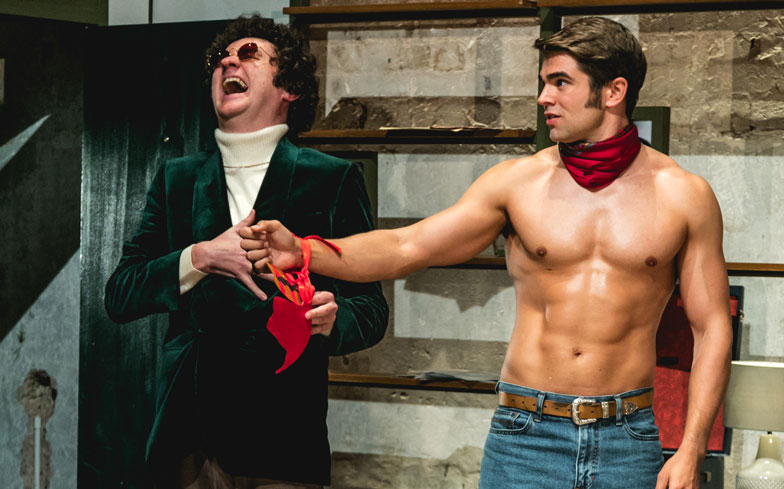
    There are seven men who strip down to their briefs every night on the Southbank – in a show called ‘Briefs!’

    At the London Wonderground right near the London Eye, ‘Briefs’ is one of the world’s hottest all-male boylesque extravaganzas. For the fourth straight year, these men are packing in audiences, and packing it in their briefs, to perform their stunts and magic tricks whilst leaving very little to the imagination! This Australian sixtet (plus one New Yorker) is led by the glamorous and vivacious and sarcastic hostess Shivannah. She is our guide throughout the show, with multiple outfit changes that outsparkle the spotlights!

    And her boys put on quite a show! For starters, we get Louis Biggs who has a thing for unscrambling a Rubick’s cube in his briefs, to Evil Hate Monkey (yes, that’s his name in the program) who does acrobatics that take him up and down, legs spread in the air, and another who does yo yo tricks that are a bit too close to his bits for comfort. And the best for last is the finale where heavily tattooed Mark ‘Captain Kidd’ Winmill splashes all about in a large champagne glass, and, just a word of caution – don’t sit in the first two rows!

    ‘Briefs’ is a show of glitter, flesh, high heals, very naughty jokes, and undressed men put in compromising positions, all for the benefit of their audience. It’s circus, physical theatre, showmanship and fun, lots of it, and it’s burlesque – with balls! The men have spent the last year touring the world and they’re fame is ever increasing, so now’s your chance to go see them. It’s a limited run that’s ending on September 24th – so get tickets now! ‘Brief’s’ is oh so sexy!

    Briefs plays at the Southbank until the 24th September

  • Theatre Review | Northern Ballet’s Romeo And Juliet – National Tour

    Theatre Review | Northern Ballet’s Romeo And Juliet – National Tour

    ★★★| Northern Ballet’s Romeo And Juliet

    Set in 14th century Verona, the rivalries between two families, the Montagues and the Capulets, are intensified when Romeo and Juliet fall for each other. But coming from rival families means that their love faces insurmountable odds, and when the conflict escalates after a street fight ends in bloodshed, with Romeo killing Juliet’s brother, a chain of tragic events is set in motion, as the lovers try to escape the confines of their family loyalties.

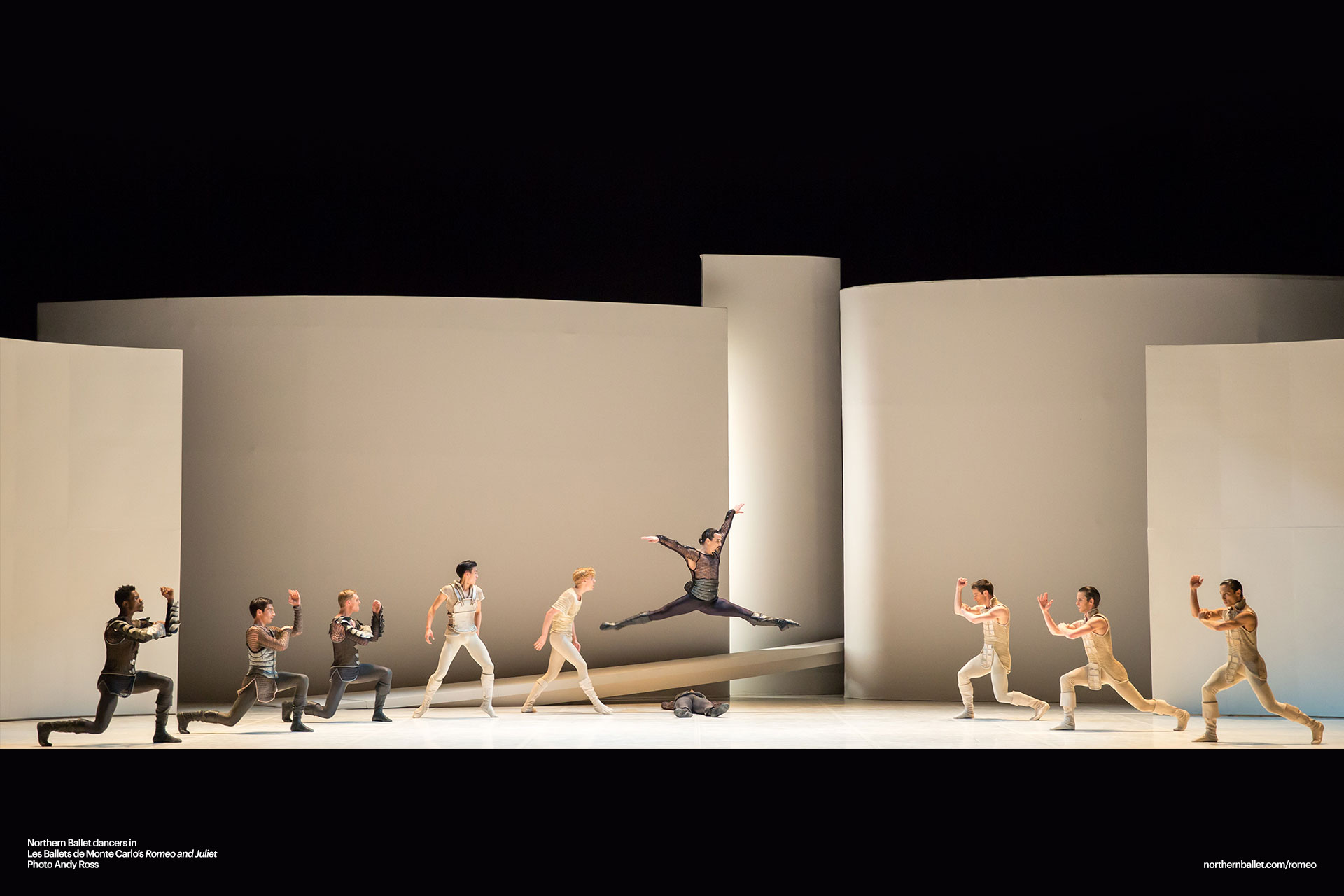
    Photo Credit - Andy Ross
    Photo Credit – Andy Ross

    Departing from their signature style, Northern Ballet presents a piece which is stripped back to the absolute minimum. Set against a purely white backdrop of linear shaped screens, splashed only with the occasional coloured lighting wash, the minimalist presentation and lack of any real set, props or backdrops only served to focus the audience’s attention to the frenetic, visceral and energetic choreography and performances. With no smoke and mirrors to hide behind, choreographer Jean-Christophe Maillot lays his work bare on the stage, and this move pays off, providing an incredibly fresh and thoroughly contemporary piece of dance. The choreography encompasses the romantic, the dramatic and the passionate; and the whole thing is dotted with the occasional pieces of humour, which helps to provide respite from the dramatic mood slightly. The costumes, with a hint of John Paul Gautier running through them, stand out from the white background to easily define the family loyalty of each character, and the use of a contrasting colour palette (predominantly cream and black) mirrors the themes which underpin the story; love and rivalry; comedy and tragedy; life and death.

    Most notable amongst the slew of energetic performances was Javier Torres as Tybalt, who portrayed his character with a bullish arrogance. There was also a noteworthy and incredibly supple performance from Mlindi Kulashe as the priest tortured by his own guilt.  The cast’s performances were tightly in unison and technically impressive, in particular, the Dance of the Knights, which was an exciting set piece performed with precision moves and breakneck speed.

    Romeo and Juliet is wholly reliant on its performances and choreography, which does not disappoint. Overall, the show has more of a feeling of modern dance than traditional ballet, but this does not detract from the skill of the performers or from the sheer spectacle of the edgy, angular and visually striking set pieces which are juxtaposed against the traditional score by Prokofiev in a clash of modern and traditional.

    Romeo & Juliet is currently playing at Sheffield Lyceum (www.sheffieldtheatres.co.uk) until Saturday 17th September, before continuing its national tour. Northern Ballet will be continuing to tour throughout the UK this year with a variety of productions, including Romeo and Juliet, Wuthering Heights and Beauty and the Beast. Visit the company’s website at www.northernballet.com for full details.