The Missing Reality in Gay TV Sex Scenes like Heated Rivalry
Television has made real strides in how it portrays gay relationships. Where gay characters were once relegated to subplots or stereotypes, many shows now allow them complexity, intimacy, and genuine sexual agency. Gay sex, in particular, is no longer automatically tragic, shameful, or implied off-screen. That progress matters. But for all this newfound visibility, there remains one oddly persistent fantasy: the idea that penetrative gay sex requires no preparation at all.
Across television and film, gay sex scenes often follow the same script. Two men come together in a moment of emotional or physical intensity. There is urgency, attraction, sometimes vulnerability—and then, almost immediately, sex happens. Smoothly. Effortlessly. As if the human body is always perfectly prepared for penetration, regardless of timing, context, or reality.
Anyone familiar with gay or indeed anyone par-taking in anal sex knows this is not how it usually works.
Preparation is a normal part of many people’s sexual lives, particularly when anal sex is involved. It can take time. It can require planning. It can even influence when and how sex happens. Yet TV narratives consistently erase this aspect, presenting a version of gay intimacy that is permanently spontaneous and frictionless.
Recent series like Heated Rivalry are far from alone in perpetuating this myth. I sat aghast (clutching my pearls) as Smootie making genius Kip – up early, busying himself in Hunter’s kitchen to make his famed Banana and Blueberry drink – only to be thanked by Hunter with a “can I fuck you” to which the answer is yes, presumably – Kip had the opportunity, before Hunter awoke to brush teeth, floss, morning poop and then douche, before digging into cupboards to find Blueberries, bananas and a nutribullet.
After work, in the middle of the night, during emotionally charged reunions—there is never a pause, a negotiation, or even a hint that logistics might play a role.
From prestige dramas to rom-coms, bottoms are routinely portrayed as being perpetually “ready,” no matter the circumstances. After work, in the middle of the night, during emotionally charged reunions—there is never a pause, a negotiation, or even a hint that logistics might play a role.
The problem isn’t that these shows feature sex. It’s that they strip sex of the realities that many people navigate, creating a polished fantasy that subtly reshapes expectations. For viewers who are young, inexperienced, or still figuring out their relationship to sex, these portrayals can suggest that readiness should be instant—and that anything else is awkward, inconvenient, or somehow undesirable.
There is also a quiet stigma embedded in this silence. By refusing to acknowledge preparation, television implies that it is too unglamorous or too bodily to belong in a romantic narrative. But bodies are part of sex. Planning is part of care. Communication is part of intimacy. None of these elements diminish desire; in fact, they often deepen trust and connection.
Importantly, realism doesn’t require graphic detail. No one is asking for explicit depictions or instructional moments. Small narrative choices would suffice: a delayed hookup, a brief exchange about timing, a moment that acknowledges sex sometimes requires coordination. Even subtle signals could normalise the idea that sex is something people plan with each other, not something that simply happens on cue.
Gay representation on television has matured enough to embrace complexity. It can handle conversations about consent, vulnerability, and emotional stakes. It should also be capable of acknowledging a simple truth: spontaneous desire is real, but sexual readiness isn’t always instantaneous. Recognising that wouldn’t make gay sex on screen less appealing—it would make it more honest.
Should putting your pronoun in emails, zoom calls and texts become standard practice? It can be a brilliant way to show allyship, but it can be deeply scarring for those who are still figuring it out.
I’m going back to school. Yep, I decided that I’m about to change the direction of my life and I’m retraining to become a therapist. It’s been a long time in the making. I used to volunteer for a well-known helpline and I’m always being told that I’m a good listener – heck, interviewing hundreds of people for this publication has really help hone my skills as a listener and good and inquisitive questioner.
But as I readied myself for the classroom, albeit online for the first semester, I was forced to confront an issue that i wasn’t quite ready to confront.
I‘ve spoken briefly before about my own gender identity and the trouble I’ve have it, and whilst I do identify as gay, I’m not entirely sure I identify as a man and whatever that means in today’s society. I’ve written before about how it just doesn’t feel right when someone refers to me that way, but weirdly I don’t mind the he/him/his pronouns, but wouldn’t necessarily attach them to myself. I’m definitely not a they, them their, perhaps more of a Ze/Zim/Zir. I just don’t know and that’s the issue.
This week I received a message from the institute where I’m about to start my course telling all students that pronouns would now be a requirement on Zoom calls. I know that the policy was written without malice and was a well intended piece of inclusiveness, but there’s a couple of reasons why pronoun usage should be encouraged rather than required.
I don’t mind admitting I’m already having anxiety pangs about starting a new course, but the idea of having to write a pronoun next to my name, felt like a chasm, that I’m just not ready or don’t know how to bridge just yet.
I know there will be people who will roll their eyes and say, “get a grip man,” but honestly aren’t we striving for a future where we’re all accepted and included, no matter how we identify or don’t?
I remember a conversation at that well-known helpline where a similar debate raged. Should we include our pronouns on emails and to callers. At the time, I didn’t really take that much notice, except being aware of a dark stirring of being uncomfortable about having to disclose something I haven’t come to terms with myself. A number of issues were raised by some in that meeting about pronouns, mainly that 1) if forced, or required that everyone disclose their identity it might force someone who hasn’t or isn’t quite ready to admit or confirm their identity to come out about it before they are ready. The second point was that if someone is forced to choose a pronoun before they are ready, the identity that they actually share maybe a lie – in order to fit in or because they fear judgement from others. Sitting with that lie next to their name would feel awful and deeply damaging.
The more I thought about it the more I started to tailspin about the first day and about how uncomfortable it might be – not just for me, but someone else who’s really not ready to have the conversation about their identity, especially in front of a group of new people – and over a Zoom call.
So should we use our pronouns wherever and whenever?
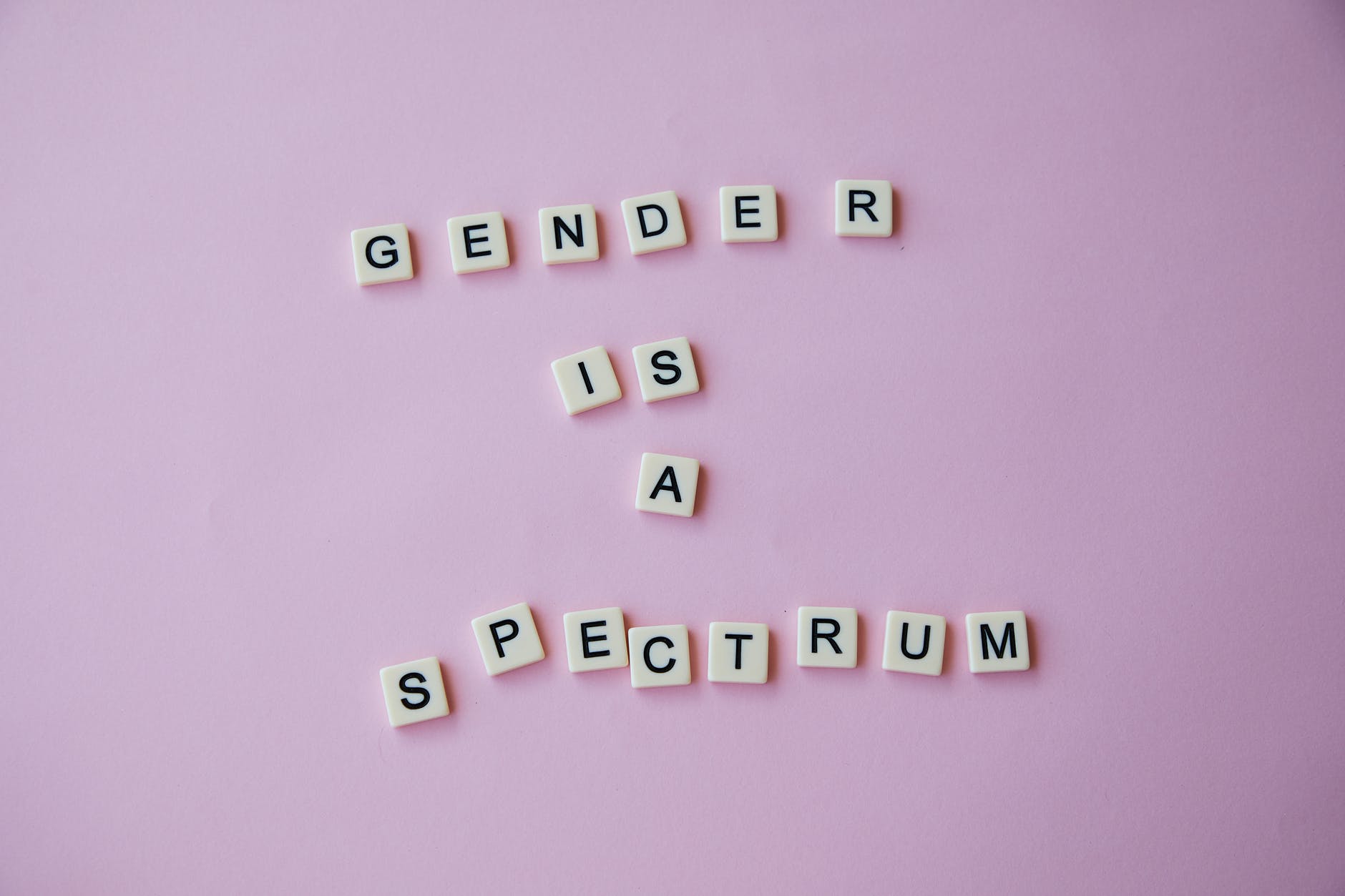
Gender is a spectrum and it’s not always easy to find the right words to describe it. Photo by Laker on Pexels.com
I would say this. If you’re comfortable doing it, then do it, particularly if you fear that you might be misgendered. It’s really important that you do let people know how you want to be referred to as.
But if there’s no fear that you will be misgendered, give a moment’s thought about why you’re doing it. It’s an awesome thing to do if your intension is to be an ally, but if it’s anything else, just stick with your name. When enforcing pronouns becomes a blanket policy – a requirement, it stops being a allyship move – and can actually cause more harm than good.
It could also lead employers open to legal issues. Speaking to THEGAYUK back in 2019, Helen Hughes, legal director and employment law specialist at the law firm, Shakespeare Martineau spoke about the legal ramifications on employers asking their employees to state their gender publicly. Hughes told us,
“Although this may be introduced with the best intentions – to address individuals with respect and courtesy in the way that they wish to be referred to – employers must be wary about requesting information from employees that could impact the way they are treated. Although they can’t force you to disclose this kind of information, you should feel comfortable sharing preferred pronouns if you feel it important to do so.
“Forcing employees to reveal their pronoun preferences could leave employers open to discrimination claims, and employees feeling alienated.”
Helen hughes
Luckily after speaking to the institute they reversed the policy and added that people were encouraged to share their pronouns.
Today is international data protection day, a day to highlight the importance of Data Protection and the right to privacy. But please don’t let that put you off reading further, I appreciate that when you say the words ‘Data Protection’ most people’s eye’s glaze over. And in many ways that’s deserving, it does have a bad rep, but also it’s far more important than that.
Let me ask you a question, are you a user of the app Grindr? If not, then this is just a fascinating article for you. If so, you really do need to be aware of what Grindr has been up to with your data.
When you use these apps, you expect them to take care of the data given that a wide range of people from our community use such apps. Yes for hook-ups, but also for contact and even just reaching out for those in remote communities or those unable to be ‘out’ where they live/work/other.
The knowledge of where a gay/bi/trans/non-binary user is and indeed their data around their personal pictures is something that, if misused, can be used to huge detrimental effect.
Grindr has had a troubled history with its Data Protection and Cyber Security protections. In 2020 a flaw in its security was highlighted to it by a ‘hacker’ and highlighted concerns over some back Cyber Security principles and standards with the online app. As an early user of Grindr, I remember the various bugs, crashes, data quality flaws that the app has faced over the years. This recent flaw highlighted some concerns in basic account security settings for an App that should now be ‘more mature’ in its approach to protecting customer data.
An app that contains location, names, photos, sexuality and HIV status details of millions of users around the globe has had a chequered past of inappropriate data sharing and storage.
This was highlighted again this week after it was announced that the Data Protection Regulator in Norway was intending to fine Grindr NOK100,000,000 (or around €10M or ~$12.1M). If the fine goes ahead, this will be one of the more serious fines under Data Protection (almost 10% of Grindr’s annual turnover last year) that we have seen since the introduction of the GDPR.
The Danish regulator investigated Grindr after a complaint was raised around Grindr’s sharing of personal data, specifically what it tells users and how it’s ‘take it or leave it’ consent is unlawful under Data Protection law.
The investigation found that Grindr was sharing users personal data with third parties for marketing purposes (including location, profile data and the fact the person has an account on Grindr (itself a revealing characteristic)). Grindr states that it informs you, the user, of this and you consent to it. When it has been found that they don’t, as what they do provide you is unclear and misleading in the way it is written.
It’s worth noting that Grindr isn’t the only one to engage in such practices. Several investigations over a range of dating and fertility apps around the globe have revealed some creepy behaviour from the majority of them. Grindr, it would seem, given the context of the platform, is just the most recent to be called out for its poor data sharing practices.
Why you should care about your data
So why is this an issue? Why should you, a ‘motivated’ user, for one thing, care about your Data Protection? The key is choice. Under Data Protection you can choose to use a service and not be subjected to marketing or irrelevant data sharing. You pay or want to use an app to do X or Y or Z. Not to then have your messages, images, profile data and even the fact you are on the app shared with other parties without your knowledge, or indeed consent.
For the vulnerable in our community, Grindr (or other such apps) can be a lifeline to allow them to express themselves and reach others. This practice can only ever be creepy unless you are happy with it and are happy to have your details shared. Knowledge and choice. Such laws are there to go give you, the individual, the power to know, understand and chose what you want to happen and not to be forced into doing it because you have no real choice.
As members of the LGBT community, we know in our history what the power of data can do. It can build and connect; it can also destroy and damage. While I’m not advocating dumping Grindr as this is a chance for them to improve their practices, I encourage you to see Data Protection as more than just a dull legalistic thing. It is every day in everything. Even if you chose to give away your data, which is your right and freedom, at least make an informed choice.
P.S. You might also want to take a look at WhatsApp and Facebook. They wrote the book on being creepy and it’s only getting worse.
It’s December 2020, and whilst there is some good news in the air surrounding three potential COVID vaccines, and yet, the age-old argument about the Fairytale of New York has reared its ugly head, because for six weeks of the year it’s apparently socially acceptable to be shouting across a bar, or nightclub: “You scumbag, you maggot, you cheap lousy f******”. Oh yes. This one. Again. if you’re looking to start a nasty debate, this is the way to go.
The argument for whether to play to song including the homophobic slur on the radio rears its head around this time every year for the last few years. However, in 2020, BBC Radio 1 made the decision to play a version of the Christmas classic with the infamous line edited so that it doesn’t offend their key demographic, 15-29, who probably don’t have the attachment of the word being a homophobic insult from a song that was written and released before they were born. BBC Radio 2, however, have made the decision to play it in its original format.
A statement from the BBC read; “We know the song is considered a Christmas classic, and we will continue to play it this year, with our radio stations choosing the version of the song most relevant for their audience”.
Bit odd isn’t it? It’s appropriate for the oldies, but not for the youngsters – how does that work?
I feel I should clear something up right now. I am not suggesting for one minute that it’s only the Oldies that listen to Radio 2, rather than Radio 1, even though I’m still clinging on to their demographic. In fact, I would choose to listen to Radio 2 any day over Radio 1. So, what I find odd and quite frankly disturbing as to why in 2020 – we are even having this debate?
Don’t get me wrong, I do love the song. I think it’s one of the best Christmas songs to be written, prior to Kelly Clarkson’s “Underneath the Tree”, but what just irks me is the groups of people, arms around each other, gleefully shouting a word that has been used for so many years to insult, belittle, scare and dehumanise LGBT+ people. I find it upsetting that we are still having to have this conversation and that people cannot see that that word still has a sting for many people.
Personally, it doesn’t particularly bother me; I’ve been called it so many times that it’s water off a ducks back, but at the same time, do I want to be reminded of it every time it comes on the Radio? No! But the sting is still there. It is still a word that holds a lot of resentment and pain for many people. Whilst we’ve worked hard to reclaim words and turn them into positive terms of endearment – for many members of the LGBTQ community, this is just a step too far.
But what we’ve seen so much of, this year, I think more than in previous years, is that those who are offended by it have been regarded as “snowflakes”, and suggesting that by censoring it, we are denying our culture as Brits. Ah there, it is. The homophobia that nobody is really talking about nowadays. We’re bringing sexuality and gender issues into a “Culture War”. Now that to me is very disturbing. We’ve seen this so-called “Culture War” flare up several times this year, whether it be around trans rights, which are human rights by the way – in case you hadn’t forgotten, or the Black Lives Matters movement. Anything supporting a minority is attacked for going against British values. Maybe I’m naive, but I thought it was more about common decency more than anything.
People don’t seem to bat an eyelid about songs having words bleeped out for being rude, derogatory or offensive. Maybe the last time I remember was the mild controversy about Britney Spears suggestive “If You Seek Amy”, and even that was given a radio edit to replace a word, or in Scott Mills’ rather comical version; “Amy with Brass”.
Maybe in 1987, it was okay for a word like “f******” to be heard on the radio; but let’s not forget that Section 28 was also brought in, just a year later. Things change; AND THAT’S OKAY! It’s okay to say now that things were different then, and we should make a positive change for the good of society. Even the song’s performers have said that it’s okay for words to be bleeped out that might cause offence, and Kirsty McColl even performed an alternative version of the song on Top of the Pops just a few years after its release. Nobody complained about it then.
At the end of the day, nobody is stopping anyone from singing along to it in their car, but I think in the grand scheme of things if we just showed some respect to what everyone else’s opinions and values are, then we maybe wouldn’t have to have this conversation every year. But, honestly, if you’re fighting this hard for the original version of it being played on BBC Radio One; then I think you might need to have a good hard look at yourself. For a country that prides itself on equality and being equal. It should surprise me that we have to have these conversations, however, alas, I am not for one bit surprised. Why do you feel the need to shout that line across the bar? I can assure you that it says more about you, than those of us that wish to hear it censored.
Two dates down with Rick and we still hadn’t shared anything more intimate than a handhold. This was definitely some kind of record for me. It’s been a rare occurrence for me to get past the first date without a bit of How’s your father.
But with Rick. De nada. Not even a kiss. Some friends thought this was a bad sign. Others believed it was romantic. I started to panic. I needed to know if that spark was there when our lips locked. As Cher categorically states, “It’s in his kiss.”
On our third date, which was only FOUR days after our second, (YES, we were certainly having a whirlwind romance), I decided a kiss had to happen. We had so much chemistry emotionally, I needed to be certain it was there physically too.
I booked us tickets to see a one woman show in a theatre in the West End. And the one woman was none other than Amanda Muggleton. YES, Amanda Muggleton.
I’m anticipating the perplexed looks of most readers, scratching their heads. Who the fuck is Amanda Muggleton? Well, let me tell you. She is one of my favourite actresses from the 1980’s cult classic, Prisoner: Cell Block H.
We sat in the theatre, watching the amazing performance. (I know, I’m biased). And we were holding hands. What had this boy done to me? When it comes to friends, I have no problems expressing my emotions and feelings. But, until Rick, I’d never been very tactile when it came to men. Apart from the odd bunk up.
As we left the theatre, we decided to grab a bite to eat. We found a beautiful little Thai place that served the most delicious Thai Green Curry. The best I’d ever got my mouth round. Rick was very cultured when it came to eating out and he was very well travelled.
We walked back towards the tube, the moonlight glistening down on the pavement and I decided now was the time. I had a duty to Cher to find out if it’s really in his kiss. Without warning, I pounced like a lion on its prey.
Words will NEVER do justice to THAT kiss. But if it had been a Hollywood movie, fireworks would have been exploding above our heads and topless dancers would have been doing backflips and cartwheels down Trafalgar Square.
I had him pinned up against the wall, sheer passion erupting from my lips, like a scene out of trashy super soap FOOTBALLERS WIVES.
He finally managed to escape my grip, and my lips, and looked me straight in the eye.
“Alright Tanya Turner”, he managed to say, as the blood came rushing back to his gums, tongue and lips. “I feel like Conrad when Tanya fucked him on the washing machine.”
That was the best compliment any man had ever given me. Besides Joan Collins, Zoe Lucker as Tanya Turner is my IDOL. And I really could have taken Rick on a full spin cycle. But I felt Trafalgar Square wasn’t the appropriate place for our first fornication.
It was time for our fourth date and we were back in Windsor, where it had all begun, just two weeks prior. After a romantic dinner date under the arches, we went for a moonlit stroll along the river. Although we didn’t make it as far as the Thames.
As we went to walk past a pub, three very drunken ladies stumbled out in front of us. Rick’s face dropped, faster than a whore’s drawers. Confused, I looked at Rick. And then at the ladies. And then back at Rick. Rick broke the silence.
“MUM! AUNTY JOY! NAN!”
I saw the horror on Rick’s face. I don’t think he had intended me to meet his family just yet. And not under these circumstances.
“Dis… a very handsome boy you have here Rick”, I heard a woman slur as she grabbed my cheeks. I assumed it was his Nan. Unless his mum had had a hard life.
Another of the inebriated women elbowed Rick and whispered. Well, it wasn’t actually a whisper, but I think they intended it to be.
“You’ve done well for yourself here Rick!”
I felt myself grow a bit taller and a slight blush pop up on my face. Although Rick was mortified and he quickly said his goodbyes to his drunken relations and abruptly dragged me off towards the river.
Our fifth date arrived and I made the decision to do something I hadn’t done with a man since my first boyfriend way back in 2003. I invited him to meet my friends. I planned a dinner party at my house.
We had a homemade curry and he went down a storm with my pals. Chatting, playing games and laughing. I looked at Rick interacting with my friends, and I just knew I would marry this man. How wrong could I be…
That week, he was due to go to Canada for a month to visit a friend. As I said goodbye at the departure gates at Heathrow, I did my best Tanya Turner impression and kissed him passionately up against a terminal five wall.
Little did I know that that was to be our last kiss.
The weeks went by and he was due back from Canada. Excited, I planned a romantic, home cooked, welcome back meal to mark his return. I had fillet steak, potato dauphinoise and as much as I hate the stuff, copious bottles of white zinfandel.
But he never turned up. And I never heard from him again…
I remember only too well when AIDS first impacted on my world and came into the public eye.
In 1981 I was 19 and there was talk in the gay clubs and pubs where I lived of a disease originating in monkeys that was killing Americans. I remember there was a lone American visiting for professional reasons and he was considered as guilty by association, just because of his accent. I look back with shame now on how people were afraid to approach him and how the treatment he received was similar to that in the dark ages a leper might have expected, minus the bell to ring and the calling out of the phrase “unclean”.
Over the next couple of years, probably longer, as it took time for information and knowledge to disseminate. The names of those who had contracted the condition made it appeared to be an illness that blighted the pretty boys and those who had the biggest cocks.
Of course, that is not true. It’s just where I lived there was a small gay circle and once infected those who were sexually promiscuous and practised unsafe sex were the first to be hit and through them as HIV spread rapidly.
There was too little information and it was too late, that was part of the problem. The other problem was a NIMBY (Not In My Back Yard) mentality. People thought it wouldn’t happen where they lived or to them as it was affecting other parts of the globe. In the 1980s the world was getting smaller and people travelled for work, holiday and to play in the gay hot-spots.
For me, it was the indiscriminate nature of the illness. There were personal losses of people I knew.
In the media, the death of Rock Hudson seemed to have an impact. In the USA I recall a movement quilting and marking the lives of the victims they knew in this way. There were powerful images of the time where over vast areas these quilts were laid out with loved ones present.
There was a TV program about a man called Terry Madeley. In interviews in 1987, he was the first in the UK to speak openly about his fight with AIDS. A year later a program about his fight for death with dignity was aired on 1st December 1988 World AIDS day. It was titled Remember Terry and 29 years ago today, I still do. He had died in the previous October and I recall an image broadcast at the funeral in a crematorium of a hand through the curtain wearing a diamante glove waving goodbye. He appeared to have such strength of character and good humour for those snippets to stay with me.
To be in 2017 when there is a more positive outlook – I can’t help pausing to consider and remember all of those who do not have the opportunity to share today.
This article was first published in 2017 and has been updated with links.
Until a rather problematic article by Conservative Women writer, Caroline Ffiske appeared online recently, I must admit that I wasn’t very educated on the idea of “Queer Theory”. But apparently, it’s something that we all should familiarise ourselves with because we need to protect our children from it.
Here we go again. Another homophobic article wrote by a privileged white person who really doesn’t have a fucking clue what they’re talking about.
So, what exactly is “Queer Theory”. Well, according to Ffiske is it based on the 1960’s neo-Marxist idea that our sexual acts and sexual identities are ‘socially constructed’. Apparently, the focus of ‘queer theory’ is all about the personal and the private and what people deem as normal can be challenged as so form of social construct and that basically what goes on in the bedroom should stay in the bedroom and not be brought out into the light of day. The article then goes on to suggest that sex should remain as an “extraordinarily intimate act which touches our soul and goes to the heart of our human experience”. Clearly, she’s never had a one-night stand. Ffiske also goes on to imply that we are normalising and encouraging sex among teenagers.
Let’s be very clear about this. Teenagers are going to have sex. They are going to have straight sex, gay-sex, threesomes, oral sex, anal sex because that’s what teenagers do. It’s not about normalising it; it’s a fact of life. I remember being a horny teenager and wanting to bone everything that was on two legs. Well, within reason. But isn’t your teenage years and your early adult years all about – experimenting? It’s about finding what you like and what you look for in a sexual partner. Your teenage years are about discovering who you are as a person. For some, that is quite straightforward, but for others, it’s a struggle. You grow into yourself as a person and sometimes that doesn’t fit with social stereotypes. Surely, we should be encouraging this exploration. We should encourage conversations for teenagers because that’s how we learn and break down social stigmas and prejudice.
Laying the blame for sexual exploration at the door of the gays
What Ffiske is actually doing, and probably doesn’t realise it, is laying the blame for encouraging sexual exploration at the door of the gays. Whilst it might be true that gay men can be very promiscuous and have multiple sexual partners during their life, it’s not fair to blame it on them. Historically, the queer theory was born out of a movement of living your life as the way you fit and how you want to. It’s about how you want to identify and isn’t having the choice to do that is the best thing for us to have in society. If you want to identify as a man or a woman or be trans, you’ve got that choice, because you have been struggling with the thoughts inside your head as a kid. It’s not been pushed on you, and the media don’t push it on anyone. It’s about education and allowing conversations to happen. Just because you don’t fit into a box, it doesn’t mean you are a freak and should be banished to an island. You should be allowed to live your own life as you want to. Bollocks to anyone else.
Ffiske talks about sex, and specifically anal sex as being degrading. She says that “young women feel that they do want to take their virginity seriously and that their psychological well-being is at stake if they are encouraged not to do so”. Let’s look at this in the broader sense. The first time for anyone is going to be something that you remember because let’s be honest – it’s never the best. It’s often clumsy, clunky and extremely uncomfortable, but it’s a part of life. I’m not saying that people don’t take that decision lightly to become sexually active, but it’s not always as black and white as that. Teenagers are hormonal, they are going to have curiosities about sex. Isn’t it more dangerous not to educate them about it? Let’s look at teenage pregnancy in the states, for example, a study in 2019 by the American Journey of Public Health showed that in states where sex education is more abstinence-based, the education actually contributed to an increase in teenage pregnancies.
Surely if we are not having more open conversations about safe, consensual sex then we’re doing the younger generation a disservice.
The problem isn’t about over sexualising teenagers. The problem is really that people think they have a right to dictate and decide what’s best of other people when they have really not got a clue about what they might be going through. The ones that that feel threatened by queer theory are those that have absolutely no idea about what being different or being queer is all about. It’s not a walk in the park. It’s often a long dark road with bumps and kinks in it. Discovering where you fit into society. How you are accepted by society and what prejudices you’re gonna encounter.
I want to side-step for just a second because I think this is important. It’s not just queer equality that is under threat from the right-wing. But equality as a whole is under threat when there are MPs in parliament like Ben Bradley who is calling on more rights for white straight men because he thinks that they are underrepresented. In a speech in the House of Commons this week; Bradley stood up, and with a very straight face, went on to moan that there is a minister for women but not men, complained about more women than men in higher education, and mourned the death of “banter”. He said that; “men are often talked about, all too often, as a problem that must be rectified”. Oh, Ben. Going on to then condemn the Equality Act as being “willfully and regularly misapplied across gender, race, and every other characteristic”. Asserting the importance of “holding the door open for a lady”, expecting a man to “provide for his family”, and “wanting to be a man’s man” who goes “down to the football at the weekend” and has “some banter with the lads”. Bradley then complained; “that banter is now bullying”.
There is nothing that riles me more than a straight white man complaining that they aren’t represented.
He’s clearly never experienced prejudice for being a straight white man. Bradley also went to say that he wants “straight equally protected as gay”. Can someone enlighten me, in how many countries you can be executed or imprisoned for being straight? Or how many victims there are of anti-straight hate crimes in the UK? Not surprisingly, the government have also ended funding aimed at reducing homophobic bullying of LGBT+ students in schools in England, just as new research by the Diversity Role Models (DRM) shows that just 27% of students think that their school is a safe space for classmates to be themselves. Leading LGBT+ charity Stonewall has started a new hashtag initiative allowing members of the community to tell people about their experiences at school. Have a read through some of the stories using hashtag #LGBTatSchool.
Back to queer theory though, Fiske’s article finishes with a quote from Oscar Wilde saying, “we are all in the gutter, but some of us are looking at the stars”. She thinks that Queer Theory is pulling us all into the gutter and diminishing rather than dignifying. Well, if we’re in the gutter, then the gutter to me is pretty fabulous. Come join us here – because we are living our best lives. But more importantly, take some time to educate yourself. It’s all very well to sit and say that you should do this, or you shouldn’t do that, but that’s not for us to decide – it’s up to the young person
I’ve said this so many times now, but I just keep coming back to it. Education is the power to change. Educate our young people that there are different types of families. Educate our kids on the importance of safe sex. Encourage conversations between youngsters. Let them make the decisions that they want to make, but make sure they are given the facts. Not what you think is right. And if you feel threatened by queer theory, don’t just blast it as not the normal thing. Take some time to research about that being queer in 2020 is like and what queer relationships genuinely look like. You never know; you might learn something. It’s not about being a snowflake or being ‘woke’ but it’s about teaching our young people that equality a right – not a privilege.
Okay. Show of hands. Who’s had the experience of dating a fuckboy? We all know them! It’s that guy. You know; you know, the one who doesn’t respect you but relies on you all the time. He’s distant. He doesn’t care about your time. He won’t commit. He’s self-absorbed, does stupid things and fucks with other’s emotions. I feel like the majority of the guys I’ve been with or had any form of chemistry with have been fuckboys and it’s had a bit of a negative impact on my dating life, or actually, lack off. I’ve been used so many times by fuckboys that it’s become the norm for me to keep going back to them.
How do you spot a fuckboy?
Beware the fuckboy
It would be easy if they walked around with a sign above their head saying “Avoid like COVID. I’m gonna text you once in three months, then you’re gonna come over and give me the best head ever”.
Alas, life isn’t all black and white.
It was a while before I experienced a true fuckboy. I don’t have any contact with him now, only maybe when I’m a little bit tipsy and I might slide into his DM’s. I’ve met a few since then and developed a keen eye to spot them. So, here are my tips for spotting the fuckboys.
They will do or say anything to have sex
(C) BIGSTOCK
This is the first big red flag. There’s no romance involved. A true fuckboy will literally do or say anything to get you into bed. These include flattery, gaslighting and grovelling. Nothing is too low for them to try. The worst thing though is that they will do all this whilst actually do the bare minimum whilst doing it. They want to do it all on their terms. They will decide it, they will just sit there and let you crack on. Don’t forget; they don’t call them jobs for nothing.
They’ll hang out with a lot of men
Now, this might seem trivial; but they’ll always have a number of guys on the go at the same times. If they’re not committing; it’s probably because they’re playing the field and shagging a couple of blokes at the same time. They like to have options. They want to know that there are people around them that they could have sex with if they wanted it; and well, we all know gay men. They’re randy little blighters and probably be boning a different guy every night.
They’ll always be a little fragile
If you tell them you can’t hang out tonight – you’ve just caused world war three. They’ll barrage you with texts about how flakey you are, or you’ll get a torrent of abuse and probably turn it round and accuse you of being a fuckboy. You can’t hold them accountable either; they don’t like that one little bit. Fuckboys are unable to accept any form of responsibilty for their poor behaviour.
Don’t even start. They won’t change because they do not want to. They will do what they want to do because their world revolves completely around them. They do not care about anyone else but themselves. THEY ARE USERS.
Fuckboys aren’t nasty, horrible, people
They just don’t know how to have serious, mature relationships. You should pity them; and get rid of them. It might be hard at the start, but it’s gonna be better for you in the long run. You’re gonna be a stronger person for it. If you recognise some of this behaviour then congratulations; you’ve admitted it. Now you can start some make some changes in your life. Most fuckboys would never acknowledge it, so the fact you actually have, means you have the possibility to change.
The sad thing is that; fuckboys are out there, and you need to be aware. Also remember, that there are decent guys out who aren’t like that all; and that’s something that we all should covet.
I was lashed on my faux leather sofa, knocking back a much-needed glass of Savvy B. I can’t remember why it was much needed. It probably wasn’t. But when it comes to Savvy B, who needs a reason?
I looked down at my phone to see a notification ping up. A Grindr notification. Looking at the half-drunk bottle of New Zealand plonk, I decided whoever it was had better be prepared to travel. I was over the limit.
“Hi. Has anyone ever told you that you’ve got really pretty eyes?”
Flattery. Will. Get. You. Everywhere.
And thank fuck it wasn’t the usual opening line of, “can u accom?”
It soon became apparent that Rick, that was his name, by the way, wasn’t looking for your typical Grindr one-night-stand. He was making decent conversation. It was the first time in my gay life that I could have let my Nan cast her eyes on one of my Grindr chats.
Before we said goodnight on that first evening of conversing, he asked me if I wanted to go for a date the next day. Of course, I said YES. We agreed to meet in Windsor at 12:30 for lunch. An afternoon date. How sophisticated.
I made the decision to drive. I came to the conclusion that if I had my car, it would stop me from getting too pissed. As this is a constant error I seem to have made on dates over the years. No one likes a lush.
Well… little did I know that Rick was, in fact, a lush himself. And the date would end up with me leaving my car in Windsor, resulting in a hefty parking charge when I went to retrieve my car the next day. But I won’t dwell on that and ruin the romance of this tale.
We started off in Browns, having the most delicious lunch. And my word, what an absolutely charming chap Rick was. I’ve just read that line back. It sounds like I’m writing an 18th century novel. But I’m not even joking, he was a thoroughly decent chap.
As for looks, he certainly wasn’t the most handsome grape in the bunch. But there was just something about him that I was immediately drawn to. He certainly wasn’t the usual type of guy I would go for, but for once, I decided I should opt for personality. Besides, going for looks hadn’t done me any favours in the past.
We laughed. The conversation flowed. And so did the Savvy B. Well, for me anyway. He was knocking back a well-known brand White Zinfandel. How anyone drinks that godforsaken wine, I will never know. I swear it could give you diabetes.
After a very boozy lunch, we decided to walk along to a pub opposite Windsor Castle. I say walk, it was more of a stumble. And then he performed the most romantic gesture.
Before I reveal this grand gesture, I must tell you all of a very geeky hobby of mine, of which I indulged in telling Rick over lunch. I absolutely adore visiting churches and cathedrals.
And as we stumbled to the watering hole, Rick spotted an open church and grabbed my hand, insisting we go in and have a look, knowing how fond I am of them. I could have cried at that moment. I don’t think I’d ever met a man who had performed such a thoughtful act.
After our impromptu visit to one of God’s houses, we continued on our quest to find our next glass of plonk. Once inside, we found a quaint corner table on their upstairs, outdoors balcony, overlooking Windsor Castle. We moved in closer to each other, clearly apparent we found each other insatiably attractive.
I found myself holding his hand. An act I’ve never been fond of in public, but it just felt right with Rick. And we couldn’t take our eyes off of each other’s gaze. Straight into the old pork pies, we both looked intently.
Time went nowhere and before we knew it, it was 6:30. We’d been together six hours. Realising how intoxicated we were, we decided it was sensible to get the train home. Going opposite directions, we left each other on our respective platforms and blew a kiss across the tracks.
No physical, on the lips kiss. And no talk of a quick bunk up. Unheard of for me. I knew it must be serious.
As my train pulled away from the platform, my phone bleeped. I looked at a text message. Rick.
“That was the best date. EVER.”
As my friends will proclaim, I’m not one for being soppy. But my eyes actually pricked with tears. Tears of happiness.
Within three days, we were on our second date. This time we opted for a Sunday lunch at a pub in Virginia Water. A place I childishly refer to as VAGINA waters. For those of you not local, this is a beautiful lake, on the outskirts of London, that you can walk around.
After a beautiful roast beef dinner with all the trimmings, filled with laugher, sparks and endless conversation, we went for a romantic walk around the lake. Holding hands. STOP PRESS. What had Rick done to me?
I looked out at the lake, took a deep breath and stared Rick straight in the eyes.
“I think I might marry this man.”
Obviously, I said that in my head. And not out loud.
After seeing his son kiss another lad in town, one dad took to Reddit to ask on how he should speak to him about it.
He laid out the situation like this,
“I saw my son (16) kissing his “best friend”. I didn’t tell my wife because she will probably hate him because of it but how could I? I really love him he’s my son after all and I don’t mind him being gay.
My question is how can I help him when he comes out and should I tell him to hold it back with his mom?”
Well, let’s just hold on a minute there as we refreeze our melted hearts. This guy might be up for dad of the year award.
Never ones to fail, guys of the AskGayMen forum, did not hold back on their advice.
Don’t confront…
With one suggesting that the dad didn’t “confront him” and that the boy would “tell you when he’s ready… but maybe you can work it into a conversation that you’re okay with it”
While another suggested that being subtle was everyone’s friend, “just be a lot more subtle than you initially think. It’s probably front and centre in his mind, so he will be very sensitive to the subject”.
While another echoed. “If I were your son I wouldn’t want to be confronted (that’s just me tho) if I’m not ready to come out I don’t want others outing me, imo you should create a supportive environment and low-key and subtly let your son know that you are lgbtq+ supportive”.
Confronting the homophobes
Confronting homophobes and homophobia in a public setting was suggested by the commentators, to show that he was supportive of the gay community. Photo by fauxels on Pexels.com
On the subject of his wife, one user suggested that the dad should “confront people who say homophobic things or at the very least say you disagree and explain your position. This will show your son that he doesn’t have to be afraid of talking about these kinds of things with you.”
The dad replied, “I never said anything against it. But I’ll definitely do it the next time.”
There’s a common speculation gay people are more creative. This is foremost rooted in the observation that gay people are over-represented in creative pursuits. But is this speculation true? And if it is, why are gay people more creative? Let us discuss.
The idea of over-representation is an interesting one. It emerged anecdotally but has attracted scholarship in recent years.
In 2016, London School of Economics published their analysis of datasets from the 2008-2010 American Community Survey and the 2008-2009 U.S. National Longitudinal Study of Adolescent Health to comment on this. They found that gay people are “drawn to a different set of occupations”. Among those with the highest proportion of gay workers are creative ones: producers and directors, urban and regional planners, and web developers.
Their analysis suggests that gay people tend to be attracted to occupations with higher levels of social perceptiveness. This is based on the idea that knowing how to read social cues might be an important skill for gay people to acquire as they are more likely to have experienced the threat of discrimination from a young age.
Now for a quick lesson in creativity. Creativity is an inherently social process. The idea that it is a solitary process has fallen out of favour. We now appreciate that creativity emerges from dialogue, interaction, and practise with others. Though Kafka worked in solitude, his work was the product of his relationship with his father. His creative output is therefore the product of a social process.
It is thus unsurprising that the experience of gay people and its impact on social processes may affect their creativity too. At present, there is little hard evidence though. There are only a couple of major studies on sexual orientation and creativity.
The first, by Christine Charyton, a professor of psychology at The Ohio State University, published in 2007, reviewed the historical, empirical, and present literature existed on the relationship between sexual orientation and creativity. The study concluded that there is little evidence to support that speculation that gay people are more creative.
The second, carried out by Sultan Idris Education University, published in 2013, assumed that gay men share more typically female personality traits to disentangle the speculation. The idea behind this being that females are more creative than males. However, its findings mirrored the study by Charyton. It concluded that there is no ‘gay advantage’ to being creative.
It is acknowledged that more research is needed to draw definitive conclusions though. Current research is limited and its scope narrow. Indeed, the latter study measured only self-perceived creativity. The idea of being well-qualified to be creative by being skilled in reading social cues is one possible avenue for future research.
The truth is we don’t really know whether gay people are more creative. The speculation that they are is compelling though. I am left thinking that we need to continue to approach the question from new directions. Are gay people more inclined to creativity because of the escapism it provides? Or is queer culture fundamentally creative in its quest to break the mould?