Tag: Civil Partnership

All the latest breaking news on Civil Partnership. Browse THEGAYUK’s complete collection of news, articles and commentary on Civil Partnership.

  • Civil Partnerships now available to opposite-sex couples

    Civil Partnerships now available to opposite-sex couples

    Civil Partnerships have now been greenlit for opposite-sex couples.

    The UK government has agreed to open civil partnership to heterosexual couples equalising the law for straight and gay couples. Speaking about the decision, Human Rights campaigner, Peter Tatchell said,

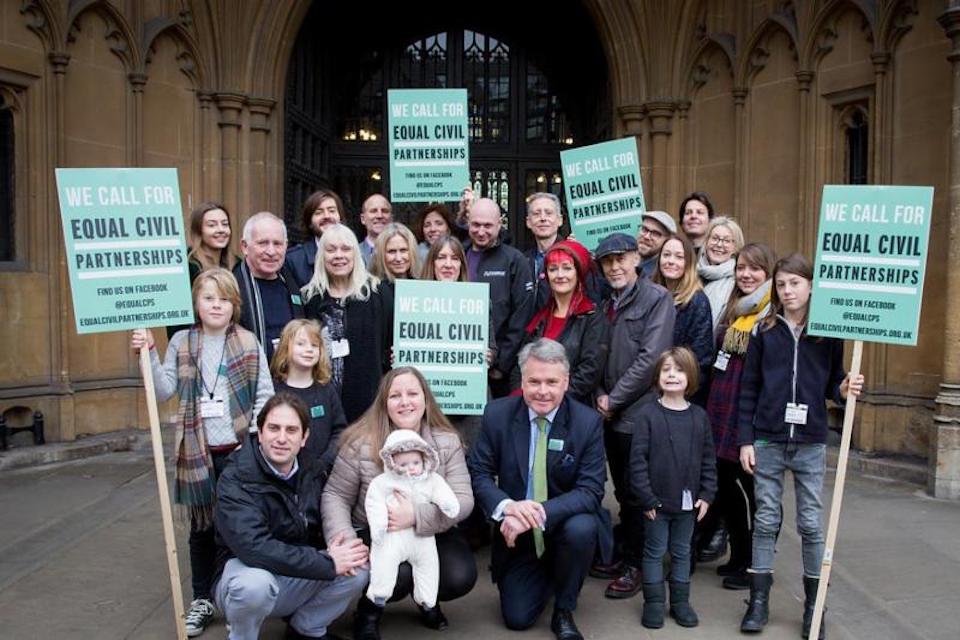
    “The planned opening of civil partnerships to opposite-sex couples is wonderful news. It is the successful culmination of a 14-year equality campaign that was begun in 2004 by myself and the LGBT+ organisation OutRage! When Labour first introduced civil partnerships but restricted them to same-sex couples we argued that this was discrimination. We campaigned for equal civil partnerships for all,” said human rights advocate Peter Tatchell.
    “We are delighted that Charles Keidan and Rebecca Steinfeld have continued this campaign and finally won this stunning result. They secured the backing of the Supreme Court in June this year, when it ruled that the ban on opposite-sex couples was unjustified and contrary to human rights principles. The government’s decision was a necessary response to the judgement of the highest court in the land.
    “We thank the government for listening to the judges, human rights law and the appeals of the many unmarried opposite-sex couples who want a civil partnership,” said Mr Tatchell.
    Civil Partnerships were first offered to gay couples in 2004 by the Labour government as a way for gay and same-sex couples to protect and formalise their relationship inline with traditional marriage. There have been over 60,000 civil partnerships in the UK since the law was introduced.
  • “Victory for love and equality” Peter Tatchell celebrates Civil Partnerships for all couples

    The Human Rights activist, Peter Tatchell has praised the Supreme Court ruling that mixed-sex couples should be allowed to have civil partnerships.

    A straight couple, Rebecca Steinfeld and Charles Keidan, have won their legal case, which will allow them to have a Civil Partnership instead of a traditional marriage.

    Up until now, the only couples permitted to have CPs were gay and lesbian couples.

    It was a law introduced by the Labour government in 2004, before the Conservatives, under David Cameron were able to vote and pass Same-Sex marriage.

    Civilly Partnered couples are entitled to many of the protections offered by marriage including, inheritance, tax, pension rights and next of kin arrangements.

    Steinfeld and Keidan argued that the Civil Partnership act was unlawful before it was incompatible with the European Convention on Human Rights.

    Speaking about the ruling, leading Human Rights activist, Peter Tatchell said, “This is a victory for love and equality. It was never right to deny opposite-sex couples the option of having a civil partnership. In a democracy, we are all supposed to be equal before the law. It is wonderful news that the Supreme Court has ruled against the government and in favour of equal civil partnerships”.

    This ruling overturns a previous judgement made by the Court of Appeal made in February 2017.

    Peter Tatchell has supported Rebecca Steinfeld’s and Charles Keidan from the outset of their legal challenge in 2014.

    Indeed, he championed the right of opposite-sex couples to have a civil partnership from the moment Tony Blair’s government announced in 2003 that the option would be available to same-sex couples only, condemning it as “blatant discrimination based on sexual orientation.”

    Speaking about today’s victory in the Supreme Court, Mr Tatchell said, “The ban on opposite-sex civil partnerships was discrimination and a violation of human rights. It is outrageous that the government was unwilling to legislate equality and that this couple were forced to go to court to get a basic human right – the right to be treated equally in law.

    “It was never fair that same-sex couples had two options, civil partnerships and civil marriages, whereas opposite-sex partners had only one option, marriage,” said Mr Tatchell.

    In May THEGAYUK.com ran a poll of its readers which found that 62 percent of LGBT+ people who answer believed that Civil Partnerships should be open to all couples, while only eight percent believed that they should remain for just same-sex couples.

    Thirty percent believed that Civil Partnerships should be scrapped altogether.


  • Straight couples should be able to get Civil Partnership, Supreme Court rules

    Straight couples should be able to get Civil Partnership, Supreme Court rules

    Mixed-sex couples should be allowed to have civil partnerships, Supreme Court rules.

    CREDIT: ©-welcomia-Depositphotos

    A straight couple, Rebecca Steinfeld and Charles Keidan, have won their legal case, which could allow them to have a Civil Partnership instead of a traditional marriage.

    Up until now, the only couples permitted to have CPs were gay and lesbian couples.

    It was a law introduced by the Labour government in 2004, before the Conservatives, under David Cameron were able to vote and pass Same-Sex marriage.

    Civilly Partnered couples are entitled to many of the protections offered by marriage including, inheritance, tax, pension rights and next of kin arrangements.

    Steinfeld and Keidan argued that the Civil Partnership act was unlawful before it was incompatible with the European Convention on Human Rights.

    This ruling overturns a previous judgement made by the Court of Appeal made in February 2017.

    In May THEGAYUK.com ran a poll of its readers which found that 62 percent of LGBT+ people who answer believed that Civil Partnerships should be open to all couples, while only eight percent believed that they should remain for just same-sex couples.

    Thirty percent believed that Civil Partnerships should be scrapped altogether.


  • LEGAL ADVICE | How do my partner and I dissolve our civil partnership, if one of us lives abroad?

    A reader asks our legal experts for advice on how to dissolve a civil partnership when one of them lives outside the UK. Megan Bennie, a solicitor at Grayfords Law looks into the case.

    How do I dissolve a civil partnership, if one of us lives abroad?
    FILE PHOTO

    Dear Legal Clinic,

    Hello. I have me tried in many ways to obtain the necessary information with no success. I hope you can help. Both my ex-partner and I wish to dissolve our civil partnership.

    The issue is I live abroad in Greece and he is in London. We have no mutual assets. We’ve been using documents from the Internet and posting to the court. But there are no guidelines for this process with one of us being non-domicile. I cannot get any documentation or information as I am not UK resident.

    Do we need for lawyers to be involved?  Just need to know the system.

    Malcolm


    Dear Malcolm,

    Thank you for your questions.  We live in an increasingly international world and now it is by no means unusual for a couple to be different nationalities, to live or marry abroad…and even to divorce from abroad. So don’t worry, there is a way through.  Even if you are living abroad, you can petition for a dissolution of your civil partnership on the basis that you last lived as a partnered couple in England and Wales (if this is the case) and/or your civil partner lives in England and Wales. One hurdle you might find harder to overcome is that you MUST have either your original marriage certificate or a certified copy (and a translation if it is not in the English or Welsh language). You can order a copy from the General Register Office for about £10.  https://www.gro.gov.uk   

    If you’re abroad and still on fairly amicable terms with your ex, have you thought about him applying for the dissolution? Unfortunately, you can’t apply together, even if you both agree the partnership has come to an end. However, that’s not to say you can’t work together to agree the paperwork in advance and split the fee. If your ex-partner still has an address in the UK it is likelier to be far quicker and easier for him to deal with the paperwork and get things moving.

    Best of luck with moving the dissolution forward. The process usually takes 6-9 months so the sooner you start, the sooner you can reach the finish line and start your new legally separate lives. 

     Megan Bennie– Solicitor at Grayfords


    Do you have a legal question you need to be answered? Click here to send us a query for free now.


    The advice given here is provided for free and is not intended to replace legal advice from your own legal representatives who will better know and understand your circumstances and situation. Before acting on any information you should check with your own legal representatives.
  • LEGAL CLINIC | I need to dissolve my civil partnership but my partner has been missing for years

    A reader asks how he might go about legally separating from his civil partner after a number of years of separation, the only problem the partner is uncontactable. We asked the lawyers for their advice.

    How to get a Civil Dissolution

    Dear Legal Clinic

    “I’ve entered into a civil partnership about ten years ago with a guy from Poland and have since lost contact with him. I have tried for a number of years now to track him down as I would like to dissolve our partnership. As I can’t locate the guy and believe he has moved back to Poland, is there a way I can dissolve our Civil Partnership with him?

    Any help would be much appreciated.”

     James

    Grayfords‘ Megan Bennie write,

    Dear James,
    Thank you for your question. Your situation may sound rare but it’s actually more common than you might think. In today’s increasingly international world, it’s not uncommon for someone to move back to their home city or country when a relationship breaks down.

    You say you’ve tried to locate your partner for a number of years. The easiest way for you to obtain a dissolution of your civil partnership is on the basis of 5 years’ separation (dissolution is the almost exact equivalent for civil partnerships of a divorce for marriages – the forms and procedures are the same). It sounds like you might be close to the 5-year point or have already reached it. The advantage of basing the dissolution on 5 years’ separation is that you don’t need the consent of the other person. If you were to base the dissolution on 2 years’ separation you would need written consent from your partner to proceed.

    The most sensible way forward is for you to petition for a dissolution based on 5 years’ separation and use your partner’s last known address on the forms. You can write to the court to submit the forms and include some information about your attempts to locate your partner. The court is likely to accept the petition as long as your attempts are genuine, sensible attempts – you don’t have to take extreme measures or go to the ends of the earth but the court does want to see you’ve at least tried.

    Once the dissolution petition is sent out – one copy to you and one to your partner’s last known address – you should apply to dispense with service upon them, in other words, do away with the requirement for papers to be successfully received by your partner. You complete a D13 form which covers the steps you’ve taken to try and find your partner, including attempts to contact them through an employer, family, etc. where possible and the court makes a decision as to whether or not it can dispense with the service requirement. There is a small additional fee of around £50 for this application (on top of the £550 dissolution fee) and it adds a little extra time to the process. However, compared to staying married until your partner resurfaces, if they ever do, it may be a small price to pay.

    You can download all the forms you need for the dissolution procedure, including the D8 application to start the process and the D13 form to dispense with service, at http://hmctsformfinder.justice.gov.uk/.

    A lot of websites offer you an “online divorce” but unfortunately, many of them simply charge you to complete and download the forms you can already download for free from the website mentioned above. I strongly recommend that, even if you start the dissolution process yourself, you take advice from a solicitor on the D13 form so that you can dispense with service quickly and easily. A solicitor will know the kinds of things you need to put down to satisfy the court you’ve done all you can.

    I wish you the best of luck James and if you do need a hand with any aspect of the dissolution process, don’t hesitate to call us, or any other solicitor. If cost is an issue, you may wish to speak with your local Citizens Advice Bureau or contact the Personal Support Unit at a local court. They can’t give you legal advice in the same way a lawyer can, but they can help with forms and procedures.

    Back to legal clinic


  • UK court rules that heterosexual couples still cannot get civilly partnered

    A blow has been struck to heterosexual couples who wish to get civilly partnered rather than married after a UK court dismisses a challenge.

    The Court of Appeal has dismissed a case which would have allowed opposite-sex couples the option to get a civil partnership instead of getting married. As it stands only same-sex couples are able to get a civil partnership.

    Rebecca Steinfeld and Charles Keidan wanted for the law to recognise their six-year relationship via a civil partnership, however, the Civil Partnership Act 2004 states that only same-sex couples are eligible. They have been campaigning to allow heterosexual couples’ rights for civil partnership for three years.

    The couple challenged a High Court ruling in November and have not ruled out take their case to the Supreme court to overturn the decision.

    Three judges who heard their case, Lady Justice Arden, Lord Justice Briggs and Lord Justice Beatson agreed that the discrimination against opposite-sex couples could not continue and that the Government should be given more time to consider the issue.

    ALSO READ:


    They argued that the Court’s decision was discriminatory and at odds with the law.

    Speaking outside the court, Rebecca Steinfeld said,

    “We are deeply disappointed by the ruling and very sorry not be able to share good news but there’s so much in the decision that gives us reason to be positive and keep going.”

    Peter Tatchell, who has campaigned on this issue said,

    “I’m hugely disappointed with the ruling since the judges agreed with 90% if Charles and Rebecca’s case,”

    “They accepted the points if law but believed the government should have extra time. Millions of different sex couples will feel that their rights have not been upheld by the court.