This spring, Exeter Phoenix and Exeter Pride are celebrating love, life and LGBT+ with Cine Queer – a new film season at Studio 74 as part of Exeter Pride’s 10th Anniversary. In a cinematic celebration of diversity and acceptance, this special film season will feature new releases, cult classics, documentary, panel discussions and more.
Cine Queer season opens on Friday 20th April with French film 120 BPM, an exhilarating drama following the actions of Parisian AIDS activists in the early 1990s. This screening will be accompanied by a special introduction about those living with or affected by HIV. The season runs until Tuesday 15th May, where it will conclude with the visually spectacular film The Wound.
Cine Queer will also feature screenings of groundbreaking new release Love, Simon, the first studio-made teen rom-com featuring a gay protagonist. A special event for drag performance documentary Kings, Queens and In-Betweens will be followed by a panel discussion on gender ambiguity with guests, The Ambiguous-A and Alyssa Van Delle, from the South West’s own drag scene. Screenings of cult-classic But I’m A Cheerleader and the eye-opening Signature Move complete the season.
Speaking this week, the season’s programmer Alix Taylor said ‘Exeter Phoenix is proud to be marking Exeter Pride’s 10th Anniversary with this brand new film season, which firmly place LGBT+ cinema in Studio 74 and opens our programme up to a wider, more diverse audience.’
Exeter Pride, one of the South West’s biggest celebrations of lesbian, gay, bisexual and transgender (LGBT+) communities, will take place at venues across Exeter on Saturday 12th May. The day promises to be an explosion of colour, positivity and pride.
Cinema tickets for Studio are £7 or book 3 films for £18. Under 25s can enjoy £5 tickets to all films at Studio 74. Tickets are available here: http://www.exeterphoenix.org.uk/category/cine-queer/ or by calling the box office on 01392 667080.
‘He has been mutilated and suffered permanent damage.’
Mother argues boys need protection against “male genital mutilation”
A mother is suing a doctor after her baby son was circumcised, allegedly without her permission. The 26-year-old mother is planning to sue the doctor after her son, was left in pain, bleeding and unable to wear a nappy.
The boy was reportedly taken to the doctor, by his paternal grandmother.
The baby’s parents are separated and the father is not named on the boy’s birth certificate, but was allowed visitations to his son. In 2013 the Nottinghamshire mother left her baby with its father during the Eid festival, and allegedly his mother took the boy to be circumcised, according to The Sunday Times.
Male genital mutilation “an unnecessary assault”
If the boy’s mother is successful, campaigners say that it could open the floodgates to other victims of “male genital mutilation”, who claim that the circumcision procedure was done without their permission as children, before they could decide whether they wanted the operation or not.
The mother claims that her son, neither can be named for legal reasons, was left in pain saying that her son was “mutilated and suffered permanent damage.”
The mother made a complaint to the police and also to the General Medical Council in 2013, when the operation took place, however, the police found there was “insufficient evidence” for a successful prosecution. The mother’s lawyer, Saimo Chahal QC, is seeking to “Crown Prosecution Service’s decision last November not to prosecute”.
Chahal QC said, ‘This mother clearly did not consent to her son undergoing the circumcision procedure, which could constitute a criminal offence.
‘While some people with religious beliefs see circumcision as normal, there are others who see it as an unnecessary assault which can be physically and psychologically harmful.’
It is currently illegal to perform female genital mutilation. There are no such laws in place for males.
“These figures are a positive step in supporting victims and ensuring they are signposted to the right services that are then able to provide appropriate care.”
Last year the force created the D66 code, specifically to record incidents of domestic violence between LGBT+ couples.
It is hoped that recording these incidents will identify trends and patterns which will help implement appropriate practices to support survivors of domestic abuse.
“Positive Step”
Detective Superintendent Denise Worth from Greater Manchester Police said, “These figures are a positive step in supporting victims and ensuring they are signposted to the right services that are then able to provide appropriate care.
“The D66 coding is a simple process which enables us to identify the community affected and provide local authorities with latest figures which allows them to commission relevant services to support victims.
“Our findings and processes have also been shared nationally and we hope this will assist other forces in adopting their own practices to help those victims.”
The Force is also continuing its partnership with the national LGBT domestic abuse helpline at Galop to better understand the issues surrounding domestic abuse in the LGBT community and encourage victims and friends and family of victims to report the issue and have the confidence to come forward.
Peter Kelley Head of Domestic Abuse Service at Galop said, “Every day staff at our National LGBT Domestic Abuse Helpline are contacted by LGBT+ people looking for help and support with domestic abuse and violence. It’s really important that victims and survivors get the help they need without facing additional barriers because of their sexuality and gender identity. Galop fully supports the continued efforts of Greater Manchester Police to increase the number of LGBT+ people reporting domestic abuse through the D66 initiative and we hope that its success over the last year will encourage other police forces across the UK to adopt similar initiatives.”
Joanne Simpson, manager at Independent Choices said, “The implementation of the D66 code has revolutionised accessible and appropriate support for LGBT domestic abuse survivors. Independent Choices are proud to offer a domestic abuse support service that is Greater Manchester-wide in partnership with the LGBT Foundation. GMP using this code has meant that the service has run to capacity from the offset and that barriers have been broken down enabling LGBT Victim/survivors to receive appropriate, timely and accessible support.”
Deputy Mayor for Policing and Crime Bev Hughes said: “Greater Manchester has led the way as the first area to record domestic abuse within LGBT communities and now, one year on, we can show the positive impact of this work. This reporting code is giving us a clearer picture of abuse, helping to break down barriers and encourage people to report it.
“Vitally, this also means that we can ensure the right services are in place to support victims of domestic abuse while continuing to work with LGBT people to raise awareness of domestic abuse and empower more people to take that first step to seek help and support.”
I have been in love with wrestling ever since I was a kid. Naturally, it was the campy, dramatic side of things that got me interested in Sports Entertainment. The first ever episode I watched involved Stephanie McMahon marrying a wrestler called Test. However, during the ceremony, it is revealed she was secretly drugged by McMahon Family nemesis Triple H who married her in a Las Vegas drive-through. It was pure soap opera and I was hooked.
“Being a gay WWE fan means that you often have to forgive a lot of previous transgressions.”
However, as the kids say, WWE has been quite “problematic” over the years. Being a gay WWE fan means that you often have to forgive a lot of previous transgressions. The Attitude Era was defining for WWE. It was when you had Stone Cold drinking beers, DX tormenting the boss Vince McMahon and there were half-naked ladies for the eye to see. It was rude, obnoxious and outrageous; it was everything we wanted to be. It was also pretty homophobic. WWE has never shied away from a gay joke throughout its time. I remember a scene when my favourite wrestler Triple H went looking for Shawn Michaels in a restaurant. He mistakes a long-haired waiter for Shawn explaining “well, that’s certainly a different look to the chaps I usually see you in there, Sexy Boy (Shawn Michaels’ nickname)”. The waiter then visibly checks Triple H out and, after Triple H apologises and tries to leave, the waiter tells him “I get off at seven”. Triple H retorts “yeah, I bet you do”. For a wrestling fan, it’s good bit, pointing out the homoerotic undertones of the Shawn Michaels/Triple H dynamic. This, though, was 2009. Not the attitude era but the PG era.
WWE’s homophobia hasn’t always been a “subtle” joke. WWE commentator Michael Cole got in trouble for calling his then-colleague a faggot on Twitter. Even favourite John Cena was under fire for gay jokes made towards The Rock in 2011. The most vivid example I remember was watching Raw with my brother in 1997. On it, Jerry Lawler was cutting a promo on Goldust telling him his father hated him because he’d married a gold digger and was now kissing men like a “flaming faggot”. This was not beeped out, this was deemed perfectly acceptable. Now sure, Lawler was playing heel (a wrestling term for ‘bad guy’) and Goldust got the win but it was particularly biting for a 7-year-old to take in.
Men who kiss men are faggots. That was my take-away from that.
One thing I have always felt as a WWE fan, though, is under-representation. WWE has always had relationship storylines. They have actually been some of my favourites. From Triple and Stephanie, Stone Cold and Debra to Zack Ryder and Eve, they are the soap opera stories that have had me interested in WWE for so long. But WWE has never had a gay-centric storyline (for any WWE fans reading this, Billy and Chuck do NOT count). We’ve had “hot lesbian action” but nothing ever gay. And let’s face it: WWE is pretty gay! It’s fit men in underwear grinding on top of each other. Yet WWE has never pulled the trigger.
Then, in recent years, WWE has launched initiatives such as Be A Star which is an anti-bullying programme of events which promote tolerance and inclusion. Many WWE Superstars even got involved in the LGBT charity campaign No H8. This was, for me, pretty remarkable as it was the first time WWE really ever gave a nod to its LGBT fans. And to have two executives like Triple H and Stephanie McMahon do it sent a clear message that WWE was becoming more inclusive. This was then reiterated by support now-released wrestler Darren Young received when he came out. However, it was given a caveat that Young’s on-screen character “is not gay” but that there may be a change in future. This, however, did not happen and sadly Young was released 4 years later (likely due to a lack of creative ideas for Young rather than his coming out).
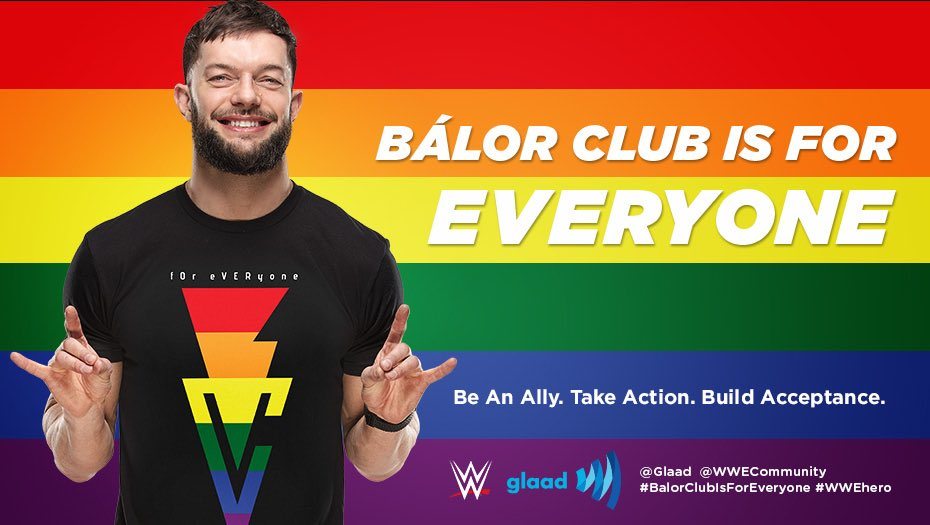
Cut to: Wrestlemania. Prior to the event, WWE Superstar and Twitter Thirst Trap Finn Balór announced that he was releasing a new t-shirt. This shirt would colour his logo with LGBT colours and a percentage of the funds would go to GLAAD, an American LGBT charity. This was the first time WWE would be showing pride colours (no, the Ultimate Warrior’s rainbow tassels don’t count). I marvelled at such an amazing gesture and was thrilled. Then… Wrestlemania. There was a pre-show Women’s Battle Royale match in which up and coming superstar Sonya Deville took part. Her usual outfit is all-black as a symbol of her fierce aggression. However, this time, she had donned white with rainbow colours. Sonya had previously tweeted praise Finn Balór’s t-shirt initiative and also came out as the WWE’s first openly-lesbian Superstar.
Then came Finn’s match. Finn was joined in his entrance by local New Orleans LGBT community members. He was wearing the rainbow shirt, had the rainbow logo on his trunks and a rainbow running down the back of his boots. This was something WWE has never seen before and it was remarkable. Finn is a hugely popular talent and to support LGBT in a brand like WWE has worldwide significance. Let alone, it was his Wrestlemania debut. I am not afraid to say, it got me emotional because I thought about how it would’ve felt for 7-year-old me to have seen Finn entire in rainbow colours rather than hearing the word faggot.
I truly hope this is a turning point to how WWE approached its LGBT fans. We are a valid part of the WWE Universe and to have this representation on their biggest show is a monumental step forward and an overwhelming gesture. I truly hope Finn, Sonya and the WWE know what an important moment that was for LGBT fans. I hope this continues and doesn’t get sidelined into a gimmick. We need an openly LGBT character, LGBT storylines and a commitment from WWE that is will continue to show its Pride.
Opinions expressed in this article may not reflect those of THEGAYUK, its management or editorial teams. If you’d like to comment or write a comment, opinion or blog piece, please click here.
Naked Fest put out a call to landowners that they are “looking for a secure and secluded rural location, suitable for camping (and possibly caravans), that can accommodate about 250 guests”
The organisers are looking for a site that is close to London or in the South East and “ideally with water and electricity and of approximately 7-9 acres”.