★★★★ ★| Ute Lemper’s Rendezvous With Marlene
 Ute
Ute
‘Falling in Love Again…’ an entranced Sasha de Suinn reviews Ute Lemper’s sold-out cabaret show Rendezvous with Marlene at the Arcola Theatre, London.
Where were you when Princess Di died?
Shocked, indifferent or simply unborn then? Like the Twin Towers, Di’s death instantly branded itself into cultural awareness worldwide, becoming a cultural landmark of collective disbelief. Still – if not quite on such an exalted plane – artistic earthquakes also create an enduring, seismic blip in public adoration and memorable regard. But forget the pointlessly premature – if still shocking – deaths of musical prodigies Prince, Amy Winehouse and Michael Jackson; they’re the negative downside of cultural lightning brilliantly caught in a bottle. Ah, but don’t despair – there’s always light in the darkness, a Dumbledore to every Voldemort! Why, given a convenient TARDIS like every cosy, pansexual Time Lord, who wouldn’t want to witness Maria Callas, Judy Garland and Bowie’s Ziggy Stardust shows at their iconic, history-making peak?
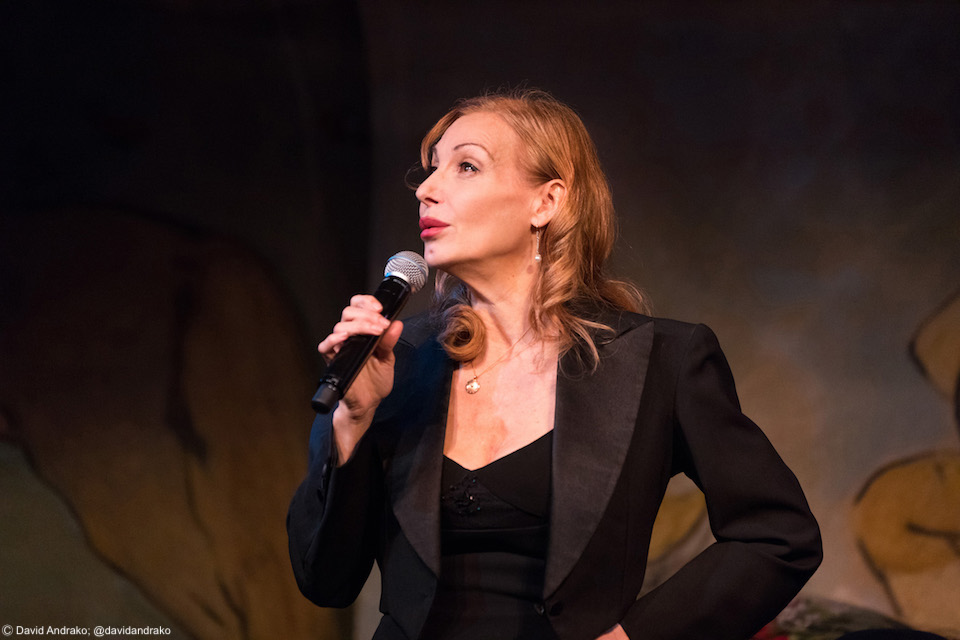
Still, those moments, if rare, continue to persist as thrilling possibilities. And culturally – right here and right now – we’re incandescently privileged to witness Ute Lemper’s totally game-changing Rendezvous With Marlene. The work of a simply superlative artist at the top of her game, it’s a fearless exploration of Dietrich’s doubts, regrets and shockingly raw humanity.
Like the finest, vintage Krug champagne – with all its’ attendant depth, resonance and complexity of flavour – Rendezvous has intensely benefitted from its’ long, thirty-year gestation in Ute’s mind.
While playing Sally Bowles in a stage version of Cabaret in Dusseldorf back in 1992 when she was 24, Ute wrote a postcard to the 88-year-old Dietrich apologising for the constant barrage of spurious comparisons lazy journalists were drawing between the two artists. To call those journalists merely misguided would be ridiculously kind; they were wildly inaccurate. Where Dietrich was breezily, bisexually promiscuous, Ute was married with children; where Dietrich barely strayed beyond performing a narrow repertoire of expected classics, Ute’s range – including tackling songs by Nick Cave and Tom Waits – was eclecticism personified; and finally, while Dietrich stage’s act and barely-passable ‘singing’ remained essentially static and she explores no other creative pathways privately, Ute was a first-class chanteuse, actress and dancer, painting and song-writing in her precious downtime.
Very different women, then, despite the most blatantly obvious, shared physical characteristics; blonde hair and shapely bodies. Still, both had a shrewd grasp of the human impact of restrictive politics – as in Dietrich’s profound disgust towards the Nazis, while Ute – pleasingly in an era of blanket, Trump idiocies – comes across as an electrifying, pro-choice Valkyrie at the Arcola, sharing Dietrich’s passion for strong, female self-determinism.

Framed as a post-modern metafiction – Ute switching characters back and forth between herself and Dietrich, and exploring Dietrich’s memories in character en route – Rendezvous is almost an act of secular worship in performing, spontaneously eliciting an aura of hushed, quasi-religious devotion from the audience. Faultlessly exhibiting the high-functioning playfulness of an Alpha-class empath, Ute is so sensitive to nuance she virtually leads the audience en mass to the emotional mountaintops of Dietrich’s revelations. Throughout, Ute exhibits two exceptional qualities wholly lacking from the frenzied, truncated idiocy that passes as modern stage direction; dignity and restraint.
Surely a reigning role-model of liquid-boned finesse, Ute’s slightest, rippling gesture speaks emotional volumes, and she has the incalculable, expressive gift of making even the most chronically over-exposed lyrics imaginable –Blowing In The Wind, anyone? – resonate with the shocking, public poignancy of Christine Blasey Ford testimony against the vile Brett Kavanaugh.
A sheer master-class in memorial intimacy, stagecraft and the taut, emotional fury of suppressed pain and regret, Rendezvous With Marlene is an astounding instance of spiritual ventriloquism, of one acclaimed performer so prepared to relinquish egotism she’ll voluntarily become the mouthpiece of another.
Utterly in tune with our present, diversity zeitgeist, Ute’s tribute is not only pansexual, acknowledging Marlene’s female and male lovers, but also – going even further than Russell T. Davies’ Years and Years – transageist, as a youthful, ebullient Ute assumes the serene gravitas of Dietrich herself. Masterly? Of course; and – by a huge margin – simply the finest act of sustained, emotional intensity and fearless self-revelation I’ve ever seen. Ute – like Bowie, Callas and Garland before her – is in an unprecedented class of her own.