The University of Liverpool has seemingly done away with the labels gay, lesbian and bisexual and replaced it with “sexual minorities” while still referring to straight people as heterosexuals.
In a press release, which was trying to convey that young people born between 1995 and 2015 who identify as a “sexual minority” i.e gay, lesbian, bisexual and pansexual are more likely to experience mental health problems.
“sexual” minorities makes us look as though we are just sexual beings”
Throughout the press release, the University, which worked alongside University College London, repeatedly called LGB people “sexual minorities” however when it came to writing about their heterosexual counterparts, it used the word heterosexuality.
THEGAYUK conducted a flash poll to see what it’s readers thought of the term “sexual minority”
The clear indication from our flash poll was that the majority of those who identify as LGB did not think that the term was right. Over 80 per cent of those who took part said they disagreed with the term and were happy to keep identities labelled as Lesbian, Gay and Bisexual.
One commenter wrote, “‘sexual’ minorities makes us look as though we are just sexual beings, a different sexuality to heterosexuality is a part of who we are not just the sex we may or may not have”
Another added, “totally agree! Sex is one aspect of a human being! I am married to a man, that is not a sexual thing! I am lucky that also part of the luck I have had”
“Attraction not Identity”
According to researchers, it’s about attraction, not identity, a spokesperson for the research said,
“We use sexual minority as an umbrella term to incorporate those who are lesbian, gay, bisexual. We use this term as we only had data about sexual attraction (from the secondary data source used i.e. the millennium cohort study) and not identity which would be more closely reflected by ‘LGB’.
“Our sample were not asked about their identity but only their attraction i.e. have you been attracted to a boy/girl. Furthermore, due to the fact they are likely still navigating their identity at this age i.e. 14 years old (savin-williams, 2011) we did not want to ascribe labels that may change in future and as such sexual minority was a more age appropriate term.”
★★★★ | Desiree’s Coming Early, Soho Theatre, London
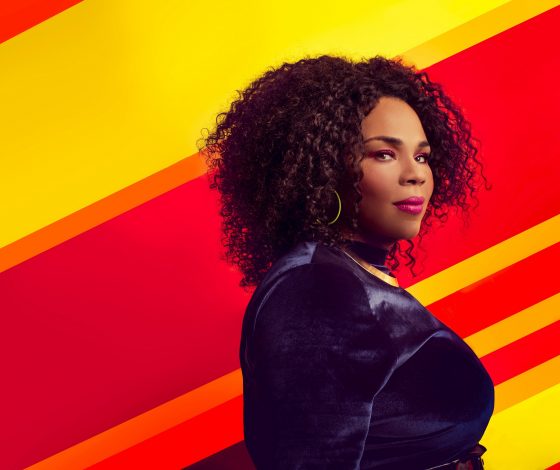
90 minutes of non-stop comedy is what you’ll get when you see Desiree Burch.
American comedian Burch, now at the Soho Theatre until Saturday November 23rd in a show called Desiree’s Coming Early – rapid fires her tale of her experience at the Burning Man Festival – a festival held every year in the Nevada desert where people are free to be naked – she was! The show is also about her quest for dick there (and not a man named Dick) after the breakup of a long relationship.
Desiree recounts the moment of her being the only woman of colour in a sauna in the desert there, where it’s mostly white people. She also doesn’t hold back on jokes about Bill Crosby, Harvey Weinstein, and more specifically Michael Jackson.
Burch is rude, crude and honest! And her American-style comedy will leave you gasping for air, because she doesn’t! But she’s forthright and honest about a law in California where it was illegal to administer IQ tests to black students. Discrimination?
You decide. It’s the background theme of the show, and a clever one at that.
Desiree Burch, who is about to take this show to New York – is fast, funny, and brutally honest.
Peter Tatchell, one of the UK’s most famous LGBT+ rights advocates has said that pride, needs a “major rethink” and for it to “get back to what pride was originally about”.
The stalwart rights campaigner then put forth a four-point plan, which included returning the parade back to a political march, getting rid of corporate branding and banning motorised floats.
The plan, he suggested should be trialled for one year.
In a statement, Tatchell wrote
“As a Patron of Pride and one of the organisers of the UK’s first Pride in 1972,
“I have attended every parade since then – 47 in all.
“I believe a major rethink is needed. We need to get back to what Pride was originally about. “
Four ways to take pride back
Peter Tatchell Foundation
The Pride parade should become a march for LGBT+ rights
As a political march, this would mean no charges being imposed by Westminster Council, the Metropolitan Police and the Greater London Authority, saving around £60,000 in fees to Westminster Council alone.
Pride should be open to all
There should be no restriction on the number of people who can march and no requirement to get a wristband.
Oppressive institutions should be excluded from Pride sponsorship & the parade
This includes weapons manufacturers, tobacco and fossil fuel companies and the Home Office until it stops incarcerating, banning employment and deporting LGBT+ refugees. Individuals from these institutions should still be welcome in the parade but without any corporate branding.
Ban motorised floats, except for disability vehicles
Having vehicles in the parade allows Westminster Council to slap onerous charges on Pride and contributes to the carbon emissions that fuel climate destruction.
Tatchell added, “I am proposing that these ideas be trialled for one-year in 2020. If they work, Pride can keep them permanently. If not, Pride can ditch them and try something new”.
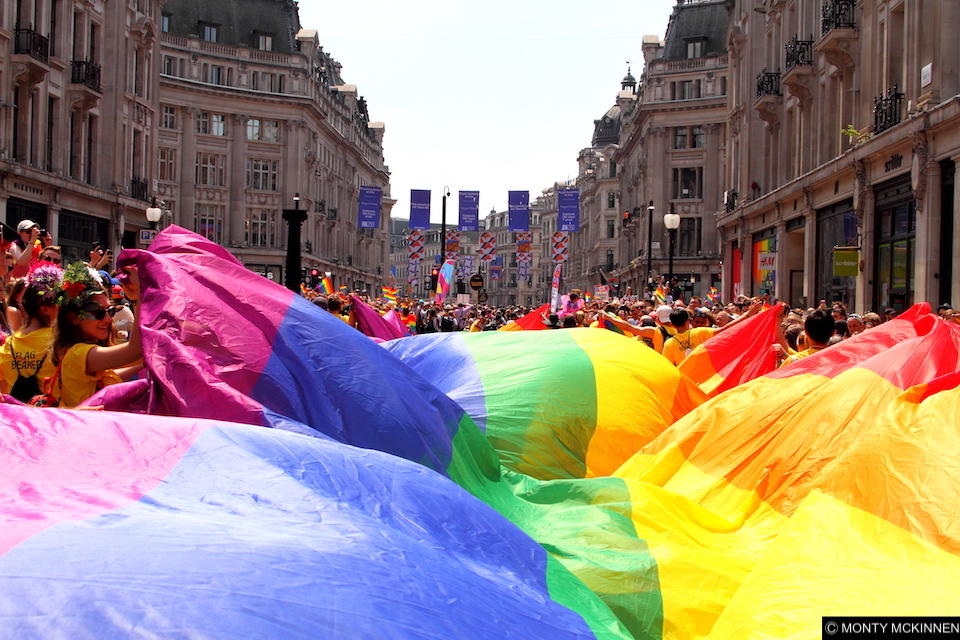
Pride In London is one of the biggest prides in the country, which regularly sees over a million people watch and take part in the huge parade.
“The Pride parade can and should remain true to its founding ideals”
CREDIT: (C) Joffe Walters
Tatchell reiterated what Pride was all about saying,
“The founding principles of the LGBT+ Pride parade in 1972 were: LGBT+ visibility, the celebration of LGBT+ life and culture and the demand for LGBT+ liberation, including the abolition of discriminatory laws and reform of anti-LGBT+ institutions. It was open to all who supported these core principles.
“The Pride parade can and should remain true to its founding ideals.
“Pride must be by and for the LGBT+ community – not city authorities or corporate funders. Their support is welcome but it must not dictate”.
Pride operates on the terms of Westminster Council, the police and Sadiq Khan
Highlighting some of the constraints that Pride In London faces, Tatchell revealed,
“The Mayor of London, Westminster council and the Metropolitan Police now hold the whip-hand. The Pride parade operates on their terms – not ours.
“We must reject any cap on numbers in the parade. It goes against the ethos of Pride which was, until recent years, open to all. In 1997, there were over 100,000 people in the parade and 300,000 at the post-parade festival on Clapham Common. Numbers are not everything but they should not be artificially restricted.
What is Peter’s vision for Pride?
“Revert to a political carnival parade for LGBT rights, like the first one in 1972. If it is a political march there would be no fees payable to the police, council etc.
“Political marches are not charged. The anti-austerity and anti-Brexit marches were not subject to any of the draconian costs and restrictions on numbers that have been imposed on Pride.
“Pride can be political and still have a colourful, joyous carnival atmosphere, as in 1972 and 1997.
“To cut parade costs, motorised floats should be axed and replaced by other options, such as hand-pulled non-motorised floats – mounted on flatbeds on wheels – as some groups had in 1997.
“These were smaller in size than the gigantic bus and truck floats of recent years but still fabulous and more diverse and imaginative eg the OutRage! giant papier-mache head of Tony Blair in Pride 1998. The Thames Festival parade is awesome but has no motorised floats. I remember a huge dragon held aloft by dozens of parade participants using tall poles. It was very effective and dramatic; proving that motorised floats are not the only way to have a spectacular carnival parade.
“My congratulations and thanks to the Pride organisers, the Community Advisory Board and all the volunteers who make Pride in London possible. Pride’s online consultation seeking LGBT+ input regarding the future of the parade was commendable. I salute you,” said Peter Tatchell.