Author: Greg Mitchell

  • THEATRE REVIEW | Sandel, Above The Stags, London

    ★★★★ | Sandel, Above The Stag, London

    First published in 1968, Angus Stewart’s novel, Sandel, about the love affair between a 13-year-old choirboy, Anthony Sandel and a 19-year-old undergraduate, David Rogers, was out of print for 40 years, its subject matter considered somehow more shocking in today’s world than it was in 1968. Throughout that time it had become something of a cult classic, until production of this stage adaptation by Glenn Chandler at the Edinburgh Festival precipitated its re-publication last year.

    Maybe, it was deemed less shocking in those seemingly more innocent years. Indeed romantic attachments between young boys at public schools and at university were almost considered the norm. In Brideshead Revisited, Lord Marchmain’s Italian mistress Carla engages Charles Ryder in conversation when he and Sebastian are in Venice.

    “I think you are very fond of Sebastian,” she said.
    “Why, certainly.”
    “I know of these romantic friendships of the English and the Germans. They are not Latin. I think they are very good if they do not go on too long.”

    Presumably more acceptable back then, though of course Charles and Sebastian were of the same age (late teens). That said, frequently younger boys would form attachments to older boys at public school, and the age gap between Tony and David (6 years) is really not very much. When David takes Tony shopping for clothes, he poses as his elder brother, but one wonders whether the sales assistant, like most people at that time just turned a blind eye, assuming, like Carla, that this was just boys going through a phase they would grow out of.

    Reading the novel through twenty-first-century eyes, I confess to finding the relationship a little disturbing, and, if various reviews on Goodreads are anything to go by, I am not the only one. That I found it much less disturbing At the Stag is down to the excellent adaptation by Glenn Chandler, who also directs a brilliantly paced and pitched production, and to the superb performances of young Ashley Cousins as Tony and Joseph Lindoe as David. We see both the maturity of the boy Tony and the immaturity of the man David, which makes the attraction altogether more understandable, not to mention palatable. It was a master stroke to cast Tony with a young actor (Cousins) who is only a couple of years older than the character he is playing. He does so with a knowing innocence, for it is Tony who makes all the running, Tony who seduces David. It is an extraordinarily mature performance from a young actor. Lindoe is equally convincing as David, at that awkward stage between adolescent and adult. Expected to be the adult in the relationship, he nevertheless displays a touching naivety. The chemistry and connection between the two actors was absolutely convincing.

    The third character in the play is David’s best friend Bruce Lang, unrequitedly and secretly in love with David, who deals with his feelings by studying to become a Roman Catholic priest. His function is to act as David’s conscience, and, blessed with a sardonic, somewhat Wildean wit, he gets many of the best lines, ably delivered here by Calum Fleming, repeating his performance from the Edinburgh Fringe production.

    If you like to be challenged, then you should make it post haste down to Vauxhall for this superb production, which runs at Above The Stag until June 14th
  • Hepatitis C To Be Eliminated By The Year 2030

    It is currently estimated that there are 144,000 people living with Hepatitis C in England alone. Though a small proportion of the total, men who have sex with men are one of the risk groups.

     Until now there has been no definite cure, and so far treatments have been long, debilitating, and often don’t work anyway. The usual outcome is cirrhosis of the liver, and eventual prognosis death.
    So why is Hepatitis C treatment in the news? According to the Hep C Trust, new treatments are now available that can cure 95% of all cases, leading to a projected saving in England alone of over 5000 lives by 2030 and preventing the need for 1000 future liver transplants. The population of those living with Hepatitis C would be cut by over 90%.
    What is needed is a nationwide screening programme and greater awareness. Often GPs don’t test for Hep C until the illness is quite advanced. Early diagnosis and treatment will mean that transmission rates will slow down, and eventually peter out, hence the projection that we could eliminate the disease by 2030. There are similarities with HIV here, in that early diagnosis and treatment can bring down a patient’s viral load to undetectable, meaning that it is virtually impossible for them to pass on the virus. But there is one important difference. Where there is still no cure for HIV, there is now a cure for Hep C, so it is doubly important that we get tested. As gay men, we are fortunate in that we are usually offered Hep C screening as a matter of course when attending a Sexual Health Clinic. If you aren’t, then ask for it.

    This awareness needs to be extended into the wider populace, where the problem is one of implementation, which, as usual, is taking too long. A few days ago, The Guardian ran a story stating that, “the NHS is to pay for around 500 people with end-stage liver disease caused by hepatitis C to receive a new drug which could cure them, without waiting for guidance from the advisory body, Nice.”

    As Charles Gore, one of the founder members of The Hepatitis C Trust put it at the media event I attended, “Are we going to step up and do this, or leave things as they are.” This would certainly seem to be a step in the right direction. Though the cost of treatment is high, it has to be weighed against the far greater cost of doing nothing, allowing Hepatitis C rates to increase, and ultimately putting a far greater burden on the NHS. We should be looking at the long term, not, as is sadly too often the case, the short term. Governments, as we know too well, rarely look past the next election date.
    Let us hope that both the Government and the NHS take notice and set us on the path to eradicating this terrible disease.
  • FILM REVIEW | Age Of Consent

    ★★★★ | Age Of Consent

    Age of Consent, tells the story of The Hoist, one of London’s few remaining leather bars, which opened in 1996.

    It being the story of a sex club, we get to see plenty of sex, some of it quite graphic. Ultimately, though, it turns out to be not only a fascinating glimpse into London’s leather scene, but a history of gay sex since decriminalisation.

    Did you know, for instance, that there were more convictions for gross indecency in 1989 than there were in 1966, the year before homosexuality was made legal for “consenting men in private”?

    The “in private” part was something the police vigorously enforced it would seem, often using pretty policeman to entrap gay men and secure a conviction. Against a backdrop of leather men grunting and groaning with pleasure, Peter Tatchell talks eloquently, as ever, about the continuing battle for equality under the law; co-owners Kurt Striegler and Guy Irwin tell us all about how the club got started., and some of its regulars tell us what makes the club special for them.

    There are no doubt those amongst the gay community (like James Wharton who was only recently proposing the closure of all gay saunas) who will find the goings on in the club quite disgusting, but surely the point is that we should all have equality before the law, whatever our sexual preferences, a fact that was brought brilliantly home by this excellent documentary.

    I do hope it gets an official release.


  • FILM REVIEW | Rosie

    ★★★★  | Rosie

    Age and aging were some of the concerns of Rosie, a Swiss film, directed by Marcel Gisler, in which gay writer Lorenz and his sister Sophie squabble and ultimately reconcile about what to do with their aging alcoholic mother, Rosie, splendidly played by Sybille Brunner.

    Plenty of family skeletons fall out of the cupboard as Lorenz tries to get to the bottom of the rift that existed between his mother and father, a rift that coloured his and his sister’s childhood.

    A touching and eventually uplifting movie about family with a sly, gentle humour.


  • FILM REVIEW | Gerontophilia

    ★★★ | Gerontophilia

    Toronto based filmmaker Bruce LaBruce is no stranger to controversy, and so it is that, in his latest movie, Gerontophilia, he turns to the subject of age gap relationships, which, according to LaBruce transgress a very strong cultural taboo.

    Lake is an unusual young man with an unusual fetish. Though he has a girlfriend, he is attracted to old men, a fetish he gets the chance to pursue when he starts a job as an orderly in an old people’s home. Whilst in the home, he is appalled at the way the inmates are treated and strikes up a relationship with Mr Peabody, weaning him off the medication that keeps him easy to manage, and eventually helping him to escape so they can set-off on a road-trip together. So far, so good, but for me the problem at the heart of the movie was that the central relationship between Lake and Mr Peabody didn’t really ring true. Maybe Pierre-Gabriel Lajoie had been encouraged to play Lake with a sort of wide-eyed innocence throughout, but it made it hard to believe that there was a strong sexual bond between the two men.

    However, with the veteran Walter Borden putting in a wittily amusing performance as Mr Peabody, it is a very enjoyable film, as much about how modern society responds to old age as it is about age-gap relationships.

    Available to buy / view on: Amazon | iTunes

  • FILM REVIEW | Lilting

    ★★★★★ | Lilting

    Lilting is a gently moving piece about bereavement, grief and colliding cultures, beautifully scripted and played and directed with a sure hand by Hong Khaou.

    The way in which he dovetails past and present, real and imaginary, whilst making sure the movie flows seamlessly was really quite special. He was immeasurably helped by some superb performances, especially Ben Whishaw’s deeply broken Richard, reeling from the recent loss of his boyfriend Kai, a performance superbly seconded by Cheng Pei Pei, as Kai’s mother Junn, a Chinese-Cambodian woman who has never come to terms with the English world she was thrust into.

    She has never learned to speak English and Kai was her only connection with the alien world she finds herself in. Despite their closeness Kai had never felt it possible to come out to her, leaving Richard with the impossible task of wanting to do right by his lover’s mother without divulging the true nature of their relationship.

    Wonderful supporting performances too from Andrew Leung as Kai. Peter Bowles as the Englishman Junn befriends in the home she is living in, and Naomi Christie as Vann, the translator Richard employs for Junn.

    Subtle, poetic, almost unbearably moving without being mawkish, this is a must see.

    Available to buy / view on: Amazon | Amazon Prime | iTunes

  • THEATRE REVIEW | Orton, Above The Stag

    ★★★★ | Orton, Above The Stag
    One of the great things about London is that you don’t have to go to the West End and pay huge amounts of money to witness great theatre. We have a thriving Fringe theatre, which can on occasion reap rich rewards, as it is presently doing at the tiny Above The Stag theatre in Vauxhall, presently the home for a brand new British musical, Orton based on Joe Orton and Kenneth Halliwell’s intense and ultimately tragic 16 year relationship.

    If you know anything of Joe Orton’s untimely demise, you might think that this would be a dark, gloomy musical, but it is in fact sublimely funny in places, delightfully entertaining and full of that wicked sense of humour that permeates all Orton’s plays. There’s no getting away from the grisly ending of course and Act II is certainly darker than Act I, but, even here, the introduction of the character of Kenneth Williams (brilliantly played by Simon Kingsley) lightens what could have been a turgid descent into tragedy and his wickedly Carry On inspired “Form An Orderly Line” received the biggest ovation of the night.

    At heart, though, this is a love story. Like many others, no doubt, I have often wondered why Orton stayed with Halliwell, when the relationship broke down, and the writes takes the view that Orton, deep down, did love Halliwell. It is also a story of colliding values, Halliwell’s rooted in the past; Orton’s more revolutionary and progressive. He was very much ahead of his time, making no apologies for his love of casual sex with labourers and the like in various public conveniences around London. This actually leads to one of the funniest numbers in the show, “Another Night Another Man”, which is brilliantly and hilariously staged by choreographer Phillip Aiden, making clever use of designer Andrew Holton’s multi-door set.

    Richard Silver’s musical numbers, if not especially memorable, always serve the action and move it forward as they should, and his lyrics are full of the kind of witticism that Orton himself would no doubt be proud of. One slight miscalculation was the inclusion of a song for Mrs Cordon, Orton and Halliwell’s neighbour. It is a lovely ballad, sung beautifully and touchingly by Valerie Cutko (who also puts in a terrific performance of Peggy Ramsay, Orton’s agent), but I question the wisdom of including so late in the show, when one feels the action should be moving inexorably towards its tragic denouement, a song for what is after all a minor character.

    Another was the inclusion of an on stage chorus while Halliwell was having his final breakdown. Though musically it works, I would have had them sing off stage, as if they were presumably voices in his head. Their presence on stage, especially in such a small space, is distracting.

    That is the only question mark I would place over Tim McArthur’s direction, whose pacing of Sean J Hume’s masterly book was always sure and apposite. He also gets wonderful performances from his two leads. Richard Dawes is careful to show the connection between Orton’s wide eyed curiosity at the beginning to his lust for life as he matures, while Andrew Rowney’s insecure Halliwell sows the seeds of his later madness from the moment of his initial obsession with Joe.

    In the movie Prick Up Your Ears, Orton says, when picking up an award, “ My plays are about getting away with it, and the ones who get away with it are the guilty ones. It’s the innocents who get it in the neck…… I’ve got away with it so far – and I’m going to go on;” words that turned out to be anti-prophetic.
    However Above The Stag have got away with it. They undoubtedly have a hit on their hands.

  • THEATRE REVIEW | A Hard Rain, Above The Stag

    ★★★ | A Hard Rain, Above The Stag

    Writers Jon Bradfield and Martin Hooper, well-known for their successful pantomimes at The Above The Stag Theatre, have for the first time turned their hands to drama, and this new play is the result.

    A Hard Rain is set in a gay bar in New York in the days running up to the Stonewall Riots. The gay bars and clubs are run by the Mafia, who pay off a corrupt police force, which, from time to time raid the bars anyway, just to show everyone who’s boss.

    This bar becomes the backdrop for the story of a disparate set of characters; the drag queen and former Vietnam soldier, Rub; the closeted mafia owner of the bar, Frank; the young single mother barmaid Angie; the kind-hearted young cop, Danny; Ruby’s young high-flying bank employee boyfriend Josh; and Jimmy, a streetwise teenager who turns tricks to make a living.

    I don’t know how the collaboration between Bradfield and Harper works, whether both writers contribute to each scene, or whether each writer takes a different scene in entirety. Either way, the various individual scenes are well realised and play out very well, with a good sprinkling of witty one-liners to relieve the often gloomy nature of the scenario. The problem for me is that the various scenes did not coalesce into a coherent whole. There didn’t seem to be any direction to the narrative, no sense of it driving forward to that historic moment of the Stonewall Riots. At 90 minutes, Act One just meandered along, whereas Act II seemed rushed, as if the writers suddenly realised they had a lot of loose ends to tie up, their final point rather clumsily made. The numerous scenes meant that there were a lot of scene changes, the sheer mechanics of which continuously held up the action, hardly helping the flow, and I did wonder if the scene changes could have been simplified in some way.

    Though I had reservations about the play itself, I had very few about the performances. Michael Edwards, in the central and extremely difficult role of Ruby, carefully revealed the vulnerability behind Ruby’s tough exterior. His performance was superbly seconded by a touchingly real and beautifully nuanced performance from Oliver Lynes as his boyfriend, Josh. Stephanie Willson was just perfect as the warm-hearted Angie, and James El-Sharawy a suitably cocky Jimmy, though we saw that underneath all the chutzpah, he was really just a nice kid who wanted to be liked. Neither Nigel Barber as Frank nor Rhys Jennings as Danny let the side down, though they both had less to work with, their characters less finely drawn.


    Ultimately, though, what sounded like a nice idea never quite came off.


    A Hard Rain plays at Above The Stag until March 30th.


    Visit: http://www.abovethestag.com

  • MUST WATCH | Russia’s Gay Hunting Season

    MUST WATCH | Russia’s Gay Hunting Season

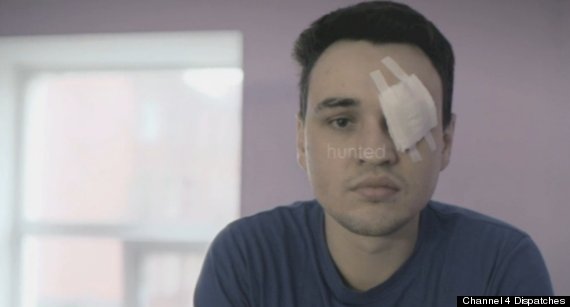
    If you do nothing else this Wednesday, sit yourself down in front of Channel 4’s Dispatches documentary “Hunted”.

    CREDIT: Channel 4
    CREDIT: Channel 4

    This deeply disturbing programme, directed by Ben Steele and reported by Liz MacKean, shows us a bleak picture of a Russia, where gay people are literally hunted down like animals, subjected to humiliating and painful abuse.

    Though homosexuality has been legal in Russia for twenty years, it has never been accepted. The recent Russian law banning propaganda of non-traditional sexual attitudes to minors, has only served to make worse anti-gay feeling, which is so deeply entrenched in Russian society, it is hard to know how to challenge it. Strengthened by the views of the powerful Russian Orthodox Church and those in power, vigilante groups carry out their crimes in full view, knowing that the police will do nothing to intervene.

    This brilliant film offers no easy solutions, but in talking to the leaders of these groups it exposes the problem at the very heart of Russia, “ the worst place to be gay in Europe”, where homophobia is normal and a contrary view, even if you are straight, is likely to get you in trouble.

    Not to be missed, “Hunted” airs at 10pm on Channel 4.

    http://www.channel4.com/programmes/dispatches/videos/all/hunted

  • FILM REVIEW | Free Fall / Freier Fall

    Free Fall (or Freier Fall, to give it its German title) is an award-winning drama from director Stephen Lacant. It has been branded a sort of German Brokeback Mountain, and indeed there are parallels between the two movies, but in some ways Free Fall is more gritty, more rooted in the present day.

    Marc would seem to have his life sorted out. He’s doing well in the police force, his girlfriend is having a baby, and they have just moved into a house, next door to Marc’s parents. He is happy (or he thinks he is) and everything is going well for him. He meets Kay at a training camp and the two men become attracted to each other. Though Marc tries hard to fight his feelings, he later starts a relationship with Kay and subsequently finds his life spiralling out of control.

    I suppose the basic storyline has a certain resemblance to Brokeback Mountain, but there the similarities end. Whereas in Brokeback much of the romance is played out against the magnificent scenery of Wyoming, this relationship is much more claustrophobic, harder to hide as so much of their life is in plain view; not much chance for the men to get away from their colleagues and Marc’s family.

    Ultimately the movie is not just about Marc’s coming to terms with his homosexuality, it is more about whether he will allow himself the freedom to walk away from the life that has been set out for him by his parents, his colleagues and his girlfriend. Marc finds it impossible to choose between Bettina and Kay because he can’t decide between the two lives they represent, between comfortable domesticity on the one hand, and freedom, with all the danger and unpredictability that suggests, on the other.

    Ultimately that choice is made for him, and though we do not know how life will pan out for Marc, there is a suggestion that he will eventually break free.

    With superb performances from the two central actors,Hanno Koffler as Marc and Max Riemelt as Kay, not to mention Katharina Schuttler as Marc’s girlfriend Bettina, it is an engaging and involving movie beautifully filmed and subtly played out. Lacant directs with a sure hand which is honest and true.


  • THEATRE REVIEW | The Gay Naked Play, Above The Stag

    ★★★ | The Gay Naked Play, Above The Stag

    Dan (Alexander Hulme) is director of the Integrity Players, a small off off Broadway group of players dedicated to “great art”. The company also consists of his loving (and very pregnant) wife Amanda (Stacy Sobieski) and their friend and leading actor Harold (Lucas Livesey). They have lofty ambitions and a staunch refusal to compromise , but they have one problem. Tiny audiences. And when their sole and major backer, who just happens to be Amanda’s Machiavellian mother Imelda (Ellen Verenieks) withdraws her support, they have an even greater problem. No money. What are they going to do?

    Enter Eddie Rossini (Christopher Woodley) and his two cronies, T.Scott (Robert Hannouch) and Edonis (Toby Joyce). Eddie proposes a trashy homoerotic stage version of Mel Gibson’s “The Passion of Christ” starring porn star Kit Swagger (Matthew Ferdenzi). It’s a sure fire commercial hit, but will the Integrity Players give in to financial pressure and in so doing lose their integrity? I’m not going to give the game away, but I think we can all guess the answer to that one.

    Adam Bell’s play is a witty and often hilarious comment on the eternal conundrum of artistic compromise; popularity versus art. The writing itself is often really clever, abounding in quips and one-liners that wouldn’t have been out of place in an episode of “Will and Grace”.

    My problem was more with the execution. Director Andrew Beckett has allowed too much of the play to be played on one level, with actors shamelessly mugging and playing too many of their lines out front. The often hilarious antics of T.Scott and Edonis would have benefited from a greater contrast with their boss, Rossini, but he too was encouraged to overplay much of the comedy, which resulted in a lack of contrast. Surely underplaying the role would have made it even funnier. It’s a shame, because the play is a lot of fun, and I feel sure that this cast had it in them to deliver a much more multi-faceted performance.

    That said, the audience on opening night enjoyed themselves enormously, and nobody was complaining about Matthew Ferdenzi getting his kit off more than once. Maybe it will settle down a bit in the next few performances.

    The Gay Naked Play is on at Above The Stags until 16th Feb 2014