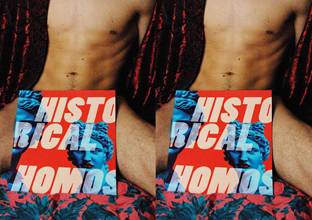
Historical Homos, a London-based Instagram blog and publication dedicated to celebrating LGBTQ+ history, has one simple mission: to “Make History Gay Again”.

Developed by Sebastian and Lucy Hendra, a brother-sister creative team based between NYC and London, Historical Homos aims to make the legacy of history’s greatest LGBTQ+ figures more visible in popular culture.
Sebastian, a writer and amateur historian, and Lucy, a graphic designer, started Historical Homos in 2017 when they noticed a lack of awareness among their generation about significant LGBT figures of the past: “It’s weird. We have this vibrant community, known for its camp and creativity; and then there’s all this history. But there’s nothing connecting them. There’s very little LGBTQ+ history that speaks our language.”
“Our audience is the RuPaul generation”, they say, “the scores of people – gay, straight, bi, queer, questioning – who have grown up with LGBTQ+ subcultures and who want to participate in them.”
Lucy’s artwork is plastered in bold graphics and pop-art collage, while Sebastian’s acid pen delivers tell-all stories about the lives and contributions of history’s great ‘YesterQueers,’ from popes and monarchs to writers, artists, scientists, and adventurers – all with an eye to the parallels, echoes, and inevitable clashes with our contemporary culture.

Drawing on the work of academics in various Queer Studies disciplines, Historical Homos aims to promote a global picture of the LGBTQ+ community’s past and their often starring roles in human civilisation.
They cast a wide net through time and space to connect the disparate strands of this rich heritage, threading together hundreds of remarkable names – some famous, some unexpected, some forgotten – through detailed research, engaging wit, and vibrant illustration.
“It’s a bit like Horrible Histories, but for grownups. And gayer.”
Historical Homos began as an Instagram blog, where it has grown a loyal following of 8K+ followers. In London, where Sebastian and Lucy currently live, they also host live events, from pop-up galleries to (self-described) “sloppier” Halloween parties.
The pair say,
“Our followers like us because we help them see a legacy that is written out of textbooks, legislated out of schools, and generally forgotten (or purposely avoided) in most heteronormative narratives of history. But queers have been around forever.
“Everyone knows that. We’ve just got to make more noise about it.”
In November 2018, the pair self-published an initial volume, Historical Homos Volume One, which offers readers 7 humorous profiles of famous LGBTQ+ figures, richly illustrated in a 70-page, high-gloss book. This first book covers well-known names — like Emperor Hadrian of Rome and Virginia Woolf — as well as lesser-known gems like the Chevalier D’Éon, a cross-dressing, genderqueer French spy from the 18th century.
HH Vol One is meant to serve as a teaser of a more ambitious series to come, which will cover the history of the world through the eyes of its most compelling Historical Homos. The 10-part series will begin development in February 2019 with the launch of a crowdfunding campaign on Kickstarter.
With HH Vol One, Sebastian and Lucy wish to create a physical, engaging reminder that the narrative of queer history extends back to the earliest days of human history, from ancient Rome and 17th century Sweden to Weimar Berlin and Stonewall-era New York. They hope to dispel the all-too-common perception, frequently perpetuated in more academic treatments of the subject, that the histories of homosexuality and queer identities begin with the invention of the term “homosexuality” in the 19th century.
“Queer lives — valid, queer lives — have always existed in history, from Hadrian’s Wall to Stonewall,” they say. “Nobody gets to tell us different.”
That said, the pair acknowledges their debt to the work of academics in the field: “We get to celebrate everyone in queer history, from the Ice Age to the 21st century, precisely because we’re not encumbered by the need to conform to academic trends and theories. But we couldn’t produce anything without the libraries of research out there that have uncovered such rich histories.”
The next volume in the Historical Homos series will cover queers at the dawn of civilisation, ‘from Paleo-Poofs and Neolithic-Nancies down to the considerably more Homophobic Hebrews.’
It will be published in November 2019.
