Category: Motoring

  • CAR REVIEW | Tipo MultiJet 120hp Lounge

    ★★★★ | Tipo MultiJet 120hp Lounge

    Finally, Fiat is coming back. The recent launch of the brilliant 124 Spider set the wheels in motion and now we have the Tipo. Admittedly it is a name from the past of a car that did great things for the Italian maker. Above all, though it is NOT a new form of 500.

    Tipo MultiJet 120hp Lounge

    I liked the original Tipo. It looked like nothing else out there. Square and boxy like the box it arrived in. It had some funk too with the top of the range models starting the digital dashboard era of displays that have now become commonplace. Above all, it didn’t fall apart.

    This is the trouble when you resurrect an old name. Some will remember the past product for reasons good or bad. I remember it for the good so naturally, I got excited about the arrival of the new Tipo.

    Visually it doesn’t fail to impress. Front on it looks rather nice. It’s not like the white elephant in the room of the original which some will say is good. The rear, however, does look a little like most hatchbacks out there.

    Since Tipo 88 (Car of the Year 1989, it was that good) Fiat haven’t really been able to keep up in this fierce segment. Bravo/Brava missed the boat by miles and the Stilo, while it looked good at the front, had a fat backside and wasn’t very good. So I am glad to say that on first acquaintance with new Tipo I am a happy chap. There was a time when Tipo 88 could match the build of Volkswagens Golf Mk3. New Tipo can now hold its head up high once again.

    Fiat has rightly or wrongly not aimed Tipo at the Golf driver. There lays the huge problem most manufacturers have come across. Your product needs to be bloody good to entice the Golf driver away. Instead, they have gone for the more lower-priced market segment. With prices ranging from £12,995 to £18,995 Fiat have priced it very competitively.

    The one thing you will notice is how well it is painted. The boot is large and missing a cargo net so I was forced to place some shopping under the boot carpet. It was here that I noticed that Fiat had painted the bits you don’t see or care about. Even the paint around the boot shut area was smooth and glossy. A lot of manufacturers these days tend to miss these areas. To be honest you probably won’t even notice it. To me, it is these little touches that show Fiat are trying hard to win back some of the market it lost. Even the engine bay is painted well.

    I’ve started doing a centre console rub. You’ll be amazed at how well or not this area is put together by manufacturers. The jigsaw pieces used on Tipo were well fitted together. No harsh edges to be felt.

    It has nothing special on it as far as the lighting goes. No expensive HID bulbs or swivelling headlights. Instead, the engineers have relied on making them good in the first place. Driving down country lanes where l live, the Tipo makes easy work of lighting my way.

    A good driving position was easy to obtain with multi adjustments within the seat and steering wheel that cater for rake and reach. What wasn’t so successful was the centre armrest. It fouled the operation of the handbrake. Something that blighted Tipo 88 so it was nice to see another consistency of old meets new.

    The Tipo was easy to live with too. Again nothing special or outlandish like a one-touch keyless entry or starting buttons. A simple key with remote buttons did the trick. A little touch l did like was the angle of the ignition keys entry. More 45 degrees instead of the usual 90. It doesn’t sound much, however, there was no scrabbling to find the key hole.

    It’s these egonomics that really are hit and miss around Tipo. The front window switches on the driver door had the front window switches too far forward. Numerous occasions I kept opening the rear windows. This is something l am sure will annoy those in the spacious rear. Like Tipo 88, new Tipo also has better rear passenger space than you would think.

    One other thing that infuriated me more than anything was the preselected text reply messages. There was no way to by-pass them and she liked to say everything and tell you everything. The software is out there to better this. For the convenience that it offered it was a little too distracting.

    The saving grace of the infotainment system was its ease of use. The DAB pick up was good and station selection impeccable.

    The 120bhp Multijet diesel engine was a strong puller. 320 Nm of torque available at 1750rpm made rapid progress through the gearbox. The useable power band mostly used was within 1750 to 4000rpm. By 3750rpm all the horses had done their bit. One downside to the engine when standing outside and scrapping the ice off the screen was that it seemed a little too clattery from cold. From inside you could be hard pushed to notice it.

    Italian cars are famed for their handling. Tipo 88 spanned the seductively fast Sedicivalvole. The chassis could handle this. In new Tipo, it needs a tweak or two from Abarth. As it is in the 120hp Lounge model it is more than adequate but not the best. A combination of subtle spring choices has taken the edge away from that foot down powerhouse hot hatch feel. It’s a move I am seeing more off as manufacturers revert away from the Teutonic tautness of the Germans and about time too

    I like Tipo. It’s not perfect in every area. It is easy to live with and on the eye, it does have good looks with crisp lines that aren’t fussy. Inside is accommodating and it has a good strong well built feel to it. Something Fiat haven’t had for a long time. With that in mind, the Tipo didn’t fail to impress me over the week I had it.


    Likes

    Build quality particularly attention to detail
    Price
    Big boot

    Loathes

    Engine clattery when cold
    Armrest fouling handbrake operation
    Preset mobile phone reply messages

    The Lowdown
    Car – Fiat Tipo MultiJet 120hp Lounge
    Price – £18,545 (as tested)
    MPG – 76.3mpg (combined)
    Power – bhp 120 @ 3750rpm
    0-62mph – 9.8 seconds
    Top Speed – 124 mph
    Co2 – 98 (g/km)

  • CAR REVIEW | Lexus NX h Sport

    There was much excitement at THEGAYUK headquarters with the arrival of the new Lexus NX. A car I had been looking forward to reviewing ever since I had a play in the bigger RX.

    CREDIT: Lexus

    The adverts interspersed in between my favourite Channel 4 drama, Humans further heightened thus feeling. Sadly like a domestic synth, it left me feeling a little cold.

    Dynamically it is a marvel. A true powerhouse of an SUV this time living up to the Sport in the title. You can hustle it along the road and it will reward you with as much grip as you could wish for in an SUV while also remaining poised and neutral. Unlike the bigger RX, the NX doesn’t lean into corners. Sitting high up it also didn’t throw you off your senses. I was sure all SUV’s should be like this or so I thought.

    The steering was nicely weighted. When overriding the CVT gearbox with manual inputs the gear changes were smooth. Only when pressed hard, the CVT gearbox would show its one true weakness inherent in these systems and that was high revs, a lot of noise and a sense of not a lot happening propulsion-wise. That said, most of the time the intrusion was minimal because it got to where you needed it to very quickly.

    Speaking of quickly it belies its 0-60 time of 9.2 seconds. Pulling out in traffic it could be frighteningly rapid with wheel spin curtailed by the traction control system. The accelerator pedal did exactly what you wanted it to.

    However, there are faults aplenty in this £34,000 machine. For a start, the spec sheet looks a little lame compared to the bigger RX model and others within this SUV segment.

    There were no parking sensors fitted.

    CREDIT: Lexus

    For something so big, so premium and with many gadgets, the lack of these is a fundamental flaw. Having them as an added accessory for £800 was a bit of an insult.

    That said, they are well worth it, if a little expensive. The front and rear extremities are very difficult to judge. While you should be able to park a car you own, the sensors do make it a touch easier. The reverse camera helps but it doesn’t show where the bulbous curves of the rear wheel arches are in the dark.

    It was delivered to me with just 40 miles on the clock. It was at 70 miles old that I almost added the first dent while reversing into my drive!

    There is also the absence of the Lexus touch and that is the retracting steering wheel. Many Lexus models I have tried over the years have had this. It is a bit gimmicky I know but I look at it as a Lexus signature piece. It’s a bit like the electric windows that slow just moments before they shut to reduce noise.

    These add up to make a Lexus more than a dressed up Toyota.

    Living with the NX is a bit hit and miss too. The boot is a good size. Very easy to load things into and all the space is available. However, the rear door doesn’t rise high enough for me. That was the miss. Or not as it proved when I clonked my head against it.

    The hit is that it is quite a vehicle. Over its RX sibling, the NX can be hustled around with great ease. The road manners retain a squat feel when hard cornering or taking S bends at rapid speed. It shouldn’t really feel like it should behave in this kind of way.

    CREDIT: Lexus

    Four up and in a hurry, no one said slow down. The only thing that lets it down when going fast is that CVT gearbox. It doesn’t really make the best of the engine’s torque. Revs stay high up at and the engine screams. It doesn’t pay to keep your foot planted into the carpet if it isn’t necessary. The engine is too vocal without sounding sexy. The V6 of the RX is far better.

    Again this gearbox system, that I am not a real fan of, ruins the fine ambience of luxury. Thankfully you can override the gearing and I found selecting 4th, 5th and 6th gear made it far more pleasurable to the ears while not leaving it vulnerable when pulling out in city traffic and rush hour madness to getting in the way of other traffic.

    The hybrid system on the NX is in keeping with the Lexus brand and used as a supplementary system only using it for brief periods or in slow traffic. Most of the time it goes into petrol mode. This didn’t really damage the impressive fuel figures Lexus state or what were achievable in the real world.

    The fit and finish in the NX are above and beyond what you would expect. It was all nicely wrapped up and made to make you feel like you have spent your money wisely. I just can’t get over the missing pieces in the spec sheet.

    It all adds up to an expensive car. As a proposition, I have to say that for the money the more expensive Audi Q7 is far better value even without the bonus of a hybrid system. It has more kit on it. And at £17000 less than the Lexus RX450h I tested.

    I am inclined to say beg steal or borrow the extra and buy the RX. And then there is Toyota’s C-HR that is some £5k cheaper. Now that is a strong contender to consider even if it is in a class lower. It’s where I would be looking.

    Love
    Finish
    Comfort
    Ergonomics

    Loathe
    Cost
    CVT gearbox
    Lack of equipment

    The Lowdown
    Car – Lexus NX300 h Sport
    Price – £34,640 (as tested)
    MPG – 54.3mpg (combined)
    Power – 115bhp @ 5700rpm petrol (bhp 197 for electric motors)
    0-62mph – 9.2 seconds
    Top Speed – 112 mph
    Co2 – 121(g/km)

  • Vandals Write-off Yellow Car ‘For Blighting Picturesque Village’

    Do you remember the banana coloured car that villagers said was ruining one of Britian’s prettiest villages… well it’s been destroyed.

    A pensioner’s bright yellow car blamed for ruining the view in one of Britain’s most picturesque villages has been written off by a vandal who has scratched ‘MOVE’ on it.

    Peter Maddox, 84, parks his banana-coloured Vauxhall Corsa outside his Cotswolds cottage in 14th century Arlington Row, which is owned by the National Trust.

    The chocolate box houses are the oldest inhabited properties in the UK and appear on the inside cover of millions of passports.

    But a row erupted in 2015 when visitors complained that Peter’s “ugly” car was wrecking the classic English scene in Bibury, Glos.

    The retired dentist insisted he had nowhere else to park and continued leaving his car on the road – until it was vandalised last week.

    A yob scratched the word “MOVE FREDDIE” onto the bonnet, scratched every other panel and smashed the driver’s side window and rear windscreen.

    Mechanics have told Peter it will cost £6,000 to repair with a full respray, making the car a probable write-off.

    But defiant Peter has said if that was the case he would buy a replacement – with a lime green colour.

    Daughter-in-law Marie Kraus said,

    “Peter is understandably upset at the loss of his car and his independence, but he is also very fond of his lovely yellow car.

    “Everyone in the village is very supportive. It is horrible to think whoever has done this has come out of their way down this little road to do something like this.

    “It will be a struggle to get another car. It will leave Peter out of pocket.”

    Peter moved to Bibury after his wife died 15 years ago and bought his car three years ago.

    In 2015 he attracted attention when photographers took to Twitter to complain about the Area of Outstanding Natural Beauty being ruined by the “ugly, yellow car“.

    Villagers are supporting Peter and calling the crime “disgusting”.

    Some have suggested there is “a financial aspect to the crime” and pointed the finger at a photographer who sells pictures of the village.

    Postmaster Richard William, 48, said,

    “We are all shocked and horrified that such mindless destruction should be visited upon a normally quiet and tranquil village.

    “A lot of people make money out of photographing Arlington Row. I should think there is a financial aspect to the crime.

    “I think it is related to the exposure it received on the internet and the objection to it parking in front of Arlington Row.”

    Ian Howard, owner of The William Morris Tea Room, said the culprits were “nasty vandals” with “small brains”.

    He added: “Peter has not done anyone any harm.”

    Rose Francome-Robinson, 73, also of Arlington Row, described the crime as “disgusting” and “malicious”.

    She said: “I didn’t hear anything, I saw the glass at the parking spot and the car had gone.”

    Police have valued the damage at £6,000 and believe the crime happened between 4pm on Sunday 22 and 7.40am on Monday 23.

    Sergeant Garrett Gloyne said,

    “We have conducted house to house inquiries. We are aware that presence of the vehicle was the bone of contention to some people.

    “Nevertheless the damage caused to vehicle is beyond the pale and we would appeal for anyone who knows anything to contact us.”

  • COMMENT | So what is the best car in the world?

    When asked “What is the greatest car ever produced?” there is only one country that can make such a car. It comes from a company that is not shy of failures. Maybe without these they wouldn’t have been so good when it came to the things that worked well?

    By Tony Harrison – originally posted to Flickr as Lancia Delta Integrale Evo 2 IMG_9403, CC BY-SA 2.0, https://commons.wikimedia.org/w/index.php?curid=4811977

    Without this companies motoring passion we would never have had some great ideas that just needed a little more investing. They were engineers. They are also one of the greatest shames of motoring of the twentieth century. I knew at a young age the nation was good at everything automotive. In primary school we had to pick a country and present it in assembly. l choose this country purely because of its cars and one manufacture in particular. It’s in Italy that we find the greatest car ever to have been produced.

    Embed from Getty Images

    The Lancia Delta is an utterly amazing car. The humble beginnings of the Delta are nothing special yet the illustrious history and development of the Delta should in reality make it a brand name like Mini, Beetle and 500. Launched in 1979, the Giugiaro designed body was crisp and clean. It had minimal fussing along the flanks that were a signature mark of Giugiaro’s Ital design studio. It was a sharp dressed car. A 5 door hatchback with sophisticated style.

    The Delta followed a typical tradition for Italian car manufacturers of the 70’s and 80’s. On its launch it was a very important car that people hoped would carry the Lancia brand into the future following the disastrous recall of the Beta from epic rust around the subframe. To help in the costs and using a proven platform from new owners Fiat, it was based on the Fiat Strada though it shared very little with it. Even the Fiat based engines had Lancia developments in them and it used MacPherson struts all round instead of the single rear leaf spring of the Strada. The Delta won the coveted prize of Car of the year 1980.

    Embed from Getty Images

    The risk of Fiat taking control of Lancia was that their ideas would be shaken out of the company and it would end up as badge engineering of Fiat products in a way Peugeot had done with Citroën. This was not to be. Those ideas were still in full flow at Lancia as we will see. Saab on the other hand did have some input into the development of the Delta’s heating system and between 1980-82 it was sold as the Saab-Lancia 600 in the Nordic countries. Already then the Delta is proving to be a little bit different.

    Those engineers at Abarth that were all part of the Fiat group were quick to make their mark on the Delta with the 1983 launch of the Delta HF (High Fidelity) with a turbo. It wasn’t until 1985 that the turbo name was mentioned with the launch of the short lived Delta HF Turbo i.e. 1983 saw strange changes made to the humbler GT i.e with the cylinder head being spun 180 degrees and the exhaust now being at the front of the engine to aid cooling whilst also lowering the gravity of the unit.

    We mustn’t forget Lancia’s rally program that was continuing while the Delta was being fettled. While the little hatchback was being made in several guises it was their 037 rally champion based on the Beta Montecarlo that was being watched on the international circuit. A car that was loosing rapidly despite its sheer speed ability to the all conquering Audi Quattro.

    1985 was a good year for the Delta. Lancia had comeback with a double bang to the world rally championship with their Delta S4. A mid engined turbo and super charged road warrior with 4 wheel drive and almost 500 bhp from its 1800cc engine. The Delta shared nothing with the hatchback except for the name. Unlike the WRC offerings from Austin Rover, Peugeot and Audi, the Delta S4 didn’t even look like the Delta except for a hatchback type style body.

    The Delta S4 was a beautiful brute in WRC. In its 12 races it won 5 of them. It could have gone on to do better if it was one little problem that it had. The Delta came with fatalities. In group B rallying it was a weapon of the road. A 4 wheeled killer claiming the lives of 29 year old Henri Toivonen and co-driver Sergio Cresto. Ironically a year to the day that Attilio Bettega died at the wheel of a Lancia 037. The writing was on the wall for Group B and the Delta S4.

    http://gty.im/638416708

    1987 started as a quiet year for Lancia. Numb from the latest fatalities they entered the Delta HF 4WD in the new standard Group A WRC. Lancia were the best equipped for rallying at the time. Over the 13 races that year the Delta won 9 of them. Not a bad start to a new chapter in world rally dominance. 1988 was even better with 10 out of 11 races being won with a Delta. However something hot was just around the corner for 1988. The Delta Integrale 8v saw Lancia engineers perform magic. The Delta HF 4WD had its fair share of problems and to combat these the Integrale sported bulging wheel arches allowing for bigger wheels and brakes to be used thus making the car even better on tarmac. As a road car it was only available in left hand drive form and would remain so until its demise.

    The Delta was once again an unstoppable force and dominated the WRC until it started to see challenges from Toyota and Mitsubishi. So the engineers upped their game and launched the Delta Integrale 16v. To mark the occasion it was painted red with Martini stripes. By the second to last rally, Lancia had every award and trophy going so decided to party into 1990 by not partaking the last race of 89. However 1989 was not without a fatality for Lancia. Though not connected with the Lancia Martini team, the Delta cost the lives of Lars-Erik Torph and Bertil-Rune Rehnfeldt when Alex Fiorio lost control of his Delta at 90mph and ended up down an embankment.

    Between 1990 and 92 the Delta continued to be a dominating force but the writing was on the wall despite half the rallies won by a Lancia and again Lancia collecting a lot of trophies for their bulging cabinets. 1993 saw the Delta, no longer in Martini colours, take not one victory. A sad end to a car that gave 46 rally wins to Lancia in a just a few years.

    The Delta Integrale continued as a left hand drive only road going car for another 6 years until its total demise in 1999. This was some 5 years after the original Delta hatchback had ended production. After 13 years in production, 1993 saw a new Delta being produced on the Fiat Tipo platform. You could be forgiven for thinking that you have never seen a new Delta before because in 1992 Lancia pulled out of the UK market. A day l remember well.

    And so in 1999 the Delta story ended. It restarted in again in 2008 to 2014 when Lancia resurrected the name for the trilogy. These were then effectively badged as Chrysler Delta’s in the UK and I’ve not really got a good word to say about them. They cannot be unseen once you have seen them.

    http://gty.im/638418868

    And so the Delta story finally ends. From a little car with a big job on its hands to an all conquering race winner, the humble Delta became the greatest car of all time. At one stage you could get a Delta with a 1300cc or 2000cc engine and fuelled by petrol or diesel. Power outputs ranged from 75bhp to 500bhp. From 1983 to 1990 you could also get it in a 4 door saloon style called the Prisma. It offered 5 seat comfort and hatchback practicalities while also offering super car performance. Name me another car that can match those credentials?

    There are many who still hold a passion for Lancia. Davide Cironi from Drive Experience on youtube who is one such man. Check out his homage to the Delta in over 16 minuets of pure glory below (also check out his other videos. The Lancia Theme 8.32 in particular).

    Fiat boss Gianni Agnelli commissioned a one off 2 door convertible Delta Integrale for himself. You could take it into a multi-storey carpark, load it up with flat pack furniture and annihilate almost anything at the traffic light grand prix. Now I’d like to see you try and do that with your Lamborghini Gallardo!

    The Lancia Delta. The best car in the world!

  • COLUMN | Okay, basically I want a VW Beetle

    COLUMN | Okay, basically I want a VW Beetle

    Everywhere around Bird towers, you will spot something relating to Volkswagen.

    More-so relating to the old school ways of the Beetle and bus. Most things during my school days related to the little VW even down to my GCSE art project. Outside of school I could always be found with my head in a VW book or making models of Beetles. I even made a radio controlled Beetle similar to the one Barbra Streisand was in from the film What’s Up Doc? I suppose it isn’t surprising then that there is a 70’s camper van in the garage and a Mk2 Golf on the driveway.

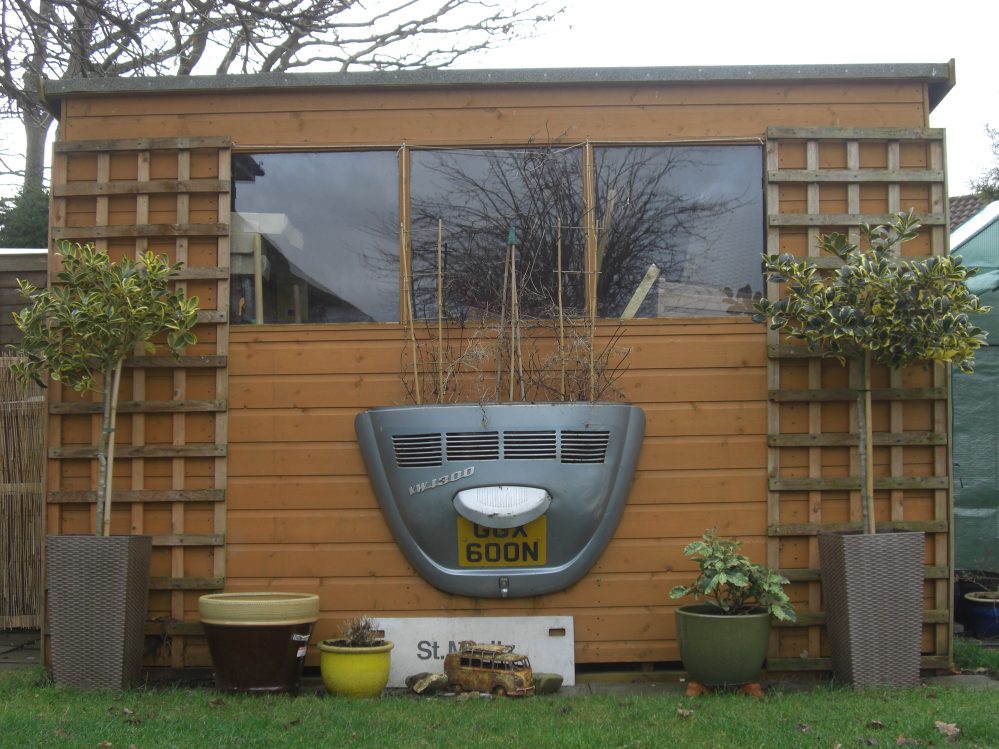
    Indoors, I am strict and have nothing car related in the lounge or my bedroom. A petrol head needs a place or two to get away from the motor vehicle. That said, the man lab has plenty of Beetle based memorabilia on the shelves and there is even an engine deck lid stuck to the shed disguising the pots my creepers grow from. There is also a Beetle bonnet behind the garage that I’ll make into something for the garden.

    So it might come as a surprise to you that I find the Beetle an absolutely awful car.

    Anyone who has owned one will be getting ready to scratch my eyes out with that above statement but I stand by it. Anyone who has just driven one may actually agree with me. They are an acquired taste and are like nothing else out there, from way back in 1948 to the day in 1978 when it was discontinued in Europe, although the convertible did continue until 1980.

    The driving position was cramped. The doors were just millimetres from your elbows. The pedals mounted from the floor giving an unusual feel. The extremities of the vehicle were impossible to see and there were no parking sensors in the 70s. The steering wheel almost horizontal and there wasn’t really any kind of dashboard until the arrival of the 1303 with its panoramic windscreen. Come to think of it the passenger compartment was cramped.

    One thing I will say is that the heating was good. It’s a complicated system full of levers by the handbrake and relies on engine speed. Badly maintained it is also prone to haemorrhaging vital air reducing the output to the breath of half a dozen kittens. Citroën’s 2CV wasn’t this bad and that relied on little heat exchangers and two cylinders.

    Considering its overall length of over 13 ft, it also lacked luggage space of anything reasonable. The bulletproof engine took up the boot area leaving the front compartment under the bonnet to resemble what should have been a spacious area for luggage. Though it was essential in propelling the Beetle forward, the fuel tank sat in the boot area along with the spare wheel. It left you with 4.9 cu.ft of space. despite it not being the easiest car to clamber into, there was some extra space behind the rear seat. The rear seat did fold down but it never turned it into an estate.

    The ride could best be described as entertaining and bouncy made even worse when lowered. The 1302 and 1303 models with McPherson struts was better. The swing axle rear end was lively.

    After the second world war, AC cars, Ford and Rootes group performed a vehicle analysis on the Beetle. None found the Beetle particularly good. It’s interesting that Baron William Rootes of the Rootes Group who owned Humber taking a dislike to the vehicle. During their testing using a Mk2 Hillman Mink, Rootes were quite keen to penalise the Beetle for the smallest indifferences. Ironic then that the flawed Beetle would go on to become a market leader, world conqueror and champion of the people’s car while his company failed and in 1979 was bought by Peugeot.

    Looking at two group tests from 1968 and 1976 one thing remains: the Beetle. In ’68 the Beetle was pitted against the Austin 1100, Ford Escort and Vauxhall Viva. In ’76 it was relegated to the cheap end of motoring with the Citroën Dyane, Honda Civic and Reliant Kitten. The Beetle was consistent in two areas. It was expensive. It was well made. It was also not the best in many areas where others were doing it so much better. FYI in ’76, the Beetle was more expensive than the better packaged VW Polo.

    Today the Beetle is still regarded by many as a wonderful car. I’m sure in some ways Disney are responsible for a generation who love the little bug. It’s true that after the first feature film, sales grew in the US.

    The Beetle had its heydey in the UK in the 80s when the Cal-look became popular. It continued to grow into the 90s. The scene for the Beetle shows no signs of slowing down. It’s true that the club scene has changed over the last 10 years. The bus that could once be bought really cheaply took over but looking around, there is a resurgence for the Beetle once-more. Probably in some part due to the bus being so expensive and the Beetle being so cheap. The trend at the moment does look set to change. The bus will never be cheap and the Beetle isn’t looking that cheap now either.

    Here then is my dilemma. Despite its flawed ways I still want one. I almost bought one 3 years ago. I want to make a Herbie replica and the one I found was perfect. I just wasn’t the highest drunken bidder on a Saturday night.

    And why do I want one? There hasn’t been a car made since the Beetle that has so much character. The sound of that engine talks to you. You can’t help to smile when you see one. It’s classless, that can cause great envy. A vehicle designed to move people from A to B and yet it moves them in other ways too.

    Watch this space.


    Opinions expressed in this article may not reflect those of THEGAYUK, its management or editorial teams. If you’d like to comment or write a comment, opinion or blog piece, please click here.

  • Motorists are being baffled by clashing speed limits

    Motorists have been left baffled after council workers painted two conflicting speed restrictions on the same road.

    CREDIT: SWNS
    • New restrictions are limiting speed limits to 20 mph across Edinburgh.

    • Around 80 per cent of Edinburgh’s road will have a limit of 20 mph.

    • Motorists caught speeding could be fined £100 and three penalty points.

    A controversial city-wide 20mph limit is set to be introduced across Edinburgh this year and some streets are already being painted with the new restriction.

    But on one road in Edinburgh, this has led to confusion with one side of the road saying the limit is 20mph and the other saying it is 30mph.

    Motorists have expressed their confusion on social media with one calling the situation “hilarious”.

    But council bosses have sought to reassure bemused drivers with the new limit set to come into force across much of the city a month from today on February 28.

    Similar signs have been spotted at the Leith Walk end of London Road.

    Accompanying the painted warnings will be traditional speed limit signs at the side of the road.

    The painted notifications of speed limits are part of a pioneering scheme to introduce 20mph limits across 80 per cent of Edinburgh’s roads.

    The initiative was rolled out in the city centre and rural west of Edinburgh last August to a groundswell of initial opposition – with a 2700 signature petition to get the decision reversed.

    CREDIT: SWNS

    AA spokesman Ian Crowder welcomed 20mph zones but only where “appropriate” – such as roads with schools.

    He said,

    “Most collisions occur in these types of streets and there’s a significant difference between hitting someone at 20mph, when there’s a good chance they’ll survive, and 30mph where there’s a good chance they’ll be killed.”

    But blanket 20mph zones across cities could be “counter-productive”, warns the motoring association.

    Mr Crowder added,

    “I would caution against putting 20mph limits across every street without good reason.
    “Drivers can become irritated by it. The majority of people respect 30mph limits but 20mph is quite slow and people can start to ignore them.”

    But subsequent city-wide consultations reported positive feedback – amid some remaining concerns around increased congestion, road safety and longer journey times.

    The scheme is the first of its kind in Scotland and is expected to be fully rolled-out by next January with £100 fines and three penalty points for drivers caught speeding.

    Key arterial routes are among the few that will retain 30 and 40mph limits.

    Bosses at Lothian Buses have previously warned the new limits could lead to higher fares and poorer services.

    A council spokesman explained the signs with the 30mph limit were for vehicles exiting onto the nearby Portobello Road while the 20mph is for those driving onto the residential street of Craigentinny Crescent.

    He said,

    “The 30mph road marking signifies the speed limit on Portobello Road on to which drivers exit.
    “This will be reinforced by an adjacent road sign signalling the end of the 20mph zone, which will be erected before the 20mph limit comes into force in this area on February 28.
    “The 20mph road marking refers to the 20mph speed limit on Craigentinny Crescent.”

  • CLASSIC CAR | Alfasud 1.3

    All good things come from the ‘South’

    (C) STUART M BIRD

    Bruno Tonioli isn’t the only quick stepping rapid rumba dancer to come from Italy. In 1972 a motoring equivalent named the Alfasud was unleashed to the motoring world.

    I have more than a soft spot for the Alfasud. If I am ever asked what car would be top in my fantasy garage of 5, an Alfasud is there. My second car was an Alfasud Ti. It was a three-month love affair that financially ruined a then 17-year-old Stuart.

    Alfa Romeo needed a small car that would entice young people into the marque of Alfa Romeo. In 1967 a Viennese designer named Rudolf Hruska was entrusted with the task of turning the dream into reality. The premise was to design, develop and instigate the building process of a small car that would then hopefully get those new customers to buy other Alfa Romeos and so on.

    There were three main prototypes presented. The first before Rudolf had joined only made it to the drawing stage. The second called the Tipo 103 was deemed too expensive to produce. This was a front wheel drive with a 900cc 4 cylinder twin cam engine in a three-box four-door saloon style body. The third incarnation was the Alfasud as we know it today.

    (C) STUART M BIRD

    Thankfully for Rudolf Hruska, Alfa Romeo had some unused facilities in a southern region of Italy in Pomigliano d’Arco. This is where the Sud or South in Italian comes into the name. The Alfasud is also the reason why ‘Milano’ was removed from the Alfa Romeo badge because now their cars were not only built in Milan.

    The Alfasud was a major departure for the Milanese company. For a start, it was to be front wheel drive. Secondly, it was to use a totally new engine in design. In some ways, it did have twin cams but that isn’t totally true. The 4 cylinder boxer engine had one cam per two cylinders so was still classed as a single cam. I still like to think of it as a twin cam. Having worked previously for Porsche and Volkswagen it was no surprise that Rudolf would opt for a flat four designed engine. The layout allowed for a low centre of gravity and a low bonnet line. This really becomes evident when you drive one.

    The body design was entrusted to Giorgetto Giugiaro of Ital design. This forward-thinking designer designed some of the most iconic cars ever to grace the roads and some that he would rather forget about. In the presence of this man don’t ever mention the Morris Ital.

    In just five years the Pomigliano d’Arco factory was up and running giving much-needed employment to the southern inhabitants of Italy.

    Sadly it didn’t all go to plan and industrial problems with an inexperienced workforce meant the Alfasud never made it the success it could and should have been. Strikes and poor workmanship were two key areas of failure. But you’d not think about these when you think Alfasud. What comes to mind is rust. And rust they did, even in areas where you wouldn’t expect it to. These rusted within two years of building.

    Now forgetting that the Alfasud dissolved quicker than an Alka-seltzer, the car was a phenomenon.

    (C) STUART M BIRD

    Launched with a little single carburettor 1186cc engine, the 63bhp engine thrived like no other engine for revs. The raspy sound was intoxicating. And this intoxication quickly led to criticisms from the press for MORE power.

    The handling at the time was legendary and for about a decade after launch, it was still the car other manufacturers tried to emulate. Alfa Romeo was quick to silence the critics with spoilers, sports style wheels, quad headlights, a rev counter and 5-speed gearbox which were all added to a two-door body and the Ti was born.

    Then there were more problems. Supply and demand could not be met. This thwarted further development of the two-door shell being available in the lower spec models and the estate version ever making an impact outside of Italy. The much-needed hatchback-style body was delayed and finally arrived in 1981. However, the pretty ‘Sprint’ did make it, adding sporting sex appeal in a coupe style body with a hatchback boot.

    Still, people wanted, even MORE, power. The Alfasud would end its 12-year production run with a 1490cc engine, twin carburettors and 105bhp in the Ti Green Clover Leaf.

    The car used for this review belongs to Stefan. A lifelong fan of the Alfasud having had several over the years and a family who also had a love for the little Alfa Romeo. This is his 1982 series 3 1.3 SC with just 36,000 miles on the clock. Low mileage it might have but that hadn’t stopped the ravages of time taking hold. It has been subjected to a full body restoration prior to purchase. Since Stefan purchased the car he has nursed it through a full engine rebuild and sorting out the mechanical side of things while also removing the drama button from the dashboard. The car has had its problems. He says “Now not only does it look great, but runs just like the Alfasud should, smooth torquey flat four engine with that wonderful music to your ears raspy exhaust note.”

    Stefan entrusted me with the keys. It has been 24 years since I last drove an Alfasud. It all came back to me very quickly. The heater fan switch on the end of the column stalk is a stroke of genius. The narrow footwell not so. The peddles were still as close together as I remembered. The low-slung engine allows for a low bonnet line. Il had forgotten that. It’s quite startling at first.

    On the move, the steering was direct and nicely weighted. The assisted 4 disc brake system as powerful as ever. The inboard front discs allowing to eliminate unsprung weight during forceful braking. The ride and handling compromise still spot on in every way. The little 79bhp 1351cc engine was as fizzy as I remembered it with a rasp and pop from the exhaust that they became known for. It’s also smooth.

    I could enthuse about the Alfasud until you fall asleep and even when you do I can still prattle on about them. So I’ll finish with a thanks to Stefan for letting me have a play and reigniting a long lost love affair.


    With thanks to Gay classic car member Stefan for the loan of his car.

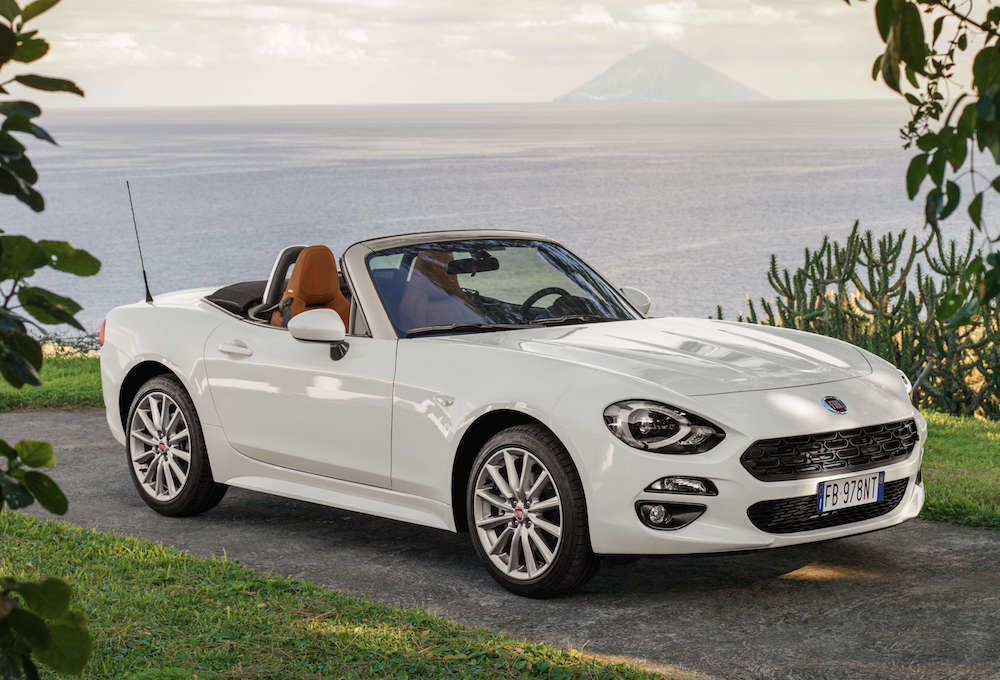
  • CAR REVIEW |  Fiat 124 Spider Lusso Plus 1.4 MultiAir Turbo

    CAR REVIEW | Fiat 124 Spider Lusso Plus 1.4 MultiAir Turbo

    ★★★★ | Fiat 124 Spider Lusso Plus 1.4 MultiAir Turbo

    On Days like these…

    Have you ever bought an album because of a car before? While I understand that he isn’t Italian, he is synonymous with an Anglo-Italian classic movie so having been given the new Fiat 124 Spider I had to get myself a Matt Monro album to go with it.

    Fiat 124 Spider Lusso review

    In a month that saw the shed leak, the garage leak, a roof tile fall off the house narrowly missing my Fiat Tempra and the trusty hatchback take in water quicker than the Titanic, I decided that testing the open-top Spider would be quite fitting. When faced with so much water and chaos what can possibly go wrong with a car that has a fabric roof? I’ll tell you, it snowed!

    Fiat were once makers of great small sports cars. The range was made up of humdrum saloons, estates and coupes topped off with a little something cheeky for the weekend. The last time Fiat tried this was with the Barchetta. It was cheeky alright, just let down by the use of the last generation of Punto chassis.

    Not so anymore with the new Spider. Underneath it is a Mazda MX-5. Now take that with a pinch of salt because the chassis was a joint development between Mazda and Fiat. While that doesn’t sound very exotic I can tell you that it translates into a beautiful chassis that never fails to satisfy.

    What Fiat have given you over the MX-5 is their own 1368cc multiair engine. It’s not as rapid as the MX-5 or as lustful in its revs. The MX-5 we tested last year would scream to 7000rpm, the Fiat is all done by 6000. Once wound up above 2700rpm, it will trounce the MX-5.

    In performance terms that translates into 140bhp at 5000rpm with 240Nm of grunt being delivered at 2250rpm. All this power and fun for over 40 miles to the gallon if you’re good. A little less if you are not. The paper spec to the actual driving feel doesn’t quite come out like that and this is probably not helped by the high gearing in all but first gear. The dashboard gauge will tell you to change up keeping it below 2000rpm. Totally pointless in almost every situation. Even crawling in traffic requires first because second is too high.

    The multiair has 2 modes. Gutless city poser below 2500rpm or manic mayhem over 3000rpm. You can drive it 2 ways, cruise and enjoy the views or allow it full range and have it try and kill you on wet roundabouts. I’ll accept that is a little bit of an exaggeration. It needs to be respected in some situations though you can have some naughty fun with it. The traction control kicking in more readily than in the MX-5. The level of adhesion even in the wet was good. The chassis allows for this however if you are too lead-footed, when the engine comes on tap at 3000rpm it will give you a wake-up call. Thankfully it doesn’t make you too nervous all of the time. A little release of adrenalin over a journey is quite rewarding.

    Get over this little annoyance and the Spider behaves in a civilised way. It’s not your all-out road rocket. The original never was and it’s nice to see this one isn’t either. It’ll take you places with wind-in-the-hair excitement and comfort. It’s a sports car at the end of the day, and not a lazy man car. The joy of a proper sports car is twirling the short throw gearstick back and forth. What it lacks in this department is a little rorty exhaust note.

    As with any car with a removable top, it is easy to fold down manually in seconds and there is almost no buffeting at any speed. I was still able to keep dry in what felt like a monsoon above 45mph. I looked a prat but what the hell. The heating and heated seats doing a fine job on a winter’s weekend in keeping me warm.

    It’s a win lose win situation with the Fiat 124 Spyder. Finally, it is a Fiat product that doesn’t look like a 500. It looks bloody lovely. Sadly the inside is Mazda. Thankfully it has that joint venture chassis so it handles like a dream.


    So only thing that lets the Spider down really is in how Mazda it is inside. The original had a dashboard screwed to the dashboard made of wood with some dials. You wouldn’t want to recreate that however making it look different would have been a bonus. Like the 3 facia dials. The digital one for temperature and fuel look out of place. It needs dials with needles. What it needs are more dials. Changing the dashboard really would make it feel such a different car. Again on the model I had, the tobacco leather strip runs short across the dashboard. For visual pleasure, it needs to run across the entire length.

    The other thing the Spider really needs is Fiat’s own infotainment system. Most certainly on the DAB radio. The one fitted is from Mazda and it is far too fussy and clumsy to select stations. The one I tried in the new Tipo was joyous because it simply worked so well.

    Style wise it is beautiful. Some have bemoaned the size of the overhangs. I like them. It is in keeping with the original lines. What Fiat have managed to do is finally tidy up the rear. Whatever they did to it back in the 60s and 70s always looked like a job your dad did in the shed. If anything they could have exaggerated the upper flicks of the rear wings a bit more. The front is a pleasure to look at. Somehow it also manages to look wider than the MX-5.

    To sum up the Spider over the MX-5 is easy. The Spider isn’t your all out sports car. It’s a touring car with the ability to go very quickly. What it needs is the option of the limited slip rear diff as fitted to the MX-5. If that was fitted it would sharpen an otherwise Bellissimo dressed package.

    If I had the money right now I’d be putting down a deposit for a Lusso Plus in magnetic bronze metallic with tobacco leather and adding historical alloy wheels. In the meantime, I’ll just play with the model I bought in my bed instead.

    Like
    Looks
    Comfort
    Performance

    Dislike
    Infotainment system
    Lack of an exhaust note
    Mazda interior

    The Lowdown
    Car – Fiat 124 Spider Lusso Plus 1.4 MultiAir Turbo
    Price – £23,295 (as tested)
    MPG – 44.6 (combined)
    Power – 140 bhp
    0-62mph – 7.5 seconds
    Top Speed – 134 mph

  • The Gay UK Motoring Hounours list of 2016

    What a year 2016 was. Over 30 new cars reviewed ranging from city cars, hatchbacks, pick-up trucks and big and small SUVs.

    In the last year I have enjoyed what I have been given, been dismayed at what I had been given, annoyed and elated all at the same time. Well sort of. Some cars annoyed me in their stupidity of things while some I was full of admiration for how they did things. Sometimes it was because they didn’t do things that made me enjoy them all the more.

    I have sat down and whittled it down to my top 3 of 2016. Let me know if you agree in the comments below.

    3) Nissan Navara NP300 Tekna


    Despite my local authority not liking the Navara as I was prevented from entering the dump with garden waste in it, I happened to love the Navara. Its sheer size and car like cabin made it a joy to be in. The fact that with its 360 degree camera made parking a breeze, it was really easy to live with. And you wouldn’t want to damage the Navara. It’s one ruddy handsome bastard.

    Admittedly I did find it a bit wayward in 2 wheel drive mode because I was always unladen. Inner rear wheel spin was always there in the wet. Put it into 4 wheel drive and its manners became impeccable.

    The interior was well thought out and well put together. The price was also enticing and possibly one of the many reasons as to why there are so many on the road. For wall that you get in the Tekna double cab package, it is so very cheap in price.

    On the road it was smoother than an empty pick-up should be. It was also surprisingly quick. Apart from some vocalised engine noise, overall it was never harsh even over poor roads and it was macho. All that was missing on the options list was a testosterone package to make the interior smell of sweat and hard graft. That might have just elevated it to second place.

    2) Peugeot 208 GTi Sport

    Second places goes to a car that did nothing to annoy me. The simple fact that I could pull away without my seatbelt on was refreshingly nice. I know that sounds quite bad and is illegal, but when you want to move the car off the drive way it was so simple to do. The 208 put YOU back in control of decision making. If you so wanted you could also start the engine with it in gear. None of this foot on clutch or brake pedal nonsense.

    What the 208 lacked in niceties and overall refinement it more than made up for it with its sheer brilliant chassis packaging and entertainment ability. A Peugeot this good as a road going go-kart has been a long time coming. The 206 and 207 lacked so much that l thought Peugeot had given up on making fun cars.

    The point and squirt ability of the car made it a hoot to drive fast. It would get a bit hair raising if you pushed it to within an inch of its incredible abilities with a touch of over steer though unlike its great ancestor, the 205, it was all so much more easy to control.

    Yes refinement over long journeys was an after thought in some ways. However if you want comfort in a GTi then don’t buy the Sport edition. And don’t buy it either if you want to carry people in the rear. Personally l don’t really care about rear leg room. I loved the 208.

    1) Jeep Renegade Trialhawk

    If I am honest I didn’t hold out much hope for the Jeep. In the past they had always been a bit hit and miss. Poor build quality and road going dynamics were sometimes in short supply. Enter Fiat who quickly changed that. The Renegade looked good, was well specced and throughly enjoyable.

    There were a few things I didn’t like. Well 2 if I am honest. It didn’t look good in red and the mud splatter on the rev counter still haunts me probably more because it looked like poop and reminded me too much of my day job.

    On the plus side the other little touches and attention to fine details were rewarding and pleasant. It was logical. It is big enough for what you need and yet small enough to make it easy to park. The long drive to Birmingham was a walk in the park and it handled a sudden lane change at speed like a sports car. Something I didn’t expect it to do.

    At first I thought it wasn’t cheap at £31,765 (then) however when compared to its Fiat 500x sibling at £25,935, that extra £6 grand doesn’t seem a lot for what you got. Go the other way and spend another £6000 and you get the Cherokee M Jet we also tested. Suddenly for what you get it all starts looking like really good value.

    And the fact that this has won “Best small 4×4” by 4×4 Magazine for two years in a row says it all. I wasn’t able to test its 4×4 ability but I won’t argue with 4×4 Magazines decision on this one. They know a few things about off roading.

    So there you have it, my top three of 2016. There were some that were close to coming into my top 3 but they just missed it. If I were allowed a 3.5 then l would award that to ‘Giggles” the Renault Twingo. I grinned from ear to ear like a Cheshire cat with that one. That was one car I was very sad to see go back.


  • CLASSIC CAR REVIEW | Volvo 265 GLE

    Volvo 265 GLE  | Luxury Load Lugger

    When someone says “think Volvo” there are many things that you think of. If you are mechanically minded you might think of extreme safety. If you are a gentleman with a liking of old things, you think of cavernous boots and the ability to carry grandfather clocks.

    If you are gay you think of uber-posh socialite Margo Leadbetter and her much put-upon husband Jerry. You also think of Felicity Kendal too. Before you came out you had a bit of a thing for her doe-eyed good looks. Anyway, I digress about myself, we are talking Volvo, not vulva.

    The 1974 Volvo 200 series from front bumper to the bulkhead was all new. From front screen and beyond it was the same as the 100 series it replaced, give or take, a bit of trim here and there. The frontal area was treated to a sloping wedge as first seen in 1972 with the VESC (Volvo Experimental Safety Car) Other important changes related to the brakes that were discs all-round and rack and pinion steering with power assistance available on higher specification models.

    To differentiate the 260 model with its V6 engine over the 240 4-cylinder was the grill being enlarged and upright while the bonnet had a protruding ledge that sat over the grill. They also gave it square headlights and some chrome brightwork trim. You couldn’t say it made it look a million dollars compared to the lesser 240s but it added a visual difference to let those out there know that you had bought a flagship model from Sweden.

    What did try to look like a million dollars was when Volvo asked Italian coachbuilder Bertone to build the 262C coupe version. A two2 door low-roofed version built between 1977 to 1981. It wasn’t money well spent. The 200 didn’t have sex appeal and removing two doors and having an elephant sit on the roof did nothing to further its appeal.

    The Volvo 265 GLE estate was an expensive car. As is the example here, in 1978 it cost £7800. For that money, you did, however, get the PRV V6 from Peugeot, Renault, Volvo (hence the name) and leather luxury. It also came with air-conditioning, all-round electric windows, electric door mirrors and headlight wipers. In an estate, this was top-notch luxury.

    Estate car drivers in the 70s and through most of the 80s were treated as second-rate motorists. Very few offered luxury to the carryall estate.

    Ford offered luxury options on their estate versions. In comparison to price, the Ford Granada Ghia was available with a better V6 option and cheaper too. Datsun offered the generously appointed wooden clad 280C for less. If you were not after such luxury but instead favoured sheer carrying capacity and technical advancements, then you could have the Citroën CX Safari.

    It’s not that the Volvo 200 series was without its technical advancements. It’s just that they were all pretty much hidden under the skin. Unlike the bumpers that were there to remove your skin should you walk into them. Big bumpers were a thing of Volvo styling. Mostly born out of American legislation for 5mph impact bumpers, Volvo fitted them to everything they imported into Europe too. Toymaker Matchbox even got in on the act and fitted an impact bumper to there Superking Volvo 245 model.

    This big bold bumper took on a form of styling cue that Volvo then used when redesigning the 100 series to the 200 and the square bumper resulted in keeping the square styling. And this went onto became the new design language used by Volvo until they learnt that they could blend them into the bodywork.

    The legendary bumpers that were sometimes fitted with reflective stripes across them were not the only visual things you could see. A Swedish trick was that the side lights illuminated all the time. Better to be seen with a 5-watt bulb glowing then none at all. Swedish regulations also stated that a headlight wash system was available too.

    Under the skin, the engineering department of Volvo was busy bringing collapsible steering columns and crumple zones into the main arena of car design and brochure print. Volvo was sold as a safe car. The 200 series also had door bars.

    This was in 1974. It took the rest of the world over 20 years to catch up.

    Indeed Volvo had a bit of an obsession with crashing their cars. In their home country, word was that if a Volvo was involved in an accident they would study the crashed car, makes notes and use it to further their enviable reputation for safety.

    Owner Graeme has owned this example for two years. In that time he hasn’t had to do anything to 64,000 mile “Burt” except give it a good wash and wax and regular servicing. The car is totally original and comes with dealer fit options like tow bar and front fog lamps.

    Riding in the 265 you are immersed in the then luxury of the 1970s. The leather has really stood the test of time. The general fit and feel of the car is as good as it was back in 1978. The doors shut with a hefty thud. Much to the annoyance of your neighbours, you can’t shut them quietly or they won’t shut at all. Not that you would care about waking them up.

    The 265 was a car for the affluent man.

    It all worked well. That V6 engine, however, did not. Fitted to the hopeless Borg-Warner automatic 3-speed box it makes a terrible mess of an engine that won praise in the Peugeot 604 and Renault 30.

    Sadly according to the DVLA, there are only 7 265GLE estates left on the UK roads. It might look as soft around the edges as a fresh stack of post-it notes but this car revolutionised car safety and if you’ve ever been in an accident, chances are it was this car genetics that saved your life.


    Thanks to Andrew Wood for the use of the Matchbox toy picture.

    GCCG member Graeme for use of his Volvo.

  • COMMENT | Vintage Cars… Will it end?

    I’m worried. I’m worried about the classic car market and you lot, the readers. More so the younger ones.

    Being one of THEGAYUK’s motoring correspondents you’d expect me to have something new or flash or a bit of both. I don’t. The newest car in my fleet of 4 is a 1993 Fiat Tempra. A car I loved the moment I saw the advert back in 1991. The oldest I own is a 40-year-old VW camper.

    In 1988 I was a spotty teenager who just happened to borrow his sister’s Just Seventeen magazine to get his feel of Marti Pellow and the rest of the Wets. In that year Fiat launched the Tipo. I liked the Tipo. It won Car of The Year 1988. THEGAYUK will be reviewing the new Tipo in the new year so I look forward to that.

    Two years later Fiat launched the booted version called the Tempra and I don’t know if it was the visual of the car’s lines that struck me or Miriam Stockley’s haunting voice in the advert but l remember it stopping me dead in my tracks.

    l said to my still teenage self that one-dayI would have one. The Tempra isn’t anything special or exotic. It’s a four door, five seat Italian saloon that sat below the Lancia and Alfa Romeo derivatives who had luxuries like turbos and V6’s.

    The recent NEC classic car show was different this year too. There was more of a shift towards 80’s and 90’s car. The classic car market is quite resilient if you allow the odd old duffer to be slightly knocked sideways in their protests that newer cars being allowed to display actually shouldn’t be. Trouble is, 80’s and 90’s cars are rapidly disappearing from our roads.

    Now here lays the problem. I am struggling to see what the young car enthusiast will aspire to in the rapid-fire world of bright and shiny things. In 2016 we all want the latest gadget, the most up to date software, shiniest shoes. This goes for everything these days. Perfectly functioning TVs are being tossed aside because the one in the shops has a curved screen and the 3-year-old unit at home doesn’t. Second place runners are not what we want. We want the best.


    The Gay Classic Car Club is a wealthy rich place to find the exotic and the mundane. Members cars range from various Bentleys worth the same as the total sum donated to Children In Need to the modest like an Austin Montego. Now don’t get me started on Montego’s because I can get a little excited about them.

    Old cars that I grew up with were simple. A key was turned, the engine turned over, fuel mixed with air in a carburettor, a spark was made and it resulted in propulsion. The cars fell to pieces due to steel reacting with air and water. You kept it going for as long as possible.

    I contact manufacturers and ask for various cars to review though not one has made me think about its life as a 20-year-old classic. Due to the throwaway society we have become, I struggle to see many actually last that long. Working with cars I see a lot of people throw a car away these days. A recent 2004 VW Touran was in for diagnosis. It had a faulty NoX sensor. The part alone was £450 from VW. Along with some other bits needed for its MOT and a service, the bill rose to £700. The car was thrown away. I spent £700 on having the Tempra welded up. Thing is, there are still hundreds of Tourans out there. The number of Tempras on the road is 110. Thankfully, due to advances made in car manufacture and dismantling, many of the parts can be stripped and recycled.

    So I sit here, at my desk, looking up Marti Pellow in the 80s and ponder what you and I might see at classic car shows in 20 years time. The new Mini, Beetle and 500 will probably still be in abundance but what about the ordinary humdrum car that wouldn’t raise the pulse even if its ignition system was rigged up as some kind of defibrillator and attached to your nipples? Or like my Tempra?

    I’ve looked out of my window to the street below in the neighbourhood. I can’t see the Nissan Duke becoming a classic. The Focus, of which there are several, are getting close to the age of being almost semi-classic. It’s still a good car to drive and being that it sold in the zillions, there are plenty still out there. Hardly a rare sight on the road.

    There is a 2004 Mazda 6.  Twelve-years-old and full of reliability. It’s a bit grey porridge if I’m honest. It’ll never go wrong and because the Japanese don’t rust like they used to, it’ll go on forever. It just won’t be desirable to cherish. Or will it?

    I’m sure there are many non-exotic cars that will make it into the echelons of the classic car underworld so in the mean time some of the GCCG members have sent me pictures of their old cars while l still struggle to think what will make it.

    PHOTO CREDITS: Chris Ianford (Rover); Graeme Aiken (Rolls); Mike Howart (Cornice); Phillip Trueman (Maxi); Rob Par (Cherry); Stephen Golder (Montego) Stuart M Bird (Tempra)


    Opinions expressed in this article may not reflect those of THEGAYUK, it’s management or editorial teams. If you’d like to comment or write a comment, opinion or blog piece, please click here.