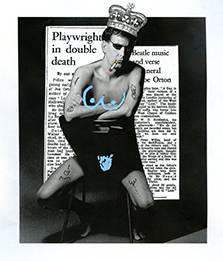
Up and At Em: Death in the Sex of Joe Orton

By Leon Horton
London, 9 August 1967. At the height of his short-lived fame, Joe Orton – anarchic playwright and cause célèbre of the English theatre – is found murdered at 25 Noel Road, Islington, his brains bashed in by his long-term lover and one-time collaborator Kenneth Halliwell. Divided in life by Orton’s hard-won success as a writer, the two are forever united in death when Halliwell savagely bludgeons Orton with a hammer then takes a fatal dose of sedatives.
In the hip chic of late 60s London, Orton, it seemed, had everything a “with it” gay writer could possibly want: a West End smash with his second play Loot, winner of the Evening Standard Award for the Best Play of 1966, holidays in Morocco where the drugs were cheap and the boys even cheaper. After years in obscurity, everyone wanted a piece of him. And on the day of his gruesome death, he was due to meet director Richard Lester to discuss his film script commissioned for The Beatles: Up Against It.
Halliwell, conversely, had nothing to show for the wilderness years spent mentoring his protégé – and his valium-suppressed jealousy ran deep. Holed up in their tiny squalid bedsit, sustaining their meagre existence on Halliwell’s dwindling inheritance, the two aspiring writers had written several unpublished novels together, were for a time allied in their lives and literary endeavours by dreams of a success that eluded them.
But even failure couldn’t last.
With Orton’s meteoric rise to fame (after a life- and career-defining spell in prison for defacing library books), it was he who now controlled the purse strings, he who was lauded in the Observer as “the Oscar Wilde of Welfare State gentility”, he alone who was invited to all the right parties. Halliwell, who had given up writing, whose literary ambitions Orton had absorbed and then eclipsed, was reduced to a mere footnote – a dedication in the programme of Orton’s first full-length stage play Entertaining Mr Sloane.
But if it was Orton’s success as a writer that brought down the hammer, it was his blatant and unabashed sexual promiscuity that put the nail in his coffin. For Halliwell was not merely envious of Orton’s literary achievements; he was the cuckolded lover, the long-suffering wife caught at the crossroads where many partners of the famous disembark. Overlooked, underappreciated, first wives are often left at the kerb, muttering threats of revenge. Paranoid that Orton would leave him, not without justification, Halliwell desperately tried to legitimise his own position as fundamental and indispensable to Orton’s success to anyone within earshot. It was an invitation to a killing.
Orton and his plays are often regarded (or dismissed) as a product of the swinging 60s, as little more than an adjunct of pop counter-culture and the sexual revolution, and while he certainly earned his place in that pantheon, there’s more to it than that. His battles were won and lost in those Beatle-heady days, certainly, but they weren’t fought there.
They were fought in his impoverished Leicester childhood in the 1940s, against a domineering mother and a weak father. They were fought at the Royal Academy of Dramatic Art (RADA) over his ambition and ultimate failure to make it as an actor in the 1950s. Ultimately, they were fought against a prejudiced and repressed society – brought into sharp focus by his and Halliwell’s harsh treatment at the hands of the authorities when they were caught defacing library books in 1962. “The old whore society really lifted up her skirts and the stench was pretty foul,” Orton said of his six months in prison. Privately, he contended that their stiff sentence was “because we were queers.”
Perversely, prison gave Orton a taste of freedom. For the first time in 11 years, he was separated from Halliwell, began writing on his own and duly delivered a radio play, The Ruffian on the Stair, to the BBC. Halliwell was humiliated by and repentant of his incarceration – a symbolic reminder of the wider failures in his life – whereas Orton found a new voice and detachment to his anger. Having reached rock bottom, he was no longer stymied by society’s values, and he savoured his newfound role as a literary outlaw and bona fide criminal. Halliwell, on the other hand, would attempt to slit his wrists within a year of release.
With his star in the ascendency, Orton faced the perennial problem of the outsider artist: how to stick two subversive fingers up and at `em, the mainstream, without being absorbed by it. Orton no more needed social or sexual acceptance than a bone needs a dog, and sex was his solution. Comedy, vengeful and violent, was Orton’s genre, but sex as both weapon and shield was his modus operandi. “Sex is the only way to infuriate them,” he noted in his diary in 1967, as he rewrote his last play What the Butler Saw. “Much more fucking and they’ll be screaming hysterics in next to no time.” Even by the liberal standards of modern theatre, Orton’s dramatic use of sex as a means of control – with homosexuality, transvestism, incest and nymphomania vying for pole position – was seen by many as a deliberate affront to good taste.
In life as in his work, Orton’s approach to sex was defiantly Dionysian and held up a mirror to the hypocrisies of polite society. “You must do whatever you like as long as you enjoy it and don’t hurt anybody else,” he once told his friend, actor and stalwart of the Carry On films Kenneth Williams. Williams, an outrageously camp and acerbic performer in public, was a privately repressed man who felt guilty about his sexuality – a hangover from a bygone age that Orton totally rejected. “Get yourself fucked if you want to,” Orton told him. “Get yourself anything you like. Reject all the values of society. And enjoy sex. When you’re dead, you’ll regret not having fun with your genital organs.”
Orton practised what he preached and delighted in regaling friends and colleagues, if only to note their reactions, with lurid tales of his sexual adventures. Williams himself recorded a particular occasion in his own diary, 30 April 1967, when strolling through Hyde Park with Orton and Halliwell, Orton casually recounted picking up a stranger near a public toilet:
“We’d been eyeing each other warily – and this fellow asked, ‘You got a place we can go?’” Joe said (in front of Halliwell), “I told him that I lived with someone, and it wasn’t convenient. The man replied, ‘I often get picked up by queers round here… They’re not all effeminate either, some of them are really manly and you’d never dream they were queer. Not from the look of them. But I can always tell `cos they’ve all got LPs of Judy Garland. That’s the big give away.’” I told Joe, “It’s marvellous the way you remember dialogue as well as the accents! You really capture the flavour of the personality you’re describing.” Joe said, “Yes, I’ve started a diary.” I said, “Pepys put all his references to sexual matters in code so that no one would know.” Joe said, “I don’t care who knows.”
Whether he cared or not, Orton’s diary (titled Diary of a Somebody) chronicles the last eight months of his life, his increasing literary success, and his disintegrating relationship with Halliwell, against the backdrop of the swinging sixties. Started in December 1966 but not published until 1986, the diary knowingly (knowingly in the sense that Orton knew it would one day be published) details his sexual peccadilloes in such a curiously dispassionate and often dismal manner that on 23 December 1966 he is able to write:
“On the way home I met an ugly Scotsman who said he liked being fucked. He took me somewhere in his car and I fucked him up against a wall. The sleeve of my rainmac is covered in whitewash. It won’t come off. I hate Christmas.”
Then, six days later, on the way to his mother’s funeral:
“I arrived in Leicester at 4.30. I had a bit of quick sex in a derelict house with a labourer I picked up… He took his pants down. He wouldn’t let me fuck him. I put it between his legs. He sucked my cock after I’d come. He didn’t come himself. It was pissing with rain when we left the house. Mud all over the place.”
That Orton adopts such a gloomy tone over these chance encounters has little to do with the death of his mother, as you might expect, when you consider his somewhat more upbeat entry on the 30 December 1966, the very day of her funeral.
“After I left Leonie [his sister], I picked up an Irishman… He had a white body. Not in good condition. Going to fat. Very good sex, though, surprisingly. The bed had springs which creaked. First time I’ve experienced that. He sucked my cock. Afterwards I fucked him. It was difficult to get in. He had a very tight arse. A Catholic upbringing, I expect. He wanted to fuck me when I’d finished. It seemed unfair to refuse after I’d fucked him. So I let him.”
And so his sexual trawling continues throughout the diary, writ large, ad infinitum: from a bacchanal orgy in an underground toilet, where “the little pissoir under the bridge had become the scene of a frenzied homosexual saturnalia. No more than two feet away the citizens of Holloway moved about their ordinary business” – to sunnier climaxes in Tangiers, Morocco, where even Halliwell could relax in the heat of hashish and Arab rent boys who “do it for sweets”. Morocco, at that time, was an infamous destination for predatory homosexuals with a sweet tooth, and Orton and Halliwell were no exception, indulging in a daily regime of sybaritic proportions. But all the while, both were painfully aware that no matter how bright the Moroccan sun shone, the damp, squalid isolation of 25 Noel Road, Islington was only a postcard’s throw away.
If Orton was being irresponsible in his sex life, he took no responsibility whatsoever over Halliwell’s declining mental state. After years of bickering, of violent arguments and threats to commit suicide, Orton was inured to Halliwell’s pain, but with his new sense of worth, he could not empathize with it. Halliwell was seeing a psychiatrist, taking increasing doses of sedatives and, numb to the world, shrinking away from everything but Orton himself. Their tiny flat, the walls of which Halliwell had covered in collages, making it seem even more claustrophobic, was his theatre and fortress. For Orton, the place was tainted, and he talked often to friends about the possibility of leaving.
But he never did.
On the 5 May 1967, Orton wrote in his diary:
“When I got back home Kenneth H was in such a rage that he’d written in large letters on the wall ‘JOE ORTON IS A SPINELESS TWAT’. He sulked for a while and then came around. He’d been to the doctors and got 400 valium tablets. Later we took two each and had an amazing sexual session. I’d decided to fuck him. But it didn’t work out. ‘I’m not sure what the block is,’ I said. ‘I can fuck other people perfectly well. But up to now, I can’t fuck you. This is something quite strange.’”
Three months later both would be dead. The writing was on the wall.
At 41, Halliwell was no stranger to death. It had clung to him since childhood. In 1937, when he was just eleven-years-old, his mother was stung in the mouth by a wasp and died in front of him. Twelve years later, he came down to breakfast to find his father with his head in the oven, dead from asphyxiation. With a cold, hard logic reminiscent of one of Orton’s characters, Halliwell claimed to have made a cup of tea and had a shave before informing the neighbours, but his parents’ deaths haunted him for the rest of his life. At RADA in 1953, he told a fellow student “I’ll end up like my father and commit suicide.”
Two weeks before their deaths, Orton and Halliwell discussed the nature of their relationship, and relationships in general, with Kenneth Williams, who records visiting the couple in his diary, Just Williams, on 23 July 1967:
“We fell to discussing relationships. ‘Sharing of any kind means an invasion of privacy,’ I said. Joe talked about his horror of involvement. ‘I need to be utterly free.’ I quoted Camus’ line, ‘All freedom is a threat to someone,’ whereupon K.H. declared ‘Love is involvement, you can’t live without love.’ ‘There are many definitions of love,’ said Joe, ‘it depends on your point of view. You can love your work and be entirely committed to the pursuit of perfection.’ ‘Sexual promiscuity,’ he said, now provided him with material for his writing; ‘I need to be a fly on the wall’. But Kenneth Halliwell disagreed: ‘It’s alright letting off steam on holiday but a home life should have the stability of a loyal relationship.’ ‘You sound like a heterosexual,’ Joe countered, but Halliwell stuck to his guns and said that promiscuity led to wasted aims: ‘You can only live properly if it’s for a person or for God.’
For Orton, both man and writer, there could be no comic revenge against an unjust and cruel “God” without anarchy, and his sordid sexual adventures were a logical extension of this. Anonymous encounters with strangers fuelled his appetite for self-destruction as a creative act and confirmed his conviction that only in pursuit of the forbidden could he unshackle himself from the suffocating environs of conventional living.
It has been dramatised on stage, screen and in books, but no one really knows what happened that night, August 9, 1967 – how the final scene played out between these stage-struck lovers. As a denouement, the tableau that faced the police when they forced their way into the claustrophobic bedsitter fits the billing. They found Orton in bed, his blood and brains splattered up the heavily collaged wall that had become Halliwell’s sole creative outlet. They found Halliwell – Orton’s blood on his hands, chest and head – naked on the linoleum floor. Next to his body was an empty can of grapefruit juice that helped speed twenty-two Nembutals into his system, killing him within minutes. They found a note on top of a red-grained binder that was Orton’s diary. It read:
If you read his diary all will
be explained.
KH
P.S. Especially the latter part.
It is fifty years since Orton’s untimely and melodramatic death, and it is fair to say that his plays no longer carry the shock and awe they once did. Yet Orton, like his writing, remains enigmatic and elusive – brilliant but difficult, elegant but easy to misunderstand. The press dubbed him an enfant terrible, and Orton willingly played the part. But in living his life at the extreme, when it came to exceeding to the bitter demands of a life in the limelight, Orton inadvertently became a character in his own macabre drama.
He would have seen the funny side.
