Tag: Five Star Film Review
The latest Five-star film review from THEGAYUK.
-
FILM REVIEW | The Circle, aka Des Kreis
★★★★★ | The Circle, aka Des Kreis
Even though he led a very closeted life, Ernst Ostertag went out in public to a gay ball held by The Circle Magazine and met and fell in love with Robi Rapp, a drag act who was performing there that night, who would later become his life partner. The year was 1956, and the city was Zurich, and although homosexuality was not illegal in Switzerland, gay men were not only just ostracised by society but also lived in real fear of losing their jobs and being shunned by their families.
This hybrid of a movie: part documentary & part fiction is the true story of how this chance encounter would survive all the pressures of an intolerant and bigoted public, and the harassment of the police and authorities, to become 60 years later, the first ever same-sex couple to have a Domestic Partnership registered in Switzerland.
Back then Ostertag was a young and somewhat naive French Language teacher at a Girls School who risked the wrath of the Principal by wanting to introduce his pupils to avant-garde work by Albert Camus. Off-duty he discovered the existence of The Circle, a gay erotic art and poetry bi-monthly magazine that was the first if it’s kind in Europe when it was founded in 1942. The magazine was sold by subscription only and the membership list was heavily guarded at The Circle’s office, but occasionally the publishers organised get-togethers, like the Ball that Ostertag met his man.
The murder of one of their number served as a thinly disguised excuse for a campaign of persecution by the Police whose biggest weapon was exposing the men publicly for being gay. It was enough to cause Ostertag’s School Principal, a married man with two children, to take his own life.
This is a fascinating glimpse into a post War War 2 mixed fortunes of a gay community in Europe before the onslaught of freedom that was about to occur with the swinging 1960’s (although maybe not quite in Switzerland). Rupi’s mother was very theatrical and not only acknowledged her son’s sexuality but also welcomed his lover into the family with open arms, whereas Ostertag’s conservative parents were so very formal and cold, that he never came out of the closet to his sister until he was 70 years old.
The movie which so excellently portrays all the emotional stress on these young men who struggled to come to terms with their own sexuality, works best with the dramatised flashbacks thanks to some masterly performances, particular by the two lead actors playing the lovers Matthias Hungerbuehler and Sven Schelker. The interviews with the present day Ostertag and Rupi, now in their 80s, are extremely touching, but really add little to the narrative itself.
‘The Circle’ aka Des Kreis won both the prestigious Teddy for Best LGBT Documentary at the Berlin Film Festival, where it also picked up a coveted Panorama Audience Award too. I think it is surely set to become a firm audience favourite too when it does the Film Festival rounds now.
Highly recommended.
-
FILM REVIEW | Starred Up
Violent prison dramas with raw angry men desperately displaying their machismo just to survive the regime of brutality that pervades in jails always have an underlying tone of homo-eroticism in them. ‘Starred Up’ with a brilliant career-making performance from 23-year-old Jack O’Connell is one such movie especially as it has the near-obligatory shower scene that ends in a naked fight.
★★★★★
O’Connell plays troublesome teenager Eric Love who has been moved from a juvenile detention facility as they cannot handle him any more. Unlike the other inmates banged up in this adult jail, he doesn’t want to get out, as the reason he has forced the authorities to send him to an adult prison, is that his father, who he barely knows, has been serving time there for the past 14 years.
The back-story as to how these two ended up being incarcerated is vague to say the least but it’s not that important as its the attempt at reconciliation between father and son that is the focus of the story. He may only be 19, but Eric is a hardened criminal who knows how to work the system, which only serves to enrage the corrupt prison guards who are determined that they will not be beaten by this youth, even if it means actually having him killed. Their undisguised anger is matched by the determination of a do-gooder volunteer social worker who is insistent that he can cure Eric, and maybe even his father, by some simplistic anger-management.
It gets a tad confusing on occasion when the men’s shouting matches become incoherent, but one doesn’t need subtitles to get the gist of the violent action most of the time. This is essentially Eric’s story and of the way that he has deliberately chosen to develop into manhood. We are never sure either because of the script, or O’Connell’s mesmerizing performance, if the boy actually loves his father or really wants him dead.
Directed by David McKenzie (‘Young Adam’, ‘Hallam Foe’) from a script by Jonathan Asser based on his own experiences as a prison social work. Even with strong supporting performances from Ben Mendelsohn as the father and Rupert Friend as the social worker, this film, one of the very best prison dramas for a long time, completely belongs to Eric, thanks to O’Connell’s portrayal. We are bound to see a lot more of this actor as he destined for stardom.P.S. Starred Up is a term used in the UK to describe the early transfer of a criminal from a Young Offender Institution to an adult prison.https://www.youtube.com/watch?v=zE4ziBfu0JA
by Roger Walker-Dack -
FILM REVIEW | Finding Vivian Maier
★★★★★ | Finding Vivian Maier
A young graduate working on a history project bought a suitcase full of photographic negatives in a Chicago auction hoping that one or two them maybe useful in his research. However what John Maloof discovered that day in 2007 was a treasure trove of what is undoubtedly one on the finest collection of street photography ever made. They all turned out to be the work of one person a Vivian Maier, someone so totally unknown there wasn’t a single mention of her on Google or any other Internet search engine.
A curious Maloof turned detective and his painstaking research helped him very gradually put together a picture of this mystery genius and at the same time discover and purchase even more of her work. Vivian Maier had been born in New York in 1929 and had then spent much of her childhood in France before returning to Chicago where she worked for almost 40 years as a Nanny. Every new discovery Maloof made about the unknown Maier was a shocking revelation as very few of the people she had worked for had any sense that this extremely odd woman they had hired to look after their offspring was a prolific obsessed photographer with such a remarkable eye. It seems most of her young charges knew as Nanny Maier dragged them through the seamier rough spots of the city clutching her camera looking for subjects as part of their daily constitutional.
As Maloof pieced together Maier’s story like a jigsaw what emerged was a picture of a very eccentric loner and a compulsive hoarder who was an immensely private person. It’s only when he traces her steps in France does he discover that Maier knew that she was talented but apart from a brief correspondence with one printer did she ever talk about letting people see her work. The fact that news of the discovery of the 100000 plus negatives and the 700 plus undeveloped rolls of film had gone viral, there were still doubters from the people who knew Maier that she would have ever wanted this worldwide fame and recognition.
This new documentary that Maloof wrote and directed, along with writer/producer Charlie Siskel, is exceptional for two distinct reasons. Firstly the very human story about this rather bizarre woman who was described as being ‘so awesomely unique’ and ‘a very closed cold person’ and who ended up losing one job with the mother explaining to her child ‘Vivian has got a little too crazy even for us’. The reminisces of the people who knew her are riveting and poignant. And then there is this whole superb body of work which is so exceptionally wonderful it stuns you into silence at times. Howard Greenberg a leading NY Gallerist who holds exhibitions of her work claims that no other photographer’s work has ever generated this much interest in his time.
Credit to Maloof on several counts. Not only for recognising the significance of his find, and for his sheer doggedness and determination to ‘finding’ Vivian Maier, but also for the impressive way he put this all together in this, his first ever movie.
There are so many components of this story that will keep you wondering and wanting to know more. Like why would this aggressively shy person produce so many ingenious portraits of herself that she could have been credited as being the creator of the ubiquitous selfie?
Unmissable: and you will want to see it at least twice.
-
FILM REVIEW | The Imitation Game
★★★★★ | The Imitation Game
Based on the real life story of legendary cryptanalyst Alan Turing, The Imitation Game portrays the nail-biting race against time by Turing and his brilliant team of code-breakers at Britain’s top-secret Government Code and Cypher School at Bletchley Park, during the darkest days of World War II.
Via a series of flashbacks, the film spans the key periods of Turing’s life, from his unhappy teenage years at boarding school and the triumph of his secret wartime work on the revolutionary electro-mechanical ‘Bombe’, which was capable of breaking 3,000 Enigma-generated naval codes a day, to the tragedy of his post-war decline, following his horrific and shocking conviction and subsequent enforced chemical castration just for having gay sex. Finally pardoned in 2013 by the Queen, for the ‘crime’ of carrying out homosexual acts that he was tried for in 1951, Alan Turing’s role was pivotal in winning the Second World War.
With such a fascinating story and a stellar cast (Benedict Cumberbatch, Keira Knightley, Mark Strong, Matthew Goode, Charles Dance) this is a film that is destined to be a major success. Already garnering critical acclaim, it’s not hard to see why. The script, period detail and performances are all exemplary. Cumberbatch is pitch perfect in his portrayal as Turing, portraying the strengths and vulnerabilities of a man with little social skills who is driven by his passion for his work and his intellect. He’s ably supported by Keira Knightley as the feisty Joan Clarke; a woman of great intellect who has to fight to the constraints of a society that devalues and oppresses women. Mark Strong as a particularly dashing MI6 agent and Matthew Goode as a fellow code-breaker, are equally strong.
The script is actually very funny as well as being poignant and thrilling. This is a must see film of this autumn/winter.
The Imitation Game is in cinemas from the 14th of November 2014
-
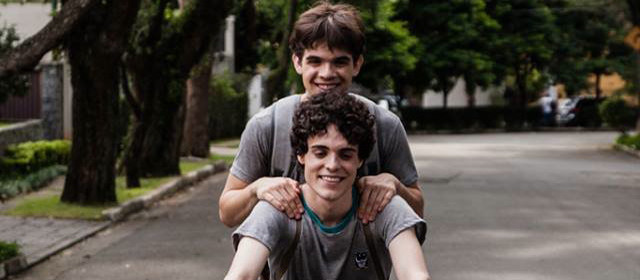
FILM REVIEW | The Way He Looks
The lazy summer is over and Leo and his best friend Giovana are back in High School for the new term when curly headed new boy Gabriel joins the class for the first time.★★★★★
-
FILM REVIEW | Gone Girl
★★★★★ | Gone Girl
When the movie opens on a quiet July morning in a small Missouri town there is no visible indication we are looking at a man who has fallen on hard times.It turns out that Nick Frost has been virtually unemployed since being laid off from his job on a magazine in NY and is now penniless. He and his wife live in a large ugly suburban house that they lease using the remains of her depleted trust fund, and this morning on his 5th wedding anniversary he is feeling sorry for himself and sipping a shot of Bourbon in the small empty bar he owns with his sister. As he sounds off about the stale state of his marriage the telephone rings. It’s his neighbour telling him that the front door of his house is wide open.
That’s not the only thing he discovers when goes back home, as the house is totally deserted and furniture is turned over and broken as if there has been a struggle of sorts. When the police check it out they find signs of blood and enough clues to be concerned for Amy’s safety and decide to mount a Press Conference the next day to appeal for help. Nick is joined for this by Amy’s psychiatrist parents who are famous authors having once made a fortune on a series of books called Amazing Amy that ruthlessly exploited their daughter’s childhood.
Initially, there is an overwhelming abundance of sympathy and support for Nick from both the police and local community but as Detective Rhonda Boney keeps uncovering further clues that indicate that Nick may be responsible for his wife’s disappearance, the mood rapidly changes. Egged on by local TV pundits who have already declared that Nick is guilty of killing his wife, everybody turns against him. When his young mistress goes public about their affair it seems like now that a motive has been established, they can be no further doubt about his guilt.
Things are far from what they seem in this latest movie from the master of suspense director David Fincher who excels at complicated thrillers such as this. By using a series of flashbacks he has shown that this once fairytale romance is now on the rocks, but even so, it’s impossible to comprehend the depths that Amy will go to resolve it in a manner that will try and exact such diabolical revenge on her unfaithful husband.
It is one of those movies that is best enjoyed knowing little beyond these bare bones of the plot because what follows is so astonishing it will certainly stupefy you. Just when you think you have it all worked out, the story will twist another 360 degrees to confound you yet once again. It is however unquestionably one of the BEST movies of 2014.
Ben Affleck is superb as put-upon Nick who you may dislike for wanting his own way, but even he doesn’t deserve the punishment Amy wants to exact on him. The movie, however, belongs to the British actress Rosamund Pike who, in an Oscar-worthy performance, is nothing less than outstanding as Amy. It’s an amazing revelation to see her being so brilliantly devious, manipulative, demented and stunningly seductive when she wants her own way. She is such a sheer joy to watch (apart from all the bloody bits naturally).
Lest I should forget, there are also some great supporting turns that deserve mention too. Kim Dickens (TV’s Sons of Anarchy) as the Detective, Carrie Coon (TV’s The Leftovers) as Nick’s sister Margo, Neil Patrick Harris as Amy’s stalker boyfriend, and Tyler Perry for once playing it straight as Nick’s hot shot lawyer.
The script, the first ever written by Gillian Flynn, and adapted from her own novel gave Fincher a great canvass to work with, but it is his superb attention to the most minute detail that makes it such the spectacular roller-coaster ride that it is.
-
FILM REVIEW | Ida
★★★★★ | Ida
It’s hard to decide exactly what period this new cinematic masterpiece from Polish filmmaker Pawel Pawlikowski is set in with its austere dramatic settings that look like they have remained unchanged for centuries. This unforgiving bleak countryside that seems to have escaped any attempt at modernization is in fact 1962 but you have this sinking feeling that this part of rural post-war Poland is probably still exactly the same today.
Ida is an 18-year-old Novice at a large decaying rather remote Convent and is just about to take her final Vows. The Convent has been her home since she had been abandoned as an orphaned baby, but now the Mother Superior tells her that she does, in fact, have one living relative, an Aunt who she should go visit before she makes her ultimate commitment to God.
She has two major shocks awaiting her at the end of her long bus journey when she finally meets her Aunt. Not only does she discover that she is Jewish by birth, but she also quickly realises that her Aunt, is a former high-ranking Communist Party Public Prosecutor who has transgressed into an alcoholic chain-smoking woman who seems to bed every man she meets. The sheltered young nun-to-be, however, seems to take it all in her stride and announces that she wants to go back to her home village just once and visit her parents grave.
An initially reluctant Aunt agrees to drive her there, as she needs to prepare Ida for the harsh reality of the situation. The parents had been slaughtered in the Pogrom in the War and even now the local anti-Semitic Communist population are in denial of their complicity as in many cases they then stole the lands left by the murdered Jews. This was the case of her own parents and it took the fearless tenacity of the Aunt to uncover the actual facts.
Along with their road-trip, they give a lift to a handsome young saxophonist who is en route to play at a Ball in the next town. Ida doesn’t realise at the time that he will turn out to be one of the reasons that she questions her vocation and her ‘calling’ to serve God.
The tense melodramatic story is as uncompromisingly bleak as the landscape it is set in, and it’s twisting plot lines as both women’s lives unfold in front of our eyes makes for compelling viewing. The reason for their sadness is understandable and the outcome is, therefore, inevitable as neither of them can really carry on as before with the knowledge that they have unleashed.
It is unquestionable one of the most powerfully moving films of the year to date. Completely stunning on so many levels but even so, it is the superb black & white cinematography that so carefully framed each single shot that took this movie to a whole another level. Faultless award-worthy acting by two sublime actors Agata Trzebuchowska and Agata Kulesza who had great chemistry as the two completely different woman who really had so much in common.
Completely unmissable.
P.S. The rather surprising detail about this movie that will undoubtedly go down in the annals of Polish cinema as a national masterpiece, is that it’s director and co-writer Pawel Pawlikowskin was born there but has actually lived and worked in the UK and France most of his life. Interesting then seeing the country, as he must remember it from his own childhood.
-
FILM REVIEW | Reaching For The Moon
★★★★★ Reaching For The Moon | Elizabeth Bishop was something of a self-absorbed cold fish. When she finished her tenure as US Poet Laureate in 1950, she was 40 years old, alone in N.Y., and suffering with ‘writers block’. At the suggestion of her friend and fellow poet Robert Lowell she decides to go to South America for a long vacation.
-
FILM REVIEW | A Most Wanted Man
★★★★★ | A Most Wanted Man
In Dutch filmmaker Anton Corbijn’s take on John le Carré’s spy thriller we are very much aware of who ‘the most wanted man’ is, but like Gunther Bachmann, a German Intelligence Officer in Hamburg, we never know why he has earned this title.
Gunther is very much the ‘good man’ in this intricate web of international spy/terrorist catching. Gruff, scruffy, chain-smoking and a fiercely independent operator in charge of a Specialised Terrorist Unit, he is trying to get information from Issa Karpov a half Russian & half-Chechen Muslim illegal immigrant before the police or other authorities can capture and imprison him.
Karpov has escaped from a Russian prison where he was brutally tortured and he is portrayed as being the innocent victim of the fact that his father was a notorious terrorist/criminal. Via a sympathetic lawyer, Karpov leads Gunther to Tommy Brue a wealthy Merchant Banker who is trying to extract himself from his late father’s dubious clients who he has inherited. This includes Karpov Snr. who still has a major nest egg stashed away in the Bank. Gunther wants to use Brue and these illegal millions to trap a respected Professor who he suspects is the head of a cell of terrorists. Although both the German Authorities and the CIA. reluctantly agree to give Gunther time to do things his way, they obviously do not mean it at all.
It’s a well told thrilling intricate story, although a tad confusing at times, and it keeps you completely engaged until the very end. It’s very much Gunther’s story, which is appropriate as the great Philip Seymour Hoffman plays him magnificently in this, his final movie role. I’m unsure if Corbijn actually re-edited the movie as a result of Hoffman’s untimely death which occurred after its Sundance Premiere, but anyway Gunther is rarely off the screen. It’s a powerful swan song from this talented actor and even more poignant because he plays yet another dishevelled character that seems to be such a perfect fit for him in his very distinguished career.
The cast is made up of Rachel McAdams as the liberal lawyer/social worker, Robin Wright as the cold-hearted double-dealing CIA. Agent, Willem Dafoe as the Banker plagued by the sins of his father, Nina Hoss as the very matter-of-fact loyal assistant to Gunther, and handsome Grigoriy Dobrygin as the hunted man who is forced to decide between his life and his religion when he is made to shave his shaggy beard off.
We came away believing the real possibility that if the Gunthers of this world were actually allowed to use Intelligence as opposed to the usual knee-jerk response of sheer brutality to try and deal with the whole scenario of terrorists, then things may even start to get resolved. And the other totally different thought ingrained in our minds as the final credits rolled, was that the world will never quite be the same after the loss of such a very fine actor.
A Most Wanted Man opens in the UK on the 12th September 2014
-
FILM REVIEW | Obvious Child
★★★★★ | Obvious Child
The movie opens with a very confident Donna in the middle of her stand-up comedy routine in a small nondescript bar in New York. She is extremely funny and disarmingly honest as she talks candidly about the absurdities of her own life.
The small audience loves it and applaud her enthusiastically when she finishes her Set. All that is except her boyfriend who had been standing at the back of the room listening to a stream of highly personal jokes made at his expense. Then minutes later the two of them are together in a rather busy unisex bathroom and he dumps her. Not for the jokes but because he has been sleeping with her best friend for some time now.
Suddenly life doesn’t seem quite so funny for this part-time comedian so she takes to her bed with a large bottle of wine and her phone. The more she drinks, the more she leaves a series of ugly voicemails on her (now ex) boyfriends machine.
Days later she’s back on stage and recounts this new development that resulted in her being a reluctant single again but she is so bitter and angry that she totally alienates the dwindling audience. This calls for more drinking in the bar afterwards and when she is well-plastered allows herself to be picked up by Max a clean-cut preppy business studies graduate who seems a fish-out-water both in this Dive and also in Donna’s bed where he ends up later.
Fast forward a few weeks and Donna discovers she is pregnant. She knows that the baby is Max’s but, as she tells Nellie her roommate, she doesn’t know how it happened. She was sure they had condoms and that she had even helped Max open the packet, but she was unsure if in their drunken stupor they had actually used them.
What Donna has no doubts about is that she will have an abortion, but when in a series of coincidences, she keeps running into Max again, she feels an obligation to at least share the news with him. The trouble is she never knows how too. She tries to confide in her puppet-making very supportive father and even in her rather cold micro-managing Professor mother but she fears losing their support. Naturally, when she does break down and break the news they are in her corner anyway and back her choice completely.
But still left with having to deal with Max, she invites the unsuspecting (and very sweet) man to watch her perform at the Bar the night before the ‘procedure’ is scheduled, the date is February 13th. She is brutally upfront with all the details regarding the unwanted pregnancy and her chosen route and has her slightly shocked audience laughing along with her. Except, Max who runs out into the cold.
This wonderful, refreshing, heart-breaking comedy that bravely dares to tackle the oft-taboo subject of abortion head on is the work of director and co-writer Gillian Robespierre and is based on the successful short film she had made a few years earlier. Both Donna and Max are very believable characters, thanks to a combination of some excellent writing and great performances, and even though they are so totally opposite on many levels they are a good fit. This is, despite the plot I have outlined so far, a romantic comedy after all. There are still some moments of great pain and struggle as Donna wrestles with the finality of her choice and I think it is also very important to note that even with its very honest and open approach to abortion, no-one in this story treats the subject glibly.
There is also a rather wonderful unexpected ending that so refreshingly steered cleared of all of the usual cliches but as it includes spoilers I have omitted covering it here.
This is indie movie making at its best and I loved it now just as much and when I first saw this at Sundance.