Day: 22 February 2020

  • CLASSIC CARS | The Fiat X1/9 Vs. the MR2 MK1

    CLASSIC CARS | The Fiat X1/9 Vs. the MR2 MK1

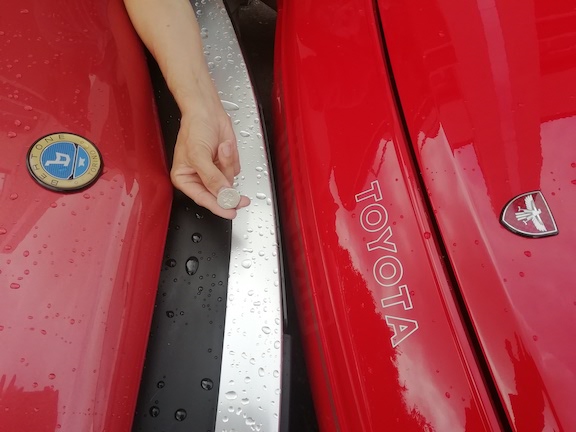
    Two-seater Toss Off

    For as long as time has begun, from the ’70s to be exact, the Fiat X1/9 has always been compared to the TR7. And this is true of the classic press too. Wedge-shaped with pop-up headlights, that is where the similarities end. The X1/9 comes out well in these tests but I fear this is because there are many that disliked BL’s wedge or the agro that went with it. 

    The TR7 died in 1981. The X1/9 carried on, unchallenged until 1984 when suddenly you could hear the X1/9’s market share fall apart much like what happened to the car itself after its first winter. 

    Launched in 1972, the X1/9 saw very little development. The main changes came in 1979 with larger US federal style bumpers and a 1500cc engine from the Strada. There were some changes to paint schemes and specs but overall, very little changed.

    Suddenly, Japan enters stage left. It comes to the party with its MR2. A dinky looking 2 seater with a rev-happy 1600cc engine packed with 16 valves and twin cams. It was what the X1/9 had been calling out for. 

    Toyota’s new car was a runaway success. What it lacked in practicalities over the X1/9, it more than made up for it by keeping up with the new hot hatches on the block. There was even competition in-house from the Corolla GT-i 16. Basically the same engine dressed in a 3 door hatchback style. It was competent and reliable but didn’t set the pulse racing with its Corolla looks.

    The X1/9, having surpassed the128 3P and still going strong considering Fiat’s Strada Abarth offering, it had finally met its match. Back to back, in everyday situations, both cars are similar. The engine sits behind you and both are vocal. In those traffic light Grand Prix trials, it’s quite fun. On a run, it can be both tiring. Both cars come with low gearing though it feels like the MR2 has the lower set of ratios. Using the Fiat Strada engine and gearbox, the X1/9’s are just a little bit taller all round.

    Those lower ratios are no bad thing though. The MR2, with its 16 valve engine has 3 stages of power delivery like boiling an egg. 1-3000 it’s all gentle, warm, nothing really happens. 3-4000 and something is happening. There are bubbles at the bottom of the pan and it’s getting hot. 4000 and beyond and it’s boiling. Stomp on the throttle and you feel a shove from the 128bhp engine that will happily spin up to the red near 8000rpm.

    There is no such gauge to be had from the X1/9. It’s 85bhp is way off what the Toyota has. All is not lost though. Despite its twin choke carb fed single cam unit, it develops all of its 87Ib/ft of torque lower at 3200rpm. This makes the X1/9 a more flexible car than you would expect and feel the more rapid in the twisty bits. It’s far easier to keep the power on. 

    With maximum bhp’s coming up high on both engines, it’s where the torque is that counts. The X1/9 doesn’t have to have the engine singing loudly to get where it wants too quickly. In contrast, the MR2 needs to be spinning at 5000rpm to get its 105 Ib/ft. The downside to the 16valve engine is that it needs revs to get the power.

    You’d expect the handling to be similar for both cars too. Well no. They differ in quite a lot of ways and both are winners and losers. Where overall comfort comes into it, it is the X1/9 that wins. Its ride from the all-round MacPherson struts is soft and comfortable. This makes it the more civilised cruiser over long distances despite its cramped cockpit and close to the controls driving position.

    On the other hand, the cornering safety goes to the MR2. Approaching its limits, it will gently understeer and the steering wheel will communicate this back to the driver effectively. The X1/9 has no such virtue. Instead, you can be caught between a rock and a hard place. It’s near-neutral handling is great. The steering loads up and its adhesion with the road is lost. Be quick though because the steering is not as quick in the rack as it is in the MR2, nor is it as light. And this issue is down to 1 factor alone. The MR2 wears wider 185 section tyres with a lower sidewall. The Fiat’s 165 sections cannot compete with 185’s.

    So who did it better? Both have plus sides over the other. At its limit, the X1/9 will try and kill you. You can’t drive it without 100% concentration all the time. The MR2, on the other hand, will allow you to be foolish and reward you without going backwards into a ditch unless you are really stupid. 

    It’s like the Minogue sisters, you can’t, apparently, like them both. The MR2 is like Danni. It can be a little bit diva and a little bit pop in as much as it will satisfy you no matter what your mood. The X1/9 is Kylie. It’s full-on disco diva, 100% of the time. Just don’t show it her years with Deconstruction records. It gets messy, much like its handling can. 

    Which would I choose? I’ve had a liking for both since I was a child. I just happen to own the Fiat. Having now driven both in almost all driving situations, (the MR2 I did manage to get on the Silverstone racetrack) would I change my own X1/9 for the MR2? If I had the chance to use it more, I would. The MR2, despite its lack of luggage carrying ability, is the more useable car. It’s both fun and easy to live with. It doesn’t feel as delicate as the X1/9 and that also goes for all-round weather ability. 

    It’s just that my X1/9 tends to spend a lot of time looking at me from the garage, not broken I might add, and much like its handling on the limit, its looks are a killer!

    Many thanks to Toyota GB’s Graham Bothamley for the loan of the MR2 from their heritage fleet.

  • Is there a gay dating site which isn’t just for hookups?

    (C) BIGSTOCK

    If you’re looking for a quickie or even some picture swapping there are plenty of apps out there where gay and bi guys can hook up, but what if you want something deeper (get your mind out of the gutter).

    This was a question recently posed on Reddit and it got people questioning where they could get a good date rather than a quick session of “fun”.

    Back in 2015 our columnist Scott Sammons tested out all the major dating apps to find out which offered the best services and dating opportunities.

    For dating opportunities he recommended Tinder, saying that the app was “designed to “match” people based on their personalities and likes/dislikes”. The app asks users to fill out a survey and then based on those results shows you profiles of guys you’re likely to want to date.

    Sammons also added, “there are very little opportunities to declare your sexual preferences or put on your profile that you’re horny”. So if you’re after dates than quick hookups this might be a solution.

    He also suggested Gaydar and Plenty Of Fish as alternatives to the likes of Grindr, Hornet and Jack’d.

    Otherwise, users on Reddit suggested OKCupid, with one user admitting that he had had a lot of “success on the platform”.

    So what’s the best way of meeting someone new?

    Readers on our Facebook page, however, were less hopefully when we asked the question about the best dating app – not for hookups.

    One user wrote, “All of them are hook up sites” while another added, “It would be nice if there WAS one you could actually connect & chat rather than just sex…..but I don’t see it happening lol”

    Finding love or just sex?

    CREDIT: ©-Vadymvdrobot-Depositphotos

    Back in 2018, we asked our readers whether they had found love on a dating up. Thirty-six per cent said that they had found love and were still together, while 39 per cent said that they used them only for short-term relationships or hookups.

  • When is Pride Month in the UK in 2020?

    When is Pride Month in the UK in 2020?

    Pride season in the UK starts around April and continues right through to September, so is there an actual “Pride Month”?

    When is Pride Month in the UK?

    Officially Pride Month is in June in 2020.

    Pride Month stemmed from the US, which has been adopted more widely across the world, but in reality, there are many Pride months across the globe. For instance, Sydney Mardi Gras, Australia’s biggest pride takes place in February (although they do have a Pride festival in June) and here in the UK, there isn’t such thing as one month for Pride.

    In the US most prides happen in the month of June to coincide with the anniversary of the 1969 Stonewall Riots, in the UK however things are a little more spread out with more and more county, city and town prides becoming available.

    There are over 150 pride events in the UK alone and they start in Feb with the last (outside Winter Pride) in September. So Pride month in the UK is better described as Pride Half Year!

    In 2019 the town of Llanelli in South Wales celebrated it’s first pride.

    Want to know more about prides, see our entire collection of Pride articles here. Want to shop for Pride Merchandise, visit our partner retailer, THE PRIDE SHOP.

  • TOM TRIES IT | Allergy Testing

    TOM TRIES IT | Allergy Testing

    In this edition of Tom Tries It, our grooming expert Thomas Swallow goes beyond the realms of male grooming and delves into the world of at-home allergy testing. Read on to find out if they are worth all the social media hype…

    Carry on reading below, to hear about Tom’s experience doing an at home allergy test. Missed the other instalments of this series? Click here to find out about Tom’s previous adventures, where he decodes the enigma of male grooming.

    Firstly, I just wanted to thank the team at Lifelab Testing for making this article possible and sending over the allergy testing kit for me try. If you do decide that you wanna give one of these kits a go after reading this article, I definitely would recommend them. The kit we used for the purposes of this article was the Complete Body Test and it is by far the most comprehensive kit I’ve seen on the market, testing for 40 food & inhalant allergies and 80 common food intolerances.

    So what is at home allergy testing?

    Now I know what you must all be thinking, that you can only do allergy testing through your GP or in a private clinic. The fact of the matter is though, that this is a widely held misconception. Most allergy testing simply consists of a blood test and as we all know through services such as Sexual Health London, it is quite safe and easy to do a finger-prick blood test from the comfort of your own home. At home allergy testing is done under the same premise. A testing kit is mailed to your door, with easy to follow blood test instructions and within a few minutes, you’re off to the post box to send of your sample.

    Why do it at home though? Surely getting our GP to do the testing for us is better?

    To be honest on this one, I’d say it is probably much simpler to do this sort of testing yourself at home. Not only will the process be a lot smoother and you’ll get your results much quicker but in many cases, these tests aren’t commonly offered out by your GP. You see the NHS really only tests for allergies, when there is evidence of adverse allergic reactions but not with an identifiable cause. Often meaning that minor allergies and intolerances aren’t tested for. Not only that, the range of testing offered is much more limited on the NHS. Due to the service being publicly funded it’s simply a fact of its existence. By all means, though a private clinic would be able to arrange the same testing for you but often for a much steeper price tag. So to put it simply, do it at home and make your life that little bit easier, whilst saving some cash in the process.

    How do they test for allergies/intolerances with a blood test?

    This is the science bit. When our bodies come into contact with substances that we are either allergic or intolerant to, our bodies release IgG antibodies. By testing for these antibodies within our blood, we are able to identify these allergies/intolerances. The main IgG antibody tested for by Lifelab Testing is IgG4. This is the subclass of IgG antibodies, that remains in our blood when we are in constant contact with an allergen/intolerance. By testing for this antibody in particular, they are able to limit the amount of false-positives in testing and as such, make their results more reliable for their consumers. Reducing the need to cut out certain foods/food groups unnecessarily.

    The results:

    Within about a week or so after sending off my testing kit, my results were in and I could access them via the dashboard on the Lifelab Testing site. They came in two forms a printable/ downloadable PDF and an interactive web based page. From these results, it was identified that I had 9 allergies and 0 food intolerances. None of the allergies mentioned, had I been aware of before and to be honest, they made up a huge portion of my diet. The allergies found for myself can be seen listed below.

    • Crab
    • Gluten
    • Rice
    • Soya
    • Almonds
    • Hazelnuts
    • Rye
    • Bermuda grass Pollen • Horse Hair

    Just to note here, all allergies identified are graded on a scale of 1 to 5 by Lifelab Testing. All of my allergies identified were minor allergies, with Soya being the highest allergen at a level of 3.

    Elimination diet:

    After I received my results, I then went on to put their findings to the test by trying an elimination diet. What an elimination diet entails, is to eliminate certain foods out of your diet for a period of 30 days and see if they were indeed the cause of an issue. Having not been symptomatic of an allergic reaction prior to testing, apart from the odd skin issue. I went into this diet with the aim of seeing what/if any changes, occurred to my body over the period of 30 days. This process was supported by Lifelab Testing sending me daily email updates, with advice on cutting the allergens from my diet and making it sustainable long term.

    Following the month of being allergen-free, I have to admit I did notice some small but noticeable changes. Firstly, I did not feel bloated in the slightest no matter how much I had eaten within a given day. Secondly, I was a lot more energetic in the mornings. Now, this could have been due to a number of factors but I did find I was sleeping much better on this diet. Thirdly, I stopped feeling so lethargic after doing cardio. Which had become more apparent in recent years since moving to London. Finally, I had no skin issues by the end of that month and this way by far the most prominent change, that I noticed. Having suffered with eczema on and off for about the last year, I think the allergens identified definitely played a part in my skin issues. Since cutting them out, all seems to have settled down in that area.

    Final thoughts:

    Overall I had a very positive experience doing an at-home allergy testing kit and I cannot thank Lifelab Testing enough for giving me the opportunity to do so. The testing kits themselves aren’t the cheapest things in the world but they are far cheaper than going to a private clinic for the same tests. So if you are in doubt about an allergy/intolerance or just feel like knowing a bit more about your body, I would definitely recommend giving these tests a go. For more information on the testing kit I did or about Lifelab Testing, please check out their website https://lifelabtesting.com/