★★★★ | Set in an old theatre in the late 1950’s, a solicitor, Arthur Kipps, enlists the assistance of a young actor to tell his story. His tale revolves around a terrifying incident when he was younger, when he travelled to Eel Marsh House to settle the estate of a long standing deceased client. Initially finding a conspiracy of secrecy from the locals, he makes his way across the Nine Lives Causeway, which is cut off at high tide. Alone in the mansion, he is plagued by the sound of a pony and trap, an unexplained banging noise and a door which appears to be locked from the inside. What secrets does the estate hold? What lurks in the swirling mist…? And who is the woman in black he keeps seeing?
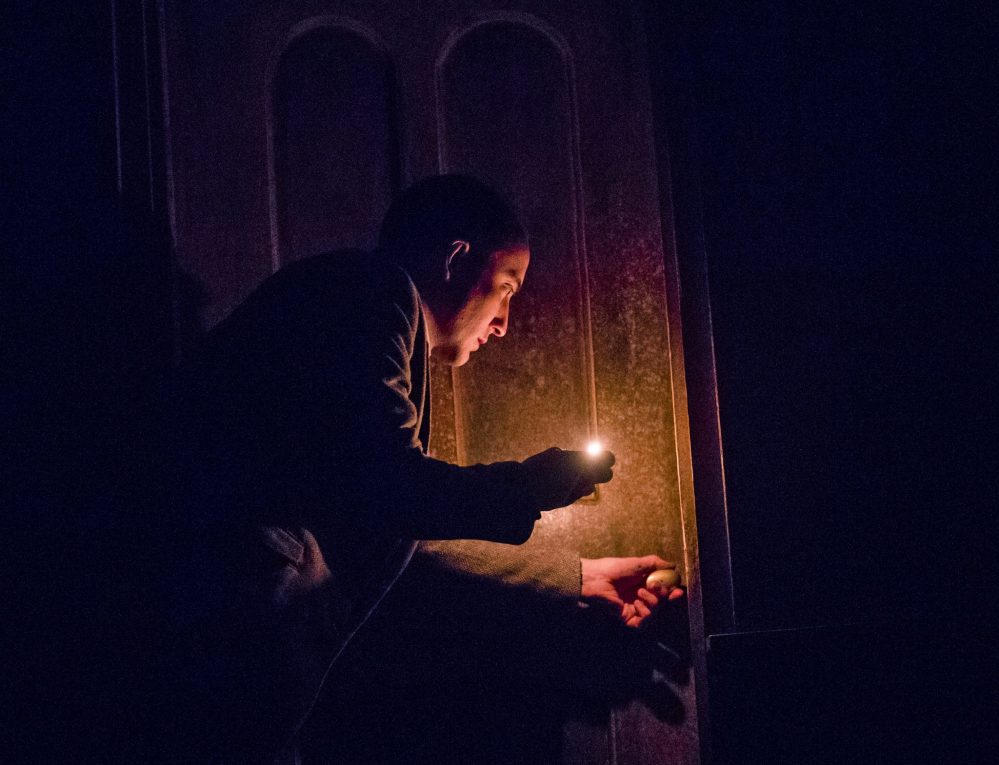
This chilling and effective ghost story is beautifully crafted and uses simple techniques to create a very taught atmosphere in the theatre. The lighting design in particular was incredibly well done – who would have thought that a dark stage with just a door highlighted would draw worried mumblings from those around you?
The production slowly cranks up the tension, which quite literally draws you to the edge of your seat and then throws you back into it with “cattle prod” jolts that elicited genuine screams of fright from the audience. The narrative of the piece draws you in; and the production avoids spoon feeding you the story, leaving you as the audience to create your own horrors in your imagination. The set, staging and props were remarkably effective in their simplicity and created an atmosphere where you held your breath with the central character as he explored the darkness. Setting the show in a theatre made you feel very much part of the story and the dark atmosphere and low level lighting only add to the gloominess and intimacy of the piece.
The performances from the two leads were both very good, with Matthew Spencer playing the part of The Actor and Young Kipps, and David Acton providing the elderly Kipps and the other characters he comes across. It’s a production which shows just how effective a simply staged double hander could be; and the way in which the audience is manipulated via the events unfolding on stage is testament to the quality of writing behind the show.
This show is faithful to its original source material, the book by Susan Hill, rather than the 2012 film; and The Woman In Black is well crafted fireside ghost story which proves that there is more to what is unseen than what is seen. This show is a chilling pre-Halloween treat and a perfect way to spend a dark, stormy winter evening.
The Woman In Black is currently at West Yorkshire Playhouse until 29th October 2016 (www.wyp.org.uk) before continuing on its national tour until June 2017 (http://www.thewomaninblack.com/).
In this musical biopic, the swinging sixties are brought back to life as Sunny Afternoon tells the story of the early days of the classic British band, The Kinks, as they fight with their management and with each other on the road to fame. Featuring a slew of classic songs, including “Waterloo Sunset“, “You Really Got Me”, “Lola”, “Dedicated Follower of Fashion” and “Sunny Afternoon”, the show charts the on-stage antics, backroom bickering and personal lives of one of Britain’s seminal rock and roll bands.
Picture Credit : Kevin Cummins
Whilst the production gives a flavour of the band’s history, the narrative is stripped back to allow for the soundtrack to take pride of place. The show never really provides any detailed or thorough insight into the band, their relationships or into the music industry of the 60s, but instead offers a show brimming with musical numbers which sit fairly comfortably within the story and remind you just how many great songs the band have done. The musical numbers veer from the tender ballads to some raw and energetic performances, with one of the musical highlights of the show being an acapella version of “Days“.
Using a wall of speakers, the recording studio style set was visually striking; and a runway from the stage leading out into the audience added gravitas to the concert style feel of the piece and drew the audience in. The costumes accurately reflected the stunning sixties style and period detail littered the set; whilst the lighting design fitted the bill without ever being intrusive.
Ryan O’Donnell provided a charismatic performance as Ray Davies, bringing with it an air of a thoughtful, reflective and somewhat fame-resistant individual to whom music was the most important thing, which was juxtaposed nicely with Mark Newnham’s confident performance as pill popping, hard drinking and cross-dressing Dave Davies. But what impressed most was the musical talent on display with the cast playing a variety of musical instruments; and in a play which holds the musical numbers out as its key feature, live performances like these really bring the show to life.
Sunny Afternoon presents as a nostalgic slice of the sixties which benefits from a soundtrack comprising of more hits from the band than you thought you knew; and an interesting, if light, insight into the band which helped define the era.
★★ | Based on the classic novel by Truman Capote; which was famously immortalised on the big screen by the 1961 film, Breakfast at Tiffany’s tells the story of an unnamed writer’s obsession with his faux-socialite neighbour, Holly Golightly, as she optimistically flirts, romances and blags her way through life via a series of romantic interludes with a number of well to do men.
Photo Credit – Sean Ebsworth Barnes
Based more on the book than on the film, this adaptation by Richard Greenberg has its moments. Firstly, the script, whilst wordy, carries with it an essence of Capote’s work, with rhythmically delivered passages of lengthy text which maintain the feeling of a novella rather than a play. Returning the time frame to the original 1940’s setting, the costumes were both glamorous, and, in the case of Holly Golightly, numerous. The set design was beautifully done, sturdily constructed, versatile and filled with period detail; and the lighting design by Ben Cracknell effectively transported the audience between New York downpours and hazy summer days.
Matt Barber (Downton Abbey) delivers his role as Fred with enthusiasm and an element of innocence as his character falls for his neighbour’s charms; despite the hint of Fred’s closeted homosexuality running through the piece. Georgia May Foote (Coronation Street) is functional and steady as Holly Golightly. Stepping into such an iconic role was always going to be a tough call for any actress and Foote holds her own, never really excelling, but never falling flat either, although she doesn’t quite pull off the charisma and allure of the character entirely.
The difficulty with this production is that is it, sadly, just plain dull. Golightly comes across as a self-absorbed, egocentric and, quite frankly, dislikeable character, which makes you wonder just why anyone would become so infatuated with someone so narcissistic. The play is heavy, slow going and overlong, which lacks any of the whimsical lightness and charm of the film version; and whilst the play is more reliant on the novella than the film, comparisons are unavoidable. The pacing and momentum of the piece is patchy; it is clumsy at times, there are a number of unnecessarily loud and messy scenes filled with a variety of unlikeable characters; and the audience warmed more to the scene stealing cat, Bob, than most of the actors on stage.
For those enamoured with the book, this is a relatively good adaptation, and they will not doubt find much to enjoy within this production, which is a grittier and darker adaptation in keeping with Capote’s writing. For those who are smitten with the film, and despite the publicity shots for the play which are tantalisingly reminiscent of the iconic imagery associated with the movie, there is likely to be some disappointment.
Based on the poems of T.S. Elliot, Andrew Lloyd Webber’s seminal, record breaking musical tells the tale of the gathering of a tribe of cats for their annual “Jellicle Ball”, where they come together to celebrate who they are, and to be chosen by Old Deuteronomy to be the Jellicle Choice to be reborn. Exploding onto the stage in an abundance of colour, choreography and energy and featuring the songs Memory and Magical Mister Mistoffelees, Cats tells of the joys of being a feline and of being an individual.
Photo Credit – Alessandro Pinna
Cats production is impressive. There is no denying that the make-up and costumes are stunning, albeit the leotards are so tight it is not difficult to see which cats have been neutered. The set, based around a rubbish dump, is static and effective, as it spills out of the stage and into the auditorium, littering the edge of the proscenium arch and the aisles leading into the audience. The sound was crisp, clear and pitched at the perfect volume, with a good balance of orchestra and vocals, allowing for the actors clear diction to be heard with ease. The lighting was well thought out and the whole thing was professionally put together.
In terms of performances, they were broadly difficult to fault. Featuring a cast of around 30 very talented actors and dancers, there were some inspired pieces of choreography, both in terms of the feline movement employed by the actors and the show-stopping ensemble pieces which were brilliant at times. The show, despite being first performed in 1981, didn’t feel dated at all, and had an air of freshness about it – it has certainly stood the test of time better than some of Lloyd-Webber’s other musicals from that era.
However, as a show, Cats is a curious beast and even now, I am still not really sure what to make of it. Oddly, and despite its success, it was never a show which really appealed to me. Audiences have lapped up this show for the best part of 35 years, so I was keen to see what has carried this show for so long. There were a few issues with the uneven pacing of the piece throughout; although the second act fared much better than the first. Some of the lyrics and choreography were slightly repetitive and overused and the whole thing felt very surreal indeed. But once you had bought into the premise and suspended your disbelief, the show did hit some highs, and it became clear why Cats has been embraced by the theatre going public. On paper, the show really shouldn’t work; but in reality, it turned out to be nonsense, but really quite fun. Tap dancing cockroaches, cats dressed as dogs and acrobatics aplenty all fed into the slightly odd but absorbing spectacle.
Despite its surreal quality, Cats turned out to be far more enjoyable than I could have anticipated. It did feel, as I left the theatre, like someone had force fed me cheese and heavily sedated me for two and half hours; but ultimately – and surprisingly for me, it won me over and did leave me feline good.
Cats is currently at Sheffield Theatres (www.sheffieldtheatres.co.uk) until 15th October 2016 before rounding off its national tour at Milton Keynes and Wimbledon, before heading to Hungary, Dubai and Germany. For details visit www.catsthemusical.com/tour/
★★★ | No Man’s Land takes place over an evening of drunkenness and a morning of sobriety, as Hirst, an upper class writer, and Spooner, a down on his luck poet, exchange stories, anecdotes and reminiscences over copious amounts of scotch; and subsequently, the following morning’s breakfast. Their stories of mutual experiences, acquaintances and relationships are tainted with the distinct flavour of one-upmanship as the pair debate what may or may not be a shared history in Harold Pinter’s absurdist play.
Picture Credit Luke Fontana (PR Supplied)
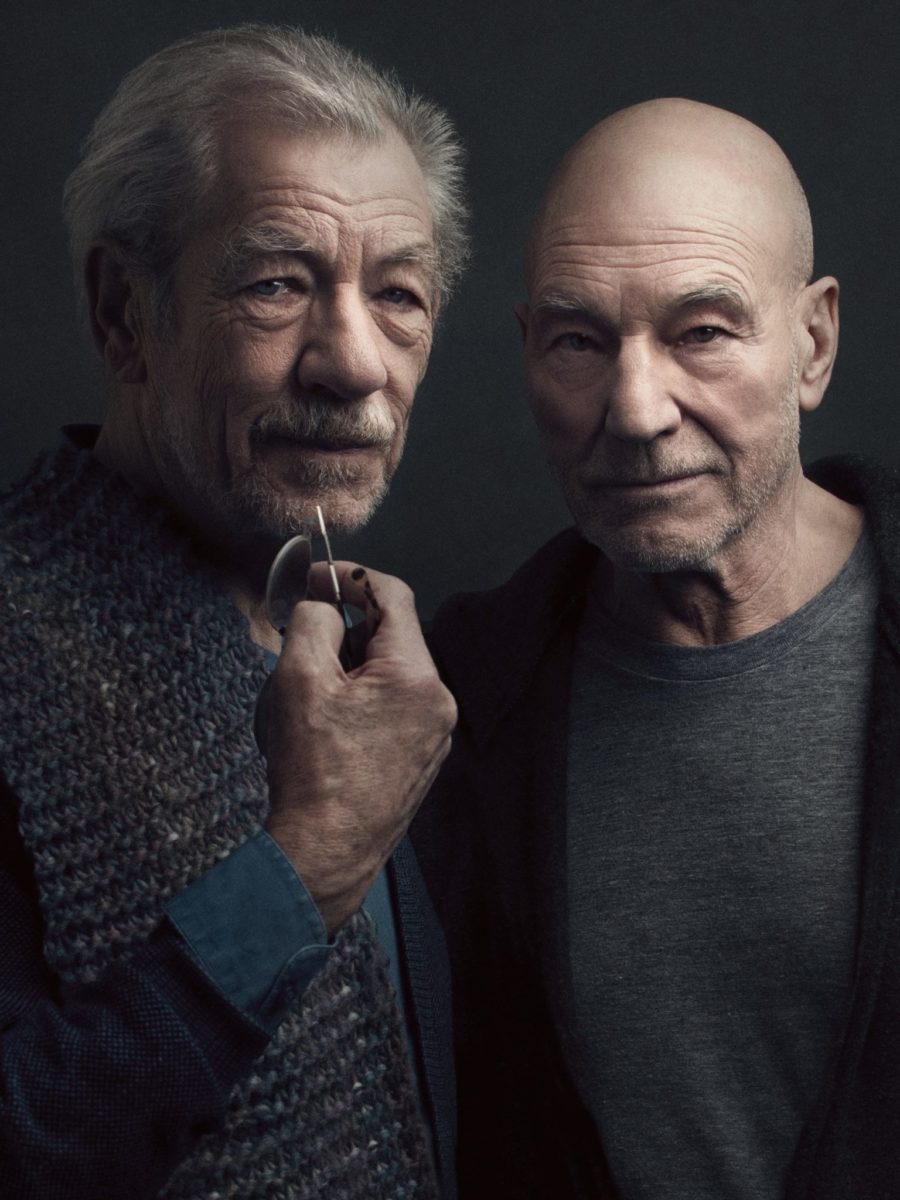
No Man’s Land reunites Sir Ian McKellen and Patrick Stewart on the London Stage and it is not difficult to see why Pinter’s play resonates with the two lead actors, containing its long passages of complex prose to articulate their way through; and a pair of strong lead characters truly dominating the stage throughout the duration.
With an abundance of strangely compelling verbal sparring between the two, McKellen’s magnetism and stage presence remains completely undeniable with a seemingly effortless performance which demonstrates why he is such an esteemed theatrical figure; whilst Stewart’s (appropriately) muted performance during the first act flowed into a more confident and surefooted second act, with the opportunity for him to revel in the demonstration of his craft. In the two supporting roles, Damien Molony and Owen Teal held their own as Foster and Briggs (a pair with a somewhat homoerotic undertone to their characters), stepping up to the challenge of sharing the stage with the two heavyweights. Sean Mathias’ direction gave a steady steer around Stephen Brimson Lewis’ quasi-symmetrical and somewhat charming set.
The difficulty with the play is that the narrative is inaccessible to the Pinter novice. Pinter’s absurdist play is just that, never really explaining the set-up, the characters, their identities, or their motivations. Their role in each other’s lives remains unclear and the play leaves the audience to draw their own conclusions and reach their own interpretations. Discussions with others have produced a number of differing explanations and theories, with the post show chatter as varied as the scripted anecdotes portrayed on stage. On a personal level, a play with a straighter narrative and less deliberate obscurity would have been far more preferable. I couldn’t honestly say that I enjoyed the actual play itself; but that did not detract from the sheer joy and superb opportunity of seeing two of this country’s finest actors doing what they do best.
No Man’s Land is more of an experience rather than a gentile evening in the West End. An intensively poetic and wordy script provides for a sometimes difficult and challenging watch for those not familiar with Pinter’s work, but whilst the play is not for everyone, the opportunity to see two titans of British theatre is well worth it, and not one to be passed by lightly.
Confrontation of prejudice is not always easy, but is essential in breaking down barriers. At 22 years old, Jamal Gerald, a black, gay, performance artist is embarking on his first UK tour with the provocatively named show “FADoubleGOT”.
Picture Credit – Mark West
Using his one man show to tell his own personal story of the highs, lows and in-betweens of growing up as a black gay man, Jamal draws on his experiences to confront the use of prejudicial language and anecdotally tells tales of sex parties, hook-up’s, relationships and Grindr dates; mixed in with candid accounts of surviving periods of self-loathing, experiences of racism and homophobia and of his internalised conflict between his religion and his sexuality. Following opening his tour at Doncaster CAST Theatre, Jamal spoke exclusively to TheGayUK about the themes of the show, why provocative theatre remains relevant and how Freddie Mercury changed his life.
TGUK – You have chosen quite a provocative title for the piece
JG – Yes, and it was very deliberate for a number of reasons. It stems from a friend of mine who I met at a festival who texted the word to me during an argument. I was astounded that someone would not only use that word towards someone who was a friend to them, but that they had typed it; they had spelt it out letter by letter – F-A-double G-O-T – and just how hurtful a word it was. But then it’s also about seizing ownership of the word for the LGBT community; about taking possession and disempowering the word by taking it back. Queer was used as an insult historically, but in recent years it has been taken back by the LGBT community and turned into a positive label. I wanted a title to reflect one of the aims of the show, which is about confronting and challenging the audience to look at issues of prejudice, racism and homophobia.
TGUK – Why do you think pieces of theatre like this are still important?
JG – Things have changed a lot, but there is still a way to go before prejudice is eradicated. Theatre is an art which has the power to do many things, and it is not just about being entertained. Of course, I want audiences to be entertained when they come to the show, but also I want them to be challenged; to look into themselves and to look at their own experiences, regardless of where their experiences lie. For the LGBT community, I hope that they will see glimpses of themselves reflected in my experiences. For straight audiences, I would hope that they either see some of the experiences that members of the LGBT community have to go through, which they themselves may not have experienced first-hand; or for them to see the impact of prejudice upon the victim. I also want younger people who may be struggling with their sexuality to come to the show and see that they are not alone; that their feelings are not unique; that they are not isolated. There are a lot of us out there, and despite the confidence that some people exude, for the vast majority of gay men and women, there has been that fear, that self-loathing and ultimately that transition into acceptance of their sexuality.
TGUK – You owe a lot to Freddie Mercury, don’t you?
JG – Freddie was the catalyst for my self-acceptance; the flamboyance and confidence he exudes made me realise that I could be the person who I wanted to be. I think most people have “a Freddie” – whether it is a person in the public eye, a friend, a family member or even an experience or moment where everything seems to suddenly fall into place.
TGUK – You have a real mix of influences in your life, your mother is from the Caribbean, you were born in Boston, Massachusetts, and you moved to Leeds when you were 11. How did you find your voice with such a varied influence of cultures?
JG – My mother is a very traditional Caribbean woman; religious, larger than life, joyous and uplifting. My experiences in America helped to shape a lot of my perceptions about myself and those around me and being brought up in Leeds, I do have a lot of “Northern mentality”. I am, in many ways, still finding my voice, and I think that every day brings something new to shape you as a person and as an artist. I am fortunate to have so many different influences from my family, friends and those around me.
TGUK – How did you reconcile your religious upbringing with your sexuality?
JG – Religion told me I was a sinner, an abomination. I was told by people in my school that I was going to go to hell. I used to pray to God to pray the gay away. But as I grew older, I was able to balance myself and my religion. I believe in the concept of a god, but I am of the view that I can believe in God; but because my race is so important to me I find it hard to believe in the bible, primarily because of the history of colonialism and the use of the bible in that process. When I look at the link between colonialism and the Bible, it is not something that I want to embrace or accept. My black heritage and my identity as a black man is something that is more important to me than my sexuality is; and the way in which the bible was used during that period of time was wholly unacceptable. For me, it remains a symbol of repression in many ways. It was used to repress the black community many years ago and, in my experiences as a younger person, it was used to repress my sexuality – but despite that, it doesn’t prevent me from embracing the idea of a higher power.
TGUK – One of the themes of your show is about your experiences as a black gay man. How has your ethnicity and your sexuality shaped your experiences of life?
JG – I have received so much acceptance and positivity about both of those things that it is hard to express some of my experiences without sounding like a cynic. The positive experiences do outweigh the negative ones, but during the show, I talk about my experience at a sex party, where a guy I was with only wanted to sleep with me because I was black and made a mood spoiling comment (when we were in the moment) about my ethnicity; and I do a section in the show about my experiences on Grindr, where the fact that I was black was often the predominant issue. It’s the usual stereotypes and prejudices; I’d get messages saying “Is it true what they say about black men?” or “I’ve always wanted to be with a black guy”; it made me realise that they didn’t necessarily want to be with me as a person, but that being black was just fulfilling a fetish for these men. It brought home to me the way in which black men can be perceived at times by others, almost as a commodity rather than a person. Racial fetishism is a subject which is not often talked about and it is another wall I want to break down with the show.
TGUK – Have you experienced more racism or more homophobia?
JG – It’s difficult to say; there have been times in my life when things have gone through phases. When I was at school, it was more about homophobia, as I went to a school in Leeds which was quite diverse, so ethnicity was not a particular problem. But as I went into higher education; it became less about my sexuality and more about my race. I have experienced both at the same time – when I was at school, someone wrote “Go home to Jamaica, Batty Boi” on our dustbin . That hurt – a lot. Given that my family is from Montserrat, it was an attack on my heritage and on my sexuality. I am naturally quite a flamboyant person, but I can hide my sexuality; I can’t hide the colour of my skin, so I would guess that would perhaps identify my ethnicity as the most obvious target. That said, I still identify myself as a black man first and a gay man second. When you look at the news about what is happening in America at the moment, with the rising racial tensions both politically and on the streets; and you look at the terrible tragic events in Orlando only a few months ago, both racism and homophobia are very much alive and predominant in society.
TGUK – When you are on stage performing this piece, you lay yourself bare, both metaphorically and literally. How does it feel to relive highs and lows of your life night after night on stage?
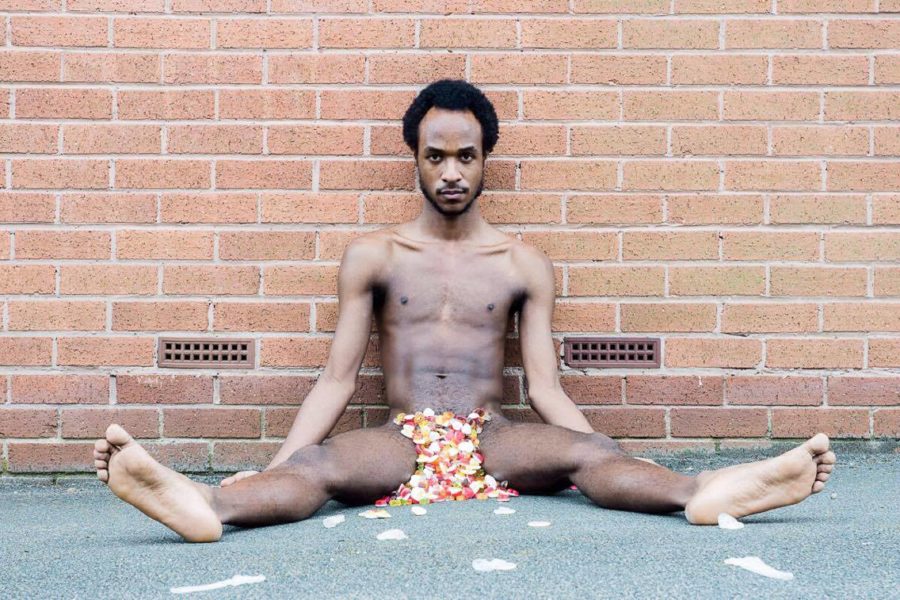
JG – It can be emotionally draining and it can be cathartic. Despite its simplistic presentation, it is quite a deep piece. I talk about things which are really difficult for me; such as my internalised homophobia as a younger man; the moment I came out, my experience in the church and about relationships which have hurt me in one way or another; but that is counteracted by the fact that I also talk about the positivity I have experienced. It’s not just about reliving the hard times; it is also about constantly remembering and reinforcing the positive steps on the journey which have led me to where I am today. By performing the majority of the piece in just a pair of short, black, tight trunks, it shows that I am hiding nothing, that I am open and honest. There is nothing to hide behind on the stage, not even clothes, and it is about reflecting that I am quite literally exposing my life, my thoughts, my experiences to the audience.
TGUK – You use a lot of symbolism to tell your story
JG – There is a section where I eat a raw onion in the show. On a simplistic interpretation, it may look like the usual analogy of an onion having layers and about how that is reflective of me as a person, which may look almost cliché. But it is deeper than that; the symbolism behind it is that, as anyone who sees the show will tell, I hate onion and consuming it is symbolic of ingesting something that I hated, of my repressed sexuality as a youngster and of my internalised hatred of who I was as a result of my cultural experiences growing up. The piece has a lot of aspects which have multiple meanings and it is for the audience to draw out their own conclusions about what the piece is saying. My show is, in some ways, a gift to the audience. They can take it and use it how they want. They can accept the gift and enjoy it, they can appreciate it, pass it on, re-gift it or put it in the cupboard – but it is something I offer to them with a genuine intention; what they then do with that is up to them.
TGUK – You end the show painting yourself in the colours of the rainbow flag. Why chose that piece of symbolism to round off the show?
JG – I wrote a poem some years ago where I used the line “ripping rainbows apart” and I wanted to bring that line to life. But also because the rainbow flag is a symbol reflecting both sexuality and colour, which is what this piece is about. It felt a natural way to bring the piece full circle. Ending the show embraced in the colours of the rainbow flag feels comfortable and is about how, despite their differences, the LGBT community do embrace each other. The flag gives us protection and a sense of togetherness. How else could I end the show except for showing the unity and the positivity of the LGBT community as a whole?
FADoubleGOT is currently on tour, calling at The Hive in Shrewsbury (30.09.16); Hackney Showroom in London (04.10.16), as part of the And What? Queer Arts Festival; Live Art Bistro in Leeds (14.10.16); Camden People’s Theatre in London (18.10.16 and 19.10.16) and Theatre Deli in Sheffield (17.11.16). You can follow Jamal on Twitter at @JamiBoii and on Tumblr at http://jamalgerald.tumblr.com/ . Many thanks to Doncaster CAST Theatre (www.castindoncaster.com) for facilitating this article.
Set in 14th century Verona, the rivalries between two families, the Montagues and the Capulets, are intensified when Romeo and Juliet fall for each other. But coming from rival families means that their love faces insurmountable odds, and when the conflict escalates after a street fight ends in bloodshed, with Romeo killing Juliet’s brother, a chain of tragic events is set in motion, as the lovers try to escape the confines of their family loyalties.
Photo Credit – Andy Ross
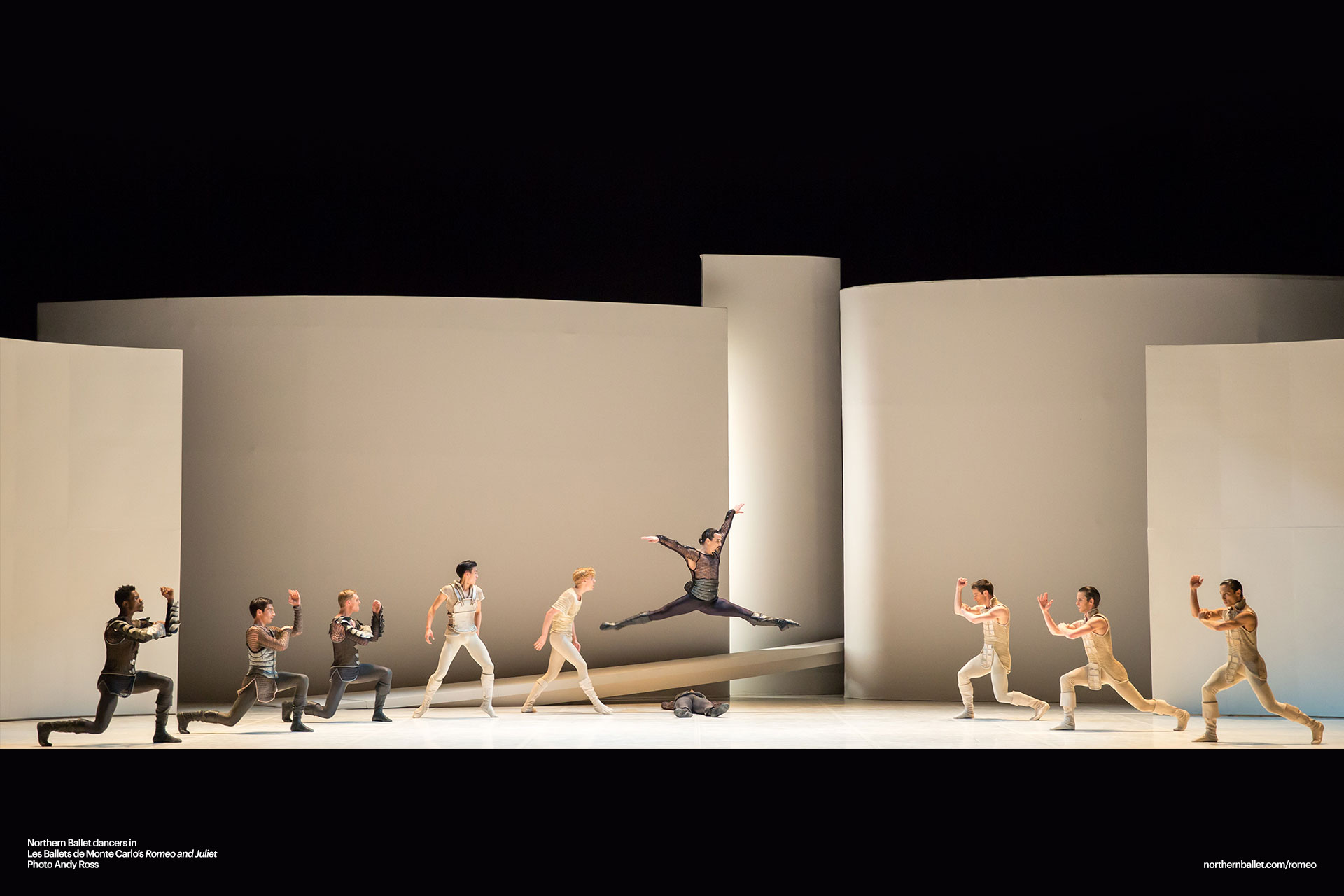
Departing from their signature style, Northern Ballet presents a piece which is stripped back to the absolute minimum. Set against a purely white backdrop of linear shaped screens, splashed only with the occasional coloured lighting wash, the minimalist presentation and lack of any real set, props or backdrops only served to focus the audience’s attention to the frenetic, visceral and energetic choreography and performances. With no smoke and mirrors to hide behind, choreographer Jean-Christophe Maillot lays his work bare on the stage, and this move pays off, providing an incredibly fresh and thoroughly contemporary piece of dance. The choreography encompasses the romantic, the dramatic and the passionate; and the whole thing is dotted with the occasional pieces of humour, which helps to provide respite from the dramatic mood slightly. The costumes, with a hint of John Paul Gautier running through them, stand out from the white background to easily define the family loyalty of each character, and the use of a contrasting colour palette (predominantly cream and black) mirrors the themes which underpin the story; love and rivalry; comedy and tragedy; life and death.
Most notable amongst the slew of energetic performances was Javier Torres as Tybalt, who portrayed his character with a bullish arrogance. There was also a noteworthy and incredibly supple performance from Mlindi Kulashe as the priest tortured by his own guilt. The cast’s performances were tightly in unison and technically impressive, in particular, the Dance of the Knights, which was an exciting set piece performed with precision moves and breakneck speed.
Romeo and Juliet is wholly reliant on its performances and choreography, which does not disappoint. Overall, the show has more of a feeling of modern dance than traditional ballet, but this does not detract from the skill of the performers or from the sheer spectacle of the edgy, angular and visually striking set pieces which are juxtaposed against the traditional score by Prokofiev in a clash of modern and traditional.
Romeo & Juliet is currently playing at Sheffield Lyceum (www.sheffieldtheatres.co.uk) until Saturday 17th September, before continuing its national tour. Northern Ballet will be continuing to tour throughout the UK this year with a variety of productions, including Romeo and Juliet, Wuthering Heights and Beauty and the Beast. Visit the company’s website at www.northernballet.com for full details.
★★★ | In 1944, big band leader Glenn Miller’s plane went missing over the English Channel as he flew to Paris to entertain the troops during the Second World War. From his humble beginnings, Miller’s musical arrangements defined the sound of a generation and secured him legendary status as one of the greatest musical artists of all time.
Photo Credit – Pamela Raith
There is a double dose of nostalgia on display in this musical biopic, with not only the music of Miller, but also the presence of the show’s top billed star, Tommy Steele as the titular character. Classed as the first English teen idol and rock ‘n’ roll star, Steele still holds a loyal fan base from his success in the late 50’s and early 60’s, clearly still resonating with the target audience and retaining a certain charisma and an air of ease and professionalism. That said, at 81 years old, he is twice the age of Miller when he died, requiring a healthy suspension of disbelief, especially during the slightly uncomfortable-to-watch romantic scenes between him and a much younger Abigail Jayne, playing Miller’s wife to be. But despite his age, Steele can still trot out the tunes and knows how to play to the audience.
So whilst Steele is billed as the star on the posters, the real attraction here is the music itself, and although the show is generally overly-light on narrative, it doesn’t scrimp on the classic big band sound; as a number of Miller’s best known numbers are performed by the on-stage sixteen piece orchestra, including Moonlight Serenade, In the Mood and String of Pearls. Throw into the mix a number of lively jazz numbers, all with the trademark Miller-style arrangements, and you have an energetic and up beat set of songs ably undertaken by the orchestra and ensemble.
There is very little in the production values to make this show stand out from the crowd. There is generally a basic, but perfectly competent, presentation and Bill Deamers choreography nicely retains the spirit of the era. But show is primarily a tribute to the music itself, and it really comes into its own as the orchestra takes to the stage, especially during the second act.
The Glenn Miller Story is a pleasant, easy and gentile watch, which is undemanding and which, most importantly, doesn’t pretend to be something it’s not. It is pure unabashed and unashamed nostalgia which gets the feet tapping and celebrates just how good these classic songs are.
On Sunday 24th July 2016, it was rainbow flags ahoy at the second Chesterfield Pride, which took place in Queens Park in the town.
Photo Credit – Paul Szabo
Following on from the success of last year’s inaugural pride event, this year’s was bigger and better, with lots of stalls, a fairground and some top class entertainment, including not only an abundance of local talent, but also their headline act, soul legend Angie Brown, who belted out some classics!
The crowds were queuing to get into the event, which had free entry to all, when the gates opened at 1pm and they partied late on into the evening. With its superb party atmosphere fuelled by a really mixed crowd, it was certainly a great celebration of diversity.
You can support Chesterfield Pride by following them on Facebook (www.facebook.com/chesterfieldpride) and Twitter (@cfieldpride)
Congratulations to everyone who organised the event and Happy Pride to all those who attended.
A warm midsummer evening, a busy hospital, a plethora of patients and staff and a mash up of Shakespeare’s best characters come together in A Dream, where the most infectious thing doing the rounds on the wards is love. Written by Chris Bush, Sheffield People’s Theatre combines a collective talent of over a hundred people to interlace some of Shakespeare’s best-known works.
Photo Credit – Mark Douet
The stories include a doctor who falls in love with a cleaner; the love between two gay men, and the impact of their love upon their parents and the relationships between parents and children. Married couples explain the secret of their relationships longevity, whilst youngsters fall in and out of love as they try to find their own way in life. Add into this mixture a number of Shakespeare staples – the girl who disguises herself as a boy, distinctions in social class, the case of mistaken identity, the issue of families separated through tragedy. All of these familiar elements are pulled together in this production.
Bringing A Midsummer Night’s Dream into modern times, via quips, quotes and characters from As You Like It, Romeo and Juliet,The Tempest, Much Ado About Nothing and Anthony and Cleopatra, A Dream makes for a whimsical and light-hearted evening which has a number of points of appeal. Chris Bush interweaves the lives, loves and stories of a number of characters, in an intertwining narrative which is light and bouncy. There are a handful of brief musical interludes and pieces of choreographed movement which are enough to keep the pace moving but not numerous enough to class it as a musical.
But beneath the whimsy and the somewhat seemingly superficial storyline was something that had real heart. The show looks at different ways in which love can manifest itself and how love can transcend boundaries of age, gender, social standing and sexuality. There is a real heart to the show, nowhere more blatant than a very well-written tribute to those who work day in day out in hospitals; and who make a difference to people’s lives with every shift that they undertake.
The show was presented well with an engaging clinical set and some good performances standing out amongst the masses. Some of the scenes seemed slightly superfluous, some slightly overlong and some seem to run out of momentum a little prematurely. But overall this is a well-written and crafted piece undertaken by a large cast of over one hundred enthusiastic performers.
Similar in style to Dickensian, which recently graced BBC One; the show can certainly be enjoyed on face value, but there is also ample opportunity for spotting the Bard references for the more ardent Shakespeare fans. It is fitting that with the setting of the hospital and the over-arching theme of love, this show is a love letter to the NHS, to the theatre and to love itself.
★★★★ | The Rocky Horror Show takes the audience on a strange journey, as Brad and Janet, two ordinary high school kids, have a little car trouble and end up at the castle of Frank-N-Furter; a cross dressing scientist cum force of nature, on the evening that he is to bring his Frankenstein-esque playmate, complete with “dark hair and a tan” to life. Featuring the songs The Time Warp, Sweet Transvestite, Science Fiction/Double Feature, I’m Going Home and Dammit, Janet; will things ever be the same for our two high school sweethearts?
Photo Credit – Sean Webb
The role of Frank-N-Furter is so iconic, that you need a larger than life personality to fill the fishnets, and Liam Tamne does a great job blending Frank’s camptastic alluring persona whilst maintaining an underlying gruffness in his vocal performance of the songs, whilst Richard Meek excelled as Brad, particularly in his rendition of Once In A While. Dominic Andersen was the personification of perfection as he filled out the gold hot pants of Rocky, and Norman Pace (of Hale and Pace fame) traded quips with the audience as the Narrator. Sadly, Kristian Lavercombe was a slightly too shouty Riff Raff and Paul Cattermole (S Club 7) was nothing more than functional as Eddie/Dr Scott.
Rocky Horror is presented here in all its gloriously loud, brash, colourful, neon Day-Glo garishness, with a set which looks luxurious and holds an almost cartoon-like feel to it; all accompanied by an excellent lighting design by Nick Richings which flooded the stage in reds, greens and purples, and some steady direction by Christopher Luscombe. But within that polished veneer, it loses some of the darker undertones of the piece, leaving it with a slight hint of almost being a caricature of itself. The slight stumbling block of this production is that, ironically, it is done so well.
But that said, the show is a phenomenon, and the atmosphere at any Rocky Horror performance is one which has to be experienced. This production is a fresh take on a classic show and one which engages the audience like no other. So pull on your fishnet stockings, warm up your vocal chords and go and “give yourself over to absolute pleasure”.
The Rocky Horror Show is at Sheffield Lyceum (www.sheffieldtheatres.co.uk), who has just launched their new season, until Saturday 25th June 2016 before continuing on its national tour until the end of the year. See www.rockyhorror.co.uk for full details.