Author: Sasha Selavie
-
THEATRE: Le Corsaire English National Ballet
BALLET ‘Le Corsaire’ by English National Ballet@The London Coliseum, St.Martin’s Lane to 24th January. 5 Stars! Flesh made Furiously Fluent! ★★★★★ (more…)
-
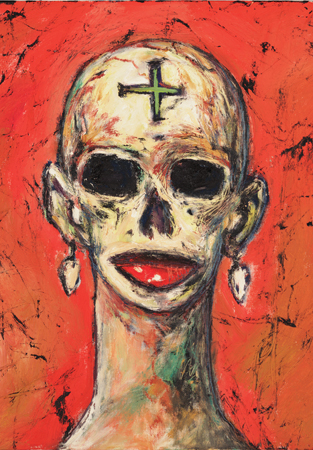
REVIEW: Voices Of The Damned, Barbie Wilde
Why does gay art – in every form – completely eclipse its’ timid, straight rival? Because – quite simply – it’s fuelled by overwhelming lust. From the lush, teeming criminality of Caravaggio’s canvases, to the pouting proportions and Apollonian aphrodisiac that is Michaelangelo’s David, gay aesthetics scream artistic arousal. ★★★★★ (more…)
-
THEATRE REVIEW | The Prime of Ms. David Hoyle
Have you ever loved a poxy, gaping wound that never heals?
Have you ever loved a poy, gaping wound that never heals? Welcome to the pure disease of radical thinking, the open-heart artistry of David Hoyle. A precision provocateur, he’s a beautiful leper puking on the bland smirk of consensus dissent. Never afraid to offend, he’ll stare, point-blank, at dead-eyed conformity, and test-drive blanket idiocy to total destruction.
So, tonight –in character as a no-limits, libertarian headmistress for tonight’s show, ‘The Prime of Ms David Hoyle’ – he’s in his element. And, as always – perhaps acknowledging some fractured, kindred mind-set – his intentionally smeared make-up is a cosmetic-Cubist’s spin on Liza Minelli. It’s pithy, visual ventriloquism, an instant, persona transplant of Liza’s unshakeable self-belief, an immediate, autocratic departure point for Ms. Hoyle.
And it’s wholly appropriate. Tonight, David’s manifesting – and inverting – that patronising sense of belonging British schools cram into pitifully vulnerable minds. Quite brilliantly, he’s subverting the crypto-fascist overtones of Muriel Spark’s Prime Of Miss Jean Brodie novel into a school-night for unedited, sexualised scandal. How? With extreme satire, the preferred poison for killer, social comedy since theatre began. Essentially, it’s the freedom to question any standards of etiquette, taste and so-called decency, and push them to blatant heights of self-evident absurdity.
Therefore – as headmistress in tonight’s mock, end of school-term assembly – David unflinchingly proclaims his inflammatory manifesto. ‘Ladies and gentlemen, and those clever enough to have transcended gender’ he begins, ‘We are now free from the ridiculous expectations of our genitals. It will be trans people, and trans consciousness that will liberate the whole of humanity’.Wow. Simultaneously utopian, hilarious and upstaging blinkered identity politics, it’s a typically stellar David Hoyle starting-gun, but not one winning full approval. One heckler –ex-forces, befuddled, confrontational – obviously feels his servile, binary-sexed values are being mocked, a surly, potential flash-point. But immediately, he’s beautifully love-bombed by David, and instantly evolves from feisty reactionary to besotted disciple.How could he not? David’s seductive power of surreal persuasion totally rewrites any opposed punter’s world-view with a stunningly queer lexicon. Fittingly, David queers our global pitch from its first, bedrock principle – education – and, as always, asks gloriously awkward questions.
‘Does education make us conform’ David ominously inquires, ‘by hacking off our beautiful eccentricities?’ Oh yes; British state and public schools give a kiss of Guantanomo Bay brutality for arty queens enduring term-time torment. But not tonight, as, quite gorgeously, our devil’s advocate headmistress unleashes three recent graduates of his maverick regime.
First, there’s Bambi Sexsmith, self-styled, queer conversion therapist, with her projectile-diction sermon on avoiding ‘Straight Complex’. In an assured blizzard of quips, she diagnoses, treats and cures any obstacles to thoroughly liberated, thoroughly queer existence. And, remarkably, that’s just for starters; each fabulously unpredictable prodigy from the Hoyle class of honour ramps the anti-hetero stakes stunningly higher.Take Ray, a flawless, drag-king Fred Astaire clone. Tap-dancing like a frenzied needle probing an addict’s veins, she strips to a startling androgyny, all duct-taped, flattened breasts and stencilled six-pack. A take-no-prisoners attack on the mediocre, mundane and pointlessly mean, David’s graduates conclude with the starkest, cautionary warning yet; enter, ‘Cis White Male’.
Naked, mute and nervous, his name scrawled on his belly, ‘Cis’ is a shocking indictment of state education crushing social and sexual dissent. Is there an antidote? For sure -Ms Hoyle’s fearless call to self-expression at any cost. It’s a fantastically liberating lesson that, ideally, should be taught and memorised from birth, the ferociously humane heart of David’s stunning rejection of global despair. Live free, live fierce, live now; there’s no finer riposte to mindless fascism.
David’s next show is December 9th at Bethnal Green Working Men’s Club.
-
Cassandra Wilson As Billie Holiday Will Leave You Breathless
Is the pop-music business truly gay-friendly?
Does it support, or viciously distort, perceptions of clearly gay pop? Both, actually. For every Bowie, Boy George and Marc Almond, there are others encouraged to view public disclosure as career suicide. It’s not surprising. If undeniably high-profile, pop’s also a hugely juvenile art-form, subsisting on one novelty sugar-rush after another. At best, it’s trashy, and, at worst, wholly undignified, a screeching, ridiculous hag reminiscent of Bette Davis’s classic, cinematic nightmare Baby Jane.
Ah, but there are far more dignified arenas for expressions of gay, artistic presence, jazz music for one.
Elegantly bypassing pop’s embarrassingly public temper tantrams, jazz, more subtly, encodes the intuitive leaps of gay logic in seductively complex rhythm sections. Put simply, that just means jazz – unlike pop – mimics the mercurial flow of queer creativityIt’s not surprising. Historically, jazz swarms with majorly influential outsider figures, all injecting a distinctly queer, unpredictable sensibility into the music itself. There’s Billy Tipton, the acclaimed, secretly female bandleader who lived her life as a man, complete with bound breasts and a padded crotch. More famous still, there’s Josephine Baker, the infamously banana-skirted toast of 1920s Paris, and finally, effortlessly heading any list of queer artistry, Billie Holiday.
All three women, quite aptly, embraced gay affairs, and Holiday, additionally – as a smack-binging black woman – had triple outsider status. So, in a world increasingly celebrating bland excess, it’s beautifully liberating to have Cassandra Wilson – arguably the finest singer in modern jazz – channel Billie’s brilliance.
Never heard of Ms. Wilson? You will. In brief, her voice is gorgeous, post-coital, smoked honey, a swooning, breathy rapture drowned in the instrumental love-making of her backing musicians. And, quite simply, her artistry soars unreachable heights beyond pop’s brain-dead, battery-farm divas pumping out clueless cover-versions night and day. Rather, her newest album– Coming Forth By Day – reworks key, Holiday songs as sultry tone-poems of loss and redemption.
So cultural expectations, perhaps, ran unrealistically high for her centrepiece appearance last weekend at London’s annual jazz festival. But in the shocking wake of the Paris atrocities, any appearance by Ms.Wilson seemed improbable, due to fraught, security fears.Only minutes before show-time, a muddled announcement seemingly cancelled the gig, but Ms.Wilson, admirably, refused to be intimidated by philistine fanaticism. And in a stunning gesture of triumphant, queer solidarity, she unleashed the full force of her talent as standard-bearer for Billy’s sublime, queer misfit mystique.
Yes, she was unavoidably late, but heartfelt music’s always been thrillingly life-affirming, and Wilson’s short, if haunting set, spoke moody volumes.
‘Hush now, don’t explain’, she sang, bringing wrenching depths of situational sub-text to one of Holiday’s greatest songs. Weaving a spellbinding, definitive refusal to oppression onstage with just her voice and band, Wilson’s serene dignity was a master-class in queer resistance.
Someday, perhaps, the most diligent pop-divas might distantly approach Wilson’s unruffled panache, but don’t hold your breath waiting. Pure art – like integrity – never settles for second-best. Frankly, for artists, as exalted as Cassandra Wilson, the Simon Cowells of planet earth merely serve as closed prison cells, not express highways to intoxicating art. It’s their loss – and ours.
-
INTERVIEW: Penny Arcade, Rage Against The Totalitarianism
‘Radically embracing queerness in every possible sense – social, philosophical and sexual- Penny Arcade is tirelessly producing a crucial body of work for our times’.
Is the 21st Century terminally corrupt? Daily, demented greed, morally bankrupt wars and savage racism rip the world apart. It’s a cluster-f*ck axis of evil that Aleister Crowley- the once globally-infamous, Great Satanist – would have adored. “Nothing is true,” he crowed, “Everything is permitted”.
It’s undeniable. We’re locked – perhaps irredeemably – into a screaming, existential hell of brutal, mass-media spin and amoral, state-sanctioned atrocities. Is there any hope, beyond the hollow refuge of wishful, magical thinking so briefly espoused, then spectacularly deflated, by author Joan Didion?
Oh yes. Say hello to passion. Say hello to clarity. Say hello – quite unforgettably – to Miss Penny Arcade, the fantastically fearless, performance-art paragon and prophet of palliative rage.
Petrol-bombed in the holy, unquenchable fire of hugely moral indignation, she’s an ultra-modern Joan of Arc, savagely castrating the gross, Grand Zero blasphemy of gentrification.
Unsurprisingly, she’s hugely daunting to interview. Even physically, even simply seated, Penny’s an electrifying, provocative presence. Textbook notions of mainstream reportage –let alone passive interviewing techniques – don’t begin to do her activist brilliance justice.
If journalism’s an ethical record of subjective judgement, scrupulous honesty demands stating I’m overwhelmed by Penny’s fire-cracker avalanche of insight and analysis. Initially, I’m thrown, but Penny’s patient, and better yet, kind. And her blistering espousal of sheer humanity – a cri de coeur of compassion, integrity and utter authenticity – is a superb narrative through-line. Miraculously, we’re good to go. How did Longing Lasts Longer –her newest, often hilarious, but devastating critique of our cultural malaise – develop?
“Longing Last Longer started as a piece about the end of my marriage, and opened up a part of me where I really started to examine my life-long need for approval”, she begins. “As the poet Adrian Rich says, ‘I was ‘shoved out on this bleak edge/ before naming/before caring’, and I felt stripped to the bone. But it did usher in this period of self-enquiry, questioning why I didn’t want to be in a traditional relationship, realising most of my desire to be in a relationship was to recreate a family life I never had as a child”.
But don’t dare dismiss Penny as a pining, nostalgia junkie – Longing Lasts Longer furiously spits on fetishizing the past. “I get so sick of hearing about nostalgia. I certainly don’t want to be who I was before, I’m an incredibly contemporary person. So in Longing Lasts Longer, there’s a difference between nostalgia and longing. Nostalgia is a sentimental yearning; not only for the past, but the person you were in that past. By contrast, longing is a persistent sense of loss that attaches to ourselves and our unrealised desires. We long into the future, as I say in the show”.Already in her 60s, but with a solo legacy beating dozens less productive, she’s keenly aware of each brutally brief second. “I realise how short life actually is, and you can’t really achieve everything you might’ve wanted to, but my life has always been directed by a need for beauty, art, and poetry that I’ve mediated my entire life through music. Often, today, you’re not allowed to speak except in a very conscripted way, but when I think back to the self-defined trannies who were so important in my life – my tribe has always been the two-spirited people questioning gender – Jayne County used the great rallying cry I will repeat as often as possible: ‘Don’t use your liberation to stifle my liberation!’”.
Exactly. Transgender myself, I’m hotly opposed to binary stereotypes and, even more, reductive identity politics, and Penny’s words strike an immediate chord with me. Linguistically, socially and theatrically, she’s validating a crucial ambiguity, a plurality of gender expression for those otherwise excluded. It’s what gay author Truman Capote’s debut novel eponymously defined as ‘Other Voices, Other Rooms’.
“I’m speaking from the position of a louche outsider, with a philosophy I have developed my entire life”, she continues. “A philosophy of pleasure, and my whole life has been about doing what I want to do, which is why I also characterise myself as an anarchist. But at the same time, I know I need to take responsibility for myself and my actions and not harm other people”.
“And there are only two groups that value ecstatic experiences above security and planning for the future”, Penny further clarifies.
“Bohemians and the ultra-poor. The writer Bruce Benderson’s Towards A New Degeneracy talks about pleasure as a radical value, and Steve Zehentner, my artistic collaborator, has always used pleasure as an investigative tool, of getting into other states of mind. Joy, authenticity and individuality are our only weapons in the face of death and annihilation”.
It’s an admirable self-awareness wholly missing from the vicious, exploitation ethics threatening every deviant art heritage. Are you sick of monoculture mediocrity, the bland homogenisation of every street, city and mind-space, on and offline? Blame Edward Bernays, the nephew of Sigmund Freud, name-checked by Penny as a major architect of modern banality.
Weaponising mass, crowd psychology as a shock-wave for ruthless marketing, Bernays’ theories rammed commodity culture – the need for pointless need –into innocent minds worldwide. No wonder Penny’s once boundless optimism is now more carefully qualified.
“We’re rolling into totalitarianism, and I see no help for that,” she sighs, “because we’re living in an era where people’s individuality has become more and more and endangered trait. So, right now, we’re living in a period of complete consensus, where anybody who stands out in any way – except by having money – is attacked. It’s just the opposite of anything that ever interested me.”
And the only way forward? For Penny, it’s a rigorous, non-stop enquiry into her own self, authenticity and hidden motives. “I was with Quentin Crisp one time, and I was quite young, 38, and he said, ‘You must go within, you must resolve the glorious opinion you have of yourself with what others call the trouble with you. This journey is not an altogether pleasant experience’”.
Perhaps not, but Penny’s severe self-analysis has facilitated disturbingly clear insight. And it’s an insight that despises vapid online addiction – the 24-7 Facebook syndrome- and blindly youth-focused media and social planning.“A huge part of modern culture is invested in convincing people the first forty years of their lives are superior to the last forty years, that you might just as well hang it up at 40 or 50. That’s unacceptable. Is your orientation that you’re just here to accumulate wealth, spouses and property? Or do you have a concept about yourself as something to be more greatly developed?”
For Penny, it’s emphatically the latter, and, if we have any humanity whatsoever, our steadily deepening empathy inevitably links us to life’s richer complexities.
“I believe as you get older, your life gets more synchronistic, and if it doesn’t, there’s something wrong”. She means sensing the intensely meaningful, but oddly random patterns of personal coincidences first conceptualised by Carl Jung, the great Swiss psychiatrist. As experienced by Penny, synchronicity is a profound, often inexplicable connection with the world.
It’s not surprising. Utterly focused on living supremely attuned to subtle nuance both on and off-stage, Penny even embraces the seemingly paranormal. One recent, memorable event occurred during a creative residency in the US at the hugely prestigious, deeply rural McDowell retreat in New Hampshire.
“I thought the trees were talking to me”, Penny reflects, “then I realised it was the artists who had died there trying to communicate with me. And one person emerged, and she was an American poet named Elinor Wylie who lived a super-scandalous life and died at the turn of the century in exile in London 1898. In Berners Street, in fact. And that’s right where I’m living while doing this show. Textbook synchronicity”.
“You see, synchronicity is us being forged into our own lives; you’re tuning into simultaneous realities. But if you don’t have an inner life, it has to be something outside you, tarted up with bells and whistles. Otherwise, you feel a gaping emptiness, but I feel fabulously rich inside”.So she should. But to sceptics and critics, of course – especially of a right-wing, semi-fascist persuasion – Penny’s rarefied thinking fatally compromises her otherwise rigorous analysis. Ah, but she’s hardly that naive, and often, crushes critics of any persuasion between ironically opposed flaws in their own logic.
It’s called the Socratic method, a fierce inquiry between orator and audience to stimulate critical thinking, and boasts impeccable queer credentials. “Do I contradict myself?” the great, gay American poet Walt Whitman mused in his magisterial poem Leaves Of Grass. ‘Very well then/I contradict myself/I am large/I contain multitudes’.
Indeed. Just like Penny herself, a teeming, unstoppable tsunami of dissident voices. Working light-years beyond Oscar Wilde’s embittered, post-trial, conceptual impotence, she’s refined his taut, inverted attacks on mass injustice into shockingly precise, social critique. It’s language stunningly deployed as a weapon of mass reconstruction, a screaming wake-up call on the crumbling edge of our global, amoral abyss. Will you listen? Or better yet, act and resist? The truth – like Penny Arcade – is out there.
PENNY ARCADE’S NEWEST SHOW – LONGING LASTS LONGER IS AT SOHO THEATRE UNTIL NOVEMBER 21st. 020 7478 0100
by Sasha de Suinn | @MsSashaDarling -
THEATRE REVIEW | Penny Arcade, Longing Last Longer
All hail Penny Arcade. Her latest, solo show – Longing Last Longer – knifes gentrification in the guts in a non-stop orgy of conceptual homicide.
Deliciously stoked and provoked by the severe, outrageously queer Gospel of Quentin Crisp, she’s a multiple-orgasm messiah high on life, love and luxuriant language. Ah, but Quentin’s brilliant, misanthropic spite – an anguished, solitary voice of sanity in a worldwide disturbed ward – is only one voice in Penny’s polyphonic choir of existential fire. Frankly, she’s our Dante, Allan Ginsberg and Martin Luther King sex-changed to a post-indulgence, Mad Max Furiosa, a warrior poetess par excellence. All punk-rock poison to mass stupidity, and spitting incandescent, revelatory bile, she massacres cultural mediocrity on the spot.
It’s a gorgeous execution. Pointless identity politics and thought-police Nazis – the PC shock-jocks – are ruthlessly dispatched with stunning erudition and torn limb from linguistic limb. So they should be. Why lobotomise ourselves with divisive labels that set one social faction against another? Don’t fascist police states do that already? And that’s where Penny’s sublime, sheer art-attack joyously weighs in. Forget theatre; Longing Lasts Longer is language as visionary music, words and concepts blown as intoxicating, be-bop virtuoso jazz solos.
Utterly fearless, following no star but her own, outré contrariness and distrust of any authority – even her own! – Penny furiously asks the unsayable. Indiscriminately puking on taboos Labour, Tory and anarchist, she explodes orthodoxies cemented by dogma as utterly facile. And her most contentious target? Arguably, the mythic chimera of sexual freedom. Whatever labels our preening egos prefer – gay, bi, trans or straight – the physical reality is that females nurture and males take. ‘The biological imperative sees no difference between a c*** and an arsehole’, Penny declares with bravura crudity. How right she is. Guys will stick their dicks in anything; hello, glory holes? And even razor blades in prostitute pussies didn’t deter vets in Vietnam.
But don’t get her wrong. No prude, Penny’s partied for 45 years, the show’s soundtrack brilliantly accenting her excesses with a sonic blizzard of Nirvana, The Doors, Prince and more. Free your mind and your ass will follow, indeed; this is culture cut loose from classrooms and set wildly free as hot, sweaty, erotic dance. ‘I haven’t watched TV for 40 years’ Penny says, and why would she? She’s too busy living, the only known antidote to bovine, terminally-addicted consumerism and online ennui.
Impassioned, on a hugely physical and flame-haired roll, she decries the certifiably insane world of compulsory self-censorship and hair-trigger text warnings we’re sleepwalking into. ‘Mediocrity is the new black’ (as in fashion essential) Penny cries, and she’s so hilariously on the money it hurts. Apparently, even skimming textual trauma triggers the reality, so how vulnerable students approach American bestseller the Bible – crammed with sex and horror – beggars belief.
Frighteningly, Penny explains, our very powers of expression – a Niagara Falls of nuances – are being systematically impoverished by corporate consensus. Terrified to even expect sustained attention spans, we Twitter ourselves en masse to gnomic vapidity. George Orwell’s novel 1984 termed the process ‘Doublespeak’; with complex language deliberately erased, even imagining abstract concepts is impossible. Which perfectly suits repressive regimes and aggressive capitalism; the more inarticulate, easily swayed and passive drones we become, the better
‘You can’t call yourself fierce and demand a safe space outside of a mental hospital’ Penny inarguably states, succinctly nailing the paradox of fake, lip-service rebellion. So what will you do when, not if, the state dictates your life, liberty and pursuit of happiness? Penny’s answer is taking brilliantly-argued responsibility for her entire life, completely owning each trauma and rapture, with not a single, squandered second. Will you do as much? Don’t delay; ‘The roses in the shops have lost their scent’, Penny bewails, a shockingly astute, contemporary human metaphor. The message is plain, and passionately perfect; either live your own life now, on your own terms, or have it lived for you. Choose life. Choose passion. Choose Penny Arcade. She’s perfect salvation in a soundbite.
-
THEATRE REVIEW | Dina Martina “Sitting Ovations”
Would you willingly embrace artistic schizophrenia?
Even fiercely kiss your inner, self-hating, subconscious bigot? Join the club. It’s a deliberate, artistic strategy stunningly deployed by stellar gay stars Penny Arcade and Franko B, the spectacular collision of two opposing points of view.
Arguably first expressed in literature by Edgar Allen Poe’s ‘Imp Of The Perverse’ and refined as ‘DoubleSpeak’ by George Orwell’s 1984, it’s contrarianism writ large as art. Which is where manic, barely-sane comic Dina Martina – the probable incest brat of Family Guy’s Stewie Griffin and Ronald McDonald – comes storming in.
Hailing from Seattle, USA, she’s 301 pounds of deeply skewed fun, a human CGI ball of deeply silly putty.
So why mention her size? Because it’s the raw material of her art, darlings, Dina’s comic rocket-fuel, like Jack Dee’s trademark misery. ‘I stick to a high-sodium diet for that lush, larger-than-life look’, she giggles, her huge, plus-size clown’s mouth dilating like a gynaecologist’s nightmare.
Think Heath Ledger’s Joker squeezed in a ball-gown cursed with Michael Jackson’s falsetto, and you too might run screaming for the exit. But wait; this funky assassin in a fright-wig only has one, single target, her own, all-too-willing self. Zoning in on personal pain with the exquisite virtuosity of the Saw torture-flick franchise, Dina masterfully misleads us from moment one.
‘I live a life without purpose’ she sadly observes, but who could possibly take this cosy, human cupcake seriously? And that’s precisely the point; we’re being taken for a brilliantly contrary ride by a Wizard of Oz Munchkin with the super-shrewd crowd perception of Sigmund Freud.
But even with hindsight, it’s hard to adequately conjure Dina’s utterly demented stage entrance. Grinning like a slaughtered, Hallowe’en pumpkin, all Sergeant Pepper frock-coat and ballooning flesh, she pipes out inane, disco lyrics like a hooker on helium.
How do we take her? At face value? Not quite. See, no matter how twisted you are, there’s always someone more extreme. Take dog poo; amateurs eat it dumped and stale, but dedicated gourmets suck it straight out. Just like comedy, in fact, and Dina’s surgically precise freak-show.
And I’m in awe. Frankly, she’s attempting – and pulling off – a knife-edge balance of audience sympathies, by deliberately playing gay public poison Number One, the mincing, often self-loathing cliché. Never met one? Then check out John Inman and Larry Grayson on vintage TV. Still guaranteed to give gay rights activists instant heart attacks, Inman, Grayson and company were the utterly bland, acceptable face of homosexuality for heterosexuals.
Try that now, and you’ll be as ostracised as white actors in blackface playing to Afro-Caribbean audiences. But remarkably, Dina embodies that fluffy, yucky stereotype – the target of mass straight derision – and still melts modern-day gay heartstrings.
And mercifully, Dina’s Sitting Ovations is utterly removed from the vile, exploitative voyeurism of Soho’s deeply morally dubious Box club. Instead, she’s conceptually elegant, a drag Noel Coward of devastating double-takes and exquisitely dry, social dissections. ‘I am currently single’ she quips, ‘due to an unspoken agreement between me and men’.
Okay, so the subtlety’s often swamped in a pell-mell parade of costume changes and video clips of spoof 1980s pop tunes, but it bites. Dina’s cracked, sectioned-on-glee-pills voice sweetly trills of infants raised on booze-filled pacifiers, and middle-aged housewives memorably disfigured by ‘Necrospheres’, facial fillers harvested from spoiled corpses. In other words, USA today through a gorgeously dark, twisted gay looking-glass Oscar Wilde would’ve killed to glance at.
But there’s far more to ‘Sitting Ovations’ than faux-naive vignettes of the grotesque, distasteful and gaggingly twee. Arguably most memorable is a moody, extended reminiscence of an encounter with a (frustratingly unnamed) vintage Hollywood legend. Young, gauche and dumb, Dina’s fabulously dismissed by the aged, but still super-chic madam stabbing a prawn in her cocktail and holding it aloft.
‘This empty husk of a formerly vital creature’ she hisses to a suddenly tomb-silent room, ‘reminds me of you’. Just like anyone rash enough to risk Dina’s quick, eviscerating, Dr. Jekyll and Sister Hyde wit, in fact. Me, I’m shrewd enough to stay way out the firing line; Dina’s an ongoing, monster talent steam-rolling any unwary opposition, and sometimes – like many reluctant celibates – it’s best to just say yes.
At the Soho Theatre until 24th October 2015
-
COMMENT: Steve Strange The New Romantic Prince Charming
Steve Strange – fascinatrix, Bowie buddy, lead singer of Visage and Blitz Club doyen – was the pop-art Diaghilev of his generation, the New Romantic Prince Charming par excellence.
Often bizarrely overlooked for far lesser icons, he’s now deservedly receiving media acclaim, following his death this Febuary at the shockingly premature age of 55.So on Saturday, September 26th 2015, London’s iconic Café Royal celebrated Steve Strange’s life and influence in a stellar, high-profile tribute. Organised by his close friends Amanda Lloyd, Rosemary Turner and Steve Mahoney, the night dripped with mystique and live, mischievously quirky entertainment. Taking stylistic cues from Weimar-era Berlin as re-imagined in the movie Cabaret, Two Blondes and a Harp – Lowri-Ann Richards and harpist Glenda Clywd – burlesqued Kate Bush and cabaret itself. Additionally, singer Eve Ferret created prankish glamour and playwright Celine Hispiche delivered spicily arch poetry.Fittingly, scalpel-sharp style scrutineer Peter York – ex-Harper’s & Queen and eternally sleek – attended, the first columnist to comprehensively articulate Steve’s protean charisma. But what deviant magic first sparked Steve Strange’s muse before his rise from Blitz Kids glory?Was early 1970s England an erotic wasteland, dominated by missionary positions and gay caricatures? Not quite. Way before Rocky Horror’s brash sleaze-a-thon, T.Rex glam-rock godhead Marc Bolan quite deliberately, quite impishly, unleashed a pansexual, Pandora’s Box for the ages.‘You can bump and grind/if it’s good for your mind/But you won’t fool/The Children of the Revolution’, Marc poutingly, presciently sang. Incidentally, he also lit a jumping, jitterbug fuse in the collective libido, a slow-burning, sartorial blitzkrieg. Poet, singer-songwriter and effortless androgyne, Marc catalysed an entire generation of potential, but rudderless glamsters ripening unseen in the UK’s dance-halls and schools.
All canny, fey, fop-till-you-bop, Tin Pan Alley Tolkien, Marc mined and set free a stunningly queer, esoteric eroticism. Popularly, in Sun tabloid-speak, revolutions are harsh, brutal and militaristic, but Marc’s was sensuous and satin-wrapped with the holy fire of imagination. It also didn’t hurt that his casual, cocky aura of dandy magnificence fit him like an irresistible, phallic glove.Predictably, Marc’s flippant, delicious, polymorphous perversity went instantly viral. If far less threatening than Bowie’s instantly alienating, killingly cerebral, bisexual drag, Marc more persuasively smirked while Bowie stalked. Eternally post-gender in his Annello and Davide ballet shoes, a deeply naughty slumber-party pixie, Marc sparked delirious dress-up dreams much more seductive than icy Ziggy’s orgies.Still – shockingly – the cosy, pop-culture cuddles died overnight as working-class, teenage dreams – omnisexual or otherwise – withered in the face of sudden, mass unemployment. Savagely shackled to dead-end dole or marriage prospects, kids attacked smug glam-pomp an circumstance like screaming rats in traps. Ah, but Art – the perennial saviour of the incurably camp and dispossessed– was hiding viciously chic in the wings.Doesn’t it always? This time – hair hacked and blunt, quite mad Miss Haversham 1976 – it came screaming, puking and spitting on velvet, a conflicted, cluster-f**k contrarian, sheer Apocalypse on amphetamine. All brutal, penal-colony buzz-cut, and PVC split, spit and snot-encrusted, this was Art as razor-blade reactionary and thuggish, year-zero conservative.Was it christened or better still, baptised? Given a name, even, beyond the No-Wave disapproval it had vaguely garnered via New York’s Patti Smith and Ramones? Oh yes; the London press, quite dismissively, called it ‘Punk’, the vicious, midnight-alley murderer of mincing glam-rock. It didn’t last, of course – perhaps too smart, furious and intensely self-defeating to survive – but Punk’s seemingly dead-end, DIY detour actually crucially empowered maverick, embryonic pop-gods in waiting. Pop gods, in fact, like one very singular – and achingly visionary – Steve Strange.Born suffering with terminal, undiagnosed Peacock Syndrome – just like kindred spirit Quentin Crisp – Strange finally bloomed into manic, unrestrained dandyism and eccentricity. A psychological Cinderella state, Peacock Syndrome – a sense of unreciprocated magnificence – is brilliantly conceptualised in Velvet Goldmine, gay director Todd Haynes’s 1998, glam-rock epic.Screw fluffy baby wards and steaming after-birth; Haynes’s infant Oscar Wilde is delivered by fairy space-aliens, a UFO Oberon and Titania. Better still, Wilde’s legacy – a glowing, green brooch gifting unbridled imagination and a sense of uniqueness– passes to other, deserving souls as needed.But the imagery, of course, was the direct, dazzling incest-child of Marc Bolan and Bowie. In a reality more miraculous than any movie, Bolan ravished Shakespeare to make Midsummer Night’s Scream with band John’s Children, and Bowie’s detached, alien persona debuted in Space Oddity. Given such a succulent source on a plate, director Haynes joyfully joined his pop-god dots.
So – quite appropriately – Bolan and Bowie – Steve Strange’s subconscious, art-hothouse midwives – gorgeously poisoned his first taste of Sex Pistols punk. And the resulting effect? None other than the shockingly outré, uncontrollable orchids of New Romanticism, shooting up furiously in their bemused, involuntary creator’s head.The first fruit – quite fittingly for the scorched-birth revisionism of 1976’s punk-rock summer – was The Moors Murderers, Steve’s charmingly-named first band. But even with a press tinder-dry for tabloid outrage, the incendiary name and 45 single Free Hindley did nothing. Exasperated, Steve ditched collaborator Soo Catwoman to launch his unwitting, killer path to glory; his Bowie Night at Soho nightclub Billy’s.
It did the trick, and, more prosaically, turned the creative tricks. Soon, the artistic infection – Steve’s very own, superbly peculiar, post-modernist plague, certainly the honorary enfant terrible of Bolan’s revolution – quickly spread. Nascent exquisites like Boy George and Grayson Perry, still lacking media labels but given surrogate birth by Steve’s example, became individual blizzards of pocket decadence, sartorially assaulting shocked, UK high streets.
Encouraged, Steve further consolidated his confrontational success with his now-legendary, unforgettable (for those who went) Blitz Club in Covent Garden. Now proxy father to the Blitz’s myriad, stained-glass, splintered rainbow tribes, he attracted inevitable attention from Bowie, guesting in the iconic, ‘Ashes to Ashes’ video.Had Steve hit the Elvis Presley, ejector-seat button to instant fame and lasting notoriety? Yes and no; his inimitable hit, ‘Fade to Grey’ with his band Visage irrevocably stained the pop nostalgia industry. Even more than close rival whack-attack on conformity Pete Burns, Steve engineered an edgy, existential, street-Bible etiquette for surviving our crushingly mediocre modernity.
He needed to. Despite the Blitz Kids and New Romantics’ glorious, inner-London uprising, Maggie Thatcher – the Wicked Witch personified – was fast-tracking creative genocide by any means possible. No, she didn’t succeed, but Thatcher’s preferred, proto-fascist Britain was viciously anti-life, all true-blue, concentrated camps of xenophobic, nationwide intolerance.
Soho, however – spearheaded by Steve’s intoxicating lead – remained a feisty, life-affirming counterforce. Yes, arguably, blandness, in personal politics and society, triumphed long-term – hello, Cameron’s UK – but briefly, to paraphrase Marc Bolan, O God, Life was strange.
And it got stranger yet. Spandau Ballet, Ultravox, Japan, Duran Duran, Culture Club and uncountable others – the tip of a Blitz Kid iceberg – ravishingly seduced a limp, post-punk pop industry overnight. And quite brilliantly, the new bands used sexuality as an explicit style medium, a self-expression as explosive as art, words or image. A new Bible, in fact, a radiant Gospel of non-bigoted, guilt-free Glamour that instantly dumped bedrock intolerance.Who, after all, needed orthodox religion, that racist, misogynistic rant of half-starved bigots hallucinating reactionary Gods? Why not procreate in your own image through the sheer, self-pleasure of passionately sparking others? Sure, pop was in danger of eating itself, becoming a glorious, shame-free act of art-rock fellatio, but why not swallow inspirational spunk?
Okay, today, perhaps we’ve taken pop’s non-stop wankathon a tad too far – live acts, laughably, even sample themselves – but isn’t that perfect post-modernism? Like it or not, we’re living the pop context Bowie, Eno and Roxy Music merely predicted – music as permanent, but inconsequential, social wallpaper.
So best, perhaps, to kiss Steve Strange goodbye as an exquisite provocateuse eternally preserved in memorial aspic, a pop Jean Cocteau poised for brilliance. Why bother exhuming his moments lesser than Fade To Grey or Ashes To Ashes? Brilliantly plucking the zeitgeist baton from Bowie just before David’s decline, Steve arguably passed the beating heart of art-pop to Gaga, his spiritual heir.
And following Lady Gaga’s inevitable fall from cutting-edge grace? Who knows, but Steve Strange’s quintessential magic – making glory from forsaken glamour – bubbles all around us every minute, in every, artistically-driven life he ever touched. There’s really no better monument than that.Opinions expressed in this article may not reflect those of THEGAYUK, its management or editorial teams. If you’d like to comment or write a comment, opinion or blog piece, please click here.
-

COMMENT | Just What Is Happening To Gay Soho?
Is extremity passé? Pre-Crossrail Soho thinks so. F**k nurturing nonconformity – now, it’s virtually a shoot-on-sight thought crime. Don’t believe it? Think again; clubs, landlords and speculator scumbags w**k themselves raw for imminent, sky-high rents. Forget Soho’s mass misfit culture spanning centuries – this is Ebola economics, toxic to anything but itself.
Forget Bohemian heritage. Those stinky, if beloved, Soho streets – strip-mined of any meaning but money – are being massacred by real-estate morons. It’s systematic, social abortion, a vicious kick in the pregnant belly of deviant culture. Forget dissent – the future is Yummy Dummy Yakuzas en mass, brutal corporate clones sipping lobotomised lattes, Orwell’s perpetual boot in the face with added, f**k-you froth.
More vicious still, it’s deliberate, a long-term, strategic pacification sicker than stowaways falling from 747s. In common with deleting council tenants in desirable postcodes for lucrative redevelopment, any breeding grounds for debate also vanish. Notice a pattern? Not just gay bars and venues, but any establishment encouraging behaviour beyond ticked boxes.
And the first casualty? Arguably, the Colony Room, Dean Street’s lusciously depraved den of artists, whores and lost souls, closed in August 2008. Commandeered (no other phrase fits) by the dulcetly vulgar dyke of distinction, Muriel Belcher – a typical greeting was ‘Alright, c**ty?’, despite actual gender – the club festered, Addams-family style, one taut, confining, sludge-green upstairs room with attached bar and drug-dusted lavatory. Part confessional, part pick-up joint and liquid muse Mecca for regulars Francis Bacon and his ilk, a utopia of free expression regardless of gender, desire or class, the Colony was Soho personified, the rank piss on a Duke’s pantyhose.
Which meant what, precisely? Oh, everything that bigoted, reactionary wage-slaves hate – blanket irreverence and relishing life’s quality, not quantity. Puking, farting, publicly squirting spunk, Soho, at best, was life raw, erudite, and flawlessly finessed at level ten on Viagra.
No longer. There’s a creeping disease – scorched-earth stupidity – alive and necrotising Soho daily. It’s called greed and property profiteering in the wake of London Transport’s Crossrail project gutting the area. A prime example? One neighbouring club – and here discretion demands anonymity– which as an amiable, if less intense, but enjoyably polysexual version of the Colony – which suffered appallingly.
Acquired by interests blatantly misunderstanding the letter B in Bohemianism to mean business, it became a pressurised, bums-on-seats cash-cow overnight. Previous founder memberships were revoked en mass, the boozy Dylan Thomas ambience severely discouraged, and every expansive inch of unprofitable eccentricity press-ganged into table-service. Result? A win-win for mediocrity par excellence; Hello to the least welcoming, fleecingly expensive, stunningly intolerant faux-Starbucks in town.
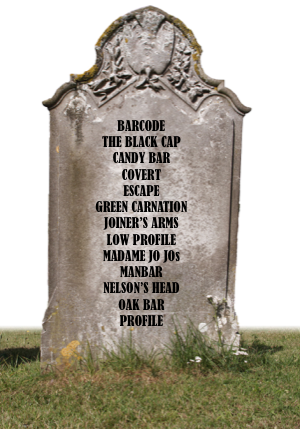
If only the scummification – the Battery Farm Bohemianism beloved by non-entities – had died there. No such luck – Jojo’s, the Black Cap, Soho’s 12 Bar Club and more have been shot faster than US police suspects. And that’s despite non-stop, impassioned celebrity pleas. ‘Stop the destruction!’ Vivienne Westwood recently demanded. ‘London is a disaster! People hate it! Clubs and dives are going, going, gone’.
Exactly. It’s Artistic Abbatoir time ASAP, the ruthless culling of any possible activity not devoted to coining cash for city coffers. Who needs ISIS demolishing irreplaceable icons with Westminster Council in town? Insanely, Ruling Baron Bojo’s forgotten – or never knew – a society’s quality of life and civility is embodied by the amenities available. Not here; Tories despise the ‘useless embellishments’- like Culture and public toilets – encouraged by an inexplicably contrary Europe.
In any form, philistine bigotry is ugly, especially posing as benign gentrification. Given free rein – like right now- Cameron and pals prefer a dead-by-night London choked with brain-dead worker ants by day. Their ideal city? A walk-away, stay-away, w*nker’s wonderland with all the cachet of a mass urinal. It’s divide and rule, a classic dictator strategy; people terrified by job insecurity simply ignore minority plights and issues.
Well, so sorry, boys- we’re human beings demanding Humanity. Ever heard the phrase, while furiously deleting Human Rights from the statute books? If an ideal city – Paris or Rome – embodies all the poise, compassion and nurture vital to sexual, social and artistic diversity, then London 2015 is a psychopathic, brain-dead glutton, eating itself alive with greed. Do you – do we – truly want to barely exist, not live, in the rancid puke it’ll toss back as a bland, back-door Bohemia? No way, José. Stick it right back up where Bojo’s brain don’t shine. Just as Westminster’s done to Soho’s Rainbow wilting in the gutter. Poor Oscar Wilde; he’d be sobbing his heart out crying to the indifferent stars.
Opinions expressed in this article may not reflect those of THEGAYUK, its management or editorial teams. If you’d like to comment or write a comment, opinion or blog piece, please click here.