Category: Comment

  • THE UNDATEABLE GAY | My ‘ALMOST’ happy ending…

    THE UNDATEABLE GAY | My ‘ALMOST’ happy ending…

    After a long-term, online, long-distance relationship with a guy that turned out to be transgender, THE UNDATEABLE GAY goes to meet the man of his dreams…

    using your mobile phone too much
    CREDIT: bigstock-kalim

    I’ve deleted all my dating apps. There’s not one to be found on my iPhone. I was fed up with all the curious straight men chatting to me on Plenty of Fish. And annoyed at everybody on Grindr being shallow and only wanting one thing. And don’t even get me started on Tinder. I may only be in my 30s but I’m rather Granny like when it comes to technology.

    After an unfortunate incident involving a 70-year-old lady and swiping right, and then being slightly stalked and receiving numerous invites for coffee and cake, I decided that Tinder was no good for me either.

    I’ve taken to more intellectual apps these days. My favourite is Words with Friends. For those of you not in the know, this is Scrabble. But on your phone. And you can play with anyone, anywhere in the world.

    One day, I started playing with this very handsome man called Joshua. Yes, you get to see a photo of who you’re playing with. I kept perving on his picture whilst waiting for him to play his move, praying he would start a conversation.

    And then the Lord answered my prayers and a chat popped up. Although it was a little ambiguous. Remember, this is not a gay app, so there’s no way of knowing whether the person you’re playing with fancies you. Or even if they’re a raving homo.

    After putting my journalistic training into practice, it was soon confirmed that Joshua was flirting with me and did indeed fancy me.

    He was only 25. Ten years younger than me but I decided that I could be a cougar if I wanted. And he lived in Southampton. I was a bit disappointed that he wasn’t in London but hey-ho, it’s only an hour’s drive or a train ride! And besides, I’ve become so institutionalized with being single, I thought it’d be perfect to have a man who didn’t live in my pocket.

    We spent months talking on the phone, exchanging WhatsApp messages and sending each other photos. I don’t think I’ve ever fancied a man as much as I had Joshua.

    He was just my type; Tattoos, quite butch and BLOODY handsome.

    We had so much in common. We drank like fishes. We had potty mouths and both adored the C U Next Tuesday word. And we both had quite common, rough around the edges accents. Surely it was a match made in heaven.

    We even discussed growing older together. And I’d never met another man who shared the same views as me about how we should behave in a care home as an old couple together. We both agreed that it would be wheelchair races through the corridors. And slipping under the table for a sly blowjob during bingo.

    A few months of a long-distance telephone relationship, I decided it was finally time to bite the bullet. Being the older gentleman, I took the lead and arranged to get the train from London to Southampton. I was finally going to meet the man of my dreams, my perfect match.

    Two days before the big first date, he sent me a message declaring, “We’re perfect for each other, I swear.” I swooned at the words and I was of the same opinion. We were so similar, the way we spoke, the thoughts we had. It was scary.

    The night before I was due to catch my train to Southampton, we had a very interesting text conversation.

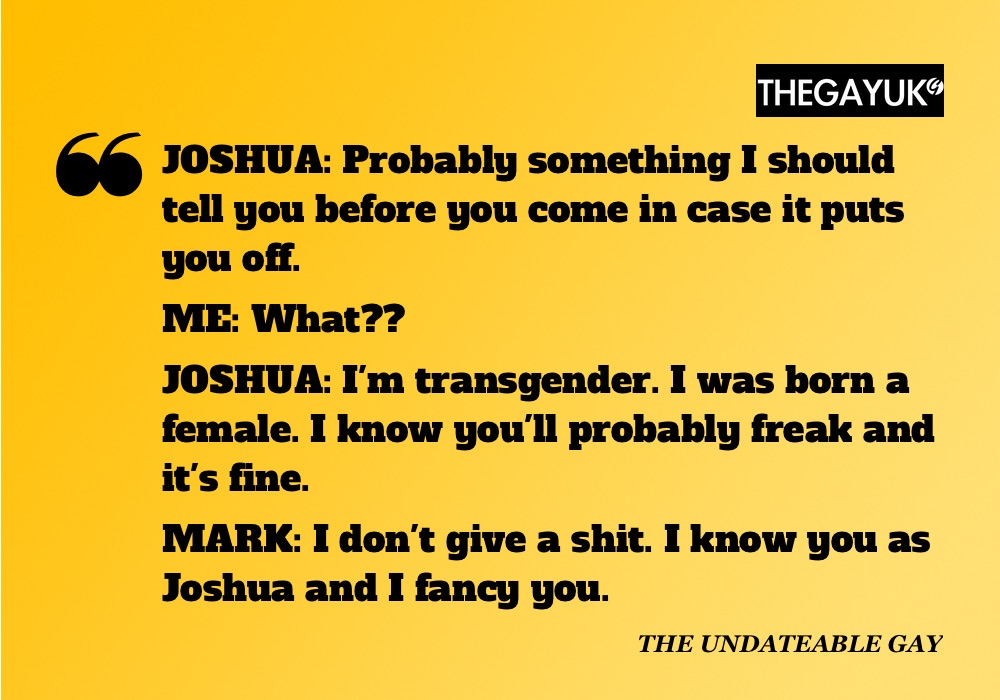
    JOSHUA: Probably something I should tell you before you come in case it puts you off.

    ME: What??

    JOSHUA: I’m transgender. I was born a female. I know you’ll probably freak and it’s fine.

    MARK: I don’t give a shit. I know you as Joshua and I fancy you.

    The morning of the date arrived and the sun was shining so brightly. The sun shines on the righteous, my dear Nan always said.

    I arrived at Southampton Docks in plenty of time for our meeting. We’d agreed on 1 pm. It got to ten past and no sign of him. I tried to call. No answer. It got to twenty past. I sent two messages. No reply.

    As the clock hit 2 pm, I thought, What a C U Next Tuesday. I’ve come all the way from London and you don’t even have the common human decency to show up or even respond to my attempts at contact.

    Being ever the positive boy that I am, I decided that I would not waste my day. The sun was beating down and it was the most beautiful day so I spent my unexpected free time wondering around Southampton. I had a few glasses of wine, ate a spot of lunch and watched the world go by.

    A few glasses of savvy b later, I decided it was time to get the train back to London. But not before I sent one final message to Joshua. I simply had to have the final word:

    “I had a lovely day in the sun at Southampton Docks. I thought it best not to waste the train tickets so I spent the day in Southampton anyway. I wouldn’t worry what people think of you because you’re transgender. I’d be more concerned with what people think of you because you’re a bit of a cunt.”
  • COMMENT | Trans awareness in the gay community is still a work in progress

    COMMENT | Trans awareness in the gay community is still a work in progress

    A gay male friend told me recently that he returns to Pride in his home town of Bristol for the drinking, as there is nothing to protest about anymore. Given the rise of hate crimes over recent years, I pointed out that this is not true even for him, let alone for me. It is not that he did not get it, but it had not occurred to him that for many transgender people Pride might be the only setting – if then – in which they actually feel safe going into a pub.

    Or take another example. A lesbian friend earlier this year shared a transphobic joke on social media. This suggested that in parts of the LGBTQ+ community – those parts, perhaps, where the need for so many letters to define us is not entirely accepted – the phenomenon of being transgender and the particular forms of discrimination we face are not yet fully grasped. Yet if we, as we should, reject heteronormative assumptions about sexual orientation, why should my lesbian friend have nonetheless have been so ready to accept them when it comes to gender? The many similarities in transgender experiences to those of gays and lesbians – in terms of exclusion, discrimination and being hidden from history – are effectively denied by jokes which treat us as more or less delusional about our gender identity.

    PHOTO: Supplied

    Happily, this has proved a rare experience. The vast majority of my gay and lesbian friends have been very supportive both of my transition and of transgender people in general. The high profile of transphobia on the streets and in certain parts of the public sphere has, in my experience, helped to ensure growing sympathy with the issues transgender people can face. All the different nuances of those experiences are, however, not always easy to grasp, even for people who are themselves transgender. I cannot be the only person to have been transplained by an older trans woman for whom her transition experience was seemingly the only authentic one.

    Then take the perennial issue of toilets. This, despite the continuing scarcity of gender-neutral ones, has not really been an issue for me as a trans woman. However, I am aware that it can be much more problematic for trans men and for those who identify as genderfluid or non-binary. Awareness of these latter groups, unfortunately, is generally much lower than for us MTF trans people. Nonetheless, they need every bit as much support and are if anything subjected to even more hostility from transphobes, who find their flouting of gendered norms more disturbing than that of the femme-acting trans woman.

    Similarly, among the gay community, there is not always ready awareness that the binary, straight/gay, does not necessarily apply to trans people any more than the binary, male/female, does. Some trans people are straight, though they are sometimes misconstrued as gay men and women who are trying unusually hard to conform to heterosexual frameworks. Some, like me, are lesbians (or transbians if you prefer) or in gay male relationships. Some are polyamorous. In terms of sexual orientation, the multifaceted nature of transgendered experience does not always make it easy readily to translate it into a gay or lesbian framework.

    In addition, there is not always full awareness of the distinctive challenges we face in terms of adjusting both ourselves and our acquaintances to identities which are social, official (changing your passport can be a nightmare) and bodily as well as sexual. Names and pronouns matter for us as signifiers of transition. Yet even in Stonewall-approved universities trans people are still regularly labelled and abused. This is not least because we challenge stereotypes imposed by heteronormativity. These stereotypes have, in the past, been used to confine and control all of us – gay, lesbian and trans – and our exclusion has been our common experience.

    Challenging these stereotypes, both as they apply to sexual orientation and to gender is, in my view, a wholly good thing for all of us.

    Pippa Catterall is a transgendered woman and Professor of History and Policy at the University of Westminster

  • OPINION | Why aren’t lesbians the default when it comes to ‘ground breaking’ decisions like Dancing On Ice’s same-sex couple reveal

    OPINION | Why aren’t lesbians the default when it comes to ‘ground breaking’ decisions like Dancing On Ice’s same-sex couple reveal

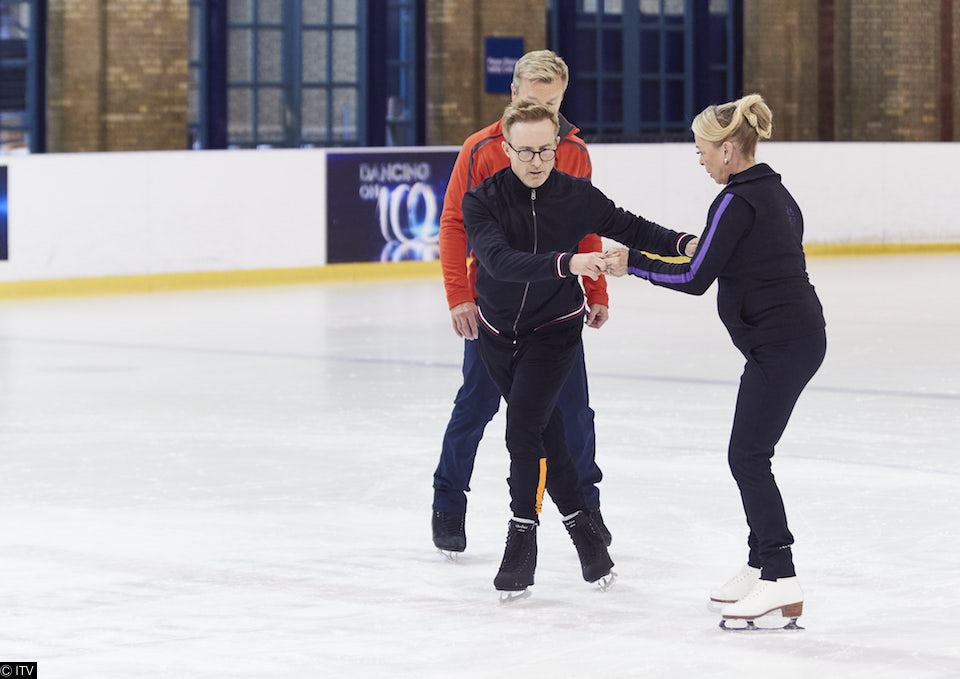
    Dr Gemma Commane, lecturer in Media and Communication at Birmingham City University, says it’s important to question what this Dancing On Ice on a same-sex couple introduction change really means and the conversations it will create.

    OPINION | Lesbians are often overlooked or are subject to ‘tragic’ storylines and they are given less space to occupy.

    “Although it’s timely for Dancing On Ice to have a same-sex couple, it’s important to understand that decisions are political and have economic reasons,” said Dr Commane.

    “In this case, examples could be sustainability for the television show, maintenance of the brand and audience expectations.

    “We need to carefully think about what privilege means and what privilege looks like. Privilege is complex and it does not simply connect to one aspect of a person’s identity. 

    “Whilst it is fantastic that changes are happening, we need to ask: what do these ‘changes’ actually mean when certain voices and identities are still rendered invisible? 

    “Lesbians are often overlooked or are subject to ‘tragic’ storylines and they are given less space to occupy, especially in primetime television. Why aren’t lesbians the default when it comes to ‘ground breaking’ decisions when introducing same-sex coupling in shows like Dancing On Ice?

    “What would it mean for ‘Dancing On Ice’ to have a lesbian celebrity skating with a same-sex partner?

    “What types of conversations would arise from the media and audiences around this selection? If this had been the case, it would have been interesting to observe how news organisations would respond to an announcement like this and if they would write about the lesbian celebrity in predictable and fetishistic ways.”

  • Here’s what you should do if you ever find yourself in the centre of a Twitter storm

    Here’s what you should do if you ever find yourself in the centre of a Twitter storm

    PhotoMIX-Company / Pixabay

    It can happen over the most seemingly innocuous thoughts and actions and can be incredibly distressing and sickening if you happen to be at the centre of people’s fury on social media.

    Twittersphere can be one mean place if you, in the eyes of some of its users, get things wrong. Being at the centre of a Twitterstorm or a pile on can be a horrible experience lasting over a 24 to 48 hour period.

    So here’s what you should do if you ever find yourself in a twitter backlash.

    Delete the tweet

    Although this might seem like curtailing your speech or what you want to say, removing the “offending” tweet means that it can’t be retweeted or quoted – leading directly to your account.

    It’s the quickest way to stop a pile on in its tracks. Yes, some people will have screenshotted the tweet and they will continue to tweet it or may even tweet it at you, but its reach will be far less felt than if you were to leave it on your timeline.

    Just turn it off

    Turn off Twitter, in fact, delete the app for a few days, so you don’t feel the need to keep on checking what’s going on or what’s been said about you. Ride it out and try not to let your imagination run wild.

    A Twitter pile on can last from 24 hours to 48 hours and will then, most likely fade away as people move on. You may get a few tweets after this, but mostly people will have moved on.

    Just remember, people’s memories can be short on social media and there’s always someone else to distract and attract a Twitterstorm away from you.

    Make a decision on whether to apologise or not

    If you come to the conclusion on whether what you’ve tweeted is offensive and Twittersphere has a point, then apologise.

    Recently social media star Trisha Paytas found herself in the middle of an epic Twitterstorm after coming out as a “transgender gay man”. The tweet, which actually led people to a YouTube video was immediately met with scorn and derision.

    https://twitter.com/trishapaytas/status/1181270127947350016/

    The tweet became quickly ratio’d meaning that the comments outranked the number of Retweets and likes, meaning that in Twitter world you’ve usually done something very very wrong.

    Trisha made an apology video within 48 hours and the pile on continued on with that Tweet, receiving over 700 comments and only 49 retweets, which meant that her apology wasn’t widely shared, so only a fraction of those aware of the story actually heard her apology.

    Meanwhile, her original “I Am Transgender” tweet continued to grow and was even picked up by the editorial team at Twitters’ moments, boosting the Tweet even further.

    If you do make an apology tweet, post or video- make it heartfelt and true and don’t use phrases like “I’m sorry you were offended”. These often PR managed tweets are met with even more backlash because people don’t and won’t believe it – and can even serve to elongate the storm.

    If you don’t feel you need to apologise – don’t. There’s nothing worse than someone apologising for something they’re not sorry for.

    Ignore it

    You can always ignore it, which is what Cosmopolitan Magazine did after it tweeted about gender critical feminists, called, “What you need to know about TERFS”

    The tweet saw thousands of people complaining about the article’s content. The magazine’s official Twitter account – which usually sees an interaction rate of 1 to 2 retweets or likes per post and rarely ever any comments, suddenly had over 7,000 retweets and thousands of comments.

    Dozens of people took to Cosmopolitan‘s timeline to say they had reported the tweet for hate speech, yet the magazine stood resolute, did not delete, did not apologise – basically it didn’t acknowledge the storm that it had created.

    Seek legal advice

    If you’ve tweeted something you shouldn’t have, like a high court’s super injuction or something that’s libelous or slanderous you might need to seek legal advice.

    You may also want to take legal advice or action if people are tweeting something about you that is factually incorrect, libellous or slanderous, as journalist Jack Monroe did against Katy Hopkins. The fallout from which saw the former TV star, journalist and radio presenter left with a huge legal bill after she lost.

  • OPINION | Is having 100+ genders too many?

    OPINION | Is having 100+ genders too many?

    Recently the BBC was attacked for teaching children that there are over 100 different types of gender. This move from the BBC received widespread criticism from the right-wing media (as expected) and unfortunately when a gender spokesperson on Good Morning Britain was interviewed on the matter they struggled to explain the differences when challenged by presenters on what the 100 genders stood for and why some of them were ‘genders’ and not simply aspects of their personality.

    It was, put bluntly, a car crash and did nothing to explain to your the majority of UK viewers what the move was about.

    Don’t get me wrong, I have my issues with Piers Morgan, but that interview was a car crash and made the gender argument look ridiculous. Love him or hate him, Piers won that round and inflicted serious damage on the public perception of gender freedom.

    It left even those of us in the LGBT community that weren’t aware of 100+ genders before now baffled and unsure of what was expected of us as allies?

    As someone that has worked with the wider LGBT+ community, I found the statement that there are 100+ gender staggering. It might easier for a child to get their head around, I can’t say as I’ve not been a child for quite some time now, but if we even struggle then how on earth is wider Society meant to cope? So I went looking to see what on earth the 100+ genders are and what they could mean.

    I found this list from Tumblr which has listed around 116 different types of genders. Some I recognise and some have just baffled me. Many of them, especially those where they say they aren’t ‘Male’ or ‘Female’, but they aren’t anything else either until you ask them, then they say they are X or Y based on that moment. That is not a ‘gender’ type, that’s an attitude or personality trait. At most that is gender fluid, so what’s wrong with being gender fluid?

    For a community that claims to despise labels and being put in boxes are we really telling the wider world that we now have 100+ labels for ourselves, a fair majority of which are based on our mood and situation at any given time?

    Me: “I don’t want you [Society] to label me, we should be beyond labels”

    Also Me: “Here are 100+ more labels, many of which depend on my mood on any given day. You wanna label me, ha I’ve just made it 100 times more difficult.”

    People have to remember that we are a community, built and based on social interaction. This 100+ list of genders and associated pronouns has just put a massive barrier up to other human beings communicating with us/them.

    If you have no idea how to address someone (as even ‘they’ wouldn’t work for some of these) then surely that person is simply not going to address you, and just avoid you completely as it’s the path of least resistance (easier). They don’t mean anything by it, they aren’t out to ‘get you’ or ‘oppress you’ they just have no idea how to interact with you because of this mind-boggling wall you’ve put up and have 1001 things to deal with other than how on earth to say hello to you and ask how you are.

    The rise in gender fluidity and the challenge of the traditional masculine and feminine associations is something to be celebrated, especially if it means we get closer to achieving true gender equality, eradicate sexism and truly accept into Society transsexuality and gender re-assignment. However, with saying to the world that there are now 115 different genders, many of which are based on circumstances and mood, are we at risk to invalidating and demeaning that freedom we have enjoyed as it is coming across as ridiculous and unrealistic?

    A friend of mine recently ‘came out’ as pansexual. For those unaware, pansexuality, or omnisexuality, is the sexual, romantic or emotional attraction towards people regardless of their sex or gender identity.

    Pansexual people may refer to themselves as gender-blind, asserting that gender and sex are not determining factors in their romantic or sexual attraction to others. Unlike Bisexuality, pansexuals tend not to see gender and just see the person/personality.

    Recently Sam Smith (not the friend mentioned above) also came out as non-binary and raising awareness of gender descriptives within our language. Smith has a valid point and if we are truly to be 21st-century race then more accurate command of the language is a good thing. The abuse Smith received from the LGBT community was completely uncalled for.

    However, the 100+ genders issue raises the question, are we using gender identity as a smokescreen for our own personality traits and rising trend to be identified as something and to use that as a banner against oppression? It’s almost as if the community has achieved a level of acceptance (which we have on the whole) but now we want evermore? Or to put it another way, have we just gotten so used to being oppressed and that feeling of ‘fighting the machine’ that we now seek new battles and new demands for acceptance?

    If some of our allies and the community itself are struggling to keep up with the notion of 100+ genders and pronouns, and find they have to ask what someone’s gender is in order not to offend, are we just simply creating a society where no one can get it right because I’ve used the pronouns for gender 67 but actually you are gender 68 which causes you offence and now I’m the oppressor? Surely we want a world where gender isn’t even factored into someone’s decision making. But this seems to want to enshrine even further it into everyday life and make it yet another thing people can use to beat you over the head with.

    Personally, I don’t see the argument for creating any more genders beyond the 6 the NHS currently uses and recognises. Or at least, certainly not for creating 100+ pronouns. I shouldn’t need to know your gender, simply what pronoun to use. For those unaware, the 6 genders the NHS uses are currently male, female, gender-neutral, non-binary, gender-fluid and gender-queer. Being referred to as ‘they’ should be perfectly acceptable for the majority if not all genders. I’ve not seen any of the 100+ that aren’t simply a very subtle variation of 1 of the six (with maybe 1 or 2 exceptions).

    If you do identify as one of the 100+ genders then you don’t need my validation to exist. You certainly don’t need my confirmation of your gender so seeking it from others is a fool’s errand.

    If you can look me in the eye and can honestly say that you are peace with the fact that you identify as whatever-sexual, I’ll believe you and quite happily accept for you that. But if you honestly think this does anything for reaching a stage where gender means nothing to Society then you are deluding yourself. This turns the gender discrimination and bias argument into a completely different beast, a beast you are very unlikely to master.

    There are a number of resources out there on Gender Freedom and Identity. I would encourage everyone to read more on the issue, starting with Mermaids charity so you can understand more around Transsexuality and wider issues. There are also some good resources from the BBC on gender identity and pronouns.

    Here I have simply asked the question and posed some issues that we need to find answers to. Do your own research and come to your own conclusion, but remember this is a debate the nation should have. Not prejudice, or an attack, or an invalidation.

    Educate yourself then see where you end up.

  • DRAMA TRIANGLE: Hero, Villain or maybe you’re neither?

    DRAMA TRIANGLE: Hero, Villain or maybe you’re neither?

    One thing you may all of noticed in your lives is that when someone wrongs you (in whatever way) they aren’t shunned by their friends or family, they often carry on with their lives and, depending on the scenario, will continue to have people give testimony to what a ‘good person’ they are.

    This, often but not always, seems to only add fuel to the fire and riles us up further as to how there is no justice in the world. I mean, how can this be so?

    How can someone that has done something so despicable in your eyes that the world can see them still as the ‘good guy’?

    Well, in short, that’s because the world varies rarely deals in absolutes, contrary to what many people today would have you believe. The world is various shades of grey and there isn’t a ‘universally agreed’ rule book on behaviour everyday behaviour. What you see as something despicable others may well not see as that bad. They may even see you as the villain and this other person the ‘hero’.

    Anxiety, depression and general mental health struggles are a big problem in our modern-day society, therefore while this article can’t cure those things, I wanted to share with you a couple of survival tips I have learnt over the years through my experiences and my struggles with Depression.

    Drama Triangle:

    One of the most powerful things I learned was about the drama triangle. It is a model that most soaps and dramas are based on and is pretty much everywhere in social life – especially amongst the gay community!

    The way it works is that in any given scenario there are always at least 3 ‘roles’. Person 1, from their point of view, may be claiming to be the ‘victim’. “This person is giving me a hard time at work” or something like that. Something is happening to them or has happened to them that they feel is ‘wrong’. To validate that belief, they will seek a witness (person 3). Someone who will be told their tale of woe and will be expected to give them sympathy and by doing so, validate their position as the victim and this other person (person 2) as the perpetrator.

    At the very same time, the person being accused of being the perpetrator or ‘attacker’ of the victim (person 2) may also be feeling attacked by the person claiming to be victim, which may be why they have been defensive or stand-offish to the person 1. In their mind, the roles are very different from how person 1 sees it. To them, they are the victim, person 1 is perpetrator and person 3 is the witness given sympathy and validation (someone who could very well be the same exact person that was the witness to person 1).

    This triangle is always chopping and changing as events and the ‘drama’ unfolds. And unfortunately, once you are in it, it is very difficult to get out of it.

    This is why I have found, albeit extremely painful at times, it is best to always be on the lookout for this triangle in effect and to try and put yourself into the ‘adult’ or ‘observer’ category outside of the triangle and able to see each angle and element to draw your own conclusions (or not). It means you are also able to see that what someone may need is not a sympathy validation of being the victim, but instead an opportunity to break the cycle and take control of their own self-awareness and mental state.

    Communication:

    One of the biggest things I have found in all aspects of life is that communication is paramount and can be a tricky thing to master. I’ve witnessed relationships (any relationships not just romantic ones) completely fall apart because of too little communication, too much communication or over-engineered communication.

    Too little communication is one of the biggest causes of issues. Things like “I assumed they wouldn’t mind”, or “I thought they might react badly, so I kept quiet” are just 2 views that you hear every time something goes wrong.

    I’ve seen romantic relationships where they have mutually ‘agreed’ to be open, but that mutual agreement might exist in one person’s head, but not the other. One has one view of what that means and another view. Both come with their own sets of rules and are often worlds apart from each other. Whereas all it takes is a little courage to speak your mind on what the rules could be and mutually agree them have actually talked about them. We make such large decisions on the basis on assumption, are we really surprised when it then comes tumbling down? Assuming really does make an ‘Ass’ out of ‘U’ and ‘Me’.

    On the flip side, of course, too much communication can be just as harmful. One example would be that we all look at the world around us and make unconscious judgments on what we see. We filter as to what is relevant to us at that moment and what isn’t. And seeing a beautiful face while walking and proceeding to spend 5 minutes talking about how that face made you feel may not be what your romantic partner wants to hear. You’ve assumed they would want to hear about it because you would want to and that could be how you communicate or did communicate with friends and previous lovers.

    Cracking the communication nut is difficult but you can’t crack communication if you communicate nothing. So, talk to your loved one, friend, family member etc and see where it takes you. Even talk to someone you consider an enemy; you might find you learn something, and communication is restored (I refer you back to the drama triangle).

    Self-awareness:

    Self-awareness is a great and useful thing, but it is also extremely dangerous and is not to be confused with things like body dysmorphia or a form of anxiety that makes you overly aware and critical of your actions.

    Self-awareness, from my experience, is about being able to not only be aware of yourself but also to be aware of what is going on around you and your influence and impact over it.

    I’ve learnt to ask why someone does what they do. What have you ‘come for me’ or ‘betrayed me’ or whatever it might be? Is it something I have done? could it be something I didn’t do? Is my action or lack of action right now having a positive or negative effect?

    If someone has walked a path I wouldn’t dream of walking, then there is something going on that I don’t know about. Genuinely ‘evil’ people are rare, and certainly not a common as the press and social media would like you to believe. People, instead, do the best they can with what they have around them at the time. The decisions they make, although questionable to outsiders, at that moment and given the choices they had, may have been the most logical or ‘best’ to them, their values and their view of the world.

    That’s something I have struggled to come to terms with and it has taken me a few years to accept it. It is a challenging thing to accept but once you start living it and making part of how you think, you learn to see the world from a far bigger picture.

    I don’t claim to be an expert on social interaction, far from it, I’ve had my fair share of mistakes, attacks and ‘dramas’ and some of that will never change. But what has changed in recent years is how I respond to them. How I chose to take part in the drama triangle or how I chose not to, let the emotion go and try, instead, to do the right thing for me. Which is what any of us can do.

    If you want to learn more about how to communicate and increase your self-awareness, I am a firm believer in Neuro-Linguistic Programming (NLP). You can find details from the Association
    of NLP
    including any local practitioners and local groups that can help you.

    Find UK-Based gay and LGBTQ+ Therapists here

  • I came out to my parents via email, and it wasn’t wrong to do it that way

    I came out to my parents via email, and it wasn’t wrong to do it that way

    It’s not wrong to write – tell the world your truth in your own way

    Free-Photos / Pixabay

    I’m not much of a talker. Never have been. I mean sure, get a few glasses of prosecco inside me and I’m yap, yap, yap – dispensing Kenneth Williams-style asides like there’s no tomorrow. But that’s all fun and games. When it comes to the ‘real’ stuff, I clam up. Words get stuck. My mouth turns drier than a bedsheet whilst fluster’n’flummox levels rise, flashing red in my mind with a big ‘EVACUATE!’ warning. So I write things instead. Because that’s something I can do.

    When I was 18 a few (ahem) years ago, I wrote my parents an email telling them I was gay. Invariably that detail comes up in conversation with people, everyone likes a coming out story. And when I say I emailed them with such important news, as opposed to talking to them, I generally get some sort of reaction, ranging from shock to even once having it called the ‘c’ word – cowardly. But I’m here to say that it wasn’t cowardly then, and that it still isn’t cowardly now to write something instead of saying it.

    It’s time to change that view for good.

    We’ve probably all heard words to the effect of, “it’s better to do it face-to-face”. Now for some things that’s true. Kissing, for example, is incredibly hard to do in written form – those little x’s don’t quite hit the spot. But for most other things I vehemently disagree.

    Who said it was better? Why is it better? It isn’t better, it’s just a different kind of communication.

    You might have also heard the line, “If you really respect them, you’ll tell them in person”. Poppycock! Twaddle! Absolute tommyrot! All that does is heap another dollop of shame on top of you, thanks very much. The mode by which you tell someone anything – including telling them you’re gay – has absolutely nothing to do with respect. Writing is respectful. Writing takes time, thought, consideration. It’s a skill, just like talking. And some of us are better skilled at one than the other.

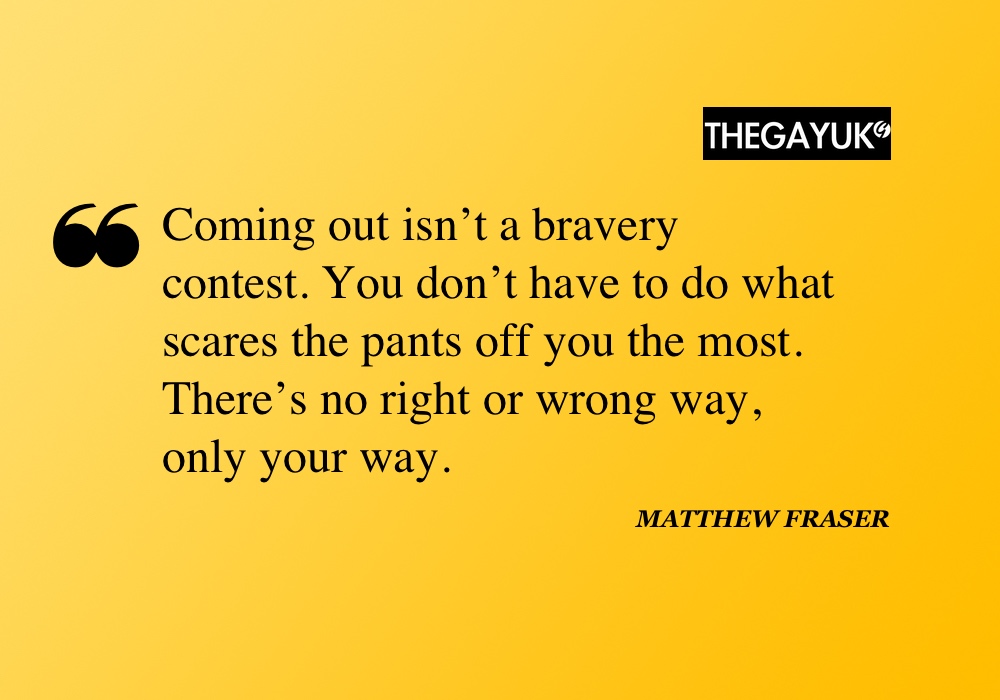
    In terms of coming out specifically, for me it was a no-brainer. But for you, if you’re reading this and are perhaps on the cusp of wanting to tell somebody, and you just don’t think you can manage the words verbally – please, please consider writing it if that comes more naturally to you. It’s not disrespectful, and it’s not cowardly. Coming out isn’t a bravery contest. You don’t have to do what scares the pants off you the most. There’s no right or wrong way, only your way.

    For what it’s worth, I’ve never even once had any regret over the way I told my parents I was gay. I think, given that the whole thing came as a bit of a shock to them, that writing it down was for the best. It gave them time. Time to read, then time to think, time to order their thoughts. For coming out to anyone is a two-way street, and the oncoming traffic may have a reaction. Spoken words can come snapping from mouths in an impulsive, thoughtless rush. The written word gives time.

    So write, or talk, whatever suits you best. Just remember – there’s no shame in any of it.

  • COMMENT | You need to start paying for your porn

    Here in the UK, we take a lot of content for granted. It’s not our fault, most of us have been brought up on a diet of free, advert-free, tv, radio and news, thanks to the BBC. But we have to change this.

    CREDIT: ©-lofilolo-Depositphotos

    As one wise puppet once said, “The internet is for porn” and he was right, it’s everywhere. It’s all over social media and there are millions of sites across the web, devoted to one of the nation’s favourite pastimes. Porn. But what is keeping this industry afloat?

    There was a time when if you wanted to look at nude people doing it, (and you weren’t able to tune into Eurotrash on Channel 4) you’d have to buy a magazine, then there was the birth of the VHS and then the DVD, which revolutionised the industry and made it very successful, but like the music and magazine industry, porn’s physical products have been supplanted by the digital revolution. An entity that has turned all our passions, from music to film into bytes that no one has really managed to monetise successfully, when compared to the physical product world.

    Getting access to porn is ridiculously easy and for the most part free to view and for most of us is as easy as logging on to social media.

    There are plenty of free sites that offer HD videos of people going at it – and that’s great but when the end user isn’t paying for it, what happens to the creators of the content we enjoy?

    People need to be paid for their performances. Editors need to be paid for their art, the photographers, the directors and all the people involved need to earn their living – and if that happens to be inside the porn industry, we should be supporting that.

    For something that is pretty much in all our lives is it too much to ask that you set aside £10 a month for a subscription of your favourite studio or even star on their own OnlyFans channel?

  • 6 things you shouldn’t say to people living with HIV

    6 things you shouldn’t say to people living with HIV

    Lizzie Jordan, Founder and Director at Think2Speak, is a multi-award-winning social entrepreneur, a mother, widow and is HIV positive. Lizzie is one person with a myriad of possible labels.

    More than a decade ago, Lizzie became a mother, a widow and HIV positive all within an 18-month period. Her life was turned upside down, in 2012 as a single mother to a grieving child, Lizzie wanted to find resources and training locally for her child’s primary school. She struggled.

    Lizzie recognised the issues being faced in classrooms across the UK and wanted to do something about the ‘uncomfortable silences’ young people often felt when discussing sensitive subjects with the professionals involved in their lives. 18 months of plotting and planning later Think2Speak CIC was founded.

    With the recent revelation that former Welsh rugby captain, Gareth Thomas has been diagnosed with HIV, here are Lizzie’s tips on what not to say, or how to approach someone who has HIV:

    Don’t bring it up unless they do:

    Someone’s HIV status is their HIV status and theirs alone – as we’ve seen with Gareth he has been forced to share his news because the press were threatening to make this public. There’s nothing wrong with being curious about HIV but there are certain things that should be respected and it isn’t every HIV positive person’s job to educate you.

    It doesn’t define someone:

    Just because someone is living with HIV doesn’t mean that’s all they are. It’s a virus, it isn’t someone’s personality, their fault, their ‘choice’ nor is it their identity or the only subject on which they can speak.

    Use your common sense:

    There are certain aspects of conversation that are off-limits, but morbid curiosity often prevails. Try to think if you actually need to know the answer to the question you’re about to ask! Or maybe you can search the internet before you ask a glaringly obvious, or even insulting question.

    Don’t ask how they got it:

    This is perhaps the most insulting. You’d never ask the same of someone who’s living with cancer or diabetes. A lot of this kind of thinking can be attributed to the ‘blame’ culture that exists when it comes to sexual health and HIV, it is often viewed as a ‘choice’. Blame is never apportioned to other health conditions.

    Don’t tell them they are ‘looking well’:

    People often comment in this way as if having HIV should mean you look ravaged by disease. This is often accompanied by a well-meaning, but ultimately patronising tilt of the head. Science has moved on dramatically since the 1980s and people with HIV who are diagnosed, accessing care and treatment, live full, healthy and happy lives.

    Don’t presume the worst:

    Many people who ask questions aren’t aware of the fact that someone living with HIV, on antiretroviral medication, can now be undetectable and therefore untransmittable. This is known as U=U (UEqualsU). It totally dispels the perceived ‘threat’ of people living with HIV. This will become general knowledge as time moves on, but for now, education and awareness is still needed.

    Overall, relax. If someone shares their HIV status with you; respect them for sharing their personal and sensitive information with you. Lots of people living with HIV, choose to share their stories to encourage awareness and understanding. Curiosity is fine, being too personal and intrusive isn’t it is all about respect.

  • THE UNDATEABLE GAY | The foot fetish

    THE UNDATEABLE GAY | The foot fetish

    When it comes to sex, I’ve always found myself to be plain and simple. Not boring, I would like to point out immediately. But I’m not one for these chains and whips activities.

    I mean, I’ve got nothing against anyone who chooses a slightly kinkier sex life than me. Each to their own, that’s what I always say. It’s just not my cup of tea. Or should I say a pot of freshly brewed coffee? I know it’s very unBritish of me, but I can’t stand tea.

    I think my dislike for tea stems back to my childhood. At the risk of sounding Freudian, I blame my dad. Until I was seven, my mum would always serve me a bottle of tea every afternoon. Yes, I know. A bottle. At seven years of age. Perhaps that’s where my oral capabilities come from. Years of sucking on a bottle, drinking my brew.

    But one day, my father got home from work and he demanded that my mother throw my bottle away. From that day in the early 1990s, I’ve never touched a drop of PG Tips again.

    Anyway, back to my tale of the fetishes. I had a boyfriend once who used to demand I call him a slag whilst making love to him. Had me screaming, “you slag!”, he did. Little did I know that he was sleeping with half of London behind my back. Ironically, he was making me speak the truth. Maybe that was his way of absolution.

    A few years later, I met a man who used to like to slap me during sex. Now before anyone becomes concerned for my safety and calls the police, it was only playful slaps across the boat race.

    It did very little for my sex drive but it seemed to turn him on no end.

    I could cope with a little slap every now and then but one day he started to scratch my back in the heat of the moment. Now scratching was still fine with me. I mean, I’d be left with a few red lines down my back for a day or two but there was no lasting damage.

    But then one day, the teeth came out to play. And I’m not just talking around the neck like most normal people. The biting got so bad that I had to take to wearing roll neck jumpers, long sleeve tops, and gloves to cover up the bite marks. So I made the suggestion that he find a fellow gay who enjoys Odaxelagnia.

    For those who can’t be bothered to google that word:

    Odaxelagnia is being sexually aroused through biting, or being bitten. It’s also considered a mild form of sadism.

    Just when I thought I might find a man who enjoyed a plain and simple sex life, along came Jamie. Now Jamie wasn’t a fan of kissing on the lips very much. Oh no, he liked to rummage his face in my armpits and kiss those instead.

    The day he text me and told me not to wear any deodorant that night was the day I feigned a migraine and never did he grace my armpits again.

    And then there was Neil. He was a Scottish man so that should have sent alarm bells ringing immediately.

    He arrived one night on my doorstep, carrying a bottle of Scotch. How romantic to be bearing gifts, I thought. Especially Scotch. I’m rather partial to a wee dram, truth be told.

    After a wee dram or three, he started to kiss me. On the lips. RESULT. No armpits. I laid back and breathed a sigh of relief to be finally getting the plain and simple sex life I’d been craving.

    “Let me suck you!” He demanded.

    Who was I to say no? As he continued to kiss his way down my body, he got to my flies. Mini Mark was poised and ready for action.

    But as I looked down, I found him at my knees. Maybe the scotch had clouded his judgment and as I tried to re-direct his head back up, his lips continued on their journey down my body.

    Before I could say Loch Lomond, I felt my sock being ripped from my foot.

    And before I could say Reflexology, he was sucking my big toe.

  • This company paraded 12 naked people in full rainbow colours for Amsterdam pride for an amazing reason

    This company paraded 12 naked people in full rainbow colours for Amsterdam pride for an amazing reason

    Amsterdam Pride is an LGBT+ festival held annually in Amsterdam during the first weekend of August.

    The festival attracts several hundred-thousand visitors each year and is undoubtedly one of the largest publicly held annual events in The Netherlands. The peak of the festival is during the Canal Parade. The 24th edition of the parade, which this year took place on the 3rd of August, featured 80 boats, which included a selection of people from the STI clinic at healthcare centre GGD Amsterdam, the fire department, the police department, AIDS Fonds, and the City of Amsterdam.

    While the event preached inclusivity, acceptance, and self-identity, it wasn’t all rainbows. Multiple people have come out reporting attacks and verbal abuse. Early on Saturday morning, a lesbian couple was beaten up by two men on a scooter in Amsterdam city centre. According to the Dutch newspaper Het Parool, they were walking hand-in-hand after a night out when they were attacked.

    The women walked away from the attack with bruises, a broken lip and a swollen nose. On the same day, a gay couple was assaulted by four men. The two victims were walking along the Prinsengracht, their arms around each other. This caught the attention of the four assailants. According to NH Nieuws, two other men held each other’s hands in the backseat of an Uber and gave each other a kiss. The driver allegedly verbally assaulted the couple and spat on their faces.

    All incidents have been reported to the police.

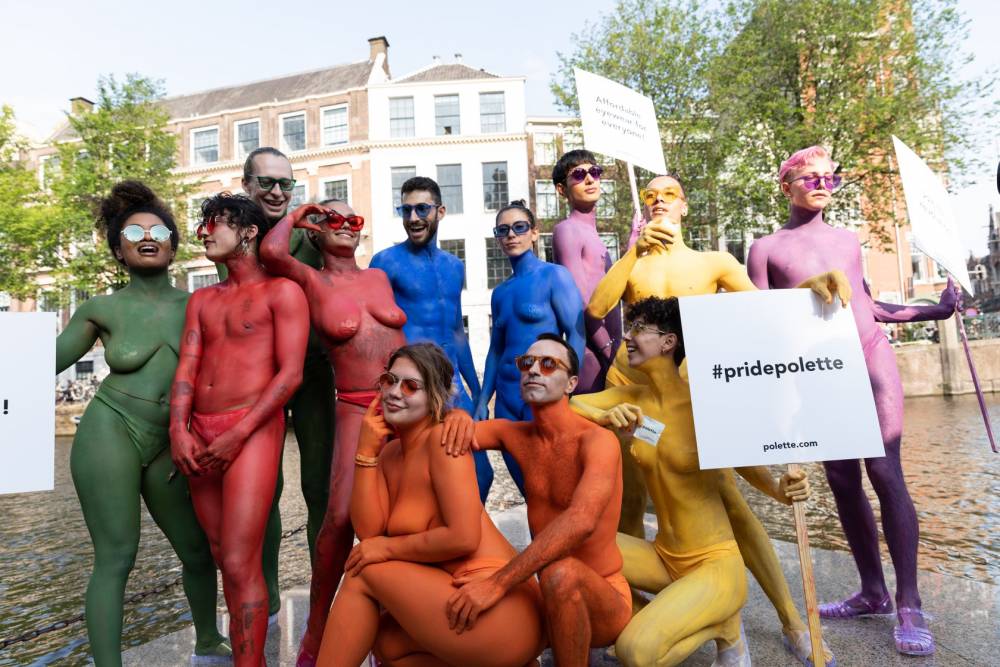
    Because cases like these continue to happen, two days before the world-famous Canal Parade, Polette decided to stand up for LGBTQ+ rights by organizing its own parade while bringing a message of love and acceptance to the streets of Amsterdam.

    Founded in 2011 by Pierre Wizman and Pauline Cousseau, Polette has revolutionized and disrupted the eye-wear industry by challenging the traditional optical establishment. The head office in Amsterdam is the creative centre of the company. The designers draw inspiration from everything around them: fashion, music, art, architecture, and everyday life.

    To celebrate this year’s Amsterdam Pride, Polette decided to create a human rainbow flag. While “remembering the past and creating the future” (the theme chosen for this year’s Pride), the 12 body-painted people (me included) marched from the iconic Dam Square to the Homomonument – a memorial which commemorates all gay men and lesbians who have been subjected to persecution because of their sexuality. Polette also filmed a mini-documentary focusing on how far we came as a community. In this mini-documentary, we hear the different stories and perspectives of the different people who took part in this initiative. Can you relate to any of our stories? Let us know in the comments.


    Miguel Martins

    (Mister Senior Netherlands 2018 3rd Runner-Up / Winner Public Choice / Winner Best Talent)