Category: Theatre

  • THEATRE REVIEW | Do you have a secret crush?

    THEATRE REVIEW | Do you have a secret crush?

    ★★★★ | Do you have a secret crush?

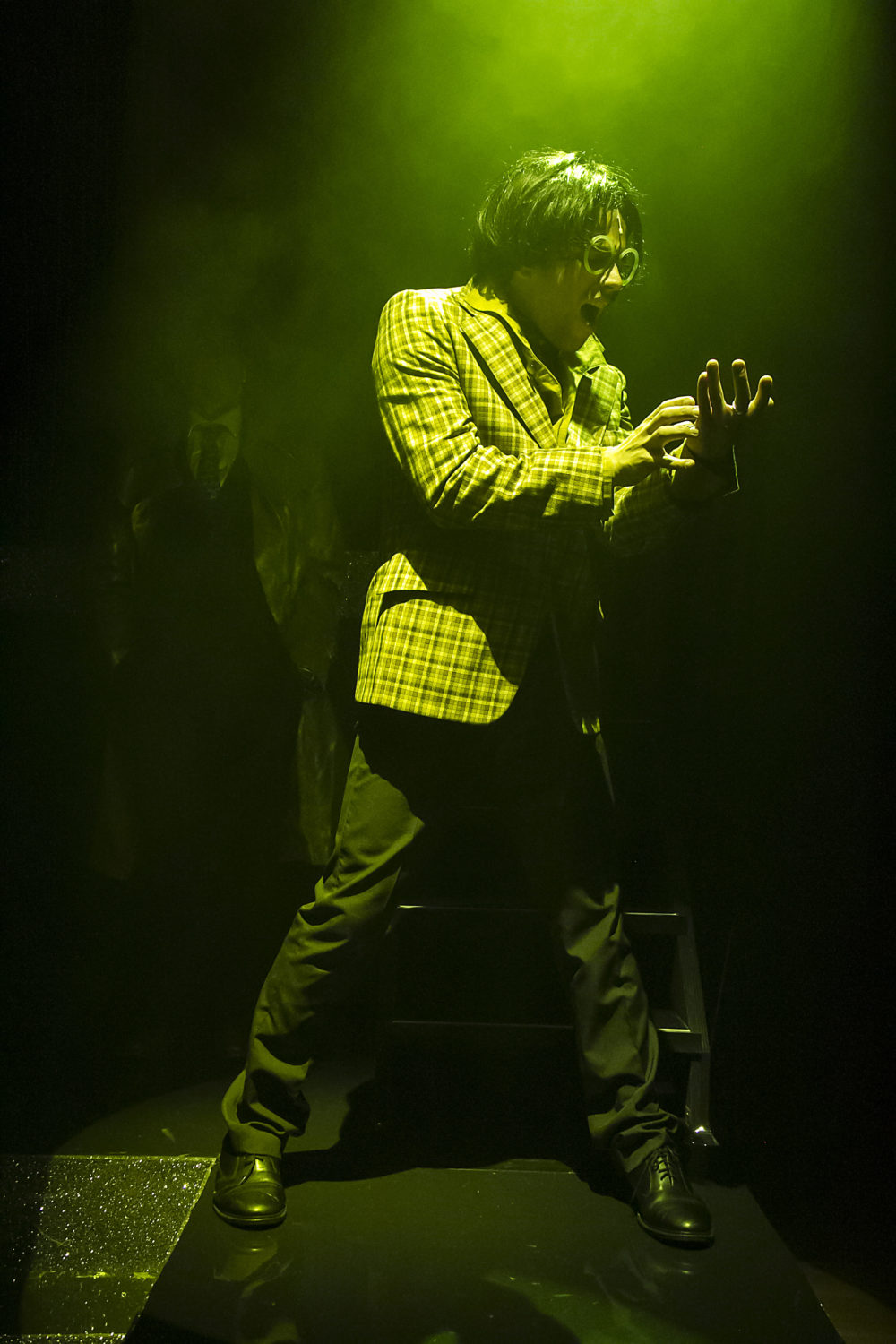
    Something quite extraordinary is happening in Wandsworth, the mid 90’s gay scene has come back to life and it’s hilarious as it is heartbreaking.

    CREDIT: PND Photography


    Based on a true story, Do You Have A Secret Crush (sleeping with straight men) transports you back to mid-90s-America, where a gay man, Stanley (Chris Britton), working in the city’s only gay bar Flamingos, is eager to spread his wings and escape Pontiac in Michigan. He falls head over heels with a straight waiter, Lee (Rich Watkins) whilst out to lunch with his drag queen friend Sally (Dave Lynn).

    He devises a plan to tell Lee that he has fallen for him, live in front of a television audience, to be broadcast nationally on the daily chat show The Jill Johnson show.

    Flown first class, limo drop offs, all expenses paid trip to New York, both Stan and Lee make their way to the studio separately for the big reveal. What could possibly go wrong?

    The small but perfectly formed company fits in the cosy space of the Lost Theatre in the heart of Wandsworth.

    You’re immediately transported back to the 90s thanks to a rather fabulous soundtrack and costumes. Britton plays Stanley confidently and cheekily, filled with life. Watkins plays straight man Lee safe, curious and slightly unnerving. Ruth Petersen’s mid-morning Talk Show host is perfectly fake, disingenuous and veneered. Drag icon Dave Lynn smoulders as Sally and belts out some glorious numbers. It is however Louie Westwood who manages to steal the show, with his shrieks and trills, hair tszujing and high-campery.

    Do you have a secret crush 1
    CREDIT: PND Photography
    Do you have a secret crush 1
    CREDIT: PND Photography


    If your in the mood this summer for some gay history, a slice of campery, a belly of laughs, a hint of longing and a tragic reminder of period less accepting, this glorious time capsule of a play is a must see.

    Do You Have A Secret Crush is playing at the Lost Theatre, Wandsworth until 21st August.


    SPOILER (if you’ve not heard of the Scott Amedure story.)

    It’s an incredibly powerful story – even more chilling that it is based on the murder of Scott Amedure in 1995, who went on the Jenny Jones’ talk show to tell Jonathan Schmitz that he was attracted to him. After a “suggestive” note was delivered an enraged Schmitz bought a shotgun and shot Amedure twice in the chest.

    Schmitz was found guilty of second degree murder and is currently serving a 25-50 year sentence.

  • THEATRE REVIEW | Blanc de Blanc, London Hippodrome

    THEATRE REVIEW | Blanc de Blanc, London Hippodrome

    ★★★★★ | Blanc de Blanc

    Blanc de Blanc is the new circus show in the cabaret theatre at London’s
    iconic Hippodrome Casino. From the team behind the sublime LIMBO and
    Cantina, it’s described as an evening of ‘breathless abandon’ and they’re not lying. It’s a dazzling spectacle of pure madness.

    Imagine if Bob Fosse’s disaffected dance hall girls from Sweet Charity met with the bawdy performers from The Kit Kat Club in Cabaret and decided to mix it up by throwing in a smattering of MTV style gyrating and twerking. If you add in the attendees at a fetish ball, the clientele of an underground Parisian bar from the 1930s and some wasted dancers from an Ibiza foam party then you’ve maybe envisioned part of it. That sounds like an unholy mess but it really isn’t. It’s bizarre but it works.

    Loosely linked by the celebration of champagne drinking, the show is hosted by French beefcake and model Monsieur Romeo and his sidekick contortionist and post-modern clown Spencer Novich. The show contains the inevitable repertoire of cabaret standards. There’s trapeze work, hoop spinning and contortionism as well as plenty of nudity and things being inserted into or pulled out of places you might not want to even think about.

    There’s the usual stuff that makes you gasp, laugh and say “Eurgh” as well as marvelling at the performer’s skills (and their beauty). The difference between this and a standard burlesque or circus evening is the style. Everything is done with panache. Choreographer Kevin Maher and director Scott Maidmont’s production is a sight to behold. It’s not surprising as between them they’ve worked with J-Lo, Madonna and Britney (to name but a few). It’s all deliciously camp and self-mocking and tremendous fun.

    The styles gel together and the show segues well between acts with a great build up to a frenetic finale. It’s raucous but restrained and even in the most absurd moments retains some dignity. It’s like an unfettered club night but one where you have to be a member and have a propensity for the darker things in life to be allowed in.

    They even manage to make a 5-minute pause for the audience to pop up on the stage to take selfies with the cast not seem too brash. If you’re looking for a good night out with attitude then you won’t go far wrong with this show.

    Blanc de Blanc plays at the Hippodrome Casino until 29th August


    Follow Chris Bridges on Twitter

  • THEATRE REVIEW | The Stripper, St. James Theatre Studio

    THEATRE REVIEW | The Stripper, St. James Theatre Studio

    ★★ | The Stripper, St. James Theatre

    CREDIT: Origin8 Photography
    CREDIT: Origin8 Photography


    Ever heard of the biographical fallacy? No, it’s not a handy, dictaphone dildo, but a warning to never, ever judge an author’s work by his life. See, back in the 19th Century, critics actually believed in pure, spun-from-thin-air fantasy, that plays and novels came from sheer imagination, not hard, lived experience.

    Oh really? Tell that to gay, smack addict and novelistic genius William Burroughs, whose entire output mirrored his self-chosen squalor. And he’s merely the tip of a non-stop, thinly-fictionalised iceberg – every second, every minute, we’re swamped by tsunamis of blogs, memoirs and blatant self-mythologizing.

    So unsurprisingly, critical theory’s undergone a complete reversal, and currently, all creative writing is viewed as ultimately flowing from biographical facts. Oh dear. That’s very bad news for Rocky Horror creator Richard O’ Brien’s latest show The Stripper, which once again showcases his low-brow, pop-culture fixations. It’s a heavy-handed, sleazy, musical theatre adaptation of a disposable, pulp-fiction, private-eye novel by hack Carter Brown, and as dire as it sounds.

    Me, I pity the show’s outstanding actors. Despite being crippled by O’Brien’s clueless, misogynistic lyrics, an uninspired score and lazily generic stage design and costuming, they often touch real brilliance. In particular, Gloria Onitiri’s lead stripper Dolores has the raw, diva heat of a young Grace Jones, while Sebastian Torkia’s private eye Wheeler is magnificently moody. More quirkily, Hannah Grover, Michael Steedon and Marc Pickering all triple-up to flesh out The Stripper’s seedy, eccentric cast. Sadly, they inhabit a world of laughably clunky exposition, with composer Richard Hartley’s score merely a serviceable, degraded blizzard of inept doo-wop and leaden jazz.

    Immediately, it’s obvious that nothing but instant closure can rescue this glacially-paced, Z-grade murder mystery.

    Yes, every possible cliché is alive and unfeasibly surviving here. There are one-note tough guys, vapid femme fatales and even – shades of Rocky Horror’s Riff-raff – a two-timing hunchback.

    Speaking charitably, it’s more Roger Rabbit than Jason Bourne. My god – didn’t it even occur to O’Brien that Carter Brown was parodying hard-boiled prose and attitudes? How could it? Peel away all the frothy, feel-good kitsch from Rocky Horror onwards and what’s left are O’Brien’s deeply unpleasant, highly reactionary, sexual politics.

    Frankly, nothing else explains such shockingly offensive lyrics as ‘I wanna fondle your tits/Baby you give me a hard-on’. There’s a simply appalling sub-text here – f*ck whoever possible and totally abuse their feelings – a textbook, sexual predator sense of intimate entitlement and presumed consent. Sure, as a songwriter, O’Brien is hardly Noel Coward or Cole Porter, but surely he’s capable of finer artistry than this abysmal, teenage smut? Honestly, do audiences really need such insensitivity casually inflicted on them in 2016?

    And even more disturbingly, O’Brien’s lyrics don’t even attempt irony – the object of their lust is meant to feel privileged! Gee, whatever happened to any notions or awareness of sexual dignity, humanity or compassion here? Heartless but superficially attractive, The Stripper is a coldly cynical exercise in period sleaze, but ultimately, one best left unattended in a forgotten, theatrical morgue.

    The Stripper run at the St. James Theatre Studio until 13th August

    Reviewed by Trixabelle del Mar

  • Theatre Review | A Dream – Crucible Theatre, Sheffield

    ★★★ | A Dream, Crucible Theatre, Sheffield

    A warm midsummer evening, a busy hospital, a plethora of patients and staff and a mash up of Shakespeare’s best characters come together in A Dream, where the most infectious thing doing the rounds on the wards is love. Written by Chris Bush, Sheffield People’s Theatre combines a collective talent of over a hundred people to interlace some of Shakespeare’s best-known works.

    Photo Credit – Mark Douet

    The stories include a doctor who falls in love with a cleaner; the love between two gay men, and the impact of their love upon their parents and the relationships between parents and children. Married couples explain the secret of their relationships longevity, whilst youngsters fall in and out of love as they try to find their own way in life. Add into this mixture a number of Shakespeare staples – the girl who disguises herself as a boy, distinctions in social class, the case of mistaken identity, the issue of families separated through tragedy. All of these familiar elements are pulled together in this production.

    Bringing A Midsummer Night’s Dream into modern times, via quips, quotes and characters from As You Like It, Romeo and Juliet, The Tempest, Much Ado About Nothing and Anthony and Cleopatra, A Dream makes for a whimsical and light-hearted evening which has a number of points of appeal. Chris Bush interweaves the lives, loves and stories of a number of characters, in an intertwining narrative which is light and bouncy. There are a handful of brief musical interludes and pieces of choreographed movement which are enough to keep the pace moving but not numerous enough to class it as a musical.

    But beneath the whimsy and the somewhat seemingly superficial storyline was something that had real heart. The show looks at different ways in which love can manifest itself and how love can transcend boundaries of age, gender, social standing and sexuality. There is a real heart to the show, nowhere more blatant than a very well-written tribute to those who work day in day out in hospitals; and who make a difference to people’s lives with every shift that they undertake.

    The show was presented well with an engaging clinical set and some good performances standing out amongst the masses. Some of the scenes seemed slightly superfluous, some slightly overlong and some seem to run out of momentum a little prematurely. But overall this is a well-written and crafted piece undertaken by a large cast of over one hundred enthusiastic performers.

    Similar in style to Dickensian, which recently graced BBC One; the show can certainly be enjoyed on face value, but there is also ample opportunity for spotting the Bard references for the more ardent Shakespeare fans. It is fitting that with the setting of the hospital and the over-arching theme of love, this show is a love letter to the NHS, to the theatre and to love itself.

  • THEATRE REVIEW | Through The Mill, Southwark Playhouse

    ★★★★★ | Through The Mill, Southwark Playhouse

    CREDIT: Southwark Playhouse

    It’s Judy Garland times three in the new musical Through The Mill now playing at Southwark Playhouse.

    The show gives us Garland in three different stages in her life. There’s the young Judy before her Wizard of Oz role – ages 13 through 16 – brilliantly played by Lucy Penrose. Then we have the Palace Judy – the time in Garland’s life when she was performing on Broadway at the Palace Theatre, age 29 – with Belinda Wollaston in the role. Then finally we are presented with CBS Judy – the 47 year-old star (played by Helen Sheals) who was in the last year of her life during which she had her own television show on America’s CBS network.

    These three eras of Judy’s life are superbly intertwined in a show that’s both fantastic and tragic. We all know that Judy died at the age of 47 in London due to an over-dosage of barbiturates. But she had such a tumultuous life, and it didn’t make matters any better in that she was an extremely insecure, and nervous, woman. Young Judy’s father (played by Joe Shefer) ran a cinema, but he also had a predilection for young boys. Her mother Ethel (Amanda Bailey) was an extremely controlling stage mother. But Palace Judy’s life isn’t much better. By this time she takes various drugs just to help her get through her day (and to get her on stage). Her life seems to be a mess, though she’s got her husband Sid Luft (Harry Anton) with her at all times. By the tim CBS Judy (who actually opens the show with a rounding version of ‘Life is Just a Bowl of Cherries’) sung brilliantly by Sheals, her life seems to be on track, she’s got a hit television show, but the network keeps on demanding more and more from her. It’s too much for a woman as fragile as Judy, and though her death is not played out on stage, we all know what’s going to happen to her.

    Through the Mill is excellent. It’s all due to the three women who play Judy, they are all very good but it’s Penrose who shines a bit more because she plays a version of Judy that is young and innocent, and Penrose conveys that excellently. When Young Judy and Palace Judy duet on ‘Zing, Went the Strings of my Heart’ together in the intimate theatre, it’s an event! And when all three get together to sing the finale – ‘Over the Rainbow’ – there’s not a dry eye in the house.

    Director Ray Rackham, along with the rest of his crew, have staged a musical that’s larger than life in a theatre that’s as intimate as a living room. And the parallel timeframes used in this production is genius. Cleverly, the musicians also act in the show, from Carmella Brown who plays CBS Judy’s assistant, to Don Cotter who is very good as Louis B. Mayer, the head of MGM who greenlit Garland for Wizard of Oz.

    Please go see Through the Mill, even if you’re not a Judy Garland fan. It’s a fabulous show.

    Through the Mill is playing at the Southwark Playhouse until July 30th .

  • THEATRE REVIEW |Geist, by La John Joseph

    ★★★ | Geist, High-Camp Hedonism!

    Is there anything more delicious than desecrating a dead, pandrogynous diva? What could possibly beat the sick, violating kick of shredding every scrap of their scanty, psychic lingerie, rooting out lies, betrayals and filthily addictive truths? Someday, perhaps – long after privacy laws expire in a surveillance culture feeding-frenzy – we can feast on Bowie’s secret excesses, but meanwhile, there’s fictional meta-scandal Geist.

    The latest, multi-media assault on mediocrity by self-styled fascinatrix La John Joseph, Geist comprehensively dissects its’ messianic star’s life and legacy. Like Orson Welles’ towering Citizen Kane, the ambition is grand; a retrospective, faux-documentary excavation of deceased celebrity myth-making, of conflicting public and private truths.

    Better yet, Geist forcibly marries Kane’s scope to Malcolm McLaren’s viciously precise, punk-rock irreverence and the stinking, incest brats of Freudian guilt and raw egotism. It’s a sublime, sick-f*** polygamy, a Sid and Nancy puke on propriety and startlingly provocative theatre, an All About Eve reconfigured as snotty, waspish, rock ‘n’ roll swindle.

    So why, overall, is Geist unsatisfying? Certainly, La John bleeds visual charisma from every skin-pore, an unlikely but striking collision of Lucille Ball and effeminate, Cecil Beaton-immortalised Oxford dandy. Like fellow, flamboyant predecessors Brian Howard and Stephen Tennant – both icons of the 1930-33 Pansy Club Craze – La John fuses soignée aplomb with savage arrogance. And that – despite Geist’s visual and thematic brilliance – is precisely the problem.

    Just like Dorothy’s Tin Man in Oz, Geist comes across, ultimately, as a show without a heart. Somehow, we never warm to La John’s portrayal of Alexander Geist, his mercurial alter-ego. Possibly, that’s a result of deliberate distancing strategies, such as the preference for gender-neutral grammar that La John habitually employs. But why – speaking as a devil’s advocate – apply that strategy to an evidently cisgender, aggressively narcissistic male? Whatever La John’s intentions, what comes across is feminine mystique forcibly misappropriated and superglued to masculine rage. It’s an intensely jarring mix brilliantly avoided by David Hoyle, who radically transcends the car-crash insensitivity of an indiscriminate, pick ‘n’ mix plundering of gender politics.

    Yes, every artist is free to explore any subject, but why not avoid ham-fisted disconnects via empathy and respect for one’s mode of expression? That’s why the work of physically trans-morphing artists Nina Arsenault and Genesis P-Orridge is so passionately human; it’s a textbook, orgasmic intercourse of form, intention and content. La John, by contrast, unwittingly embraces the fallacy so brilliantly skewered by Joan Didion’s Year Of Magical Thinking, presuming that wishful dreaming always trumps reality. Ideally, he’s hoping to embody some transcendent, omnisexual Puck or Ariel, but the actuality onstage is mere pretty-boy petulance.

    So it’s a pity La John never risks exploring emotional vulnerabilities; Geist cries out for moments of soft, lyrical exposure beneath an inflexibly brittle surface. Ideally, I’d prefer to view the show’s smug, one-note waspishness as a deliberate critique of celebrity solipsism, but nothing here seduces the heart and soul.

    Rather, Geist’s appeal remains purely analytical, the solving of a performance art puzzle-box frustratingly devoid of divine madness. And who needs a faux film-noir inhabited by a non-stop, Mariah Carey diva strop? Hopelessly, I prayed that Alexander Geist would experience Marquis De Sade moments, the shocking, anecdotal bites of exceptional depravity that forcibly challenge all conventional moralities.

    Oh, don’t get me wrong; there’s much to enjoy in Geist, especially the multiple shoals of Hitchcockian red herrings cunningly orchestrated by director Robert Chevara. Still, creating intriguing innovations hugely challenges every contemporary director – virtually every pop-culture and media motif has been ruthlessly recycled, so even sheer brilliance seems passé. Not here. Staging Geist as a restless, cinema verité investigation, Chevara splits our focus between La John live, performance footage, and Geist’s sister/former/future self? – being video-interviewed.

    And choosing to include actress Francis Lima as a deliberate, unspecified sea of possibilities – who or what is she/he? – is Chevara’s directorial master-stroke. Instantly, Geist’s resonances deepen, as Lima’s serene, fascinating ambiguity provokes comparison with searing, Roman Polanski psychodramas – Repulsion and The Tenant – far beyond La John’s dazzling flippancy.

    Still, Geist is very much a work in progress, but even now, has the fabulous, if very faint, imprint of Michael Moorcock’s Jerry Cornelius novels. Never read Jerry? Don’t delay– he’s a multi-gendered, rock ‘n’ roll assassin simultaneously exploring contradictory versions of his own reality. Just like La John Joseph, in fact, who – with just a little fine tweaking – will emerge as Bowie’s flaming, ambisexual heir. We’ll all be watching with breathless awe.

    Follow Sasha Selvie on Twitter

  • THEATRE REVIEW | Savage, Above The Arts Theatre, London

    ★ | Savage

    PR Supplied

    Denmark is a country that has a long history of tolerance to gay men and same sex relationships were legal from 1933. With the German occupation of Denmark in World War Two, Copenhagen saw many of its previously openly gay men having to hide and flee. Dutch doctor Carl Peter Vaernet believed that he’d found a cure for this ‘disease’ of male homosexuality.

    The Nazis’ belief that being gay was an ‘abnormal existence’ that should be eradicated were sympathetic to his own and he was allowed to experiment on men in Buchenwald concentration camp. His methods were brutal with enforced injections of hormones into men’s testicles.

    There’s been a worrying emergence of far right wing groups in recent times and with politicians with links to religious ‘gay cures’ or terrible voting records on LGBT rights emerging from their creepy backwaters in quests for power, it’s a good time to be reminded of the lessons from history. Indeed, British history isn’t squeaky clean and in the 1990s the prime minister apologised for the enforced chemical castration of 49,000 men during the mid twentieth century.

    Unfortunately, well intentioned though Claudio Macor is in examining this subject matter, the play fails to engage or shed any new light on history. He focuses on a gay couple, one of who is arrested and experimented upon. Alongside this he offers a contrast to their situation by showing the relationship between a secretly gay, Champagne swilling Nazi officer and a cabaret artiste who he is keeping prisoner. The script feels messy and poorly written with lines that often feel melodramatic and trite. The Nazi general struts about, boasting of torture like something from a cartoon, people stare wistfully into the distance and utter philosophical lines about life and love with misty eyes. This should be a painful play to watch because of its theme but instead is excruciating for other reasons.

    The actors are too broad in their gestures for such a small and difficult space and the production is stagey with little hint of reality or genuine emotion. Only Nick Kyle as half of the gay couple manages to make much of the unwieldy script. On a positive note there are some excellent costumes from Jamie Attle and the set by David Shields is clever in making use of a limited area.

    Sadly this is definitely one to give a miss. You’ll learn more about the subject matter from a quick read of Peter Tatchell’s 2015 Guardian article and save yourself a couple of unentertaining hours.


    Savage plays at The Arts Theatre Upstairs until 23rd July 2016

  • THEATRE REVIEW | 1984

    ★★★ | 1984

    George Orwell’s classic book 1984 was not always going to be easily transferable to the stage. But a new production of it has just opened at the Playhouse Theatre.

    CREDIT: Manuel Harlan

    If you’ve ever read the book (either in school or for leisure), you will know the story. Written in 1949, when the year 1984 seemed like a long way off, Orwell wrote about a world where, simply, big brother is watching everything you do, everywhere you go. It’s like the present day North Korea where the government dictates how and where you will live your life, but it takes it to a bit more extreme in that anyone with an individual thought or who speaks bad about the government is punished, it’s a totalitarian state.

    The protagonist of the show is Winston Smith (bravely acted by Andrew Gower). He knows and understands that the world he lives in is bad, cruel, harsh. And he really hates it. He has put his thoughts onto paper, an illegal act if there ever was one. But there’s lots more to this complicated story, on the surface and underneath, and to explain it would be to write a very long explanation.

    But in summary, Smith has an affair with Julia (Catrin Stewart) and it all goes wrong for both of them. You see, they thought that a secret bedroom they were shown by a shopkeeper was free of surveillance, but it wasn’t. They’re rustled up and taken to prison where they are interrogated, and the shopkeeper turns out to be a spy for the government. Smith is labeled a ’thought criminal’ and is tortured, and comes face to face with his self-confessed worst nightmare – rats.

    A production of 1984 was produced by Nottingham’s Headlong Theatre company before embarking on a UK tour in 2013 and then had a sell out run at the Almeida Theatre. It’s a show that’s hard to watch. The story, and characters, are a bit complicated and not very well understood; we seen them but don’t really know who they are. And perhaps that’s the point. But it takes shock theatre to all new levels with lots of blood in the torture scene (the woman next to me had her eyes closed), and the use of very bright strobe lights used intermittently during the play which is very jaring. But it’s Chloe Lamford’s sets that keep 1984 in its time period – it’s a minimalist world where total surveillance is common.

    Credit goes to directors Robert Icke and Duncan Macmillan for putting together a show from a book that’s been described as complicated at best. And Gower gives an amazing performance as the literally tortured soul who is punished for his thoughts.

    If you can stomach a production of 1984, then this is well worth the effort. If you’re looking for something a bit light-hearted, then this show is not the show for you.

    1984 plays at the Playhouse Theatre until the 29/10/16

  • THEATRE REVIEW | Get Em Off, Above The Stag

    ★★★ | Get Em Off

    Well, it’s not exactly The Full Monty – it’s called ‘Get ‘Em Off!’ Set in the suburbian enclave of Croydon, ‘Get ‘Em Off’ takes place in the only gay bar around for miles – The Golden Canary – and it’s a dive.

    Run by proprietor/proprietress Quinny, a/k/a Baz (Dereck Walker), it’s a bar that needs some spicing up. So it’s his employee Mitch (Joe Goldie) who comes up with the idea of turning Monday night into a gay strip competition to bring in more customers. And so that’s what they do. And they encourage their customers to enter in the hopes of winning the cash prize. Milosh (Michael Nelson), from Kosovo, is one of the first ones to enter, he’s definitely not shy about showing his body. Then there’s Ricky (Ashley Daniels), who is a regular customer to the bar when his boring partner (David Michael Hands) is out of town on business and who actually forbids Ricky from going to the gay bar as he doesn’t think they should lead ’that kind of lifestyle.’ But there’s a spark between Milosh and Ricky that’s palpable.

    Meanwhile back at the bar, Baz, all dolled up in sequins and a head wrap, hosts the competition. Mitch urges his all so sexy and very hot straight friend Luke (Tom Bowen) to enter, hey Luke’s wife is about to give birth to their first child so he says why not? And it’s poor Brian (Stuart Harris), Mitch’s school teacher, newly single after six years, trying to find his way back into the gay scene, and finds himself at The Golden Canary. With the strip competition such a success, Quinny decides to enter her men in a national strip competition. So ‘Get Em Off’ follows The Full Monty’s plot where the men practice and practice for the competition where we all know what’s going to happen.

    ‘Get Em Off’ should’ve been called ‘The Gay Full Monty.’ It’s a camp musical comedy with very funny lines but not very funny nor memorablesongs (one is titled ‘Get Your Dick Out).

    The book, by Jon Bradfield and Martin Hooper, gives Quinny some of the best lines in the show, though Milosh and Mitch have some as well. Walker steals the show even when his/her men get naked – he’s hilarious! Hands also deserves a mention as he plays various roles and is unrecognizable in each one of them. ‘Get Em Off’ is not the best show the Above the Stag has produced, but it’s perhaps perfect for the summer season when all gay boys want to do is see to watch light-hearted fare with cute guys and lots of nudity. This is the show for them.

    Get Em Off run at Above The Stag until 28/08/16

  • THEATRE REVIEW | Dancing with the Devil

    ★★★ | Dancing with the Devil

    Josh Brandao and Nicolai Kornum
    Josh Brandao and Nicolai Kornum

    Rudolph Nureyev was one of the greatest ballet dancers of the 20th century. His colourful life and volatile personality make him a fascinating study and a perfect subject for drama. Aletta Lawson has taken an inspired premise of looking at Nureyev’s life in retrospect via his dying delusions. Starting in his Parisian flat in the early 1990s we see Nureyev in his early 50s, weak and frail, in denial about his imminent death from an AIDS. related illness. He opens and closes a jewellery box, conjuring up hallucinations of his most famous dance partner Margot Fonteyn (who sits on a lit podium like a ballerina on a spring in a child’s music box). His memories drift back to his early life, through to his present illness.

    The program contains a writer’s note stating that the play isn’t intended to be a biography. Bizarrely, the play then runs as a biography with a whistle stop and often superficial imagining of key events in Nureyev’s life. We briefly glimpse a troubled childhood, the discovery of his talent, his defection to the West, his love affair with Eric Bruhn and some of the more show-business aspects of his stardom. It’s a lot to fit into ninety minutes and the play suffers for this, often failing to have impact or to convincingly engage with emotional events.

    Benny Maslov is spookily reminiscent of Nureyev and he works well within the confines of an often-clumsy and occasionally mawkish script. The moments where he dances are illuminating and captivating although sadly sparse. He captures a multi-faceted character perfectly, veering from petulant arrogance, passionate perfectionism through to glimpses of vulnerability and fragility.

    There are some good scenes such as the one where Rudolph and Eric first meet or the occasional interactions with Nureyev and Fonteyn. Sadly, these are few and far between and the play feels bogged down by its awkward dialogue and occasionally clumsy presentation. Some of the accents feel like they belong in terrible 1980s sit-com ‘Allo ‘Allo and the acting is variable with some uncomfortable moments that are painfully pantomime where the comedy falls entirely flat.

    This is worth seeing for Maslov’s performance alone but that aside this is a 5 star performance from an accomplished actor and dancer in a 2 star play.

    Dancing with the Devil plays at Sadlers Well until 29th of June 2016

  • THEATRE REVIEW | Barbu

    ★★★★ | Barbu

    What can be better on a rainy summer night in London than sitting in an atmospheric, mirror lined, wooden tent (once graced by Marlene Dietrich) and watching a troupe of hairy male acrobats strip down to their skimpy pants? Not much if you ask me. I quite like a hairy man in black pants. Cirque Alfonse have returned to London Wonderground after their hit show “Timber!” with another testosterone-fuelled show of daring circus skills. “Barbu” is absurd, silly and above all entertaining.

    Accompanied by a live band, who set the tone with a throbbing and dirty soundtrack, they roller skate, backflip and form human pyramids. The awkward yet thrilling dancing is a site to behold and there’s more perineum and hairy thigh flashed onstage than in a night in a backroom in Playa Del Ingles. Naturally they’re not just pieces of gristly, fleshy meat with beards (but oh what flesh). They’re also consummate performers who are self-mocking and raucously funny at times. Whilst not the most thrilling of circus shows around, there are moments that set the audience’s pulses racing. It’s also an incredibly raunchy show, provided dirty and sweaty gets you off. There’s a moment of pure beauty when they set a whole new standard of pole dancing with an ensemble horizontal twirl. It’s a wry and witty piece that’s good (if not clean) fun.

    The show starts a little too slowly and although there’s nothing limp about these men there’s the occasional flaccid moment in the first half hour or so. Prepare to be wowed when it warms up though. There’s real skill here and whilst the movements are less balletic than gruff bearish male strutting and lumbering this just adds to their charm. The physical performances are definitely spectacular too.

    The Southbank’s Wonderground is a stylish funfair themed go to venue for early evening drinks and there’s a frenetic feel to this show that mixes well with alcohol and groups of friends. It’s not hard to see why this show was such a hit in Edinburgh last year.


    Reviewed by Chris Bridges, follow on Twitter