“…there are no actual rules except the ones we choose to live under. You need to eat, drink water, sleep now and then. The rest is negotiable.”
There’s a celebration of punk this year in London. But what exactly is ‘punk”? A 40 year-old music genre, a lifestyle choice or a way of thinking? Commerce would have you believe it’s a look that you can emulate by spending cash on the high street. It’s way more complex than any of those definitions. “punkplay” relates Punk to the lives of two teenage boys who are feeling conflicted and struggling to see how they fit into 1980’s American society.
Duck’s father wants him to enlist in the army to learn discipline and awkward and ungainly Mickey wants to find where he fits into the scheme of things and snog the face off schoolmate Sue Giki. He’s also keen to learn about sex from Duck. The boys linger in Mickey’s bedroom, making up band names, calling each other faggots and surrendering to feelings of disaffected rage. They’re on roller-skates too, all the way through the play. Don’t ponder this one too much. It makes sense by the end. They fight over a girl, insult each other and French kiss: usual teenage boy stuff.
It’s hard to capture the anarchic and chaotic feel of punk without resorting to clichés but the mostly novice team here have managed to do this with verve and a resounding freshness. It’s uncomfortable viewing, claustrophobic and raucous with bursts of comedy. Naturally, there are blasts of music as the boys riff on an electric guitar and hammer at drums.
This isn’t a play that will suit everyone but it has a soul and a message and it’s one that grabs the viewer. It’s one of those plays that gains something from being reflected upon and the ending redeems everything that went before. There’s a peculiar beauty to the piece and it has a witty symmetry. The play left me thinking of how “punk” relates to “queerness” and gay identity. Lack of rules and negotiable norms? I’ll take some of that.
Imagine an afternoon Channel 5 film full of ‘women’s issues’. Or one of those novels that you take on holiday, read, instantly forget and then leave in the hotel room when it’s over. Syrupy sweet and wholesome but emotionally stirring on some levels. Predictable yet mildly intriguing and easy to digest but enjoyable nonetheless. That’s “Vanities” in summary. Oh, I almost forgot to mention: it’s also tremendous fun.
CREDIT: Pamela Raith
The story follows the friendship between three women through being High School cheerleaders in 1963 (yes, it’s American. Very American), living together in a sorority house at university in Dallas, reuniting in their late twenties in New York and finally meeting again as they are hitting 40 back in Texas. Joanne is traditional and wants to be a wife and mother, Kathy is driven and organised and wants a career as a sports teacher and Mary just wants adventure (a.k.a. sex and travel). There we have it in three handy female stereotypes: earth mother, career woman and bitch/whore. Naturally. There’s infidelity, hurt, alcoholism and nervous breakdowns plus the odd abortion, betrayal and blazing row. It’s soapy, light and watchable.
There are, however, various qualities that elevate Vanities above this form. Firstly, the songs: they’re almost a parody, aping the girl groups of the 60s and 70s with tones of Bacharach, The Supremes and The Shangri-Las. Kirschenbaum’s lyrics are witty and amusing and although they’re not the most memorable riffs, they’re easy to listen to, raise a smile and work well in the context. Racky Plews’ choreography echoes the styling of the music and there are some moves worthy of a lip-syncing runner-up in RuPaul’s Drag Race.
Secondly: the cast. Lizzy Connolly, Ashleigh Gray (a previous Elpheba in the Wicked U.K. tour) and the lovely Lauren Samuels (who was award nominated for ‘Bend It Like Beckham’) are all equally strong and carry the show with ease.
Thirdly, the staging: the tiny space of Trafalgar Studios 2 is transformed into a shifting, overtly feminine space full of the cluttered paraphernalia of girlhood. The show works well at such close quarters, given the minuscule cast and scrutinised emotion.
A 2009 sickly saccharine musical that was based on a 1974 Broadway comedy and that has never managed to hit this side of the pond? It may not sound like the best proposition for a good night out. Sit back, relax and this hollering, dancing all female group will show you just how wrong that assumption would be. Just don’t take your straight male friends. I’m not entirely sure that they’re going to ‘get’ this one. School of Rock or Groundhog Day, anyone?
Vanities: The Musical plays at the Trafalgar Studios until 1st October 2016
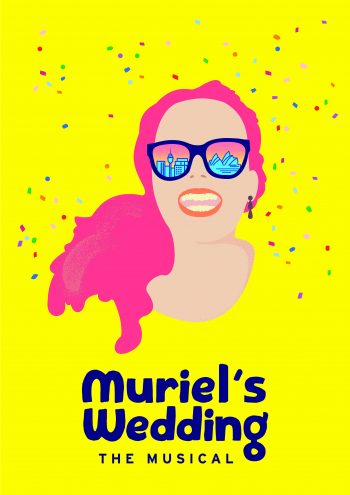
That’s right folks, “You can’t stop progress” as Muriel’s Wedding is to be made into a new musical stage show adapted to stage by, “What a coincidence”, it’s the original film’s writer and director PJ Hogan.
The show will feature all those much loved ABBA numbers whilst both the script and Muriel herself will be re-set in 2017. Will marriage be easier to find in this new world of social media and app dating?
Speaking to AussieTheatre.com.au PJ Hogan said, “I’ve been asked many times to put Muriel’s Wedding on stage and I’ve always said no – mainly because the film seemed to do what I wanted it to do, and has somehow resisted the obscurity that time and changing fashions are apt to visit upon everything and everyone. So why tempt fate and invite Muriel (and a singing Muriel, at that) to cavort in 2017?
“Back in 1994 Muriel had a problem that seemed peculiar to her… how do you become famous (that is loved/admired/envied by all) when you have no discernible talent, no achievements, and when no one believes in you except you? The new millennium has provided the tools for dreamers afflicted by obscurity: Twitter, FaceBook, Instagram, You Tube, not to mention that Hogwarts for the irrelevant, Reality TV.
“Muriel was born to be a Millennial. So a Millennial she has become. Who sings.”
Sadly the tickets prices may be a little ‘sky-high’ for us Brits as the world premier takes place at the Roslyn Packer Theatre, Sydney, Australia. Though fingers are crossed for a speedy export to the UK.
If you are travelling out there next year from the 20th Nov – 30th Dec 2017, then you can pre-book tickets at: SydneyTheatre.com.au
There are two men who get their kit off every night near Trafalgar Square, and I recommend that you go have a peek!!!
These two men are Mike Tyler and Christopher Wayne, and they are starring in a new show at Trafalgar Studios called The Naked Magicians. Having seen the show, I can vouch that they do indeed take off all of their clothes (except for the strap that holds the microphone battery!).
Directly from the Edinburgh Fringe Festival, Tyler and Wayne are two Aussies who’ve been performing as naked magicians all over the world for over two years, so they’re both used to baring all in front of an audience. But their charm and cheekiness in the way they strip is unique, and best of all, lots of fun.
Both men are actual real-life magicians (and not strippers) and their show features all sorts of magic tricks. Ninety minutes in length, the handsome gents perform tricks such as pretending to smash an audience members mobile phone, using an inflatable penis to get members of the audience to reveal their porn names (name of street you grew up on and the name of a pet) while already having it written down, card tricks galore, and of course the disappearing clothes trick, are all part and parcel of what they do. Of course, any magic show wouldn’t be a magic show without audience participation, and some lucky (?) members of the audience get the chance to go on stage and help the men to ‘perform’ their magic. Since this boisterous magic show is R-rated, the humour and the jokes, are for an adult audience, so if you’re prudish, go see Aladdin instead! And near the end of the show, the buffed men wear top hats, not on their heads, but hats that are strategically placed and in which an audience member is tasked with holding the hat in place while Christopher performs some rope tricks. It’s hilarious! By the time the men attempt to get themselves out of straightjackets (tied by two audience members), they are practically naked, but it’s the hungry audience who wants to, and gets to, see more, and they definitely get to see more.
The Naked Magicians takes magic to a whole new naughty level and it’s a level where you want to be at!
During the early years of World War Two, Benjamin Britten lived in exile in a townhouse in New York with his friend, the poet W.H. Auden and a shifting cast of artists and writers. The composer was criticised by the British press for his ‘avoidance’ of the war and faced a tribunal for conscientious objection on his return in 1942. Whereas Auden embraced his sexuality and was having an affair with a younger man, Britten was still struggling somewhat with his in the oppressive environment of 1940s England. Add to this mix some of the other residents: bisexual writer Carson McCullers hiding out from her husband, hitting the bottle and chasing after women and burlesque stripper Gypsy Rose Lee, trying to write a crime thriller. The potential for a fascinating story is all there on a plate. Sadly, writer Zoe Lewis and director Oli Rose have somehow made a dull play out of an intriguing piece of history.
The play feels oddly old fashioned (and not in a good way). There’s something twee and tedious about the drunken party games and fumbling. The cast seem like they’re in a void and in spite of Cecilia Carey’s excellent set there’s no atmosphere at all. The four lead actors try to recreate a thriving Bohemian arts scene of hedonistic parties (which isn’t easy with four people) and instead it feels like a staid afternoon tea that anyone in their right mind would exit sharply. There’s a whole ‘You don’t have to be mad to work here but it helps!” and “Looks how eccentric we all are!” vibe that actually just feels incredibly tiresome.
The venue of Wilton’s Music Hall (a Grade 2 star listed music hall from 1859) is gorgeous and is an echoing chamber of a space. Dom James’ sound design is beautiful when it’s in evidence: clanging boat engines, New York traffic in the background and distant music. Sadly, this isn’t very often and for most of the play the actors have no backing at all, adding to the strangely sterile environment.
The saving grace of the play is Ryan Sampson who gives a strong central performance as Britten. He’s convincing in his vulnerability and manages to show glimpses of pain through a veneer of genteel awkwardness. The actors playing Gypsy Rose Lee (Sadie Frost), Auden and McCullers also perform ably but are saddled with a lacklustre script that feels two-dimensional.
If you know a little about these fascinating characters then you’ll leave knowing about as much as when you came in. If you know nothing at all then you’ll be perplexed. It’s a shame that this didn’t pull it off. As the strippers told Gypsy “You Gotta Get a Gimmick”. Maybe the team here should heed that advice.
What happens when your once passionate relationship starts to become stale and sexless? In the case of Tom and Joan, you sleep with a stranger, tell your wife about it and then wait for the explosions of bitterness, venom and rage. Oh…and the retaliation.
Found 111 is a pop up theatre on Charing Cross Road in an old college building. It’s hosted critically acclaimed hits including ‘The Dazzle” with Sherlock’s Andrew Scott and “Bug” with the luscious James Norton. It’s a tiny space and in the case of issues about sex, for once, small is good. This play works well in a cramped environment. It’s a hilarious and excruciating 75-minute trawl through moments in the lives of two couples as they lurch around a bed on the stage. This is a voyeuristic and intimate experience that is as painfully uncomfortable as it’s intriguing. Thankfully, it’s very funny too which helps.
Niamh Cussack (of the Cussack acting dynasty) shows her pedigree and is monumental as the wronged wife. She’s a delicious mixture of seething, uncontained anger contrasted with insecurity and hurt. She’s magnetic and is almost impossible to draw your gaze away from. She’s more than ably accompanied by Sean Campion as her feckless and beaten-down by life husband. They have the best lines in the play and Joan and Tom are well rounded and fascinating in their ordinariness.
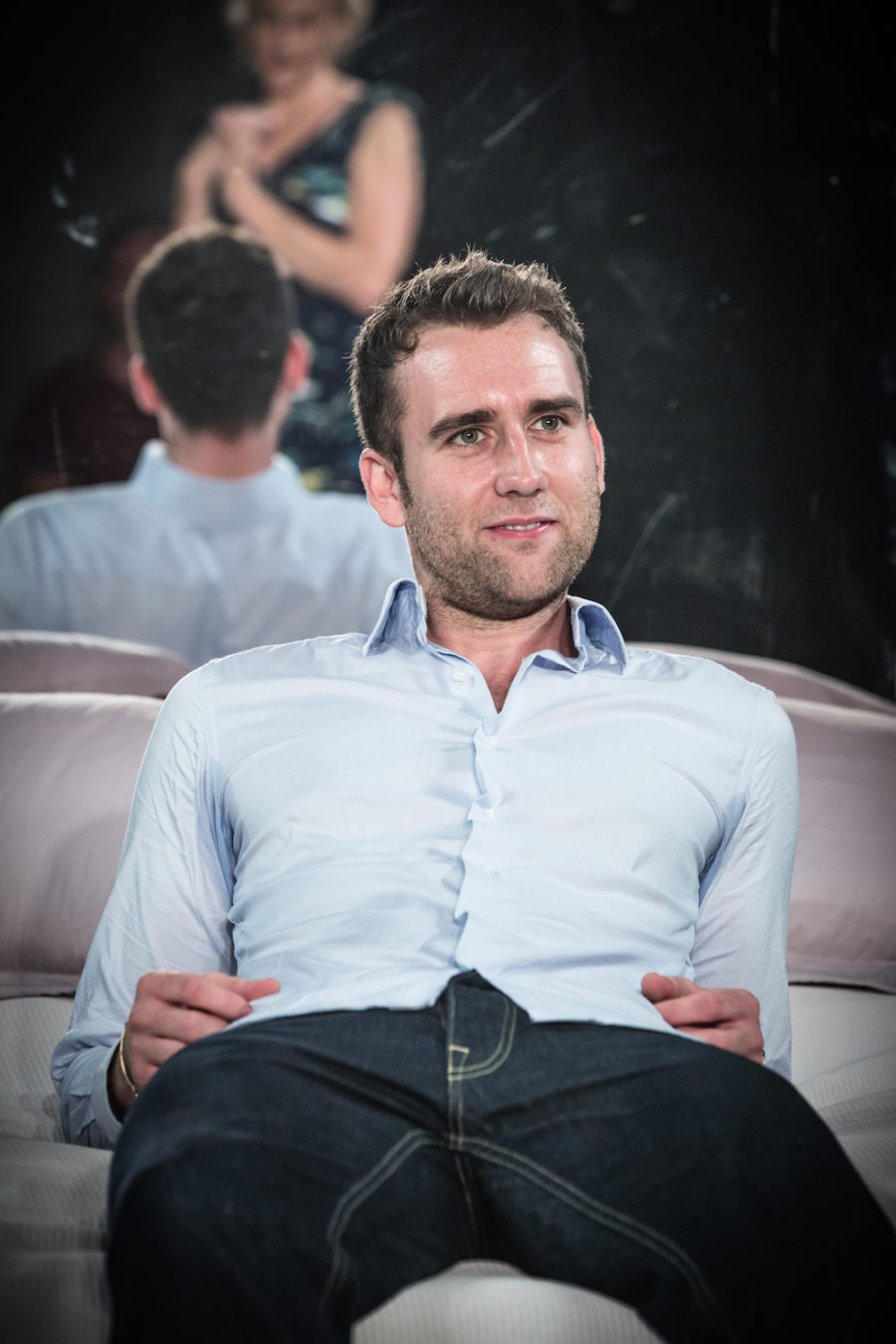
Matthew Lewis (Harry Potter’s Neville Longbottom all grown up and buff) and Ruta Gedmintas play less instantly credible characters. They eventually flesh out (as well as getting flesh out) and in spite of a slightly creaky plot, become almost plausible. Lewis plays a well-hung male hooker with a heart and Gedmintas plays his lost-soul girlfriend, so bored with her life that hooking up with middle aged men in bars seems a diverting pastime.
Owen McCafferty’s script is tight and engaging with no slack moments and the characters are mostly resonant and sympathetic. This isn’t a Whitehall farce or a night at the musicals but there’s something thrillingly earthy about the whole experience. Theatre in microcosm with a stellar central performance like Cussack’s is a rare opportunity and one to be embraced.
Shakespeare fans “roll up roll up” – thou art in for The Tempest of treats. The young British theatre company, The Faction, have refashioned, revved up, edited, Selfridges-styled and speared Much Ado About Nothing into the 21st century – much like Alessandro Michele’s influence on Gucci.
CREDIT: PR Provided
Popping a pop-up theatre in the basement of Selfridges is poetry to one’s ears. Sampling Roja Parfums: A Midsummer Dream, eau de parfum – a snip at only £295 – while passing through the perfumery. Then straddling the escalator to the lower deck – a quick whizz through Conran and Danish design brand Hay, followed by a spot of wick sniffing in Jo Malone – all before parking your derrière in the contemporary mini-catwalk 122-seat auditorium.
You wouldn’t produce a production of Romeo, and no Juliet – so why a theatre and no bar? #justsayin
Director Mark Leipacher and Co-director Rachel Valentine Smith have sharpened William’s comedy of confused love, slander and tell-tales with news bulletins, Kooples clobber, an enthusiastic, flowery and playful cast thrown in with some horny, animalistic line-dancing. The story is clear and punchy. They’ll be no “wherefore art thou amusement” – the humour is as fresh as the dark amber and ginger lily emanating from the defusers in Selfridges Ultra Lounge.
“The course of true love never did run smooth” – but Shakespeare, Selfridges and The Faction is no question, to be.
Introducing a hexagon of narratives that will surge a memory, ignite a demon or pep your G spot.
PR Supplied
If you’ve never darkened the dimly lit doorway of a chill-out, you’ll grasp that the etiquette for accepting others’ pharmaceuticals is to putout; sexual health workers hand out condoms in saunas to the beats of Kylie; Bermondsey is a hotspot for Roman style orgies; gays high on meth get lost buying cigarettes; G-o’clock equals a contorting face; overdoing the liquid-high could leave you with an unexplained bleeding rectum.
Writer Patrick Cash leans on the darker side of the drug-fueled free-for-all, with more authenticity than an Eastenders’ Christmas double bill – graphically touching on a mosaic of very real circumstances.
Sex, high on narcotics, can rocket your orgasm to another sphere, but, for some, what happens when the euphoria fades?
Denholm Spurr (Nameless), snorts Andrex-Puppy-ness into a character you’ll know, have seen or can relate to. Charly Flyte (Fag Hag Cath) is credible and injects a decent size syringe full of humour.
Leave ya poppers at home and there’s no need for laughing gas. You’ll rush, and sink to the bottom, in this well-quilled chem-hole.
The Chemsex Monologues plays at The Kings Head Theatre until 20th August 2016, 0207 226 8561
★★★ | In 1944, big band leader Glenn Miller’s plane went missing over the English Channel as he flew to Paris to entertain the troops during the Second World War. From his humble beginnings, Miller’s musical arrangements defined the sound of a generation and secured him legendary status as one of the greatest musical artists of all time.
Photo Credit – Pamela Raith
There is a double dose of nostalgia on display in this musical biopic, with not only the music of Miller, but also the presence of the show’s top billed star, Tommy Steele as the titular character. Classed as the first English teen idol and rock ‘n’ roll star, Steele still holds a loyal fan base from his success in the late 50’s and early 60’s, clearly still resonating with the target audience and retaining a certain charisma and an air of ease and professionalism. That said, at 81 years old, he is twice the age of Miller when he died, requiring a healthy suspension of disbelief, especially during the slightly uncomfortable-to-watch romantic scenes between him and a much younger Abigail Jayne, playing Miller’s wife to be. But despite his age, Steele can still trot out the tunes and knows how to play to the audience.
So whilst Steele is billed as the star on the posters, the real attraction here is the music itself, and although the show is generally overly-light on narrative, it doesn’t scrimp on the classic big band sound; as a number of Miller’s best known numbers are performed by the on-stage sixteen piece orchestra, including Moonlight Serenade, In the Mood and String of Pearls. Throw into the mix a number of lively jazz numbers, all with the trademark Miller-style arrangements, and you have an energetic and up beat set of songs ably undertaken by the orchestra and ensemble.
There is very little in the production values to make this show stand out from the crowd. There is generally a basic, but perfectly competent, presentation and Bill Deamers choreography nicely retains the spirit of the era. But show is primarily a tribute to the music itself, and it really comes into its own as the orchestra takes to the stage, especially during the second act.
The Glenn Miller Story is a pleasant, easy and gentile watch, which is undemanding and which, most importantly, doesn’t pretend to be something it’s not. It is pure unabashed and unashamed nostalgia which gets the feet tapping and celebrates just how good these classic songs are.
With Allegro, the charming space at Southwark Playhouse sees the UK premiere of a dusty old 1947 musical. Thanks to the partnership of Thom Southerland and Danielle Tarento (Titanic, Grey Gardens, Dogfight and Parade) this forgotten piece has had the cobwebs blown off it, regained its sparkle and is a welcome find rather than a lacklustre piece of tat from the store cupboard of musicals that should stay dormant.
Rodgers and Hammerstein’s musicals have been entertaining theatre audiences since the early 1940s when they hit the scene with Oklahoma. The pair went on to score a string of hits with The Sound of Music, The King and I and South Pacific among many others. Given their continued critical and commercial success it was a surprise when Allegro floundered and failed to win over American audiences when it premiered. Theories abound as to why this was: a misguided choreographer/director, a storyline ahead of its time or too radical a departure from accepted musical theatre form. Whatever the reasons, it’s resulted in something quite extraordinary for us in that we now have a ‘new’ musical from an iconic writing duo to enjoy.
The storyline isn’t the strongest around, the intention of the show being to tell a simple tale of an all American everyman. It’s a little flawed, has the odd flabby moment in Act One and is occasionally too sentimental for modern tastes but has an endearing core message. None of that matters though and it’s easy to overlook the cracks in the core material. The genius of the show lies with the team behind it. Southerland has stripped back the show and presents it on a pared down set of almost perpetually moving ladders and platforms with a cast of sixteen and an eight-piece band. The cast form the musical equivalent of a Greek chorus, commenting on the life of small town doctor Joseph Taylor Jr. as he moves from birth through to an early mid-life crisis at 35 with individual members stepping forward and taking on the roles of significant people.
Unlike the ill fated first run where a reputedly Gorgon like choreographer reigned havoc, the choreography is one of the key factors that makes this performance work. Lee Proud makes use of the limited space and the company move with panache, seamlessly augmenting the narrative. The ensemble singing is as strong as the individual numbers and really packs a punch. Some killer numbers and an accomplished cast combine to make this a winning show. Gary Tushaw as Joseph is handsomely wholesome without being nauseating and Kate Bernstein is particularly enlivening as his waspish nurse, Miss Lipscombe. Her take on “The Gentleman is a Dope” is a sight and sound to behold.
Forget Jesus Christ Superstar. If this team continue to breathe life into shows that are as dead as Lazarus then we’ll definitely be hailing them as a the new Messiahs of musical theatre.
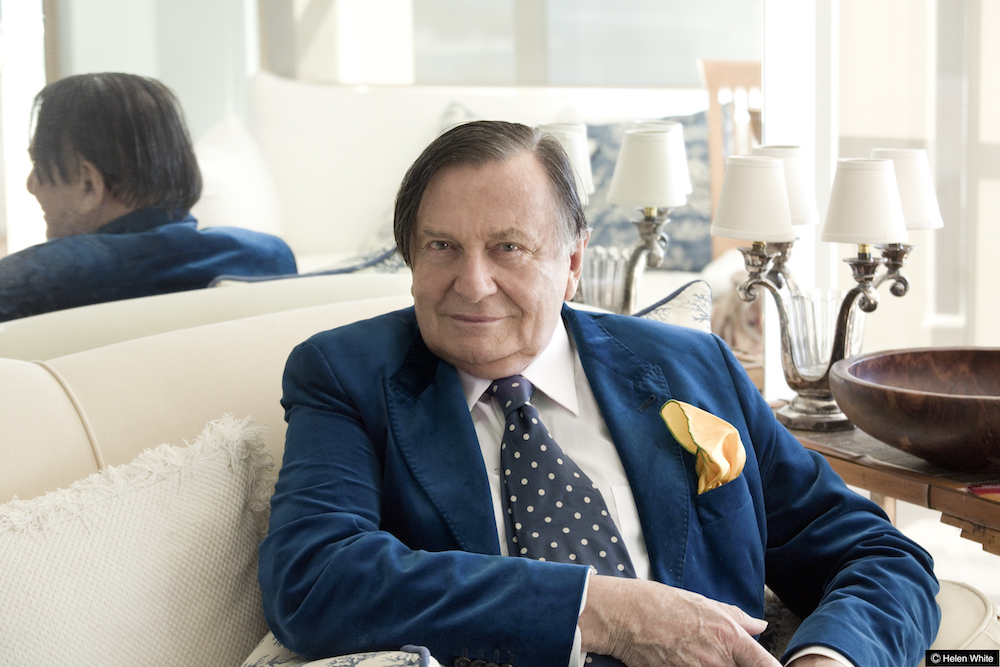
What’s your deepest impression of Barry Humphries? The tacky, kitsch-bitch supreme Dame Edna Everage, all ghastly, C&A drag and granny glasses, or worse, the snot-and dandruff spattered Sir Les Patterson?
CREDIT: Helen White – PR Supplied
Hopefully, it’s neither. See, the true Barry Humphries is a deeply cultured graduate of the fine arts, and has written definitive articles on eccentric, human sexuality. He’s also a superb character actor, to the extent audiences mistake his Sir Les Patterson creation for a genuine Ambassador of Australian culture! And if Brits, unfairly, accuse Americans of misunderstanding irony, it’s sheer, poetic justice that they’re completely insensitive to Barry Humphries’ deathly dry, Australian wit.
There’s a reason for that, of course – what ex-colonial, reactionary, right-wing regime can bear ridicule?
Not Little Britain, that’s for sure, and Humphries, initially, works hard to win over a cold, deeply monied and highly privileged Chelsea audience. Still, he’s a charming and infectiously erudite bon vivant, all barrel-chest, squat neck and deliberately ironic, his physicality eluding rigid, anal-retentive analysis. Quite simply, the audience – many of whom have never seen the real Humphries – don’t know what to make of him, suspending their typical, pack-mentality persecution prejudices. Oh, don’t get me wrong, many hardcore Conservatives adore the arts – remember David Mellor, anyone? – but often, they view culture as shockingly disposable.
Not tonight, perhaps. ‘I’m doing my hardest impersonation ever tonight’ Humphries quips, ‘myself’.
Too true, and Humphries’ actual, authoritative, deeply knowledgeable self is instantly seductive company. Always ferociously anti-fascist and bitterly opposed to any suppression of human diversity, he’s a tireless champion of Berlin’s Weimar Republic, immortalised by Christopher Isherwood’s Cabaret.
Never heard of the Weimar Republic? Google it ASAP – it’s essential queer history. An inter-wars, sexually diverse paradise, the Republic briefly flourished from 1919-1933, an intense island of queer resistance against crushing, hetero-normative banality. And Humphries, obviously, is in his element, showcasing the cream of Weimar musicality – his entire career has hilariously skewered homophobia on the spot.
So naturally, his Weimar night shares a treasure-chest of subversive memories. Discovering stacks of obscure, German sheet-music in late 1940s Melbourne, Humphries, enthralled, tracked down any possible recordings and information on the Weimar Republic. Many otherwise utterly obscure composers – Krenek, Spoliansky, Schulhoff and Hollaender – set cynical, Weill and Brechtian lyrics into thrillingly mutated music fusing American jazz and indigenous folk motifs.
And that music, of course – soon becoming the vital staples of furiously transgessive cabaret throughout Berlin – was pure poison to Germany’s ultra-reactionary, proto-Nazis. Physical, sexual and emotional spontaneity – all encouraged and cemented by Weimar’s signature, polyrhythmic musical delights – was seen as instantly inflammatory, undermining every fascist orthodoxy.
Tragically, with the brutal rise of Nazi supremacy in 1933, Weimar was immediately suppressed, but Humphries’ gorgeously provocative time-capsule of the era suggests what we’ve lost. Appropriately, he’s accompanied by mischievous, multi-talented diva Meow-meow, channelling as always the spirit, attitude and killer glamour of every possible living drag queen! Yes, Meow-meow is a biological female, but far more than fellow, drag manqué Holestar, Meow-meow performs her femininity as an intoxicating artificiality she’s just discovered. Does it work? Oh god, yes – as sublimely as Ru Paul in full, killer-queen mode, and visiting and inhabiting Weimar’s music simply demands a hugely exaggerated reality!
CREDIT: Harmony Nicolas PR SUPPLIED
It’s a theme that extends, even, to Humphries’ backing chamber orchestra, all uniformly dressed in sharp, Bohemian black, all Joel Grey trilbies for men and women. And the music’s a revelation, all instantly contagious, colloquial melodies grafted to the spare bones of classicism and non-European, imported tonalities. Yes, there’s some expected, Weimar favourites – ‘Pirate Jenny’ and ‘Surabaya Johhny’ – but the stand-out is Erwin Schulhoff’s ‘Dada masterpiece’, the Sonata Erotica.
Bearing radical, avant-garde comparison to John Cage’s 4.33’ – four minutes of silence with the score considered any random sounds within that time – Sonata Erotica still startles. Exuberantly performed by Meow-meow, it’s orgasmic moaning, pants and screeching delivered as fine, operatic art, the most joyous, unrestrained expression of subversive sexuality possible!
No wonder Humphries, after an awkward but endearing dance with Meow-meow, finally exits with an ecstatic grin- he’s just mentally liberated yet another slice of Little Britain!