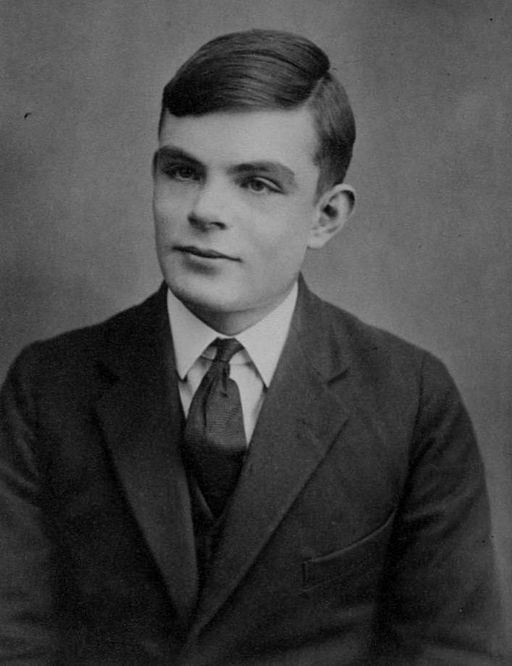
Tag: Alan Turing

All the latest breaking news on Alan Turing Browse THEGAYUK’s complete collection of news, articles and commentary on Alan Turing.

  • President Trump ‘erases LGBTQ history’ by claiming Americans “won two world wars”

    President Trump ‘erases LGBTQ history’ by claiming Americans “won two world wars”

    A former Liberal Democrat MP has criticised President Trump after he claimed that the American’s “won two world wars” completely erasing the involvement of Alan Turing‘s code-breaking invention, widely thought to bring down the Nazi war machine, helping to bring WWII to an end four year early and saving over 14 million lives.

    John Leech, blasted Donald Trump after the official White House twitter account tweeted a portion of a quote which said, “Americans harnessed electricity, split the atom, and gave the world the telephone and the internet. We settled the Wild West, won two World Wars, landed American Astronauts on the Moon—and one day soon, we will plant our flag on Mars!”

    Leech replied,

    “If anyone could claim to have “won” a World War, it would be a Manchester hero who cut WWII by 4 years and saved 14 million lives with his invention, before being pushed to take his own life. His name is Alan Turing.

    “Don’t erase LGBTQ history.

    “And don’t claim it as your own”

    Unsung war hero

    Alan Turing was a British pioneering computer scientist, mathematician, logician, cryptanalyst, philosopher and mathematical biologist.

    During the Second World War, Turing worked for the Government Code and Cypher School (GC&CS) at Bletchley Park, Britain’s code-breaking centre. For a time he led Hut 8, the section responsible for German naval cryptanalysis and created the Turing Machine which decrypted the “unbreakable” German Enigma code.

    Turing’s pivotal role in cracking intercepted coded messages enabled the Allies to defeat the Nazis in many crucial engagements, including the Battle of the Atlantic. It is said by some historians that Turing’s work at Bletchley Park shortened the war by two to four years and saved approximately fourteen million to twelve million lives.

    Nevertheless, Turing led a sheltered and castigated life due to his homosexuality. Whilst he was briefly engaged to fellow Bletchley Park worker Joan Clarke, it was a purely platonic relationship and they soon divorced. Turing was prosecuted by the police in 1952 for homosexual acts, when such behaviour was still criminalised in the UK.

    He accepted treatment with oestrogen injections (chemical castration) as an alternative to prison and became incredibly depressed. He committed suicide in 1954. Turing’s wartime heroics were not celebrated until he received an official pardon from Prime Minister Gordon Brown in 2009 following an internet campaign, and then a further royal pardon from Queen Elizabeth II in 2013.

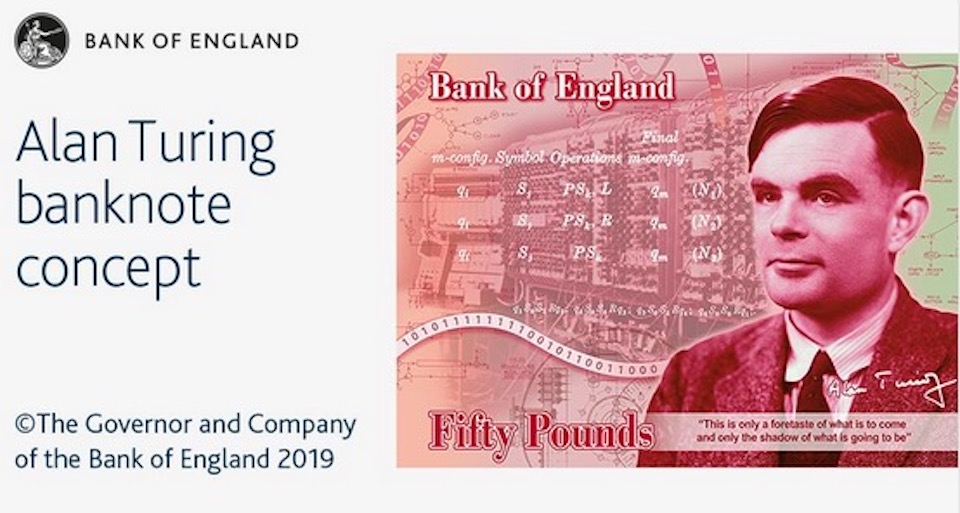
    In 2019, Alan Turing was honoured in the UK by becoming the face of the £50 note.
  • This is who is on the new £50 note

    This is who is on the new £50 note

    It has been announced that scientist and code breaker, Alan Turning is the new face of the £50 note.

    The Bank of England have announced that Code Breaker and gay scientist, Alan Turing is to be the new face of the £50 note.

    Today, the Bank of England announced that WWII hero Alan Turing will be the face of the new £50 note at an event in Manchester’s Museum of Science and Industry.

    Former Manchester MP and gay rights campaigner John Leech led a nearly decade-long campaign to pardon Alan Turing, gaining immense public support from legendary physicists such as Stephen Hawking.

    During the campaign, Leech submitted several bills to Parliament describing Turing’s long-held conviction as “utterly disgusting and ultimately just embarrassing”.

    After his campaign proved successful, Leech turned to secure pardons for the 75,000+ other men and women convicted of the same outdated crime in what is now nicknamed the Alan Turing Law.

    Welcoming today’s news, Turing pardon architect John Leech said, “It is almost impossible to put into words the difference that Alan Turing made to society, but perhaps the most poignant example is that his work is estimated to have shortened the war by four years and saved up to 21 million lives.

    “And yet the way he was treated afterwards remains a national embarrassment and an example of society at its absolute worst.

    “I’m absolutely delighted that Turing will be the face of the new £50 note and I hope it will go some way to acknowledging his unprecedented contribution to society and science.

    “It is a fitting and welcome tribute to a true Manchester hero.

    “But more importantly I hope it will serve as a stark and rightfully painful reminder of what we lost in Turing, and what we risk when we allow that kind of hateful ideology to win.”

  • Could Alan Turing be the face for the new £50 note?

    Could Alan Turing be the face for the new £50 note?

    There are calls to make Alan Turing the face of the new £50 to serve as a “painful reminder of what we lost.”

    Alan Turing
    Public Domaain

    The Bank of England has invited members of the public to vote on which figure should appear on the new £50 note.

    Former Manchester MP John Leech led a nearly decade-long campaign to pardon Alan Turing, gaining immense public support from legendary physicists such as Stephen Hawking.

    During the campaign, Mr Leech submitted several bills to Parliament saying it was “utterly disgusting and ultimately just embarrassing” that the conviction was upheld as long as it was, and celebrated the posthumous pardon.

    He then turned to acquiring pardons for the 75,000 other men convicted of the same outdated crime.

    At the UK premiere of a film based on Turing’s life, The Imitation Game, the producers thanked Mr Leech for bringing the topic to public attention and securing Turing’s pardon.

    Supporting Turing for the new £50 note John Leech said, “It is almost impossible to put into words the difference that Alan Turing made to society, but perhaps the most poignant example is that his work is estimated to have shortened the war by four years and saved 21 million lives.

    “And yet way he was treated afterwards remains a national embarrassment and an example of society at its absolute worst.

    “Placing Turing on the £50 note would at least go some way to acknowledging his unprecedented contribution to society and science.

    “But more importantly it will serve as a stark and frankly painful reminder of what we lost in Turing and what we will lose again if we ever allow that kind of hateful ideology to win.”

  • LEGAL CLINIC | Following the Turing Law, Am I entitled to claim for unfair dismissal and wrongful imprisonment?

    A reader asks now that the Turing Law is a reality, can he claim for unfair dismissal from the army and wrongful imprisonment.

    Am I entitled to claim for unfair dismissal and wrongful imprisonment?

    I am 55 years of age.

    I joined the army at 19. In 1983 I was court martialed for gross indecency, sentenced to 6 months in military prison and discharged with disgrace. Under the Turing law, I have since received a royal pardon and my record wiped clean both by the Home Office and the Ministry of Defence.

    My question is: Am I entitled to claim for unfair dismissal and wrongful imprisonment?

    John (Name changed)

    Dear John,

    Thank you for your question. I’m very glad to hear you’ve been able to use “Turing’s Law” to obtain a statutory pardon.

    Although the effect of the conviction being disregarded means the conviction should in all circumstances be considered as never having happened, the pardon itself does not retroactively change the status of the then applicable law. This means that, unfortunately, you cannot take any action for wrongful imprisonment because, according to the laws of the time – unfair as they were, the action taken by the court martial was lawful. Neither can you pursue the issue in terms of employment law. Court martial decisions are not covered by the Employment Tribunal (which is the only place you can pursue unfair dismissal claims) and in any event, claims have to be brought within three months of dismissal.  Employment law is incredibly restrictive at the moment and is generally thought to favour the employer over the worker.

    This means that, unfortunately, you cannot take any action for wrongful imprisonment because, according to the laws of the time – unfair as they were, the action taken by the court martial was lawful. Neither can you pursue the issue in terms of employment law. Court martial decisions are not covered by the Employment Tribunal (which is the only place you can pursue unfair dismissal claims) and in any event, claims have to be brought within three months of dismissal. Employment law is incredibly restrictive at the moment and is generally thought to favour the employer over the worker.

    You have suffered a great deal and I know you will be disappointed that this legal advice is not more positive. The key with employment law today is to act quickly and anyone suffering from discrimination at work because of their sexuality should to take advice from a trade union or a solicitor as soon as they can. Even if you are not a member of trade union now, or at the time of the discrimination, you should still contact a local union rep as they can help you nonetheless.

    Check your household insurance too: sometimes it will cover legal services without you realising. No one should have to suffer any detriment at work because of their sexuality, or any other characteristic that has nothing to do with their job, so if you are suffering in this way, please seek help.

  • Alan Turing Law is ‘hugely historic” and “deeply emotional”

    The Alan Turing law has been welcomed by John Leech, the pardon architect and campaign leader.

    More than 75,000 people criminally convicted of homosexuality have today been pardoned under the “Sexual Offences (Pardons Etc.) Bill 2016-17”, known informally as the “Alan Turing Law”.

    The decision has been warmly welcomed by the architect of Alan Turing’s pardon, former Liberal Democrat MP John Leech, who said,

    “For years I have campaigned and fought for this moment.

    “This is a hugely historic, proud and deeply emotional day, but it is certainly not before time.”

    Mr Leech submitted several motions to parliament and campaigned hard to secure Alan Turing’s historic pardon, stating that it was “utterly disgusting and ultimately just embarrassing” that the conviction was upheld as long as it was.

    He added today,

    “I hope this will provide relief to all those that suffered with this awful and unjust burden for so long.

    “It’s an enormous step forward for LGBTQ+ history.”

    Alan Turing was a pioneering English computer scientist and mathematician whose groundbreaking work is thought to have brought WWII to an end four years early.

    However, at a trial in 1952, Turing admitted to “acts of gross indecency” before being sentenced to chemical castration. His conviction meant he lost his security clearance and was forced to stop work at Bletchley Park.

    Aged just 41, he was found dead from cyanide poisoning in 1954 with a half-eaten apple by his side. An inquiry concluded that it was suicide.

    In 2013, Alan Turing was given a posthumous royal pardon and an official apology by former Prime Minister Gordon Brown, following a high profile campaign led by the former Manchester MP John Leech.

    Today, it is under Alan Turing’s name and legacy that the injustice of so many is finally brought to an end.

    Following the success of his campaign, Mr Leech turned to securing the pardon for the 75,895 other gay, lesbian, bisexual and transgender people who were unfairly convicted for similar offences.

    It was in Manchester, in 1952, that Turing was arrested for having sex with another man, whilst much of his ground-breaking scientific work was conducted at the University of Manchester. Today, mathematics students at the university attend lectures in the building proudly bearing his name.

    Mr Leech added,

    “I believe Alan Turing would be truly overwhelmed to see tens of thousands of people rightfully vindicated in honour of his name.”

    It is predicted that Turing’s work saved the lives of an estimated 14 to 21 million.

    Mr Leech said Turing’s persecution “by the state for being gay was a scandal that shouldn’t have ever been allowed to stand”.

    The first motion Mr Leech submitted called for a recognition of the “vital contribution made by Alan Turing to Britain’s war effort” and “regrets that following his years of national service he received a criminal conviction for having a sexual relationship with another man”.

    It added that there were 75,895 other gay, lesbian, bisexual and transgender people who were unfairly convicted for similar offences and called on the Government to ensure that they too received pardons.

    The former Liberal Democrat MP of ten years, John Leech, wrote to the SNP MP John Nicolson, who sponsored the Sexual Offences bill, to thank him for “seeing the campaign through to its very end”, adding that it was a “deeply emotional day for him and his team” who have fought for this moment for years.

  • Thousands of gay and bisexual men posthumously pardoned from old sexual offences

    Thousands of gay and bisexual men posthumously pardoned from old sexual offences

    Thousands of gay and bisexual men have been posthumously pardoned by the UK’s government.

    gay men posthumously pardoned over historic sexual offences

    Thousands of men who were charged with offences of now abolished sex offences will be posthumously pardoned by the government. The pardon effects those men who have since died and does not include those who are still living.

    It is believed that only men who have died with have their charges pardoned.

    The law is dubbed the Turing Bill, after scientist Alan Turing. Alan Turing was convicted in 1952 of “gross indecency” with a 19-year-old man. He was chemically castrated. He died two years later from cyanide poisoning in an apparent suicide. He was pardoned in 2013 with a posthumous royal pardon.

    Speaking about the historic pardons, Justice Minister Sam Gyimah called it a ‘truly momentous day’. The MP was heavily criticised last year after he filibustered a proposal forwarded by SNP MP John Nicolson, who suggested that the Turing Bill should “‘prioritise the living’. Sam Gyimah claimed that it would be very difficult to distinguish between those who had been convicted of offences that are still illegal and those that have now been abolished, such as homosexuality.

    Homosexuality was decriminalised in the UK in stages, with the law change in England and Wales in 1967, in Scotland in 1982 and in Northern Ireland in 1982.

    Those similarly convicted but still alive will also receive pardons if they have successfully applied for a disregard, or in future successfully apply for a disregard under the Protection of Freedoms Act.

    This is a breaking news story. Please click refresh to get the latest update.

  • 75,000 to be awarded a Governmental pardon for the criminal act of being gay

    75,000 to be awarded a Governmental pardon for the criminal act of being gay

    The Government is to hand pardons to tens of thousands of deceased gay and bisexual men who you were criminally convicted of homosexuality.

    Alan Turing
    Public Domain


    The UK Government is to start issuing pardons for gay and bisexual men who were convicted of the crime of homosexuality. The Ministry of Justice said that no individuals cases would be singled out.

    Homosexuality was decriminalised in the UK in stages, with the law change in England and Wales in 1967, in Scotland in 1982 and in Northern Ireland in 1982.

    Former Liberal Democrat MP for Manchester Withington, John Leech, who led the successful campaign to pardon Alan Turing, has today secured an agreement with the Government which will grant a posthumous pardon to tens of thousands of gay and bisexual people convicted under long abolished sexual offence laws.

    The decision to accept the amendment has been warmly welcomed by the architect of Alan Turing’s pardon, Cllr. John Leech, who said,

    “For years I have campaigned and fought for this moment and I’m completely overwhelmed that this is finally coming to a positive end.

    “This is a deeply profound and emotional day for my team and I.”

    Those similarly convicted but still alive will also receive pardons if they have successfully applied for a disregard, or in future successfully apply for a disregard under the Protection of Freedoms Act.

    The Government will add their name to the Liberal Democrat amendment to the Policing and Crime Bill that when passed will finally grant the long-awaited pardon to over 75,000 people.

    This has been a long-fought campaign for John Leech who first raised the issue in the Houses of Parliament and began campaigning in 2011.

    Mr Leech submitted several motions to Parliament and campaigned hard to secure the historic pardon, stating that it was “utterly disgusting and ultimately just embarrassing” that the conviction was upheld as long as it was.

    In 2013, Alan Turing was given a posthumous royal pardon and an official apology by former Prime Minister Gordon Brown, following the high profile campaign led by John Leech.

    Following the success of his campaign, Mr Leech turned to securing the pardon for the 75,895 other gay, lesbian, bisexual and transgender people who were unfairly convicted for similar offences.

    Alan Turing was a pioneering English computer scientist and mathematician whose groundbreaking work is thought to have brought WWII to an end four years early.

    However, at a trial in 1952, Turing admitted to “acts of gross indecency” before being sentenced to chemical castration. His conviction meant he lost his security clearance and was forced to stop work at Bletchley Park.

    Aged just 41, he was found dead from cyanide poisoning in 1954 with a half-eaten apple by his side. An inquiry concluded that it was suicide.

    It is predicted that Turing’s work saved the lives of an estimated 14 to 21 million.

    Mr Leech said Turing’s persecution “by the state for being gay was a scandal that shouldn’t have ever been allowed to stand”.

    The first motion Mr Leech submitted called for a recognition of the “vital contribution made by Alan Turing to Britain’s war effort” and “regrets that following his years of national service he received a criminal conviction for having a sexual relationship with another man”.

    John Leech concluded: “This is an enormous step forward for LGBTQ+ history and I believe Alan Turing would be truly proud to see tens of thousands of people rightfully vindicated in his name.”

    Leader of the Liberal Democrats, Tim Farron MP, added: “The Liberal Democrats continue to be the strongest voice on equality in and out of Parliament.

    “This was a manifesto commitment which even in opposition, thanks to the tireless work of John Leech alongside our MPs and peers, we have been able to deliver on.”

  • Benedict Cumberbatch Celebrates Diversity In The UK

    Benedict is joined by other national treasures including The Beatles, William Shakespeare, Arctic Monkeys and Banksy.

    CREDIT: S. Buckley
    CREDIT: S. Buckley

    (more…)

  • Unsung Gay Heroes In History

    We look back into history and highlight other unsung gay men who have made an incredible different to our lives.

    Alan Turing (1912–1954)
    Alan Turing was a British pioneering computer scientist, mathematician, logician, cryptanalyst, philosopher and mathematical biologist. During the Second World War, Turing worked for the Government Code and Cypher School (GC&CS) at Bletchley Park, Britain’s code-breaking centre. For a time he led Hut 8, the section responsible for German naval cryptanalysis and created the Turing Machine which decrypted the “unbreakable” German Enigma code. Turing’s pivotal role in cracking intercepted coded messages enabled the Allies to defeat the Nazis in many crucial engagements, including the Battle of the Atlantic. It is said by some historians that Turing’s work at Bletchley Park shortened the war by two to four years and saved approximately fourteen million to twelve million lives. Nevertheless, Turing led a sheltered and castigated life due to his homosexuality. Whilst he was briefly engaged to fellow Bletchley Park worker Joan Clarke, it was a purely plutonic relationship and they soon divorced. Turing was prosecuted by the police in 1952 for homosexual acts, when such behaviour was still criminalised in the UK. He accepted treatment with oestrogen injections (chemical castration) as an alternative to prison and became incredibly depressed. He committed suicide in 1954. Turing’s wartime heroics were not celebrated until he received an official pardon from Prime Minister Gordon Brown in 2009 following an internet campaign, and then a further royal pardon from Queen Elizabeth II in 2013. From 9th March, 2015, the biopic of Alan Turing’s life and heroics, THE IMITATION GAME, will become available on Blu-ray and DVD courtesy of StudioCanal.

    Bayard Rustin (1912-1987)
    Bayard Rustin was the brain behind Martin Luther King Jr. and the civil rights movement in 1960s America. Rustin was one of the driving forces behind the Congress for Racial Equality and the Southern Christian Leadership Conference (SCLC). Most significantly, Rustin organized the 1963 March on Washington — where King gave his legendary “I have a dream” speech. However, due to his homosexuality and his membership in the Communist Party, he has often received short shrift from historians and his integral role in the civil rights movement is often overlooked. At the time, Rustin selflessly avoided the limelight because he knew that elected officials and politicians would attempt to discredit the civil rights movement by pointing out his sexual and political leanings. Rustin was also heavily involved in the anti­–Vietnam War and gay rights movements before his death in 1987.

    Sergei Diaghilev (1872-1929)
    Sergei “Serge” Diaghilev was a Russian art critic, patron, ballet impresario and founder of the Ballets Russes, but also one of the first outspoken and unapologetically gay men of the early 20th century. Sergei Diaghilev reshaped that epoch’s ideas about art and performance, and was a pioneer in adapting new musical styles to modern ballet. He created the Ballets Russes mainly as a showcase for his lover and protégé Vaslav Nijinsky, who is still considered one of the greatest dancers who ever lived. Diaghilev had exquisite tastes, bringing the work of such artists as Balanchine, Picasso, Pavlova and Cocteau onto the stage in his cutting-edge productions, which were often unabashedly erotic. After the Russian Revolution of 1917, Diaghilev was condemned as an especially insidious example of bourgeois decadence and his contribution to Russian art was written out of history by the Soviets for more than sixty years.

    Larry Kramer (1935-present)
    Every movement needs a voice of anger and righteousness, and when the AIDS pandemic hit, the gay community was lucky to have Larry Kramer, whose editorials and plays (particularly The Normal Heart) demanded that the government take action and that gay men take responsibility for their health. A fascinating author and a rabble-rouser in the best sense, Kramer continues to be a vital and often infuriating presence. Kramer co-founded the Gay Men’s Health Crisis (GMHC), which has become the world’s largest private organization to raise funds for and provide services to people stricken with Acquired Immune Deficiency Syndrome (AIDS).

    Harvey Milk (1930–1978)
    Harvey Milk was an American politician who became the first openly gay person to be elected to public office in California when he won a seat on the San Francisco Board of Supervisor.
    Milk moved from New York City to settle in San Francisco in 1972 amid a migration of gay men to the Castro District. He ran unsuccessfully for political office three times. Nevertheless, his theatrical campaigns earned him increasing popularity, and Milk won a seat as a city supervisor in 1977. Milk served almost 11 months in office and was responsible for passing a stringent gay rights ordinance for the city. On November 27, 1978, Milk and Mayor George Moscone were assassinated by Dan White, another city supervisor who had recently resigned but wanted his job back. Despite his short career in politics, Milk became an icon in San Francisco and a martyr in the gay community. In 2008 a Hollywood biopic Milk, starring Sean Penn, honoured Harvey Milk’s transformation of San Fransisco into a mecca for LGBT Americans and in 2009 Milk was posthumously awarded the Presidential Medal of Freedom.

    The Imitation Game is out on Blu-ray, DVD and digital download platforms now , courtesy of StudioCanal

  • GAY HISTORY: Unsung Gay Heroes In History

    We look back into history and highlight other unsung gay men who have made an incredible different to our lives.

    Alan Turing (1912–1954)

    Alan Turing was a British pioneering computer scientist, mathematician, logician, cryptanalyst, philosopher and mathematical biologist. During the Second World War, Turing worked for the Government Code and Cypher School (GC&CS) at Bletchley Park, Britain’s code-breaking centre. For a time he led Hut 8, the section responsible for German naval cryptanalysis and created the Turing Machine which decrypted the “unbreakable” German Enigma code. Turing’s pivotal role in cracking intercepted coded messages enabled the Allies to defeat the Nazis in many crucial engagements, including the Battle of the Atlantic. It is said by some historians that Turing’s work at Bletchley Park shortened the war by two to four years and saved approximately fourteen million to twelve million lives. Nevertheless, Turing led a sheltered and castigated life due to his homosexuality. Whilst he was briefly engaged to fellow Bletchley Park worker Joan Clarke, it was a purely plutonic relationship and they soon divorced. Turing was prosecuted by the police in 1952 for homosexual acts, when such behaviour was still criminalised in the UK. He accepted treatment with oestrogen injections (chemical castration) as an alternative to prison and became incredibly depressed. He committed suicide in 1954. Turing’s wartime heroics were not celebrated until he received an official pardon from Prime Minister Gordon Brown in 2009 following an internet campaign, and then a further royal pardon from Queen Elizabeth II in 2013. From 9th March, 2015, the biopic of Alan Turing’s life and heroics, THE IMITATION GAME, will become available on Blu-ray and DVD courtesy of StudioCanal.

    Bayard Rustin (1912-1987)

    Bayard Rustin was the brain behind Martin Luther King Jr. and the civil rights movement in 1960s America. Rustin was one of the driving forces behind the Congress for Racial Equality and the Southern Christian Leadership Conference (SCLC). Most significantly, Rustin organized the 1963 March on Washington — where King gave his legendary “I have a dream” speech. However, due to his homosexuality and his membership in the Communist Party, he has often received short shrift from historians and his integral role in the civil rights movement is often overlooked. At the time, Rustin selflessly avoided the limelight because he knew that elected officials and politicians would attempt to discredit the civil rights movement by pointing out his sexual and political leanings. Rustin was also heavily involved in the anti­–Vietnam War and gay rights movements before his death in 1987.

    Sergei Diaghilev (1872-1929)

    Sergei “Serge” Diaghilev was a Russian art critic, patron, ballet impresario and founder of the Ballets Russes, but also one of the first outspoken and unapologetically gay men of the early 20th century. Sergei Diaghilev reshaped that epoch’s ideas about art and performance, and was a pioneer in adapting new musical styles to modern ballet. He created the Ballets Russes mainly as a showcase for his lover and protégé Vaslav Nijinsky, who is still considered one of the greatest dancers who ever lived. Diaghilev had exquisite tastes, bringing the work of such artists as Balanchine, Picasso, Pavlova and Cocteau onto the stage in his cutting-edge productions, which were often unabashedly erotic. After the Russian Revolution of 1917, Diaghilev was condemned as an especially insidious example of bourgeois decadence and his contribution to Russian art was written out of history by the Soviets for more than sixty years.

    Larry Kramer (1935-present)

    Every movement needs a voice of anger and righteousness, and when the AIDS pandemic hit, the gay community was lucky to have Larry Kramer, whose editorials and plays (particularly The Normal Heart) demanded that the government take action and that gay men take responsibility for their health. A fascinating author and a rabble-rouser in the best sense, Kramer continues to be a vital and often infuriating presence. Kramer co-founded the Gay Men’s Health Crisis (GMHC), which has become the world’s largest private organization to raise funds for and provide services to people stricken with Acquired Immune Deficiency Syndrome (AIDS).

    Harvey Milk (1930–1978)

    Harvey Milk was an American politician who became the first openly gay person to be elected to public office in California when he won a seat on the San Francisco Board of Supervisor.

    Milk moved from New York City to settle in San Francisco in 1972 amid a migration of gay men to the Castro District. He ran unsuccessfully for political office three times. Nevertheless, his theatrical campaigns earned him increasing popularity, and Milk won a seat as a city supervisor in 1977. Milk served almost 11 months in office and was responsible for passing a stringent gay rights ordinance for the city. On November 27, 1978, Milk and Mayor George Moscone were assassinated by Dan White, another city supervisor who had recently resigned but wanted his job back. Despite his short career in politics, Milk became an icon in San Francisco and a martyr in the gay community. In 2008 a Hollywood biopic Milk, starring Sean Penn, honoured Harvey Milk’s transformation of San Fransisco into a mecca for LGBT Americans and in 2009 Milk was posthumously awarded the Presidential Medal of Freedom.

    The Imitation Game is out on Blu-ray, DVD and digital download platforms now , courtesy of StudioCanal

  • THEATRE REVIEW | That Is All You Need To Know

    ★★★ That Is All You Need To Know | In a day and age where you can share every aspect of your life at the touch of a social media button, the concept of an entire workforce keeping ‘what they did in the war’ a secret for 30 years is one which may be difficult to comprehend. But for the workforce of Bletchley Park, where the government brought together some of the greatest minds of the time together to gather war time intelligence, that is exactly what they had to do.

    (more…)