★★★★ | A modern farce that delivers ounces of emotion, comedy and suspense. A full platter!
(Photo credit: Robert Day)
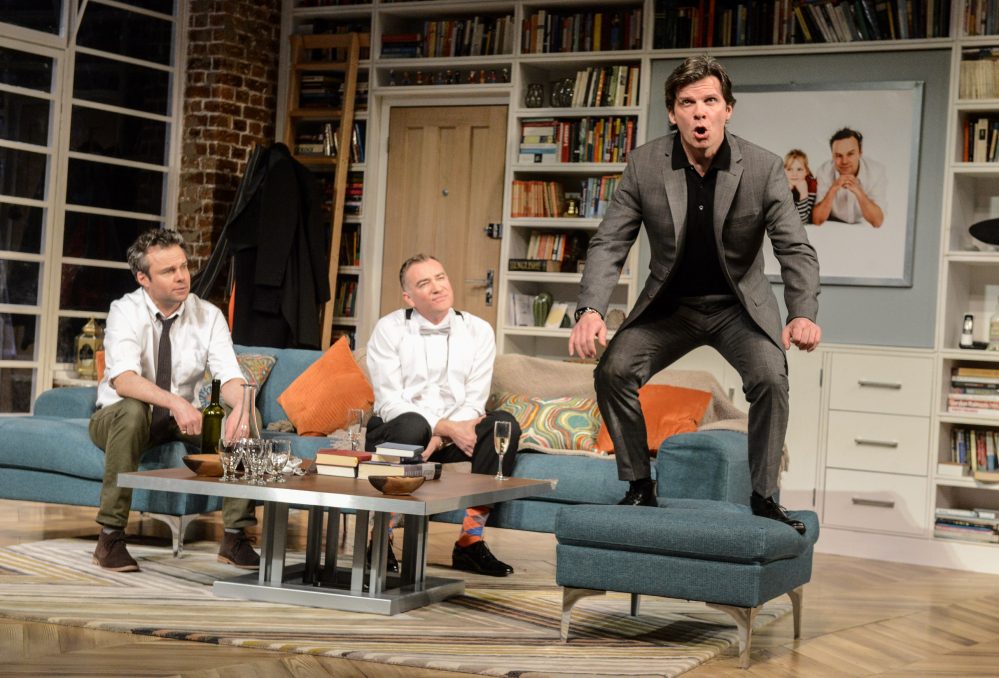
What’s In A Name, written by Alexandre De La Patellière and Matthieu Delaporte, stages a dinner party packed with many surprises and twists that kept you on edge, and slightly edgy, while holding your belly for laughing. It is set in London, and the story centres itself around the name of Adolphe which Vincent jokes about calling his son when he is born. The story then darkens as secrets are revealed within each of the five guests.
Sarah Hadland, who most would remember as Stevie in Miranda, stole the show with her multi-emotional portrayal of Elizabeth. Sarah was completely natural and every line and action was delivered with sheer dexterity and conviction. I was so happy to see Sarah aka Stevie up close, and to not see her as Stevie at the same time, which was something I really enjoyed. Raymond Coulthard was magnificent as Carl, and was great to see him back at the Birmingham Rep after watching him in King’s Speech. Carl carried the biggest secret and Raymond played the audience well, never giving any of it away. Nigel Harman, Eastenders, was formidable as Vincent, Elizabeth’s younger brother. Nigel conveyed him with such energy and natural flair that one could not help but be drawn every time he spoke and moved. Jamie Glover was excellent with his cross-examining scenes as Peter, challenging Vincent and others to prove a point. He made the set appear like it was his own home with the way he perched on or leaned against features in the front room signalling natural familiarity. Olivia Poulet as Anna was a great ingredient to turn the drama on its head with coming in quite late and revealing a hidden secret. Olivia was charismatic and held her own against the other theatrical titans.
I seriously suggest everyone go and see this as it draws you in with the clever humour and sophisticated drama – you just didn’t know what you were going to get!
I remember reading Pride and Prejudice in my early teens, and recall falling in love with characters and the way they came to life on every page. Last night, Simon Reade’s stage adaptation delivered the feeling of nostalgia and I couldn’t help but fall in love again.
It is quite rare to see a cast where every character, minor or major, stand out equally, and contribute superbly to every scene they are in. This was true of Pride and Prejudice. I was blown away by the humour, the tension, and the vulnerability that every actor was able to portray throughout the production. Matthew Kelly did a sterling job as Mr Bennet, with his on-point comedic timing and powerful voice that rippled through the auditorium. The shining actor was Felicity Montagu who played Mrs Bennet, and what a sensation she was. Felicity was the true embodiment of the role and from minute one she had you in stitches. The dour portrayal of Mr Darcy by Benjamin Dilloway was accomplished and perfect for the character, showing Benjamin’s versatility, for his change of mood when he confesses his love to Elizabeth Bennet was more heartfelt and the audience were drawn in. There were some ‘awwws’ when he professed his true feelings to Elizabeth. Elizabeth Bennet, portrayed by Tafline Steen, was a whirlwind. Headstrong, charismatic, un-lady like, and the Elizabeth I envisioned when I first read the book. This was a typical feeling I had, as every role was expertly crafted to suit the novel, making it a magical experience for the Austen aficionados. Doña Croll’s Lady Catherine De Bourgh was a sensation and the epitome of the high class of the era. Her characterisation was composed, edgy and a little on the dangerous side.
The set, as well as the props and effects, transported the audience into the early 1800s where ‘things’ were seen of more value than people. Gossip and hearsay were a constant pleasure manifested in the society of the era, and Austen did a brilliant job capturing it. Simon Reade outdid himself by introducing to us the story we cannot help but go weak at the knees at every time.
I was so impressed by the energy and enthusiasm shown across the production that I want to see it again and again, and haven’t stopped recommending Pride and Prejudice to friends. Perhaps that is why there are scarcely any seats left!
Pride and Prejudice plays at the Birmingham Rep until 12th November
Is prejudice innate or learned? Is racism okay if everyone is? And is there such thing as racism equality? These are some of the questions that What Shadows evoked, and are still riddling my mind.
In 1968, Enoch Powell made a speech in Birmingham that created a fissure along the street where it was famously delivered and divided a nation with words that scarred those who became a target of it. The Birmingham Rep put on the production of What Shadows and a troubling moment of history was resurfaced.
In the Studio Theatre, real trees had been planted to give the idea of wilderness and lighting cast shadows on the wall for different moments of the play. I found myself staring at them a lot to figure out their purpose, and it dawned on me, halfway through, that the trees were probably the same ones that had witnessed history across the decades that the play was set in. They were the shadows of time.
Cast-wise, each performer was equal in acting craftsmanship. Most actors multipart played different roles showcasing dexterity and natural flair, which contributed to an extremely believable production that took you on a chronological journey of identity. Chris Hannan, the writer of What Shadows, summoned a mixture of feelings in the audience, and without bias, created a story that made the audience ask and debate inwardly how they felt about their own identity: what is natural for human beings to feel? And, is double standards of racism correct?
Ian Mcdiarmid not only looked the part but his physicality, as well as his tone of voice, were uncannily accurate. The power and fragility of Enoch was brought out by Ian in a subliminal way, and it was one of those performances that stunned you and made you feel incredibly glad to have had the opportunity to watch it.
Bríd Brennan played Enoch’s wife, Pamela, and Sofia Nicol, an unrivalled genius of the early 90’s, which were played in a delicate and powerful way. The actor who stood out for me for his passionate, strong and utterly convincing portrayal of the Sultan was Phaldut Sharma. When he begged for his wife, Grace Hughes (Paula Wilcox), to remember him was close to tear-jerking, and the racial divide was felt the strongest when he gave a speech about serving with the Punjabi regiment and in the British Army as well as being a comrade of Enoch’s, and then Enoch’s dismissal and belittling of the sacrifices made by his regiment brought racism home. A superb performance I will never forget.
Paula Wilcox did a sterling job as Grace Hughes, a lady who lost her husband during the war, and embodied, with impeccable skill, a racist resident in Birmingham who sided with Enoch’s views, but when she got to know the Sultan, the racial tension fell away, and left room for love.
★★★★★ | The Exorcist was a frightening occasion with jumps, bumps, and lights were left on in my home.
Robert Day
The original ‘The Exorcist’ written by William Peter Blatty brought horror to U.K. cinemas in the 1970’s being banned in most of them, for people fainted, were sick and were left immobilised from the terror. The Birmingham Repertory Theatre developed the play version alongside Bill Kenwright, and playwright John Pielmeier for a U.K. premiere which happened on the 21st October.
I was stunned immediately by the ambition of the set design and special effects used throughout the play. I previously thought it would be a play that was going to be hard to get a scared out of as you knew what was going to happen, as well as you are not manipulated by the sounds and editing that you normally experience in a film. However, The Birmingham Rep’s ‘The Exorcist’ took you by surprise and you daren’t bat an eyelid. The illusionist setting and apparition of the evil spirit were special effects you would see in a film now. The illusion design was masterfully developed by Ben Hart. The way the walls appeared to move and the dark cloud traveling along the set as the demon were just otherworldly!
Robert Day
The performance, delivered by the cast, matched the effects with equal conviction with Regan, in particular, played by Clare Louise Connoly, shining brilliantly. Clare’s multifaceted portrayal of Regan was sublime, and delivered every ounce with dexterity. She surpassed herself when becoming possessed with ambitious physicality and movement that contributed to the eerie ambience of the production. Jenny Seagrove played Chris, Regan’s mother, and played her emotions very authentically as well as showcasing anger and fear very intelligently.
Peter Bowl’s Father Merrin stole the show for me. He played the Father quietly, confidently, and made the audience feel at ease as the one who was going to solve the puzzle. An incredibly gifted actor whose short time on stage provided entertainment to the last second, and the audience hung onto every word he said. The flamboyant character Burke, played by Tristram Wymark, had genial comedic timing. A couple of times leaving some audience members in hysterics. Adam Garcia contributed to the sombre mood of the play with his portrayal of Father Karras, whose mother had been ‘taken by the devil’, and had died from the event.
It was a well-accomplished production, with effects that could not be believed were possible, acting that was on point, with all characters providing an air of mystery and suspense; and the effects that made the audience jump, which to me was a treat that I won’t be forgetting any time soon.
Drama based on the rise and fall of Thatcher has been in production ever since the year she lost power. By the very nature, ‘Thatch- iopic,’ as coined by my theatre colleague, can be bitty and could potentially reduce long-standing working relationships and battles to single scenes or moments.
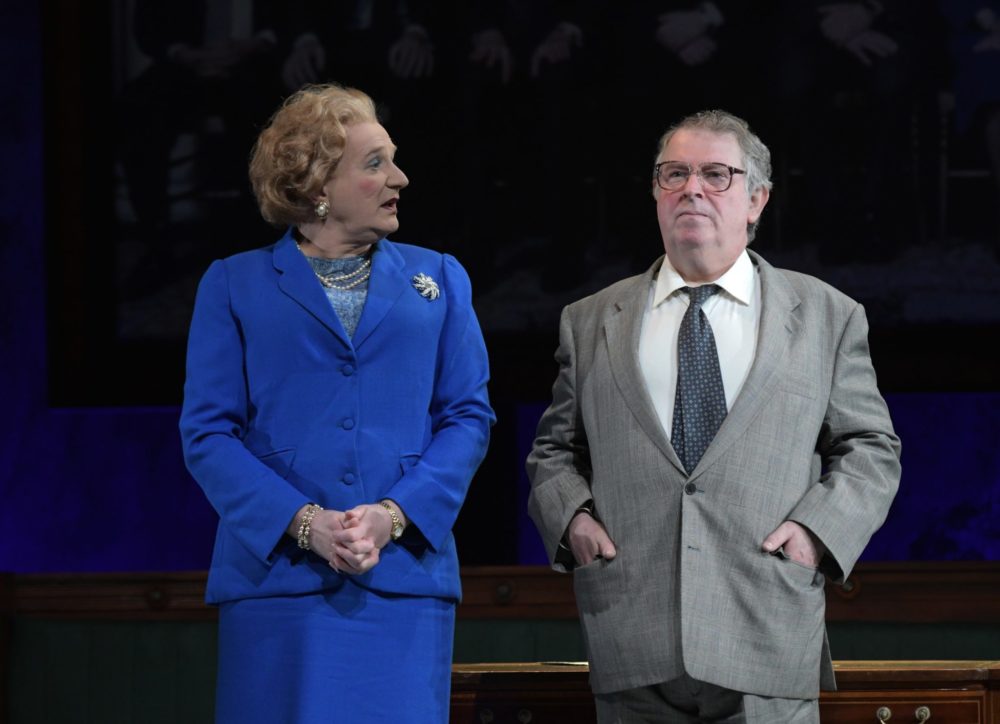
Dead Sheep is a focused theatre piece in which the relationship between Margaret Thatcher (Steve Nallon), Geoffrey Howe (Paul Bradley, best known for playing Elliot Hope in Casualty), and his wife, Elspeth Howe (Carol Royle) take centre-stage. The triangle, where Howe finds himself in the middle of, is a tug-o-war that eviscerates Howe and forces him to choose one side. Torn between political loyalty and spouse angst, Bradley delivers a formidable and emotionally dynamic performance that was purposely understated to enhance the subtlety of the personality.
The highlight and perhaps selling point was casting Margaret Thatcher as a man.
Steven Nallon did an astounding job playing her, it was as if the Iron Lady herself was present before us with the line delivery as well as the movement, stunned and entertained the audience throughout. A couple of belly laughs were had.
Three actors played narrators (Graham Seed, Christopher Villiers and John Wark) as well as politicians/minister in her cabinet. This entertained the spectators, but at times detracted from the action. Sometimes we just wanted to be shown the story as opposed to being told beforehand. It ruined the drama for us, in part.
Overall, a successful and refreshing take on the ‘iron’ age of British politics, and as Jonathan Maitland (Writer) said: “But there is one corner the tractors seem to have missed.” What it was like for Geoffrey Howe at the right side of the force not to be reckoned with.
It’s Saturday 28th May 2016 and I’m at Birmingham Pride. I attend each year and always have a great time. However, I cannot help but have mixed feelings about it too. Something sits very uncomfortably with me, despite the fact that I have a good time.
Before I continue, I must first congratulate Birmingham Pride for successfully running a festival of such magnitude. It’s not an easy task, but year after year the organisers do an amazing job of it and for that they must be praised.
As a fellow Pride organiser, the last thing I want to do is criticise another Pride event, as I know how difficult it is to put everything together. However, there is an aspect of Pride that worries me. That is the fact that the spirit of Pride seems to be getting lost along the way.
When the Pride movement began, Pride was a protest. People marched for their rights and what they believed in. Now that LGBT people have almost full equality in law, I can’t help feeling that the true meaning of Pride is being lost, despite parades and marches still being a part of such events.
I’m sure we are all aware that the larger Prides are now commercial machines that do not fully represent LGBT people or the spirit of the Pride movement. An example of this can be seen when looking at main stage performance line-ups. I only attended Birmingham Pride on the Saturday, but to my knowledge there was only one LGBT performer on the main stage that day. The rest were heterosexual and cisgender. It lacked the kind of representation that LGBT people deserve at a Pride festival.
It appears to be increasingly common these days for Pride festivals to book lots of straight acts to appear on their main stages. Having looked at several Pride line-ups, I’ve wondered where the LGBT representation is. Recently, somebody was protesting on Twitter that a certain Pride didn’t have any LGBT acts booked. I don’t know if that’s actually the case or not, but the lack of LGBT performers at LGBT Pride events is a worrying trend.
At Warwickshire Pride, 90% of this year’s main stage line-up is LGBT. It’s a percentage that we strive to increase or at least maintain each year in order for the festival to truly represent the people it primarily caters for.
That’s not to say that Warwickshire Pride is leading where others should follow. Far from it, in fact. It’s entirely up to the organisers of each Pride event to book the acts they want, move in the direction that they view as being best, and to respond to the wishes or needs of the community that they represent. At Warwickshire Pride, we pride ourselves on being a little bit different to other Prides and a lot of that comes from the feedback that local LGBT people provide. Yes, we have some fabulous elements such as Angie Brown and Wagner from the X Factor performing last year, but ultimately we try to create something in the spirit of the original Pride movement.
Perhaps it’s the activist in me. Every part of my being is about furthering the rights of LGBT people, both legally and socially. I believe that Pride is absolutely a protest, but do acknowledge that it’s a celebration too. There is nothing wrong with celebrating. However, I also feel that as a Pride movement we are in danger of losing touch with our roots.
What I’d like to see is more Prides having actual LGBT performers on their main stages, not just confined to cabaret tents. I’d also like to see more protesting and highlighting of social issues that our communities face. Finally, I’d like to see Prides being more inclusive. There are four letters in the acronym LGBT and it’s important that the B & T are remembered and included. This is something that the smaller, grassroots Pride events do very well, but it’s time that the larger Prides stepped up and truly represented their communities once more.
Opinions expressed in this article may not reflect those of THEGAYUK, its management or editorial teams. If you’d like to comment or write a comment, opinion or blog piece, please click here.
Last night was one of those nights where you sit there, and for the whole of the two hours you felt so lucky to be a theatre reviewer. I didn’t think theatre could touch a person that deep, in the way that William Nicholson’s Shadowlands undoubtedly did.
“Shadowlands is based on events that occurred in the lives of two real people – C.S Lewis and Joy (Davidman) Gresham (…) I have used parts of their story, not used other parts, and imagined the rest.” – William Nicholson.
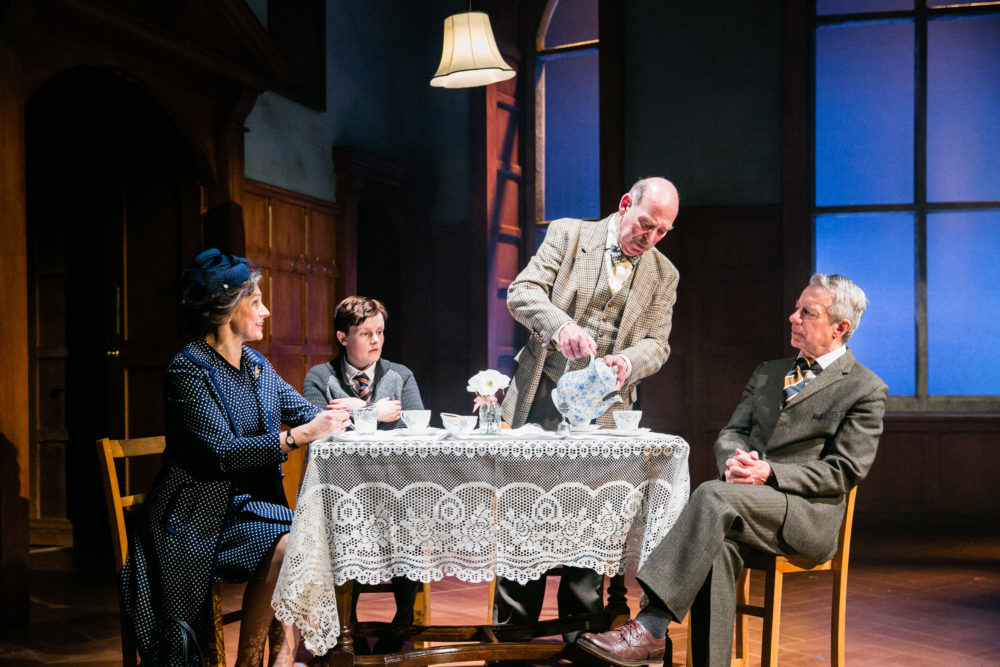
‘Jack’ Lewis and Joy Davidman were played by Stephen Boxer and Amanda Ryan respectively, and I will never see the two actors as themselves again. C.S Lewis and Joy were resurrected and put on stage for the audience of the 21st Century to see the marvel that his world was, and the imagination he had, through William Nicholson’s own genius take on Chronicles of Narnia legend’s life. The portrayal was too surreal to be called acting. For a week only, the two lives come alive and let us in to see the lives that lived in and around C.S Lewis’.
Credit: Jack Ladenburg
The formidable writing of Nicholson astonishingly captivates C.S Lewis and you were reminded of Narnia, as the story was told. I particularly adored the moment in which Lewis sparked the notion of magic with young Douglas, who wanted to believe in it so bad. Having seen The Lion, The Witch and The Wardrobe at Christmas at the Birmingham Rep, I was gleefully pleased to see some features used for this. It made the experience so much more magical.
It is rare not to be able to control your lacrimal glands in public, but this story pushed them out of you whether you liked it or not. And I wasn’t the only one, with sniffles and other crying-like noises surrounding me, the whole theatre could not help but give in to the emotions of the heart-breaking story. One couple were so engrossed that were constantly saying: “Oh dear” as the action darkened.
The subliminal acting, combined with almost too-good-to-be-true storytelling by William Nicholson evoked emotions that could not help but escape the depths of the human soul. “The happiness now, is part of the pain then.” Said Joy when she was on holiday with Jack, as the dreaded end was near, which touched so many people.
Other acting, from Denis Lill (Warnie), Simon Shackleton (Prf Christopher Riley) and all the others contributed to the fullness of the play, and created exquisite drama which helped bring to life the man who made so many of our childhoods magical and filled with wonder.
Thousands of people are expected to take part in this year’s Birmingham Pride. Here’s all the latest information to help you make the most of your day.
What Time Does Birmingham Pride Start
The parade for Birmingham Pride starts at 12.00pm (noon) on Saturday 28th May and will be setting off from Victoria Square. It is expected that from start to finish the walking time of the parade is 45 minutes. However the parade itself will take much longer than that because of the number of people involved with this year’s festivities.
What’s the Birmingham Pride Parade Route.
After setting off from Victoria Square the parade will then venture down New Street and left onto High street. It will then turn right at Carrs Lane and right again on to Smallbrook Queensway. The parade will then turn left onto Hurst Street until it reaches the Pride festival site.
Motorists should expect road closures and longer waiting times than usual in the city centre and it is best to avoid the areas around Hurst Street and Victoria Square.
The Festival
The Pride festival kicks off from 12:45PM until 12:00AM and then from 1PM till midnight on Sunday. Entry to the festival is by wristband only. After 8pm only attendees over the age of 18 will be permitted to enter the festival area. Under 18s already within the site are permitted to stay, but if they leave they will not be allowed reentry.
You can still watch the parade if you don’t have a wristband.
Tickets cost £40.00 for a weekend pass or £25.00 for Saturday or £25.00for Sunday.
Concessions are priced at £20.00
Who’s Performing At Birmingham Pride?
Fleur East, Katy B, Lawson, Liberty X and Lucy Spraggan are just some of the names confirmed to perform on the Saturday. Sunday’s performers are confirmed to include Andy Bell, DJ Fresh, Lisa Stansfield, MNEK, Blonde, Vengaboys, Karen Harding and Stooshe
“But I am bound upon a wheel of fire, that mine own tears do scald like moulten lead” – King Lear
The story, written by Shakespeare between 1604 and1606, depicts the tragedy of a family who lose trust, compassion, and all for the material gain of land. Those who are good of heart suffer the most and unspeakable tragedy befalls them. When Lear’s oldest two daughters plot to usurp him from his thrown, it is a wayward journey where no traveller returns.
Talawa Theatre Company and the Royal Exchange Theatre present a moment in theatre that is both harrowing and compelling. From powerful performances by Don Warrington (Lear), Philip Whitchurch (Earl of Gloucester), and Alfred Enoch (Edgar); to an ambitious set that delivered surprises and was thematic with the shape of a circle that glowed like a ‘wheel of fire.’
Don was very convincing as the King with strong tones of authority, madness, and sensitivity; the second half particularly, Don commanded with emotion and powerfully delivered ‘howl, howl, howl’ whilst carrying a dead Cordelia in his arms. Philip portrayed Gloucester with sincerity and truth, which made his tragic scene even more difficult to watch. His speeches and dialogue were very eloquent and combined with the emotion, galvanised the role to a very high standard. Alfred, who most will recognise from playing Dean Thomas in the Harry Potter franchise, gave an electric performance as Edgar/Poor Tom with physicality that was moving, edgy, and kept your eyes glued to the stage. The way in which he portrayed Poor Tom when he transitioned was fantastic in terms of the acrobatic movement and flair of speech delivery. It was a shame they cut Poor Tom’s speech about him becoming Poor Tom. It was also a pity that the Fool’s speech about the end of the world was cut, which would have contributed to the apocalyptic feel of King Lear. But then again, I am not sure Miltos Yerolemou (Fool) would have handled it as well as he did his comedy. His comedic timing was brilliant, but the scenes in the wilderness were a little lacklustre, in terms of line delivery and truth.
Though there were some great moments, there were others that took away from key scenes, and therefore spoiled the play overall. Unfortunately, Pepter Lunkese who played Cordelia was overly shout-y and whiny, and not much of her in the play, which made it hard for the audience to feel sad for her death at the end, even though Don’s lamentation was sublime.
The key disappointment for me was the ‘camp’ portrayal of Oswald. I thought we had come a long way since portraying characters as camp for the purpose of seeking a cheap laugh from the audience, or as a device for a character to come across evil. It was both offensive and shocking to see.
Birmingham Pride happens this weekend and thousands of people will be filling up the city to celebrate LGBTI life.
(C) ArenaPhotoUK-bigstock
Birmingham Pride is held over the spring bank holiday – this year that falls on the 28th and 29th May. For two days Birmingham City centre will give way to one of the UK’s biggest pride events, with over 2600 people apparently taking part in the parade.
Where does Birmingham Pride Parade Begin?
The Birmingham Pride parade starts off at Victoria Square at 12.00pm (noon) on Saturday 28th May.
What Route will the Birmingham Pride Parade Take?
Leaving Victoria Square, the parade will travel down New Street and left onto High street. It will then turn right at Carrs Lane and right again on to Smallbrook Queensway. The parade will then turn left onto Hurst Street until it reaches the Pride festival site.
The Festival
The Pride festival kicks off from 12:45PM until 12:00AM and then from 1PM till midnight on Sunday. Entry to the festival is by wristband only. After 8pm only attendees over the age of 18 will be permitted to enter the festival area. Under 18s already within the site are permitted to stay, but if they leave they will not be allowed reentry.
You can still watch the parade if you don’t have a wristband.
Tickets cost £33.55 / £37.95 for a weekend pass or £23.65 for Saturday or £19.80 for Sunday.
Concessions are priced at £15.40 to £17.60.
Who’s Performing At Birmingham Pride?
Fleur East, Katy B, Lawson, Liberty X and Lucy Spraggan are just some of the names confirmed to perform on the Saturday. Sunday’s performers are confirmed to include Andy Bell, DJ Fresh, Lisa Stansfield, MNEK, Blonde, Vengaboys, Karen Harding and Stooshe
This year’s Birmingham Pride which celebrates 20 years of the parade as we know it, promises to be the biggest ever, and the stuff they have organised certainly speaks volumes.
Here’s my handy guide to just some of the things to look forward to over the weekend of Pride.
1. The Vengaboys.
Yep you read that correctly, our favourite guilty pleasure of the 90’s are appearing at Birmingham Pride on Sunday the 29th on the main stage, so you can re-live your Hooch (or Blue Nun) fueled dance routines, while wearing a mask to protect your identity and coolness obviously. One can’t actually be SEEN watching and enjoying The Vengaboys now can we…
2. Willam Belli & Latrice Royale.
Two of the greatest queens from RuPaul’s Drag Race have been booked for the Saturday (Willam) & Sunday (Latrice) and I for one am so excited about this. Willam will be in the Cabaret arena, and Latrice is appearing at the Village Inn. Honestly I’d just be happy to watch Latrice laughing for an hour.
3. Liberty X.
Work it a little, get hot just a little and dance along to the fabulous Liberty X on the Saturday on the Main Stage. After Kevin’s success on The Voice, he’s rejoining his band mates to get our little gay asses dancing to some fabulous tunes from the early noughties. The band is also appearing later in the evening at The Nightingale Club
4. One half of Erasure.
Luckily the singing half of Erasure, Andy Bell. We all know A Little Respect and you can dance along with him on the Sunday on the main stage. For us gays born before 1995, Erasure was the campest thing we’d seen, and it was amazing.
5. Vicky Jackson.
The brilliant and talented Vicky Jackson who sings her heart out at every performance and impersonates some of our favourite artists including Katy Perry, Pink and Amy Winehouse will be gracing the Cabaret stage on the Sunday. I’ve never been disappointed by what she does, and even had the pleasure of performing on stage with her once
6. The random acts.
Sometimes you can find a hidden gem performing in the various bars and clubs around the Gay Village that you forgot about seeing on the line-up or who was booked last minute. A couple of years ago and during a slightly (OK, very) drunken moment, I walked into one of the bars and saw this little ginger Liverpudlian singing away, and loudly announced during a quiet bit in the song “Is that f**king Sonia?” (it was) I got a smile in return.
7. The Parade
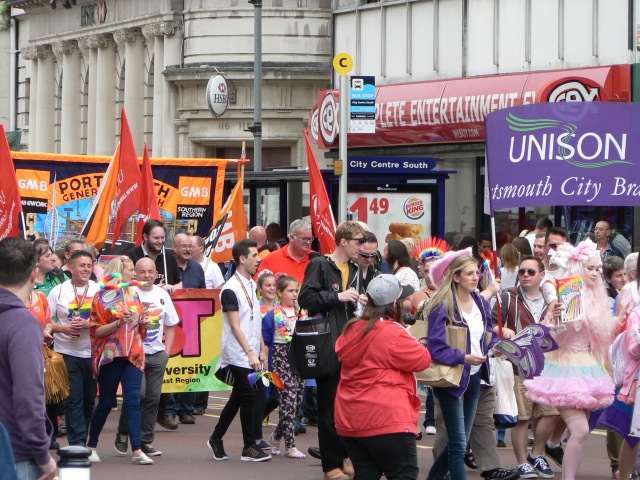
Always a great start to the weekend, the actual march itself is something amazing to see, with so many varied people taking part and having the time of their lives. You can’t help but smile at the floats and the shockingly hot men in skimpy shorts.
The whole weekend is a brilliant opportunity to just let loose and be yourself. There’s going to be 80,000+ people there, from bears to drag queens, you will find people you relate to and you’ll find yourself having the most random conversations with people you meet
outside the bars, clubs and arenas
9. The Gale – Or The Nightingale Club to be precise.
The biggest gay club in the village. It never fails to deliver, and this year Alesha Dixon is appearing there to perform her own and Mis-teeq’s tracks. But if you don’t want to see her, it has multiple floors with various styles of music.
10. Something for everyone.
There’s so many different types of acts that you would be hard pushed to NOT find something that you can enjoy. From DJ’s to pop royalty, there is going to be something there for you, so kick back and relax with a beer in hand trawl round the various stages and clubs with your friends old and new
The full line up is available here and while tickets are limited now, there are still some available, and you can get some on the gate on the day. But be aware it’s going to be incredibly busy that weekend.
Opinions expressed in this article may not reflect those of THEGAYUK, its management or editorial teams. If you’d like to comment or write a comment, opinion or blog piece, please click here.