Tag: Movie Genre Drama

All movie reviews for films in the Drama genre

  • FILM REVIEW | In The Grayscale – A Chilean love affair

    FILM REVIEW | In The Grayscale – A Chilean love affair

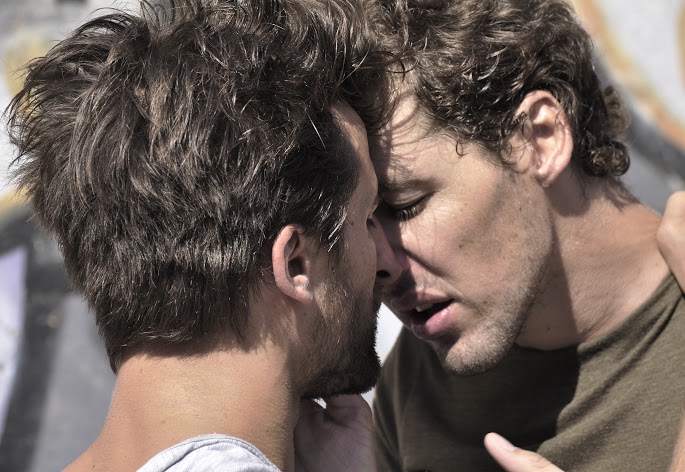
    Two men, who seem perfect together, fall in love in the new Chilean gay film ‘In the Grayscale.’ ★★★★

    We first meet Bruno (Francisco Celhay) in his grandfathers’ workshop studio where he is living. He’s an architect, and has been assigned by the city commissioners to design a new monument in Santiago. Bruno is introduced to Fer (Emilio Edwards), a history teacher who knows Santiago inside out and will help Bruno look for a unique spot for the monument. Bruno is recently separated from his wife Soledad (Daniela Ramirez) and they share custody of their young son Daniel (Matias Torres). Soledad is very depressed about the breakup of their marriage, and there are days when she can’t get out of bed, even when she’s supposed to be watching Daniel.

    Bruno, a handsome quiet type, and Fer, who’s very goodlooking, perky, full of jokes, very energetic with a perfect smile and perfect hair, spend their days together riding their bikes around Santiago. And over the course of their tours of the city, Bruno slowly starts to fall for Fer. It’s a love affair that Bruno finds surprised to be in; he always had doubts about his sexuality but didn’t realize he was going to find someone like Fer. But Bruno has responsibilities with his family, plus he’s ignoring the work that he’s been given so he’s under a lot of pressure to please everyone. And word is out that he’s been seen spending time with, and kissing, another man. Can Bruno handle the pressure of his new relationship while trying to be a role model to his son?

    ‘In the Grayscale,’ which literally translates to being in a state of flux, or being in a range of gray without any color, is pretty much a depiction of Bruno’s life, and is an impressive debut feature from Claudio Marcone. It’s an eye opening film depicting one man questioning his sexuality pitted against another man who’s very comfortable with his. The two male leads are very good, confident in their roles, making the story very believable. But the best bit of the movie comes at the end in the form of a song called ‘Disfruto’ by Carla Morrison which rolls over the closing credits. Morrison’s voice is angelic, and the song, which translates to enjoy, is an ode to secret love, where she sings (in Spanish) ‘be with me during this time, to guard the secret, and to be careful with these moments.’ It’s a beautiful song that wraps up the love between the two men in the film.

    Available on Amazon

  • FILM REVIEW | Under Milk Wood, earthily sexy

    Under Milk Wood | ★★★★

    I studied Dylan Thomas’s “Under Milk Wood” for my English A Level, rather more years ago now than I choose to mention and it came as quite a surprise to me to realise that I still remembered, almost word for word the narrator’s first long speech, beautifully spoken here by Rhys Ifans.

    “Under Milk Wood” is really an extended dramatic poem for voices. It was first conceived as a radio play, commissioned by the BBC in 1954, with Richard Burton voicing the narrator. Later it was turned into a stage play, and there is at least one previous film (1972) with Burton reprising his narrator role, and with such luminaries as Elizabeth Taylor, Peter O’Toole and Glynis Johns amongst the cast.

    Whilst remaining absolutely true to Thomas’s original text, the screenplay of this new film, brings out more than any I’ve seen or heard, the sheer earthy, lascivious and hilariously funny filthiness of Thomas’s dreamscape, a true celebration of the joys of sex. Only most of the sex in this story takes place in people’s minds, their fantasies and desires brought out in full, luscious technicolour glory. The film looks superb, for which director of photography Andy Hollis deserves enormous credit.

    Director Kevin Allen has at his disposal an excellent cast of Welsh actors, many of them faces well-known from TV, all perfect for their roles. Rhys Ifans, who also doubles as Captain Cat, is quite as effective as Richard Burton in his long opening speech, his accent, though perfectly intelligible, just that bit more Welsh, where Burton, targeting a 1950s audience, slightly Anglicised his tones.

    Charlotte Church, making a very successful screen debut, is cast as Polly Garter. She has a plump, rounded, wholesome sexiness that is absolutely perfect for the fertile baby machine, that the rest of the village like to gossip about.

    Ultimately, though, the film is also about loss; loss of community, loss of a way of life. Captain Cat is old and dying and his demise is symbolic of the death of the village Llareggub (Bugger All spelt backwards). There hangs over the film a purveying sense of nostalgia for a time that never waa. Gritty realism is swept away with a click of the camera, and for 85 minutes we can escape into a world of dreams and fantasy. I enjoyed it immensely.

  • FILM REVIEW | Suffragette

    ★★★★ Suffagette | The plight of the British women who fought for the right to vote is beautifully told in the excellent film ‘Suffragette.’

    Suffragette’ is told through the eyes Maud Watts (Carey Mulligan) in London, 1912. She works in a local factory, the Glass House Laundry in Bethnal Green, is married to fellow factory worker Sonny Watts (Ben Whishaw) and they have a young son. Watts has actually been a part of the factory since she was very young: her mother worked in the same factory and would strap her to her back when she went to work. Her mother died when she was four and Maud started working part-time there at the age of 7. At the age of 12, she started working full-time. She’s now a lead washer where she makes 13 schillings a week (compared to the salary a man is paid for the same job – 19 schillings a week). Watts has also been sexually molested by the hard core boss Norman Taylor (Geoff Bell).

    One day Watts is asked to accompany another women who’s to speak at Parliament about women’s working conditions and a bill to give women the right to vote. Watts wasn’t supposed to speak, but the other woman, Mrs. Violet Miller (Anne-Marie Duff) had been beaten up and didn’t look presentable, so Watts is thrust into giving the preprepared speech. Watts speaks from her heart, and from her experience, ignoring the script that was written. This lights something within Watts and turns her into an activist. She gets more more disgusted at the lack of women’s rights, and even more so when she sees young factory worker Maggie Miller (Grace Stotter), Violet’s daughter, being groped by Taylor in his office. Taylor is a sexual predator who believe women have no rights, and he tells Watts to ‘leave the vote to us.’

    But Watts’ pleas to Parliament are not enough. They say that there is not enough evidence to support the bill. The women rebel in front of the Houses of Parliament; many are thrown to the ground by the police with little regard for the women’s safety. Some, including Watts, and fellow protestor Edith Ellyn (Helena Bonham Carter), are sent to jail, where they are humiliatingly stripped naked. But this doesn’t deter them, and this leads to Watts becoming a member of the ever increasing suffragettes – a group of women working full-time to advance the rights of women.

    The Suffragettes are led by Emmeline Pankhurst (Meryl Streep) – a woman who has given up her life to further the cause. She’s also in hiding for fear of getting arrested for leading the movement (during those times women had very little rights).

    Determined police inspector Arthur Steed (Brendan Gleeson) puts the women under surveillance – he won’t let them carry on with their protesting and letter box bombings – he wants them all arrested, especially Pankhurst, and calls the women the “East London ladies.” But Pankhurst rallies the women – she tells them at a gathering in a speech from a balcony “We would rather be lawmakers, not lawbreakers.” The women continue their protesting, even resorting to bombing an M.P.’s house, just to get their message across. But Watts eventually loses more than what she bargained for, but she’s more determined than ever to fight for the cause.

    ‘Suffragette’ tracks the foot soldiers of the early UK feminist movement, working class women who were forced to go into hiding to pursue equality. They were willing to risk, in their fight, their jobs, homes, families, and for some of them, their lives. And it’s a great movie. The film lies heavily on the shoulders of Mulligan’s portrayal of her character, a fictional character but someone who we route for every step of the way. It’s an unflawed performance that hopefully will see Mulligan receive an Academy Award nomination. Streep, who shares top billing, is only in the film for less than five minutes, but her character’s presence is felt all throughout the movie. Carter is perfectly cast as the local pharmacist and fellow activist, with a husband who supports her every step of the way. Carter is actually the great-granddaughter of Herbert Asquith – the Prime Minister during the time this movie takes place. Director Sarah Gavron (Brick Lane), working from a script by Abi Morgan (The Iron Lady), successfully and beautifully blends in actual footage of the real protestors into the film, in a film that effectively uses dark lighting and unglamorous costumes to set the mood of the times. And while the plot may be familiar (the recent Made in Dagenham follows a similar plotline), ‘Suffragette’ is an important film to highlight what women did to get equal rights. And we have to be reminded that they are still fighting, and in some countries around the world (Saudi Arabia), women still have very little or no rights.

  • FILM REVIEW | Wasp, Sexual tension in Provence

    A gay couple and a jilted woman spend a weekend together in a house in Provence. It’s a triangle that becomes messy, in the new film ‘Wasp.’ ★★★★

    Olivier (Simon Haycock) and James (Hugo Bolton) have been together for a year. Caroline (Elly Condron), a college friend of James, has just been dumped by her French boyfriend of 3 years. So James invites Caroline to spend the week with him and Olivier in a house that belongs to Olivier’s family. It’s a beautiful house, typical French Chateau, with an outdoor pool, a trampoline in the backyard, and amazing views of the valley. Olivier is a privileged man; he’s 30, handsome, has a great job, and comes from a well-off family. And he’s got a younger good looking trophy boyfriend in James. He also used to sleep with woman.
    So the tension, not just sexual but all sorts, builds up as the week progresses. Caroline hears Olivier and James having sex upstairs, yet she’s vulnerable and feels a bit left out.
    Olivier starts noticing Caroline more and more. He steals glances at her from across the pool, and Caroline notices. She plays it up, teases Olivier, until James realises what is happening right in front of him. And the relationship between all three of them may never be the same again.
    Director/Writer Phillippe Audi-Dor makes an auspicious debut film. His style of long shots of various places and objects (wasps being one of them) brings out the beauty of the locale, as well as helps to build up and sustain tension between the three characters. Audi-Dor begin filming Wasp just four months after graduating from film school, and what an impressive debut it is. And while the films winds down with a very melodramatic ending, Wasp is an impressive filmmaking debut with a just as impressive cast.
  • FILM REVIEW | 45 Years

    Tom Courtenay is Geoff, while Charlotte Rampling is Kate, both giving superb performances. ★★★★★

    (more…)

  • FILM REVIEW | LIFE: There Is No Life in Life

    There’s a famous photograph of James Dean in Times Square taken by Dennis Stock. It is now a movie called ‘Life.’ ★★

    The photo, taken in 1955, shows James Dean, cigarette in his mouth, head tilted towards the ground, the billboards of Times Square in the background, dark clouds overhead, made the cover of Life Magazine. It also made Stock’s career.
    So ‘Life’ the movie is all about that photograph, and the events leading up to, and after, that photograph was taken. It’s also a buddy movie: one man on the cusp of celebrity, another man trying to capture him while struggling to make it as a photographer and to also spend time with his young son, with an un-cooperative ex-wife. Stock (Robert Pattison) is tasked with an assignment: to do a photo essay on an unknown actor. So he’s introduced to James Dean (Dane DeHaan) at a party, where he’s also introduced to a young Natalie Wood (Lauren Gallagher). Dean in on the cusp of fame – his first film – East of Eden – was yet to be released. So Dean agrees to have Stock follow him around to get some shots. The first are rejected by his editor – who wants to see hazy shots of an unknown actor boozing it up in a club with Eartha Kitt (Kelly McCreary)? Stock thinks about taking another job, this one in Japan, but he decides to stay in New York and gets back together again with Dean, and on the spur of the moment that famous Times Square photograph is taken. Not to end there, ‘Life’ takes us with Dean and Stock to Dean’s hometown in Indiana.
    There is where Dean feels most at home, and comfortable; with family, aunt and uncle and Grandma and nephew (his mother died when he was nine and his father sent him to Indiana to live with them). More famous photographs are taken there; Dean with his nephew, Dean on the farm, Dean in the kitchen; these photos would become part of the Life Magazine photo essay. And that’s the movie.
    As you can second guess, there’s not much of a story to build on. ‘Life’ is not only about the photographs, it’s also about the relationship between these two men and especially the trust Stock builds with Dean. But ‘Life’ is boring, with stale dialogue, and with acting that is quite lifeless. Pattison is fine as Stock, but DeHaan, even though he has hair that looks identical to Dean’s, just doesn’t bring the right energy and sparkle that we can presume Dean had. Ben Kingsley, however, is excellent as Jack Warner – the man who guided Dean’s career. And while the period details (clothes, cars, hairstyles) are fine, it’s the story that is not a very exciting one and is not enough to warrant a 110-minute film.
    Director Anton Corbijn just doesn’t bring any ‘Life’ to this movie.
  • FILM REVIEW | Irrational Man

    Irrational Man | ★★★

    Woody Allen’s 47th film, ‘Irrational Man’, sticks to several themes he’s already explored in a few of his previous films, and is not one of his best.

    An older man being pursued by a younger woman is a plot device that Allen has presented to us many times before (Magic in the Moonlight and You Will Meet a Tall Dark Stranger). In Irrational Man, Joaquin Phoenix plays pot-bellied depressed middle age philosophy professor Abe Lucas (Joaquin Phoenix).

    He’s the newest teacher at a small town college in Rhode Island. He’s single and doesn’t seem to have much going for him. However, two women vie for his attention; unhappily married fellow teacher Rita (Parker Posey) who fantasises them running away together to Spain, and student Jill (Emma Stone). Jill is in Abe’s philosophy class, and she is mesmerized by his teachings and his stance on life. They start to spend lots of time together outside of the classroom, much to the dismay of Jill’s perfect boyfriend Roy (Jamie Blackley). Abe tries and tries to resist the urge to sleep with Jill, though he has no trouble having sex with Rita.

    However, Abe’s relationship with Jill is becoming stronger and stronger, until he can no longer resist her, and they eventually sleep together. Jill is so smitten with Abe that she breaks the news to her boyfriend Roy that she wants to break up. The plot then takes a turn: one day at a diner Abe and Jill overhear a woman talking about a local judge who has ruled against her in a divorce proceeding and has awarded custody of her kids to her husband. She also tells the people she is with how the judge has destroyed her life. At this point Abe decides he’s going to do something about this woman’s problem. His decision rejuvenates him, it transforms him from someone who is aimless and depressed to someone who is full of life and energetic. And he actually does go through with his plan. Of course his actions are irrational, but to him they are rational. But does he think he’s pulled off the perfect crime?

    There’s not much more to the film’s plot which is probably why it’s only 95 minutes. But Allen does get more from his actors than what the script provides. Phoenix is perfectly cast as the loner professor who struggles with his identity but is lucky enough to have two attractive women vying for his attention. Stone overdoes it a bit as Jill, the student who has a good thing going with Roy but sees something attractive in Abe that we don’t see. Stone played a similar role in Allen’s last film – Magic in the Moonlight – falling for Colin Firth’s much older character. Posey is a delight as Rita, fantasising about a life with Lucas in Europe.

    But Allen’s script doesn’t provide much magic, it’s humdrum at the very best in a film that can be categorized as not one of his best. It also won’t have much box office appeal here in the UK- in the U.S. the film has made a measly $3.7 million – a far cry fromMagic in the Moonlight’s total gross of $32 million. At age 79, we’re sure there’s lots more films in Woody Allen’s repertoire to redeem himself from this one.

  • FILM REVIEW: Everest: Breathtaking Epic Adventure

    In 1996, dozens of people tried to get to the top of Mount Everest. Some succeeded, and some died trying. The gripping and realistic ‘Everest’ recounts, in dramatic fashion, this event. ★★★★

    There were quite a few expeditions on Mount Everest in May 1996, and they all had one goal, to get themselves, and their clients (who each paid $65,000), to the top of Mount Everest, and it was up to the expedition leaders to make this happen. Rob Hall was the leader for Adventure Consultants, and he happened to have Jon Krakauer on his team (journalist Krakauer, who was on an assignment for Outside magazine, would go on to write ‘Into Thin Air’ – a book about the disastrous events that took place on the mountain during this climb ). Hall was also responsible for 7 other clients. The Mountain Madness expedition was led by Scott Fischer, who also had 8 clients, including Sandy Hill Pittman, a very wealthy New York Socialite who was, at the time, the wife of Robert Pittman, the founder of MTV. In addition to the clients, several sherpas (local people who are hired by the expedition companies to carry up the mountain supplies and food, to fix the ropes and ladders to make it easier and quicker for the clients to get up – getting everything in place) were part of the teams as well. Of course most of Hall’s and Fischer’s clients were not professional mountain climbers, they climbed mountains as more of a hobby, and expected to reach the top of Mount Everest because of the huge amount of money they paid. One of Hall’s clients was a postman (Doug Hansen). Another was a doctor from Texas (Beck Weathers). Also on Hall’s team was Yasuko Namba, a Japanese woman who had climbed six of the Seven Summits. And Hall and Fischer knew that it’s good for their businesses to have their clients actually make it to the top. So along with these two expeditions groups, other groups of people trying to climb the mountain at the same time were from South Africa, France, Tibet, and 13 members of a Taiwanese team.

    But the weather gods were not smiling on Hall and Fischer and their clients during this climb. And this is the story that ‘Everest’ the film successfully and gloomily brings to life. We are introduced to the teams six weeks prior to the start of their expedition. Hall (played by Jason Clarke) is from New Zealand who leaves his pregnant wife (Keira Knightley) behind to go to work. Beck Weathers (Josh Brolin) says goodbye to his wife (Robin Wright) in Texas to try to accomplish the almost impossible task of getting to the top of Mount Everest. Doug Hansen (John Hawkes) meets up with the gang in Nepal, as does Sandy Hill Pittman (Vanessa Kirby), which is the starting point for all expeditions. It is in Nepal where the teams get to know each other and bond, but it’s when they get to base camp that the adventure, and danger, begins. Base Camp is already at such a high altitude (17,600 feet), that climbers need to be acclimatized so their bodies can get used to the high altitude. It’s also where the operations for the expeditions take place, led by Helen Wilton (Emily Watson). ‘Everest’ takes us on the journey of these team climbing the mountain. But first they need to navigate the Khumbu ice fall, soaring ice towers and crevasses so deep that there really is no bottom. Camp I and Camp II are where the teams stop and rest and basically take their time. But it’s Lhotse Face that is one of the most challenging bits on the mountain. It’s a 3,600 foot wall of ice that they have to climb to reach Camp III, where most climbers need to use bottled oxygen to breath. But it’s above 26,000, right below Camp IV, which is where the climbers use as the final stop before their ascent, called the ‘Death Zone’ because it’s where humans cannot survive for long. If climbers have survived as high up as Camp IV, then it’s full throttle ahead to reach the summit, usually at midnight so that the teams can reach it before noon, that if they survive the heavy gusts of wind and the Hillary Step, a 40-foot tower of ice and rock on an exposed part of the mountain that becomes a human traffic jam for people getting to the top, as well as coming back down. But it’s the climb back down that is hardest. The climbers are exhausted, some suffering from high altitude conditions, but it’s the lucky ones who are in ok shape, and it’s these people who have to decide whether to save the almost dead or to leave them behind to save their own lives. As recounted in ‘Everest’, Hall and Fischer’s teams encountered a major storm on their way down, but it was not the only mistake that took place on that climb. Besides too many people on the mountain, Hall took Hansen up to top, way past the agreed time. And the search for them cost another climber his life. Fischer was not in the best of shape as he was climbing to the top, and had a much harder time going down. And a storm overtook the climbers, which turned out to be unexpected and deathly. And it’s reenacted in ‘Everest’ to extreme detail; high winds, blowing snow, climbers struggling just to survive, dead bodies littered here and there, and almost blacked-outconditions. ‘Everest’ also recounts Weather’s struggle for survival, Hall’s loyalty to his client, and the operations team realizing that there is nothing they can do for the people trapped on the mountain.

    ‘Everest’ successfully, and grippingly, tells the story of the people who survived the mountain that fateful year. And while there have been a few books and one television movie made about this event, ‘Everest’ is based on the book by Weathers ( Left for Dead: My Journey Home from Everest (2000)), recollections from some of the survivors, as well as satellite phone conversations between the climbers, their families, and base camp. And the actors who portray the real life characters are superb. Josh Brolin has his best role in years as Weathers, a man who amazingly was left for dead on the mountain but somehow survived. Jason Clarke as Rob Hall is excellent – he’s determined to get his clients to the top and at the same time determined to get back home to see the birth of his first baby. Emily Watson as Wilton, the base camp operations coordinator, is concerned, and then doomed, after she realizes that a few lives have been lost on the mountain. And John Hawkes as postman Hansen gives us a portrait of a man who wants to be there but is not experienced in any way to climb the mountain. Luckily Knightley is relegated to a role not on the mountain, she plays Hall’s wife back at home, and there’s nothing she can do to help him. Gyllenhaal’s role as Fischer is relegated to a few scenes, mostly up on the mountain – he’s far from being the star of the movie. Director Baltasar Kormakur (2 Guns, Contraband), working from a script by William Nicholson and Simon Beaufoy, takes us with the teams on their journey, and it looks all too realistic. While there are lots of characters to keep track of (the all important Sherpas are virtually ignored), especially when they are all wrapped up, ‘Everest’ brings to the big screen the real life 1996 Mount Everest disaster. Eight people eventually died during this expedition. ‘Everest’ was shot at high elevation on the trek to Everest in Nepal, in the Italian Alps and at Cinecitta Studios in Rome, and Pinewood Studios in the UK. It can be experienced in IMAX 3D as well as standard 3D and 2D. ‘Everest’ is an epic adventure that will take your breathe away.


  • FILM REVIEW | Monsters, Dark Continent, Beautifully Chilling

    The highly successful 2010 film ‘Monsters’ saw the arrival of giant tentacled monsters to Earth. It’s sequel ‘Monsters: Dark Continent’ has five army men in a Middle East war zone who are attempting to deal with an insurgency, and dealing with these monsters as well. It’s explosive and shattering.

    (more…)

  • FILM REVIEW | Elephant Song

    ★★★★ | Elephant Song

    At only 26 years old, French-Canadian Xavier Dolan already has five films under his directorial belt, all of which have been well received and critically acclaimed. In addition, he’s acted in 12 films, including the just released Elephant Song.

    In 2009, Dolan directed, produced, starred and wrote J’ai Tué Ma Mére (I Killed My Mother), a semi-autobiographical story about him as a young gay man at odds with his mother, and wrote the script when he was at the tender age of 17. It won 3 awards at the Cannes Film Festival. The next year he wrote, directed, produced and starred (again) in Les Amours Imaginaires (Heartbeats), a story about three close friends who are involved in a love triangle. In 2012 Dolan continued his string of emotional and heartfelt films by writing and directing Laurence Anyways. At 168 minutes, it was an ambitious project for the young director to do, it was about the struggle of a straight man who, over the course of ten years, transitions from male to female, and how it affects the relationship with his lover (with amazing performances by Melvil Poupajd and Suzanne Clément). Laurence Anyways won many awards, including two Cannes Film Festival Awards (the Queer Palm Award and Best Actress for Clément). Lawrence Anyways was also nominated for ten Canadian Screen Awards (winning two), and more importantly, at the Toronto International Film Festival, it won Best Canadian Feature film. Not bad for a local boy.

    2013 is when Dolan wore multiple hats in a film. In Tom á la Ferme (Tom at the Farm), Dolan, who wrote, produced, directed and starred, plays Tom, a young man who works in an advertising agency and travels to the Canadian countryside for the funeral of his 25-year-old boyfriend. The problem is that the grieving mother did not know that her son was gay, so she accepts Tom as his friend in the hopes that he can tell her all about her dead son’s life. Meanwhile, the deceased’s brother, 30-year-old Francis (an amazing Pierre-Yves Cardinal), knew that his brother gay but could never really accept it. Conflict, anguish, thought provoking moments, anger, love, and acceptance follow. More acclaim followed Dolan when Mommy was released in 2015. It stars French Canadian actress Anne Dorval who is a widowed mother overwhelmed by her teenage son (Antoine Olivier Pilon – a relevation) and his attention deficit disorder. Dolan wrote, produced and directed Mommy, and it won the Jury Prize at the Cannes Film Festival and won nine Canadian Screen Awards, including Best Motion Picture.

    In the newly released Elephant Song, Dolan, who co-stars along with Bruce Greenwood and Catherine Keneer, plays Michael, a psychologically unwell young man in a mental institution who may or may not have had something to do with the disappearance of his psychiatrist. So it’s up to Greenwood’s Dr. Greene to interview Michael to try to get to the bottom of his colleague’s disappearance. During the interrogation, Michael plays mind games with Dr. Greene, alluding to the fact that he knows where his psychiatrist is but is not quite yet ready to tell. Michael is clearly a very disturbed young man, his very famous opera singer mother all but ignored him, and the one time he spent with his father was when he took him elephant hunting, with the boy Michael crying over his father’s killing of an elephant. And Michael alludes to a sexual relationship that he is having with his psychiatrist, so it’s up to Dr. Greene to take what Michael is saying with a grain of salt. Even the head nurse, Susan Peterson (Keneer), warns Dr. Greene to keep his distance from Michael. It’s a film that at its centrepiece is Dolan, who is perfect as Michael, very good looking yet very mischevious, you don’t know whether you want to hug him or to run away from him. And the film revisits the themes of homosexuality and the lack of acceptance so common in Dolan’s films.

    What’s next for Dolan besides conquering the world? He just finished shooting ‘It’s Only the End of the World,’ about a young man who returns home after 12 years to announce his impending death to his family. It stars Marion Cotillard and Vincent Cassel. Dolan will also be shooting his first film in the United States, to be titled The Death and Life of John F. Donovan, in 2016. It’s a fictional story about an actor who is famous for playing a Marvel-style superhero whose life and career are turned upside-down when his private correspondence with an 11-year-old fan is exposed and made to look indecent by a villainous gossip columnist. This one stars Hollywood heavyweights Kit Harrington, Jessica Chastain, and Susan Sarandon. If his previous films are anything to go by, these new films (and his future films) will be eagerly anticipated and will be must sees.

  • FILM REVIEW | Boys In Brazil

    ★ | Boys In Brazil

    This painfully unfunny dramedy starts and ends with a group of four closeted gay friends at São Paulo’s Gay Parade, one of the largest in the world. As the Parade ends one of them is gay-bashed and after they beat the thugs off, the four make a pact that by the time of next year’s Parade they will all finally come out of the closet.

    Outrageously camp teenager Mauro has aspirations to be a Drag queen, something his devout evangelical parents are quick to put a stop too once they catch him midstream trying out his lip-synching routine. Their reaction is to drag around their local priest to exorcise the devil out of their son. Mauro’s rather shy best friend Rodrigo just needs a push to hook up with another handsome classmate, and telling his parents that he now has a boyfriend is rather a non-event.

    Mauro’s gay uncle Vicente who was also part of the group is a high-flying businessman who panics when his boss is in town from Paris and insists on having dinner with Vicente and his wife. Vicente’s best girlfriend is dragged into be his beard, but he needn’t have bothered as the boss turns out to be gay too. Who Vicente would have preferred to be dining with is Roger the rather hunky man he helped rescue from the gay bashing incident. Roger, however, is married and about to be a father a second time, and just cannot find the time to reach his part of the pact and come out to his wife. It’s not helped by the fact that his mother-in-law (played by a real-life drag queen!) practically lives with them.

    Then there is the angry and rather annoying self-righteous lesbian blogger who sits in judgement of them all and wants to publicly ‘out’ both Roger and Mauro against their wishes.

    The cliché driven very lame plot is packed full of old-fashioned stereotypes that seem so out of place in contemporary gay cinema. Even the coming-out aspect of the stories are handled so clumsily, that they are difficult to empathise with.

    I saw this one so you wouldn’t have too!