Tag: Section 377

  • Singapore dismisses appeal to decriminalise homosexuality

    Singapore’s High Court has dismissed a legal challenge to end a colonial-era law that criminalises sex between two consenting men, echoing another dismissal that took place in 2014.

    Gay and bi men in Singapore will, for the time being, continue to live as “un-apprehended criminals” under Section 377A after the High Court dismissed a challenge to close out a colonial-era law that outlaws “acts of ‘gross indecency’ between men”, a law that has been imposed since the British colonisation of Singapore.

    Although prosecutions are rare, any man who commits any act of ‘gross indecency’ with another man can be jailed for up to two years. This also extends to any man who abets, procures or attempts to procure such an act.

    Speaking about the decision, Director of the Human Dignity Trust (HDT), Téa Braun said, “In declining to strike out this archaic and discriminatory law, the Court has reaffirmed that all gay men in Singapore are effectively un-apprehended criminals”.

    Although Section 377A only targets gay men, activists in Singapore say that the culture of shame and homophobia it engenders casts a shadow of oppression over the whole lesbian, gay, bisexual and trans LGBT+ community.

    The challenges were mounted by Johnson Ong Ming, a 43-year-old disc jockey and producer; 42-year-old Bryan Choong Chee Hoong, the former executive director of LGBT organisation Oogachaga; and Roy Tan Seng Kee, a 61-year-old retired medical doctor.

    Against a backdrop of similar unsuccessful legal challenges in Singapore, the ruling today is particularly unwelcome, says HDT.

    Gay sex remains illegal in Singaore
    rihaij / Pixabay

    In October 2014, the Singapore Court of Appeal declined to remove the country’s anti-gay law from the statute books and held that LGBT people would have to wait for reform of Section 377A to come through Parliament

    Following the historic and regionally significant September 2018 Indian Supreme Court ruling that decriminalised consensual same-sex sexual activity, and increasing levels of acceptance of LGBT people amongst Singaporeans, lawyers and activists were motivated to mount a fresh challenge to the discriminatory law.

    “The ruling will also echo harmfully around Asia”

    “This decision will be extremely disappointing for the plaintiffs and the wider LGBT community in Singapore, who had great hopes that new evidence presented to the Court would make it clear that these draconian laws cannot withstand proper constitutional scrutiny. The ruling will also echo harmfully around Asia, where millions of people are criminalised simply because of their sexual orientation or gender identity,” added Braun.

  • BIG GAY GLOSSARY | Section 377

    BIG GAY GLOSSARY | Section 377

    What is Section 377?

    Section 377 is a British-Colonial Era law which effectively outlaws same-sex, sexual relations between men. It was installed in 41 former British colonises.

    The text of the law reads,

    377. Unnatural offences: Whoever voluntarily has carnal intercourse against the order of nature with any man, woman or animal shall be punished with imprisonment for life, or with imprisonment of either description for a term which may extend to ten years, and shall also be liable to fine.

    Explanation: Penetration is sufficient to constitute the carnal intercourse necessary to the offence described in this section.

    It is still in place in countries across the world, most notably in Singapore, where activists have tried to have the law dismissed.

    What does Section 377 mean?

    Activists in India were able, in 2018, to have the law struck down, but only after years of campaigning and u-turns from the Government.

    The UN has said that the law defies international law

    The law still stands in Malaysia, Singapore (see Section 377A of the Penal Code of Singapore), Pakistan, Bangladesh, Burma, and Jamaica.

    Section 377 is the model for similar laws that remain in force in Bhutan, Brunei, Kiribati, Papua New Guinea, Tonga, Tuvalu, Samoa, Malawi, Mauritius, Sierra Leone, Somalia, Sudan, Solomon Islands, Sri Lanka (as Article 365 of the Sri Lankan Penal Code), Ghana, The Gambia, Kenya, Nigeria, Tanzania, Uganda and Zambia

    Can you expand this definition? Use the comments below and your answer could be used to expand or define this glossary entry.

    Check out more definitions in our Big Gay Glossary

  • Here are the Commonwealth countries where being gay is still a crime

    Here are the Commonwealth countries where being gay is still a crime

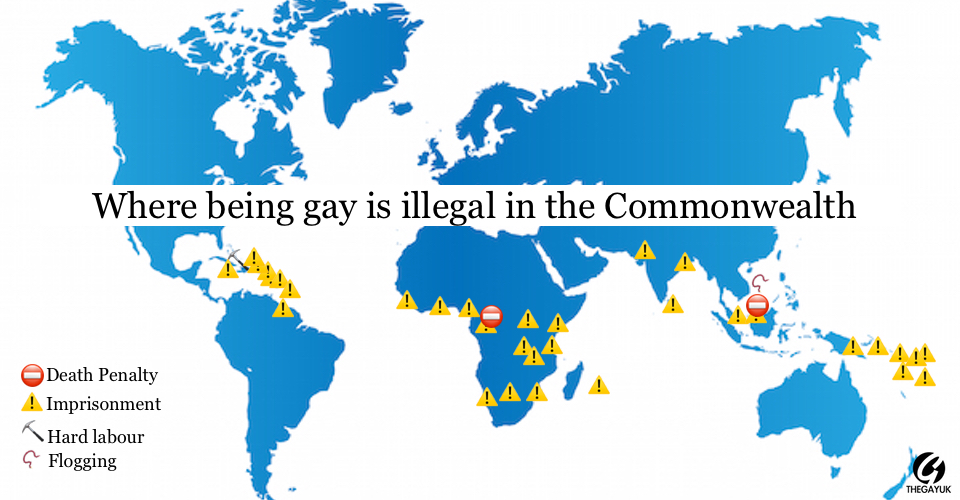
    There are over 70 countries where homosexuality is illegal. 35 of them are in the Commonwealth.

    As our Government looks to form closer relationships with the 53 countries that make the Commonwealth post-Brexit, we discover which of those nations have active legislation against being gay. There are 35 nations in the Commonwealth where it is illegal to be LGBT+, more specifically the laws usually only target gay and bisexual men. Some of these countries have harsh punishments for those caught in same-sex relationships, such as the death penalty, flogging or life imprisonment.

    1. Antiqua and Barbuda
    2. Bangladesh
    3. Barbados
    4. Botswana
    5. Brunei
    6. Cameroon
    7. Cook Islands
    8. The Gambia
    9. Ghana
    10. Grenada
    11. Guyana
    12. Jamaica
    13. Kenya
    14. Kiribati
    15. Malawi
    16. Malaysia
    17. Mauritius
    18. Namibia
    19. Northern Nigeria*
    20. Pakistan
    21. Papua New Guinea
    22. Saint Kitts and Nevis
    23. Saint Lucia
    24. Saint Vincent and the Grenadines
    25. Samoa
    26. Sierra Leone
    27. Singapore
    28. Solomon Islands
    29. Southern Nigeria*
    30. Sri Lanka
    31. Swaziland
    32. Tanzania
    33. Tonga
    34. Tuvalu
    35. Uganda
    36. Zambia

    Northern and Southern Nigeria are one nation but have different laws pertaining to homosexuality.

    Where did the anti-gay laws come from?

    Many of the countries that make up the Commonwealth were part of the former British Empire, which established forms of British law in colonies created by administrators. One of these is the infamous Section 377, which India recently struck down. The section prohibits homosexual acts, more specifically anal sex between men.

    Which countries in the Commonwealth have the death penalty for gay people?

    There are two nations which currently have the death penalty for same-sex relationships between men. Northern Nigeria and Brunei. There are some countries which have a maximum of life in prison, these include, Bangladesh, Barbados, Guyana, Pakistan, Sierra Leone, Tanzania and Uganda.

    In Jamaica, the penalty for same-sex relations is 10 years imprisonment and hard labour in Jamaica. In Kenya, the punishment is 14 years.

    Flogging?

    In Malaysia, you could be subject to flogging and 20 years in prison.

    What has the UK said it will do?

    In 2018 the UK’s government launched an LGBT+ action plan, in which it said it wanted to deal with issues faced by the LGBT community across the Commonwealth. Part of the plan specifically mentioned the Commonwealth. The government has offered support to Commonwealth countries wishing to reform discriminatory legislation. There is a £5.6 million programme, to be delivered through civil society organisations and will advance the legal equality and rights of all Commonwealth citizens, regardless of gender, sex, sexual orientation or gender identity. However, critics say that £5.6 million is a minuscule amount of money to split between the nations that could consider decriminalising homosexuality.

    The government also stated it would, “work through UK embassies, high commissions and through international organisations, including the United Nations, European institution and the Commonwealth, to protect and promote LGBT rights and to address laws discriminating against LGBT people”.

    What has Theresa May said about anti-gay laws in the Commonwealth?

    In April, the UK’s Prime Minister, Theresa May said that anti-gay laws in the Commonwealth “were wrong then, and they are wrong now”.

    In a speech to the biennial Commonwealth Heads of Government Meeting (CHOGM), Ms May said, “I am all too aware that these laws were often put in place by my own country. They were wrong then, and they are wrong now

    “As the UK’s prime minister, I deeply regret both the fact that such laws were introduced, and the legacy of discrimination, violence and even death that persists today,” she added.

  • Gay sex now legal in India

    Gay sex now legal in India

    A law known as Section 377 has been overturned by the Indian Supreme Court.

    The court’s ruling reverses a 2013 decision that a colonial-era law, known as section 377, under which sex between two men is categorised as an “unnatural offence” would stay on the books.

    According to the BBC, “It is one of the world’s oldest laws criminalising gay sex, and India has been reluctant to overturn it”

    That is until now.

    Speaking about the ruling, leading LGBT+ rights activist, Peter Tatchell said,

    “This historic legal ruling sets free from criminalisation almost one fifth of the world’s LGBT+ people. It is the biggest, most impactful gay law reform in human history. I hope it will inspire and empower similar legal challenges in many of the 70 countries that still outlaw same-sex relations, 35 of which are member states of the Commonwealth.

    “Ending the ban on homosexuality is just a start. There are still huge challenges to end the stigma, discrimination and hate crime that LGBTs suffer in India.

    “Indian LGBTs now revert to the legal status of non-criminalisation that existed prior to the British colonisers imposing the homophobic section 377 of the criminal code in the nineteenth century.”

    Read the full story on BBC.com

  • Singapore Rules To Keep Anti-Gay Laws In Place

    A challenge to the law that criminalises homosexuality has today been dismissed by Singapore’s highest court, meaning that it’s still a crime to be gay in the country.

    Lim Meng Suang and Kenneth Chee Mun-Leon, a gay couple brought a case against Section 377A of the Penal Code in 2012, arguing that the provision, which outlaws gay sex, infringed on their rights. After initial losses at the High Court of Singapore, Mr Suang and Mr Mun-Leon appealed, and their case was heard along with fellow appellant Mr Tan Eng Hong in July 2014.

    Private same-sex sexual activity between adults has been illegal in Singapore since 1938, with the Penal Code that the British exported.

    NOTHING WE CAN DO.
    In the written ruling, handed down today, the judges said, ‘While we understand the deeply-held personal feelings of the appellants, there is nothing that this court can do to assist them. Their remedy lies, if at all, in the legislative sphere.’

    Jonathan Cooper, Chief Executive of the London-based Human Dignity Trust, which provided technical legal assistance to support the challenge, said, ‘This decision means that every gay man living in Singapore remains an unapprehended criminal.

    ‘And the criminalisation of homosexuality does not only affect men. The culture of shame and homophobia it fosters forms a shadow of oppression over Singapore’s entire lesbian, gay, bisexual, transgender and intersex (LGBTI) community.

    ‘The decision of the Court of Appeal to maintain the country’s anti-gay law – a poisonous remnant of British colonial rule – is a great disappointment, if not a surprise.

    ‘The Singaporean Constitution does not protect basic rights such as privacy and dignity and is therefore very limited in comparison to other Commonwealth countries we work in, which show more promise for legal challenges.

    ‘There is nowhere to go from the Singaporean Court of Appeal, meaning that this judgment is final. We must now look to the Singaporean Government, where strong leadership and progressive legislative change is required to pave the only path forward for LGBTI people.

    ‘The Singaporean Government must see, as the international business community will, that archaic homophobic laws frankly have no place in a modern hub of global finance and commerce.’

    ‘The stakes are high for multinational companies with a presence in Singapore, whose gay employees are currently at risk of prosecution simply for being who they are.

    ‘Employers with a commitment to equality and diversity face a difficult dilemma.’