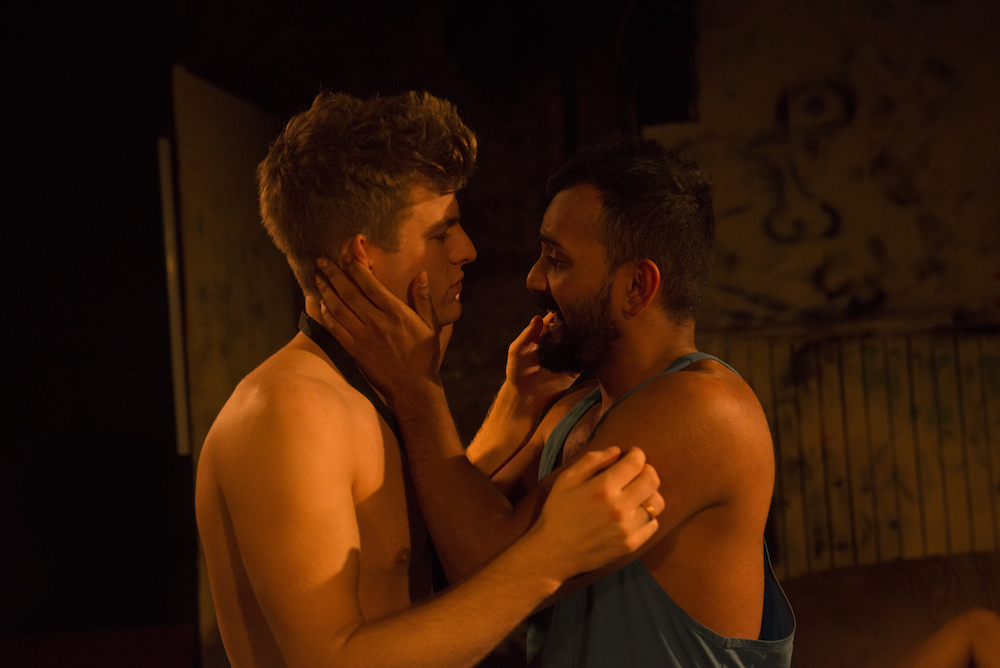
Tag: Three Star Play Review

The latest Three Star Play Review from THEGAYUK.

  • THEATRE REVIEW |Geist, by La John Joseph

    ★★★ | Geist, High-Camp Hedonism!

    Is there anything more delicious than desecrating a dead, pandrogynous diva? What could possibly beat the sick, violating kick of shredding every scrap of their scanty, psychic lingerie, rooting out lies, betrayals and filthily addictive truths? Someday, perhaps – long after privacy laws expire in a surveillance culture feeding-frenzy – we can feast on Bowie’s secret excesses, but meanwhile, there’s fictional meta-scandal Geist.

    The latest, multi-media assault on mediocrity by self-styled fascinatrix La John Joseph, Geist comprehensively dissects its’ messianic star’s life and legacy. Like Orson Welles’ towering Citizen Kane, the ambition is grand; a retrospective, faux-documentary excavation of deceased celebrity myth-making, of conflicting public and private truths.

    Better yet, Geist forcibly marries Kane’s scope to Malcolm McLaren’s viciously precise, punk-rock irreverence and the stinking, incest brats of Freudian guilt and raw egotism. It’s a sublime, sick-f*** polygamy, a Sid and Nancy puke on propriety and startlingly provocative theatre, an All About Eve reconfigured as snotty, waspish, rock ‘n’ roll swindle.

    So why, overall, is Geist unsatisfying? Certainly, La John bleeds visual charisma from every skin-pore, an unlikely but striking collision of Lucille Ball and effeminate, Cecil Beaton-immortalised Oxford dandy. Like fellow, flamboyant predecessors Brian Howard and Stephen Tennant – both icons of the 1930-33 Pansy Club Craze – La John fuses soignée aplomb with savage arrogance. And that – despite Geist’s visual and thematic brilliance – is precisely the problem.

    Just like Dorothy’s Tin Man in Oz, Geist comes across, ultimately, as a show without a heart. Somehow, we never warm to La John’s portrayal of Alexander Geist, his mercurial alter-ego. Possibly, that’s a result of deliberate distancing strategies, such as the preference for gender-neutral grammar that La John habitually employs. But why – speaking as a devil’s advocate – apply that strategy to an evidently cisgender, aggressively narcissistic male? Whatever La John’s intentions, what comes across is feminine mystique forcibly misappropriated and superglued to masculine rage. It’s an intensely jarring mix brilliantly avoided by David Hoyle, who radically transcends the car-crash insensitivity of an indiscriminate, pick ‘n’ mix plundering of gender politics.

    Yes, every artist is free to explore any subject, but why not avoid ham-fisted disconnects via empathy and respect for one’s mode of expression? That’s why the work of physically trans-morphing artists Nina Arsenault and Genesis P-Orridge is so passionately human; it’s a textbook, orgasmic intercourse of form, intention and content. La John, by contrast, unwittingly embraces the fallacy so brilliantly skewered by Joan Didion’s Year Of Magical Thinking, presuming that wishful dreaming always trumps reality. Ideally, he’s hoping to embody some transcendent, omnisexual Puck or Ariel, but the actuality onstage is mere pretty-boy petulance.

    So it’s a pity La John never risks exploring emotional vulnerabilities; Geist cries out for moments of soft, lyrical exposure beneath an inflexibly brittle surface. Ideally, I’d prefer to view the show’s smug, one-note waspishness as a deliberate critique of celebrity solipsism, but nothing here seduces the heart and soul.

    Rather, Geist’s appeal remains purely analytical, the solving of a performance art puzzle-box frustratingly devoid of divine madness. And who needs a faux film-noir inhabited by a non-stop, Mariah Carey diva strop? Hopelessly, I prayed that Alexander Geist would experience Marquis De Sade moments, the shocking, anecdotal bites of exceptional depravity that forcibly challenge all conventional moralities.

    Oh, don’t get me wrong; there’s much to enjoy in Geist, especially the multiple shoals of Hitchcockian red herrings cunningly orchestrated by director Robert Chevara. Still, creating intriguing innovations hugely challenges every contemporary director – virtually every pop-culture and media motif has been ruthlessly recycled, so even sheer brilliance seems passé. Not here. Staging Geist as a restless, cinema verité investigation, Chevara splits our focus between La John live, performance footage, and Geist’s sister/former/future self? – being video-interviewed.

    And choosing to include actress Francis Lima as a deliberate, unspecified sea of possibilities – who or what is she/he? – is Chevara’s directorial master-stroke. Instantly, Geist’s resonances deepen, as Lima’s serene, fascinating ambiguity provokes comparison with searing, Roman Polanski psychodramas – Repulsion and The Tenant – far beyond La John’s dazzling flippancy.

    Still, Geist is very much a work in progress, but even now, has the fabulous, if very faint, imprint of Michael Moorcock’s Jerry Cornelius novels. Never read Jerry? Don’t delay– he’s a multi-gendered, rock ‘n’ roll assassin simultaneously exploring contradictory versions of his own reality. Just like La John Joseph, in fact, who – with just a little fine tweaking – will emerge as Bowie’s flaming, ambisexual heir. We’ll all be watching with breathless awe.

    Follow Sasha Selvie on Twitter

  • THEATRE REVIEW | 1984

    ★★★ | 1984

    George Orwell’s classic book 1984 was not always going to be easily transferable to the stage. But a new production of it has just opened at the Playhouse Theatre.

    CREDIT: Manuel Harlan

    If you’ve ever read the book (either in school or for leisure), you will know the story. Written in 1949, when the year 1984 seemed like a long way off, Orwell wrote about a world where, simply, big brother is watching everything you do, everywhere you go. It’s like the present day North Korea where the government dictates how and where you will live your life, but it takes it to a bit more extreme in that anyone with an individual thought or who speaks bad about the government is punished, it’s a totalitarian state.

    The protagonist of the show is Winston Smith (bravely acted by Andrew Gower). He knows and understands that the world he lives in is bad, cruel, harsh. And he really hates it. He has put his thoughts onto paper, an illegal act if there ever was one. But there’s lots more to this complicated story, on the surface and underneath, and to explain it would be to write a very long explanation.

    But in summary, Smith has an affair with Julia (Catrin Stewart) and it all goes wrong for both of them. You see, they thought that a secret bedroom they were shown by a shopkeeper was free of surveillance, but it wasn’t. They’re rustled up and taken to prison where they are interrogated, and the shopkeeper turns out to be a spy for the government. Smith is labeled a ’thought criminal’ and is tortured, and comes face to face with his self-confessed worst nightmare – rats.

    A production of 1984 was produced by Nottingham’s Headlong Theatre company before embarking on a UK tour in 2013 and then had a sell out run at the Almeida Theatre. It’s a show that’s hard to watch. The story, and characters, are a bit complicated and not very well understood; we seen them but don’t really know who they are. And perhaps that’s the point. But it takes shock theatre to all new levels with lots of blood in the torture scene (the woman next to me had her eyes closed), and the use of very bright strobe lights used intermittently during the play which is very jaring. But it’s Chloe Lamford’s sets that keep 1984 in its time period – it’s a minimalist world where total surveillance is common.

    Credit goes to directors Robert Icke and Duncan Macmillan for putting together a show from a book that’s been described as complicated at best. And Gower gives an amazing performance as the literally tortured soul who is punished for his thoughts.

    If you can stomach a production of 1984, then this is well worth the effort. If you’re looking for something a bit light-hearted, then this show is not the show for you.

    1984 plays at the Playhouse Theatre until the 29/10/16

  • THEATRE REVIEW | Get Em Off, Above The Stag

    ★★★ | Get Em Off

    Well, it’s not exactly The Full Monty – it’s called ‘Get ‘Em Off!’ Set in the suburbian enclave of Croydon, ‘Get ‘Em Off’ takes place in the only gay bar around for miles – The Golden Canary – and it’s a dive.

    Run by proprietor/proprietress Quinny, a/k/a Baz (Dereck Walker), it’s a bar that needs some spicing up. So it’s his employee Mitch (Joe Goldie) who comes up with the idea of turning Monday night into a gay strip competition to bring in more customers. And so that’s what they do. And they encourage their customers to enter in the hopes of winning the cash prize. Milosh (Michael Nelson), from Kosovo, is one of the first ones to enter, he’s definitely not shy about showing his body. Then there’s Ricky (Ashley Daniels), who is a regular customer to the bar when his boring partner (David Michael Hands) is out of town on business and who actually forbids Ricky from going to the gay bar as he doesn’t think they should lead ’that kind of lifestyle.’ But there’s a spark between Milosh and Ricky that’s palpable.

    Meanwhile back at the bar, Baz, all dolled up in sequins and a head wrap, hosts the competition. Mitch urges his all so sexy and very hot straight friend Luke (Tom Bowen) to enter, hey Luke’s wife is about to give birth to their first child so he says why not? And it’s poor Brian (Stuart Harris), Mitch’s school teacher, newly single after six years, trying to find his way back into the gay scene, and finds himself at The Golden Canary. With the strip competition such a success, Quinny decides to enter her men in a national strip competition. So ‘Get Em Off’ follows The Full Monty’s plot where the men practice and practice for the competition where we all know what’s going to happen.

    ‘Get Em Off’ should’ve been called ‘The Gay Full Monty.’ It’s a camp musical comedy with very funny lines but not very funny nor memorablesongs (one is titled ‘Get Your Dick Out).

    The book, by Jon Bradfield and Martin Hooper, gives Quinny some of the best lines in the show, though Milosh and Mitch have some as well. Walker steals the show even when his/her men get naked – he’s hilarious! Hands also deserves a mention as he plays various roles and is unrecognizable in each one of them. ‘Get Em Off’ is not the best show the Above the Stag has produced, but it’s perhaps perfect for the summer season when all gay boys want to do is see to watch light-hearted fare with cute guys and lots of nudity. This is the show for them.

    Get Em Off run at Above The Stag until 28/08/16

  • THEATRE REVIEW | Karugula

    ★★★ | Karugula

    What is “Karugula” and what is this play about? I’m not sure that you’ll leave this play with a definitive answer and you may well not even care but it’s an epic journey in this dark imagining of a dystopian world. Prom kings and queens are ritually shot dead, strange cults rule and a twisted version of the Kennedy assassination is a legend that has influenced society as the grassy knoll is reverentially mentioned. This is a sprawling and pleasantly confusing play with non-linear storytelling and a cast of seventy characters played by nine actors in a constantly changing set.

    Philip Ridley has been knocking audiences sideways and winning multiple awards for his ‘in-yer-face’ plays since The Pitchfork Disney in 1991. He’s elicited wide ranging critical responses and there are fables of fainting audience members and people stalking out of theatres in disgust. However, to look at his plays as ‘shock’ pieces would be to misunderstand and cheapen his work. His worlds are violent and terrifying but his skill is in integrating horror with the everyday world that we know. His work draws you in politely and then grabs you with an icy hand and refuses to let go. He’s also witty and wise, with a wry sense of the state of the world. Karagula is no exception. Ridley fans have learnt to never know what to expect from each new play. Here he’s crafted a fable reflecting modern society and the world’s political tensions but has set it the framework of an apocalyptic science fiction story. Much like Alistair McDowell’s ‘X’ and Anne Washburn’s ‘Mr Burns’ that both recently divided critical opinion; this is an unusual theatrical foray into an infrequently explored genre.

    Cheerleaders chant about assassinations, 1950’s housewives brag of murders in pink kitchens and milkshake parlours aren’t places you’d really want to be. Figures in white clothing inhabit starkly lit interrogation boxes and talk of concentration camps whilst Mad Max style renegades pick over ruins. It’s tongue in cheek and thankfully self-mocking throughout. There are insane touches reminiscent of a 1970’s Doctor Who episode intercut with David Lynch style eeriness. The science fiction references are frequent. Extremism, jingoism and patriotism abound. It’s a mad, mad world but one not far removed from our own. The dialogue is perplexing, odd and hilarious. Ridley’s hallmark style of slowly imbuing the innocuous and banal with sinister overtones works well here.

    The play is overlong at over three hours and is by no means perfect with uneven tones and scenes that feel extraneous. Emotion is rarely poignant or moving (with the exception of a beautiful scene surrounding a mother who’s daughter was taken from her). It’s housed in a disused ambulance station in Tottenham Hale. The production is shaky at times and Shawn Soh’s constantly changing set and the script’s moving focuses of action although impressive, are too distracting. Regardless of any flaws, the acting is skilled and Jethro Cooke’s throbbing ambient soundtrack is a suitable accompaniment.

    Overall it’s an intriguing play but feels less accessible and immediately beguiling than some of Ridley’s prior work.

    Karugula plays at the Styx Theatre until the 9th of July 2016

    Follow Chris Bridges on Twitter

  • THEATRE REVIEW | King Lear

    ★★★ Intense, cathartic, but lacked a punch.

    “But I am bound upon a wheel of fire, that mine own tears do scald like moulten lead” – King Lear

    The story, written by Shakespeare between 1604 and1606, depicts the tragedy of a family who lose trust, compassion, and all for the material gain of land. Those who are good of heart suffer the most and unspeakable tragedy befalls them. When Lear’s oldest two daughters plot to usurp him from his thrown, it is a wayward journey where no traveller returns.

    Talawa Theatre Company and the Royal Exchange Theatre present a moment in theatre that is both harrowing and compelling. From powerful performances by Don Warrington (Lear), Philip Whitchurch (Earl of Gloucester), and Alfred Enoch (Edgar); to an ambitious set that delivered surprises and was thematic with the shape of a circle that glowed like a ‘wheel of fire.’

    Don was very convincing as the King with strong tones of authority, madness, and sensitivity; the second half particularly, Don commanded with emotion and powerfully delivered ‘howl, howl, howl’ whilst carrying a dead Cordelia in his arms. Philip portrayed Gloucester with sincerity and truth, which made his tragic scene even more difficult to watch. His speeches and dialogue were very eloquent and combined with the emotion, galvanised the role to a very high standard. Alfred, who most will recognise from playing Dean Thomas in the Harry Potter franchise, gave an electric performance as Edgar/Poor Tom with physicality that was moving, edgy, and kept your eyes glued to the stage. The way in which he portrayed Poor Tom when he transitioned was fantastic in terms of the acrobatic movement and flair of speech delivery. It was a shame they cut Poor Tom’s speech about him becoming Poor Tom. It was also a pity that the Fool’s speech about the end of the world was cut, which would have contributed to the apocalyptic feel of King Lear. But then again, I am not sure Miltos Yerolemou (Fool) would have handled it as well as he did his comedy. His comedic timing was brilliant, but the scenes in the wilderness were a little lacklustre, in terms of line delivery and truth.

    King Lear1

    Though there were some great moments, there were others that took away from key scenes, and therefore spoiled the play overall. Unfortunately, Pepter Lunkese who played Cordelia was overly shout-y and whiny, and not much of her in the play, which made it hard for the audience to feel sad for her death at the end, even though Don’s lamentation was sublime.

    The key disappointment for me was the ‘camp’ portrayal of Oswald. I thought we had come a long way since portraying characters as camp for the purpose of seeking a cheap laugh from the audience, or as a device for a character to come across evil. It was both offensive and shocking to see.

    King Lear plays at the Birmingham Rep  until 28th May

  • THEATRE REVIEW | Doctor Faustus

    ★★★| Doctor Faustus

    Picture Matt Humphrey

    The story of Doctor Faustus, the man who sells his soul to the devil, is an enduring one that translates well to the modern age. People can become elevated to giddy heights and accrue endless riches and advantages in the realms of celebrity and politics through seemingly mysterious and nefarious means. It’s still tempting to wonder what kind of pact they might have made whether spiritual or, more realistically who they’ve trampled on and betrayed along the way. The truth is probably less titillating and more prosaic. Doctor Faustus was originally published over 400 years ago but retains its relevance.

    The original author Christopher Marlowe is an Elizabethan enigma; dying in a much speculated upon pub brawl at the age of 29. His writing contained openly queer characters, complex romantic relationships and overtly homoerotic prose. Was he a gay man, a spy or a wily criminal? The speculation has lasted centuries along with his plays.

    “Doctor Faustus” opens with a gloomy dwelling with a Hieronymus Bosch style twist of hellishness. Dark figures loiter, hands reach around doors and faces are pressed against the windows. Naked figures move forward, blood flows and sedated looking humans in stained underwear creep around the set. Take your eyes off Kit Harrington (which isn’t easy as he’s incredibly handsome) for more than a few seconds and more horrors appear. Figures appear halfway up the walls, lurch out of doorways and materialise as if from nowhere. It’s actually really quite terrifying. This isn’t a production for the feint hearted. The warning list on the way in is quite impressive with a list of what horrors await you. Instead of the usual ‘theatrical haze’ and ‘strobe lighting’ there’s an itinerary that would make Mary Whitehouse turn in her grave.

    Kit Harrington proves that he can really act with an incredibly powerful performance. He’s also almost naked on a few occasions and that’s no bad thing. Jenna Russell (last seen in ‘Grey Gardens’) is on her usual top form as Mephistopheles. There’s also a very able supporting cast, a stunning and cunning set by Soutra Gilmour and appropriately intense sound and lighting design.

    All good so far but sadly the good stuff is very good and the bad stuff is very cringe-worthy. The Elizabethan script works as does the modern script by Colin Teevan but the two don’t blend together well. In fact, they positively jar. The modern allusions to celebrities and politicians are a little painfully awkward and the humour often falls flat. The second act starts with Jenna Russell singing “Bat Out of Hell”. It’s a bizarre beginning but definitely a sight worth witnessing. The action then flails somewhat and the atmosphere is shattered with skits that often feel silly, although fortunately the play always manages to pull itself back.

    Strongly recommended to see some amazing work from the lead actors (provided you can cope with violence, blood, faeces and sex) but ultimately, Dr Faustus fails to deliver all that it promises.


    Doctor Faustus plays at the Duke of York’s theatre until 25 June.


    @chrisb715

  • THEATRE REVIEW | In the Bar of a Tokyo Hotel

    ★★★ | In the Bar of a Tokyo Hotel

    CREDIT: Scott Rylander

    A middle-aged woman sits in a bar in a Tokyo hotel waiting for her husband; knocking back cocktails, sexually harassing the waiter and throwing out barbed comments. Her speech is unfiltered and whilst lyrical at times is also staccato and brutal at others. She sits well within the ranks of Tennessee Williams’ characters: a brittle yet beautiful monster who is bemoaning the onset of old age and so tightly coiled that an unravelling of some sort is inevitable. In short, she’s simultaneously a joy and a horror to watch.

    Tennessee Williams’ late play “In the Bar of a Tokyo Hotel” was met with a hostile critical reaction when it was first staged in 1969 and has rarely been produced since. It’s a shame that this work has floundered out of sight, as there’s much merit to it, despite its flaws. Written at the start of his final descent into addiction and depression’ it’s an unusual play with absurd elements and strange patterns of speech. The characters are unsympathetic at times, the dialogue isn’t easy to follow and the interactions are surreal. Yet, it’s also a very funny play in parts and there are moving aspects to the scenario. As the play progresses it becomes easier to fall into the patterns of the dialogue.

    Director Robert Chevara has bravely mounted this version and done so with aplomb. The movement and rhythm is perfectly captured in his use of a well-chosen cast and a stylish set. The great Linda Marlowe plays Miriam with spiky coolness and is pitch perfect. She careers round the vertiginously steep stage on heels like a terrifying Gorgon crushing everyone in her path yet flashing hints of her underlying vulnerability. Andrew Koji is desperately handsome as the deadpan barman, gritting his teeth as Miriam shamelessly fondles him. Alan Turkington puts over the waspish campness of Leonard with style. Yet beneath all this lies an imperfect play that just doesn’t quite rise to the occasion.

    If you’re a fan of Williams’ work then this play is an interesting addition to the body of his work. Within the period piece hallucinatory style there are echoes of characters, themes and styles that will be familiar. If you’re a newcomer to his work then it’s still worth a try.

    Even at his less than best Williams is a monumental writer and always worth revisiting.

    In the Bar of a Tokyo Hotel plays at Charing Cross Theatre until the 14th May 2016

    @chrisb715

    (more…)

  • THEATRE REVIEW | FLYING SOLO

    ★ Flying Solo |Running a marathon was the hot topic of the Birmingham Repertory Theatre last Friday night, in the form of Flying Solo. A one-woman show which was performed and written by Manjeet Mann tells the story of Amber who is preparing for the London Marathon.

    (more…)

  • THEATRE REVIEW | The 39 Steps National Tour

    ★★★ The 39 Steps | A murdered spy, a misty Scottish moor, a dastardly plot and a daring escape (coupled with a stiff upper lip and rather attractive pencil moustache) are the order of the day as dashing hero, Richard Hannay, uncovers the secrets of The 39 Steps in this knockabout comedy.

    Based on the book and the Hitchcock film of the same name (and with more than a few nods to the Hitchcock legacy, including a cameo from the man himself), The 39 Steps is a classic spy thriller which finds our hero, Richard Hannay, falsely accused of the murder of a seductive spy, leading him to go on the run to Scotland and to uncover a dastardly plot to smuggle secrets out of the country.

    This playful, tongue in cheek production takes a gentle comedy sideswipe at the spy films of the 30’s and 40’s with a knowing smile and an approach which displays a genuine affection for the source material and the genre as a whole. But the twist with this production is that the 130 characters that adorn the stage are played by just four actors, who give a whistle stop tour of the major plot points and protagonists at breakneck speed.

    In a style that is not too far removed from the deadpan delivery of the “Airplane” or “The Naked Gun” films and with just a hint of “The League Of Gentlemen” – the rapid delivery and scattergun approach to the stream of gags ensure that if you don’t find the last joke funny, there is another on the way in a few seconds. The cast play their roles with a completely straight bat, taking the narrative deadly seriously and seemingly oblivious to the chaos and ridiculousness that surrounds them.

    The use of mime, limited props, quick change costumes and clever staging compel the audience to use their imagination to an extent, but by buying into the premise and presentation, the audience is well rewarded. It was hard to fault the physical performances of the cast who were clearly so well-rehearsed that the switching between characters was second nature; and who were all clearly thoroughly enjoying themselves on stage.

    As with all comedy, not every joke hit the mark, but there was a fair balance of comments, actions or situations which led to a smile, a groan, a guffaw or a belly laugh. Despite a few of the repeated gags starting to nudge their way towards outstaying their welcome, the main criticism of the show was that it was sometimes difficult to hear the script, either as a result of quiet diction from the actors, the fast paced nature of the script or due to their indeterminable caricature accents, but these issues were soon passed and soon forgiven as the next comedic moment rolled along.

    Happily, the show stays on the right side of silly fun, delivers a joke-per-minute ratio which far exceeds most productions over the course of the show’s 100 minute running time and rightly retains its reputation on its tenth anniversary tour.

    The 39 Steps plays at Sheffield Theatres until 20th February 2016.

    @IAmScubamonkey

  • THEATRE REVIEW | 5 Guys Chillin’

    THEATRE REVIEW | 5 Guys Chillin’

    Five gay, short-sporting, horny promiscuous guys with gobs of liquid G, copious consignments of crystal meth, in a smog of monotone club beats opens up a whole production-line of tinned STI’d-worms.  ★★★

    (more…)

  • THEATRE REVIEW | The Solid Life of Sugar Water

    This is a story that describes events between a couple who go through hell and back again while having disabilities.

    ★★★

    (more…)