Category: Comment

  • COMMENT: What Xena Did For The Gay Community?

    It’s been 20 years since it started and 14 since it ended, but I can still hear the “Aalalalala” of the Warrior Princess Xena’s war cry, cementing herself into LGBT culture. And with talk of a reboot/re-imagining in the pipeline, Xena and her chakram are back in the public consciousness.

    For anyone who has never seen it, Xena Warrior Princess is a fantastically kitsch, camp and raucous TV series that made a then 12-year-old me absolutely enthralled with it. Her sometimes-tragic adventures around the ancient world kept me watching for 6 seasons and to this day I will still have a Netflix binge-watch of all the seasons. She was unapologetically strong and unapologetically female, sexy and powerful, unafraid to get sweaty and dirty on the job, and all the more beautiful for it. And despite the few utterly terrible and pointless future based Xenaverse breaking episodes, I absolutely loved it. But why would a TV series that from the outside could potentially be terrible have such an impact on the gay community?

    The relationship between Xena and her sidekick Gabrielle has always been a constant source of speculation for the fans, with thousands of fan fiction stories focusing on it. Even main star Lucy Lawless herself has said that she believes Xena and Gabrielle had a relationship even though it’s never said outright during the show.

    But what about Xena appeals to the gay community, why would she make such an impression? I think it has to do with the themes of the show, togetherness, acceptance, strength and community. But like other fantasy TV shows with a strong female lead, gay men absolutely love the Warrior Princess. She is the very epitome of things gay men relate to, the need for courage, love and sheer bravery in a world that is against them with no need for a man to prove themselves. Xena made bold choices in characters, making one of Xena’s main nemeses, the flawed and very much damaged warrior Callisto, almost sympathetic with a legitimate gripe against Xena, and her past as a ruthless warlord. But even through the drama and heartache, one central theme resonated.

    Love and sacrifice always won, and even Callisto was saved by Xena’s need for redemption of her past.

    All the characters are flawed in their own way, and many of the fans could see a part of themselves in them. However, unlike some other female-empowerment shows, Xena eschewed overtly feminist messages (with occasional exceptions, such as a jab at beauty pageants when Xena went undercover as a contestant). Xena and Gabrielle fought a variety of mostly male baddies, but they were not fighting sexism or the patriarchy. Gender, in the Xenaverse, just wasn’t a big deal. No one questioned Xena’s ability to fight and command, or Gabrielle’s desire to be a warrior, because they were girls. Ironically, one of the few episodes that dealt explicitly with gender issues introduced a man-hating female outlaw just to teach her the lesson that it’s not women vs. men, it’s good people vs. bad.

    In fact, plenty of the shows good people were men, its primary male regular, Xena and Gabrielle’s occasional tag-along, Joxer, was a comically bumbling warrior wannabe but also, in his own way, a true hero willing to risk his life for his friends. Meanwhile, the Amazons were not an idealized sisterhood but tribes with their own power struggles, conflicts and tyrannies. Women on Xena were simply human, no better or worse than men, feminism as it ought to be. It showed that everyone has their strengths and weakness and the gay audience appreciated that.

    Various episodes within the Xena canon showed gay characters in a positive light and how everyone should accept and love them, even resulting in a musical number in the episode Lyre, Lyre, hearts on Fire for Joxer’s gay brother Jace, but dedicated to the shows gay fans. And while gay men adore the ass kicking, leather clad anti-heroine, it was our lesbian sisters who took Xena into their hearts. They related to the strong connection between the two friends and Xena was one of the first major TV characters that had a possible lesbian sub-text and the devotion Xena and Gabrielle showed one another was never in doubt.
    These were two women who loved each other fiercely, and for a generation of lesbian and bisexual women, that meant everything. But even to gay men, the relationship between the two women resonated with them, simply because it was such a wonderful example of solidarity, trust and overcoming all odds to remain close to one another. But while the show had the serious themes, the fact it didn’t take itself too seriously and could whip out a musical episode or two, along with a drag queen winning a beauty contest and many other humorous moments kept the gay audience entranced.
    One could say that Xena’s sexual ambiguity adds to her larger-than-life quality. She is beyond labels, all things to all people. And yet it’s a pity that so much of the buzz generated by a show about a mythic female hero has ended up focusing on who she’s sleeping with. As openly gay Xena producer Liz Friedman once said in an interview, the show was “not about the romantic foibles of Xena and Gabrielle,” it was about redemption and friendship.
    Xena came at the right time to bring fans together. The Internet was out of its infancy and people flocked to the Xena message boards to talk about the show. But like everything on the Internet these days, the show divided fans almost from the word go.
    Some fans praising the idea of a possible lesbian relationship between the two main characters, while others thought it overshadowed the rest of the themes of the show. My own personal opinion is that at the beginning of the show the characters weren’t gay, but actually were close friends who had formed a strong bond, but unfortunately towards the end, especially the 6th season the lesbian sub-text became too apparent and took the edge off the show. The fans stayed true though, and it still spawned numerous spin-off media and in 2011 The Xena Movie Campaign was launched on Facebook that encouraged the fans to mass tweet and write to NBC and may well have influenced them to consider rebooting the series.

    The annual Xena conventions used to bring thousands of fans together from all walks of life who could identify with the show. No one was judged, everyone just went for a good time, and even though the last convention took place this year, if the re-boot is made and takes off, there could be a new generation of LGBT fans treading the floors of convention centres around the world, screaming out a war cry or two.

    Opinions expressed in this article may not reflect those of THEGAYUK, its management or editorial teams. If you’d like to comment or write a comment, opinion or blog piece


  • How The Equality Act Is Costing Gay Couples Billions And Refusing Pension Rights

    News that the Court of Appeal has refused the application of a gay man for his husband to be treated in the same manner upon his death as a surviving heterosexual spouse has underlined that the principal of equality does not extend to every area of the law.

    (more…)

  • COLUMN: Why I Am Outraged by LGBT People’s Outrage

    If there’s one thing that really annoys me these days, it’s people being ‘outraged’ over things that do not require any amount of outrage.

    Particularly with social networking sites being so popular, it’s easy to log on to the likes of Twitter and jump on a bandwagon of outrage against something.

    This week there have been two stories in the news that have resulted in LGBT people claiming outrage. The first is about the comments that Sir Tom Jones made regarding his former views on homosexuality. In an interview he said he was paranoid about homosexuals in the 50s and 60s when he was starting out in the music industry. When I read the article I had no doubt that he was referring to a certain period in history and that his views are surely more open minded now. However, the outraged brigade failed to see that and leaped on to the Tom Jones bashing bandwagon to call him out for being a homophobe. As Tom Jones himself has since said via his Twitter feed, let’s put this story into context. He was clearly talking about a period in history when homosexuality was illegal and people had very different views to ones that are held today.

    In another part of the interview he said that he soon realised that most people “were normal” before going on to clarify that “homosexuals are normal” and that “he shouldn’t have put it like that”. From my point of view he had said something that could cause offense, realised what he had said and then corrected himself.

    Therefore there’s no issue, right? Apparently not so, as swarms of people took to Twitter to berate him for saying homosexuals are not normal; something which he never actually said. I wonder how many of those people criticising him actually read the article or considered the context of what he said, and how many blindly jumped on the bandwagon of being outraged by something that he didn’t actually say.
    The second story that caught my eye is regarding the calls to ban Germaine Greer from speaking at Cardiff University due to transphobic comments she has made in the past. I’ve long been an advocate of trans rights and actively campaigned on behalf of trans people. However I have to disagree with any calls to ban Germaine Greer from speaking at Cardiff University (or indeed any other university). Although I do not agree with the comments she has made about trans women, I also do not believe in silencing or censoring people who have differing views, regardless of how offensive people may find them. As long as no laws are being broken and there isn’t any incitement of hatred, I am all for freedom of speech. Surely it is much better to organise a peaceful protest or actively challenge Germaine Greer over her views than to act to silence her. Doesn’t that make us as bad as those who act to silence our voices?

    The link between the two stories and the views I hold, is the outrage and offense that people claim they feel. While I cannot tell people what they do or do not feel, I can’t help but think that people need to read between the lines, see things for that they are, and perhaps open their minds a bit more before getting angry.

    Another example is when I recently organised an equality rally in my hometown of Leamington Spa to peacefully protest against a rise in violent attacks on LGBT people. Although not a dangerous place, attacks on the community have been slowly rising over the past couple of years and I decided to do something about it. As well as organising the rally, I also spoke to many local councillors, my MP and the Police to alert them to the situation and call on them to do more to support the LGBT community. The concerns were positively received and in particular the Police were incredibly supportive. They agreed a series of strategies to combat hate crimes against LGBT people, encourage reporting and support the community. I posted about the positive outcomes on social media so that those attending the rally could see what was happening behind the scenes. While the news was welcomed by the majority, there was a sect that became outraged that I would allow the Police to be involved with LGBT people and LGBT events.
    A number of very angry individuals, who were acting on behalf of a militant LGBTQ+ group, began aggressively posting their thoughts on how the Police actively murder people from our community and stated that the Police should be banned from all LGBT events. My response was to again explain the context of Police involvement. I told the individuals that the Police were being supportive of our community and that they were not attending local LGBT events to ‘police’ us. It was about positive community engagement and trying to learn how they can do better for our community. My clarification fell on deaf ears and the outrage of that sect became increasingly intense. Along with their outrage and aggressive posts came personal attacks on me, including racism.

    Ultimately what happened was a group of people became outraged over something they completely missed the context of and refused to listen to any kind of reasoning or explanation. I guess that’s the same in the case of the Tom Jones and Germaine Greer stories; people are becoming outraged over something without really understanding the context or considering the alternatives.

    As I keep saying, the LGBT community is sometimes its own worst enemy.


    Opinions expressed in this article may not reflect those of THEGAYUK, it’s management or editorial teams. If you’d like to comment or write a comment, opinion or blog piece, please click here.

  • COLUMN: Can Gay Relationships Ever Be Honest and Open?

    Is there such a thing as a healthy open relationship? I can only go on my own experiences, which were mixed.

    I met Adam in the early 2000s. He was six foot two, tattooed, broad and masculine and counterbalanced my more twinky look. He was hairy and I was smooth, lean and blond with boyish looks. We were smitten in no time at all and entered a really passionate relationship. I was less experienced than him and in my late twenties. He was in his mid thirties and had been around the block a fair bit, trying things that I never had but which turned me on at the very thought of them. He’d had scores of anonymous one night stands, attended an orgy or two and engaged in numerous threesomes. The very thought of this made me squirm with lust.

    The sex was brilliant and we were very compatible. One minor problem was that we were both quite insecure about our looks and both a little bit possessive. I resented his friendship with an ex; he mistrusted me with my gay friends. The usual things. We’d been together a couple of years and were on holiday when we ended up in a bar with a back room. The combination of drink and holiday atmosphere led to us entering into a mass fumbling session and both ending up with sticky hands, hangovers and regrets the next day.

    It sparked something off though and we started to fantasise together about threesomes and about group sex. The next holiday we went on we entered another gay bar and this time ended up taking a hot young Swedish bloke back to our hotel room. It was a pretty good experience. This started the bizarre pattern we followed for the next few years.

    Both of us were incredibly tempted by the array of horny blokes on offer on the gay scene. Both of us disapproved of infidelity. We came to a dangerous compromise. We would have a semi-open relationship. We could both sleep with other people of our choice but the other partner had to be present, either watching or joining in.

    We set ground rules: safer sex only, we both had the right to say we didn’t want to pursue someone and we both had to agree. This worked for a while. We met a variety of blokes, some sexier than others, some duller and weirder and some more wildly exciting than we could have hoped for. We trawled the internet, saunas, back rooms and bars and managed to pull a fair bit.
    Naturally, the problems soon set in. Firstly: I fancied big, manly blokes who were slightly older. He fancied younger blokes who were more effeminate. Who did we choose? The ideal was another couple like us but that wasn’t always so readily available.

    How safe was safer sex? What did we do if someone wanted to see us again? Didn’t that smack of a relationship that could come with unwanted baggage

    The biggest issue was jealousy. Although we were both turned on to distraction watching each other getting it on with another man; it was also slightly disturbing. Was he enjoying it more than he liked sex with me? Was I enjoying it more and could he tell? Was this “proper”? What would my mates, colleagues and family think if they knew?

    He broke the rules once in Amsterdam. I’d nipped to the loo and came back to find him giving a young man a hard pounding in a dark corner. I was turned on but also fuming as he hadn’t asked my permission and the man was also very good looking. He was equally put out when I got quite hung up on a particularly well-endowed trucker and didn’t hide it well enough.

    The other couples we met seemed much like us but sometimes I got the feeling that there was one partner who wanted this more than the other which felt funny. There was also the issue where it was obvious that the invited guest fancied one of us more than the other, which had a tendency to lead to sulking and insecurity.

    We split up eventually for various other reasons. I’m now with someone else and we don’t sleep with other people (unless there’s something he’s not telling me). I kind of miss it in a weird way. Do I regret what me and the ex used to do? Not at all. I’ve got a fantastic bank of memories. Would I do it again? Probably not…but never say never. I know that different arrangements suit different people but I also now know what’s right for me.

    by Chris

  • COMMENT: Steve Strange The New Romantic Prince Charming

    Steve Strange – fascinatrix, Bowie buddy, lead singer of Visage and Blitz Club doyen – was the pop-art Diaghilev of his generation, the New Romantic Prince Charming par excellence.

    Often bizarrely overlooked for far lesser icons, he’s now deservedly receiving media acclaim, following his death this Febuary at the shockingly premature age of 55.
    So on Saturday, September 26th 2015, London’s iconic Café Royal celebrated Steve Strange’s life and influence in a stellar, high-profile tribute. Organised by his close friends Amanda Lloyd, Rosemary Turner and Steve Mahoney, the night dripped with mystique and live, mischievously quirky entertainment. Taking stylistic cues from Weimar-era Berlin as re-imagined in the movie Cabaret, Two Blondes and a Harp – Lowri-Ann Richards and harpist Glenda Clywd – burlesqued Kate Bush and cabaret itself. Additionally, singer Eve Ferret created prankish glamour and playwright Celine Hispiche delivered spicily arch poetry.
    Fittingly, scalpel-sharp style scrutineer Peter York – ex-Harper’s & Queen and eternally sleek – attended, the first columnist to comprehensively articulate Steve’s protean charisma. But what deviant magic first sparked Steve Strange’s muse before his rise from Blitz Kids glory?
    Was early 1970s England an erotic wasteland, dominated by missionary positions and gay caricatures? Not quite. Way before Rocky Horror’s brash sleaze-a-thon, T.Rex glam-rock godhead Marc Bolan quite deliberately, quite impishly, unleashed a pansexual, Pandora’s Box for the ages.
    ‘You can bump and grind/if it’s good for your mind/But you won’t fool/The Children of the Revolution’, Marc poutingly, presciently sang. Incidentally, he also lit a jumping, jitterbug fuse in the collective libido, a slow-burning, sartorial blitzkrieg. Poet, singer-songwriter and effortless androgyne, Marc catalysed an entire generation of potential, but rudderless glamsters ripening unseen in the UK’s dance-halls and schools.
    All canny, fey, fop-till-you-bop, Tin Pan Alley Tolkien, Marc mined and set free a stunningly queer, esoteric eroticism. Popularly, in Sun tabloid-speak, revolutions are harsh, brutal and militaristic, but Marc’s was sensuous and satin-wrapped with the holy fire of imagination. It also didn’t hurt that his casual, cocky aura of dandy magnificence fit him like an irresistible, phallic glove.
    Predictably, Marc’s flippant, delicious, polymorphous perversity went instantly viral. If far less threatening than Bowie’s instantly alienating, killingly cerebral, bisexual drag, Marc more persuasively smirked while Bowie stalked. Eternally post-gender in his Annello and Davide ballet shoes, a deeply naughty slumber-party pixie, Marc sparked delirious dress-up dreams much more seductive than icy Ziggy’s orgies.
    Still – shockingly – the cosy, pop-culture cuddles died overnight as working-class, teenage dreams – omnisexual or otherwise – withered in the face of sudden, mass unemployment. Savagely shackled to dead-end dole or marriage prospects, kids attacked smug glam-pomp an circumstance like screaming rats in traps. Ah, but Art – the perennial saviour of the incurably camp and dispossessed– was hiding viciously chic in the wings.
    Doesn’t it always? This time – hair hacked and blunt, quite mad Miss Haversham 1976 – it came screaming, puking and spitting on velvet, a conflicted, cluster-f**k contrarian, sheer Apocalypse on amphetamine. All brutal, penal-colony buzz-cut, and PVC split, spit and snot-encrusted, this was Art as razor-blade reactionary and thuggish, year-zero conservative.
    Was it christened or better still, baptised? Given a name, even, beyond the No-Wave disapproval it had vaguely garnered via New York’s Patti Smith and Ramones? Oh yes; the London press, quite dismissively, called it ‘Punk’, the vicious, midnight-alley murderer of mincing glam-rock. It didn’t last, of course – perhaps too smart, furious and intensely self-defeating to survive – but Punk’s seemingly dead-end, DIY detour actually crucially empowered maverick, embryonic pop-gods in waiting. Pop gods, in fact, like one very singular – and achingly visionary – Steve Strange.
    Born suffering with terminal, undiagnosed Peacock Syndrome – just like kindred spirit Quentin Crisp – Strange finally bloomed into manic, unrestrained dandyism and eccentricity. A psychological Cinderella state, Peacock Syndrome – a sense of unreciprocated magnificence – is brilliantly conceptualised in Velvet Goldmine, gay director Todd Haynes’s 1998, glam-rock epic.
    Screw fluffy baby wards and steaming after-birth; Haynes’s infant Oscar Wilde is delivered by fairy space-aliens, a UFO Oberon and Titania. Better still, Wilde’s legacy – a glowing, green brooch gifting unbridled imagination and a sense of uniqueness– passes to other, deserving souls as needed.
    But the imagery, of course, was the direct, dazzling incest-child of Marc Bolan and Bowie. In a reality more miraculous than any movie, Bolan ravished Shakespeare to make Midsummer Night’s Scream with band John’s Children, and Bowie’s detached, alien persona debuted in Space Oddity. Given such a succulent source on a plate, director Haynes joyfully joined his pop-god dots.
    So – quite appropriately – Bolan and Bowie – Steve Strange’s subconscious, art-hothouse midwives – gorgeously poisoned his first taste of Sex Pistols punk. And the resulting effect? None other than the shockingly outré, uncontrollable orchids of New Romanticism, shooting up furiously in their bemused, involuntary creator’s head.

    The first fruit – quite fittingly for the scorched-birth revisionism of 1976’s punk-rock summer – was The Moors Murderers, Steve’s charmingly-named first band. But even with a press tinder-dry for tabloid outrage, the incendiary name and 45 single Free Hindley did nothing. Exasperated, Steve ditched collaborator Soo Catwoman to launch his unwitting, killer path to glory; his Bowie Night at Soho nightclub Billy’s.
    It did the trick, and, more prosaically, turned the creative tricks. Soon, the artistic infection – Steve’s very own, superbly peculiar, post-modernist plague, certainly the honorary enfant terrible of Bolan’s revolution – quickly spread. Nascent exquisites like Boy George and Grayson Perry, still lacking media labels but given surrogate birth by Steve’s example, became individual blizzards of pocket decadence, sartorially assaulting shocked, UK high streets.
    Encouraged, Steve further consolidated his confrontational success with his now-legendary, unforgettable (for those who went) Blitz Club in Covent Garden. Now proxy father to the Blitz’s myriad, stained-glass, splintered rainbow tribes, he attracted inevitable attention from Bowie, guesting in the iconic, ‘Ashes to Ashes’ video.

    Had Steve hit the Elvis Presley, ejector-seat button to instant fame and lasting notoriety? Yes and no; his inimitable hit, ‘Fade to Grey’ with his band Visage irrevocably stained the pop nostalgia industry. Even more than close rival whack-attack on conformity Pete Burns, Steve engineered an edgy, existential, street-Bible etiquette for surviving our crushingly mediocre modernity.

    He needed to. Despite the Blitz Kids and New Romantics’ glorious, inner-London uprising, Maggie Thatcher – the Wicked Witch personified – was fast-tracking creative genocide by any means possible. No, she didn’t succeed, but Thatcher’s preferred, proto-fascist Britain was viciously anti-life, all true-blue, concentrated camps of xenophobic, nationwide intolerance.

    Soho, however – spearheaded by Steve’s intoxicating lead – remained a feisty, life-affirming counterforce. Yes, arguably, blandness, in personal politics and society, triumphed long-term – hello, Cameron’s UK – but briefly, to paraphrase Marc Bolan, O God, Life was strange.
    And it got stranger yet. Spandau Ballet, Ultravox, Japan, Duran Duran, Culture Club and uncountable others – the tip of a Blitz Kid iceberg – ravishingly seduced a limp, post-punk pop industry overnight. And quite brilliantly, the new bands used sexuality as an explicit style medium, a self-expression as explosive as art, words or image. A new Bible, in fact, a radiant Gospel of non-bigoted, guilt-free Glamour that instantly dumped bedrock intolerance.

    Who, after all, needed orthodox religion, that racist, misogynistic rant of half-starved bigots hallucinating reactionary Gods? Why not procreate in your own image through the sheer, self-pleasure of passionately sparking others? Sure, pop was in danger of eating itself, becoming a glorious, shame-free act of art-rock fellatio, but why not swallow inspirational spunk?

    Okay, today, perhaps we’ve taken pop’s non-stop wankathon a tad too far – live acts, laughably, even sample themselves – but isn’t that perfect post-modernism? Like it or not, we’re living the pop context Bowie, Eno and Roxy Music merely predicted – music as permanent, but inconsequential, social wallpaper.

    So best, perhaps, to kiss Steve Strange goodbye as an exquisite provocateuse eternally preserved in memorial aspic, a pop Jean Cocteau poised for brilliance. Why bother exhuming his moments lesser than Fade To Grey or Ashes To Ashes? Brilliantly plucking the zeitgeist baton from Bowie just before David’s decline, Steve arguably passed the beating heart of art-pop to Gaga, his spiritual heir.
    And following Lady Gaga’s inevitable fall from cutting-edge grace? Who knows, but Steve Strange’s quintessential magic – making glory from forsaken glamour – bubbles all around us every minute, in every, artistically-driven life he ever touched. There’s really no better monument than that.

    Opinions expressed in this article may not reflect those of THEGAYUK, its management or editorial teams. If you’d like to comment or write a comment, opinion or blog piece, please click here.


  • COMMENT | Gay Rape. It exists and we need to talk about it

    COMMENT | Gay Rape. It exists and we need to talk about it

    Rape is a most detestable crime.

    It is a crime that involves sex but also violence, deceit, power and in some instances romance. As a society, we have come to the (unfounded) conclusion that rape is a violent affair, committed by a stranger in a dark alley at midnight and victims are always women. How wrong we are.

    Historically, there has been little consideration of men as victims of rape. The law only recognised non-consensual penetration of the anus as rape in 2003 under the Sexual Offences Act. But male rape in the twenty-first century is, more than ever, a social issue.

    According to the most recent government statistics, The British Crime Survey (2013) found that out of 473,000 victims of sexual assault, 72,000 are male. Narrow this to rape and it is estimated that 78,000 people in the UK are victims of rape, of which 9,000 are believed to be men. For those who like statistics, male rape accounts for almost twelve per cent of the estimated national total; a figure that cannot be ignored.

    Whilst this is a serious social issue, you wonder why a gay lifestyle magazine is raising the subject. The reason is that current law is gender specific, meaning only men can be perpetrators of rape, not women. In other words, men are raping 9,000 other men a year. Gay rape exists and we need to talk about it.

    The most basic definition of rape is sexual intercourse without consent. The issue with this is that there exists no clear definition of what consent means and it presupposes that both parties define consent in the same way. As a result, victims often don’t understand that they have been abused.

    When violence is involved, it is easier to identify a lack of consent because there would often be evidence of resistance. Although it is no longer necessary to show that force was used to prove that sex was non-consensual, it remains difficult for most to understand this and a gap is created between principle and practice. In principle, any submission to non-consensual sex is rape. Yet those who are subject of rape will often fail to recognise this and would not consider themselves victims.


    It is alarming to discover that the real rape stereotype, mentioned above, is so wrong. In most instances the victim is raped by someone known to him and this is known as acquaintance rape; often this involves some form of deceit, intoxication and also romance. Note that violence is very rare in this scenario and it distinguishes between force and unwanted sex. It is important for us as a community to recognise this distinction and recognise the later as the most prevalent form of gay rape.
    In large, social attitudes are to blame for us not recognising rape when it happens. But another hurdle for male rape victims is the police. Since the legal identification of male rape, there has been an increase on police reporting every year. However, these figures are an underestimation of the true reflection of male rape due to the reluctance many have to report their experience. The statistics in this instance are merely the tip of the iceberg.
    Recent reports* have suggested that police officers responsibility and care for victims of male rape is very poor. Treatment provided is completely insufficient because there is a lack of training, awareness and understanding. Compare this to the extensive training and recent reform gone in to female rape and it may appear somewhat homophobic, that the police consider male rape as a less serious issue. All this adds to the reluctance victims have to report their rape to the police.
    As a result of poor education, police often challenge male rape victims’ sexuality and masculinity. In instances of acquaintance rape (which we know is the most common form) police tend to view victims as somewhat culpable for their rape because they failed to fight off their attacker. Consequentially, the police are far more likely to blame homosexual male rape victims than heterosexual male rape victims for their rape. This would suggest that the police consider sexual violence less distressing for homosexual men and are more likely to view the rape as consensual sex.

    Despite all this, if a rape victim manages to be taken serious and the case was to proceed to trial, the victim has to endure the gruelling process of cross-examination. As questions surrounding the male rape victim’s sexual history with the alleged perpetrator are allowed at trial, it can be argued that if consensual homosexual sec took place previously, it was also consensual sex at the time in question. In addition to this, the victims’ physical response can be used to discredit the male rape victim. For example, if the victim were to have an erection and ejaculate, despite this being an involuntary reaction. Yet this involuntary body response is used as to argue that the male rape victim consent to the sexual activity.

    It is evident that there is a lack of understanding to manage male rape victims because there is a lack of understanding and knowledge of male rape. This is amplified by the continuing presence of rape myths and stereotyping certain (homosexual) victims of male rape. The only way to counter this is to demand attention and to discuss the issue, amongst ourselves, with the police and if be it in court.


    * Javaid, A. (2014) Male Rape: The Unseen World of Male Rape. Internet Journal of Criminlogy, ISSN 2045 6743

    Khan, N. A. (2008) Male Rape: The Emergence of a Social and Legal Issue. Great Britain: Palgrave Macmillan.

    Rumney, P. (2008) ‘Policing male rape and sexual assault.’ Journal of Criminal Law, 72 (1), pp. 67-86.

    by Joshua Vaughan | @Joshua_Le_Von

    If you need to report a sexual assault or need to talk to somebody about issues raised in this article please contact the Victims Support Helpline on 08 08 16 89 111


    Opinions expressed in this article may not reflect those of THEGAYUK, its management or editorial teams. If you’d like to comment or write a comment, opinion or blog piece, please click here.

  • JOURNEY TO FATHERHOOD 2 | The Money

    The second instalment of Simon Hill’s journey to becoming a father. It’s about the money…

    A man once told me a story about money, it went like this: The board of a FTSE 100 company is meeting at lunchtime. As they start to debate the next item, an investment of £10bn, there is a knock at the door, and Liz, the sandwich lady comes in. Picking out a sandwich, drink and crisps, the FD hands over a £5 note. “It’s £5.50, John”, says Liz. “Eh?!” John looks up, “It was £5 yesterday and has been since I’ve been here.” “Well”, says Liz, “prices have gone up and it’s now £5.50.” There then ensues a long debate over the price of sandwiches and subsidising the canteen. The debate ends; John looks up and says “Let’s vote, whose in favour of the investment?” All raise their hands and the business agrees to spend £10bn. The point is that it’s very easy to pay for something, when you don’t appreciate the amounts of money involved. But, when we are asked to pay for something which, we can relate back to time spent in our day job, it really brings home how much something costs.

    Paying for surrogacy is a bit like the £10bn investment. It involves cutting edge science, which we have only heard about on TV and is paid for by sums of money we will only deal with a few times in our lives, let alone actually see laid out before us on a pallet. Add to this the emotional time and personal investment and it goes from being a risk to something we can’t fully get our heads around.

    At the parenting conference we attended in August 2012 there was a presentation by an agency; let’s call it ‘Agency A’. At the end of the presentation, there were questions. One of the questions was, ‘how much is it’? To which the reply was, ‘about 100,000 dollars’. Clearly the speaker didn’t want to alienate his audience. A quick calculation of 1.5 dollars to the pound and it works out around £66,000. Hmm, I thought, £66,000 doesn’t seem so bad. That’s a quantifiable figure.


    At the time I was also attending counselling. I asked my counsellor, how could I get £60,000? His response was quite clever. He told me to take a white sheet of A4, and half way up draw a line from left to right. Next he told me to mark a start point at the left edge of the line. Then he asked me, what I could afford to save a month? “About £1,000”, I said. “Okay,” he said, “£60,000 divided by £1,000 is 60. So that’s 60 months. At the right edge of the line mark your end point: month 60.” And there laid out before me was a five year timeline to pay for surrogacy. This way I was able to start to quantify what it might cost me to have a child. For £1000 a month I could: lunch every working day for £50 or go out each weekend and spend £200. What does £1000 mean to you? £60,000 is a lot of money.

    Two years later, I started to investigate it further and in July of 2014 I agreed to meet Agency A. When I got to their offices, you could tell that there was money, but decorative taste was clearly harder to come by. I met a very nice lady who during the course of our conversation confirmed it was ‘about $100,000.’ She said to contact them once I had the money ready.

    66 months is a very long time and I wanted to have children while I was in mid-life, so, I sold my house and moved in with friends. Three months later, following completion, I had £66,000 in the bank. I put £16,000 to one side for a new deposit and prepared to transfer £50,000 into dollars. It took a lot of thought. Was I really going to make this commitment? At this sort of price, even a slight fluctuation in the exchange rate could mean losing thousands of pounds. The pound had been at 1.7 dollars, now it was 1.64 dollars. Should I wait for it to go back up? I decided to take the plunge and get on with it. Today I am very thankful. The dollar got stronger a few weeks after and still today is trading around $1.50 to the pound. I could have lost out on a lot of dollars. For weeks after my father said to me “transfer it back, you will make two or three thousand pounds” –yes, but then I won’t have any dollars!

    I contacted Agency A again and spoke with my proposed project manager. My ‘professional head’ kicked in, “I need to pin down the costs before I sign contracts,” I said. “Well,” he said, “we tell our couples to budget up to $150,000 just in case, but hopefully it’s less.” “Hang on a minute”, I replied, “that’s not $100,000”. Suddenly I had gone from $100,000, ‘up to $150,000.’ I now needed £100,000, not $100,000. However, I decided to push on and see what the details looked like. I asked to visit their offices once again to work through the different costs. “We still wouldn’t be able to give you firm costs” came back the reply.


    READ THE ENTIRE Journey To Fatherhood series


    I went through the outline costings, budgeting $119,000 and $130,000 for worst case. New costs were added, and the budget became $150,000 and worst case $170,000. Since selling the house I had gone from $100,000 to a worst case of $170,000 which couldn’t be guaranteed. It was all too much of a gamble for me. So I left it.

    This gives you some idea of what I am up against. Transparency is available if you ask the right questions. But as this is such an emotional and new process, knowing the right questions is often not possible. In February this year I was offered a fixed price deal at $120,000. This gave me some surety and peace of mind. It is roughly £80,000 of which I already had £66,000, meaning I only had to find £15,000. The package included project management, surrogacy and fertility agency fees, egg donor fee, surrogate fee and US legals. All that remained were deductibles such as maternity clothing, three month maternity leave salary compensation (if applicable) and UK legals. Interestingly without the fixed fee deal I calculated these costs were about $153,000, not far from Agency A’s pricing. So I signed on the dotted line.

    Today my costs are now closer to $138,000 (about £90,000). What’s changed is small additions to the fixed package, such as: add $2,000 for ‘unlimited’ US legals, $1,500 for a contract enabling your children to legally contact their egg donor, $5,000 for the surrogate salary compensation, deductibles increasing by $2,250, counselling $299, surrogate’s lawyer and travel $3,358. And still, I’m confused, e.g. is surrogate travel part of deductibles? No one seems to be able to tell me, least of all my project manager! So I rely on my own spreadsheet, which I regularly review. And now this means I will dip into the house deposit money.

    As a result I now have a GoFundMe page. If you like my story please do contribute to my fundraising campaign, so that I don’t finish with too much debt to the detriment of raising my children. Any contribution is valuable to me, so please contribute what you can at: gofundme.com/simonhill.

    Next time I want to cover off family and friends. We live inside very complex social networks and mine isn’t an exception to this, how do you tell friends and family? If you have any questions, please contact me on twitter.

    @simonxhill

  • COMMENT | Just What Is Happening To Gay Soho?

    COMMENT | Just What Is Happening To Gay Soho?

    Is extremity passé? Pre-Crossrail Soho thinks so. F**k nurturing nonconformity – now, it’s virtually a shoot-on-sight thought crime. Don’t believe it? Think again; clubs, landlords and speculator scumbags w**k themselves raw for imminent, sky-high rents. Forget Soho’s mass misfit culture spanning centuries – this is Ebola economics, toxic to anything but itself.

    Forget Bohemian heritage. Those stinky, if beloved, Soho streets – strip-mined of any meaning but money – are being massacred by real-estate morons. It’s systematic, social abortion, a vicious kick in the pregnant belly of deviant culture. Forget dissent – the future is Yummy Dummy Yakuzas en mass, brutal corporate clones sipping lobotomised lattes, Orwell’s perpetual boot in the face with added, f**k-you froth.

    More vicious still, it’s deliberate, a long-term, strategic pacification sicker than stowaways falling from 747s. In common with deleting council tenants in desirable postcodes for lucrative redevelopment, any breeding grounds for debate also vanish. Notice a pattern? Not just gay bars and venues, but any establishment encouraging behaviour beyond ticked boxes.

    And the first casualty? Arguably, the Colony Room, Dean Street’s lusciously depraved den of artists, whores and lost souls, closed in August 2008. Commandeered (no other phrase fits) by the dulcetly vulgar dyke of distinction, Muriel Belcher – a typical greeting was ‘Alright, c**ty?’, despite actual gender – the club festered, Addams-family style, one taut, confining, sludge-green upstairs room with attached bar and drug-dusted lavatory. Part confessional, part pick-up joint and liquid muse Mecca for regulars Francis Bacon and his ilk, a utopia of free expression regardless of gender, desire or class, the Colony was Soho personified, the rank piss on a Duke’s pantyhose.

    Which meant what, precisely? Oh, everything that bigoted, reactionary wage-slaves hate – blanket irreverence and relishing life’s quality, not quantity. Puking, farting, publicly squirting spunk, Soho, at best, was life raw, erudite, and flawlessly finessed at level ten on Viagra.

    No longer. There’s a creeping disease – scorched-earth stupidity – alive and necrotising Soho daily. It’s called greed and property profiteering in the wake of London Transport’s Crossrail project gutting the area. A prime example? One neighbouring club – and here discretion demands anonymity– which as an amiable, if less intense, but enjoyably polysexual version of the Colony – which suffered appallingly.

    Acquired by interests blatantly misunderstanding the letter B in Bohemianism to mean business, it became a pressurised, bums-on-seats cash-cow overnight. Previous founder memberships were revoked en mass, the boozy Dylan Thomas ambience severely discouraged, and every expansive inch of unprofitable eccentricity press-ganged into table-service. Result? A win-win for mediocrity par excellence; Hello to the least welcoming, fleecingly expensive, stunningly intolerant faux-Starbucks in town.

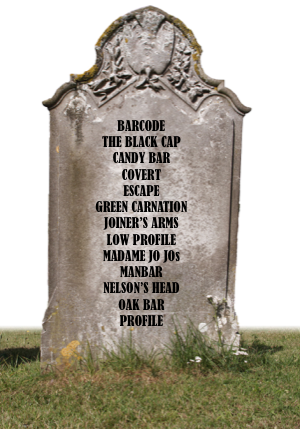
    If only the scummification – the Battery Farm Bohemianism beloved by non-entities – had died there. No such luck – Jojo’s, the Black Cap, Soho’s 12 Bar Club and more have been shot faster than US police suspects. And that’s despite non-stop, impassioned celebrity pleas. ‘Stop the destruction!’ Vivienne Westwood recently demanded. ‘London is a disaster! People hate it! Clubs and dives are going, going, gone’.

    Exactly. It’s Artistic Abbatoir time ASAP, the ruthless culling of any possible activity not devoted to coining cash for city coffers. Who needs ISIS demolishing irreplaceable icons with Westminster Council in town? Insanely, Ruling Baron Bojo’s forgotten – or never knew – a society’s quality of life and civility is embodied by the amenities available. Not here; Tories despise the ‘useless embellishments’- like Culture and public toilets – encouraged by an inexplicably contrary Europe.

    In any form, philistine bigotry is ugly, especially posing as benign gentrification. Given free rein – like right now- Cameron and pals prefer a dead-by-night London choked with brain-dead worker ants by day. Their ideal city? A walk-away, stay-away, w*nker’s wonderland with all the cachet of a mass urinal. It’s divide and rule, a classic dictator strategy; people terrified by job insecurity simply ignore minority plights and issues.

    Well, so sorry, boys- we’re human beings demanding Humanity. Ever heard the phrase, while furiously deleting Human Rights from the statute books? If an ideal city – Paris or Rome – embodies all the poise, compassion and nurture vital to sexual, social and artistic diversity, then London 2015 is a psychopathic, brain-dead glutton, eating itself alive with greed. Do you – do we – truly want to barely exist, not live, in the rancid puke it’ll toss back as a bland, back-door Bohemia? No way, José. Stick it right back up where Bojo’s brain don’t shine. Just as Westminster’s done to Soho’s Rainbow wilting in the gutter. Poor Oscar Wilde; he’d be sobbing his heart out crying to the indifferent stars.

    Opinions expressed in this article may not reflect those of THEGAYUK, its management or editorial teams. If you’d like to comment or write a comment, opinion or blog piece, please click here.

  • COMMENT | What Jeremy Corbyn Has Already Done For The Gay Community

    Many of my gay chums often tell me they are not “into politics”. Personally, I’ve always often thought this was a bit odd because I’ve always thought of being gay and being political as going hand in hand.

    We have long had things to fight for in the name of fairness and equality and pressure to put on those in power; the long struggle for equal marriage being just one example in recent history.

    But politics, especially that coming straight out of Westminster, leaves many cold. And after the recession and all that nasty MP’s expenses business then is it any wonder?

    Even if you despise all things political though, the rise of Jeremy Corbyn has been inescapable. And somewhere in the media storm and the thousands of words written about him, there is one announcement that is both very welcome and hugely long overdue.

    In unveiling his Shadow Cabinet team, Corbyn named Luciana Berger as the very first Shadow Minister For Mental Health.

    Here we need some context: a University of Cambridge study published in September 2014 found that 12 percent of lesbian women and almost 19 percent of bisexual women reported mental health problems, compared with six percent of heterosexual women. Also, 11 percent of gay men and 15 percent of bisexual men reported problems, compared to five percent of heterosexual men.

    It’s pretty clear that mental health is an area of huge importance to the continued wellbeing of us all in the LGB community. However long waiting times for an initial hospital consultation and the postcode lottery that results in standards of care being entirely dependent on where you live continue to be a big problem.

    And we all know that the Conservative policy of austerity has led to funding cuts to many organisations that were previously there to provide support and advice.

    Let’s not get too ahead of ourselves here; the appointment of a Shadow Minister is in no way the miracle cure to solve the problem with the current state of care. And to be brutally realistic, we still have a government in power who plan on cutting public services yet more in the next few years. Not a great sign that an already difficult situation will get easier anytime soon. But at least for once we can say with certainty that a political party is actually taking it seriously rather than paying lip service with a brief paragraph in the manifesto at election time.

    So yes, these are politicians we are talking about. And we’ve all learnt not to trust them right? So it could turn out to be a naïve hope but just maybe the appointment of Luciana Berger means that with the closer scrutiny a designated minister should bring, there just might be a grown up conversation about mental health care in this country.

    Yes. I did say it was possibly a naïve hope.

    But mental health matters. Given the statistics it is a topic that touches all of us in the gay community, if not personally then chances are through our closest friends and families.

    And that is true, whether you are “into politics” or not.

    Views expressed in this article may not reflect those of THEGAYUK, its editorial team and owners. As part of our mission statement, we have published this comment piece as part of our open platform. If you’d like to reply please use the comment section below and if you’d like to write an opinion piece please visit: www.thegayuk.com/Submit


  • LETTER FROM THE EDITOR: More than the sum of our parts

    This month, I happened to be invited to a sit down pasta/policy night with a well-known community leader. Around the table I was joined by five colleagues from the LGBT media.

    Yes, we are all individual and no we don’t all like Madonna, musicals or muscles, but there has to be something more than just the love of a certain type of genitalia that unites gay people. What about shared experience? Surely there’s a common understanding of what it feels to feel slightly out of the ‘norm’. We will never be the ‘norm’ just from a statistical point of view, we’ll always be a minority, doesn’t that imply a certain unity?

    Or what about the fear of coming out. Show me someone who has never feared coming out to anyone, and I’ll show you a liar.

    Haven’t we all watched a Hollywood movie with the perfectly presented heteronormative narrative and thought – “wow this does not apply to me in any shape or form?”

    But being gay does go deeper than willies and vaginas. Isn’t it about who we want to fall in love with? Isn’t love greater than that? Isn’t it about with whom we see ourselves growing old with? Isn’t it deeper than the sum of our parts?

    I find comfort in being and feeling part of something. A collective. A unified voice. That’s why pride parades can feel so incredible. All those voices – an incredibly powerful voice with an incredibly powerful message.

    We need to be a clear and strong community, to ensure our voices are still heard and that they continue to be heard. We may have almost legal equality, but there’s still a fight for acceptance and societal equality to be had.

    Enjoy the issue and as always please don’t forget to let us know what you think and rate us on Android and iTunes.

    Feel free to leave your comments below.

  • COMMENT | Manchester Pride & Me: A time for community

    I recently attended one of the best pride events I have been to in a long time. For me, Manchester pride is a shining example of how a pride should be.

    The reminders of our past, the celebration of our achievements and the hope for our future all wrapped up in 1 event. All you have to do is look around at how everyone interacts and how the businesses operate and you get such a sense of community in the air. I’ve been to many different prides over the last 10 years or so including some of those in Europe and I would gladly place Manchester pride up there amongst the best.

    Yes I had a cider or 2, but then I’d have a cider or 2 regardless of it being pride. But for me it was a weekend of friends, old and new, learning about new things and pushing my boundaries to do and experience new things. To challenge some of my own prejudices and short comings and come out the other side with a sense of achievement.

    On the Monday evening, for those that did not stay the full weekend, in the community park a candle lit vigil occurs on behalf of the Georges House Trust (GHT). GHT have been in Manchester offering HIV-related services & support for 30 years and this year decided to remember those 30 years and some of those that have used the service.

    Each of the various different national and local well-known figures brought with them to the stage a memory, a memory of someone close to them that they are there to remember. Someone who cannot be with us but is with us in our hearts. Each talk, albeit short, was utterly moving and emotional. A local theatre company performed a selection of calls that had been received by the GHT to their telephone support line. The 3 performers read out the ‘call diary’ of the volunteers on call that detailed what the call was and what advice was given.

    Some calls were sweet. Some calls were creepy. Some were routine and some revealed the sheer scale of horror and injustice that living with HIV was like in the 80s and 90s. You could not help but be moved to tears when you hear about a man losing his partner because he committed suicide after finding out he was HIV+, or a mother so scared for her HIV+ son that she turns to the GHT for help in utter desperation. In each call the GHT volunteers were there to help and they, and all other organisations throughout the world that offer a similar service, are truly a shining light in the darkness of someone’s desperation.

    Many people ask me “what is the point of pride” especially when we enjoy such freedoms and exposure these days and all the say is a load of youths drinking. For me I answer with this; pride is not a march, it is a parade. It’s a celebration of all we have achieved but also a remembrance of all those we have lost. Those that have given their lives or suffered greatly fighting for what is right deserve to see the benefits of their work. To be remembered and celebrated and to allow people to be whomever they want to be and live in a world with no prejudice for phobia. Even if that is only during the pride festivities.

    Pride also reminds us is that we have still a long way to go on some areas. In the recent Dean Street data incident, the fact that some people have taken that list of email addresses and are sending the recipients abusive messages shows that HIV ignorance and prejudice is still a problem in this country. Even some of the news agencies listed Dean Street as an “AIDS clinic” rather than the sexual health clinic that it is. So long as ignorance and intolerance of HIV & AIDS exists then work will go on. For that matter, so long as HIV still exists then the work will go on.

    GHT handed out to everyone and encouraged them to share these 5 facts about HIV via social media. I encourage everyone to do the same. Even if you don’t engage in pride or know of anyone that has suffered with HIV you can do your bit and simply share some common facts to promote awareness.

    1 – Testing regularly for HIV is the right thing to do

    2 – Medication is stopping HIV from being passed on

    3 – HIV is a manageable condition when diagnosed early

    4 – People living with HIV are enjoying happy and fulfilling relationships

    5 – Positive attitudes encourage discussion about HIV

    by Scott Sammons | @i_scotty