Tag: Politics

The latest news, interviews, and views from the world of LGBT politics in the UK and internationally.

  • How important is the gay vote in this general election?

    How important is the gay vote in this general election?

    The gay vote is a significant and increasingly influential factor in general elections for several reasons:

    Demographic Size: The LGBTQ+ community represents a considerable portion of the electorate. There has long been a widely-held belief that around 10 per cent of the population is gay, lesbian or bisexual or who identify as non-heterosexual. This is probably the most accurate of all the figures – as more and more people feel comfortable to come out about their sexuality.

    The most up-to-date statistics show that six per cent of people identify as homosexual while seven per cent of people identify as bisexual. This equates to 13 per cent of the population identifying as either gay, lesbian or bisexual. EuroClinix surveyed 2,000 people around the UK to find out more about the sex lives of Brits.

    Political Engagement: Historically, LGBTQ+ voters tend to be highly politically engaged. This community often has higher voter turnout rates compared to the general population. Their participation can be pivotal, especially in closely contested races.

    Key Issues: LGBTQ+ voters are often mobilized by specific issues such as anti-discrimination laws, marriage equality, healthcare access (including transgender healthcare), and protection against hate crimes.

    Candidates and parties that address these issues effectively can garner significant support from LGBTQ+ voters.

    Local Elections: In local elections or tightly contested districts, the LGBTQ+ vote can be particularly influential. Even a relatively small but motivated group of voters can sway the outcome in such scenarios.

    Alliances and Coalitions: LGBTQ+ voters often align with other marginalized groups, creating broader coalitions that amplify their electoral impact. This intersectionality can drive turnout and influence policy platforms.

    Advocacy and Influence: LGBTQ+ organizations and advocacy groups are active in political campaigns, lobbying, and voter education efforts. Their influence extends beyond just voter numbers, shaping public discourse and policy priorities.

      So, don’t underestimate the power of the pink vote! We are important in general elections due to our size, our engagement levels, and the critical issues that motivate our community. Candidates and political parties that recognize and address the needs and concerns of LGBTQ+ voters can gain a crucial advantage in elections.

    1. UK government apologises for anti-gay employment policies in the Armed forces

      The UK’s government has apologised over what it called, “egregious” policies that banned gay and lesbian people from working in the armed forces.

      The government issued a formal apology for the mistreatment of LGBT veterans, following the release of an independent review investigating the military’s ban on LGBT personnel before 2000.

      The review, presented in Parliament, was initiated by the Ministry of Defence and the Office for Veterans Affairs and chaired by Lord Etherton. Its focus was to examine the experiences of individuals affected by the ban on homosexuality in the Armed Forces between 1967 and 2000.

      Unacceptable and regrettable

      Previously, the government acknowledged that the treatment of LGBT personnel and veterans before 2000 was completely unacceptable and regrettable. The report by Lord Etherton revealed that investigations into individuals’ sexuality were intrusive and invasive, resulting in severe and long-lasting impacts on the lives of veterans and their families.

      The government’s unwavering commitment to supporting veterans and the LGBT community was highlighted in the review. The Prime Minister and Defence Secretary offered a formal apology in the House of Commons today to all those who suffered under the ban.

      The review focused on three main areas: the impact of the historical policy on affected individuals and their future lives, the accessibility of veterans’ services for LGBT people, and the full recognition and acceptance of LGBT veterans as valued members of the armed forces.

      Sunak expressed deep remorse

      Prime Minister Rishi Sunak expressed deep remorse, acknowledging that the ban on LGBT individuals serving in the military until 2000 was a failure of the British state, lagging far behind the country’s laws. He recognized the immense suffering endured by many who faced sexual abuse, violence, and homophobic bullying while courageously serving their nation.

      Defence Secretary Ben Wallace was pleased that the review shed light on a shameful chapter in the Armed Forces’ history, acknowledging the denial of tolerance and values to many who served.

      Restoring medals, pension rights

      Within the review, 49 recommendations were made, including the restoration of withheld medals, clarification of pension rights, and the presentation of the Veterans Badge, among others. The government accepted these recommendations in principle and committed to collaborating with LGBT veterans to ensure the appropriate implementation of restorative measures.

      Minister for Veterans’ Affairs Johnny Mercer viewed the apology as a historic moment to address past wrongs and honor the extraordinary service of LGBT veterans. He also emphasized the need to enhance support services for veterans impacted by the issues raised in the review.

      Minister for Defence, People, Veterans, and Service Families, Dr. Andrew Murrison, acknowledged the wrongdoing and pledged to study the review’s recommendations to determine the government’s response.

      Since 2000, the government has made significant strides in removing barriers and implementing initiatives to improve the experience of LGBT personnel. These include providing guides for parents of LGBT children, delivering LGBT allies training, and offering Pre-exposure prophylaxis (PrEP).

      The establishment of the Office for Veterans’ Affairs has also expanded support for all veterans as they transition out of the Armed Forces.

      The review is a crucial part of the Government’s Veterans Strategy Action Plan, demonstrating its commitment to compassionately address historical hurt and disadvantage experienced by sections of the veteran community.

      Furthermore, the government has extended the Home Office’s disregard and pardons scheme to ensure the expungement of convictions for same-sex sexual offences.

      To support those impacted by the ban and today’s announcement, the Office for Veterans’ Affairs is providing £250,000 to LGBT organizations for offering support services to affected veterans. This is in addition to the £45,000 funding provided last year to help gather evidence for the review.

      Craig Jones MBE, Executive Chair, and Caroline Paige, Chief Executive of Fighting With Pride, expressed relief that the voices of those who suffered under this abhorrent policy are finally heard and their truth acknowledged. They view the government’s apology as a significant step toward providing substantial reparations and ending this unjust and dishonourable chapter in history.

    2. Labour announces they’ll be marching in Prides across the UK, and lots of people are unhappy about that

      Labour announces they’ll be marching in Prides across the UK, and lots of people are unhappy about that

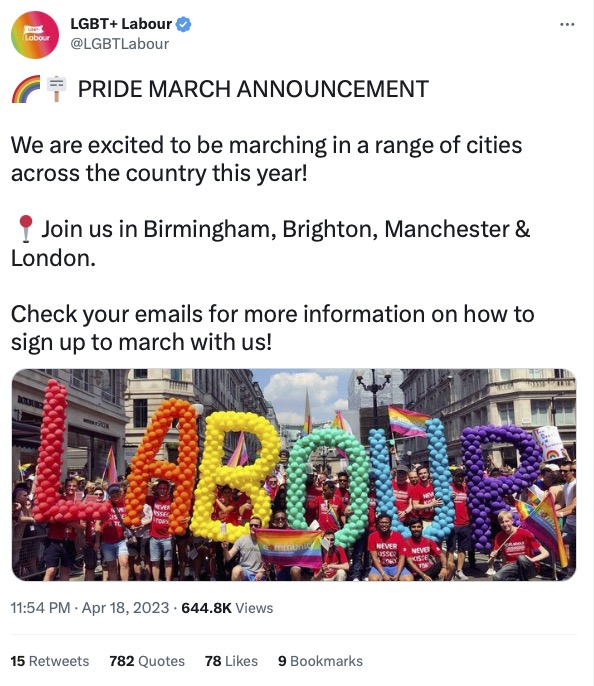
      The opposition party said it was “excited” to announce it was going to be marching in LGBT+ Prides across the UK on Twitter but blocked anyone from replying to their tweet.

      The UK’s Labour Party has said that it will be appearing on Pride marches across the UK in 2023. In a tweet sent late last night (18 April 2023 at 11.54PM) the LGBT+ section of the party, LGBTLabour, announced that it was planning to join marches in cities including, Brighton, Birmingham, Manchester and London.

      However, it closed off replies to the tweet meaning that followers were unable to air their views on the announcement. However the Tweet itself has been ratio’d, it has only recieved 74 likes (at time of publish) but over 709 Quotes.

      THEGAYUK examined the first 100 quotes and found that all were responding negatively to the announcement.

      Despite replies being turned off for the Tweet, Twitter users could reply via “Quotes” and many, many users were very unhappy about Labour joining Pride marches.

      Labour, led by Sir Keir Starmer, is facing heightened scrutiny regarding their stance on LGBTQ+ issues, particularly those relating to transgender individuals.

      In early April, Starmer received criticism for his statement regarding female sex organs, in which he stated that it is “completely biological” for 99.9% of women. Additionally, Labour faced backlash from LGBTQ+ activists for expressing support of the Equality Human Rights Commission’s proposed review of the UK’s Equality Act, which seemingly advocated for a definition of “sex” as biological, potentially impacting both cis and trans individuals negatively.

      Trans activists cautioned against such a change in definition, arguing that it could adversely affect their lives. At Easter, Starmer generated further controversy for meeting with a Manchester church leader with anti-LGBTQ+ links. This was not the first instance of such controversy, as he previously visited Jesus House in London in 2021.

      Now users on Twitter are user “Quotes” to share their distain for Labour

      https://twitter.com/raptorbaitjoe/status/1648646223463604224
      https://twitter.com/QueerThassie/status/1648646355236143104
    3. What was Section 28 in England and Wales?

      What was Section 28 in England and Wales?

      Section 28 was a controversial provision of the Local Government Act 1988 in England, Wales, and Scotland, which stated that a local authority “shall not intentionally promote homosexuality or publish material with the intention of promoting homosexuality” or “promote the teaching in any maintained school of the acceptability of homosexuality as a pretended family relationship.”

      When was section 28 enacted?

      This provision, which was introduced during the conservative government of Margaret Thatcher and remained in force during the government of John Major, was widely criticized by LGBTQ+ rights activists, educators, and progressive politicians. They argued that the provision contributed to a culture of discrimination and prejudice against LGBTQ+ individuals, and had a chilling effect on the ability of schools and other organizations to provide support and resources to lesbian, gay and bisexual individuals.

      Section 28 was eventually repealed in Scotland in 2000, and in the rest of the UK in 2003. Its repeal was seen as a significant victory for gay rights advocates, and paved the way for greater acceptance and legal recognition of the LGBTQ+ community in the UK.

      Wokandapix / Pixabay

      What was section 28 called in Scotland?

      In Scotland, the provision known as “Section 28” was officially called Section 2A of the Local Government Act 1986, which was passed by the UK government under the leadership of Prime Minister Margaret Thatcher.

      Section 2A was identical to Section 28, which was introduced in England, Wales, and Northern Ireland by the Local Government Act 1988, during the same period of time. The provisions prohibited local authorities from “promoting homosexuality” or teaching “the acceptability of homosexuality as a pretended family relationship.”

      The section 2A provision was ended in Scotland before the rest of the UK, as it was repealed in 2000, two years before it was repealed in the rest of the country. The repeal of Section 28 in Scotland was seen as a significant victory for LGBTQ+ rights advocates, and paved the way for greater acceptance and legal recognition of the LGBTQ+ community in Scotland.

      When was section 28 scrapped?

      Section 28, a controversial provision of the Local Government Act 1988 in the United Kingdom that prohibited the promotion of homosexuality in schools and local authorities, was repealed on 18th November 2003. The repeal of Section 28 was a significant moment in the history of LGBTQ+ rights in the UK, and was widely celebrated by LGBTQ+ rights advocates and progressive politicians.

      The repeal of Section 28 followed years of campaigning by LGBTQ+ rights activists, who argued that the provision contributed to a culture of discrimination and prejudice against LGBTQ+ individuals, and had a chilling effect on the ability of schools and other organizations to provide support and resources to LGBTQ+ individuals.

      The repeal of Section 28 was seen as a significant step forward for LGBTQ+ rights in the UK, and paved the way for greater acceptance and legal recognition of the LGBTQ+ community. However, it is important to note that despite the repeal of Section 28, LGBTQ+ individuals in the UK still face discrimination and prejudice in many areas of life, and there is still work to be done to ensure full equality for all members of the community.

    4. Was John Major anti-gay when he was Prime Minister?

      Was John Major anti-gay when he was Prime Minister?

      John Major, who served as the Prime Minister of the United Kingdom from 1990 to 1997, had a mixed record when it comes to LGBTQ+ rights. While he did not openly express anti-gay views, he did not actively support gay rights during his time in office.

      Section 28

      During Major’s tenure as Prime Minister, the Section 28 of the of the Local Government Act 1988 remained in power after being introduced by John Major’s predecessor Margaret Thatcher. This provision prohibited local authorities from promoting homosexuality, and had a chilling effect on the ability of schools and other organizations to provide support and resources to LGBTQ+ individuals. Major initially supported the provision, but later indicated that he regretted it.

      In addition, Major’s government maintained a number of discriminatory measures against LGBTQ+ individuals, including a ban on gays and lesbians serving in the armed forces, and a refusal to recognize same-sex relationships for the purposes of immigration.

      Regrets? He has a few…

      Embed from Getty Images

      Overall, while Major did not explicitly express anti-gay views, his record on LGBTQ+ issues during his time as Prime Minister was not supportive of the community. It is worth noting, however, that Major has expressed regret for some of the policies that remained during his time in office, and has since spoken out in support of LGBTQ+ rights.

      During John Major’s tenure as Prime Minister of the United Kingdom from 1990 to 1997, his government decided to keep several laws and policies that discriminated against LGBTQ+ individuals.

      One of the most controversial laws during Major’s time in office was Section 28 of the Local Government Act 1988, which prohibited local authorities from “promoting homosexuality” or teaching “the acceptability of homosexuality as a pretended family relationship.” This provision had a chilling effect on the ability of schools and other organizations to provide support and resources to LGBTQ+ individuals. Section 28 was eventually repealed in 2003.

      Gay Ban In the Military

      In addition, during Major’s time in office, the government continued to ban LGBTQ+ individuals from serving in the armed forces. This ban, known as the “gay ban,” was not lifted until 2000.

      During this time, the UK’s government did vote to reduce the age of consent for gay sex from 21 to 18.

      The age of consent for gay men in the UK was reduced from 21 to 18 on November 30, 1994, under the government of Prime Minister John Major. This change in the law was part of the Criminal Justice and Public Order Act 1994, which also introduced a number of other provisions related to criminal justice and public order.

      Prior to the change in the law, the age of consent for homosexual acts was higher than the age of consent for heterosexual acts, which was set at 16. This discrepancy was widely seen as discriminatory and unjust, and had been the subject of long-standing campaigns by LGBTQ+ rights activists. The reduction of the age of consent for gay men to 18 was seen as a significant victory for LGBTQ+ rights advocates, and paved the way for further changes to the legal status of LGBTQ+ individuals in the UK.

      he age of consent for homosexual acts was further equalized with that for heterosexual acts in England, Wales, and Scotland by the Sexual Offences (Amendment) Act 2000. This act lowered the age of consent for homosexual acts to 16, bringing it in line with the age of consent for heterosexual acts.

      The Sexual Offences (Amendment) Act 2000 was introduced by the Labour government of Prime Minister Tony Blair and received Royal Assent on November 30, 2000. The act also introduced a number of other important reforms related to sexual offenses, including the creation of new offenses to address sexual abuse of children, and the abolition of the offense of gross indecency between men.

      Did the UK ban gay people from working in the military?

      Yes, the UK had a ban on gay and lesbian people serving in the military until the year 2000. This policy, which was known as the “gay ban,” was introduced in 1981 under the Conservative government of Margaret Thatcher and remained in place throughout the subsequent Conservative government of John Major.

      Under this policy, openly gay and lesbian people were not allowed to serve in the armed forces, and those who were discovered to be gay or lesbian while serving could face discharge. This policy was criticized by LGBTQ+ rights advocates, who argued that it discriminated against gay and lesbian individuals and created a culture of fear and secrecy within the military.

      The ban was eventually lifted in 2000 under the Labour government of Tony Blair. This change in policy followed a ruling by the European Court of Human Rights that the ban was a violation of the European Convention on Human Rights. The lifting of the ban was seen as a significant step forward for gay rights rights in the UK, and paved the way for greater acceptance and inclusion of LGBTQ+ individuals in the armed forces.

      John Major’s government refused to recognise Gay Couples

      Embed from Getty Images

      Furthermore, the Major government refused to recognize same-sex relationships for the purposes of immigration. This meant that LGBTQ+ individuals in relationships with foreign nationals were unable to sponsor their partners to join them in the UK.

      Overall, while Major’s government did not introduce a large number of anti-gay laws, the policies and laws that were enacted had a significant impact on the lives of LGBTQ+ individuals, and contributed to a culture of discrimination and prejudice against the community.
    5. Lords have voted to ban Lord Maginnis over homophobic bullying claims

      Lords have voted to ban Lord Maginnis over homophobic bullying claims

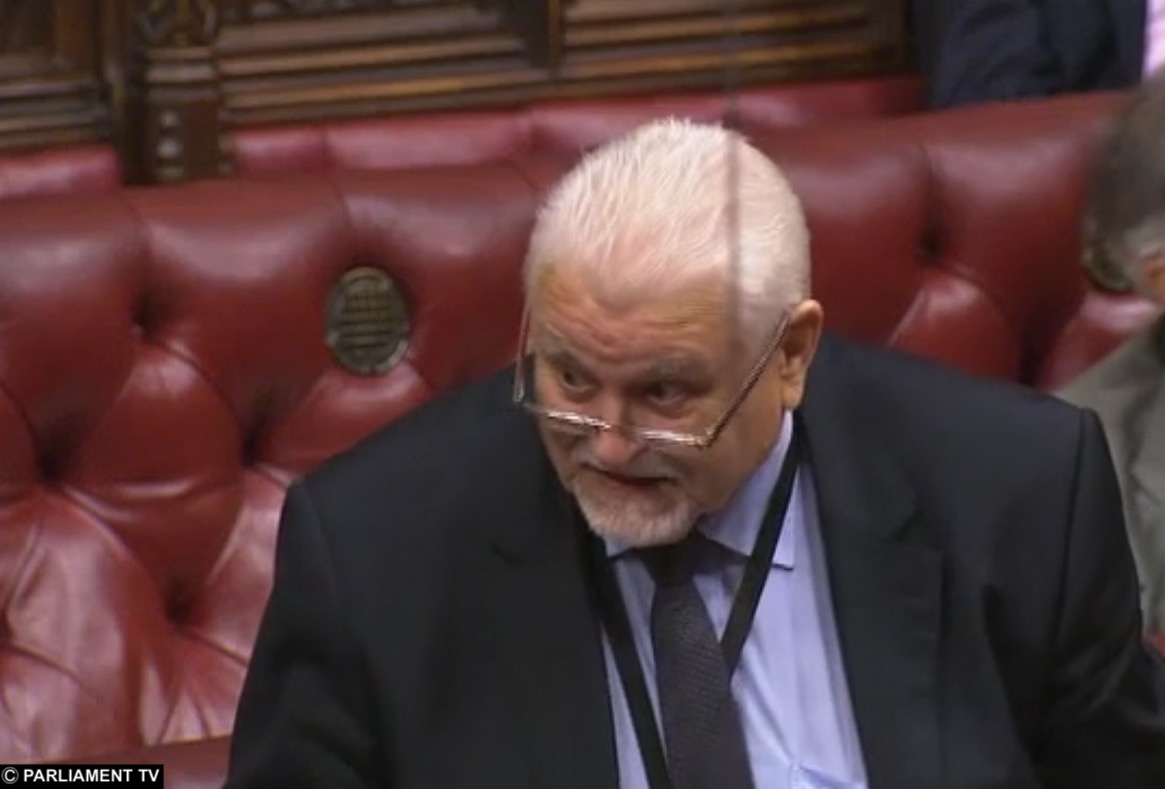
      Lord Maginnis, an independent Ulster Unionist Peer, was found to have broken conduct rules by using homophobic language according to an investigation by the Lords Conduct Committee. The punishment is an 18-month suspension from The Lords, although that suspension could be increased if he fails to undertake a designated course of bespoke behaviour change training and coaching.

      The Lords Conduct Committee, which made the investigation advised Lord Maginnis that he would need to take “behaviour training” or face an even longer suspension. Maginnis has refused to embark on the training, meaning that his suspension could run longer than a year and a half.

      Maginnis has denied bullying and called the Lords Conduct Committee’s report “ridiculous” when it was published last week.

      What did the investigation into Lord Maginnis find?

      Embed from Getty Images

      An inquiry into the Lord’s behaviour found that there were a series of complaints brought against Maginnis in early 2020.

      First, there was a report from a parliamentary security officer, Christian Bombolo, who reported that the Maginnis was “verbally abusive” after he was requested to show his pass to enter the Palace of Westminster on 7 January.

      Scottish National Party MP Hannah Bardell intervened and says that she was treated “rudely and aggressively”.

      On 11 February, Lord Maginnis apparently became “agitated” during a meeting of the All-Party Parliamentary Group for the Armed Forces when not called upon to ask a question. He apparently addressed “rude remarks” to the meeting’s chair, Labour MP Luke Pollard.

      The 82-year-old Lord then complained about Mr Pollard via email sent to a number of parliamentarians – including the APPG chair, Conservative MP James Gray. The email apparently contained a “homophobic subject line” allegedly, “Discrimination by Homos” and contained “remarks about Mr Pollard which centred on his sexual orientation and were homophobic”.

      Lord Maginnis later discussed the incident with the media, using “disrespectful and derogatory” language about Mr Bombolo and “homophobic and derogatory” language about Ms Bardell.

      Labour MP Toby Perkins asked Lord Maginnis what had happened, and claimed that the peer answered by being “homophobic, aggressive and disrespectful, including by making further homophobic remarks” about Mr Pollard and Ms Bardell, the inquiry found.

      A few weeks later on 4 March, Lord Maginnis was embroiled in a “heated discussion” with Mr Gray at an APPG breakfast meeting after he was told he couldn’t attend due to his behaviour towards Mr Pollard.

      Who is Lord Maginnis?

      Lord Maginnis, was the Ulster Unionist MP for Fermanagh and South Tyrone between 1983 and 2001. He had previously served in the Ulster Defence Regiment. He became a life peer in 2001.

    6. Lord who likened gay marriage to bestiality faces 18-month suspension for homophobic bullying

      Lord who likened gay marriage to bestiality faces 18-month suspension for homophobic bullying

      Lord Maginnis who is an Independent Ulster Unionist, is facing suspension from the Lords after an inquiry found that he had bullied three MPs and one security guard, using anti-gay language.

      The Lords Conducts Committee has recommended an 18-month suspension, which is one of the longest ever handed down and will come into effect if it is voted for by Lords on the 7th December.

      An inquiry into the Lord’s behaviour found that there were a series of complaints brought against Lord Maginnis in early 2020.

      First, there was a report from a parliamentary security officer, Christian Bombolo, who reported that the Maginnis was “verbally abusive” after he was requested to show his pass to enter the Palace of Westminster on 7 January.

      Scottish National Party MP Hannah Bardell intervened and says that she was treated “rudely and aggressively”.

      Embed from Getty Images

      On 11 February, Lord Maginnis apparently became “agitated” during a meeting of the All-Party Parliamentary Group for the Armed Forces when not called upon to ask a question. He apparently addressed “rude remarks” to the meeting’s chair, Labour MP Luke Pollard.

      The 82-year-old Lord then complained about Mr Pollard via email sent to a number of parliamentarians – including the APPG chair, Conservative MP James Gray. The email apparently contained a “homophobic subject line” allegedly, “Discrimination by Homos” and contained “remarks about Mr Pollard which centred on his sexual orientation and were homophobic”.

      Lord Maginnis later discussed the incident with the media, using “disrespectful and derogatory” language about Mr Bombolo and “homophobic and derogatory” language about Ms Bardell.

      Labour MP Toby Perkins asked Lord Maginnis what had happened, and claimed that the peer answered by being “homophobic, aggressive and disrespectful, including by making further homophobic remarks” about Mr Pollard and Ms Bardell, the inquiry found.

      A few weeks later on 4 March, Lord Maginnis was embroiled in a “heated discussion” with Mr Gray at an APPG breakfast meeting after he was told he couldn’t attend due to his behaviour towards Mr Pollard.

      In a normal workplace Lord Maginnis would be “shown the door”

      Speaking about the potential 18-month ban, Ms Bardell said,

      “I appreciate that an 18-month ban is a serious sanction and that Lord Maginnis’s return to the House of Lords will be dependent upon him undertaking ‘a designated course of bespoke behaviour change training and coaching’,” said the Livingston MP.

      “However I consider it likely that if this had happened in any normal workplace in the UK and someone behaved in such a systematically abusive, bullying and homophobic way, which the report clearly states he has, they would be shown the door.”

      The report said that the recommended suspension of 18-months, the longest ever dished out, should not finish until Maginnis has completed behaviour change training showing that he is “able to demonstrate a clear understanding of how his behaviour impacts on other people in the parliamentary community”. 

      Lord Maginnis has a history of unacceptable behaviour and comments towards LGBT+ people

      In June 2012 the Ulster Unionist Party whip was withdrawn from Lord Maginnis by party leader Mike Nesbit over his anti-gay remarks, where Lord Maginnis likened gay marriage to bestiality on Northern Ireland’s Stephen Nolan Show. Lord Maginnis said that gay marriage was, ‘a rung on the ladder’ to ‘other deviant practices’ and ‘Will the next thing be that we legislate for some sort of bestiality?’

      In 2012, Lord Maginnis was nominated by Stonewall for the Bigot Of The Year award and when approached by THEGAYUK for a comment he called the outlet an, “aggressive, perverse and corrupting influence on susceptible and vulnerable young people”.

    7. UK gov vows to make changing your gender “kinder” and more straight forward

      UK gov vows to make changing your gender “kinder” and more straight forward

      According to the Government, transgender people in the UK, who want to legally change their legal sex are about to find the process “kinder” and more straight forward. The government says it has changed elements of the GRA (Gender Recognition Act), that trans people themselves had raised as concerns about.

      The consultation was answered by 108,000 people, 7000 of whom identify a transgender. Of those who had completed their transition, around 2 in 5 said that they had a Gender Recognition Certificate, a higher proportion than is often believed. The survey then asked those who had not applied what had prevented them from doing so. They were able to choose as many reasons as they wanted.  

      Thirty-eight per cent of respondents said the process was “too bureaucratic” so the process will now be put online. Thirty-Four percentage that the process was too expensive and to address this the government will decrease the cost of obtaining a certificate from £140 to just what it called a “nominal amount”.

      Three new gender clinics

      The government have also stated that they will open three more gender clinics, a process that will apparently cut the waiting list by around 1600 people.

      “The full benefit of the increases in clinical capacity that we’ve been able to secure will lead to greater patient choice, shorter waiting times, better geographical coverage and easier access.  It will also make it easier to fulfil the medical requirements of obtaining a GRC”.

      According to the Minister for Women and Equalities Liz Truss MP, the UK Government said,

      “Britain leads the world as a country where everybody is able to lead their life freely and treated with respect and that, for many years, transgender people have been widely accepted in British society; able to use facilities of their chosen gender; and able to participate fully in modern life.    

      “At the heart of this is the principle of individual liberty. Our philosophy is that a person’s character, your ideas, and your work ethic trumps the colour of your skin or your biological sex. We firmly believe that neither biology nor gender is destiny

      “The Equality Act 2010 clearly protects transgender people from discrimination. The same act allows service providers to restrict access to single sex spaces on the basis of biological sex if there is a clear justification”.

      “Missed opportunities”

      A spokesperson for Amnesty International said that it was disappointed that the government had not taken the steps to demedicalise the process of changing your legal sex.

      Amnesty International UK, Liberty and Human Rights Watch released a co-statement, saying,

      “It’s hugely disappointing that the Government has missed this vital opportunity to update the process for legal gender recognition so it meets human rights standards.

      “Research has found that medical barriers to gender recognition for trans people are unnecessarily intrusive and can harm their physical and mental health. With medical requirements still in place, trans people will continue to be forced through harmful processes to have their gender legally recognised.  

      “After a three-year wait, we’re presented with a few administrative changes, which, whilst a step in the right direction, only scratch the surface of what we need to ensure all trans and non-binary people can live equally, freely and fully.”

    8. Matt Hancock won’t condemn homophobia because Tony Abbott is a trade expert

      Matt Hancock won’t condemn homophobia because Tony Abbott is a trade expert

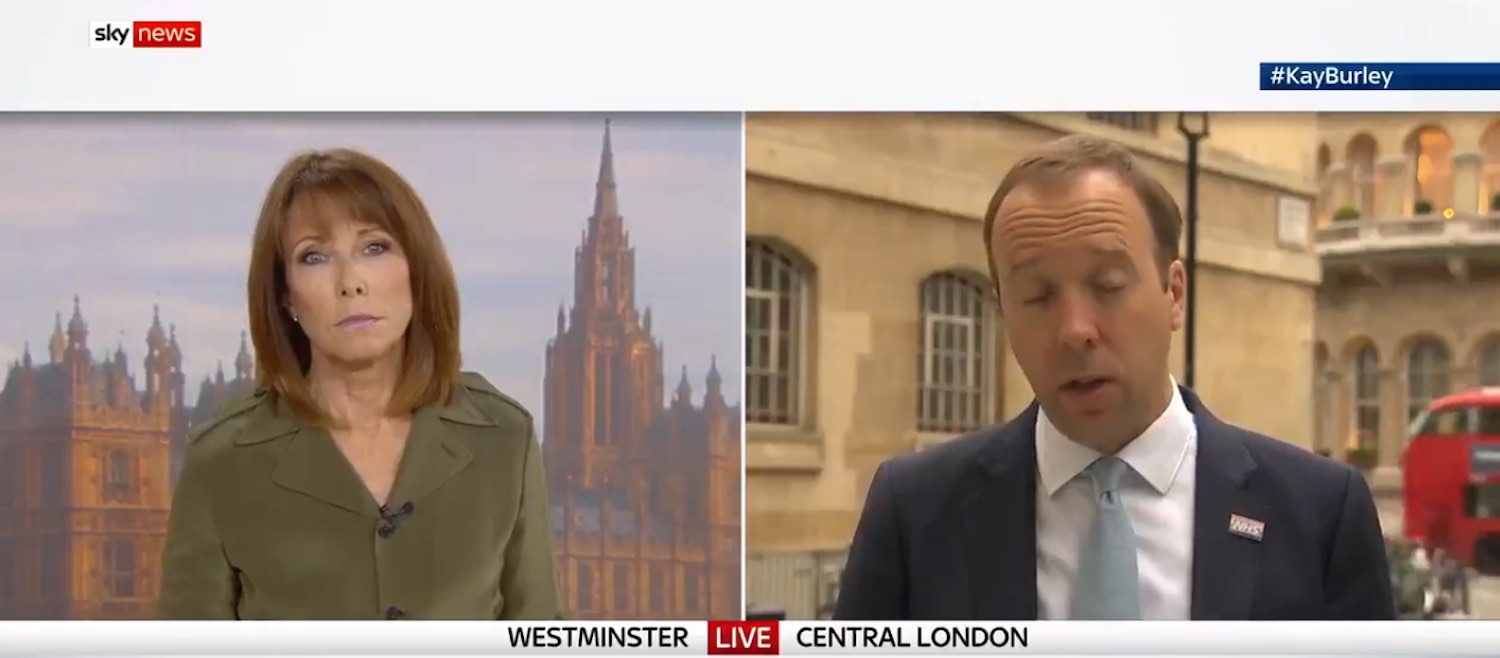
      In an awkward exchange with Sky‘s Kay Burley, Health Secretary Matt Hancock seemingly excused homophobic and misogynistic comments by the former Australian PM, Tony Abbott, because he is an “expert on trade”.

      The former PM is reportedly being eyed up to be the joint president of the UK’s Board of Trade as the UK prepares its trade deals upon leaving the EU.

      Previously Abbott opposed gay marriage before it became legal in Australia and said that he feels a “bit threatened by homosexuality”.

      “I don’t believe that’s true”

      Hancock firstly argued that he didn’t believe Tony Abbott to be a homophobe or a misogynist, saying, “I don’t believe that’s true, I haven’t seen any of his (comments)”

      When Burley replied, “I just told you what he said, I’m sure you don’t support some of his comments, he’s a homophobe and a misogynist”, Hancock’s response was. “He’s also an expert on trade”.

      Pressing the point, Burley went on to ask, “So one plays off each other? Really? Is that what you’re really saying, Health Secretary? Come on!”

      Hancock responded, “No, what I’m saying is that we need experts in different areas and the former Prime Minister of Australia is obviously an enormous expert in the area of trade. it doesn’t change my views.

      So forgive because he’s good at trade?

      Embed from Getty Images

      Burley continued, “So we can forgive his comments about women and about letting the elderly die of Covid-19 and his views on the gay community, even though his sister is gay. We can forgive all of that because he’s good at trade?”

      Hancock didn’t answer the question and went back to form, by saying, “I’m doing everything in my power to prevent a second wave and protect people from coronavirus

      At which Burley butted in and remonstrated the Health Secretary, by pointing out “That was not my question”, she asked, “Is he a fit and proper person to represent us?”

      “Mr Abbott is very good and very experienced in trade”, responded Hancock, “It is clearly a very important decision that the Prime Minister (Boris Johnson) and the Trade Secretary are across, because we do want experts… and have huge experience”

    9. The EU’s most anti-LGBT+ leader has been reelected in Poland

      The EU’s most anti-LGBT+ leader has been reelected in Poland

      In a blow to LGBT+ rights activists in Poland, Andrzej Duda from the far-right wing Law and Justice Party has won the presidential election. However, he only won the election with a tiny majority, with only 51.2 per cent of the votes.

      Duda ran an electoral campaign which heavily vilified the LGBT+ community, calling it a “destructive” force.

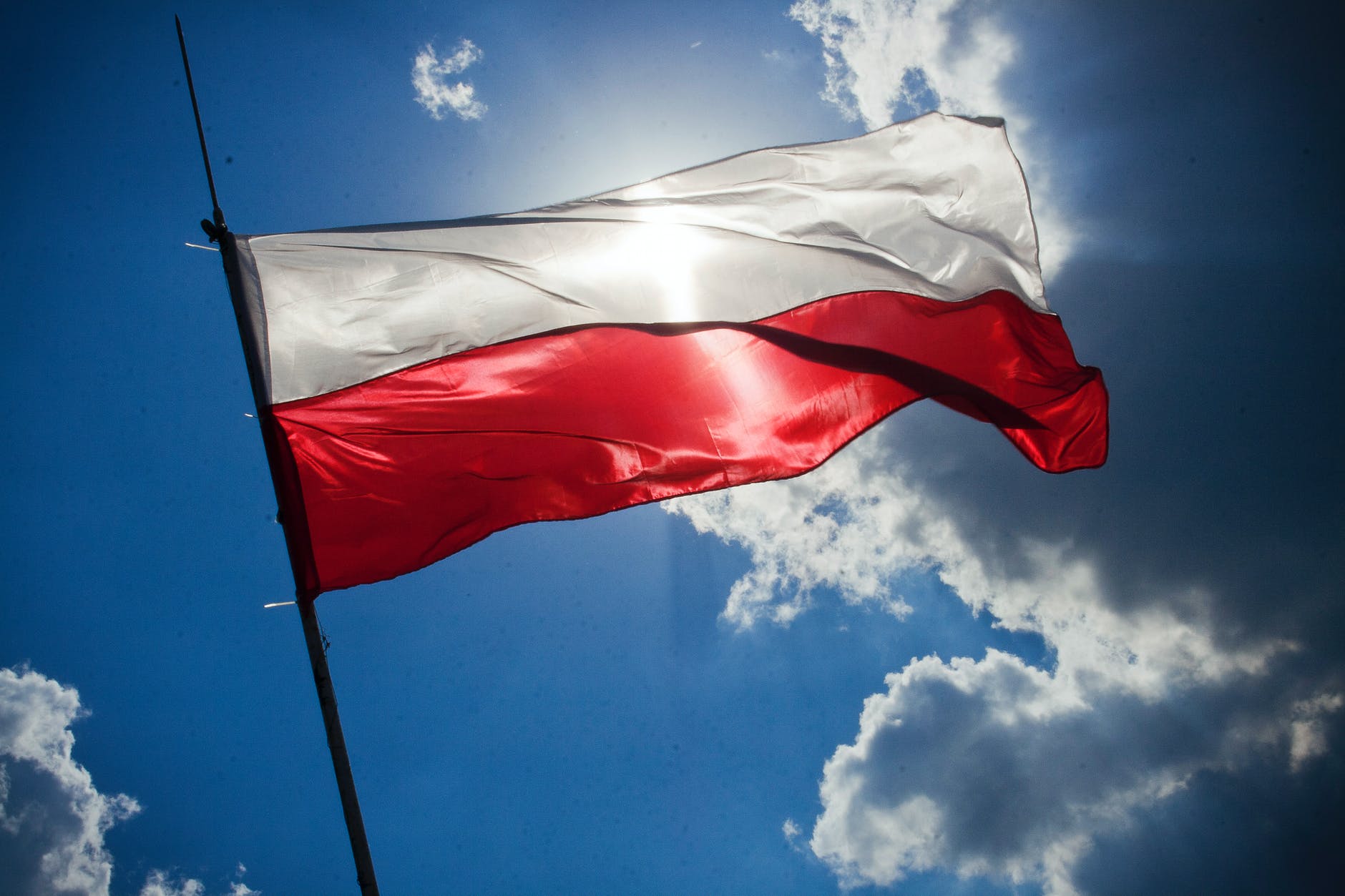
      flag of poland
      Photo by Kaboompics .com on Pexels.com

      The tiny majority is the tightest win Poland has ever had. Rafal Trzaskowski, the current major of Warsaw, who runs on a liberal platform narrowly lost with 48.8 per cent of the vote.

      During Duda’s campaign, he signed one of the most anti-LGBT charters in the EU against what he calls the “LGBT Ideology”, which he said was “more destructive than communist indoctrination”.

      Embed from Getty Images

      The charter defends the “institution of marriage” which means that there is no acceptance of gay marriage.

      He’ll also refuses to accept allowing gay couples to adopt children.

      Poland has the worst LGBT+ rights for any EU country

      Poland’s lags way behind its fellow EU countries when it comes to LGBT+ rights according to Rainbow-Europe.org. It has just a 15.8 per cent approval rating, compared to Malta which sits at the top with nearly 90 per cent approval. Neighbouring countries to Poland, Lituania, Belarus, Slovakia and the Czech Republic all fall well below 50 per cent on the scale.

    10. House of Commons faces huge backlash after asking whether “Gay Cure” should be made illegal

      House of Commons faces huge backlash after asking whether “Gay Cure” should be made illegal

      The House of Common’s official Twitter account has been blasted by users after asking if conversion therapy or “gay cures” as it is more commonly known should be made illegal in the UK, despite the government already admitting that the practice was “wrong”.

      As it stands gay cure therapy or conversion therapy is still legal in the UK, it has been debated and defeated in the Commons numerous times, in 2015 and then again in 2017.

      Back in 2018 the Conservative UK government, under Theresa May, said that conversion therapy was something it would address in its “LGBT Action Plan”.

      (C) BIGSTOCK

      However, two years on, not much progress has been made on any of the points made in the plan. Now a recent Tweet by the official House of Commons Twitter account has been slammed for asking a question that many have said is not open to debate.

      The tweet was heavily ratio’d after asking users “How does #conversiontherapy affect the #LGBTQ community? Should it be made illegal? What would that mean to you? @HoCpetitions is investigating a petition calling for the practice to be made illegal”

      https://twitter.com/HouseofCommons/status/1279000022189817857

      The response was swift with condemnation of the way in which the question had been posed with many people taking issue that was necessary of debate.

      Conversion therapy is seen by many doctors has deeply ineffective and LGBT+ advocates say that therapy of this nature is entirely problematic.

      Alison Camps, the co-chair of Pride in London replied to the Tweet,

      “Is this some kind of joke? The Government pledged to do this two years ago. It’s inhuman that you continue to make us BEG for something that is so obviously barbaric.”

      https://twitter.com/AliCamps/status/1279043812850106369

      MP Alicia Kearns MP for Rutland and Melton also replied to the Tweet adding,

      “Of course it should be made illegal, it’s abusive and fraudulent. The Government has committed to ban it already, and legislative options will be put up for consultation to determine the best legislation to protect the LGBTQ+ community.”

      “Our intention was to provide a platform for people to share their opinions”

      A House of Commons’ spokesperson said,

      “A Petition calling on the Government to make LGBT conversion therapy illegal in the UK has reached almost 200,000 signatures. In its response to the Petition, the Government did not make a specific commitment to making conversion therapy illegal. Given the strength of interest in this issue, the Petitions Committee decided to further the conversation by gathering evidence from the public on the subject.

      “The questions posed on the House of Commons social media feeds were intended to encourage people to submit their experiences. This information will then be presented to the Government. A petition with over 100,000 signatures would usually be considered for a Westminster Hall debate, however, given restrictions placed on Parliament as a result of COVID 19, Westminster Hall debates are currently suspended.


      “We apologise. Our intention was to provide a platform for people to share their opinions on this subject with the Petitions Committee, and inform its case to the Government. Clearly we misjudged this and have now deleted the tweet.”

      Why is homosexual still seen as something that can be cured?

      Homosexuality was declassified as a mental illness in 1973, however, it is still possible to obtain treatment via the NHS, by referral,  to “cure” you of your homosexuality. As it stands the psychotherapy industry in the UK is not regulated by the state – and therefore some therapists still offer “gay cures”.

      In October 2019 it was revealed that 10 per cent of the UK’s population could be cured.

      This is coupled with the horrifying revelation that around 20 per cent of people (one in five) said that being LGBT+ was immoral or went against their beliefs.

      Does conversion therapy actually work?

      There are a number of therapists and organisations in the UK and in the USA that make the claim that conversion therapy can help LGB people to become heterosexual. However, according to the Royal College of Psychiatrists, there is no evidence that such change is possible.