Tag: Two Star Play Review

The latest Two Star Play Review from THEGAYUK.

  • THEATRE REVIEW | Stories To Tell In The Middle Of The Night, Birmingham Rep

    Stories To Tell In The Middle Of The Night written and performed by Francesca Millican-Slater was not what I expected. ★★

    © Graeme Braidwood

    Its premise explores the many thoughts that people have before trying to fall sleep, and then still not being able to do so hours later. It’s a great concept for many of us can relate to the drivel that goes through our minds prohibiting our brain to switch off and go to sleep. However, Francesca’s stories were too disconnected for the average person to relate to. The odd story resonated some recollection in the back of our memory archive – like the supermarket couple scenario, but the rest were just tales that didn’t quite grip spectators, having to wait a while for a punchline. It would be a great sketch for a Spoken Word night, but as performance it lacked spark. We were merely watching a woman talk about things that go on in her own head. Sadly, they were things that not many people could connect to, alienating us in parts. It was neither comedic, nor was it dramatic. Stories To Tell In The Middle Of The Night would have been something to play on the radio to help you fall asleep.

    There were some poetic notes to the writing. So, audibly, and in some instances, it was pleasing; particularly when Francesca came back to the middle podium and described where we were in the night using astronomical angles and nautical references to help us imagine the arrival of the dawn, and the familiar feeling of ‘oh shit, I need to be up in a few hours’.

    The Rep Foundry is a fantastic programme that gives new writers the opportunity to create, and later perform, their own work. Perhaps the next draft would benefit from a framing device whereby the three podia that the protagonist utilises may represent the id, ego, and superego of the insomniac psyche portrayed. As it stands, the stream of consciousness text is lost in the back waters.


  • THEATRE REVIEW | Dirty Great Love Story, The Arts Theatre

    ★★ | Dirty Great Love Story, The Arts Theatre

    CREDIT: Richard Davenport

    I’m a bit unconventional in my views when it comes to romance. I strongly believe that sex before the first date is a sensible action (who wants to sit through a tedious meal with a fake smile plastered on your face when you can cut to the chase?) but I also have a secret love of ‘will they won’t they’ romantic comedies.

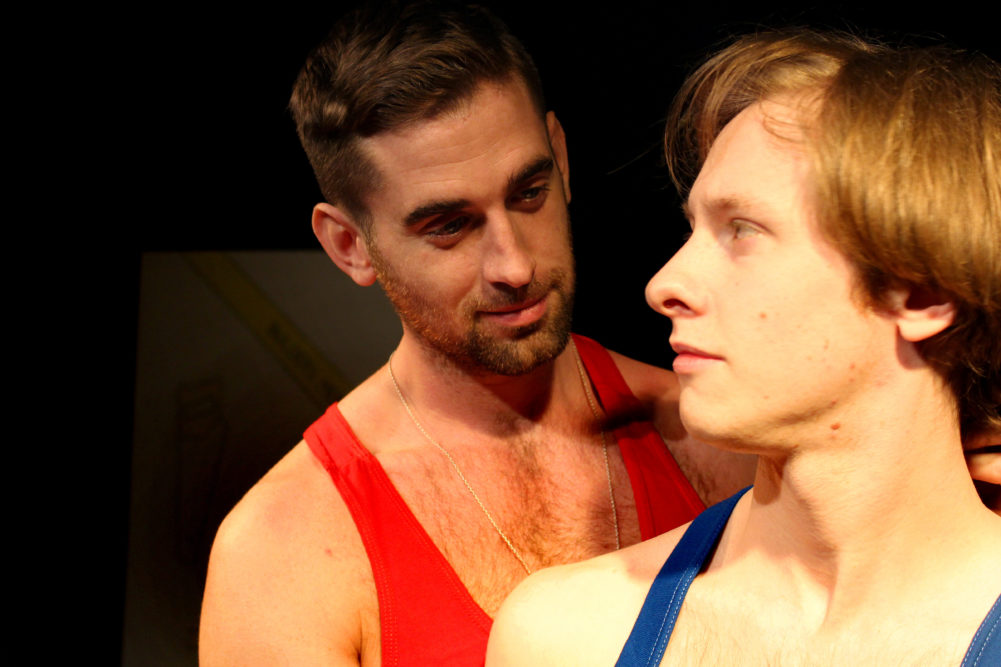
    Slam poetry champion Richard Marsh and writer/performer Katie Bonna originally conceived Dirty Great Love Story as a short pub performance piece.

    It evolved into a longer two-hander play and was well received at the Edinburgh Fringe in 2012 where the writers also performed the piece. Outlining a meeting between gauche and shy Richard and recently heartbroken Katie on a stag and hen do, followed by a one night stand in a Travelodge, the play then goes on to tantalise with an almost/on and off romance, that burgeons in spite of obstacles.

    It’s classic rom-com but recited partly in verse.

    In this new incarnation at The Arts Theatre, the pair is played by actors with accomplished performances from Ayesha Antoine and Felix Scott. This is where the problem seems to lie, though. Maybe performance poetry works better coming from the mouth of the poet and in this case, fails to translate over easily despite the actors’ efforts.

    In spite of their skill as performers, the verse feels stilted coming from their mouths and sits oddly with a touch of the painfully twee about it in parts. Yes, they’re sometimes talking about the dirty bits of this relationship, but in a Richard Curtis style romantic comedy format with poetry that sounds like Pam Ayres on a 1980s edition of That’s Life.

    It splutters dimly more that it illuminates and feels tired and dated. Not so great and a tiny bit dirty but a love story nonetheless, there are flashes of brilliance but they feel few and far between.

    When the funny moments hit they’re worth waiting for, there’s a clever set by Pia Furtado with bits that drop down and pop up to illustrate various scenes but overall it all falls a bit flat.


    Dirty Great Love Story plays at The Arts Theatre until 16th March 2017

  • THEATRE REVIEW |  Beauty On The Piste

    THEATRE REVIEW | Beauty On The Piste

    ✭✭ | Beauty on the Piste

    Beauty on the piste
    CREDIT: Above The Stag

    It’s Panto season in case you’ve been hiding under a rock, and with that comes shows that are silly and campy, some good and more than a few not so good. But does it really matter?

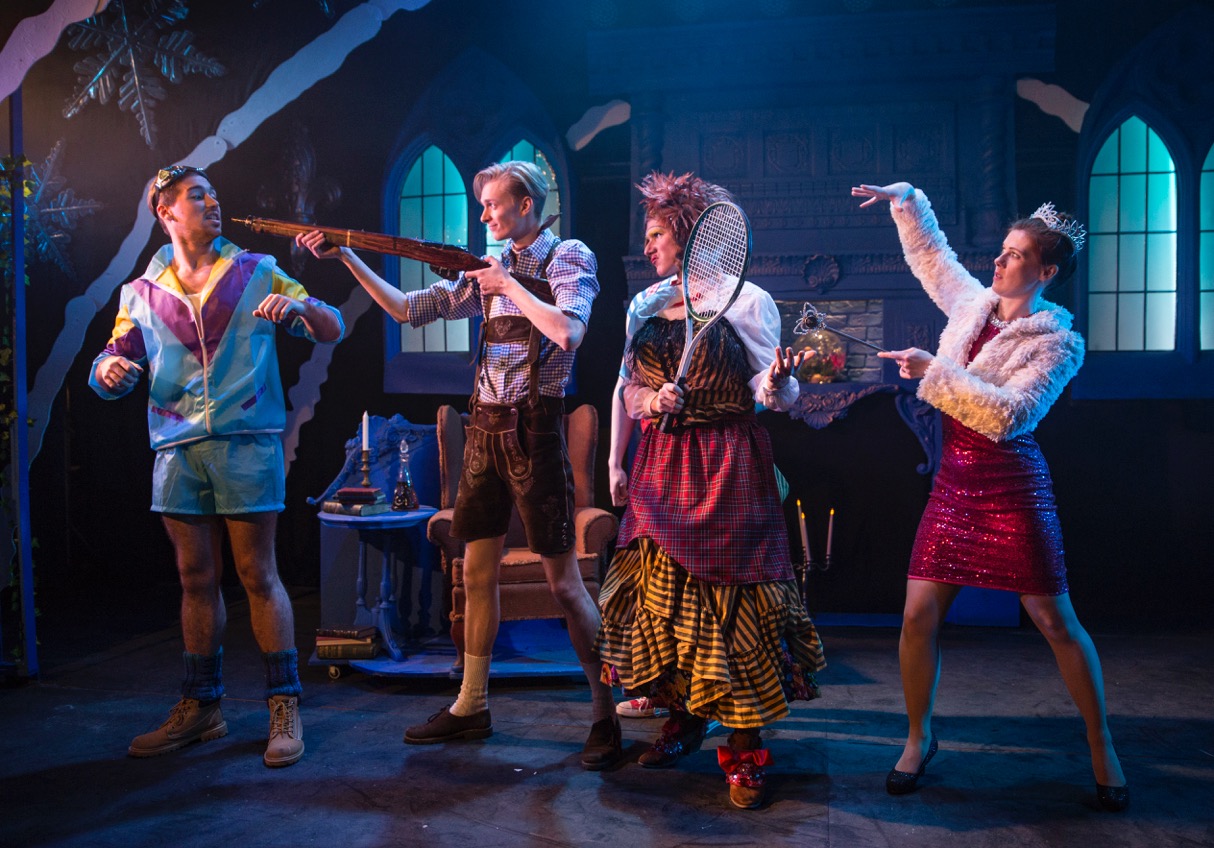
    This year’s panto at Above the Stag is Beauty on the Piste, a reimagining of Disney’s Beauty and the Beast, and it’s exactly what you would expect, but perhaps a bit less.

    This is the plot, in a nutshell: Morag (David Moss) and her son Mac (an adorable Ross Tucker) own a tea house high up in the mountains in a town called Les De Nice (Les Dennis – cue laugh here).

    Passing by the tea house is the young lithe and blond boy Beau (Joshua Oakes-Rogers) and his father Gustav (Andrew Truluck). Beau is eternally horny and always on Grindr (we’re getting tired of Grindr being in almost every gay play nowadays). But nearby is where The Beast (Jamie Coles) lives, behind huge gates in an old mansion, and he’s hardly ever seen.

    One night Morag and Gustav decide to take a walk to get to know each other better, but they are kidnapped by The Beast, and it’s up to Morag and Beau to go looking for them. They find them in The Beast’s home, and Beau trades places with his father to let him free, and it’s only a matter of time before sparks fly between Beau and The Beast. But trouble lies on the horizon; the gay Sebastian St. Moritz (Simon Burr), who owns lots of the property in Les De Nice, wants to raise the rent of the tea house, so what’s the newly rescued Morag and her son going to do? Throw in Mabel the Fairy (a cute Briony Rawie), and The Beasts housekeeper – Heidi (Ellen Butler) – who keeps morphing into various items one finds in the house- and what you’ve got is a show, with a sing-a-long, that’s full of glitter and glee.

    Does it matter that the songs are awful? No!

    Does it matter that this production is not one of the Stag’s better shows? No!

    And does it matter that most (if not all) of the cast can’t sing? Of course not!

    Why?

    Because you’re not going to see Beauty on the Piste because it is sold out for the rest of it’s run! So perhaps console (or congratulate) yourself and buy a ticket to their next production – Bitches Ahoy – a show that bills itself as a “gay holiday hilarity” – hopefully it’s a return to the Stag’s better quality shows. Just one month to go until Panto season ends, whew!

    Just one month to go until Panto season ends, whew!

    Beauty On the Piste plays at Above The Stag until 14th January 2017

  • THEATRE REVIEW | The Shawshank Redemption – Sheffield Theatres and National Tour

    ★★| Andy Dufresne, a quiet and mild mannered banker, arrives at Shawshank Prison after being convicted for the murder of his wife and her lover. As he settles into his new life, he befriends old timer, Red, the prisoner fixer and a man who is known to “acquire certain items from time to time”.  Andy splits his time between maintaining his innocence, carving rocks, avoiding the violent “sisters” (a predatory gang of sexually violent inmates) and trying to improve the lives of those around him.  But when Andy overhears a conversation between two of the guards, he is provided with opportunity which he simply cannot pass up.

    Picture Credit – Mark Yeoman


    The Shawshank Redemption is based on the Stephen King novella, and the 1994 film of the same name. The film has gone on to become one of the nation’s favourites, and with this in mind, the stage show has some big prison-issue boots to fill. The static set is reflective of the prison setting, with its tall, oppressive walls towering over the proceedings; and it’s bland, dreary appearance is being quite befitting for the fictional prison.  In the book and the film, the story of Dufresne’s time in Shawshank is one which is filled with optimism and hope; and it is the contrast of that emotional warmth juxtaposed with the cold starkness of the confines of the prison walls which works so well.

    Paul Nicholls (Eastenders) leads the cast as Andy Dufresne, with TV stalwart Ben Onwukwe (Eastenders, London’s Burning, Coronation Street) playing Red, both of whom gave functional performances without ever really capturing the refinement of the two lead characters or their relationship. The remainder of the cast, sadly, seemed to replace acting with shouting, leading to some rather unsubtle performances; with only Jack Ellis in his portrayal of the Warden and Nicolas Banks as Tommy ever really finding their feet.

    Adapted by Owen O’Neill and Dave Johns, the script is choppy and never seems to gather momentum or develop into having any natural flow, with somewhat clunky transitions from one plot development to the next. Rather than allowing the drama to play out on stage, comedic moments are added to scenes of tension, which had the audience laughing when they should have been on the edge of their seats, lessoning the impact of the story and the events portrayed. Whilst the story does not shy away from the harsh reality of prison life, David Esbjornson’s direction is as bland as the prison walls and as heavy handed as the prison guards themselves, often leaving much to the imagination and hinting at the acts of violence rather than portraying them.

    The show is a bold attempt to bring to life something which is so well loved, but as much as it pains me to say it, the writing, acting and direction all had their own issues which meant that they never really came together; and whilst some of the audience clearly enjoyed the show, for me personally, it simply didn’t work.

    The Shawshank Redemption is currently winding up its national tour. The show was reviewed at Sheffield Theatres (www.sheffieldtheatres.co.uk ), who are soon hosting the world premiere of a new musical based on the BBC3 show “Jamie: Drag Queen at 16” Search #TalkingAboutJamie.

  • THEATRE REVIEW | Breakfast At Tiffany’s – Sheffield Theatres and National Tour

    ★★ | Based on the classic novel by Truman Capote; which was famously immortalised on the big screen by the 1961 film, Breakfast at Tiffany’s tells the story of an unnamed writer’s obsession with his faux-socialite neighbour, Holly Golightly, as she optimistically flirts, romances and blags her way through life via a series of romantic interludes with a number of well to do men.

    Photo Credit – Sean Ebsworth Barnes

    Based more on the book than on the film, this adaptation by Richard Greenberg has its moments. Firstly, the script, whilst wordy, carries with it an essence of Capote’s work, with rhythmically delivered passages of lengthy text which maintain the feeling of a novella rather than a play. Returning the time frame to the original 1940’s setting, the costumes were both glamorous, and, in the case of Holly Golightly, numerous. The set design was beautifully done, sturdily constructed, versatile and filled with period detail; and the lighting design by Ben Cracknell effectively transported the audience between New York downpours and hazy summer days.

    Matt Barber (Downton Abbey) delivers his role as Fred with enthusiasm and an element of innocence as his character falls for his neighbour’s charms; despite the hint of Fred’s closeted homosexuality running through the piece. Georgia May Foote (Coronation Street) is functional and steady as Holly Golightly. Stepping into such an iconic role was always going to be a tough call for any actress and Foote holds her own, never really excelling, but never falling flat either, although she doesn’t quite pull off the charisma and allure of the character entirely.

    The difficulty with this production is that is it, sadly, just plain dull. Golightly comes across as a self-absorbed, egocentric and, quite frankly, dislikeable character, which makes you wonder just why anyone would become so infatuated with someone so narcissistic. The play is heavy, slow going and overlong, which lacks any of the whimsical lightness and charm of the film version; and whilst the play is more reliant on the novella than the film, comparisons are unavoidable. The pacing and momentum of the piece is patchy; it is clumsy at times, there are a number of unnecessarily loud and messy scenes filled with a variety of unlikeable characters; and the audience warmed more to the scene stealing cat, Bob, than most of the actors on stage.

    For those enamoured with the book, this is a relatively good adaptation, and they will not doubt find much to enjoy within this production, which is a grittier and darker adaptation in keeping with Capote’s writing. For those who are smitten with the film, and despite the publicity shots for the play which are tantalisingly reminiscent of the iconic imagery associated with the movie, there is likely to be some disappointment.

    Breakfast at Tiffany’s is on national tour (see www.breakfastattiffanys.co.uk/ for details) and is currently playing at Sheffield Lyceum Theatre (www.sheffieldtheatres.co.uk) until 22nd October 2016.


  • THEATRE REVIEW | Confessional

    THEATRE REVIEW | Confessional

    ★★ | Confessional

    CREDIT: Simon_Annand
    CREDIT: Simon_Annand

    If a play is ‘rarely performed’ or ‘an undiscovered gem’ then be wary. There’s often a good reason for that: it’s usually because it’s not a very good play. “Confessional” was an early draft of Tennessee Williams’ later 1972 play “Small Craft Warnings” and is a sprawling elegiac piece laden with dramatic speeches. It concerns a group of low life characters in a bar in a grotty seaside town. Its main point of interest is for scholars and connoisseurs of his work in that this is the first of Williams’ plays where he felt able to include openly gay characters.

    The bar is populated by the usual suspects that mark Williams’ later works: a drunken and angry woman, a swaggering stud who has a name for his penis, an alcoholic doctor and a washed up older gay man with a boy who’s he picked up at the roadside. They rant, cry, shout and ramble. It’s beautiful in parts and there are poetic moments but on the whole it feels a bit of a mess.

    Director Jack Silver has transposed the action from 1950s American to a pub in Southend in the present day with mixed results. The theatre has been transformed into a pub with the audience dotted around at tables and on banquettes with the actors roaming amongst them. Justin Williams’ set is pitch perfect. This is a pub that you’d probably walk in and walk out of again in a hurry. Sticky looking tables, beer and a burger offers and a sense of dilapidation: it’s a pub we’ve probably all been in and wished we hadn’t. The characters fit in well and you can imagine a pub like this being stalked by enraged beautician Leona yelling at her good for nothing going to seed Chav man Bill and her promiscuous weeping friend Violet.

    Where the concept flounders is the language. Characters talk in a style befitting of 1950s Southern California and use old-fashioned America language that doesn’t translate well to the present day. The Jukebox has mournful violin music that Leona plays on repeat. There’s something distinctly dated about their attitudes and stances too/ It often feels jarring and stylistically wrong.

    The play is still worth seeing for three reasons: the concept, the set and the acting. The cast are universally strong and there’s something magnetic about Lizzie Stanton and Gavin Brocker (and I don’t just mean his too tight clothing or references to his cock which he has named ‘Junior’). The set is a witty and authentic interpretation. The third factor is the concept of the actors having free range. There’s a script and a set and actors. The rest is the actors’ choice on the night. They stand where they want, cry or don’t cry and choose just how dark or how funny the play is on any given night. Surprisingly, this works and there’s a strong chemistry that comes across with a naturalistic feel to the piece in spite of the incongruous language. That’s quite a feat given such lacklustre raw material.


    Confessional plays at the Southwark Playhouse until the 29th October

  • THEATRE REVIEW | Britten in Brooklyn, Wilton’s Music Hall, London

    THEATRE REVIEW | Britten in Brooklyn, Wilton’s Music Hall, London

    ★★ | Britten in Brooklyn

    CREDIT: Darren Bell
    CREDIT: Darren Bell


    During the early years of World War Two, Benjamin Britten lived in exile in a townhouse in New York with his friend, the poet W.H. Auden and a shifting cast of artists and writers. The composer was criticised by the British press for his ‘avoidance’ of the war and faced a tribunal for conscientious objection on his return in 1942. Whereas Auden embraced his sexuality and was having an affair with a younger man, Britten was still struggling somewhat with his in the oppressive environment of 1940s England. Add to this mix some of the other residents: bisexual writer Carson McCullers hiding out from her husband, hitting the bottle and chasing after women and burlesque stripper Gypsy Rose Lee, trying to write a crime thriller. The potential for a fascinating story is all there on a plate. Sadly, writer Zoe Lewis and director Oli Rose have somehow made a dull play out of an intriguing piece of history.

    The play feels oddly old fashioned (and not in a good way). There’s something twee and tedious about the drunken party games and fumbling. The cast seem like they’re in a void and in spite of Cecilia Carey’s excellent set there’s no atmosphere at all. The four lead actors try to recreate a thriving Bohemian arts scene of hedonistic parties (which isn’t easy with four people) and instead it feels like a staid afternoon tea that anyone in their right mind would exit sharply. There’s a whole ‘You don’t have to be mad to work here but it helps!” and “Looks how eccentric we all are!” vibe that actually just feels incredibly tiresome.

    The venue of Wilton’s Music Hall (a Grade 2 star listed music hall from 1859) is gorgeous and is an echoing chamber of a space. Dom James’ sound design is beautiful when it’s in evidence: clanging boat engines, New York traffic in the background and distant music. Sadly, this isn’t very often and for most of the play the actors have no backing at all, adding to the strangely sterile environment.

    The saving grace of the play is Ryan Sampson who gives a strong central performance as Britten. He’s convincing in his vulnerability and manages to show glimpses of pain through a veneer of genteel awkwardness. The actors playing Gypsy Rose Lee (Sadie Frost), Auden and McCullers also perform ably but are saddled with a lacklustre script that feels two-dimensional.

    If you know a little about these fascinating characters then you’ll leave knowing about as much as when you came in. If you know nothing at all then you’ll be perplexed. It’s a shame that this didn’t pull it off. As the strippers told Gypsy “You Gotta Get a Gimmick”. Maybe the team here should heed that advice.

    Follow Chris Bridges on Twitter

  • THEATRE REVIEW | Saucy Jack and the Space Vixens

    ★★ | Saucy Jack and the Space Vixens

    CREDIT: Will_Frost

    Saucy Jack and the Space Vixens is billed as an inter-galactic disco extravaganza that explodes all around you. Well something exploded, or backfired. Think all-singing, trying-to-dance Battlestar Galactica meets Mad Max, throw in some glitter, silver lamé and a few other odds and sods from another solar-system’s secondhand dressing-up box.

    In amongst magnetosphere-of-madness is a wannabe poet cosmic Cyclops, a zodiac German doctor impersonator, a metallic-headed basque-sporting Medusa with two klingons in tow – the vixen trio. And thrust into the starlight as if she just landed from another planet, Chesty Prospects (Sophie Cordwell James): imagine Cheryl Fernandez-Versini trying to pull-off ‘fierce’, with a live vocal performance wearing a studded bra and stardust. Light years from close.

    Confused? So were we. There’s a serial killer, and these super-fashion crime-fighters from a groovier galaxy with a mission to fight crime and liberate the universe harnessing the Power of Disco. Or, a dark-matter Rocky-Horror-esque disco blended with a whole sphere of amateur cabaret.

    The production lifted off quite well but gravity kicked in and it landed flat on Uranus. The concept is fun but the stage time could have been halved, and for some, more rehearsal time added.

    Saucy Jack and the Space Vixens  plays at The Kingshead Theatre until 21st May

  • THEATRE REVIEW | Abominations

    THEATRE REVIEW | Abominations

    ★★ | Abominations

    CREDIT: Robert Piwko / www.robertpiwko.co.uk

    CREDIT: Robert Piwko / www.robertpiwko.co.uk

    Jeff is a married man with a fetish for wrestling. He’s walked out on his religious but shrewish wife and is hiding out in his hometown in southern England where he’s having a fumble with grieving youngster Malcolm. By coincidence, Malcolm’s boss is Jeff’s Biblical claptrap spouting father.

    Is a play about a secretly gay married man still relevant in 2016? Sadly it is. It’d be naïve to think that being gay in contemporary British society was accepted by everyone and that gay men weren’t still suppressing their sexuality and trying to hide in plain sight. Any foray into gay life will tell you that the phenomenon of the closeted gay man is still very much present. You can’t spend more than five minutes on a hook-up app, the Internet or in a sauna without tripping over a married man or two. The issues in the play are still prevalent. Gay men might be able to marry and public opinion might have moved on but people are still prejudiced and still spout obscure parts of religious tracts to justify this. Some people are still so affected by the prejudices of others that they suppress their natures and try to be things that they aren’t.

    In spite of this there’s something dated feeling about “Abominations”.

    The problem with the play isn’t the subject matter but the dialogue and characterisation. Whilst Jeff feels generally convincingly drawn and credible, his wife feels like a two-dimensional throwback to a dated sit-com. Malcolm is an earnest ukulele-playing buffoon who reveals few other character traits than naivety and rather than endearing, is more of an irritant. The dialogue is stilted and quaint at times. Scenes are short with awkward shuffling pauses. In spite of some well-drawn sections the sum of the play is much less than its parts and fails to gel. The comedy often falls flat and sits awkwardly with the more intense and better-written scenes.

    The saving grace of the piece has to be the stunning central performance from Alexander Hulme as Jeff. He handles the part with style, imbuing the character with credibility and hinting at the shifting emotional landscape of a man unravelling. He’s all swagger and brittle chav charm but manages to give glimpses of something deeper and darker with a softer core. He’s also very easy on the eye and displays a lot of flesh that distracts the viewer. In the midst of the play there are some genuinely moving scenes between Jeff and his father and Gary Heron displays some fine acting that ably supports Hulme in his role.

    This is definitely a play that had potential and there are glimpses of unrealised style and impact. The well-written lines stand out and there are scenes that have real power. Sadly, the finished overall product felt almost as tired and lacklustre as the location of the theatre: Camden High Street.

    Abominations plays at the Etcetera Theatre Until the 29th of May 2016


  • THEATRE REVIEW | The Illusionist live at Shaftesbury Theatre

    America and Britain’s Got Talent has quite the same format and it’s this bi-coastal variety TV show that springs to mind and also celebrates the essence of The Illusionist.

    The Illusionist recently opened on Broadway in New York and currently running simultaneously with a different batch of Illusionist’s in London’s West End. I was accompanied by someone who was going to make this show her first Broadway experience and how rapid did any excitement dissolve and replaced with disappointment as the show came across as a highly, taut, expensive and stretched variety show.

    Audience participation was relied on and the faces on the unlucky chosen were illusions of willing victims that seemed as though they were not embarrassed to be on stage but more so embarrassed to be associated with some of acts.

    Ok, so despite the show being a glamorised magic show (thanks to the heavy advertising and prestigious theatres that house these shows), there were a few steals to be had. The Anti Conjuror shocked the audience by regurgitating a few razor blades that were strung through a piece of floss, ‘’how did he do that?’’, muttered the audience whilst covering their children’s eyes.

    Technology was revealed on stage by The Futurist and his acts with bright technology and perfect timing were very welcomed – finally something decent and suitable for the kids in the audience.

    No magic show is complete without someone escaping from something – The Escapologist made sure that was served up whilst being hung upside down in flames (of course).

    The Trickster continued to blow fresh air throughout the whole show with his adult focused comical one liners and had the kids muttering ‘’what does that mean?’’. The Trickster certainly left the stage with the adults wanting more.

    Good seats are important to view this show so everything on stage is beamed onto a screen for everyone that sits say beyond the 10th row in the orchestra. What’s the point of sitting beyond this and more so what’s appealing with going to a theatre to watch a screen?

    The Illusionists create their standalone performances so don’t expect them to interact together. The show doesn’t offer anything that most viewers haven’t seen before.

    I did leave the theatre thinking ‘’how did they do that…how does a show like this become Broadway worthy?’’ – that’s magic!

    The Illusionist live at Shaftesbury Theatre, London & Broadway, NYC, 14/11/15 – 03/01/16


  • THEATRE REVIEW | Roaring Trade – bankers misbehaving in a play with very little bark

    The strange world of bond trading and the lives of the traders who inhabit it is explored in the new play “Roaring Trade.” ★★

    There are four desks in an office in Canary Wharf where four unique personalities ply their trade day in and day out. Their goal, of course, is to make money. But not all of them do. Fortunes are made, and lost, in a single second. It’s a very stressful job, one that has direct effects on their families.
    ‘Roaring Trade’ is set on a bond trading floor of a fictional investment bank called ‘McSorleys.’ It introduces us to the four people who live and breathe their jobs. We’ve got beautiful blonde Jess (Lesley Harcourt), confident but not cocky. She’s got more balls than some of the men she works with, including Donny (Nick Moran), who’s putty in her hands, and is the cocky one. Then there’s PJ (Michael McKell), burnt out yet still slaves away at his job to appease his keeping up appearances wife Sandy (Melanie Gutteridge). Spoon (Timothy George) arrives as a new team member, very young, getting the job because his father is a fat cat in the City.
    For these four, it’s all about the money, and the bonus that validates their performances. It’s what drives them to succeed, at any cost, and whether that puts another team member at risk, so be it. When newbie Spoon makes £3.6 million on a trade, he suddenly becomes the golden boy. And when it comes to bonus time, Donny is oh so curious as to how much Spoon has received, enough so to attempt to take a peak at Spoon’s bonus letter. But when PJ receives less than what he’s expecting (a luxury trip to Barbados is cancelled for a trip to Brussels), this means his wife Sandy will not get her new kitchen, and their seven bedroom house will have to be put up for sale. Sandy says she’s worried that they will be the target of gossip if they sell their house, though PJ says that she likes to be the center of good gossip when the money is coming in and she is spending.
    Meanwhile, Donny instills his work ethic on to his son Sean (William Nye), teaching him how to make money using a sachet of ketchup as an example. He tells Sean that in the bond world, money can be made by selling something one doesn’t own, and making money off of it. It’s an example the son takes to heart.
    But things get very tense on the trading floor when Donny is down £8.6 million on a trade, and it gets even more tense when PJ is offered a head trading role at fictional investment bank Shads, and he wants to take the rest of the team with him. But when one trade goes in a different direction than expected because of internet chat room gossip, it’s anyone’s guess whose going to be in the money and whose going to be out of the money. And it’s not who you would expect.
    ‘Roaring Trade’ takes the ‘bankers are wankers’ phrase and runs with it. Donny, the veteran, seems to just care about making money. Jess appears heartless but always in control, while Spoon the newbie is so green that he will take risks just to get ahead. We get a different message from PJ – that not all bankers are bad. While the acting is not bad (George is superb as the new kid on the block) and Harcourt nails it as the tough-as-nails Jess, Mckell’s acting is a bit over the top, and the character behaviour not quite believable. Originally written for the stage in 2009 and quickly updated to reflect today’s news (a line in the show is “bonds are dropping like VW”), ‘Roaring Trade’ has more of a yelp than a roar. And while our real banks have taken risks in the past and are paying heavily for it now, as Donny says in the play – ‘There’s risk in everything that matters.’
    ‘Roaring Trade’ is playing until 24 October 2015 at The Park Theatre in Finsbury Park. To buy tickets, click here