You wouldn’t think that in 2019 myths about bisexuality would still exist… but oh boy do they! We asked readers who identify as bisexual what comments gave them complete attacks of the eye roll and oh boy did the myths come rolling in…
So listen up peeps – take note – these are the myths about bisexuality that we need to destroy in 2020!
Why do gay men take the attitude that bi is just a transitional sexual status … the whole “bi now; gay later” attitude?
Patrick
That I want to have sex with everyone. Yikes, and ick NO. We’re not sexual Velociraptors FFS.
Maggie
You can be black and bi, white and bi, Asian and Bi and all that’s in between. Bi isn’t binary.
Thomas
That bisexuals only like cis men and women. I’m a bi and trans man, and that tells me is that the speaker doesn’t view me as an actual man, or sees bisexuals as inherently genital focused, or both.
Cato
That we get laid than more people.
Sam
The idea that we will eventually “pick a side” and become either straight or gay.
ANON
That bisexuals are oversexed and can not have a monogamous relationship.
Dave
We’re not a god-damned trend. This is our life, respect that.
Jenny
You can still be bi- even if you’re in a hetero or gay relationship
AJ
We don’t have to 50/50 either way. It’s cool to be 70 % more attracted to the same sex and 30 % the other way… Still bisexual!
Paul
You can be trans, non-binary and genderfluid and you can be bi… Your gender expression doesn’t affect or dictate your sexuality
If you look up the word “Queer” in the dictionary you find two separate explanations for it. The first is the original meaning of the word which is; strange; odd. Then there is the other explanation for it. It’s the other explanation that terrifies many LGBT people. Reclamation is messy. The word Queer holds so much power, in both its pain and its empowerment.
I remember the first time I was called a queer across the playground at school by somebody who I didn’t particularly like. I still feel the sting in the words. For many, it is a word with so many negative connotations that bring back so many feelings of pain, resentment and hurt, and until very recently it did the same for me. Until I made a conscious decision to embrace it as a positive and a term of endearment.
To reclaim the word and use it positively and inclusively, you have to accept and recognise the complications of the word. We have to accept that those taunts in the playground or the office happened, and we have to within ourselves accept that this is a word that is going to be around us for a long time. The moment we accept that it gives us the power to reclaim it. Queer is a word we should use with both respect and love
Gender identity has been a massive talking point over the last few years, with people becoming more confident about living their lives their way and not giving any fucks. I’ve never been a fan of labelling oneself and putting myself in a box regarding the way I look and the way I act. I have always been a flamboyant person, pretty camp and very unique in my fashion taste. I like to bend the rules a little bit. What’s wrong with that? Nothing – it’s an expression, and it’s an extension of who I am. Queer seems to me like a more fluid term that matches the way I view my identity and my persona – which isn’t always a rigid thing.
“For some, the word queer is just too painful to reclaim. It’s been used to defame and hurt so many times, that it’s hard for people to embrace.”
It’s important to understand, that it’s not for everybody. For some, the word queer is just too painful to reclaim. It’s been used to defame and hurt so many times, that it’s hard for people to embrace. For a long time, I was very much like that. The number of times that I’ve had that term hurled at me in the street, or seen it used to describe who I was as a lesser human being. It’s about the way we use the word. Embracing the word Queer into the LGBTQ community encompasses a more diverse range of identities and experiences. It allows those who don’t wish to label themselves to feel a part of this family.
To me, the definition of Queer is now; “describes sexual orientations and gender identities that are not exclusively heterosexual or cisgender”. What is not appropriate, is to still use the word as a slur.
The gay community has this thing about labels. It’s almost a necessity to put yourself in a box. Whether you’re a top or bottom, a twink, otter, daddy, masc or femme. Labels have become synonymous within the gay community, but what is the difference between identities and labels? Simple; identities are about unique qualities of an individual – which is used to set themselves apart from others whereas labels are often more rigid and defined by stereotypes and expectations.
[totalpoll id=”120589″]
Remember, Queer is a label that is adopted by some and rejected by others, and it will probably stay that way, but we need to be more receptive how people wish to identify themselves. I think the younger generation are more tuned to that. I guess I’m in that funny demographic where for some its fine, and for others, it’s a word to be avoided as it still poses problems to some members of our community. It’s icky. I asked a few friends about what they thought about it and a lot of them were very against it because for them it’s so ingrained in them as a slur and it invokes so many unwanted and upsetting feelings.
It’s also important to remember that some people feel, and I can understand, that queer is going to be a get out of jail card for ignorance if you don’t know somebody’s identity. Ask questions, but never assume. I would rather somebody took the time to ask questions and try to gain some form of understanding, rather than just put me in a box and leave it there. I’ve had the experience of this first-hand over the last couple of years. Outside of the column, and to pay the bills, I work in a very heterosexual industry, and I’m pretty sure for some of them I was one of the first openly gay people that they have met. I’ve had conversations with them, and they’ve taken time to ask questions and understand what makes me tick, and it was appreciated, because not only did they want to understand me, they wanted to expand their understanding. It’s encouraging to see this happen.
If we are to truly reclaim the word, then we have to start with education. I’ve talked a lot about this in recent columns, but I think it’s essential. Education is the starting and the basis for true equality. If the use of the word queer as a derogatory term is condemned at an early age, and education encourages the use of the word more positively and inclusively then we are halfway there. As the older, more conservative generation dies out and is replaced by a more liberal demographic then we can improve the lives of queer people. There’s always going to be small-minded bigots in the world, and we have to accept that – we cannot change everyone’s minds.
[totalpoll id=”120591″]
I think that what I’m trying to say is that we have the freedom and the right to choose how we want to live our lives at the end of the day. If we want to identify as queer or as gay that’s up to us, or whether we wanted to identify as a toaster oven – we have the right to choose, and you have the right to be accepted as that. If I’m completely honest, I guess I’m coming around to the idea of using queer as a way to describe me. I’m not one hundred per cent there yet. But the more I discover parts of myself, then the more of me I understand. The change comes from within, you might not ever feel comfortable reclaiming queer and it’s fine but think about it for a while and you might just change your mind.
A gay male friend told me recently that he returns to Pride in his home town of Bristol for the drinking, as there is nothing to protest about anymore. Given the rise of hate crimes over recent years, I pointed out that this is not true even for him, let alone for me. It is not that he did not get it, but it had not occurred to him that for many transgender people Pride might be the only setting – if then – in which they actually feel safe going into a pub.
Or take another example. A lesbian friend earlier this year shared a transphobic joke on social media. This suggested that in parts of the LGBTQ+ community – those parts, perhaps, where the need for so many letters to define us is not entirely accepted – the phenomenon of being transgender and the particular forms of discrimination we face are not yet fully grasped. Yet if we, as we should, reject heteronormative assumptions about sexual orientation, why should my lesbian friend have nonetheless have been so ready to accept them when it comes to gender? The many similarities in transgender experiences to those of gays and lesbians – in terms of exclusion, discrimination and being hidden from history – are effectively denied by jokes which treat us as more or less delusional about our gender identity.
PHOTO: Supplied
Happily, this has proved a rare experience. The vast majority of my gay and lesbian friends have been very supportive both of my transition and of transgender people in general. The high profile of transphobia on the streets and in certain parts of the public sphere has, in my experience, helped to ensure growing sympathy with the issues transgender people can face. All the different nuances of those experiences are, however, not always easy to grasp, even for people who are themselves transgender. I cannot be the only person to have been transplained by an older trans woman for whom her transition experience was seemingly the only authentic one.
Then take the perennial issue of toilets. This, despite the continuing scarcity of gender-neutral ones, has not really been an issue for me as a trans woman. However, I am aware that it can be much more problematic for trans men and for those who identify as genderfluid or non-binary. Awareness of these latter groups, unfortunately, is generally much lower than for us MTF trans people. Nonetheless, they need every bit as much support and are if anything subjected to even more hostility from transphobes, who find their flouting of gendered norms more disturbing than that of the femme-acting trans woman.
Similarly, among the gay community, there is not always ready awareness that the binary, straight/gay, does not necessarily apply to trans people any more than the binary, male/female, does. Some trans people are straight, though they are sometimes misconstrued as gay men and women who are trying unusually hard to conform to heterosexual frameworks. Some, like me, are lesbians (or transbians if you prefer) or in gay male relationships. Some are polyamorous. In terms of sexual orientation, the multifaceted nature of transgendered experience does not always make it easy readily to translate it into a gay or lesbian framework.
In addition, there is not always full awareness of the distinctive challenges we face in terms of adjusting both ourselves and our acquaintances to identities which are social, official (changing your passport can be a nightmare) and bodily as well as sexual. Names and pronouns matter for us as signifiers of transition. Yet even in Stonewall-approved universities trans people are still regularly labelled and abused. This is not least because we challenge stereotypes imposed by heteronormativity. These stereotypes have, in the past, been used to confine and control all of us – gay, lesbian and trans – and our exclusion has been our common experience.
Challenging these stereotypes, both as they apply to sexual orientation and to gender is, in my view, a wholly good thing for all of us.
Recently the BBC was attacked for teaching children that there are over 100 different types of gender. This move from the BBC received widespread criticism from the right-wing media (as expected) and unfortunately when a gender spokesperson on Good Morning Britain was interviewed on the matter they struggled to explain the differences when challenged by presenters on what the 100 genders stood for and why some of them were ‘genders’ and not simply aspects of their personality.
It was, put bluntly, a car crash and did nothing to explain to your the majority of UK viewers what the move was about.
Don’t get me wrong, I have my issues with Piers Morgan, but that interview was a car crash and made the gender argument look ridiculous. Love him or hate him, Piers won that round and inflicted serious damage on the public perception of gender freedom.
It left even those of us in the LGBT community that weren’t aware of 100+ genders before now baffled and unsure of what was expected of us as allies?
As someone that has worked with the wider LGBT+ community, I found the statement that there are 100+ gender staggering. It might easier for a child to get their head around, I can’t say as I’ve not been a child for quite some time now, but if we even struggle then how on earth is wider Society meant to cope? So I went looking to see what on earth the 100+ genders are and what they could mean.
I found this list from Tumblr which has listed around 116 different types of genders. Some I recognise and some have just baffled me. Many of them, especially those where they say they aren’t ‘Male’ or ‘Female’, but they aren’t anything else either until you ask them, then they say they are X or Y based on that moment. That is not a ‘gender’ type, that’s an attitude or personality trait. At most that is gender fluid, so what’s wrong with being gender fluid?
For a community that claims to despise labels and being put in boxes are we really telling the wider world that we now have 100+ labels for ourselves, a fair majority of which are based on our mood and situation at any given time?
Me: “I don’t want you [Society] to label me, we should be beyond labels”
Also Me: “Here are 100+ more labels, many of which depend on my mood on any given day. You wanna label me, ha I’ve just made it 100 times more difficult.”
People have to remember that we are a community, built and based on social interaction. This 100+ list of genders and associated pronouns has just put a massive barrier up to other human beings communicating with us/them.
If you have no idea how to address someone (as even ‘they’ wouldn’t work for some of these) then surely that person is simply not going to address you, and just avoid you completely as it’s the path of least resistance (easier). They don’t mean anything by it, they aren’t out to ‘get you’ or ‘oppress you’ they just have no idea how to interact with you because of this mind-boggling wall you’ve put up and have 1001 things to deal with other than how on earth to say hello to you and ask how you are.
The rise in gender fluidity and the challenge of the traditional masculine and feminine associations is something to be celebrated, especially if it means we get closer to achieving true gender equality, eradicate sexism and truly accept into Society transsexuality and gender re-assignment. However, with saying to the world that there are now 115 different genders, many of which are based on circumstances and mood, are we at risk to invalidating and demeaning that freedom we have enjoyed as it is coming across as ridiculous and unrealistic?
A friend of mine recently ‘came out’ as pansexual. For those unaware, pansexuality, or omnisexuality, is the sexual, romantic or emotional attraction towards people regardless of their sex or gender identity.
Pansexual people may refer to themselves as gender-blind, asserting that gender and sex are not determining factors in their romantic or sexual attraction to others. Unlike Bisexuality, pansexuals tend not to see gender and just see the person/personality.
Recently Sam Smith (not the friend mentioned above) also came out as non-binary and raising awareness of gender descriptives within our language. Smith has a valid point and if we are truly to be 21st-century race then more accurate command of the language is a good thing. The abuse Smith received from the LGBT community was completely uncalled for.
However, the 100+ genders issue raises the question, are we using gender identity as a smokescreen for our own personality traits and rising trend to be identified as something and to use that as a banner against oppression? It’s almost as if the community has achieved a level of acceptance (which we have on the whole) but now we want evermore? Or to put it another way, have we just gotten so used to being oppressed and that feeling of ‘fighting the machine’ that we now seek new battles and new demands for acceptance?
If some of our allies and the community itself are struggling to keep up with the notion of 100+ genders and pronouns, and find they have to ask what someone’s gender is in order not to offend, are we just simply creating a society where no one can get it right because I’ve used the pronouns for gender 67 but actually you are gender 68 which causes you offence and now I’m the oppressor? Surely we want a world where gender isn’t even factored into someone’s decision making. But this seems to want to enshrine even further it into everyday life and make it yet another thing people can use to beat you over the head with.
Personally, I don’t see the argument for creating any more genders beyond the 6 the NHS currently uses and recognises. Or at least, certainly not for creating 100+ pronouns. I shouldn’t need to know your gender, simply what pronoun to use. For those unaware, the 6 genders the NHS uses are currently male, female, gender-neutral, non-binary, gender-fluid and gender-queer. Being referred to as ‘they’ should be perfectly acceptable for the majority if not all genders. I’ve not seen any of the 100+ that aren’t simply a very subtle variation of 1 of the six (with maybe 1 or 2 exceptions).
If you do identify as one of the 100+ genders then you don’t need my validation to exist. You certainly don’t need my confirmation of your gender so seeking it from others is a fool’s errand.
If you can look me in the eye and can honestly say that you are peace with the fact that you identify as whatever-sexual, I’ll believe you and quite happily accept for you that. But if you honestly think this does anything for reaching a stage where gender means nothing to Society then you are deluding yourself. This turns the gender discrimination and bias argument into a completely different beast, a beast you are very unlikely to master.
There are a number of resources out there on Gender Freedom and Identity. I would encourage everyone to read more on the issue, starting with Mermaids charity so you can understand more around Transsexuality and wider issues. There are also some good resources from the BBC on gender identity and pronouns.
Here I have simply asked the question and posed some issues that we need to find answers to. Do your own research and come to your own conclusion, but remember this is a debate the nation should have. Not prejudice, or an attack, or an invalidation.
Let me tell you about my own gender expression before we go on. I don’t think of myself as a “man” because I don’t really fit into what society expects of men. When I was a child all I wanted to do was be called a girl, wear high heels, my mum’s dresses and sing Petula Clark’s ‘Downtown’ on repeat.
I was a Grade A queer/trans kid. As an adult I couldn’t admit that to anyone outside my immediate family. I was so shamed by this behaviour – and bullied mercilessly at school when I chose to wear the white, patterned “girls’” socks instead of the regulation grey socks for boys.
Nowadays, I dress in typically masculine clothes, I have a boyfriend, I have short hair and people assume that I’m a man and a gay one at that. I respec the privileges that, for the most part, that assumed identity affords me. But, it never really feels right when someone refers to me in that way.
That said, I don’t mind if people use the pronouns him/his or he when they refer to me.
Although it does jar me if someone calls me a man.
Weird? Right?
I also don’t mind it if I’m referred to with female pronouns.
I’m pretty relaxed about the pronouns that are used to describe me.
But for some, words really matter. So here’s some advice to help us all become better allies to our non-binary, gender non-conforming siblings.
It seems that we’ve all got our lives set to transmit only. We need more receiving in our lives. So when someone is telling you something about them, listen.
Someone once wisely told me, “Assumptions are the mother of all fuck-ups” – and they were completely right. How often have you assumed something about a situation only to find that nothing was as you imagined? Pretty often, right?
Your assumptions are based on your own life experience. It doesn’t take into account other people’s experience. So leave your assumptions at the door and again, open your mind.
If a person tells you what their preferred pronoun is, accept it don’t fight it. It’s what they’ve asked you to call them. The decision is effectively out of your hands. It’s the same as when someone tells you their name. You accept it and it becomes part of their identity. Well, pronouns are the same.
Some non-binary, gender fluid and gender non-conforming folks use a number of different pronouns. Some popular ones are: Zim/Zer and Ze, they/them and theirs or even thon, which was actually added to the dictionary in 1964. They as a singular pronoun has been used for centuries.It’s not particularly new, it’s not trend based, it’s just getting a lot of media attention at the moment.
Blue for boys, Pink for girls… gender stereotyping is all so the 1950s and really doesn’t work for today’s society. No one likes living in a predefined box and we don’t live in a black and white world. There’s a whole rainbow out there.
Gender norms and stereotypes, when adhered to, just keeps society attached to a patriarchal system that’s almost impossible to climb and doesn’t work for all of us, particularly LGBT+ people. So lets bin it shall we?
Normalise the conversation surrounding pronouns. Write your preferred pronouns in your social media profiles. As @thalestral says on Twitter, “normalise that shit”.
Also on twitter, stop assuming people’s pronouns based on their profile pic and your binary stereotypes.
Read their profile. Check their pronouns. Don’t assume.
And while you’re there, put your own pronouns in your profile.
Let me tell you about my own gender expression before we go on. I don’t think of myself as a “man” because I don’t really fit into what society expects of its men. When I was a child all I wanted to do was be called a girl, wear high heels, my mum’s dresses and sing Petula Clark’s ‘Downtown’ on repeat.
I was a Grade A queer/trans kid. As an adult I couldn’t admit that to anyone outside my immediate family. I was so shamed by this behaviour – and bullied mercilessly at school when I chose to wear the white, patterned “girls’” socks instead of the regulation grey socks for boys.
Nowadays, I dress in masculine clothes, I have a boyfriend, I have short hair and people assume that I’m a man and a gay one at that. I enjoy the privileges that, for the most part, that assumed identity affords me. But, it never really feels right when someone refers to me in that way.
That said, I don’t mind if people use the pronouns him/his or he when they refer to me. Although it does jar me if someone calls me a man. Weird.
I also don’t mind it if I’m referred to with female pronouns.
I’m pretty relaxed about the pronouns that are used to describe me.
But for some, words really matter. So here’s some advice to help us all become better allies to our non-binary, gender non-conforming siblings.
It seems that we’ve all got our lives set to transmit only. We need more receiving in our lives. So when someone is telling you something about them, listen.
Someone once wisely told me, “Assumptions are the mother of all fuck-ups” – and they were completely right. How often have you assumed something about a situation only to find that nothing was as you imagined? Pretty often, right?
Your assumptions are based on your own life experience. It doesn’t take into account other people’s experience. So leave your assumptions at the door and again, open your mind.
If a person tells you what their preferred pronoun is, accept it don’t fight it. It’s what they’ve asked you to call them. The decision is effectively out of your hands. It’s the same as when someone tells you their name. You accept it and it becomes part of their identity. Well, pronouns are the same.
Some non-binary, gender fluid and gender non-conforming folks use a number of different pronouns. Some popular ones are: Zim/Zer and Ze, they/them and theirs or even thon, which was actually added to the dictionary in 1964. They as a singular pronoun has been used for centuries.It’s not particularly new, it’s not trend based, it’s just getting a lot of media attention at the moment.
Blue for boys, Pink for girls… gender stereotyping is all so the 1950s and really doesn’t work for today’s society. No one likes living in a predefined box and we don’t live in a black and white world. There’s a whole rainbow out there.
Gender norms and stereotypes, when adhered to, just keeps society attached to a patriarchal system that’s almost impossible to climb and doesn’t work for all of us, particularly LGBT+ people. So lets bin it shall we?
Normalise the conversation surrounding pronouns. Write your preferred pronouns in your social media profiles. As @thalestral says on Twitter, “normalise that shit”.
Also on twitter, stop assuming people’s pronouns based on their profile pic and your binary stereotypes.
Read their profile. Check their pronouns. Don’t assume.
And while you’re there, put your own pronouns in your profile.
On the surface, the term “White Gay” may not strike a chord of recognition. But it’s an issue that is becoming insidious and problematic within some areas the community.
I’m hoping that after the explanation, people do continue reading because this is an issue that needs to be discussed and understood. So what does “White Gay” actually mean?
It’s the notion that within the community there is a simmering underbelly of racial/societal ignorance. Now I dislike the term white privilege because as soon as that phrase is mentioned, there is an instant backlash against anyone trying to point out, that society IS in general easier for someone who is white, tall and thin. It’s not an individual thing, obviously, there are tall, fit, white people out there who have a hard time. This is a generalised observation of how society views these white people and people of colour.
As a white person myself, I will never truly understand actual racism and I don’t pretend to know what any person of colour goes through on a daily basis. Jane Elliott conducted many experiments around racism, most famously The Blue-eyed/Brown-eyed experiment. She went about separating blue-eyed people away in a different group and treating them with contempt, while openly praising and helping the brown-eyed group. Reactions were mixed, and some people thought her experiments were nasty and pointless and only fueled the idea of racism. But she made very valid points regarding the fact that after the workshop, no matter how bad the white blue eyed people were treated, it would stop, people of colour don’t get that kind of break.
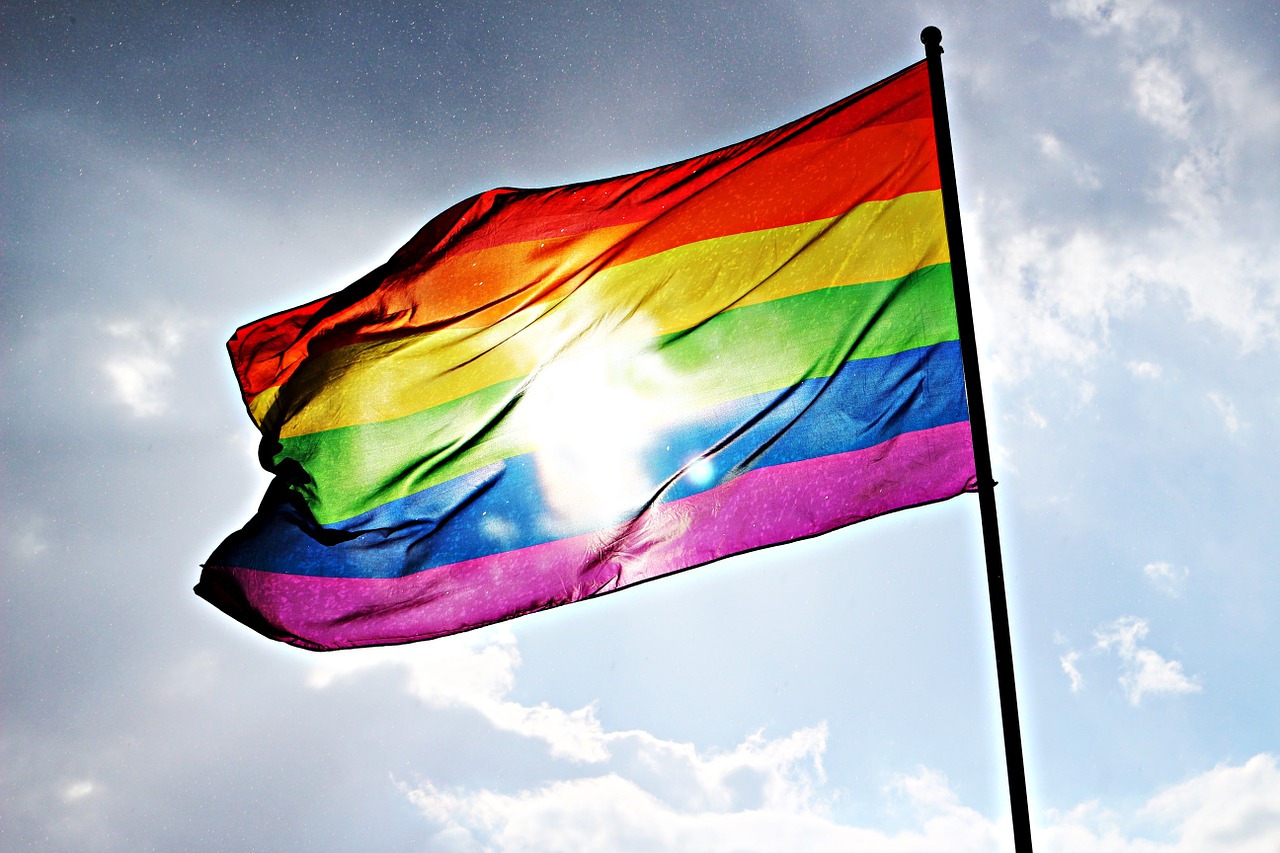
But I digress, how does this reflect on the LGBTQ+ community, surely we are all one harmonious group of rainbow love. Sadly this just isn’t the case. Recently there has been a contentious issue regarding adding a black and brown stripe to the rainbow flag to represent people of colour in the community. On the one side, there are people who feel these stripes should be added because those people the new stripes represent do feel marginalized within an already marginalized group. And on the other side are the people who feel the flag was never about race, the stripes represent different emotions, and feelings of the community and further segregating groups only feeds the fire of alienation.
The issue of the stripes also came into sharp focus in the community when drag queen Peggy Wessex shared a poster designed for her depicting the black and brown stripes being vomited up by a unicorn with the rainbow colours in the background and the tagline “taste THE rainbow.
There was of course defenders of Peggy saying she was a comedian and that banning comic things was just political correctness gone mad.
Is it racism, or is it simply ignorance of race? There is a huge difference between the two.
Now don’t get me wrong, I’m all for nothing is sacred in comedy, but when it comes to taboo subjects, it all depends on how you construct the joke. This was poorly thought out and just wasn’t funny. It was deliberately designed to provoke a reaction. Peggy didn’t design the poster, but she endorsed it by sharing it and making comments such as “how it should be”.
Speaking to a friend of mine about the flag, he voiced worries of being seen as racist if he didn’t have the flag with the black and brown stripes on.
But he made an interesting point, as a white man, the stripes aren’t for him to decide upon, so the flag isn’t for him to wave.
Another point he made was that a lot of the arguments seemed to be between white people, he saw few people of colour voicing an opinion. Is this a symptom of trying to look “woke” and tolerant instead of actually just being nice to people as a normal behaviour? Does an overcompensation actually do more harm than good?
I can see both sides of the argument, the flag never represented race, but people of colour can feel like they aren’t fully a part of the community and want a valid representation of their identity.
Is it racism, or is it simply ignorance of race? There is a huge difference between the two. Ignorance of race is unpleasant, rude and stupid, Racism is dangerous, unlawful and pervasive. And it can start off small, with the idea of preference.
We’ve all heard people say “but it’s just my preference” about who they are attracted to and having a preference is fine no one is telling you to be attracted to someone you’re not, but one has to ask themselves, is it truly a preference, or is it ignorance of race? Outright dismissing or fetishizing someone based solely on race IS racism and it can be incredibly damaging. And some people are disturbingly open about it, putting on their dating profile their “preferences” usually in an incredibly disparaging way.
White Gay term doesn’t just cover race
But the White Gay term doesn’t just cover race, it covers a multitude of things, based on weight, height, amount of hair, gender identity & disability among other things. An easy dismissal of someone based on how they look. Small snide comments such as “You’d look good if you lost a few pounds”.
A look at someone in disgust, whispers and pointing/laughing. These things can really affect a person and while obviously as a society the first thing we see is appearance and an initial attraction is based on looks, that only goes so far. You can find an incredibly hot guy and he’ll turn out to be narcissistic, selfish and shallow. Personality can easily outshine any perceived flaws.
Differences should be acknowledged, and talked about in a positive way. A lot can be learned from other people’s experiences or heritage.
I have sadly heard stories of certain gay clubs (which shall remain nameless) actually refuse entry to someone based on how they look. No wonder there is self-segregation within the community. But self-segregation is just as damaging as outside segregation. Only sticking with your own group highlights the differences instead of everyone coming together and being supportive of each other. Differences should be acknowledged and talked about in a positive way. A lot can be learned from other people’s experiences or heritage.
The point of this piece isn’t to call anyone racist or shallow because not everyone is, it’s to bring light to an issue that is there and does have ramifications towards people.
I’m also very aware that any discussion from my point of view can be instantly shut down with the phrase “You’re a cisgendered white male, you’ll never understand” And no I won’t fully understand or appreciate everyone’s experiences, but that doesn’t mean that I can’t have a meaningful debate and discussion where we can learn from each other without any valid points being dismissed.
I live by two simple mantras, treat everyone how you’d like to be treated yourself, and learn something new every day, no matter how small. The more we learn, even from people we disagree with, the more we grow.
People are so quick to argue or take offence instead of actually talking, and figuring out why a reaction is had. Will this solve the issue? Far from it, but I’m hoping it at least opens up an important discussion.
Mark Fletcher, the chief executive of Manchester Pride, said in a statement to THEGAYUK: “We have seen that the iconic rainbow must adapt to reflect the modern society that we live in.
“A lot has happened but there is still a long way to go, especially in the recognition of people of colour in the LGBT+ community,” he continued.
The decision of Manchester Pride to release this as their 2019 design has received a backlash on social media, with many users questioning the inclusion of race in a flag that has for many years represented sexuality, with one user on Twitter commenting ‘When was sexuality about color? Never. You only just made it about color by adding that. Are you going to put white in there too?’
And they have a point. The six colour flag, created by Gilbert Baker, has developed over a number of years and has represented life, healing, vitality, nature, serenity and spirit, with the missing colour on the Pride flag to represent the lack of equality for the LGBT community.
The Pride flag has been used for the last forty years, without issue.
Despite the Chief Executive of Manchester Pride stating we ‘must adapt’ to reflect the society we live in, we need to remember the meaning behind the flag that has represented a community for this length of time; It’s about sexuality, rather than the race of individuals within the community.
A study last year found that 70 percent of gay people were opposed to the new flag, while most white people and members of the Baby Boomer generation were also against the move.
In contrast, Millennials, people of colour and trans people were more likely to be in favour of adopting a flag with black and brown stripes.
This morning I was on Twitter and I clicked on the #TransAwarenessWeek hashtag and I came across a very insightful tweet from a user, who gave some great tips.
Let me tell you about my own gender expression before we go on. I don’t think of myself as a “man” because I don’t really fit into what society expects of its men. When I was a child all I wanted to do was be called a girl, wear high heels, my mum’s dresses and sing Petula Clark’s ‘Downtown’ on repeat. I was a Grade A queer/trans kid.
Nowadays, I dress in masculine clothes, I have a boyfriend, I have short hair and people assume that I’m a man, and a gay one at that. I enjoy the privileges that, for the most part, that assumed identity affords me. But, it never really feels right when someone refers to me in that way.
That said, I don’t mind if people use the pronouns him/his or he when they refer to me. Although it does jar me if someone calls me a man. Weird.
I also don’t mind it if I’m referred to with female pronouns.
I’m pretty relaxed about the pronouns that are used to describe me.
But for some, words really matter. So here’s some advice to help us all become better allies to our non-binary, gender non-conforming siblings.
It seems that we’ve all got our lives set to transmit only. We need more receiving in our lives. So when someone is telling you something about them, listen.
Someone once wisely told me, “Assumptions are the mother of all fuck-ups” – and they were completely right. How often have you assumed something about a situation only to find that nothing was as you imagined? Pretty often, right?
Your assumptions are based on your own life experience. It doesn’t take into account other people’s experience. So leave your assumptions at the door and again, open your mind.
If a person tells you what their preferred pronoun is, accept it don’t fight it. It’s what they’ve asked you to call them. The decision is effectively out of your hands. It’s the same as when someone tells you their name. You accept it and it becomes part of their identity. Well, pronouns are the same.
Some non-binary, gender fluid and gender non-conforming folks use a number of different pronouns. Some popular ones are: Zim/Zer and Ze, they/them and theirs or even thon, which was actually added to the dictionary in 1964. They as a singular pronoun has been used for centuries.
It’s not particularly new, it’s not trend based, it’s just getting a lot of media attention at the moment.
Blue for boys, Pink for girls… gender stereotyping is all so 1950s and really doesn’t work for today’s society. No one likes living in a predefined box and we don’t live in a black and white world. There’s a whole rainbow out there.
Gender norms and stereotypes, when adhered to, just keeps society attached to a patriarchal system that’s almost impossible to climb and doesn’t work for all of us, particularly LGBT+ people. So lets bin it shall we?
Normalise the conversation surrounding pronouns. Write your preferred pronouns in your social media profiles. As @thalestral says on Twitter, “normalise that shit”.
Also on twitter, stop assuming people’s pronouns based on their profile pic and your binary stereotypes.
Read their profile. Check their pronouns. Don’t assume.
And while you’re there, put your own pronouns in your profile.
Writer Simon Sayers-Franklin urges you to think carefully about being an ally to trans people in our community and what you can do to help with the soon-closing Gender Recognition consultation.
Transgender women ARE women… Sadly this is something that is contested by an increasing number of so called feminists. These vicious groups of Trans-Exclusionary Radical Feminists have made it their business to demonise and hurt trans people at all costs.
They make the most bizarre claims, ranging from: “Trans women can never be women because they have experienced “male privilege”” to “Any man could pretend to be a trans woman in order to gain access to female spaces with a predatory intent.”
The activist group, Fair Play for Women, just the other day took a whole page spread in the Metro, a free newspaper which is mostly distributed on public transport and therefore reaches a large audience. Their message not only displayed crude language but an absolute lack of understanding about transgender people and demonstrated a strange obsession with genitals. The ad questions whether “men” should be able to compete in sport with women. Whether “fully intact men” should be allowed to live in women-only prisons and the list goes on. The cost of this vile ad? £45,000. Now, that sort of money does not come from nowhere. These groups have some serious funding coming from somewhere and while we don’t know where it’s from, we can assume they have big sponsors somewhere. Don’t we deserve to know who it is so we can boycott or take appropriate action against them?
While Ofcom have said they will look into complaints surrounding the ads, we will have to wait and see what their decision is. Judging by the recent outcome of the Ashers Bakery “Gay Cake” legal battle, which did a U-turn on the second appeal, it’s a worrying prospect.
This ad comes just weeks after a billboard in Liverpool had to be removed within hours, following complaints. The group Standing for Women, had placed a plain, black billboard with white writing stating that “woman” means “adult human female.” Word got out and many quickly tweeted the company who had no idea about the motive behind the ads. The company were deeply shocked and upset. The billboard was quickly removed.
Standing for Women, reacted with: “As you may have read, the billboard has been deemed transphobic and is being removed in an act of grotesque misogynistic rage. We are seeking legal advice and will make a full statement in due course.”
We are still waiting for that full statement.
Sadly, facing such hatred is the norm for transgender people in this day and age. The bullying is relentless and groups like Standing for Women, etc, keep pushing on and nobody seems to help. It’s a heart breaking statistic that almost half of young, transgender people have attempted suicide. This should not be happening and we need to do something.
I recently met with Dr Adrian Harrop (@DrAdrianHarrop) who is an LGBTQ+ activist and is very passionate about taking a stand for transgender people’s rights and speaking up against these anti-trans groups. He has developed quite a name for himself for doing so, speaking on TV and radio as well as his twitter. The groups paint him out to be a monster but they couldn’t be further from the truth. He is warm, friendly and keen to make a positive change in the world.
During my chat with Dr Harrop, we discussed the issues faced by transgender people in the modern world with smear campaigns in the media, the government not caring enough to do anything to help and abuse in the streets.
The comparisons to paedophiles, perverts and sexual predators are no different to the abuse that the gay community faced in the past. It is scarily close to the attitudes of the 80s and early 90s at the height of the AIDS crisis, except now there’s no escape from the constant bullying. Online, anti-trans activists swarm like flies around any remote mention of a trans issue and let rip.
For lots of us under thirty, we don’t remember a world with such dangerous hostility towards LGB people. We were too young to properly remember the AIDS crisis; we saw the back end of Section 28 in our school life, sex was legal for us sat 16. We have been very lucky to grow up in a world where battles have been fought and won by people who had a much harder time than us. Sadly, a majority of these heroes are no longer with us but we still owe it to them, to continue their fight. While the world is still not entirely accepting of LGB people it is so much easier than it was and now is the time to stand up for our transgender brothers and sisters.
As cisgender gay men we are very privileged and we must use that to our advantage. Our transgender family have fought along side us for so long. We cannot forget that there is a T in LGBT and we must make a stand and fight alongside these people as they did for us.
Now, the main question is “How do I become an effective transgender ally?” When we met, Dr Harrop explained how we can effectively help our transgender family. Here are some simple steps to being a trans ally:
1. Respect and validate people without question. People know themselves better than you do. It’s a fact. Nobody should be made to feel like they need to explain themselves or that they need to validate their existence and their right to be who they are. This would never be expected of any other minority.
2. Be prepared to call out transphobia. Most people would be confident to call out racism, lots would also be confident to call out homophobia… transphobia is no different. Call that out too whether it’s online or in person. Transphobia can sometimes be difficult to spot but it must be tackled. Examples include small things (which actually have a massive impact on the person receiving the abuse) like misgendering and calling someone by their dead name (their birth name) to more extreme cases where someone’s identity is being questioned with hurtful words and/or violence.
3. Be supportive. Be kind. Be human.
4. There is currently a consultation about the GRA (Gender Recognition Act) which involves a long, dehumanising and hurtful process for transgender people to “prove” their gender. If we make our voices heard, we can change this and make life much easier for our transgender family. Filling in the consultation is quick and easy and is a great way to start your journey to being a trans ally.
It was reported recently that a club goer to the members club XXL in London was refused entry because they were in (what is being described as) high heels and looked ‘feminine’. They were told they had to remove their heels and dress appropriately as this was a venue that celebrates everything masculine (it was a bear club after all).
Free-Photos / Pixabay
It then transpires that this is actually one of many incidents of this kind and to add insult to injury the owner of XXL even decided to go on an anti-fem (amongst other things) rant on twitter (I’m not going to link to it as it doesn’t deserve the airtime).
These recent incidents have quite rightly sparked a fresh debate about toxic masculinity on the gay scene and how ‘fem’ guys are being pushed out in favour of a more ‘masc’ (masculine) culture. In a recent article by Otamere Guobadia, they talk about anti-femme door policies at various places including quoting examples where drag queens and trans women on nights out are excluded from venues for being too feminine (or not masculine depending on your point of view).
In response to the incidents by XXL, there is a protest against the door policy at XXL on the 23 September and even organisations like All Together UK (an LGBT social group) are boycotting the venue to ensure their members and potential don’t feel excluded from events. With the debate raging is there a danger that nobody wins in all of this?
On the ‘masc’ side you have years of the gay community trying to get away from the stereotypical portrayal of a gay man in the media. Deliberately engaging with, what they see, as normal everyday masculine blokey stuff. Discouraging ‘camp’ behaviour, veering away from more feminine activities and hobbies towards more physical activities, the celebration of the 6 pack and chisled body etc. Has this gone too far down the masculine path? Now that concepts of ‘gender’ are more fluid than they ever have been before, is such a masculine idealism toxic to the community?
On the ‘fem’ side you have pretty much the opposite reaction to the above. After years of being told what is masculine and to be gay, you have to be x body shape or behave in Y fashion this is the inevitable result of that. If you repress anyone for long enough they will eventually burst out and push back on the repressive ideas that held them back. This is exactly what we are seeing now and personally, I celebrate it.
“The moment we repress one over the other is the moment everyone loses”
My worry is that this whole argument shouldn’t be a case of masculinity is bad or femininity is bad. Both are good and bad in their own measures and are both valid ways of being in their own rights. The moment we repress one over the other is the moment everyone loses. Calling for masculine bars to be banned is wrong, just as calling for feminine bars to be banned is wrong. Both can exist so long as ones from the other can enter hassle free. That boys and girls is a diverse and inclusive environment not one over the other.
No one should be repressed for being who they are. Masculine, Feminine, Undecided, Fluid or whatever! If we truly want to call ourselves an ‘inclusive’ society then all options should be on the table. If a fem person wants to enter XXL then so be it, just as a butch person walks into a drag show then so be it. They know what XXL is and what its brand is about, just because someone in a corset walks around doesn’t mean the ‘buff’ ‘masculine’ brand and feel of the place has changed. Last time I checked masculinity was a lot more stable than that (but I could be wrong…?).
Personally, I have no idea what I would fit in. I wouldn’t call myself masculine as I was never really a typical ‘bloke’ in that sense. However, I wouldn’t call me particularly effeminate either but I do have my moments. Not that it matters in the grand scheme of things but I wanted to give you where I stand in all of this so maybe you can see why I see both sides of the debate here.
Now that I know a little more about what the XXL owner is about (personally) and while their door policy remains so bullish I’ll also be boycotting the venue – there are plenty of other decent nights out in London! I don’t often boycott as it affects staff more than it does the boss but in this instance, it may just do the trick.
However, if I now have to queue to get into the Eagle I will not be happy.