Category: Motoring

  • CAR REVIEW | Volvo V40

    ★★★★ | Volvo V40

    Your Personal Volvo Has Arrived.  And it’s almost autonomous!

    I took delivery of Volvo’s latest V40 R-Design Lux Nav and immediately liked what l was seeing. And then I wasn’t. For a V range model it wasn’t exactly versatile in load carrying space if you like to load the boot to the gunnels with flat pack furniture from Sweden’s best export company. The opening is too shallow in height for what is sold as an estate. Add to this the rear seats’ quick folding system with neat folding rear head restraints it still didn’t make the boot as big as you’d expect from Volvo. For those who love a Jack Russell the boot it’s perfect but don’t try and carry a greyhound. It all added up to a boot that was ok but not deep enough in height. Sometimes l feel Volvo should have introduced an H range for hatchback.

    On the road the 1.6 litre turbo is a wonder of smoothness and refinement. For the size of the engine it boasts a modest sounding 120 bhp but the lowdown torque of 280NM available from 1500 to 2250RPM makes driving a breeze. Either way for a lazy driver like l am most of the time or spirited when you need to be, it will satisfy all but the most ardent of boy racers out there. Trouble is the car likes to keep itself at 1500RPM. Not bad l suppose if you like economy but l found keeping it at 2000RPM made for a much better car with power more on tap when you needed extra oomph. This also added another problem to my 21-years of driving. Around town only the first 4 gears were needed. So high is 4th that 5th leaves you with gutless performance and 6th was a no go zone. On the open stretches 5th and 6th were acceptable but 6th was just too tall for use with the two cruise control systems unless you were going very fast.

    That’s right reader l did say two. One keeps you at the set speed regardless of how far the accelerator is pressed which is ideal on the motorways with cameras almost every 200 yards, while the other is called Adaptive Cruise Control (ACC). This fabulous system keeps you at a set distance and applies the brakes to slow you down if the car in front slows for any reason, returning to the set speed when it can. As naughty as it sounds it was brilliant in the fog keeping me at a safe distance from the car infant even when l struggled to see it clearly.

    The mere mention of the word Volvo and you instantly think of safety and acronyms. And there are plenty to be had because the V40 is buzzing like a rampant rabbit and all of its seven settings.

    Along with the aforementioned ACC, there is also DAC (Driver Alert Control) CTA (Cross Traffic Alert) and BLIS (Blind Spot Info System) At first the BLIS system annoyed , however, ts alert did prove handy for when cyclists would come up around you in traffic or motorbikes when on the move. Sadly the passenger’s side alert light was too far out of my peripheral vision. l didn’t quite have the balls to try out the full auto brake system but it did activate when a bus pulled out in front of me on a roundabout.

    It’s disconcerting at first and makes you wonder what else Volvo could do to better this? Well let us look at “lane assist”. It’s a great idea in principle but it does need further work if it is to save lives. While l understand that it is there as a secondary assist system it does get confused when the lines are not clear. When the lines are clearly picked up by the system, it will actively steer the car for you. The autonomous car is almost here!

    My daily commute of 40 miles, taking in some rough country roads, fast A roads and twisting hairpins did nothing to shake the fillings out of my teeth. You couldn’t say the ride was a compromise between sporty or soft because it soothed out the ruts where needed without sending jarring motions through the seat all whilst retaining total composure in the corners. For an everyday car that has to be everything from entertaining to drive to keeping the eggs needed for the soufflé in one piece I’d find it hard to beat. The V40 does handle well. Doing what it needs to, the electronic stability program feels all very non-health and safety or Volvo like for that matter. The ESP doing what it has to without causing a fuss or alerting you to its presence.

    The wellbeing promoted in the cabin is further enhanced by the ambient mood lighting. There were so many choices you get bored after a while trying to find the right one. It has all the colours of the rainbow! For me the eco facia theme and green ambient lights were to my liking giving it a touch of Avantgarde class and a sense of calmness.

    For decades Volvo have always sat just outside the mainstream in the various sectors they enter but the time has come for buyers to look across to Sweden because there is now a real contender to challenge the might of the Golf. At the end of my time with the V40 l still liked it and liked it a lot.

    Its relaxed driving environment promotes calmness that only citalopram can give you in today’s fast paced, high drama, must have it all now now now world that we live in. You wouldn’t mention the V40 in a Facebook status but given the option you would click a “like” for it.

    All this gushing has to have a down side, there were a few things l didn’t like. Save yourself £600 by not opting for the leather and all its trimmings. Personally it didn’t feel that great to the touch and had the look and felt of vinyl. And then there was the exposed front seat mounting bolts. This might sound a bit petty, however in a car costing as much as this and with the attention to detail that Volvo have lavished on its smallest offering, it is a tremendous let down. And then there was having to give it back. Now that was a sad day.

    Loves

    Safety devices

    Ease of driving

    Styling

    Loathes

    Lane assist a bit hit and miss

    Leather upholstery

    Boot opening

    Lowdown

    Car – Volvo V40 D2 Manual R-Design Lux Nav

    Price – £25,970 (£32,595 as tested)

    Combined MPG – &8.5 mpg

    Power – 120 bhp

    0-62mph – 10.5 seconds

    Top Speed – 118mph

    Co2 – 94g/km
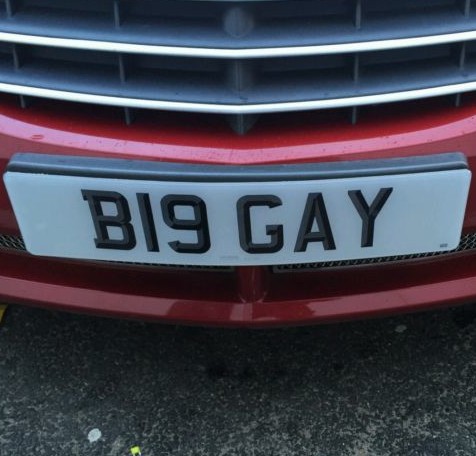
  • Big Gay numberplate for sale

    Big Gay numberplate for sale

    How much would you pay for a used Big Gay?

    eBay

    That’s the question everyone’s wondering on eBay at the moment where a private number plate B19 GAY is up for sale.

    The used B19 GAY numberplate is currently at £870.00 with 18 bids, though we expect this will go a little higher over the next 5 days left of bidding.

    Seller Jamie, who started the listing at just 99p, says he’ll use the money to help with a mortgage and give some to the charity GOSH (Great Ormond Street Hospital) where he spent a lot of time.

    Would you drive around with a plate like this in your neighbourhood?

    You can find the listing at: eBay


  • CAR REVIEW | Ford Fiesta Black Edition

    Firstly, the Ford Fiesta Black edition is almost exactly the same as the Red Edition, sparing opposite paint schemes. Whichever colour scheme you go for, they are both absolutely stunning cars. Evidently, as I own the Black Edition this is my favourite.

    The Fiesta Zetec S Black Edition has a bold, sculptured, aggressive look with contrast details that make sure you don’t get confused with any other Fiesta in the car park. Considering, since going on sale in 2008, the Fiesta has been the UK’s best selling car it is in no doubt that you need something to make you stand out. This special edition model composes the great styling of the standard Fiesta with a racy body kit, lowered suspension by 10mm, black 17” alloy wheels and red accents across the car from the grill surrounds, front splitter, mirror caps and roof all presented against Ford’s “Panther Black” paint. The Red Edition is exactly the same, sparing the paint scheme, where there is red it is black and where there is black there is red. The only other difference between the two is the price, the Black Edition is slightly more expensive then the red due to the black paint being a premium choice.

    The star piece of this car is the engine. In most other Fiesta models you can choose boring petrol or diesel engines, which are pretty standard, and nothing special. What is special, is Ford’s 1litre turbos, the “Ecoboost” engines. The standard 1litre turbo gives of an impressive 98bhp – nothing to scoff at. However, Ford have made the engine for the Black Edition pump out an amazing 138bhp, and what a sweet engine it it. Considering how small the engine is it loves to rev, makes a gorgeous thrumming noise and is pretty rapid.

    The Black Edition is almost the same as the standard Zetec, however, here we get some red accents throughout the cabin.

    Where the Black Edition is let down, as with all Fiestas, is the infotainment system, which is immensely dated and aged, where most rivalling cars get a colour touch screen Ford offers a rather analogue looking display, with lots of buttons.

    Another overlook on the Fiesta are the materials. Some of the plastics do feel cheap and scratchy, however considering that the Fiesta is churned out in obscene amounts we have to give credit were it’s due.

    The technology is very good. Considering the look of the bad infotainment system it does fairly well. There’s voice commands to control some of the functions as well as Bluetooth connectivity which lets you make calls, have texts read out, stream music and the car even calls the emergency services for you if you have an accident.

    Other features, which you’ll love to test are the hill hold assist, which holds the car for you for three seconds to allow you to move off without juggling controls and rolling back. The start/stop technology, helps to keep this car’s CO2 emissions low. This feature can be turned off via a button on the dashboard.

    For concerned parents, this Fiesta also comes with “My Key” which allows restrictions to be put on for anyone driving with the spare key. You get two keys, the master and the spare, with the master in the ignition you can set restrictions such as speeds and volume for the audio, it even tells you how many miles have driven with the key. As optional extras on the car you can have rear privacy glass, auto wipers and lights, rear parking sensors, heated seats, cruise control, automatic climate control, and active city stop. So this can be a car for anyone.

    The Black Edition sits in the range between the standard Fiesta and the Fiesta ST. I see this car as a stepping-stone into the true “hot hatch” market. It is faster and sportier than a standard fiesta without setting off alarm bells with the insurance company, as to them this is still a 1.0 Ecoboost Zetec with a body kit. What I appreciate about this car is its comfort. Compared to the shockingly hard suspension on the ST and bum numbing bucket seats this feels like a luxury limousine. Although the Black Edition is lowered and has 17” alloys, it makes almost no difference to the ride quality, only improving handling and driving fun.

    CREDIT: Ford/Newspress

    I live by a philosophy of “if you don’t look back at your car once it’s parked, you’ve got the wrong one”. And not a time goes by I don’t look back at mine and think how lucky I am. I can forgive all the little niggles about it, like the build quality and the infotainment system because when something puts a smile on your face like a Fiesta does, then its perfect no matter what.

    LOVE

    Punchy engine

    Sporty looks

    Great road handling

    Loathe

    Infotainment system

    Poor materials low in the cabin

    Fuel economy

    Lowdown

    Car: Ford Fiesta Black Edition 1.0 litre 140PS Ecoboost

    Price: £16,945 (starting price)

    MPG: 62.8mpg

    Power: 138bhp

    0-62: 9 seconds

    Top Speed: 125mph

    Co2: 104 (g/km)

    Find out more from Ford.

  • CAR REVIEW | The New Mazda MX5

    ★★★★ Mazda MX5 | Say Hello to the only car you’ll ever need.

    We had a customer come in recently with a car that had died due to a lack of oil pressure. To put it right would have cost a fair bit of money. She said that she had always wanted a Mazda MX5 and I replied to her “You’re a long time dead, go treat yourself” So she did. Next thing I knew she was pulling into the workshop with a 5-year-old MX5.

    Had I known that Mazda were due to relaunch the next generation MX5 I would have told her to save her money and buy the new one. It’s rather good. And that’s it. This review is over. However, the editor wants more words said about the subject of this test so I am forced to rattle on with some extra words.

    There are two responses you get when you mention an MX5. From those who have never driven any of the four generations of car saying they are just cars for the hairdresser and those who have had one who can enthuse about it until they really bore you so much you actually want to slam your fingers in a door. Here in its fourth incarnation it has become even more of a driver’s car with an appeal for everyone. Even grown-ups with a child are catered for with the passenger’s seat coming with ISO fixings for the baby seat. If you want a sports car, have a baby and are single, Mazda have catered for you. The church, on the other hand, may frown at you but what the hell, you have a removable roof that makes you closer to God.

    Opening the roof is like opening a can of Pepsi and just as quick. It takes literally seconds to fold the snug roof down as it is to put up. So simple in its operation that I do wonder why I see so many MX5’s with their roofs up? It’s almost draft free too. On the model I tested there was an occasional whistle around the door window but this is the price you pay for a car with no roof. That roof can also take one battering from the rain. One bad down pour experienced with the car revealed no weakness in keeping the water out.

    Speaking of wonders I liked the kit you get with it. You couldn’t call it palatial but Mazda has created a car that gets back to the basics of what makes a good sports car.

    The everything at finger-tip reach cockpit comes with hip hugging heated seat, power windows, mirrors and air conditioning. It also comprises a DAB stereo and CD player pumping out the sounds through a Bose speaker system.

    The heads up display for sat nav, stereo and car information is controlled by a single wheel knob with a few buttons placed around it on the transmission tunnel and in its operation it works well, though why it needs another volume control here when there is one on the steering wheel was beyond me. One annoyance I had with this was that there was no mute button on the wheel. A more logical place for it to be.

    On the road is where the MX5 wins you over again and again. With the 1500cc engine and weighing in a little more over the 1989 original, it proved to be sensational. 0-60 comes up in 8.3 seconds and taking it to 7000rpm enables you to get the best from the smooth as silk revving engine. The power mutes itself at the 7500rpm redline where there is no noise and no fuss. A quick change up and it’s pulling away again. Keep the engine above 4000rpm and it’s entertaining all the way until you reach 6th gear and then it cruises along. On the motorway, it was almost always necessary to drop it down 2 gears to get the best overtaking performance. Sixth gear is long legged. And this is where the MX5 again makes you wonder why all cars are not like this. It’s relaxing to drive around town. The exhaust is muffled except for a little rasp that excites the senses and yet when you need the power it’s there just a few gears down.

    What makes the MX5 a hoot to drive was its lazy traction control. Playing with it for fun it wouldn’t get too messy though it did allow for some tail happy sliding that makes you feel alive or will wake you up on the morning commute should the coffee fail you. Nine out of ten times you would have backed off before the car would have sorted you out. Turn it off and your senses are woken to full adrenaline shots coming at you from every gland around your body. Everything talks to you demanding inputs here there and everywhere. And then when you have to be normal again, the car behaves like a shopping shuttle. Its suspension is a tad too soft in places. Hard acceleration forces the light beams to illuminate the sky when the back bites in. That said, make it too hard and the car looses its everyday attraction. Not once during my testing did I wish for another car. The ride around town being compliant and there was no back breaking jolts experienced over speed bumps or small pot holes. If you have to have just one car in your fleet then make it the MX5.

    Taking a look at the rest of the MX5 range I would say you are doing an injustice to yourself if you opt for the 2000cc engine. Apart from being a second quicker to 60mph, the rest of the performance figures aren’t really anything to write home about. You do get a little more grunt in power but I doubt it’ll give you the same joyous feeling the 1500 gives. It also won’t rev to beyond 7000rpm. And for its greater power you pay dearly at the fuel pumps too.

    I wouldn’t call them problems but things I didn’t like about the much-acclaimed MX5 was the use of carbon fibre type trim on the doors. I do dislike this material and it was out of place on this model. I also don’t like the bonnet badge. Its overstated nature is overbearing for the beautifully sculpted front.

    Likes

    Ease of roof

    Ride

    Smiles per mile

    Loathes

    Carbon fibre trim

    Lane assist

    Bonnet badge

    The Lowdown

    Car – Mazda MX5 1.5i Sport Nav

    Price – £23,105

    MPG – 47.1mpg (combined)

    Power – 131bhp at 7000rpm

    0-62mph – 8.3 seconds

    Top Speed – 127mph

    Co2 – 139 (g/km)

  • CAR REVIEW | Seat Ibiza FR Red Edition 1.2 TSI

    ★★★★ Seat Ibiza FR Red Edition 1.2 TSI | I’ll say it now and get it out of the way. The Ibiza has just too much Volkswagen about it.

    (more…)

  • CAR REVIEW | Mitsubishi L200 Barbarian

    I don’t know quite what I was expecting when l took delivery of the new and improved series 5 Mitsubishi L200 Barbarian pick-up.

    Visually you are made aware of its almost 5300mm in length. Its load bed length of 1470mm looked bigger than it actually was. The L200 range has come a long way since its launch in 1982 and the new model sees a subtle design change with some of the feminine curves replaced by straight lines making it look a little sturdier than the old model, while still being civilian friendly looking over the opposition from the likes of Nissan and Toyota. More importantly, there is now a city friendly tighter turning circle too. With 7 different guises of L200 pick-up available it is possible that every member of the family could find a pick-up to suit.

    The interior finish is rugged looking and the leather-covered seats are comfortable. All plastic surfaces practical and functional plastic of the hard variety that literally makes cleaning a wipe over. The fascia is laid out well and all the controls minus the heated front seat switches were within easy reach. The steering wheel housed controls for the stereo, phone and cruise control. It was all quite too civilised for what a pick-up should be. Thankfully l found some hard edge plastic under the switches on the steering wheel. An ideal edge for filing off that hard skin from a day’s graft on-site. This masculine touch was then ruined by the floor lighting. Nothing wrong with floor lighting l hear you say but the blue was just a touch 2000’s Lexus and even they don’t do it in blue anymore. Even more, Lexus was the pick-ups “Barbarian” signature illuminated in the kick plates.


    I developed a love/hate relationship with the inbuilt sat-nav and infotainment system. Its touch screen was easy to use for my thin fingers but having asked a real man we’ll call Dave to have a play, he moaned that its on-screen buttons were too compacted for his manly fingers. And the brightness of the screen at night was reminiscent to that of a Hollywood dashboard. So intense was the light l couldn’t use the sat-nav at night. The night option changed the colours making it harder to view quickly while on the move.

    On the road, this fully loaded pick-up will set you back £30,238.80 with no options available because it literally has everything thrown at it or for £2000 cheaper when bought with the manual gearbox. Traction control is quite essential in 2WD mode. The 2442cc in-line 4 16 valve DOHC turbo diesel MIVEC engine packs quite a thud in the back when needed.

    The price you pay for having a pickup that goes from 0-60mph in 11.8 seconds is that the 317 Ib.ft of torque at 2500rpm would spin the rear wheels without much provoking on moist surfaces. Select the 4WD and all the power was planted where you wanted it. Again on the road and over most surfaces it performed with car-like comfort and ability. The steering was nicely weighted more towards town driving ease with feedback of road ahead being well communicated through the thick-rimmed steering wheel. In 4WD mode, you could feel the front differential working via a slight rumble through the wheel.

    The engine could be heard if really pushed but in the normal day to day it was bearably audible from a cold start until fully warmed. All this power doesn’t come with an added fuel premium either and official figures suggest a respectable 43.5mpg giving a range of over 700 miles. With today’s fuel prices that’s quite commendable for a tank that’ll cost you about £80 to fill. 4WD’s have become greener and cleaner over the years and the Barbarian is one of the greenest.

    Remember that 5300mm in length l mentioned, in practice, it doesn’t feel that big on the road. Admittedly you will struggle to park it within a single bay at your local DIY store but the reverse camera and big mirrors make it an easy task. l am not the best at reversing anything bigger than a hatchback so the reverse camera was a nice addition and one of the best l have ever used. The lines that appear on the screen are just perfect for achieving your 10/10 parking space award. You shouldn’t find the Barbarian on that website where people park inconsiderately.

    I have to conclude that overall l was impressed by almost every aspect of the Barbarian. Its ease of driving, the quietness of the cabin, the way it was screwed together and even the engine bay was laid out in a simple logical layout. It was better than l thought it could and should be and if you were to have just one vehicle for work and play then this has to be high on the list. It’s car like applications such as one touch door handles, push start, full electric windows, climate control and cruise modes all add up to make this a civilised machine for not a lot of money when you consider what it can do and where you could go with it. l wasn’t able to trial its off-road ability so l have to take Mitsubishi’s word for it, though with its long established history and range packed full of 4WD models I’m pretty sure this could take you as far away from civilian life as you’d want to go on a weekend. Sadly the Barbarian being so civilised it’ll remind you all too soon that you have work on Monday.

    Pros

    Comfort
    Go anywhere ability
    More useful than you’d think

    Cons

    Blue LED lighting
    Dazzling sat-nav screen
    No hill descent control

    The Lowdown
    Car – Mitsubishi L200 Double cab Barbarian
    Price – £23,799.00 (£30,238.80 as tested)
    MPG – 43.5 mpg
    Power – bhp
    0-62mph – 10.5 seconds
    Top Speed – 109mph
    Co2 – 189g/km

  • CAR REVIEW | Mercedes AMG A38

    As potential performance cars go, the first generation Mercedes A-Class is not a vehicle that immediately springs to mind.

    (more…)

  • CAR REVIEW | Mitsubishi ASX

    Launched in 2009 to high expectations, the Mitsubishi ASX failed to make an impact on the competitive Sports Utility Vehicle sector which at present is dominated by the Nissan Qashqai and Toyota Rav4.

    However according to the Society of Motor Manufacturers & Traders, in 2014-2015 sales grew by as much as 20% for the ASX. This is already on top of Mitsubishi sales, in general, rising over the last 3 years. This might account as to why we are seeing more and more ASX’s on the road. Now 7-years-older and finally finding love on the forecourt, can it now start worrying the competition? I had one for a week to find out.

    Visually she’s aged well. It is still striking to look at and in a carpark full of small SUVs from the likes of VW and BMW it demonstrates a victory against the bland.

    Sadly the interior cannot be said to have impressed as much. While the seats were supportive and comfortable with an impossible to locate switch to heat them, the plastics were of the hard wearing type similar to what’s used in the man machines from Mitsubishi like in their L200 pick up. There lacked a soft touch feel about the cabin. This soft touch was further lacking in stupid imprinted signs on the door pockets and centre console saying “no cups!” Most annoying after all it’s my car and I’ll put cups where I want them. Bottles were allowed in the door pockets.

    Further annoyances were found with the lack of illuminated switches on the doors for windows and mirrors except for one flimsy light for the drivers switch. You forget how much you take for granted an illuminated switch in the dark. So instead of giving these lights, Mitsubishi added some sunshine lights into the glass roof panel and it screamed cheap electrical light tape found on a famous auction website. That said when the roof panel was open it did make the spacious cabin even more tardis like. It wasn’t an unpleasant place to be if I am honest.

    And then there was the satnav and its illumination horrors. In the day the system was like Dr Jekyll. However, come dusk and nightfall it became Mr Hyde. At night in day mode it was just too bright. Thankfully there is a switch that turns it to night mode. It then becomes too dark using blacks and blues in colour.

    So far there isn’t a lot to recommend this 7-year-old car and then you drive it. Two things stand out as negatives. Firstly there is an almighty amount of road roar in the back. At first, I thought I had the window open. Secondly, from a standing start, there is an awful delay that catches you out when pulling into traffic. This can be over come by trying to get a slight roll going before you push down hard on the accelerator. It is then that the 2.2-litre diesel engine mated to one of the smoothest 6-speed automatic boxes l have tried makes you feel like you’ve spent a million dollars. Mitsubishi gives you paddle shifts on the steering wheel too but unless you are really into spirited driving there is very little need to use them. The gearbox was always in the right gear.

    This impressive gearbox and power unit managed to further impress in its economy in 4WD where l found it at its best as a driver’s car and in road behaviour.

    In 2WD the economy according to the onboard computer was exactly the same over the same route of 31MPG. As you would expect in 4WD, traction was increased and it was also felt that the traction control system was less needed in keeping it where it was pointed. And then there are the headlights. Nothing fancy about these units, they didn’t even swivel. What they did give you though was a beautiful beam pattern and crystal clear view on even the grimmest of road conditions. Commuting through the wildness of Surrey I found there was little need to use the main beam.

    So the ASX was starting to make me appreciate it and its appeal so quickly lost on taking delivery was starting to make sense. There is bags of room inside and the cabin does have a tardis feel about it. The boot is very generous for this size of vehicle and rear seat leg room with my 6-foot frame behind the wheel was more than adequate. With this opulent amount of space must come a good heating system and it was good. And then it was bad. and then it was perfect. Call it what you like but there were times l felt like Goldilocks. Set to 19 degrees it would heat the cabin until it was as hot as the sun and then cool it down with blasts of cold. Only then would it settle to a perfect temperature. This lasted around 10 miles per journey and opening a window would only confuse it.

    Where this ASX really excels is in its price. The top end £24,899  model is £1400 more expensive that its 1.6-litre sister and that only comes in manual. You do pay more at the pumps if you go by official figures of over 10 MPG worse for the 2.2 but only 4 MPG over the extra urban. I, however, was not able to match even its lowest figure of 39.8 for the urban dash. Compare the top of the range ASX to its lowest family member and it £9,000 saving doesn’t make the 1.6 ASX 2WD look good at all unless you are after an estate looking vehicle with no functions. The ASX is already 10 years out of date, don’t do yourself a disservice and make it worse by opting for the lesser model.

    Overall all is not lost for the quite likeable ASX. According to the 14 owners on the Autotrader website, it scored 4.6 stars out of 5 and prices are set to become even more competitive with talk of a new model ASX coming in 2017. Need yourself an SUV with a 5-year warranty? Now is the time to talk to Mitsubishi.

    Pros

    Automatic gearbox

    Headlights

    Standout looks

    Cons

    Poor switch gear

    Road noise

    Throttle response from standing start

    The Lowdown

    Car – Mitsubishi ASX

    Price – £24,899 (as tested)

    MPG – 39.8 urban

    Power – 147 bhp (at 3500 rpm)

    0-62mph – 10.8 seconds

    Top Speed – 118 MPH

    Co2 – 152 g/km

    by Stuart M Bird

  • CAR REVIEW | Volvo V60

    ★★★★ | Volvo V60

    Estates have taken a bit of a battering in the last few years.

    It seems that these days the default choice for those needing more room for cargo, dogs or dead bodies is a chunky crossover rather than a long-roofed car. All is not lost though, Volvo (who else?) is now offering a dash of off-road appeal to its V60 estate with this Cross Country model.

    So what does it take to make the Cross Country variant? First, the suspension is jacked up by 65mm, not a vast amount but enough to give a noticeably loftier viewpoint on the world. Next, Volvo add silver skidplate effect bumpers front and rear with matching side skirts. Finally, you get chunky mud and snow tyres beneath plastic wheel arch extensions. All-wheel drive is an option but only on the most powerful engine.

    While those changes may not sound like much, they do toughen up the V60 by a significant amount giving it a little more presence on the road. That the normal V60 is a pretty handsome thing doesn’t hurt at all. Inside feels very well put together and is attractive in a sober, Swedish kind of way. It may not immediately appeal but it proved to be a wonderfully calming, well-made environment in which to clock up the miles. This was helped by excellent seats with plenty of adjustment, clear instrumentation (especially with the optional TFT dials) and easy to follow sat-nav.

    Our test car came with keyless entry and start. As long as the key was on you, you could unlock the car with a tug of the door handle and fire up the engine with the push of a button. You could even lock it again without the key fob in your hand. Nice. Once I was inside and ready to set off, I did notice the gearstick seemed a little bit too far back in the cabin with the cupholders unhelpfully beneath your arm as you changed gear.

    On the road, the gearchange action itself was long but not unpleasant. Not that you had to stir the stick much, even with the lowest power engine the V60 CC proved surprisingly rapid. The 150hp unit may have been a little loud (although easily masked by a quality sound system) but had plenty of grunt; it always seemed faster than the 9.1 second sprint to 62mph suggested. Unfortunately thanks to those chunky tyres, there was a bit of torque steer and a fair amount of wheelspin even in second gear.

    Pushing the V60 CC around bends highlighted the issues with putting a car on stilts. Turning the car into a bend over a crest could unsettle the rear while it did float a little over bumps too. The steering was well weighted but lacking any real feedback. To be fair though, it’s unlikely you’d buy one of these for its handling prowess. In a relaxed cruise it proved effortlessly comfortable, refined and pretty economical too. Over my usual mixed route, I was averaging around 44mpg. It’s just a shame that rough road surfaces did make things get a little jiggly. Yes, you can call it that.

    I was also a little disappointed with the load space, or rather the lack of it. Don’t get me wrong, there’s still plenty more than something like a Ford Focus hatchback but not anywhere near as much as you’d think for a car of this size. Unfortunately in giving the V60 its svelte shape at the rear, boot space has been sacrificed. At least the cargo bay is a decent shape with no lip. On the subject of negative points, while the V60 CC range starts at £30,000, you’re looking at around £35,000 for an AWD model.

    In summary, there’s a lot to like about the V60 Cross Country. The driving experience and high-quality interior combine to offer a relaxing experience while real world economy is more than acceptable. While you could argue that not offering AWD with all engines is a bit of an oversight, most people will buy these for the looks rather than for any off-road ability. Rivals may be cheaper but I doubt they’d feel quite this plush. Is it worth the premium? I think for many the answer will be yes.


    Loves

    Relaxing to drive

    Performance

    Looks

    Loathes

    Boot smaller than expected

    Lack of traction

    The Lowdown

    Car – Volvo V60 Cross Country D3 SE Nav

    Price – £30,995 (£35,545)

    Power – 150hp

    0-62mph – 9.1 seconds

    Top Speed – 127mph

    Co2 – 111g/km

  • CAR REVIEW: Alfa Romeo 4C

    If you’ve stopped staring at the picture and started reading, you might be wondering what the incredibly sexy automobile in front of you could be. ★★★★

    With something as low, lithe and purposeful as this, you might be expecting it to have a prancing horse on the badge and a price tag of over £150,000. What will surprise some of you is that this is, in fact, an Alfa Romeo with a starting price of not much more than £50,000.

    You may associate Alfa with a range of small hatchbacks but their history is full of sports and racing cars. The 4C featured here is the latest from the Italian marque and one that aims to bring excitement back to driving. While it may be a throwback in some respects – there’s not even any power assistance for the steering – it’s a thoroughly modern vehicle. Underneath the achingly beautiful body is a chassis made out of carbon fibre, the stuff they make Formula One cars out of.

    Fold yourself through the door opening and into the heavily winged driver’s seat and you’ll be just a few inches off the floor. The view out of the curved windscreen is dominated by the rising front wings and the plunging nose. Look in the door mirrors and you can see straight into the dramatic scoops that feed the engine and keep the intercooler chilled. As for the rear view mirror, you could just about see flashing blue lights approaching but not much else.
    The cabin itself is sparse with plenty of exposed carbon fibre, a TFT instrument cluster in front of you and not much else. You do get electric windows, air conditioning, a stereo and the option of leather seats but the luxuries stop there. For storage, there’s a compact glovebox with another small compartment in between the seats. Other than that, there’s just a pair of cupholders inside and a boot big enough for a couple of squishy bags. Practical it isn’t.
    Directly between the rear seats is the same 240bhp four cylinder 1750 TBi engine found in the Giulietta QV coupled to a six-speed semi-automatic gearbox with steering wheel mounted paddles. Those hoping for a manual gearbox should look elsewhere. While you might think that engine isn’t exotic or powerful enough given the mini-supercar looks, the reality is quite different. Thanks to the carbon construction, the 4C weighs less than a tonne.
    To put that into perspective, launch control helps the 4C get from 0-62mph in a mind-blowing 4.5 seconds. All you need to do is select ‘Dynamic’ mode on the three-way ‘DNA’ switch (‘Natural’ and ‘All Weather’ modes are also available), plant your left foot on the brake and flatten the throttle with your right foot. The revs rise to around 3,000 at which point you come off the brake. Assuming its dry, the 4C then finds amazing traction and hurls you towards the horizon while making some great noises.
    Not all aspects of driving this Alfa are quite as simple though. The unassisted steering is heavy at parking speeds and although it soon gets lighter, it constantly writhes about in your hands. While there’s no doubt it engages you in driving the car, the inexperienced will be intimated by the way it follows every little tramline and camber in the road. Although you soon learn that a little wandering is natural and grip the wheel less tightly, you can never relax in this car.
    The upshot of this comes in the shape of steering feel that shames almost every modern car I’ve driven. You always know what the front wheels are doing even as the limit of grip approaches while the speed of the rack helps catch any little slides you may encounter. Don’t get me wrong, it isn’t a drift monster but it is very easy to unstick the rear tyres coming out of junctions for instance. In ‘Dynamic’ mode (even with the traction control on) you’ll find yourself having to feed in opposite lock before the computers sort things out. It might sound scary but it becomes good fun very quickly.
    Not that you have to be travelling quickly to have fun. On several occasions on familiar roads it felt like I was hammering along only to look at the speedo and see surprisingly low number. If you did want to make those numbers bigger (on a track of course), then you really need to concentrate and work hard. For many it’ll be too much effort especially when compared to the likes of a Porsche Cayman. For me, it was addictive in a way few cars are. It really is an adrenaline pump virtually all the time.
    Despite this, fuel consumption was astonishingly good. On one thirty mile plus journey, I was able to coax nearly 40mpg out of the 4C without having to try too hard and keeping pace with traffic at all times. Even driven hard, the average refused to drop below 25mpg. Thank the relatively small engine and tiny kerb weight for that. There aren’t many rivals that can match that real world fuel consumption, that’s for sure.
    Does this make the 4C a car you could have as your everyday car though? I would argue not. Although the sensory overload is great when you’re in the mood, a day behind the wheel left a friend and I tired and with headaches. Storage space is limited at best and it isn’t easy to get in and out of. I would also bet that while being the centre of attention wherever you go was great fun during my time with the 4C, it would get old quite quickly.
    Would I have one though? Without any shadow of a doubt; the 4C makes you feel alive like little else on the road.
    Loves
    Looks
    Acceleration
    Economy

    Loathes

    Loud

    Impractical

    Can be a handful

    The Lowdown 

    Car – Alfa Romeo 4C

    Price – £51,500

    Power – 240bhp

    0-62mph – 4.5 seconds

    Top Speed – 160mph

    Co2 – 157g/km

    Reviewed by Alan Taylor Jones / October 2015

  • CAR REVIEW | Alfa Romeo Giulietta QV

    ★★ | Alfa Romeo Giulietta QV

    It seems the default choice for a premium hatchback these days is Teutonic in origin. Whether it has a three-pointed star, four rings or a blue and white roundel, the Germans seem to have the market all wrapped up.

    What if you want some passion with your prestige though? Step forward the Italians with the gorgeous Giulietta.

    A competitor to the Audi A3 and Mercedes A-Class, the Giulietta is a five-door hatchback pretending to be a sporty three-door. The nose is reminiscent of the 8C & 4C sportscars with subtly sculpted flanks leading to an attractive rear end with distinctive tail lights. We’re not looking at any old Giulietta however, this is the top Quadrifoglio Verde (QV for short) model. Meaning ‘cloverleaf’ in Italian, it’s been the symbol of the most athletic Alfas since 1923.

    The Giulietta QV gains a couple of big bore exhaust pipes, sporty side skirts and 18” wheels, in this instance glorious teledial items that hark back to fast Alfas past. These items and cloverleaf badges on the front wings aren’t the only things that mark out the QV though. Under the bonnet is the same 1750 TBi turbocharged four-cylinder engine and six-speed dual clutch TCT gearbox that’s found in the 4C. Like in the mid-engined two-seater it has 237bhp; enough for a 0-62 mph time of six seconds dead.

    Driving the QV up to around seven-tenths pace, all seems good. You wouldn’t ever call it soothing but it strikes a good balance between ride comfort and handling. Yes, you do feel bumps but sharp edges are rounded off nicely and the car feels pretty agile. The gearbox shuffles between ratios smoothly and the steering is nicely weighted if not dripping with feeling.

    You can calm things down further by switching from ‘Natural’ to ‘All Weather’ modes on the three-way ‘DNA’ drive mode selector. This blunts performance but does tend to be the best choice for day to day use, ‘Natural’ seemingly always in a gear lower than you want when you’re being sensible. It also puts the traction and stability modes on high alert should conditions get slippery. It’s the ‘D’ in ‘DNA’ that’s most interesting though; that stands for ‘Dynamic’.

    Not only does it make the engine even more responsive, it reduces the assistance of the power steering to add weight and gets the electronic limited slip diff working as hard as it can to improve traction. There’s even a launch control mode that (in theory) makes that 0-62 time easily achievable. Just put your left foot on the brake, give it full throttle and then step off the brake. The computers will do the rest.
    Assuming you’re on a nice flat piece of tarmac with lots of grip, there’s plenty of flashing from the traction control light in first gear before it hooks up in second and flies making a fantastic noise in the process. Try accessing the performance on rougher roads especially in the wet and things get a little crazy. The differential isn’t a true limited slip diff, instead, it works by braking the front wheels individually seriously limiting progress and causing the nose to wander too.

    Pile into a corner really hard and the QV always seems safe but never really feels like it wants to play. Only braking deep into a corner will get any movement from the tail and you can’t turn off the traction and stability control either. The upshot is that it never feels like it’s going to throw you off the road but then never is it truly exciting – not unless you’re hard on the throttle with the steering wheel writhing in your hands and trying to stop it pulling you into a ditch.

    Still, you can count on Alfa Romeo for a stylish and driver focussed interior, can’t you? Errr no, not in this case. For starters, it’s like a coal bunker inside with an all black dashboard, black seats and a black headlining too. There may be some colourful piping on the disappointingly unsupportive seats but it’s not enough to lift the interior ambience. Some cheap plastics don’t help either. In the centre of the dash is a touchscreen infotainment system which works well enough but is trumped by newer rivals. Overall it feels a couple of generations old which isn’t really acceptable in a car that was facelifted just over a year ago. At least the boot is a decent size and rear legroom adequate.

    As a fan of much of Alfa Romeo’s back catalogue, I really wanted to like the Giulietta. I’ll even go as far as to admit to being prepared to overlook a few foibles and the stiff £28,000 price tag for a bit of Italian flair and excitement. Look past the good looking exterior and fantastic engine and you’re sadly left with a car that was at best mid-pack when it was introduced around five years ago. Fast forward to now and it’s way behind the pack in almost all areas. Alfa may be looking to facelift the Giulietta again but really they need to put it out of its misery and pull the plug.


    LOVES

    Engine
    Looks
    Not the obvious choice

    LOATHES

    Expensive
    Dated interior
    Could be more entertaining to drive

    LOWDOWN

    Car – Alfa Romeo Giulietta Quadrifoglio Verde
    Price – £28,120
    Power – 237bhp
    0-60 – 6.0 seconds
    Top Speed – 151mph
    Co2 – 162g/km

    Reviewed by Alan Taylor Jones /Sept 2015