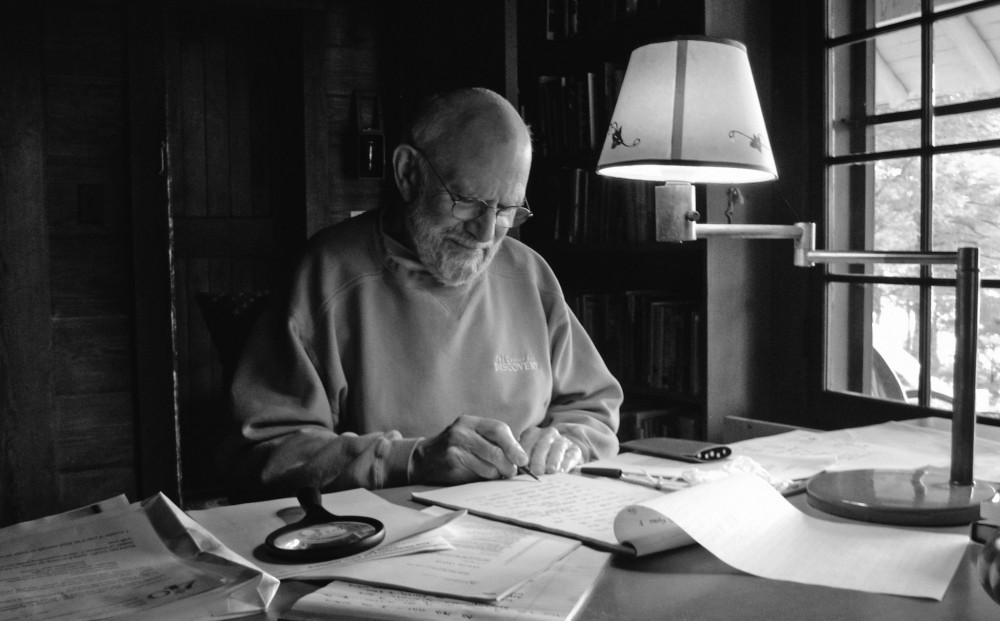
The late Oliver Sacks was a very fascinating man. Learn more about him in the upcoming documentary Oliver Sacks: His Own Life.
Sacks was not just a scientist and neurologist, he also wrote dozens and dozens of books including best sellers, was a master in his field, greatly respected, became a celebrity later in life, and he was also gay.
Sacks grew up in an upper-middle-class family in Cricklewood, London. Both his parents were doctors – so it was almost a natural that he’d be a doctor. But it wasn’t until his older brother Michael was diagnosed schizophrenic, an illness that affected the whole family but Oliver more so, that Sacks future was sealed. Going to medical school in Oxford, then to America where he took up residency in San Francisco is when his true self came out – a man with a motorbike dressed in head to toe leather. But while he was taking care of patients with severe neurological issues (stunning footage shows him with patients with neurological diseases and oddities) – Sacks never really found love or romance. His mother vehemently objected to his homosexuality but she also turned into a champion of his while he spent a summer writing a book at his childhood home. But her death affected him greatly, and after he turned 40 he remained celibate for the next 35 years.
Quite a bit of footage of Sacks is of him in his West Village apartment surrounded by staff, friends, etc. His personality comes through in these moments like a bright red sunset – with his charming laugh, unique British accent and sparkle in his eye that will win you over. He won Bill Hayes over – at age 75 Sacks and Hayes (20 years younger) remained together until Sacks death in 2015 at the age of 83. It’s a happy relationship to the end of an amazing life led by a man who changed medical science and at the same time opened our eyes to it. Director Ric Burns really captures the life and times of Sacks, especially of his final years of being with Hayes.
Remember your first romance? It probably took place during the summer. The new film Summer of ’85 beautifully tells the story of one young man who experiences his first romance – in the summer of 1985.
The opening song ‘In Between Days’ by The Cure sets the era for the film (yes, you know it if you were around then). Summer of 85 is set in a Normandy, France, seaside town where Alexis Robin (a memorable Félix Lefebvre) lives with his parents and is in the gap period between school and college.
Alexis enjoys being the near the water, so much so that one day he takes a small boat out to sea but gets caught in a storm. He is rescued by the all too dashing Benjamin Voisin (David Gorman). Benjamin makes sure Félix is fine and takes him to his home to take care of him, where his mom (a very good Valeria Bruni Tedeschi) undresses Félix for a hot bath and admires his manhood). This leads to a quick relationship where Alexis has his first real crush (and love) with Benjamin. But it’s all too fast and furious, and when Benjamin’s mom (who was recently widowed) asks Félix to work in their nautical shop full time, it’s might be too much too soon for the perfect pair. And when Brit Kate (Philippine Velge) enters the picture the boys’ relationship is put to the test. Will it pass or fail? And then an unseen tragedy, typical in French films, dramatically changes the tone of the film.
Directed and co-written by the masterFrançois Ozon – the creator of so many great and memorable films (recent films include By the Grace of God and L’Amant Double) scores another winner here with a superb choice of actors, location, and songs (’Sailing’ by Rod Steward and Bananarama’s ‘Cruel Summer’ tells the story in their titles). Though the film goes a bit off the charts by having Félix dress up as a young woman in one silly scene (reminiscent of The New Girlfriend), Summer of ’85 is a very memorable and charming film about young love. It’s a film that will take you back to your first summer love.
Summer of 85 is in cinemas and on Curzon Home Cinema
An Australian singer, with a young daughter in tow, arrives in 1996 New York to make it as a singer. The woman’s name was Helen Reddy.
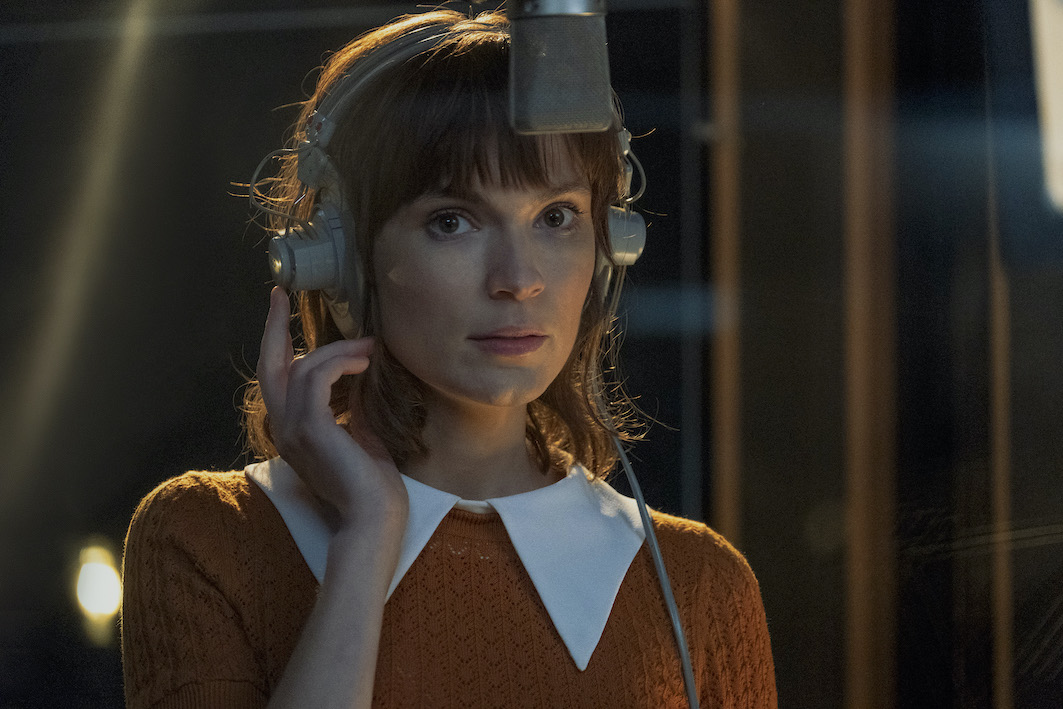
Yes, Helen Reddy the legend who sang such hits as “I Don’t Know How to Love Him”, “Delta Dawn” and “Angie Baby” and the iconic “I am Woman” started her career in NYC as a singer in a bar lounge. Thus begins the story of one of music’s greatest superstars in the new film I Am Woman.
Yes, she was sure a woman. And Reddy, who just recently passed away in September in Los Angeles, had it rough when she moved to NYC after winning a singing competition in Australia where the prize was a ticket to NYC and a recording contract. But with a suitcase and only $230 in her pocket, and with no recording contract, she was determined, and desperate, to make it on her own.
Besides hanging out with rock journalist Lillian Roxon (Danielle Macdonald), she also meets Jeff Wald (a fantastic Evan Peters who steals the movie), a young aspiring talent manager who becomes her agent and eventually husband, and he helps her get to the top. After their move to Los Angeles, Reddy’s singing career began, and continued to hit new peaks, where she became the first Australian singer to top the US charts, and even winning a Grammy award in 1973. But Wald had a cocaine habit, which eventually got worse and worse, and with Reddy not home a lot due to a Las Vegas singing residency, and with a new son to take care of, their relationship started to crumble, and eventually ended when Reddy found out Wald had made bad investments with her money.
However, I am Woman is the story of a woman, against all adversity, who was determined to make her dream come true. Reddy not only became the most successful female recording artist of her time, but she also broke stereotypes and led the way during the most crucial period of the women’s liberation movement. And she became a role model for what all women could achieve.
It’s an incredible story, made all the more real by director Unjoo Moon, who has very little experience in the directing world, and by Tilda Cobham-Hervey, who effectively plays Reddy, but unfortunately, it’s not an award-winning performance. It’s Peters’ performance who steals the film as her husband. But it’s also Reddy’s life and legacy that will most stick with you. What she had to do and what she accomplished, in a time when women’s rights were just a passing hope, and how perhaps her message through song and her voice really did help propel the feminist movement in helping to pass the equal rights bills across America.
IN CINEMAS AND ON DIGITAL PLATFORMS FRIDAY 9TH OCTOBER
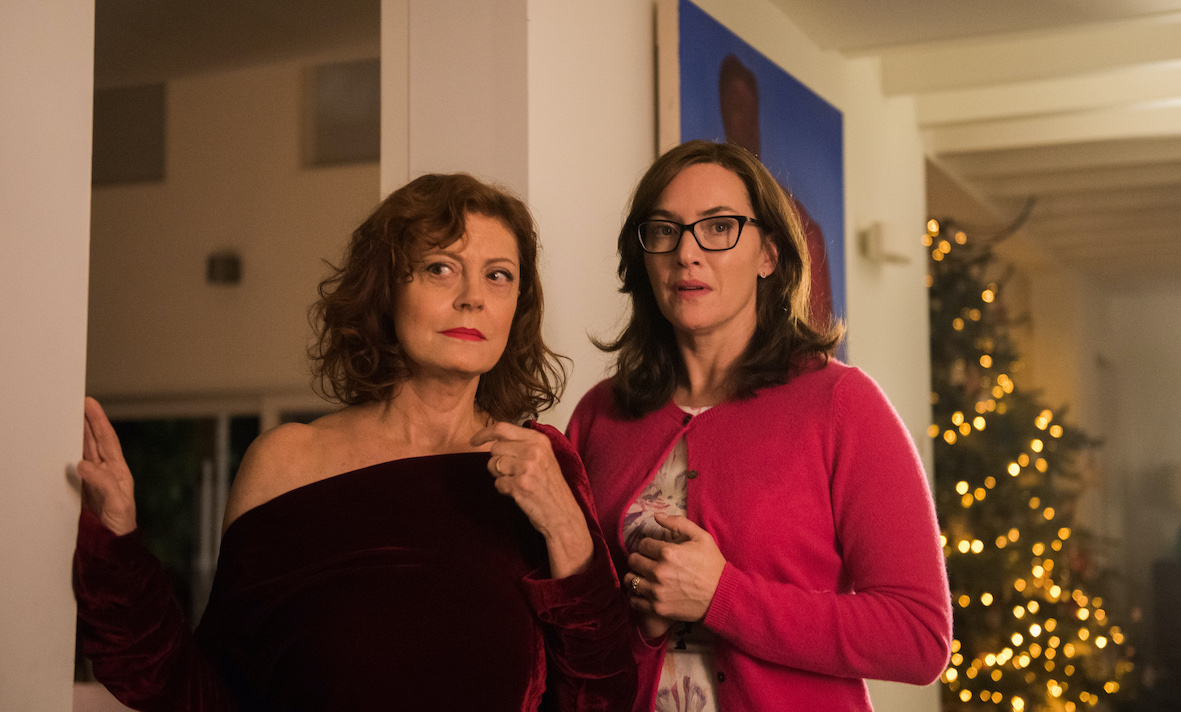
Susan Sarandon is amazing as Lily, a woman slowly losing her faculties and who has decided that at the end of a perfect weekend she will choose to die. The perfect weekend includes visits by her two daughters – Jennifer (an unrecognisable Kate Winslet) with husband Michael (Rainn Wilson) and their teenage son Jonathan (Anson Boon); dysfunctional Anna (Mia Wasikowska) and her female partner Chris (Bex Taylor Klaus). Also along for the ride is Lily’s best friend Elizabeth (Lindsey Duncan) as well as her loyal and handsome husband Paul (Sam Neill), who has always been by Lily’s side.
The family is not a perfect one – Jennifer has controlling issues while Anna has never been truthful and transparent about her life. Sure she’s in a same sex relationship but there’s been times where she’s fallen off everyone’s radar – but Lily is still proud of both of her strong daughters who she raised to be just like her. But as the clock ticks to the final moment we know is coming, there is some excellent family time around the house, including the emotional ‘Christmas Dinner’ they have which is Lilly’s last evening meal. There is also lots of tension when several unresolved issues are revealed. ‘Blackbird’ is hard to sit through – it’s very emotional and very real, but up until the end, when every truth has been told and every tear has been wept, Sarandon still holds the screen – and our attention. It’s one of her finest film performances.
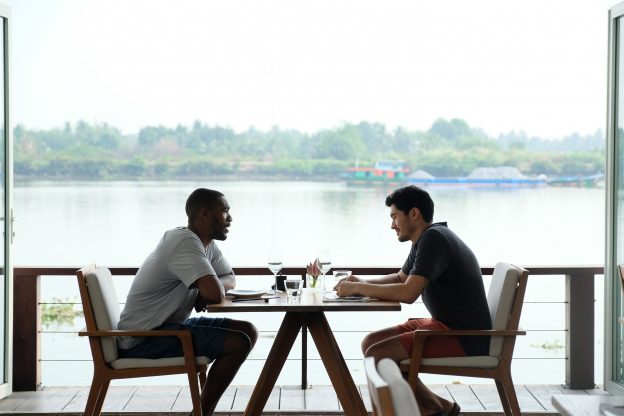
In Monsoon a young man of Vietnamese descent, who now lives in Britain, returns to Saigon to return his mother (her ashes) to her home country, a country her and her husband fled during the Vietnamese war. But Vietnam is also a country that Kit (Henry Golding) also knows very little about – he was 5 when they left. So his return to the home country is a poignant one, his father has also died and Kit’s brother is bringing their father’s ashes so him and Kit can bury them together. While Kit returns and visits old friends of his and his mothers, he falls for American Lewis (Parker Sawyers) and establishes a semi-relationship with him. While the gay storyline is a bit irrelevant to the focus and mission of the plot, it’s played out against the backdrop of a city full of traffic, noise, people, motorcycles, and beautiful sunsets that linger in the horizon.
Monsoon also brings us lulled moments – quiet and contemplative – in a film that’s oh so short at 85 minutes.
Henry Golding (Crazy Rich Asians) is good in the role – but the film itself could’ve explored more of his background and his relationship with his family (perhaps flashbacks) to give more of a background into his homosexuality. In all, if you’re looking for a meditative and quiet film, this film is for you.
A young man tries to find his way in life after the sudden death of his mother in the new film Socrates.
Socrates, now in cinemas and streaming online, is an emotional and sad story of 15-year old Socrates (Christian Malheiros), who with his mom, a cleaner, live on the margins of society in a favela in São Paulo. His sick mom suddenly dies in their small apartment, and leaves Socrates alone, and crushed. Determined to make it on his own, he does everything he can to find a job to pay the rent, which is way overdue. He even tries to take over his mom’s job but, being underage, the boss says it is not possible. With nowhere to turn, he ends up getting a construction job, where he hauls equipment back and forth.
His co-worker, Maicon (Tales Ordakhi) picks a fight with him, but this is a distraction because Maicon likes Socrates, and suddenly (perhaps a bit too sudden), Socrates finds himself at Maicon’s apartment where they fall into each other’s arms and get it on. In light of this unbelievable plot point, Socrates still has to struggle to pay the rent and survive, and when his long lost father shows up to take him (as he is a minor), Socrates runs away. Things go from bad to worse when he is kicked out of the apartment and has nowhere to live. With no help from social services, and not wanting help from his father, and with Maicon busy with other responsibilities, Socrates fights to survive in a world that seems to be putting roadblocks in his way.
Executive produced by Academy-Award nominated Brazilian director Fermando Meirelles (‘City of God’), ‘Socrates’ brutally shows us what it’s like to grow up poor (and gay) in one of the worlds largest cities. Malheiros is superb as the downtrodden Socrates (he has won two film festival awards for his performance and won the ’Someone to Watch’ award at the 2019 Independent Spirit Awards), while other cast members hold their own. Directed by Alexandre Moratto working with a script written by himself and Thayna Mantesso, Socrates is a film you won’t easily forget.
And while the gay aspect of this film is unbelievable and a bit irrelevant, the story as a whole is about resilience, perseverance, and hope against all odds.
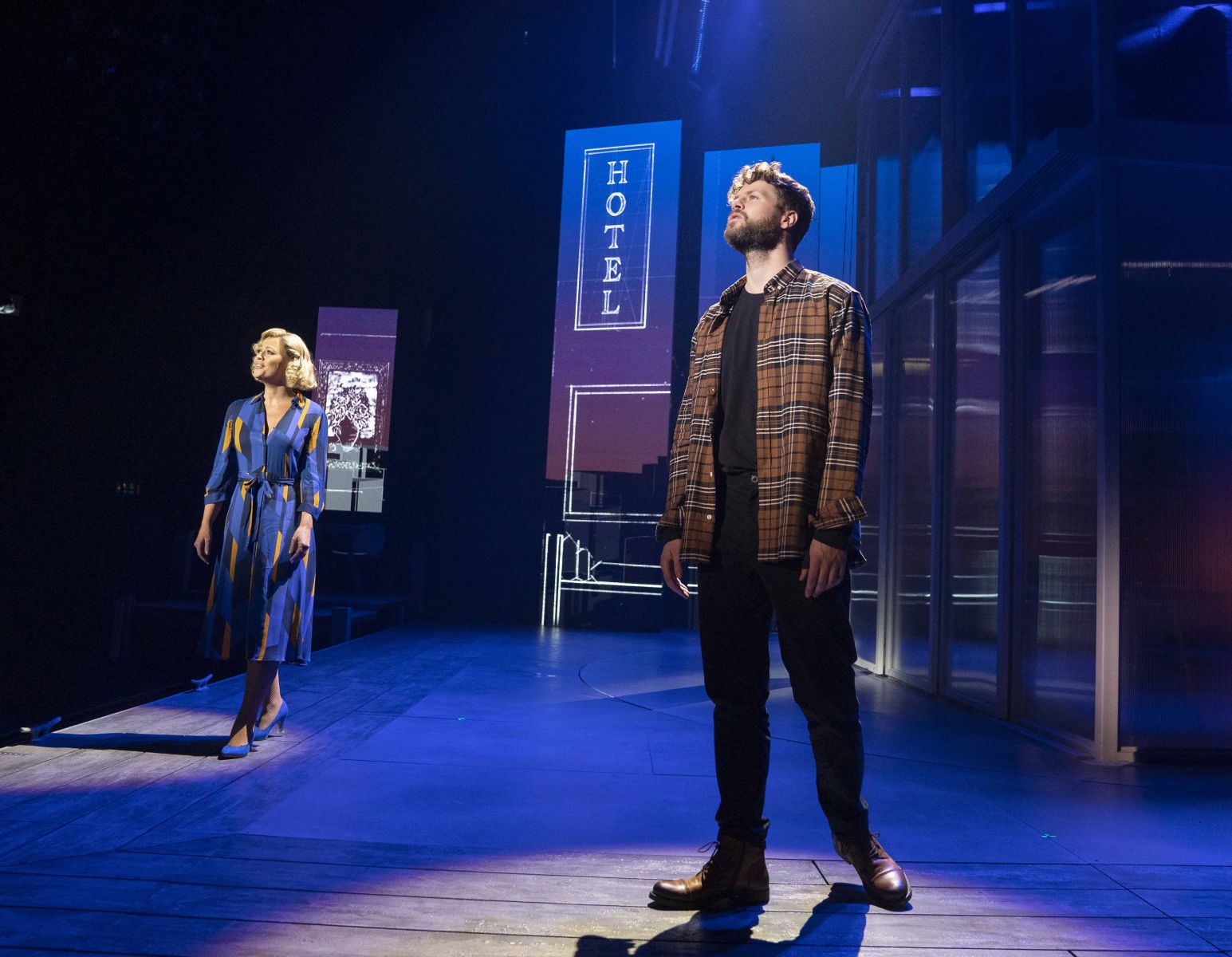
Sleepless the first major stage productions to open up in London in 6 months (Regent’s Park Open Air Theatre opened in Mid-August with Jesus Christ Superstar). Originally scheduled to open on April 1st, it was sidelined, like all other productions, until further notice. But now it is here, and it’s a fun and lively show that will keep you entertained and emotional, not just because of the romantic plot but also because it’s a real live show that you’ll be watching, and not a taped show on your laptop!
Playing at the Troubadour Wembley Park Theatre, in, yes Wembley (not quite the West End), Sleepless is based on the 1993 hit film Sleepless in Seattle (which starred Meg Ryan and Tom Hanks). And while stars Jay McGuiness and Kimberly Walsh are no Hanks and Ryan, they make a fantastic pair as a man and woman who are destined to be together.
If you don’t know the plot, McGuiness is single father Sam. His wife passed away a year ago and he is left with young son Jonah. Jonah calls into a radio station to announce that his father is available to meet someone new, very much to Sam’s dismay. Enter Walsh’s Annie, a journalist about to be married to the dull but romantic Walter (Daniel Casey). When Annie hears about Jonah’s plea, she somehow feels that for her it’s a true calling, and she decides on a rendevous time and place in the hopes that Sam will be there and then. Of course, Sleepless ends on a happy note, and without giving too much away it’s happily ever after, with toe-tapping songs and a very good supporting cast to get us to the happy ending. While it’s not quite award-winning stuff, it gets my award for bringing a smile to people’s faces, and for ambitiously opening up.
The seating capacity at this very large and very new theatre has been reduced from 1,300 to 400. Masks are required to wear while inside the auditorium (including the bar area), temperature checks and track and trace are there as you walk into the compound, and the cast and crew are subject to daily testing. But it’s a magnificent theatre with a bar outside and inside and plenty of space to move around.
But here’s to producers Michael Rose and Damien Sanders for getting this show, a brand new one never been done before, up and running. Kudos to Michael Burdette for the book, Robert Scott and Brendan Cull (new British writers) for the music and lyrics, and the 12 piece orchestra. And kudos to the people you see on stage – they all make it look so seamless and easy, making us forget, temporarily, the events of the past 6 months.
This is what theatre is all about.
SLEEPLESS, plays at Wembley Park until 27th September 2020. Book tickets here.
Linga Franca follows the story of an undocumented Filipina transwoman Olivia (Isabel Sandoval) in Brooklyn’s Brighton Beach Russian neighbourhood.
Olivia is the live-in caregiver for elderly feeble Russian Olga (Lynn Cohen – remarkable). Olivia has yet to get her green card, and she’s vulnerable to getting kicked out of the country in Donald Trump’s fetish for kicking out illegal aliens – it’s his rhetoric and voice that permeates in the background of the film. Olivia’s best friend and fellow Filipina transgender friend Trixie (Ivory Aquino) has found happiness with a good-looking American man and is more or less guaranteed a green card.
One day Olga’s Grandson Alex (Eamon Farren) returns from being away for a year – he’s the black sheep of the family. He stays with Olga and Olivia in Olga’s house and gets a job in a meat factory owned by his uncle.
Sure enough you can guess what happens next. Alex is attracted to Olivia and perhaps all too suddenly they fall into each other’s arms and make love. But is this what Olivia really wants? She had just been dumped by a guy who promised her the world, and Olivia, who was at a loose end and desperate, should’ve welcomed this new man in her life, but she doesn’t. We never really get to understand what makes Olivia tick and what will indeed make her happy.
While Lingua Franca is a very sensual and provocative film, we never really get to the heart and soul of Olivia. And the love affair between Olivia and Alex is a bit too easy. And while the direction and writing by Sandoval herself are delicate and moving, she brings us into an already chartered territory (it’s hard to top 2017’s ‘A Fantastic Woman’).
Lingua Franca may frustrate you a bit but it’s saved by terrific acting – especially by Cohen (she played Miranda’s housekeeper in ‘Sex and the City‘), who unfortunately passed away earlier this week.
Electric motorcycles; The future or the devil’s work? An inevitability or a passing phase?
Ever since I visited one of Europe’s largest electric motorcycle dealers, English Electric Motor Co, I have been hooked. They graciously facilitated my inauguration to electric motorcycles.
There is, however, no substitute for living with a bike, so Zero was kind enough to lend me their SRS press bikes for a while, to give me an opportunity to do a real-world review.
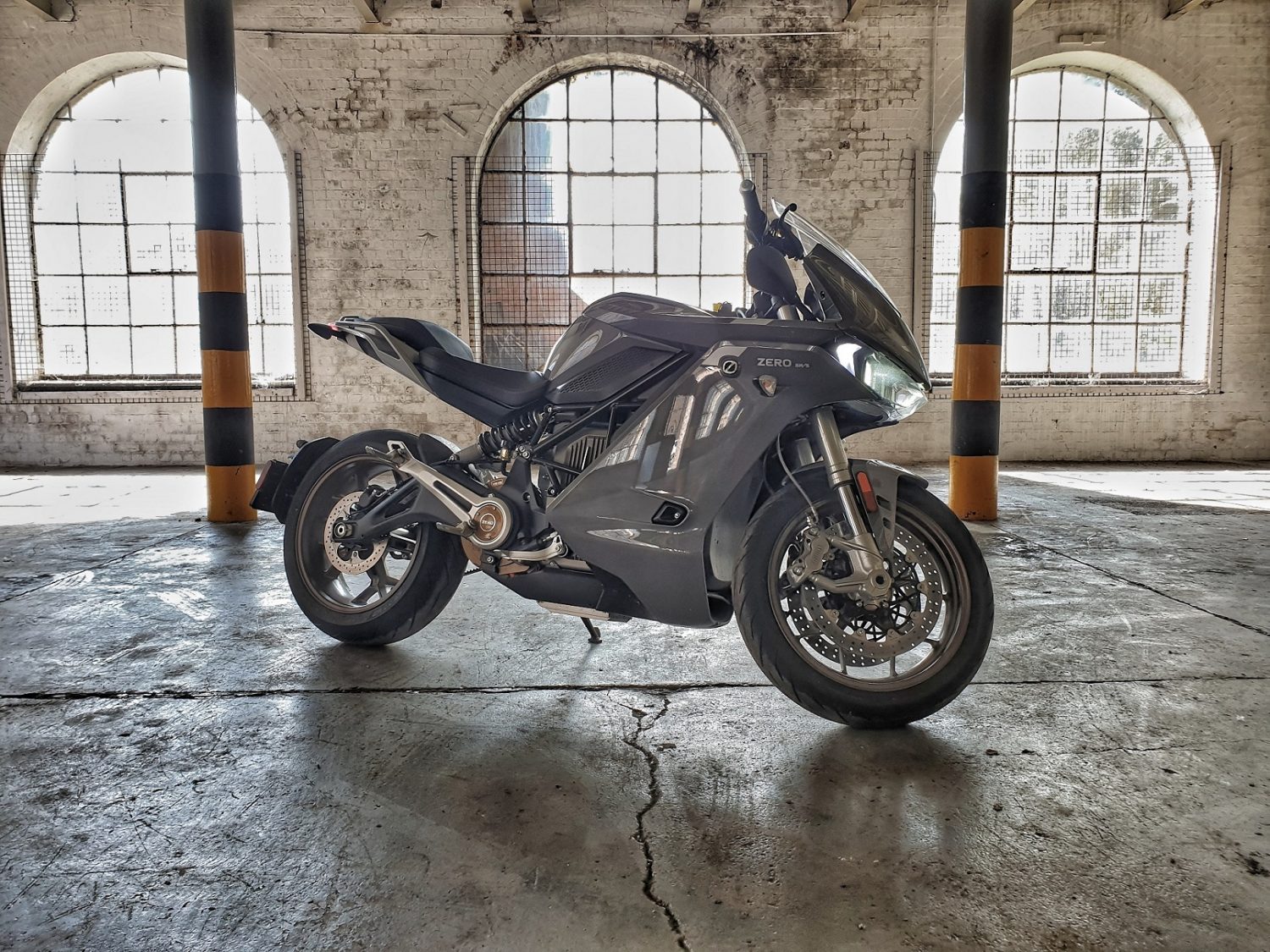
Zeros’ SRS is a fully electric motorcycle, like all of their bikes, and in the Zero stable, the SRS is the biggest, most expensive, most capable bike they make.
Let’s run through some statistics. This bike weighs 230kg, which is around 20kg heavier than a conventional ICE (Internal Combustion Engine) motorcycle. For example, the Suzuki GSX-S1000 is 209kg and the Yamaha MT10 is 210kg, not bad at all.
Power is deceptive and stated as 110bhp, which doesn’t sound like much. Don’t let this dampen your enthusiasm, rest assured you won’t be disappointed in the performance from this SRS. To add some perspective, a Ducati Panigale V4 makes 123Nm torque, the BMW 1000RR makes 100Nm torque. The Zero SRS make 190Nm of torque… yes… 190Nm!! Make no bones about it, in sport mode, this bike is seriously fast.
Bear in mind also that the power and torque from an electric motor are delivered in a different way to an ICE engine. On a traditional motorcycle, as revs build, generally power builds too. With an electric drivetrain, the power and torque are linear, meaning you have very strong power available from the moment you twist the throttle if you want it.
Interestingly, it carries its weight quite low. Most of the weight is in the battery and motor, which is all below your knees. What would be the fuel tank on an ICE bike, is the storage box for the charging cable on the SRS.
Let’s talk about range. It’s usually one of the first questions people ask about electric motorcycles generally. It’s actually really hard to answer. This isn’t an excuse or me trying not to answer. There are a lot of factors that affect the range, such as temperature, riding style, type of roads and more. Batteries perform worse in hot weather for example and if you ride aggressively and in sport mode all the time, your range will suffer. The same applies to sustained high speeds such as motorways or dual carriageways, where the constant draw on the battery takes a toll on the range.
When I first collected the bike, I inevitably selected sport mode and spanked it for a few miles, quickly discovering the negative impact this had on the range. Fast forward a few days and by riding a bit more carefully, switching modes to soften the power and regenerate electricity in traffic, I could easily see 110 miles+ on a mix of roads.
Talking about rider modes, there are 5 on the SRS. You have the full-fat Sport mode which lets you have all of the power with reduced regenerative braking. You still have ABS and traction control though (which is a good thing). Next is Street mode, which offers slightly reduced power and increased regenerative braking. This mode is great for general riding. Next is Eco mode which restricts power and offers maximum regenerative braking. Top speed is restricted to 75mph. I use this is traffic to extend the range when there’s no point in using street or sport modes. There is also a rain mode which has the softest power delivery and least amount of regenerative braking. Rain mode is designed for low traction conditions.
Lastly, there is Custom mode. This is a mode that you can personalise, for example, maximum power with increased regenerative braking. You can also rename it. The team at English Electric Motor Co customised theirs and called it Beast mode.
Zero have taken a fairly traditional approach to styling on the SRS. They could have taken a more radical, futuristic approach, but I really like it, it looks great. There are some neat touches like the mirrors. They are mounted low on the fairing below the handlebars and actually look under your arms. It sounds odd but they are very effective. Quality of components is construction is outstanding. The bike is excellent and feels very premium and it’s the easiest bike to ride. Controls are absolute simplicity with no clutch, no gears and just brakes and throttle. The throttle is progressive and very smooth.
Handling is superb, this thing corners so hard. It’s a little short, but I like that, it helps to deal with the poor condition of our roads. The suspension is fully adjustable Showa front and rear and brakes are J-Juan radial callipers and are excellent.
“How long does it take to charge?” is another common question. Let’s do some man maths. The battery is 14.4kwh. Think of it as a fuel tank. If you charge up from a domestic 3 pin plug, you will see a charging rate of 2.3kwh. That means that every hour, 2.3kwh flows into the 14.4kwh battery, simple. Think of kwh as litres if you like. If the battery was empty, on a 3 pin plug it would take just over 6 hours to fully charge, which you would typically do at night when the electricity is cheap.
The maximum rate you can charge the battery is 6.6kwh on a type 2 fast charger such as the ones at supermarkets, shopping centres and fast-food restaurants. This means, if it was completely empty and you used any fast charger, regardless of the rating, it would charge the SRS at 6.6kwh and it would fully charge in just over 2 hours.
In reality, it is unlikely that people will fully charge ‘on the go’, but instead, maybe top-up.
On one of my rides, I stopped at a shopping centre in Milton Keynes and topped up for 30 odd minutes. In that time I increased the battery charge by 20%. It was simple and free.
Another big bonus of running an electric motorcycle is running costs. At home, you will probably pay something like 6p/kWh for your electricity. Let’s say 10p for the sake of man maths. If you charge at home, from a 3 pin plug, at night, a 14.4kwh battery will cost £1.44 to charge. Even better, if you charge at a shopping centre or McDonald’s on a fast charger, it’s usually free.
In addition to the minimal running costs, servicing is a far more economical affair. Remember, electric drivetrains are simplicity themselves. Very few moving parts, just an electric motor. No gearbox, no complicated engine with hundreds of moving parts. Servicing tends to be consumables such as brakes, tyres, drive belt and so on. The battery has a 5-year warranty and after that, is expected to last the lifetime of the motorcycle if looked after correctly.
To sum things up, the Zero SRS really is a great motorcycle. It is outrageous if you want it to be, or it can be a pussycat. It’s incredibly easy to ride and very well built. It’s pretty practical but not suitable for everyone. I love it and am very pleased to have had the time to get to know it.
Subaru has kept things very simple with the Levorg. There is one body style, one engine option, one trim level and one gearbox.
Actually now there are 2 engine options, but we’ll come to that.
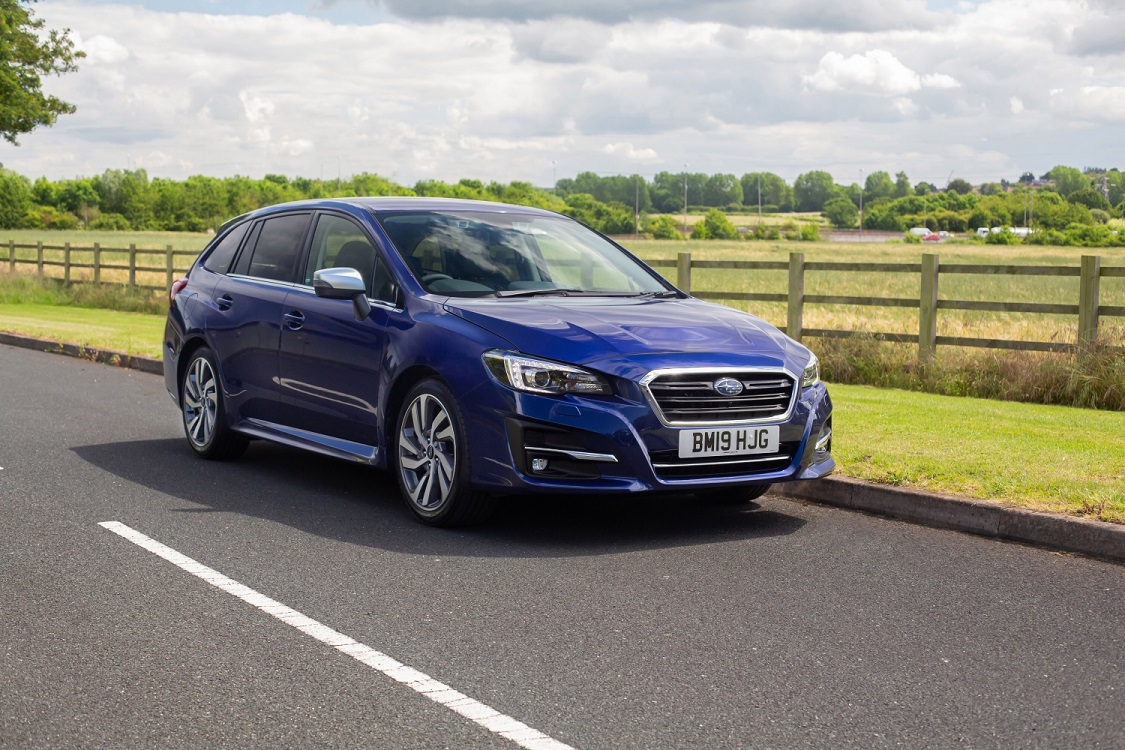
The body style is estate car, the trim level is GT, the engine is a 2.0 L petrol boxer engine which produces 147bhp and 198Nm torque and the gearbox is a lineartronic CVT (constantly variable transmission). This is basically an automatic gearbox but doesn’t have set gear ratios like a conventional automatic gearbox.
With the Levorg, Subaru seems to have had a keen eye on active and passive safety. This is a very safe car with a 5 start Ncap rating.
Literature and advertising around the Levorg point towards the active and passive safety features of the Levorg. To that end, it has just about every safety aid that you can find on modern cars. For example, it has Subaru’s EyeSight which is a form of driver-assist technology, a vision system working through a pair of cameras at the top of the windscreen monitoring the outside world, which feeds into the safety aides in the car adaptive cruise, pre-collision braking, pre-collision throttle management and lane keep assist with saw warning.
This is a lovely car to drive, very smooth and the suspension is on the comfortable side of sporty. It’s not softly sprung which would bounce you around, but it’s not to stiff so doesn’t jar you or crash over potholes. Although the 2.0L boxer engine produces 147bhp, maybe it’s the CVT gearbox, but it isn’t fast. It’s fine around town, with plenty of initial acceleration, but when the road opens up and you want to press on, there’s not a great deal there. Then again, that’s not what the Levorg is about. Subaru symmetrical all-wheel drive is standard. On the Levorg it is a road-biased system which means it doesn’t have the off-road electronics like x-mode. Symmetrical all-wheel drive means that the drive shafts are all equal lengths and the engine and gearbox are placed further back for better weight distribution. This means power is transferred to all of the wheels equally, resulting in better road holding. The boxer engine also sits low, keeping the weight low, reducing body roll. It works well and holds the road very well.
It doesn’t have a great deal of ground clearance, and there is a subtle body kit on the car, so I wouldn’t be keen to take it off-road like the Forrester for example.
The interior is excellent. Our test car had covered something like 11k miles and was like new. No rattles or squeaks and nothing broken, it really is a quality interior. The seats are full leather front and rear and are electrically adjusted and heated. They really hug you and are quite sporty but are nicely shapes and very comfortable. When you climb in, it feels great. You will find leather on the seats as mentioned, on the doors and centre console and some on the dash. Where there isn’t leather, the plastics are a high-quality soft touch.
Our test car came in dark blue pearl, which I felt really suited the car. Exterior styling is sleek and sporty, but if I had one criticism I would say it’s a little anonymous.
In summary, the Levorg drives well, is well priced, looks good, it’s not quick and handles well, in fact, it could easily handle more power I’d say. Maybe one day we’ll see an STi version.
Trump built his Aberdeenshire, Scotland golf course in 2012, disturbing the land and making life hard for the people who didn’t want to sell their land to him. One of these people is 96-year-old Scottish widow Molly Forbes who the billionaire says reminds him of his own Scottish mother. She scoffs at this. She is no Trump lover, and neither is filmmaker Anthony Baxter. But Trump was cruel enough that he had her water supply cut off because the pipes to her water supply ran through his golf course property, so for five years Forbes, and her son and his wife who lived nearby, had no running water. In interviews with Trump himself and his son Donald Trump Jr., we see the Trumps pretend to care but in reality, they don’t, and actually lie to the cameras in true Trump style.
Filmmaker Anthony Baxter was arrested and thrown in jail when he first discovered the water supply to Molly and her family had been cut off by Donald Trump’s workers while constructing a luxury golf resort near Aberdeen. The charges were thrown out and the police forced to issue an apology. However Baxter is astounded to learn Molly and her son Michael – who Mr Trump branded ‘a pig’ – is still without a reliable water supply half a decade on.
However, when the film was completed, the Trump Organization threatened any cinema that showed it. The US distributor then pulled out – denying the film a proper theatrical release or broadcast. But now Journeyman Pictures is releasing the film worldwide.
You’ve Been Trump Too is a remarkable document of what we know about the man who runs America – he is a liar, crook and as Forbes, son Michael says – “full of bullshit.” It’s a film about the little people who stand no chance against the Trumps, especially against a man as evil and conniving as Trump.
You’ve Been Trump Too is the film Donald Trump doesn’t want you to see. Hopefully with the U.S. election coming up soon, the world will be rid of him.