This year’s Eurovision Song Contest host, Ukraine has just banned Russia’s act from the country.
Russia’s Eurovision entry, Julia Samoilova has been banned from appearing at the competition as it emerges that shehas performed in Crimea.
The former Russian X Factor singer had been due to perform her ballad “Flame Is Burning” at the competition in May, however, Ukraine’s security services, SBU, have determined that her visit to the territory would be “illegal”.
Ukraine law forbids entering Crimea in order to perform.
According to sources around 140 other Russian artists have been blacklisted by the SBU following the annexation of Crimea last year.
Russia and Ukraine have been in dispute since the annexation of Crimea and the fighting in east Ukraine.
The UK’s Foreign office updated its advice for travellers to the Ukraine for Eurovision saying that it advised against travelling to Donetsk oblast, Luhansk oblast to the east of the country and Crimea in the south. It also warned that the UK was not able to provide consular services to any part of Donetsk and Luhansk oblasts and Crimea.
It tells travellers,
“Russian forces and pro-Russian groups have established full operational control in Crimea. Following an illegal referendum on 16 March 2014, Russia illegally annexed Crimea on 21 March 2014 and tensions remain high”.
The EBU has released a statement about the decision to ban Julia Samoilova saying,
“We have to respect the local laws of the host country, however we are deeply disappointed in this decision as we feel it goes against both the spirit of the Contest, and the notion of inclusivity that lies at the heart of its values.
We will continue a dialogue with the Ukrainian authorities with the aim of ensuring that all artists can perform at the 62nd Eurovision Song Contest in Kyiv in May. “
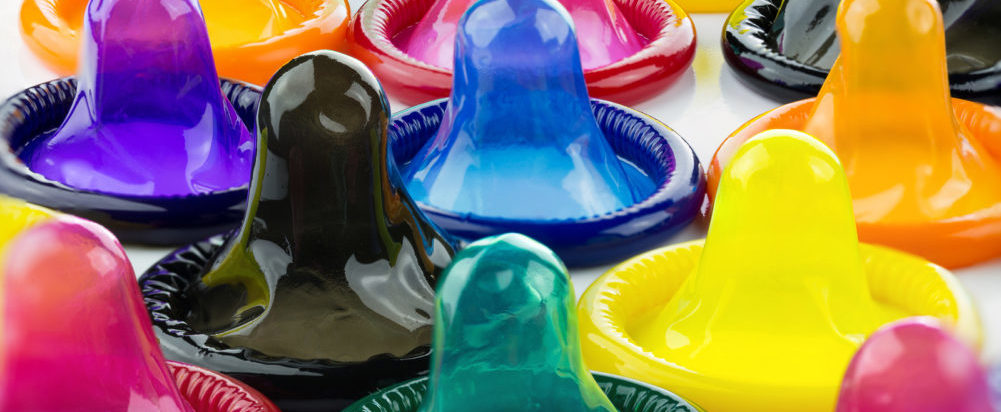
Durex condoms are to be removed from stores in Russia after the product was found to be incorrectly registered.
Concerns are rising in Russia that sexually transmitted infection could spread across Russia after Durex maker Reckitt Benckiser has been forced to withdraw the popular Durex brand because the product’s paperwork was not “registered in the proper manner,” said Mikhail Murashko who heads up the federal healthcare watchdog.
The condoms could be back in Russian stores soon, but only if Reckitt Benckiser follows the correct registration procedure.
Murashko said that access to condoms should not be a problem for Russians, as Durex is just one of sixty brands available for purchase in Russia.
However, according to The Guardian, Durex accounts for one-quarter of all condom sales in Russia – but Durex’s withdrawal could potentially affect the public’s access to safe and rigorously tested condoms.
Monday morning and the phone rings. It’s Russia on the phone. Well Russia Today to be more precise. RT is the Russian Government funded television network. They’re offering me an interview with one of their journalists. It doesn’t seem the obvious choice, I have to say.
Russia and homosexuality haven’t had the best press in the last 5 years and a string of actions, commencing with the Country’s President, Vladimir Putin, enacting an anti-gay propaganda law, the broadcasting of Channel 4’s horrifying Hunted documentary, the Sochi Olympics and numerous anti-gay attacks and even the alleged murder of an LGBT activist have not done Russia’s perceived tolerance of gay people any favours.
The journalist in question is Martyn Andrews. Born 1979 in Liverpool, he’s a former musical theatre actor turned ‘man-on-the-street’ reporter and journalist. His main employer is the British speaking news service RT, which boasts the eyes of two and half million viewers in the UK. As well as RT, he’s a regular fixture for CNN and a print journalist for Condé Nast Traveller Magazine.
Ten years ago RT joined the world’s biggest media companies including France 24, Al Jazeera, Sky and, of course, BBC News in the race to form the go to news platform. These rolling news channels all giving their own voice and editorial comment to domestic and international news.
Martyn jokes, “I’ve always said, all these news channels on Sky or Preview, they basically all watch the same car crash.”
For 10 years he’s lived his life out in front of the RT cameras. He’s not short of words, his natural charm and inquisitive nature means that he’s perfect for getting to the nub of the story.
Although it wasn’t what he first planned, he had wanted to be an anchorman. He was invited to screen test for RT. At the end of the audition he was told he was “too vivacious” and his teeth too white to present the news. After not hearing from them for a month he sent a cheeky email outlining ten reasons why they needed to hire him right then and there – and they did.
On the 13th August 2005 he left England for Russia with a one-way ticket.
He’s a giant of a man, standing a proud 6 foot 3; his brilliant white smile is warm and engaging.
Based now in London, Martyn is key to RT’s cultural and human-interest stories. He’s gone from the “cookery guy, and the travel arty-farty cultural presenter, to actually talking about more political issues in society.”
“I did two cookery shows. I did Eurovision. I did a breakfast chat show. I did a live magazine show which is almost like The One Show. I’ve done a weekly series which was very popular for three years called Moscow Out. Who called it that God knows. I mean, isn’t that an oxymoron? Moscow Out.”
CREDIT: Monty McKinnen / THEGAYUK
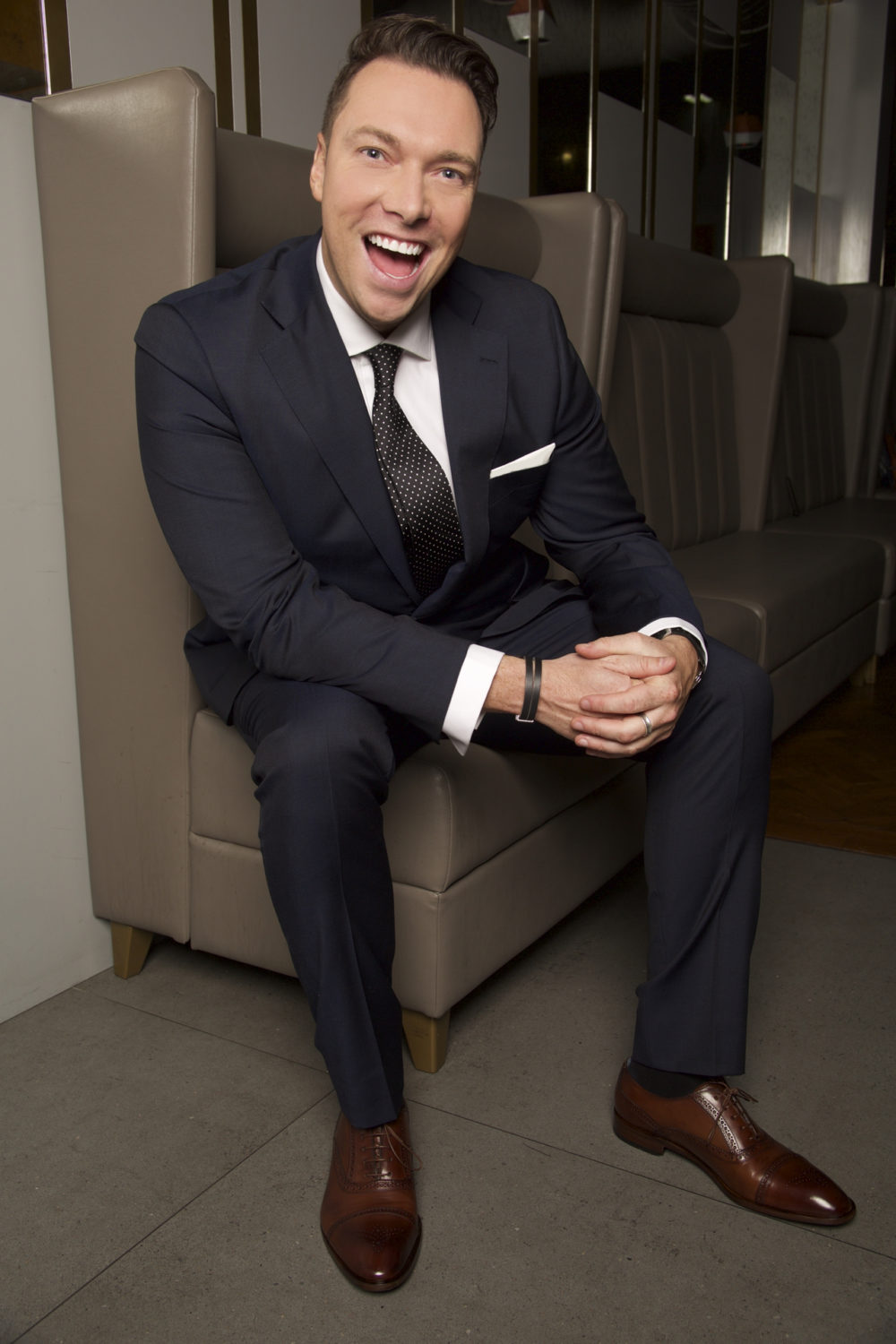
As we’re setting up for this month’s cover shoot, Martyn is relaxed but in control. He remarks that being all suited and booted isn’t his natural style. He’s more used to thick outdoorsy coats and the famous warm ushankas, the fur Russian hats. There’s a little self-consciousness that surprises me, yet he’s keen to play the jester with a sparkling tale or two about his time in Russia. When you speak to him about his work and his adventures he has a story or a line about everything. From climbing mountains to speaking with the locals about same-sex marriage, Martyn is, in his own words the “Gremlin in The Kremlin”.
“I have a crazy rule in my life and that’s I go to a different country every month”, he laughs and it’s quick to see why Martyn is a go to guy. His knowledge about travel is seemingly never-ending. “It’s not cheap. I fly and use everybody from Ryanair to random dangerous Chinese, African airlines, to Crack Air, to whoever.”
The man is on a mission to visit every country in the world before he dies and with 157 already marked off the list, he’s got just 39, depending on your source, countries left. We talk about the countries still left to conquer, North Korea is up there on the list, but he’s cautious about how he’d get in. They are, after all, notoriously paranoid about journalists entering the country. So are, it seems, many nations. He explains that he’s not always truthful about who he is or the nature of his travels and often forms an undercover identity. The less to do with journalism the better.
“I normally say I’m an accountant, with the whitest teeth in the world.”
He dumbs down his camera-ready style.
Arrests at immigration aren’t unusual for Martyn,
“I dumb it down. I come across boring, always appear monosyllabic (but) your personality will be, sort of, beaten out of you in immigration.”
Actual arrests?
“I’m normally arrested in most immigration and passport controls anyway because they say I’m a terrorist.”
One incident where he was frog marched off a flight to Australia during a layover in Los Angeles, he recalls that during his interrogation he told the police officer, “The worst thing I’m going to do to you is give you a bad manicure.” That, he says went “down like a lead balloon.” He was stuck in LA for 5 days, because Australian immigration had banned him for explanations not made clear.
So is he on government files?
“Yes! I am the Gremlin in the Kremlin. I mean, please”, he jokes.
Beside travel, Russia is Martyn’s passion and it’s clear, having lived there for nearly 9 years, he loves the culture, the people and shows a deeper understanding of its intricacies.
“I’m a strong Russophile and I will always culturally, kind of, defend Russia historically, emotionally, physically. Not that I think they’re right always, but just because I goddamn know that country better than anybody I know, including most Russians.
“I’ve dated them, I’ve lived and breathed it, from one star to five-star. Private jets with oligarchs to crazy poor students. I just know it so well. I get their objectives and their emotional reasoning behind what they’ve been through in the past 400 years. (It) really gives the reasons for the behaviour they have today.”
Having lived in Russia both pre and post the recent anti-gay law means that he has first hand experience of how life in Russia has changed for the gay community.
“I have a lot to say about Russia and the LGBT scene. Especially because it doesn’t come from RT telling me what to say. It doesn’t come from me reading a book. It comes from me being an out gay man living in Russia for eight years, ten months. All of it is from personal experience.
“Also, it doesn’t come from me living in this celebrity bubble, or me living a five-star expat lifestyle.
“When it comes to gay lifestyle in Russia, first of all, the rule was absolutely stupid. The law was wrong.”
The law he’s speaking about is the one that Putin’s government introduced in 2013, forbidding the promotion of “none-traditional” sexual relationships to anyone under 18. It has been described as similar to the UK’s Section 28 law, back in the 80s.
“It never should’ve been brought in. It was brought in the year before Sochi (Winter Olympics) happened. The worst decision. I’m against any kind of law that is detriment to the progression of any LGBT community.”
CREDIT: Monty McKinnen / THEGAYUK
With the spotlight on the Winter Olympics in Sochi, LGBT rights in Russia became a high-profile matter. Vodka was being poured down the world’s drains and brands associated with the event were boycotted. The media went to town on how unprepared Russia was for the Olympic brand and all it stands for. Russia was under attack.
“You have to understand the paradoxical contradictions of lifestyles in Russia”, explains Martyn.
“You have to understand the history of where it’s been. Because somebody reading about Russia in Leeds, for example, really just sees Russia. They look like us, they seem to act like us, they don’t seem to be as far away as some general African country.
“I think because they look like us, people think they are connected to us in this kind of European way, but they’re not.
“They’re not Europeans. I mean, Russians think they are or they want to be. You know, people say Moscow’s the biggest city in Europe. It’s not really, it’s actually Eurasia.
“At the same time, in the last 20 years where religion has been on fast-forward, so has the ‘I want to show off my new wealth, my new money, my D&G blingy’ kind of, you know, the typical Russian you see in Chelsea. Russians are party animals. I say that because they live like there’s no tomorrow. Because they didn’t for the last 100 years. And I say that politely regarding their lifestyle of culture, but I also mean that sexually as well. I’m trying to say this in a polite way. They are adventurous, I’ll say that.”
More so than the British?
“I mean far more than Brits are actually.”
Do the gay men in Russia have sexual hang-ups? Are they all defined roles?
“When it comes to Russians, gay men especially, in fact men have huge masculine hang-ups. I think that comes from the fact that the woman’s role in society has a much stronger position than we do in the west.
“It’s like the old Russian granny. 27 million people died in the Second World War. Most of them were men. Most men today in their 40s and below were really brought up by their Russian granny. When people kind of think of old Russian women throwing rocks at gay parades and things, they just come from a complete different mind-set than my grandfather did in Liverpool.
“When I came out to my grandmother 10 years ago she said ‘Good for you son. You gay men get more sex than anyone.’
“You can quote that because it’s just a fabulous thing. She died last year, but I always say that was one of the best things she ever said to me.
“She didn’t have the Soviet hard, communist, repressed life that most, if not all, well all actually, women in Russia had. Throw that in with the tumultuous, real sort of party, debauched, blingy world of modern-day Russia and it comes up with this crazy cultural vortex of crazy, misunderstood identities.”
CREDIT: Monty McKinnen / THEGAYUK
Since the anti-propaganda there has been an influx of negative press about the treatment of gay men in Russia. Channel 4’s Hunted series exposed how some gangs are using hook up apps and websites to falsely arrange dates and then beating, blackmailing and abusing gay men in particular. I ask Martyn his view on Russia’s homophobia.
“Having lived there, I don’t really see much difference between Liverpool in the 80s or 90s and modern-day Russia. It’s not illegal to be gay in Russia. 76 Countries it is illegal. I think that most media establishments jumped on the fact that Russia brought this in because of a political stance.
“Actually, you can be happy and gay in Russia. I have friends who are out in Russia and have amazing, fabulous lives. It’s far more cosmopolitan, and western, and safe than people think.”
And are you out to your work colleagues?
“I was out and the entire world knew, all my camera guys knew I was. They all sort of, when I left, patted me on the back and gave me hugs and said that I was their favourite. I think actually homophobia gets confused with ignorance.
“I will always say that I know from my personal experience that having met people, camera guys, or producers, or whoever, Russians who met me for the first time… And not that I go around singing, looking like Liza Minnelli, wearing a bright pink scarf. I’m really quite open and confident with who I am, what I am, etc. Actually, give me two or three days with somebody and I’ll show them that I’m a nice person, I’m fun, you can have a good time with me. I’m kind to them. Actually, after three days they don’t give a damn who I am, what I am. They just care about the relationship they have with me.”
So can a gay man be out?
“I think that is… It’s a little bit don’t ask, don’t tell. That is the contradictions of Russian society. I can honestly say that I have no negative experience in almost nine years. I wasn’t attacked. No homophobia at work. I didn’t see any attacks in any gay clubs. I actually made this statement, I always say this, I actually think that Moscow is safer than London.”
Our attention turns to Sochi. In the run up to the winter Olympic much was made of what the Mayor had said, and with some certainty that there were no gays in his town, despite one of Russia’s oldest gay clubs actually residing in his town.
“I know the Mayor and the Mayor’s an idiot. He probably is homophobic and that’s ridiculous. Of course there are conservative, ridiculous people like him, but there are also millions of other Russians that are traveling around. Even though the fall of the ruble, the ruble being half, has greatly affected them. If anybody goes on holiday now to Egypt, probably not the best place for an example, but Thailand or Miami, you will see hundreds of Russians. That’s because they spend like there’s no tomorrow and they all love holidays, and they all escape the cold. Actually, they didn’t do that 20 years ago. The more that Russians travel, the more they will naturally be educated by their own experiences. I mean that in the millions.
“The huge gay issue was stratospheric I think. People pouring vodka down the drain even though vodka may be Polish anyway, and it’s produced in Warrington.
“The Commonwealth Games in Glasgow, I think there are 52, 53 countries in the Commonwealth. 42 countries in the Commonwealth it’s illegal to be gay.
“There were no protests. There was no media. There was no comment. There was no mention of any homophobia, or any resentments, or any banning, or any athletes pulling out, or any protests outside, or no embassies, or magazine articles about that. Nothing.
“I found that really interesting. That you’ve got Sochi, and Russia brings in this city law which was exactly, more or less, as the UK brought in 1988, and the world goes crazy.
CREDIT: Monty McKinnen for THEGAYUK
During the ’80s and ’90s Margaret Thatcher’s government implemented Section 28, a law, which meant that homosexuality could not be promoted in a positive light to anyone under the age of 18. During that time the gay scene in the UK went through an explosion. Hundreds of venues cropped up throughout Britain. It might be hard to draw a correlation between the two events, but marginalisation meant that LGBT spaces were necessary to create safe spaces, to create places where LGBT people could be themselves. Gay culture started to simmer. There were gay kisses on EastEnders and Brookside. Music from the likes of Boy George and Pet Shop Boys became mainstream. London’s Old Compton Street and Manchester’s Canal Street went from strength to strength.
Martyn theorises about queer culture in Russia,
“I think it will bubble along from being a sub-culture to mainstream. The best example of that is Section 28. Margaret Thatcher brought it in 1988 and then you’ve got all the fabulous Soho bubbling scene of the 80s, and Heaven, and Boy George, and all that.
“Even though Section 28 was in place, the sub-culture of Soho and other scenes around the UK, bubbled up… I would say 99% of gay men in this country probably don’t even know that. I know that because I’ve had so many interviews. I’ve done all my research. Basically it’s proof that you’ve got idiotic politicians bringing laws, dictating what you can and can’t say to kids, but actually at the same time the social behaviour actually bubbled along by itself.”
So could Putin’s anti-gay promotion law be actually good for gay culture?
“I’m not saying that the law is a good thing in any way at all and I never have. No, I’m not. I think it’s a bad thing.
“What I’m saying is I think that Russia in comparison to Africa, far eastern countries, South America, Middle East, etc. Where they’ve got real problems regarding homophobia. I think that Russia was actually happily bubbling along as it was before everybody went crazy about it.
“Russia really is not that much different to Poland, to Latvia, to Estonia, to Ukraine, to Moldova, to Romania, to all those, even further over to Croatia. It’s all that Eastern Europe block which really is in the shadow of us in Western Europe. But actually it was doing okay.
“Society dictates the law in Russia. It’s not the law that dictates society. It’s a different way than we work really. Meaning that it’s a very lawless place. If Russia brings in a seat-belt law on January the 5th, on January the 6th generally nobody has really done anything about it.”
So what does he think about Russia and its homophobia becoming a bit of Cause Célèbre? It drives him “bonkers”.
“If you want to speak to Putin then why don’t you speak to the 76 countries where it’s illegal to be gay because perhaps the millions of gay people there have more of a problem being thrown off of buildings. Or executed, or your head chopped off.”
I approach the question whether RT is a tool of the Government, and what it’s like to work for RT? His answer didn’t surprise but perhaps the tone in which he delivered the message was.
“RT has never told me what to say ever, ever, ever. I wouldn’t work for them; I’m not a puppet as you can probably hear. I’m quite opinionated and I’ve got strong opinions of my own. No editor or journalist or broadcast person would say to me ‘Martyn, you have to rewrite that to make Russia sound good’.”
He tells me that his friends presume that he is brainwashed by the Russian government. He recalls one friend who said that he would refuse to ‘put his money in the Russian economy’.
“I dragged him to Russia last summer and he walked around with an open mouth for five days because he just couldn’t believe what a glamorous, gay, fun, safe, wonderful, stylish city Moscow was. He said ‘Martyn, I just presumed you were completely brainwashed by the Kremlin.’
And so to his personal life, does his work schedule allow for a relationship, “it’s complicated” comes the answer and I’m told that within the last few years that his grandmother, mother and partner all died within a few years of each other. “I could write a book about grief. I’ve personally had the worst… That was really one reason why I left Russia because I had three in one, all very close to each other. Just going through some life shit.”
Grief, he tells me makes you ‘humble,’ that it makes you a little nicer.
“It makes you good. Too many people in the world are obsessed with their daily commute and the habits that they have. Life is far too short. I’ve really learned that in the past two or three years.”
In attempt to deal with his terrible losses, he tells me it’s why he travels so much.
“That’s why next month I’m going to India. In March I’m going to Ghana”, he quips.
And that journalist mind never turns off.
“I was in Colombia for the last two weeks and I thought, damn, I should have an entourage and a camera crew following me and sell this for a million pounds.”
This interview was taken from Issue 19 available on iTunes and through Android.
The Israeli entrant for this year’s Eurovision Song Contest, Hovi Star, has claimed that he suffered a homophobic reaction whilst in Russia to promote his song Made Of Stars.
Credits: Ronen Akerman
Singer Hovi Star, who is representing Israel in this year’s Eurovision Song Contest has claimed that passport control officers in Russia ripped his passport and told him that he couldn’t get into Moscow.
During an interview he said that he was surprised at the alleged reaction and questioned whether it was because he is openly gay, the way he dresses and that he wears makeup.
ADVERT
[adinserter block=”1″]
Speaking on Malta TV, Star said,
‘Maybe people in Moscow have a rough time with people like me, maybe because I’m gay, maybe because I dress like this, maybe because I wear make-up, I don’t know. But when I wanted to get into Moscow, I had problems with passport control. They told me I can’t go in, they looked at my passport, they ripped my passport.
Star also claimed that the two officers laughed at him.
‘It’s amazing that this happened in the Eurovision bubble because my song Made of Stars it talks about equality it talks about how everybody is the same, everybody was born the same, everybody will die the same.
During his interview in Malta, Star talked about how his song, Made Of Stars, is about equality and how everybody is born the same and dies the same.
The live studio audience erupted into applause at his speech.
‘Let’s take this as a lesson. I don’t take it personally, I really like Sergei Lazarov and I like Russia. This wasn’t a nice experience, we live, we learn, we continue, we smile and we give free love to everyone.’
Star was eventually let in to Moscow not before, he said, he had to go to the Israeli Consulate in Moscow to get a brand new passport.
TheGayUK.com reached out to Moscow Airport for comment.
The UK has lost its place as the number one place for LGBTI rights in Europe after Malta introduced a raft of new legislation.
New rules surrounding outlawing surgery on intersex children, education and civil partnerships have all added to Malta’s new position at number one on the ILGA-Europe’s Rainbow Europe
Malta is now ranks at #1 on LGBTI rights, scoring 89% across forty sets of criteria; the UK falls behind in second place on 86%.
Malta’s Prime Minister Joseph Muscat took to Twitter to welcome the news.
The UK still lags in a number of places mainly in not granting asylum on gender identity grounds, a legal requirement for trans people to get medical investigation before being allowed to change their gender and surgery to “correct” an intersex child’s gender.Down at the bottom of the list Russia and Azerbaijan score 8.35% and 5% respectively.
It had looked as though life for the LGBT community was about to be acknowledged in a meaningful way when Sir Elton John announced that President Putin was ready to talk about gay rights in Russia, however it turned out to be a hoax.
It had seemed that the Rocket Man singer had managed the impossible when he told the media that he had in fact spoken to Putin and been invited to Moscow to talk about gay rights in Russia. It soon emerged that Sir Elton had been talking with a prankster.
Here we have the audio of the English part of a prank phone call between Elton John and Vovan and Lexus the Russian comedians who pretended to be President Putin.
Prank Putin – Elton John Phone Call (English Only)
Last night in an interview on Russia Today Vovan and Lexus revealed it was actually them saying,
“We gave Elton what he wanted”.
The phone call itself did not outwardly mock Sir Elton, though towards the end did invite the popstar to Gay Pride in Moscow which has been banned in the country for years.
The Russian President was responsible for signing in an anti-gay law that forbids the “propaganda” of non-traditional relationships to anyone under the age of 18. Same-sex relationships are considered non-traditional in Russia.
In a curious twist, President Putin’s press secretary has denied Elton John’s revelation that the pair are to meet to discuss LGBT rights in Russia.
Legendary rock veteran Sir Elton had announced thatPresident Putin had agreed to meet to discuss the state of LGBT rights in Russia. However, the president’s press secretary has denied that Russia’s number one is to meet with the Rocket Man singer.
The Russian President was responsible for signing in an anti-gay law that forbids the “propaganda” of non-traditional relationships to anyone under the age of 18. Same-sex relationships are considered non-traditional in Russia.
President Putin has agreed to meet with rock legend Sir Elton John to discuss his nation’s legacy on gay rights.
Legendary rock veteran Sir Elton has asked President Putin for a debate on gay rights. The Russian President was responsible for signing in an anti-gay law that forbids the “propaganda” of non-traditional relationships to anyone under the age of 18. Same-sex relationships are considered non-traditional in Russia.
According to Elton, the president reached out to him after he branded his attitude to gay rights as “ridiculous.”
Putin apparently rang Elton yesterday to accept his invitation to discuss the deplorable conditions that gay people across Russia are finding themselves.
Since the introduction of the anti-gay law, attacks on the LGBT community have been numerous and there has been more than one alleged murder that has rocked the community in Russia.
The news of the meeting come as Putin gives a Russian State Honour to the vehemently anti-gay politician Vitaly Milonov, who was instrumental in bringing about the “gay propaganda” law. The Russian State Honour is the highest award that can be given to a civilian.
Vitaly Milonov has gone on record to call the Eurovision song content a “sodom show” and he branded Stephen Fry as sick over his suicide attempts in 2012.
This week has been a week of wonder… One that could either lead to greatness or mayhem. From Janice Dickinson promising to be a surrogate mother, to Jeremy Corbyn’s election as the new Labour leader.
1) Janice promises to be Austin Armacost and Jake Lee’s surrogate for any child they may have in the future… This is an interesting concept and won that we think would make an excellent reality TV show.
2) The first ever “test-tube baby” Louise Brown is delighted that gay couples can use IVF to start familes.
3) Elton John reaches out to President Putin to discuss ‘ridiculous’ anti-gay prejudice. According to The Guardian the Rocket Man has asked for 5 with the Russian Prez. We await the outcome. If Elton can achieve the melt down he did for Dolce And Gabbana, maybe there could be so movement, then against probs not.
4) This news site based in the deeply homophobic country of Nigeria suggests women could and should strap on a dildo and screw their men. Unsurprisingly the men in the poll aren’t so sure.
5) Jeremy Corbyn, who has voted pro gay issues since his induction as an MP, has been voted in as the new Labour leader.
6) The Daily Mail, thinks that Brits have won a “war” because famous women over the age of 70 haven’t had plastic surgery,
The US Embassy looks like it will defy anti-gay laws in Russia by adding a screening of I AM MICHAEL to a film festival it is sponsoring in September.
Amfest, which will run from the 16-27th September in Moscow and St. Petersburg announced that it added Justin Kelly’s directorial debut, I Am Michael, starring James Franco and Zachary Quinto to its line up of films.
I AM MICHAEL documents the true story of a gay activist who turns straight and becomes a Christian pastor. The film has won a number of awards including FilmOut International Film Festival – Best Film, Best Director, Best Screenplay, Best Actor, Best Supporting Actress, Best Supporting Actor
Although the anti-gay Russian legislation, which was introduced in 2013, doesn’t ban films about homosexuality it does become illegal if someone under the age of 18 should watch the presentation.