Having just returned from New York, I can reveal the best airport to fly into from the UK.
After an eight hour flight, the last thing you want to be doing is waiting 2 hours in an arrival queue. andychoinski / Pixabay
When you fly to New York there are two main choices of airport to fly into, the famous JFK which is actually in the State of New York or Newark Liberty International Airport which is actually in New Jersey, one State over. Despite this, getting into Manhattan from both airports is easy and takes around the same amount of time. So which are you best off flying into?
My last trip to New York, I opted to fly into John F. Kennedy International Airport – having previously only flown into Newark. It was a mistake. Despite the heritage of JFK and its incredible structures, like the old TWA terminal, the arrivals queues are long – very long.
As I already had an ESTA I opted for the re-entry queue, which on the face of it looked short, but in reality, there was just ONE officer, who was stressed, to say the least, checking everybody’s passports, including US citizens, reentry ESTA visitors, Armed Forces and diplomats. Except, the last two got priority over everyone already standing in line. It took me over two hours to get through to baggage claim from the door of the aircraft.
My partner who was travelling with me, who didn’t have a previously used ESTA had to use the main line. It took him 30 minutes longer. So in total, we had to wait two and half hours in queues before we even reached the arrivals’ hall.
You can check peak times and queue wait times at the AWT website. Skitterphoto / Pixabay
Perhaps this was a off day, however speaking to a representative from the airline at baggage claim, she confided that sometimes the lines were even longer – with an extra 45 minutes wait time.
Of course, it all depends on the time of your arrival. Many of the inbound flights from the UK arrive later in the day, which could account for the backlog. According to AWT, which calculates wait times at US airports, the busiest time in terms of passengers happens around 1 PM, 7 PM and 10.00 PM.
I have flown into Newark a few times and never experience this kind of queue. So in my opinion, I’d opt for Newark in New Jersey from now on.
We all know the drill. Before your flight takes off, you’ll most probably be asked to remove your headphones by the flight attendants, and the same again will happen as your plane prepares to land. But they never explain why.
Most people onboard oblige, but some will just pop them earbuds straight back in once the cabin crew have passed by and taken their seats. But a stark warning from an airline pilot on Quora, has us thinking maybe we all need to start doing what we’re told!
Sebastian Lender, who is an airline pilot, advises that if your plane should hit a flock of birds – known as bird strike, and you’re wearing headphones that are banging out the latest Justin Bieber tune, that you won’t hear the warnings from the flight deck or from the cabin crew telling you to brace for impact, which could lead you to receive catastrophic injuries like shattered shins, fractured arms, but perhaps worst of all, that the impact from the “vertical compression broke your back”.
Although rare, bird strike is a real threat to aircraft, particularly during takeoff and landings. One of the most recent high-profile instances of a bird strike causing an aeroplane to crash land was the US Airways Flight 1594, which crash-landed in the Hudson River in New York in 2009.
Luckily no one was killed or severely injured in that particular crash due to the professional actions and instructions from the flight deck and from the cabin crew, but there have been instances were crash landings have caused fatalities and horrifying, life-changing injuries.
So remember when your cabin crew tell you to do something, it’s always for a reason and shouldn’t be ignored.
If you’re flying into New York’s JFK airport, there are a few options on how you can get to Manhattan Island, both Downtown and Midtown. But there’s one way that’s super cheap and really doesn’t take any longer than a cab ride or airport shuttle.
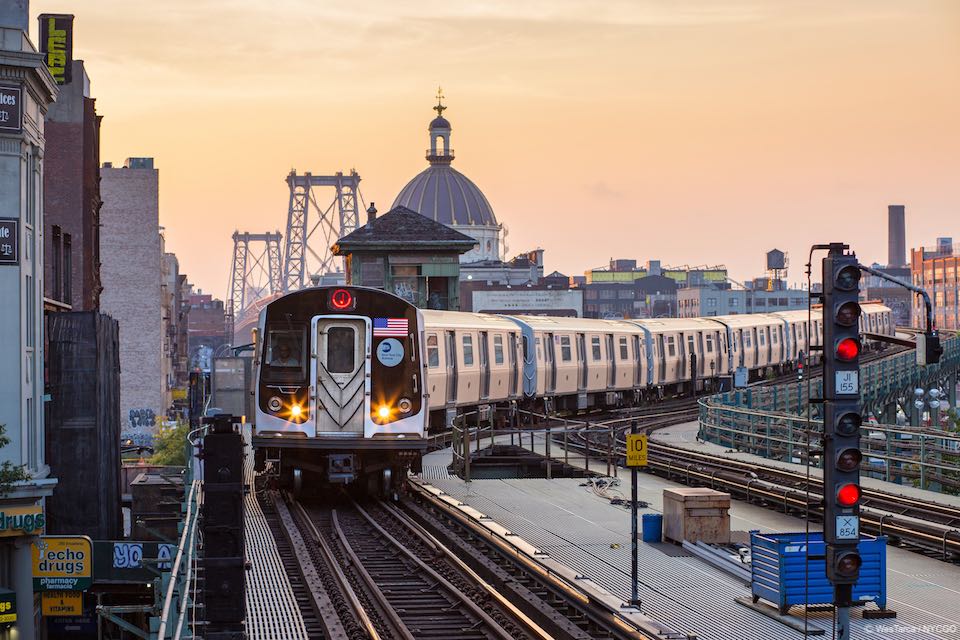
JMZ Train, Williamsburg, Brooklyn
If your hotel offers a shuttle from JFK, then you should get on board that baby, but if you’re looking at getting into Manhattan on a budget the best way is by the AirTrain which runs directly out of JFK and then catch the subway to your destination. It takes just under an hour – which if you’re caught in traffic to or from the airport, which is more than likely, it could end up being a quicker option. Obviously, it won’t be as picturesque, but you’ll definitely get to people watch and save a lot of dollars.
A cab ride into midtown currently costs over $60 and once you ad tip you’re heading towards $70 – it’s not the cheap way to start off your trip. Or, you can hop on the airport shuttle bus, you’ll find them in the arrivals hall, which is $18 each – so if there’s two of you that’s $38 – plus tip if you’re feeling generous. Or you can spend under $8 and get the AirTrain, which takes around 50-60 minutes.
How to access the AirTrain at JFK.
Subway, New York City
Look for the signs for the AirTrain, you’ll need to get the one that’s heading towards Federal Circle (which is where you’ll find Airport Hotel shuttles and car rental companies and onto Howard Beach Station. This section of your travel is free, so you don’t need a ticket if you’re getting off at Federal Circle.
If you’re going downtown and Lower Manhattan you’ll need the train heading to Howard Beach. If you’re going to Midtown or Upper Manhattan you’ll the Jamaica Station.
Once you arrive at Howard Beach or Jamaica Station, you’ll need to buy your ticket to leave the station and to get your onward travel to Lower Manhatten. Go to the ticket machine and buy a travelcard.
How much does the AirTrain cost from JFK to Manhattan?
It will cost $5 for the AirTrain (which you’ve just travelled on) and $2.75 for the connecting subway. You’ll also be charged $1 for a Metrocard, which you can refill and reuse each time you use the subway, so don’t throw it away.
Once you’ve cleared the gates at Howard Beach or Jamaica, head to the platform which has trains heading towards Lower Manhattan or Midtown.
At Howard Beach, you need to get onboard the A Train – on the Subway map it’s a dark blue colour. At Jamaica, you need to get the E train, it’s also dark blue in colour.
If you’re heading to Upper Manhattan you’ll need to make a change when you’re in Manhattan. Use the MTA’s TripPlanner to find the best route. Trips up to the Upper island will take another 15 minutes or so.
Maybe you shouldn’t kick ’em off just before take off.
You know the drill, you’ve settled in for your flight, you’ve got your thimble of champers (if you’re in business/first) the aircraft has just pushed back from the gate and you kick off your shoes and make yourself a little more comfortable. But one expert suggests that perhaps you should keep them on, at least for take off – and then again for landing.
Take off and landings are the most dangerous part of the flight most air crashes happens during takeoff or landing.
One expert on Quora has suggested that keeping your shoes on, could, in fact, save your life in case of an emergency.
Tony Luna suggests that after a crash a lot of debris could litter your exit route and that litter could include shards of glass and scraps of metal. Not having shoes on could literally shred your feet and stop you reaching safety.
Remember that scene with Bruce Willis in Die Hard?
If you’re thinking that you could just slip them on in the case of an emergency, Tony warns that in a cabin filled with panic and chaos every second counts. He explains, “during an emergency, all sorts of debris and unpleasant ground surface will block your way towards the exit, as well as outside the aircraft.
“If your feet isn’t [sic] properly covered, you’ll have a hard time making your way to safety.
“Imagine destroying your bare feet as your run down the aisle covered with broken glass, fires and metal shards. Kinda like John Mclane in Die Hard, but worse.”
But before we all melt into worry about flying, to put an accident into perspective, in 2017 there were no major air crashes involving a passenger jet. Flying remains one of the safest ways to travel.
Ryanair, the-world’s-favourite-squeeze-more-out-of-you airline is set to change its cabin baggage policy.
In a bid to tackle late departures, Ryanair says that passengers who haven’t booked a priority ticket, will only be able to carry on “one small” cabin bag – you will have to check your larger items.
Previously all passengers were allowed to take on two pieces of baggage, one small handbag and a larger suitcase like cabin bag, but that’s all set to change from January 15th. Now if you want both bags with you on the plane you will have to have a priority, Flexi Plus or Family Plus ticket. If you’re a standard ticket holder, your larger item will have to go in the hold – although that will be for free. The only catch is you’ll have a longer wait time at the airport at the end of your destination as you’ll have to pick it up from baggage reclaim.
Want to keep both sets of baggage with you on the plane? You’ll have to cough up €5.00 for a priority boarding pass, at the time of booking or €6 up to one hour before the flight.
It’s not all bad news though, Ryanair has lowered the price of its checked baggage from €35 to €25 each way and raised the limit from 15kgs to 20 kgs.
What will I be able to take into the Ryanair cabin with me?
If you are a standard, non-priority customer, you’ll only be permitted to bring on one small cabin bag. If you bring larger cabin bag, you will have to put it into the hold.
Your handbag must be no bigger than 35cm x 20cm x 20cm your cabin bag or suitcase must be no bigger than 55cm x 40cm x 20cm and 10kg in weight.
Time for change
Speaking about the policy change, Kenny Jacobs said,
“We will delay the introduction of our new cabin bag rules until 15th January 2018, to allow our customers more time to familiarise themselves with the policy changes. From Jan, we will be restricting non-priority customers to one small carry-on bag (their wheelie bag will be placed in the hold, free of charge at the boarding gate) which will speed up the boarding of flights and eliminate flight delays.
“We have already introduced the first phase of the new bag policy which offers our customers lower bag fees for a 33% increase in their check-in bag allowance. This will lead to fewer customers with 2 carry-on bags at the boarding gates, which is causing flight delays.
“The new cabin bag policy will be implemented for all travel after 15th January 2018, and we hope our customers will enjoy the savings of our new simplified bag policy.”
You might want to think again before downing a cup of packeted Nescafe…
So apparently some totally gross people are using their hotel room’s kettle to boil their underwear. I mean WTF people.
I mean WTF people.
Now you might assume that boiling water kills off bacteria – but apparently, not all microbes and bacterium are killed off by simply boiling water.
A senior lecturer in Molecular Biosciences at Massey University in Aukland, Dr Heather Hendrickson, spoke to Gizmodo to say that indeed, boiling your underwear in a kettle was just not cool.
She said,
“It is super super super super gross,”
Apparently, some bacteria form spores that are highly immune to temperatures up to 120 Celsius and over a long period of time. Botulism causing Clostridium botulinum spores are a good example of this…
That cheapy hotel kettle just isn’t going to cut it!
She continued,
“These don’t cause sickness if they are consumed, but their presence in certain environments can encourage them to produce a toxin that can be deadly.”
People… please don’t use your kettle to boil your undies – use the laundry service – that’s what it’s there for.
The land of ice and fire seems straight out of an episode of Game of Thrones, mainly because a big chunk of it is filmed there.
It has an eery feel to its vast wilderness that fits the show perfectly and makes for a really cool gay trip. Here are a few gay travel tips that will make your visit to the land founded by Vikings that were too tough for the rest of ancient Scandinavia, as much fun as that sentence was to write.
1. Check out AirBnB
Tourism is Iceland’s biggest industry, and since the financial crash decimated a lot of other businesses, they have invested heavily in getting as many tourists there as possible. With insanely cheap flights connecting Europe to North America, there’s plenty of foot-traffic, and the government would prefer that they stay in fancy-ass hotels. So that’s what they built. You’ll find plenty of luxury hotels and a few hostels, but not much in between. If you’re on a budget, but wouldn’t call yourself a budget traveller, Airbnb is a popular option.
2. Book everything in advance
The best time of year to visit is definitely summer, although that does rule out seeing the Northern Lights as the sun never really sets. This means that flights, accommodation, and tours will all be booked solid if you leave it until your trip to book anything. This includes booking your entrance AND transport to and from the Blue Lagoon in advance. There’s no difference in price but there is limited availability, so get clicking now.
We flew direct from Gatwick to Keflavik (Iceland’s only international airport) with low-cost airline rising stars Wow Air. They offer civilised flight times for a reasonable price (from £250) or plenty of those crack of dawn flights for even more reasonable prices. Both of which come complete with lavish purple decor, and check out this legroom!
When it comes to the typical tourist jaunts, Reykjavik Excursions endless options and departure times, ferrying us to the Golden Falls (careful) and the Blue Lagoon in comfort. However, if you fancied something a little special, you could opt for a gay tour company called Pink Iceland, who arrange many of the same tours, but with a little rainbow twist.
4. Rainbow unicorn chocolate
There’s rainbow unicorn chocolate. If you don’t buy it you’re technically not allowed to call yourself gay anymore.
Yeah, of course, there’s a penis museum. Why wouldn’t there be?
6. Get the public transport app
If you don’t drive or don’t really want to drive while in Iceland, then you need to download the Straeto.is app. For some bizarre reason, Google doesn’t recognise any of Iceland’s rather limited public transport, so this is the only way to figure out how to actually get anywhere rather than paying 3,000 Kr (£21) for each taxi trip into town. Plus the buses will not give you change, and you can pay for tickets directly through the app.
7. Take a sleeping mask
If you go during the summer, don’t underestimate the importance of a sleeping mask. Iceland gets about an hour or 2 of “darkness” per night, so you basically just don’t sleep and go a little crazy.
Before hitting the town for a night of gay dancing at the infamous and only gay club in the country, Kiki bar, be sure to get lightly trashed before heading out. Like many things in this beautiful country, alcohol is insanely expensive. And this is coming from someone who lives in London.
9. Hook up
Iceland is the safest country in the world, so you should feel confident to go meet up with guys. And be sure to set aside some time for this, since the community is so small and insular, any fresh meat will be well received and the locals would be grateful of some new conversation. Note: We cannot guarantee that they’ll all be winners.
Be sure to check out Pink Iceland for more information and to book a gay tour or two. And feel free to check out my Instagram for more pictures of me being a dork around Iceland (and around the world!).
Although they may only get a few days of sunshine each year, Iceland’s summers make British summer seem positively balmy. So getting naked and wandering around in a field is not going to be an option for about 360 days of the year. I mean you could, but there’d be some serious shrinkage. However, we’ve never let that stop us before have we boys? 😉
So if you’re planning to bare it all in the barren countryside of the land of ice, here are a few things you should know before stripping off:
1. You won’t find (m)any Icelandic nudist groups
The cool and laid-back nature of Icelanders will have you thinking that nudism is widely celebrated like it is in many other European countries. In truth, nudism in Iceland is more typically done individually rather than in groups or at social gatherings, as it has only recently started to be popular.
2. Spa does NOT imply nude spa
Unlike my recent trip to Germany which left me lacking a towel even when in polite company, Icelanders aren’t all about getting your bits out. Spas and swimming pools are a big part of Icelandic culture, but they almost always involve wearing swimming trunks. So don’t rock up to the Blue Lagoon with the D hanging out. You will be asked to leave. (However, the water is so opaque, I doubt anyone would notice if you stripped off while you were in there)
3. You MUST shower naked
Let me clarify that, as you probably shower naked anyway. You must shower naked before entering public pools or spas. There were even shower police on-hand in the changing rooms to make sure that you didn’t just rinse yourself in your swimmers. Showering thoroughly before getting into the spa is a topic of national importance in Iceland. So much so that this public service message was made to further clarify the issue.
4. Find a remote spot to strip off
Spas in and around the capital city tend not to allow nudity, likewise with the Blue Lagoon. And while there aren’t any official nude beaches or specific nudist locations in Iceland, the vast majority of Iceland is barren and remote, with plenty of natural hot springs and geyser dotted across its volcanic landscape. And while I wouldn’t recommend skinny dipping in a geyser as they tend to reach temperatures of 80-100 degrees Celsius, few people would judge you for stripping off in a secluded natural hot spring.
Maybe check out the Secret Lagoon, but be warned, there may be children there. And keep an eye out on social media for groups looking to promote naturism within Iceland. They will often rent out swimming pools after hours, or arrange nudist meetups in remote locations, which would be a great way to get nekkid and mingle with some Viking locals in the buff.
This week a reader is looking to book a ticket to Australia but wants to ensure that the layover is in a gay-friendly destination.
Dear Travel Team
I’m in the process of booking a flight to Australia and I wanted to know where I should stop over. Many airlines offer a stop over in Abu Dhabi or Qatar or other Arab nations and I realise that homosexuality is legal in many of these countries. I was wondering which airlines offer the safest places to stop over for LGBT+ people
John,
Hello John,
Travelling to Australia is a long process and requires at least one layover on the way. There are two ways in which airlines traverse the planet to get to Australia – either westwards over North America, which involves a stopover in Los Angeles in the US or Vancouver in Canada. The other way is eastwards where there are many more layover options. However in many of these countries, as an openly gay man, you may face legal issues.
Homosexuality is still illegal in many destinations in the Middle East, including Abu Dabi, Dubai and Qatar, which are all incredibly popular pit stops for the airlines. Some airlines also use Singapore or Malaysia where homosexuality is also illegal.
So we would recommend looking at a stopover destination which is gay-friendly or where at least homosexuality isn’t illegal. Luckily there are loads of choices in the USA, Philippines, Japan, Canada and China. As an extra benefit, many of these countries have airlines operating the UK/Australia route which has the least expensive flights.
Here are some of the places in which airlines stop where homosexuality is illegal:
Air France stops in Abu Dhabi.
Alitalia stops in Abu Dhabi.
British Airways stops in Singapore.
Emirates stops in Dubai.
Etihad Airways stops in Abu Dhabi.
Malaysia Airlines stops in Kuala Lumpur Malaysia.
QatarAirlines stops in Hamad Intl. Doha.
Qantas stops in Dubai.
Singapore Airlines stops in Singapore.
Virgin Austrailia stops in Abu Dhabi.
Virgin Atlantic stops in Singapore.
Airlines which fly to Austraila using stopovers in countries which are gay-friendly or where it is not legal to be gay.
Air China stops in Capital Intl in China.
All Nippon Airways stops in Haneda Japan.
Air Canada stops in Canada (Vancouver).
American Airlines stops in Los Angeles, USA.
Asiana Airlines stops in Seoul in South Korea.
Cathay Pacific stops in Hong Kong.
China Eastern Airlines stops in Shanghai, China.
China Southern Airlines stops in Baiyun Intl in China.
KLM stops in Guangzhou, China.
Lufthansa stops in Los Angeles, USA.
Thai Airways International stops in Suvarnabhumi Intl, Thailand.
Philippines Airlines stops in Manila, Philippines.
So our Travel Ed, Nick Baker, just knocked it out of the park with his unpacking GAME.
We hate packing, but we also hate unpacking too. In one way it’s nice to fill a new wardrobe with your bits and pieces – so you can see them clearly, but it’s the repacking malarky that really is bothersome.
Our travel Editor, Nick, just gave us packing goals…
Low cost airline, easyJet, explained their hand signals after a passenger tweeted a video of cabin crew conversing using bizarre hand signals.
Virgin Radio DJ, Jamie East, posted the short clip of staff using a secret code to communicate with colleagues.
The video shows a cabin crew member doing a ‘chicken arm dance’ while serving up food to passengers.
Jamie East tweeted: “.@easyJet excuse me but please explain what ON EARTH is going on here?!”
The footage left social media users baffled, with people taking to Twitter to share their guesses on what was going on.
One user tweeted: “Got to be cabin crew playing charades right?!”, and another said: “It’s the birdie song!”
In response easyJet posted a video usually used for internal training purposes.
The clip revealed the crew member was signalling to a colleague that a chicken baguette had been ordered.
The instructional video is used to teach new cabin crew members the secret code.
Hand motions explained in the training video include food orders and signals for various scenarios including marriage proposals and stag parties.
Tina Milton, Head of Cabin Services said,
“With over six million passengers served each month, the ‘secret code’ has been invented to enable our cabin crew to deliver a speedy and efficient service, whilst keeping unnecessary crew noise to a minimum and provide passengers with a relaxing and enjoyable flight.
“easyJet flight attendants are trained in all aspects of customer service and air safety, and the secret hand signals are an integral part of their inflight knowledge.
“We pride ourselves on providing an excellent inflight food service over the past 21 years, and our ‘secret code’ helps us to ensure customer satisfaction in a timely manner.”