Tag: UK

  • Homophobic assault appeal cancellled by British Transport Police

    British Transport Police (BTP) officers investigating a homophobic-related assault in Lancashire have cancelled their appeal for assistance.

    Officers have called off an appeal for information issued on the 7th May 2013, after three women were subjected to a homophobic attack on a train between Blackpool North and Preston.

    The BTP released an image of a man who they wanted to question with regards to the matter, who has now come forward and will be spoken to officers about the incident.


    PC Tony Greenwood said:

    “The men became extremely offensive and hurled homophobic abuse at the women before spraying them with a bottle of shaken-up lemonade.

    “As the offensive behaviour got more extreme one of the men became violent and knocked a 21-year-old woman to the floor before further assaulting her.

    “As a result the woman suffered bruising and swelling to her face, head and arms and has suffered from partial memory loss since the incident.”

    PC Greenwood added:

    “This was a particularly nasty and vicious assault which all began with unwarranted and totally unacceptable homophobic abuse.

    “Everyone has the right to travel in a safe environment free from abuse and violence. Sadly some people seem intent on causing trouble and we will use all tools at our disposal to bring them to justice.”

    After the man came forward, PC Greenwood thanked the media and public for their assistance saying,

    “I’d like to thank the media and the public for their assistance in this matter. As a direct result of the appeal we now have a number of leads to follow.”

  • Stonewall raises £65,000 to tackle anti-gay bullying

    Stonewall, Britain’s largest lesbian, gay and bisexual charity, raised £65,000 in 10k Equality Walk through Brighton.

    Over 800 Stonewall supporters took to the streets of Brighton for the charity’s tenth annual Equality Walk on Sunday. The annual fundraiser – supported by American Express and Square Peg Media – made over £65,000. Stonewall will use the funds to support its new DVD film for primary schools, FREE, which will help strengthen the charity’s campaign against homophobic bullying.

    Zoe Lyons hosted this year’s walk and was joined for a picnic in the Royal Pavilion Gardens by hundreds of families and fundraising teams. MPs John Bercow, Caroline Lucas and Simon Kirby, and the Mayor of Brighton & Hove Bill Randall, also attended the 10k walk, which ended at sea-front bar Coalition. There Zoe congratulated the top fundraising team (PwC, who made nearly £2,700) and the best individual fundraiser, Jason Sloan, who made over £1,000 and won a weekend in Paris courtesy of American Express.

    Stonewall Head of Education Wes Streeting said:

    ‘We’re truly bowled over by how hard our 800 walkers worked to raise such a huge sum for our anti-bullying work. While we all enjoyed the sunshine, we always keep in mind the fact that over half of gay young people in Britain face a gloomy nightmare of homophobic bullying at school. Every penny raised this weekend will help us make sure those young people can look forward to better days.’

    Stonewall’s new DVD for primary schools, FREE, will help teachers tackle homophobia, which is one of the most common causes of bullying in primary schools. The film follows the success of the charity’s popular secondary school film FIT, which was distributed to every secondary school in Britain. Playwright Rikki Beadle-Blair produced FIT and has returned to work on Free, which is currently in production and will be released later this year. For more information about FREE visit www.stonewall.org.uk/free

  • THEATRE REVIEW | Desperately Seeking The Exit, Leicester Square Theatre

    How do you turn one of the West End’s biggest flops into a success? Turn its story into a 70 minute hilarious monologue, of course! And that is exactly what writer Peter Michael Marino has bravely done here.

    (more…)

  • THEATRE REVIEW | The Kite Runner, Nottingham Playhouse

    ★★★ | The Kite Runner

    Set against the complex backdrop of a 1970s Afghanistan in upheaval and later 1980’s Los Angeles, the story – narrated by an adult Amir who jumps in and out of the action – is of two young boys Amir and Hassan whose friendship is complicated by racial inequality and servitude.

    The boys are united through kite running competitions but a nasty incident and an act of cowardice tear the two apart.

    Wide in scope, heavy in emotion: The Kite Runner’s story is where its strengths lie but with Khaled Hosseini’s bestselling book and the film already available is this the best medium for it? The Kite Runner suffers in translation from text to stage due to its reliance on narration. The story is arguably too unwieldy to be dealt with in any other way but this is a story of human relationships and powerful emotions and too often I wanted to be shown instead of told. As a result the stage regularly appeared empty, lacking dynamism and I felt distanced from a story that had the potential to wrestle me to the ground.

    Credit to Ben Turner though, who was present on stage through the whole piece, switching as he does between the narrative voice and on-stage persona of Amir. Sadly though, I was never blown away; his American accent jarred and when playing the younger Amir I felt he went too young for the role, verging on childish caricature. Turner performed competently but never quite gripped. The supporting cast impressed though, including Farshid Rokey playing the childhood friend Hassan. Rokey again played it too young but was more convincing and I believed his unwavering loyalty. Emilio Doorgasingh as the father doesn’t quite fit the role of domineering patriarch in stature and voice but I felt his conflicted emotions and his frustration and he won my affection. Special mention goes to the on stage percussion – a nice touch that added a layer of energy to the performance and it seemed to me that as the curtain fell it was the percussionist that enjoyed the loudest applause.

    Simple but effective set design – minimal props and projection – allowed for quick and efficient set changes that let the story flow. The animated hand drawings of childhood and misshapen comic book skyline of Los Angeles added a sense of magic and warmth to what was often a heavy story.

    If this is the Playhouse’s centre-piece for the coming season then ultimately I was a little disappointed. It didn’t drag but it didn’t grab. Its strength is in its source material and this was source material I was familiar with; on stage I was hoping for something a little different, a little more dynamic.

    The Kite Runner is on until the 18th of May.

    Book here:http://www.nottinghamplayhouse.co.uk/whats-on/drama/the-kite-runner

  • Stolen Soho Bombing Victims’ Plaque Replaced

    Stolen Soho Bombing Victims’ Plaque Replaced

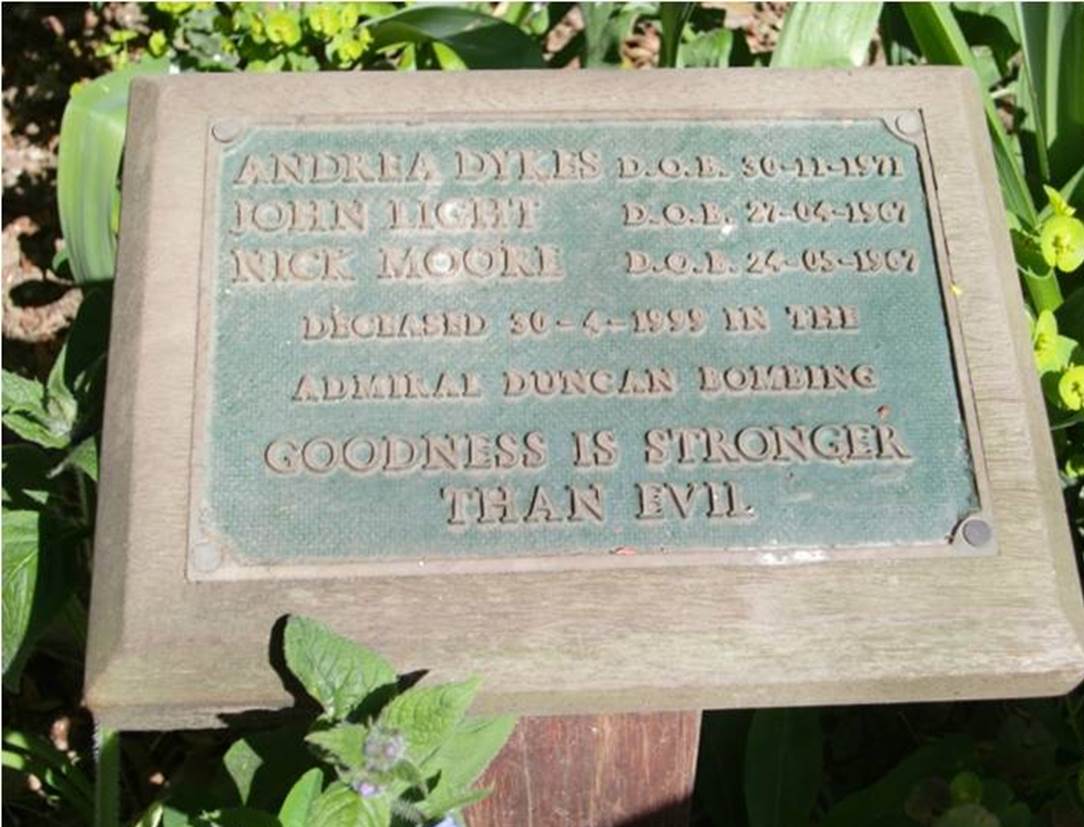
    The missing original plaque dedicated to the three victims of the Soho nail bomb attack in April 1999 has been replaced ahead of memorial event tomorrow evening.


    We reported yesterday that the plaque dedicated to the memory of Andrea Dykes, John Little and Nick Moore had gone missing from St. Anne’s Gardens in Soho, London ahead of the memorial event planned for the 30th April – which will be the 14th anniversary of the attack.

    The nail bomb, which went off on the 30th April 1999 in the Admiral Duncan was aimed at the gay community in Soho. It was the 3rd of three attacks planned and orchestrated by David Copeland who is currently serving six concurrent life sentences and in 2007 the High Court ruled that he must serve 50 years.

    A replacement plaque has been ordered and will be on display at tomorrow’s memorial event held in Soho.

    Cllr Ed Argar, Westminster City Council cabinet member for city management, said:

    “I find it appalling that anyone would steal the memorial plaque remembering those who died and were injured in the horrific Soho bombing of 1999.

    “We have moved swiftly to get a replacement memorial delivered and installed ahead of the 14th anniversary of the Soho bombings tomorrow (Tuesday 30th April), having been alerted to its removal, and we hope it will be in place later today.”

    The new plaque has cost £260, with half being paid by Westminster City Council and 17-24-30.org paying the other.

    The replacement plaque will be installed this afternoon and reads:

    Andrea Dykes D.O.B 30-11-1971

    John Light D.O.B 27-04-1967

    Nick Moore D.O.B 24-05-1967

    Deceased 30-04-1999 in the Admiral Duncan Bombing

    Goodness Is Stronger Than Evil

  • SCENE: The Clubs We Have Loved And Lost

    You no doubt think I’m a bit old to be going clubbing these days, and you’re probably right (though actually I only hung up my gogo jock last year), but there was a time when I was out every weekend, and it was not uncommon for me to visit three or more clubs in the space of a weekend.

    I won’t deny that this marathon was only achieved with a certain amount of chemical assistance, nor that my memories of it are now somewhat blurred. I do remember, however, that I had a fantastic time.

    I was a bit late coming to the club scene, and this reminiscence is very much from a personal point of view, so apologies to all those clubs I’ve missed out. For much of my twenties and thirties, I thought clubbing rather frivolous, and, to be honest, I had very few gay friends. Consequently, I rarely hit the scene. There were occasional visits to Heaven (very different from it is now, and, in those days, more reminiscent of the set for a 70s porn movie, with a couple of pool tables in the bar. I’m pretty sure it was men only when it first opened), but that was about it, and also to Bang, which was held in the same club in Charing Cross Road, where G.A.Y got started. G.A.Y itself became a huge success for Jeremy Joseph and eventually moved into the Astoria (I once appeared there in the musical “Grease”) until the Astoria was pulled down to make way for Crossrail.

    For a long time Heaven and G.A.Y. (odd, then, that Heaven is now home to G.A.Y.) were the only clubs I really knew about and stories I’d heard about the likes of Trade terrified me. All that changed when I took my first E. I was in my 40s, would you believe. Maybe I’d been thinking life was passing me by, maybe the landmark decade was to blame, but one weekend a friend and I decided that we were going to try E, and that was the beginning, or the end, depending on how you look at it. I remember we went to Love Muscle at the Fridge in Brixton. Love Muscle was a raunchy gay night, which first opened at the Fridge in 1992, and ran pretty much every Saturday night till 1998. After that Love Muscle nights became increasingly infrequent, till it stopped altogether, though it did have one brief revival on 31 December 2008. It doesn’t figure hugely in my club going, but there is no doubt that for many years it was enormously successful, and I know many who have great memories of it. Brixton was always just that little bit too far away for me, and, truth to tell, by the time I discovered clubbing, Love Muscle’s heyday was (just) over.

    So, a perfect weekend for me those days would probably have started at Crash on a Saturday night. Very occasionally I’d have made Fiction at the Cross on a Friday, but that would have made for an even longer weekend than usual, and even I had my limits, so Crash in Vauxhall (now Union) it would be. Back in those days there was very little else in Vauxhall – no Fire, no Area, no Bar Code, no Chariots, and the only other gay venue was The Hoist. Vauxhall was not the gay mecca it subsequently became. Crash (promoted by Wayne Shires) was dark, sexy and underground, and was where international DJ, Tom Stephan first made his mark. This was not elegant, sophisticated clubbing. This was a place to get down and dirty, though it wasn’t a sex club, and there was no play area. At its peak it would be rammed with sexy, shirtless men, grinding away to the tribal sounds for which it was famous. I managed to acquire one of the highly prized black membership cards (don’t ask me how), which gave me and a guest free entry and queue jump on any night. I’d just march down to the front of the queue, flash the card, and I’d be allowed straight in. Ah, those were the days!

    They were also the days when promoters, though in competition, would be careful not to tread on each other’s territory, and would often collaborate in the realisation that they each fed each other. It was this happy state of collaboration, which allowed clubbers to buy their tickets for Trade at Crash before making their way to Clerkenwell to continue their night. Fortunately, or maybe unfortunately, Trade’s home, Turnmills, was literally only a couple of minutes’ walk from my flat, which meant that I could go home, freshen up, and amble over to Trade just as the queues were dying down, and by which time the club would be in full swing.

    Infamous, notorious Trade is a name that even younger clubbers will no doubt recognise. The first after hours in London, it was started by Lawrence Malice back in 1991, when the only way it could get a licence was by providing food, which it did in the upstairs café. It was not licenced to sell alcohol, though the resourceful could usually find a way of acquiring it, and till very late in its residency at Turnmills, used to officially only sell soft drinks, and also tea and coffee in the upstairs café. Mind you, who needed alcohol to carry on dancing through Sunday morning. Everything you’ve ever heard about Trade is probably true, the drugs, the muscle boys in the fittingly christened Muscle Alley, the trannies. Madonna was even known to put in the occasional appearance. Simon Patrick, who was manager from 1995 till 2008, recalls one occasion when he was called over to the platform that overlooked the dance floor by a bouncer, with the nickname of “The Mortician”. Simon looked out over the dancers wondering what it was he was looking for. “Just wait,” said the Mortician, and, sure enough, after a few minutes a lone female figure leapt up out of the crowd, visible for just long enough to be identifiable as Bjork.

    From a single room, when it first opened, Trade expanded until every square inch of the building was in use, including Gaudi, the restaurant. And indeed Gaudi was the reason for the intricate iron work on the staircases and the colourfully tiled bathrooms. Another of its famous features was the installation of the awe-inspiring lasers somewhere around 1994. As Crash faded, Trade would become my first club of the weekend. I would have an early night on Saturday and get up early on the Sunday morning. My friends would all come over for a quick breakfast, usually just a coffee and a pill, and off we would go, fresh and rested and raring to party. We would descend into its caverns, as others would pass on their way to church, hearing only the thud of the music and noting the steam escaping from the air vents. No doubt a they would consider it hell. To us it was paradise.

    The Trade sound became famous worldwide, and many DJs made their name there, principal amongst them being Tony de Vit, who tragically died of AIDS-related bronchial failure in 1998. Other names associated with Trade, include Smokin Jo, Pete Wardman, Alan Thompson, Malcolm Duffy, Gonzalo, Steve Thomas and Lisa German.

    However, when Beyond opened at the Coliseum, Trade revellers began to drift away. Maybe the desire for hard house was coming to an end. I do recall one morning, sitting on the stairs chatting to a good friend of mine, and becoming aware of the racket emanating from the DJ booth. “What the hell are we doing here?” he said, “That’s not music.” Whatever the reasons, its popular peak was over and Trade ceased its weekly residency at Turnmills in 2002, though it continued to put on occasional one off parties, which were invariably packed out. Then it was announced that Turnmills would close its doors forever in 2008. Trade would hold its last ever event there in March. Its fame was so widespread that people came from all over the world to bid farewell to the club they had so many great memories of. I was there with all my old friends, of course, and, though we had determined to stay until the last record was played, by about four in the afternoon we were exhausted and had to leave. Pete Wardman played the final track ever to be played at Turnmills, (Schoneberg by Marmion) at 5.45pm on 16 March 2008.

    Trade continues to stage occasional events in various different venues, but for me, as for so many others, Trade is Turnmills, now just a pile of rubble prior to the building of a new office block. I feel a twinge of regret each time I pass it.

    There are others I remember fondly of course, likeSalvation, once monthly on a Sunday evening at the suavely sophisticated Café de Paris, Action at what is now known as the Renaissance Rooms, Thursday night’sDiscoteq at The End, Factor 25, which, if memory serves me right, changed venues and nights quite a few times, and a few others whose names escape me, but there is one that, for me, reigned supreme.

    On a Sunday night in November 1999, the usually quiet area around Smithfield market was besieged with crowds of people queuing to get into a new club. New super club Fabric had opened a week or two before, and the queue on this Sunday night snaked all the way from the front door of the club to Farringdon tube station. For weeks the gay papers had displayed two-page ads with the single word Addiction, but the word on everyone’s lips was DTPM.

    DTPM (which stood for Demens Trelirium Post Meridien) had originally opened on an afternoon in April 1993 at Villa Stefano in Holborn, and was started by promoter Lee Freeman to cater to the clubbers leaving Trade, who wanted to carry on partying. As the club became more popular, it moved to Bar Rumba in May 1994 and then to The End in January 1995, when it also moved to an early evening time slot. When it finally left its residency at The End, there was a three-month hiatus before it re-opened at Fabric, this time as a late club (10pm to 5am). Lee had filled the three-month void with expectation, and, in all my years, I don’t think I’ve ever come across a night filled with such excitement and buzz. Fabric was still brand new and there seemed to be a problem with security that night, as we had to wait for a long time before finally being admitted, and only then after a group of suited men carrying clipboards were seen to leave the building. Once inside, though, we were thoroughly amazed by what we saw. This was a huge venue, expensively and glamorously decked out. There were three rooms, each with its own sound system and featuring a vibrating floor in Room One: known as a “bodysonic” dancefloor, sections of the floor are attached to 400 bass transducers emitting bass frequencies of the music being played. Many people shook their heads, opining that the club wouldn’t last, the venue was too big, there wouldn’t be enough people to fill it weekly on a Sunday night, especially as it went on till 5 in the morning. Well they couldn’t have been more wrong. DTPM’s run at Fabric lasted an amazing, incredible 8 years. I should know, I spent almost every Sunday night down there for every one of those years! I suppose its proximity to where I lived was my downfall. Sunday evenings could be so boring, and, however much, I might tell myself that I was going to stay in, come 10pm, my resolve would disappear. “Maybe just for a couple of hours,” I’d tell myself, but invariably I’d find myself stumbling home at five in the morning, usually with some young thing in tow.

    So what was it that made DTPM so special? Well it was a combination of all the elements coming together to create that total experience. First and foremost among them, as also with Crash and Trade, was the music, something that too many promoters seem to forget these days. Many of DT’s DJs, such as Smokin Jo, Alan Thompson and Steve Thomas were also Trade stalwarts, but the music they played at DT was very different, deep and funky. There was planning to the music too, so that, by the end of the night, you felt you had been on a journey. Room one was my favourite haunt and a perfect evening would find me getting in the mood with Miquel Pellitero, flying with Alan Thompson and finally getting on down with Steve Thomas. When Alan Thompson left to live in Sydney, DTPM took a while to settle down and fill that middle slot, but eventually, Mark Westhenry was a great replacement. So, having got the venue and music right, the rest was down to attracting the right crowd. From day one, Lee had stressed that the club was polysexual, not gay or straight, but anything you wanted it to be. Though the vast majority of clubbers were gay, there was a good cross-section of all types. I remember an elegantly dressed woman, who used to come down with her son and all his gay friends. Plenty of big names attended too, amongst them George Michael, Robbie Williams, Jason Orange, Rupert Everett and Liza Minnelli of all people. The fabulous Kerry, who at one time, controlled traffic in the downstairs loo like a sergeant major, tells a story of one famous diva (I can’t, of course, mention names) who turned up with a deal of pomp, fuss and ceremony at the front entrance, only to be carried comatose out of the back one five minutes later.

    On bank holidays and other special days, the club would stay open until seven in the morning, and, even then, the place would still be packed, until the last song had played out, the crowds applauding and screaming for more. In the notes accompanying the second DTPM CD release, celebrating 10 years of DTPM, Lee Freeman stated,

    “The hard core of customers are very loyal and come back regularly, receiving a warm welcome from the long-standing staff and promoters, who take a genuine and personal interest in the club. A family has been created and this is a large contributing factor, which has helped to sustain the success of DTPM.”

    I guess I was one of those hard core customers, and they certainly made you feel welcome. I became a member a couple of weeks after their first night at Fabric and remained one until they eventually left. Membership was well worth it too. For a very reasonable annual fee, you got reduced entry, four free tickets on your birthday, and, most prized of all, queue jump. I remember asking which queue I should join on the first occasion after becoming a member. “You don’t,” said Mark, aka Edna, “You just present your card at the barrier and security will let you straight in.” I can’t tell you how valuable that was. At its peak, even on a normal Sunday, the queue for entry used to snake round the building towards Farringdon station. It may seem hard to believe now that a Sunday club could attract that many people, but it did, I can assure you.

    Eventually though, and, like all good things, it came to an end. There were many reasons for its demise. The drugs people used changed and the club, which had always had a very relaxed attitude, had to become more vigilant. Hardly surprising when clubbers were regularly passing out on GHB and GBL, and ambulances were often seen outside the venue. Also, a certain promoter had decided that rather than join in the general air of collaborative rivalry that existed between promoters, he would do his utmost to kill them all off. His tactics worked and personally I think the club scene became the poorer because of it.

    DTPM tried a couple of revivals (I remember a particularly fabulous New Year’s Day party at the Café de Paris), but its heyday was over and it seems safe to say that DTPM is now just part of history, particularly as Lee Freeman now has a new (and very successful) project, The Kennington gastro pub in Oval.

    With the demise of Trade and DTPM, my clubbing days virtually came to an end. If I do go out these days, it will probably be to XXL, which seems to defy the passage of time, and is now doing better than ever in its fabulous new home, Pulse, or I will go to Hard On, run with burning zeal and energy by its indefatigable promoter Suzie Krueger. Suzie is, without doubt, a survivor. She started Hard On’s forerunner, Fist, back in February 1994. Fist was a strict fetish club; leather, rubber, uniform – no trainers or jeans (unless worn under chaps), and that rule persists to this day. With a huge play area, the club has never made any secrets about the crowd it is attracting, though you might be surprised to find out how social it can be.

    Not everyone goes to have sex. Many just enjoy the dressing up. Unfortunately, the homophobic local police managed to get Fist closed down in January 2002. Unfazed, and determined not to be beaten, Suzie started a new club called Hard on, in September 2003, at Cynthia’s, a swingers’ club in London Bridge. This time it was strictly members only, and it was not possible to join on the door. Applications had to be received in advance. Probably an administrative nightmare, but somehow she managed it and the first night was absolutely packed. Since then the club has moved around a bit, enjoying a 5 year run at Hidden in Vauxhall (a nearby church managed to get Cynthia’s closed down). It is now very comfortably housed in Union, formerly Crash, also in Vauxhall and, if my last visit is anything to go by, is enjoying something of a revival. When Hard On left Hidden, its clientele seemed to be shrinking, but recently the club has been packed again. In addition to the leather, rubber, uniform code, sports kit is now allowed (though not just trackie bottoms) and this may have contributed to bringing in a younger crowd. What’s more, when I was there last week, the music (provided by DJs Brent Nicholls, and Hugo’s land) was pumping, the crowd were social and friendly and the bar and dance floor just as busy as the play areas.

    All in all, it was a great night, so it is good for me to be able to end on a positive note, with a club we have loved and still love; Hard On!


    Opinions expressed in this article may not reflect those of THEGAYUK, its management or editorial teams. If you’d like to comment or write a comment, opinion or blog piece, please click here.
  • Soho Bombing Victims’ Plaque Missing

    The original Soho Bomb memorial plaque has gone missing according to Mark Healey, the founder of the anti-hate campaign 17-24-30.org, from its position in St. Anne’s Gardens in Soho, London.

    Soho Nail Bombing Victim Plague

    The memorial remembers the three victims who lost their lives in the blast which ripped through the popular Soho pub, the Admiral Duncan in April 1999, killing Andrea Dykes, John Light and Nick Moore.

    The Soho nail bomb was the 3rd of three attacks planned and orchestrated by David Copeland. He planted the other two bombs in Brixton (17th April 1999) and Brick Lane (24th April 1999).

    He is currently serving six concurrent life sentences and in 2007 the High Court ruled that he must serve 50 years.

    In a statement from 17-24-30 the organisers of the Act Of Remembrance which is to take place on the 30th April have said that, ’17-24-30 have agreed to help cover the costs so that it can be ordered straight away and hopefully in place ready for the service on Tuesday 30th April – marking the 14th anniversary of the attacks.’

    The new plaque will cost £260 and it is hoped that it will be delivered and installed before Tuesday’s service.

  • Reports Of Homophobic Crime Drop In London from 2012 to 2013

    Figures released by the Metropolitan Police Service (MPS), the UK’s biggest police force, show that reports of crimes that are perceived as homophobic, either ‘by the victim or any other person’ are down 12.7% in the last 12 months.

    In total 1,103 homophobic crimes were reported to the MPS in the 12 months up to March 2013, whilst the year before 1,264 crimes were reported.

    Of the 32 boroughs policed by the MPS, 12 reported an increase in reported homophobic crimes, with Enfield observing the biggest increase in reports. Nineteen boroughs had lower reportages and Ealing had exactly the same number of reports as the previous year.

    An Enfield Council Spokesperson said:

    “Enfield Council works closely with the police and the local community to deal with hate crime against the LGBT community and works tirelessly to create an environment where people affected by homophobic hate crime feel confident enough to report what has happened to them in a supportive environment.

    “While the number of homophobic crimes reported in Enfield this year remains extremely low, thanks to our extensive work with the police in this area, we have seen a significant increase in confidence amongst the LGBT community and consequently the number of reports of homophobic hate crime have increased.

    “Enfield Safer and Stronger Communities Board have a number of initiatives in place to engage with and support the LGBT community including our hate crime strategy, Enfield Council also funds the LGBT Network to help provide support for the community work it does and we have run a number of successful initiatives to improve tolerance and community cohesion amongst all our communities.”

    Overall crime is down in London by 6% and the MPS Commissioner Sir Bernard Hogan-Howe said: “Crime is down by 6%. This includes some excellent performance across London, with serious youth violence down by 28%, gun crime down 20%. Robberies are down by over 10% and 1000 gang members are in prison or under judicial restriction.

    “These are very significant numbers that have been achieved against a backdrop of substantial operational challenges to the Metropolitan Police such as the Queen’s Diamond Jubilee celebrations, the London Olympics and Paralympic Games. All of this has been done whilst also saving money.

    “I hope the people of London will be proud of the Met’s achievements.”

    You can take a look at your borough’s crime rates at:http://www.met.police.uk/crimefigures

  • Touching Tribute From A 7-Year Old Pupil Of Trans Teacher Lucy Meadows

    Nearly 100 Teachers, union members and students joined forces on Saturday to march in memory of Lucy Meadows, a trans teacher from Accrington in the United Kingdom, who was found dead in her home in March.

    Miss Meadows was thrust into the media spotlight after a letter to parents from the head teacher of St. Mary Magdalene’s Primary School, where she was working, regarding her transition was sent to the press in December.

    A day later the Daily Mail published a column by Richard Littlejohn that was headlined:

    “He’s not only in the wrong body… he’s in the wrong job”

    A petition, which called for the resignation of Richard Littlejohn because of the article, garnered over 200,000 signatures in less than a week and a vigil held outside theDaily Mail offices in London in memory of Miss. Meadows attracted over two hundred people.

    Daisy Moreton, a 7-year-old student at St. Mary Magdalene’s attended the event on Saturday and according to the Manchester Evening News carried a handwritten poem that she had composed for her late teacher.

    The poem read: “Makes you happy/ in high spirits/ smiles/ said kind things./ Made us feel good/ ever helpful/ always nice/ delightful/ one of a kind/ wonderful teacher/ scientist.”

    Speaking to the Manchester Evening News, organiser Debs Gwynn, the North West National Union of Teachers Lesbian, gay, bisexual and transgender representative, said:

    “This rally was called for two reasons – to allow the local community to show support and solidarity for what happened and to raise the issue of transphobia more widely.

    “I have been talking to parents and pupils today and the kids were supportive of Lucy. And they are devastated that their teacher is now dead.”

    She added:

    “It was a great success, lots of people spoke at the end and they were keen to stress that they were there to support Lucy, her family and her colleagues.

    An inquest into Miss. Meadows death has been opened and adjourned.

  • THEATRE REVIEW | Californian Lives

    Issues surrounding love and trust are often explored in a variety of ways, but this powerful and original production written by Martin Foreman and directed by Emma King-Farlow has brought something entirely new to the table. A series of three monologues, Californian Liveslooks at what it really means to three very different characters living three very different lives.

    In the first piece, Los Feliz, performed intensely but very well by Robin Holden, a young man falls in love with a beautiful woman and concocts an entirely fictional life in order to get close to her. As he weaves his tale, the initially unlikeable character reveals his insecurities and gradually draws the audience closer to him. Holden commands the stage extremely well and holds the audience’s attention throughout; something that is inherently difficult in a monologue.

    Ben and Joe’s is a look into the lives of a group of mostly middle-aged men who while away their afternoons in a San Fernando Valley bar, united in their lust for the young barman who flirts expertly with each of them. A new arrival, Christopher, shakes their easy existence and causes a rift between the men as each of them is forced to confront their own prejudices. This difficult subject is delivered expertly by John Vernon who held the audience captivated throughout his performance.

    Finally, the evergreen treat that is Carolyn Listerbrought an instant warmth and dose of humour to Sunset with her portrayal of a grandmother reminiscing to her husband on the long life they have shared together, with its succession of highs and lows. On the surface, her story is one of a very traditional marriage, but this is soon revealed to be a somewhat thin veneer as this apparently timid character reveals a strength and resilience initially unseen.

    Californian Lives is no light-hearted feel-good piece, and not one for the faint-hearted. It is, however, exactly the kind of emotionally-charged and thought-provoking theatre that we need to see more of in this age of Disney-esque expectations.

    Californian Lives plays at the King’s Head Theatre, Islington on Sundays and Mondays until 26 May. Tickets £11.50 – £20 from the King’s Head website.

  • HOTEL REVIEW | The Wensleydale Heifer

    ★★★★★ | The Wensleydale Heifer

    They say no-one expects the Spanish Inquisition. They would probably also not expect a rather splendid fish restaurant and boutique hotel in the landlocked Yorkshire Dales.

    Nestling in the ample bosom of the picturesque Dales, the Wensleydale Heifer is admittedly off the beaten path, situated in the tiny village of West Witton, but it’s well worth the drive to experience what is one of the finest dining experiences my partner and I have had in a long time.

    The hotel itself comprises a number of themed bedrooms all playfully but tastefully decorated. We had the Whiskey Room for our night’s stay, which was pleasantly warm and inviting, incorporating distillery memorabilia around the walls with tartans and a wee dram of complimentary whiskey which greeted us on arrival (not a great whiskey fan I instead devoured the marvellous complimentary home made cookie and pondered what delights the people in the next door Chocolate Room were enjoying. Would they ever leave the room?)

    Dinner was in the fish restaurant after making our menu selections in the informal warmth of the lounge. A nice touch when we reached the table was the two small hors d’oeuvres to whet our appetites. Service was good and what they very occasionally lacked in professional finesse they made up for in attentiveness.

    My starter was Japanese panko crusted goats cheese fritters with jam, pine nuts and rocket salad. My partner had Whitby crab, gravalax, potato, shallot and chive tian, salmon, pink grapefruit vinaigrette and salad. Both were excellent, well presented with a nice contrast in taste. For mains I had tarragon and white truffle crusted hake with parmesan and rocket risotto and shallots and my partner had Roast Cornish turbot fillet, tagliatelle of Venus clams and brown shrimp, white wine and garlic fresh pea shoots and pea oil. We loved both. You could tell that this is a restaurant that loves its fish. The wine and garlic cream gave the latter a nice body without it being too heavy and both mains were excellently presented with lovely flavours. The hake was fresh and though it’s very easy to over serve risotto, they got the quantity just right.

    Looking forward to dessert I plumped for the ice cream brownie and my partner the stem ginger parfait, both of which were very good.

    After retiring for the night we had the English breakfast that though didn’t quite match the fine dining of the night before, was still very welcome.

    Overall The Heifer is highly recommended whether you fancy a few days retreat in exclusive and quirky surroundings or just booking a classy meal out. Even if you don’t think you’re a fish fan you can’t fail to be bowled over by the combination of flavours and styles in each dish which, combined with a stylish contemporary setting and excellent accommodation should put it on every foodie’s menu.

    To book the Wensleydale Heifer call: 01969 622322 or visit: http://www.wensleydaleheifer.co.uk