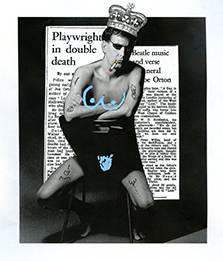
Author: Leon Horton

  • COMMENT | Out to Lunch with William Burroughs

    It was summer 1991, I think, when sharing a joint on a brick fire escape after a night of acid-tapped cartoon lunacy, my friend Steve exhaled smoke into the Manchester morning and casually asked if I’d heard of a writer called William Burroughs.

    I hadn’t, but that moment has stayed with me as the dawn of what was to become a deep and unremitting love for the man J.G. Ballard called “True genius and first mythographer of the mid-twentieth century”. Steve passed the joint and disappeared indoors – momentarily leaving me staring, rabbit-eyed, into the headlights of reality – before returning with a tatty, nicotine-thumbed paperback. “Read this,” he said, thrusting the book at me. “You’ll love it.”

    Naked Lunch: odd title, I thought, flipping the book from cover to blurb to cover again. What is this, some kind of naturists’ cookbook? I turned to the introduction and read:

    “I awoke from The Sickness at the age of forty-five, calm and sane, and in reasonably good health except for a weakened liver and the look of borrowed flesh common to all who survive The Sickness … Most survivors do not remember the delirium in detail. I apparently took detailed notes on sickness and delirium. I have no precise memory of writing the notes which have now been published under the title Naked Lunch. The title was suggested by Jack Kerouac. I did not understand what the title meant until my recent recovery. The title means exactly what the words say: NAKED Lunch – a frozen moment when everyone sees what is on the end of every fork.”

     “What the fuck is this?” I said, burnt synapses trying hard to connect. Steve smiled, sane as he could muster. “Read it,” he repeated, snatching the joint from me. “You’ll love it.”

    William Seward Burroughs II (1914-1997) – a Harvard man: junkie, queer, outlaw, writer. The Priest, they called him, El Hombre Invisible, Old Bull Lee. His books have been praised as radical satire, pilloried as pornographic, appropriated by other gods for their own sybaritic sermons. His ideas, language and imagery have infiltrated popular culture through his influence and collaborations in literature, film, music and art. David Bowie, Anthony Burgess, David Cronenberg, Patti Smith… so many have paid tribute to the Burroughs method.

    I read the rest of Naked Lunch that afternoon in a foetal curl; couldn’t put it down. I couldn’t be sure what I was reading wasn’t just residual damage from the previous night, didn’t know if I was still hallucinating. An acid comedown is a strange place to encounter near-eastern Mugwumps gorging themselves on slender youths, the “talking asshole” routine, Doctor Benway and the black meat, or A.J.’s annual party, where an appreciative, ejaculating audience watches red-haired, green-eyed Johnny get fucked by his girlfriend with a giant metal dildo – Steely Dan III from Yokohama.

    This stuff was written in the 50s, for Christ’s sake, how the hell did they get it past the censor? Truth is they didn’t – not at first. After it was finally published in the US, Naked Lunch was put on trial for obscenity. But that was way back in Boston in 65, and anyhoo…

    After Naked Lunch, I devoured just about everything by or about Burroughs I could lay my fevered mind on: slid through the early confessional narratives of Junkie and Queer; waded knee-deep in the experimental cut-ups of the Soft Machine/Ticket that Exploded/Nova Express trilogy (notebooks, Bill, put ‘em away for later); masturbated to the lyrical alien sex of The Wild Boys; marvelled at the malarial masterpiece Cities of the Red Night; and absorbed, agog, Ted Morgan’s seminal biography Literary Outlaw.

    Here was a man whose life jumped from the page every bit as unconventional and dangerous and as funny as anything he had written. His life and his art weren’t just intertwined, as with most writers, they were conjoined twins pickled in apomorphine. The lifelong on/off heroin addiction, the accidental killing of his wife during a drunken party trick in Mexico, the subsequent exile in Tangiers, Paris and London…  JUNK SICK routines and vacant lot scenes of CONTROL, parasitic possession and WORD as VIRUS appear again and again, in ever evolving mutations, across the body of his life and work.

    Not for Burroughs the easy journey of write what you know. “In my writing I am acting as a map maker, an explorer of psychic areas… a cosmonaut of inner space, and I see no point in exploring areas that have already been explored,” he once said. For this guy, words were the beginning not the end of writing, and he illustrated this in his endless, sometimes exasperating experiments with just how far, and in what forms, language can go.

    I didn’t truly understand the power of Burroughs’ words until I first heard his voice: that St Louis drawl – the cracked mumblings – the gnarled fingers talk of a prophet with no easy message. When I first heard him speak, it was on a flickering, badly recorded video – The Final Academy Documents – of a reading he gave from The Place of Dead Roads at Manchester’s Hacienda club in 1982. This was a double whammy for me. The Hacienda was my club of choice in the early 90s, and when I learnt Bill once graced that piercing-cold warehouse with his presence, suddenly I didn’t feel so frozen on the dance floor. And that voice – oh, that voice – crackling from the past – had me fixed to the spot; grinning homunculus in the palm of a bony hand.

    Burroughs came to see his work both as a search for immortality (figuratively and literally) and as an attempt to exorcise the ‘Ugly Spirit’ he believed had possessed him and caused the death of his wife when he shot her through the forehead. He later admitted in the introduction to Queer (written in 1951but not published until 1985): “I am forced to the appalling conclusion that I would never have become a writer but for Joan’s death, and to a realization of the extent to which this event has motivated and formulated my writing. I live with the constant threat of possession, from Control. So the death of Joan brought me in contact with the invader, the Ugly Spirit, and manoeuvred me into a lifelong struggle, in which I have had no choice except to write my way out.”

    To focus only on the profoundly wretched aspects of Burroughs’ life, however, is to miss much of a writer who was also an arch humorist, with a switchblade wit that could cut through bone. The man could be wildly funny, and if you find that hard to believe, read Twilight’s Last Gleamings, where Doctor Benway (one of Burroughs’ most popular and recurring characters) drunkenly operates on a patient on a sinking ship; or Roosevelt After Inauguration, where the incumbent president celebrates his victory by forcing the Supreme Court to have sex with a baboon. And if you don’t fall about laughing then seek medical attention, for it is my diagnosis that you are dead already.

    For my money, Burroughs’ acerbic wit was put to best use when he turned his ire on evils perpetrated by the big three: religion, government and big business. After all, this was the man who lashed out at the shits of the world with The Last Words of Hassan I Sabbah in 1981:

    “Listen to my last words, anywhere! 
    Listen all you boards, governments, syndicates, nations of the world,
    And you, powers behind what filth deals consummated in what lavatories,
    To take what is not yours,
    To sell out your sons forever! To sell the ground from unborn feet forever? For Eve-R
    Listen to my last words, any world! Listen if you value the bodies
    for which you would sell all souls forever!
    I bear no sick words junk words love words forgive words from Jesus
    I have not come to explain or tidy up
    What am I doing over here with the workers, the gooks, the apes, the dogs, 
    the errand boys, the human animals? 
    Why don’t I come over with the board, and drink Coca-Cola and make it?”

    Those words resonate today as powerful and as prescient as they ever were. It would be fascinating to hear what Burroughs would have to say about the ills of today, to see what he’d make of Trump in The Whitehouse (baboon, anyone?), of a planet going to hell in a religious handcart, of a population more and more willing to sacrifice their personal freedoms and inalienable human rights to social media.

    It would be fascinating to know if he felt the weight of being right when he wrote “the blood, and bones, and brains of a hundred million more or less… went down the drain in green piss! So you on the boards could use bodies, and minds, and souls that were not yours, are not yours, and never will be yours… These words are not premature, these words maybe too late.”

    It is twenty years since William Seward Burroughs died from complications following a heart attack at 6:50 p.m. August 2, 1997.

    Feels like yesterday. But for a writer who was rarely linear, time passes in both directions. His last words were reportedly a quote from his long-term friend and collaborator, the artist Brion Gysin: “Back in no time.” Three days before, Burroughs wrote in his final journal entry: “Thinking is not enough. Nothing is. There is no final enough of wisdom, experience – any fucking thing. No Holy Grail, No Final Satori, no final solution. Just conflict. Only thing can resolve conflict is love, like I felt for Fletch and Ruski, Spooner and Calico [his cats]. Pure love.”

    I agree with the latter part.

  • The Freaks’ Roll-Call: Changing Perceptions of Sexual Deviancy

    The Freaks’ Roll-Call: Changing Perceptions of Sexual Deviancy

    For my 18th birthday, in 1986, I was given what most would consider some unusual coming-of-age presents: a wooden hatstand, a crystal whisky decanter, a book on the occult…

    My extended family are an odd bunch at the best of times, but of all the gifts I unwrapped that day, the most bizarre – the only one I still possess – was the one my aunt gave me: A Dictionary of Mental Health by Richard B Fisher. What that says about me, I don’t know, but they say people give gifts they want themselves, so…

    It is admittedly a fascinating book: a guide through the twin mind fields of psychiatry and psychology – a mostly balanced study for its time – and one of the most useful dictionaries I’ve ever owned. Not that I’m neurotic or a hypochondriac, but over the years A Dictionary of Mental Health has saved me countless hours on psychiatrists’ couches. Thanks to that oft-thumbed paperback, I know I’m neither neurotic nor hypochondriac, I don’t have dipsomania and I can’t claim to be suffering from Tourette’s syndrome. I am, however, according to the dictates of this dictionary, a sexual deviant.

    Ah, well. It’s a dirty job, but someone’s got to do it.

    Published in 1980, at a time when the right-wing tabloid press casually associated homosexuals with paedophiles, when casual racism was mainstream comedy, when mental well-being meant “pull your bloody socks up”, A Dictionary of Mental Health helpfully lists the main areas of sexual deviancy (or paraphilia as it is also called) as:

    • Bestiality (no argument)
    • Exhibitionism (only when I’m drunk)
    • Fetishism (I don’t know, does the smell of wild garlic count?)
    • Frigidity and impotence (only when I’m drunk)
    • Homosexuality (even in my sleep)
    • Masturbation (even in my sleep)
    • Paedophilia (again, no argument)
    • Sadomasochism (not even in my sleep)
    • Trans-sexuality and transvestism (whatever floats your boat)

    Perhaps voyeurism, necrophilia and – oh, I don’t know – frottage weren’t nominated that year, but there it is, in a golden envelope: I am a pervert of many colours. It feels unnerving that in my formative years, when I was coming to terms with and exploring my sexuality, the psychiatric world could pigeonhole me alongside paedophilia and bestiality (which A Dictionary of Mental Health laughingly describes as “said to occur frequently among boys in farming communities”). It’s a Freudian slap in the face – and there’s a dirty old man with a lot to answer for. Just because you fancied your mum, Sigmund, doesn’t mean we all do. Besides, I grew up in a farming community and I can assure you…

    To define sexual deviancy it is, of course, necessary to provide a definition of sexual normalcy, and again A Dictionary… comes through with a description so ridiculous it is neither accurate nor helpful: “sexual activity which sub-serves reproduction”. This accounts for the inclusion of masturbation on the list, which makes perverts of us all, but excludes the possibility of, say, a transvestite satisfactorily impregnating their wife or partner. And since when was failing to get it up a form of deviancy? We all have our off days.

    To classify sexual deviancy as any form of sexual activity not intended to produce a baby is to miss a fundamental point: sex is – or at least should be – something to be enjoyed, and not merely a biological duty. Moreover, to define sexual deviancy in purely clinical terms fails to take account of both perceived cultural differences and changes in public opinion. Public perceptions have often resulted in changes in attitude long before psychiatry and/or psychology and the law have woken up in bed together with no idea of how they got there. Besides which, “sexual deviancy” is a pejorative term often used interchangeably with “perversion” – and to deviate from something is not to pervert it, anymore than to travel into town on the bus is to abuse the train.

    In fairness to Mr Fisher and his dictionary, he does point out that many textbooks on psychiatry rightly regard any such association as unjustified, and goes on to say “to describe any [italics mine] sexual practices as perverse… is a mischievous holdover from the intensely moralistic psychology enshrined by Freud and his followers.” Perhaps I should be a little more forgiving in my treatment of A Dictionary of Mental Health. After all, times have indeed changed and 1980 was a long time ago – wasn’t it?

    In 2012, the psychiatric world finally caught up with the assumed zeitgeist when a study by clinical psychologist James Cantor, “Is Homosexuality a Paraphilia? The Evidence For and Against”, conveniently discovered that while homosexuality shared certain features with other paraphilias, they appeared to differ on “sex ratio, fraternal birth order, handedness, IQ and cognitive profile, and neuro-anatomy.” Or, to put it country simple, I’m more likely to:

    • Get more sex (excellent)
    • Be the first born (I am)
    • Be left-handed (I am)
    • Be more intelligent (I’ve got a masters, fuck you)
    • Have a different brain structure to your run-of the mill deviant (well, I did take a lot of acid in the 90s)

    As a result of his findings, Cantor suggested treating homosexuality as distinct from other sexual deviancy categories (which I guess is a roundabout way of saying “sorry, we fucked up again”), but regarded his own conclusions as “quite tentative” given the current limited understanding of paraphilias.

    Ah, well. Psychiatry is a dirty job, but someone’s got to do it.

    These days sexual deviancy is classified by the American Psychiatric Association as “the experience of sexual arousal to atypical objects, situations or individuals.” Hmm. Well, maybe. This broader definition conveniently sidesteps the lack of consensus as to the difference between unusual sexual desires and what we might call deviancy, but again fails to address what that difference is. We’ve come a long way, true, but it seems we’re only halfway there.

    So there it is: almost fifty years after homosexuality was decriminalised in the UK, I am – in one psychiatric category, at least – officially off the deviancy list. I can only live in hope for some sort of apology to follow.

    As for the rest of you freaks, you’ll just have to wait your turn.

  • COMMENT | Cruising: If you loiter long enough, there are still days when you get what you want

    COMMENT | Cruising: If you loiter long enough, there are still days when you get what you want

    If you go down to the woods today…

     By Leon Horton

    Exit my back door at speed (so many have), turn left, hotfoot it past the school, take another left and slide on down to the nature reserve… and you’ll find yourself at a gay cruising area. In a city, you’re never more than a hard-on away from a cruising area, but this is the big one: “Manchester’s answer to Hampstead Heath” (where I once fell headfirst into a bog and played Othello to declining taxi drivers all the way back to Islington.)

    If you approach the cruising area from the other direction, from the pub car park on the other side of the river (this being the famous River Mersey no less) you’ll see the warning sign:

    Please note that for your safety this area is regularly visited by the police and local authority patrol services

    Any person participating in illegal or inappropriate behaviour may be prosecuted

    Illegal or inappropriate – sounds great – but look a little closer – Paint cracked and peeling, metal fringes rusting…

    The sign is old.

    There are two main areas, car park or woods, and the action tends to move with the sun. You can, as the brochure says, start in the apple orchards about midday. Enjoy the lunchtime rush at your leisure, with two spikes around 12 p.m. and 1 p.m. And if you’re still hungry after lunch, why not hang around all afternoon, walk in circles until your balls ache and convince yourself the fuck of your life is just around the corner, because one day…

    Nothing doing, head across the footbridge to the pub for a couple, while all around are walking their dogs, jogging, cycling, pushing baby buggies, then follow the dying sun along the footpath to the middle bit – another wooded area. The middle bit used to be busy at dusk, and you still might get lucky even today, though it’s doubtful. Best just smoke a joint and wait.

    [epq-quote align=”align-left”]Doggers are high-risk stupid people, often fucking in plain sight in broad daylight. They attract attention because they’re mostly exhibitionists, and they bring the police.[/epq-quote]

    With darkness you’ve only one option left: the car park by the visitor’s centre, where the Doggers might be hiding out in the open. Bastards, get your own place, we were here first. Doggers are high-risk stupid people, often fucking in plain sight in broad daylight. They attract attention because they’re mostly exhibitionists, and they bring the police.

    Not that we are any better. In its heyday, this place would be crawling with gay and bisexual men once the sun disappeared. Walking up and down or hanging back in the shadows, checking each other out, disappearing together into the bushes: we were noticed; and the police and the council acted together to put a stop to it… for a while.

    The “powers that be” didn’t actually do much – they just had to be seen to be doing something. And putting up warning signs, cutting down trees and bushes – depriving the enemy of cover – with a couple of police raids thrown in for good measure, was effective enough in the short term. But trees and bushes grow back, and police raids are needed elsewhere.

    And all that theatre can be seen for free if you park your arse at the picnic benches at the right time.

    The brochure makes this place sound like the last days of Rome: Cupid nursing a hard-on in the long grass, Bacchus on his knees in the bushes. And time was when it was just like that – but now? The brochure is old – wrinkled in sepia tone – chemical memories of amyl nights. Rome wasn’t burned in a day, but thanks to smartphone dating apps, this once and mighty empire has enough barbarians at the gate to put a funeral pyre under it.

    Grindr ate my sex life.

    But glance around this open-air crematorium… and with the wind blowing ashes in the right direction, you can still see the fit and the young (the all too rare), guys on benefits or in care (sorry, retired), the self-employed and the dispossessed, pretend joggers (who break into a run the minute they see you – so funny) and the hetero-perplexed. There are no guarantees, but if you sit by the stones under the apple trees, you might get to watch the dance: the billing and cooing and the backward glance.

    And then sometimes… sometimes there’s “nothing” so quickly. You might sit there for hours on a glorious summer’s day, the place emptier than a boy on prunes. Then again, you might trudge through winter snow to the Promised Land – it’s all just pot luck.

    I’ve seen some oddball characters down here, made some good friends too: Panda Eyes, Chicken Legs George, Mr Shitter, Heavy Metal Tracy… Panda Eyes, now he just wants to watch and masturbate, ask you what your family would think if they could see you; Chicken Legs George smokes weed and tries to sell you Viagra; Mr Shitter carries a satchel of toilet rolls wherever he goes, leaves them hanging on trees; Heavy Metal Tracy, long hair and leather jacket, looks like a 1980s rocker – until he/she opens his/her mouth. “Call me, Tracy,” he/she says, effeminate to the core.

    And then there’s the Crow Man – a Jamaican guy obsessed with superhero films, who plays the racist card if panicked. First time I saw him he was tearing pages from a bible and scattering them along the paths, shouting to no one in particular “I know what you’re doing!”

    Much later, when I asked why he’d accused my friend of being racist, he played the racist card and screamed to a group of passing joggers I was threatening him. Dumb cunt might’ve got me into serious shit had the joggers not realized he was bone-dead mental.

    The Crow Man – so named because he was once spotted running across a field, flapping his arms and squawking like a carrion bird – never has been, never will be my friend.

    Stan By Your Man is my friend. A born raconteur, with a neat line in comedy and filth, Stan is an afternoon stalwart of this place – and what with most writers being drunk by lunchtime, that’s probably when we first met; although I can’t remember how long ago.

    “No, I can’t remember either,” he says, over a pint in the pub across the footbridge, “but we’ve both been coming here years, haven’t we? I mean, if you think my dog died in 2012 –”

    “Oh, it’s long before that. I’ve been coming here since 2001.”

    “Exactly, we’ve rung the changes.”

    Whenever it was, that is how Stan, a second generation Austrian in his late 50s, who used to make a living buying and selling online (sometimes from police proceeds of crime auctions), that is how he and I first met – down in the orchards, where apples aren’t the only fruit, in among the shape-shifting sun-dappled branches and the circling vultures.

    Stan recalls one such vulture known as the Wrestler, a great big denim-clad bruiser of a man who liked to play rough with all and sundry – myself included. We’ve all got a story about the Wrestler. After my last encounter, I wanted to spray-paint “paedo” on his car.

    “I was the first one to meet the fucker,” Stan says, “and when I met him – well, you know how big he was – and in no way am I slight – I told you he picked me up with one fucking arm –”

    I burst out laughing, remember who we’re talking about and immediately apologise. “It’s not funny, I’m sorry.”

    “He said, ‘let’s go over there and get naked and wrestle.’ And I’m like, ‘Oh, no, no, oh fucking hell, no,’ and when I went back – you know to the stones where all the lads were sat – they’re all sort of saying ‘Oh, fucking hell, Stan, you always get ’em, don’t you?’ Steve – you know Steve? – he picked him up – picked him up and threw him to the fucking floor.”

    “That’s what he did to me,” I say. “Jumped out of the bushes and pinned me down. I thought I was gonna get raped.”

    “That’s what Steve said. If he wanted to rape you – if he was on top of you – you’d have no fucking chance.”

    We both fall silent for a moment. This isn’t the laugh-out-loud anecdote either of us is aiming for, and my use of the word “rape” has punctured the story before it goes any further. Still, it serves as a strong reminder that gay cruising, online or out there in the real world, can be a risky and dangerous pastime – which for some is part of the pleasure.

    [epq-quote align=”align-right”]Still, it serves as a strong reminder that gay cruising, online or out there in the real world, can be a risky and dangerous pastime – which for some is part of the pleasure.[/epq-quote]

    I get another round in, grease the wheels a little, and we talk off subject for a while about a mutual friend who regularly gets a blow job in a well-known burger chain’s toilet from one of the staff.

    “Oh, god,” Stan says, chuckling to himself. “I must’ve told you the one about the guy and the baby oil.”

    “I don’t think so.”

    “Well, I was walking along the path, you know, not even in the woods, when all of a sudden I hear this voice.” (Plaintive camp voice) “‘Helloo… Helloo…’ And I think, what the fuck is that? Anyway, there’s this guy up ahead comes out the bushes, he wasn’t even – he was just on the path – and he was like ‘Hellooo…’ So I walk up, and honestly, he had a pair of cut-off jeans – cut off up to here – one ball hanging out, and he’s wearing this camisole top, see-through, and he’s covered head-to-toe in baby oil. And I’m not being horrible, but he was the most ugly looking pig you’ve ever seen –“

    “A greasy pig?”

    “Yeah. And he goes, ‘Will you rub some more oil on me?’ and I said ‘Oh, no, get lost.’ So anyway, I go in the woods, and about half an hour later he comes up to me and says ‘Still no chance of a shag then?’ So I says, ‘No, I’m not fucking touching you.’”

    “Was he a big guy?”

    “No, he was only small. Anyway, if you can imagine this, he’s still got a ball hanging out –”

    “The last turkey in the shop.”

    Stan laughs. “Yeah. And he’s still covered in this oil. And I sort of said ‘Mate, you know, be careful walking round like that because, you know, normal people walk in here.

    And he says (laughs) ‘I can’t fucking remember where I put me clothes, I left them in a bush.’”

    I’m in hysterics now.

    “So anyway, I do a circuit, and he’s there again, on one of the stones in the middle, and the cut-off jeans were off, and he’s getting shagged rotten by this fella, and he’s squealing like a stuck pig. So I stood there and I’m thinking, I’m gonna watch this for two minutes because I don’t fucking believe it and we are all gonna get arrested here.”

    My belly aches from laughing.

    “Anyway, this fella shoots his load all over his back, so he’s covered in spunk and baby oil, and he’s putting his things back on – his cut-off jeans and camisole top – and he says to me, on poppers – he was poppered out of his head – ‘I’ve gotta go find me clothes now.’ And I thought, what the fuck have I just walked into? ‘Hellooo. Hellooo…’”

    You couldn’t make it up. We laugh at Stan’s propensity for running into the most bizarre situations, and talk some more about the good old days – the days before Grindr.

    But time is against us and we part company. Apropos of nothing, I head off into the woods.

    All things move towards their end –

    “Excuse me, sir…” – a voice from the past.

     – and everything has its time.

     “Excuse me…” – bleeds into present tense.

     And sometimes –

    Excuse me…” – registers.

     “WHAT? WHAT THE FUCK DO YOU WANT? I’M SUMMING UP HERE.”

    “Might I ask what you’re doing here, sir?”

    The police: ah, yes, let’s not forget the police. The first thing you notice when a plainclothes policeman taps you on the shoulder is the accusatory tone. Don’t panic. This is your opportunity to wrong-foot the bastard – by telling the truth. If there’s one thing guaranteed to turn a copper blue, it is someone telling them the truth. It upsets their natural order.

    “Well, I’m not being funny, but you know what I’m up to.”

    “Erm…Oh… Right… Well, that’s refreshing. Most people give me some cock and bull about losing their dog.”

    I’m not most people and I don’t own a dog – and unless they catch you in the act, in flagrante, there isn’t much the law can do. Cruising in itself isn’t illegal. That officer asked me why I didn’t just go to a gay bar to cop off, and when I said – only partly joking – there were too many vacuous little faggots down that street, he was visibly shocked.

    “You can’t say that.”

    “No,” I replied, “you can’t say that. I have diplomatic immunity.”

    “Well, that’s as maybe,” he blustered, “but I’m here all night, so you might as well go home.”

    All things move towards their end and everything has its time. And sometimes this place feels like a mausoleum – with “right place, wrong time” etched into its stone façade.

    But a headstone is not a grave.

    A wise old Chinese physicist once told me that energy, in all its disparate forms, can neither be created nor destroyed, it can only dissipate – that is, it can only change its form.

    And as sure as Grindr and all the other smartphone dating apps will one day be usurped, gay cruising will adapt and survive in some shape or form. Give a man a fish, and he will eat for a day. Give him a rod, and he’ll stick it where the sun don’t shine.

    So if you go down to the woods today, you won’t be sure of a big surprise. But you just might find, if you loiter long enough, there are still days when you get what you want.

  • Up and At Em: Death in the Sex of Joe Orton

    Up and At Em: Death in the Sex of Joe Orton

    Up and At Em: Death in the Sex of Joe Orton

    By Leon Horton

    London, 9 August 1967. At the height of his short-lived fame, Joe Orton – anarchic playwright and cause célèbre of the English theatre – is found murdered at 25 Noel Road, Islington, his brains bashed in by his long-term lover and one-time collaborator Kenneth Halliwell. Divided in life by Orton’s hard-won success as a writer, the two are forever united in death when Halliwell savagely bludgeons Orton with a hammer then takes a fatal dose of sedatives.

    In the hip chic of late 60s London, Orton, it seemed, had everything a “with it” gay writer could possibly want: a West End smash with his second play Loot, winner of the Evening Standard Award for the Best Play of 1966, holidays in Morocco where the drugs were cheap and the boys even cheaper. After years in obscurity, everyone wanted a piece of him. And on the day of his gruesome death, he was due to meet director Richard Lester to discuss his film script commissioned for The Beatles: Up Against It.

    Halliwell, conversely, had nothing to show for the wilderness years spent mentoring his protégé – and his valium-suppressed jealousy ran deep. Holed up in their tiny squalid bedsit, sustaining their meagre existence on Halliwell’s dwindling inheritance, the two aspiring writers had written several unpublished novels together, were for a time allied in their lives and literary endeavours by dreams of a success that eluded them.
    But even failure couldn’t last.

    Embed from Getty Images

    With Orton’s meteoric rise to fame (after a life- and career-defining spell in prison for defacing library books), it was he who now controlled the purse strings, he who was lauded in the Observer as “the Oscar Wilde of Welfare State gentility”, he alone who was invited to all the right parties. Halliwell, who had given up writing, whose literary ambitions Orton had absorbed and then eclipsed, was reduced to a mere footnote – a dedication in the programme of Orton’s first full-length stage play Entertaining Mr Sloane.

    But if it was Orton’s success as a writer that brought down the hammer, it was his blatant and unabashed sexual promiscuity that put the nail in his coffin. For Halliwell was not merely envious of Orton’s literary achievements; he was the cuckolded lover, the long-suffering wife caught at the crossroads where many partners of the famous disembark. Overlooked, underappreciated, first wives are often left at the kerb, muttering threats of revenge. Paranoid that Orton would leave him, not without justification, Halliwell desperately tried to legitimise his own position as fundamental and indispensable to Orton’s success to anyone within earshot. It was an invitation to a killing.

    Orton and his plays are often regarded (or dismissed) as a product of the swinging 60s, as little more than an adjunct of pop counter-culture and the sexual revolution, and while he certainly earned his place in that pantheon, there’s more to it than that. His battles were won and lost in those Beatle-heady days, certainly, but they weren’t fought there.

    Embed from Getty Images

    They were fought in his impoverished Leicester childhood in the 1940s, against a domineering mother and a weak father. They were fought at the Royal Academy of Dramatic Art (RADA) over his ambition and ultimate failure to make it as an actor in the 1950s. Ultimately, they were fought against a prejudiced and repressed society – brought into sharp focus by his and Halliwell’s harsh treatment at the hands of the authorities when they were caught defacing library books in 1962. “The old whore society really lifted up her skirts and the stench was pretty foul,” Orton said of his six months in prison. Privately, he contended that their stiff sentence was “because we were queers.”

    Perversely, prison gave Orton a taste of freedom. For the first time in 11 years, he was separated from Halliwell, began writing on his own and duly delivered a radio play, The Ruffian on the Stair, to the BBC. Halliwell was humiliated by and repentant of his incarceration – a symbolic reminder of the wider failures in his life – whereas Orton found a new voice and detachment to his anger. Having reached rock bottom, he was no longer stymied by society’s values, and he savoured his newfound role as a literary outlaw and bona fide criminal. Halliwell, on the other hand, would attempt to slit his wrists within a year of release.

    With his star in the ascendency, Orton faced the perennial problem of the outsider artist: how to stick two subversive fingers up and at `em, the mainstream, without being absorbed by it. Orton no more needed social or sexual acceptance than a bone needs a dog, and sex was his solution. Comedy, vengeful and violent, was Orton’s genre, but sex as both weapon and shield was his modus operandi. “Sex is the only way to infuriate them,” he noted in his diary in 1967, as he rewrote his last play What the Butler Saw. “Much more fucking and they’ll be screaming hysterics in next to no time.” Even by the liberal standards of modern theatre, Orton’s dramatic use of sex as a means of control – with homosexuality, transvestism, incest and nymphomania vying for pole position – was seen by many as a deliberate affront to good taste.

    Embed from Getty Images

    In life as in his work, Orton’s approach to sex was defiantly Dionysian and held up a mirror to the hypocrisies of polite society. “You must do whatever you like as long as you enjoy it and don’t hurt anybody else,” he once told his friend, actor and stalwart of the Carry On films Kenneth Williams. Williams, an outrageously camp and acerbic performer in public, was a privately repressed man who felt guilty about his sexuality – a hangover from a bygone age that Orton totally rejected. “Get yourself fucked if you want to,” Orton told him. “Get yourself anything you like. Reject all the values of society. And enjoy sex. When you’re dead, you’ll regret not having fun with your genital organs.”

    Orton practised what he preached and delighted in regaling friends and colleagues, if only to note their reactions, with lurid tales of his sexual adventures. Williams himself recorded a particular occasion in his own diary, 30 April 1967, when strolling through Hyde Park with Orton and Halliwell, Orton casually recounted picking up a stranger near a public toilet:

    “We’d been eyeing each other warily – and this fellow asked, ‘You got a place we can go?’” Joe said (in front of Halliwell), “I told him that I lived with someone, and it wasn’t convenient. The man replied, ‘I often get picked up by queers round here… They’re not all effeminate either, some of them are really manly and you’d never dream they were queer. Not from the look of them. But I can always tell `cos they’ve all got LPs of Judy Garland. That’s the big give away.’” I told Joe, “It’s marvellous the way you remember dialogue as well as the accents! You really capture the flavour of the personality you’re describing.” Joe said, “Yes, I’ve started a diary.” I said, “Pepys put all his references to sexual matters in code so that no one would know.” Joe said, “I don’t care who knows.”

    Whether he cared or not, Orton’s diary (titled Diary of a Somebody) chronicles the last eight months of his life, his increasing literary success, and his disintegrating relationship with Halliwell, against the backdrop of the swinging sixties. Started in December 1966 but not published until 1986, the diary knowingly (knowingly in the sense that Orton knew it would one day be published) details his sexual peccadilloes in such a curiously dispassionate and often dismal manner that on 23 December 1966 he is able to write:

    “On the way home I met an ugly Scotsman who said he liked being fucked. He took me somewhere in his car and I fucked him up against a wall. The sleeve of my rainmac is covered in whitewash. It won’t come off. I hate Christmas.”

    Then, six days later, on the way to his mother’s funeral:

    “I arrived in Leicester at 4.30. I had a bit of quick sex in a derelict house with a labourer I picked up… He took his pants down. He wouldn’t let me fuck him. I put it between his legs. He sucked my cock after I’d come. He didn’t come himself. It was pissing with rain when we left the house. Mud all over the place.”

    That Orton adopts such a gloomy tone over these chance encounters has little to do with the death of his mother, as you might expect, when you consider his somewhat more upbeat entry on the 30 December 1966, the very day of her funeral.

    “After I left Leonie [his sister], I picked up an Irishman… He had a white body. Not in good condition. Going to fat. Very good sex, though, surprisingly. The bed had springs which creaked. First time I’ve experienced that. He sucked my cock. Afterwards I fucked him. It was difficult to get in. He had a very tight arse. A Catholic upbringing, I expect. He wanted to fuck me when I’d finished. It seemed unfair to refuse after I’d fucked him. So I let him.”

    And so his sexual trawling continues throughout the diary, writ large, ad infinitum: from a bacchanal orgy in an underground toilet, where “the little pissoir under the bridge had become the scene of a frenzied homosexual saturnalia. No more than two feet away the citizens of Holloway moved about their ordinary business” – to sunnier climaxes in Tangiers, Morocco, where even Halliwell could relax in the heat of hashish and Arab rent boys who “do it for sweets”. Morocco, at that time, was an infamous destination for predatory homosexuals with a sweet tooth, and Orton and Halliwell were no exception, indulging in a daily regime of sybaritic proportions. But all the while, both were painfully aware that no matter how bright the Moroccan sun shone, the damp, squalid isolation of 25 Noel Road, Islington was only a postcard’s throw away.

    Embed from Getty Images

    If Orton was being irresponsible in his sex life, he took no responsibility whatsoever over Halliwell’s declining mental state. After years of bickering, of violent arguments and threats to commit suicide, Orton was inured to Halliwell’s pain, but with his new sense of worth, he could not empathize with it. Halliwell was seeing a psychiatrist, taking increasing doses of sedatives and, numb to the world, shrinking away from everything but Orton himself. Their tiny flat, the walls of which Halliwell had covered in collages, making it seem even more claustrophobic, was his theatre and fortress. For Orton, the place was tainted, and he talked often to friends about the possibility of leaving.

    But he never did.

    On the 5 May 1967, Orton wrote in his diary:

    “When I got back home Kenneth H was in such a rage that he’d written in large letters on the wall ‘JOE ORTON IS A SPINELESS TWAT’. He sulked for a while and then came around. He’d been to the doctors and got 400 valium tablets. Later we took two each and had an amazing sexual session. I’d decided to fuck him. But it didn’t work out. ‘I’m not sure what the block is,’ I said. ‘I can fuck other people perfectly well. But up to now, I can’t fuck you. This is something quite strange.’”

    Three months later both would be dead. The writing was on the wall.

    At 41, Halliwell was no stranger to death. It had clung to him since childhood. In 1937, when he was just eleven-years-old, his mother was stung in the mouth by a wasp and died in front of him. Twelve years later, he came down to breakfast to find his father with his head in the oven, dead from asphyxiation. With a cold, hard logic reminiscent of one of Orton’s characters, Halliwell claimed to have made a cup of tea and had a shave before informing the neighbours, but his parents’ deaths haunted him for the rest of his life. At RADA in 1953, he told a fellow student “I’ll end up like my father and commit suicide.”

    Two weeks before their deaths, Orton and Halliwell discussed the nature of their relationship, and relationships in general, with Kenneth Williams, who records visiting the couple in his diary, Just Williams, on 23 July 1967:

    “We fell to discussing relationships. ‘Sharing of any kind means an invasion of privacy,’ I said. Joe talked about his horror of involvement. ‘I need to be utterly free.’ I quoted Camus’ line, ‘All freedom is a threat to someone,’ whereupon K.H. declared ‘Love is involvement, you can’t live without love.’ ‘There are many definitions of love,’ said Joe, ‘it depends on your point of view. You can love your work and be entirely committed to the pursuit of perfection.’ ‘Sexual promiscuity,’ he said, now provided him with material for his writing; ‘I need to be a fly on the wall’. But Kenneth Halliwell disagreed: ‘It’s alright letting off steam on holiday but a home life should have the stability of a loyal relationship.’ ‘You sound like a heterosexual,’ Joe countered, but Halliwell stuck to his guns and said that promiscuity led to wasted aims: ‘You can only live properly if it’s for a person or for God.’

    For Orton, both man and writer, there could be no comic revenge against an unjust and cruel “God” without anarchy, and his sordid sexual adventures were a logical extension of this. Anonymous encounters with strangers fuelled his appetite for self-destruction as a creative act and confirmed his conviction that only in pursuit of the forbidden could he unshackle himself from the suffocating environs of conventional living.

    It has been dramatised on stage, screen and in books, but no one really knows what happened that night, August 9, 1967 – how the final scene played out between these stage-struck lovers. As a denouement, the tableau that faced the police when they forced their way into the claustrophobic bedsitter fits the billing. They found Orton in bed, his blood and brains splattered up the heavily collaged wall that had become Halliwell’s sole creative outlet. They found Halliwell – Orton’s blood on his hands, chest and head – naked on the linoleum floor. Next to his body was an empty can of grapefruit juice that helped speed twenty-two Nembutals into his system, killing him within minutes. They found a note on top of a red-grained binder that was Orton’s diary. It read:

    If you read his diary all will

    be explained.

    KH

    P.S. Especially the latter part.

     It is fifty years since Orton’s untimely and melodramatic death, and it is fair to say that his plays no longer carry the shock and awe they once did. Yet Orton, like his writing, remains enigmatic and elusive – brilliant but difficult, elegant but easy to misunderstand. The press dubbed him an enfant terrible, and Orton willingly played the part. But in living his life at the extreme, when it came to exceeding to the bitter demands of a life in the limelight, Orton inadvertently became a character in his own macabre drama.

    He would have seen the funny side.