Tag: Trafalgar Studios

All the latest breaking news on Trafalgar Studios. Browse THEGAYUK’s complete collection of news, articles and commentary on Trafalgar Studios.

  • THEATRE REVIEW | Vincent River, Trafalgar Studios

    THEATRE REVIEW | Vincent River, Trafalgar Studios

    ★★★★★ | Vincent River

    Lady Sasha de Suinn reviews director Robert Chevara’s highly-praised take on Philip Ridley’s Vincent River, the gripping, LGBT psychodrama now running at the West End’s Trafalger Square Studios to June 22nd.

    Ever had a loved one viciously murdered by homophobic thugs? Shockingly frequent, it’s a homicidal hate-crime that’s an appalling indictment of the mindset and culture responsible, and the emotional impact on those left behind grieving forms the premise of author Philip Ridley’s taut, tense, Vincent River.

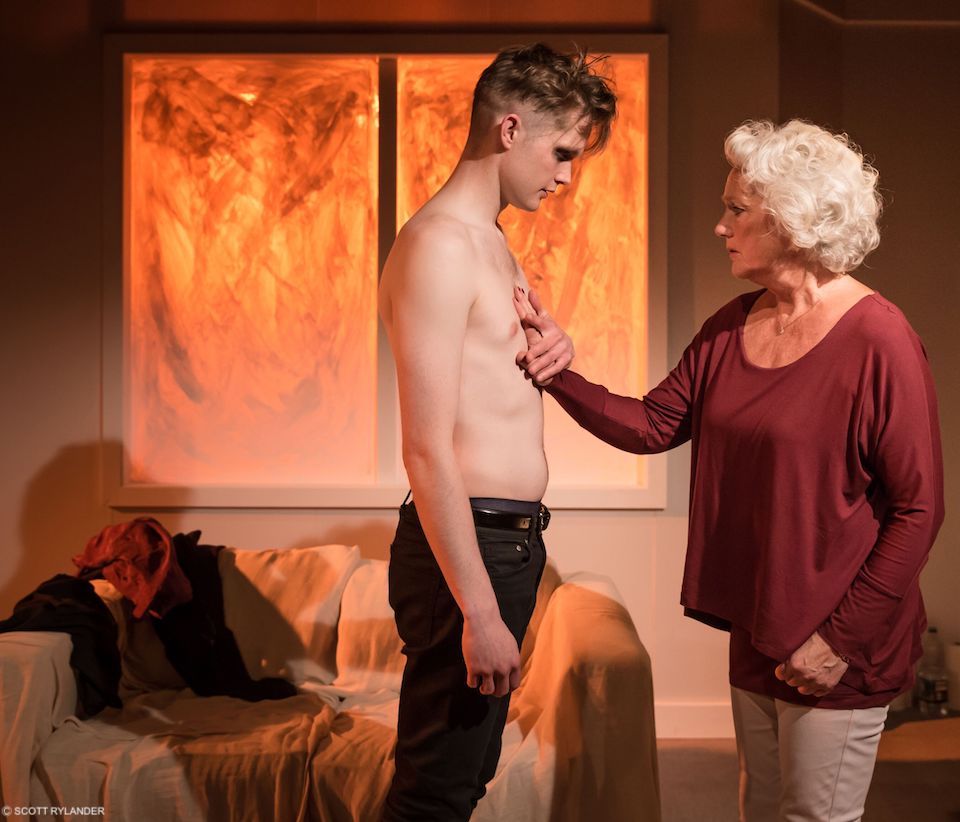
    The scene? Night, in an East London council flat; a tall, lithe boy in a hoodie – Davey – walks in on Anita, a much older, white-haired woman, her body language simply sizzling with barely-suppressed emotional cyclones and explosive attitude. The static, living-room set epitomises sink-estate notions of chic, a relentless tsunami of IKEA décor, as utterly unmemorable and stripped of personal panache as a freshly-embalmed corpse. A deliberately bland, dramatic arena, it’s a staging choice that subtly deflects audiences from imposing spurious subtexts on anything but the raw, visceral performances themselves.

    Still, perhaps even author Ridley himself overlooked one interpretation of his play; it’s certainly possible, as I do, to view Vincent River as a schizophrenic Armageddon, staged Samuel Beckett-style inside the metaphysical confines of the protagonist’s skull. A tempting take, sure, but which would severely impoverish Ridley’s magisterial excavation of the nuances of human grief.

    Effortlessly displaying the sure-footed, forensic finesse of a Jed Mercurio police procedural, Vincent River meticulously unpicks the mingled rage, denial and loss seething in the toxic glories of motherly grief.

    Let’s get specific; the action throughout probes the fraught, powder-keg dynamics between hooded youth Davey (Thomas Mahy) and grieving mother Anita (Louise Jameson). Unexpectedly – considering he’s gained only limited, professional acting experience since recently graduating – Thomas Mahy is hugely impressive, his quicksilver body language adroitly mimicking his character’s kaleidoscopic shifts of youthful moods and nuances; the emotional awkwardness and naivety of Harry Enfield’s Kevin re-imagined with the forensic finesse of a Dostoevsky.

    And (much) older readers might fondly remember Jameson as Dr Who’s companion Leela, way back in the late 1970s, but please, forget the threadbare, cartoon character development she was insultingly offered there; Ridley’s challenging, meaty script grips like a Shakespearian pit-bull on crack. Thrillingly, it fully stretches Jameson’s hugely fluent emotional reach; here, she’s been unavoidably weathered by life, but also gained a gnomic, Delphic oracle of the streets wisdom. She’s spiky, defensive – but also strangely unflustered. In a subsequent, staccato blizzard of character-revealing small talk – done with aplomb that, by brilliant contrast, exposes TV soap dialogue as the chronically one-dimensional trash it is – we learn the bare bones of Anita and Davey’s intimately connected dilemma.

    Initially assuming Davey’s a stalker – he’s been conspicuously lurking in her vicinity ever since her son was murdered – Anita jumps to clichéd, wholly unjustified and negative conclusions. Most obviously, she’s completely wrong-footed by Davey’s unselfconscious, wholly natural adoption of ‘Ebonics’, the swaggering patois of sussed, urban black kids, endearingly mimicked by clueless white boys craving instant street credibility. But, she’s hardly some morally-impeccable Disney mom, presented as an admirable and infallible role-model. Rather, she’s given to snap, ethically-dubious judgements, her blanket dismissal of neighbours with ‘names you can’t pronounce’ exposing her subconscious problem with diversity,  socially and sexually.

    Still, we’ve barely scratched the poisons lurking behind Davey and Anita’s initially benign shadow-boxing. And thank Lord Buddha on benzedrine for that serious, internal darkness powering the action – the last thing serious drama needs is a crippling attack of snowflake hypersensitivity. But guess what? Unpleasant moral ambiguities make fascinating theatre, but while King Lear might not require trigger-warnings – except for Instagram-deluded addicts suffering terminal fluffy-bunny syndrome – Vincent River, quite gloriously, hurts to watch!

    Oh, not in some negative, so bad it’s painful sense, of course; rather, what director Chevara has crafted is a riveting, hyper-refined master-class in one of the least explored theatrical modes of the 20th Century; Antonin Artaud’s Theatre of Cruelty. Put off by the name? Don’t be – we’re not talking lame flourishes of public, S&M sex for knackered libertines and mistresses. No, Artaud wanted theatre that raged with the incandescent fury and passion of a Nelson Mandela intoxicated by the unstoppable conviction of his own belief, of performances so committed and emotionally fluent the only ‘cruelty’ they’d inflict, ideally, was provoking some reaction from terminally apathetic audiences, and maybe, just maybe, challenging and changing their petrified points of view!

    Does Vincent River do that? Oh god, yes –  in spades. Jamming a theatrical pedal to the metal from Moment One, the pace – as in Mad Max: Fury Road– never lets up. Davey, it transpires, didn’t kill Vince, but found his butchered corpse, and he’s been haunted by intrusive memories ever since. And one (possible) solution? A devil’s advocate pact; Davey (often prompted under pressure) gradually discloses the circumstances surrounding Vince’s murder. Simultaneously, a startlingly courageous Anita gradually strips off her emotional armour, revealing her love, scalding grief, and – most shockingly – subconscious unease with her son’s sexuality.

    Building a ferocious, cumulative intensity courtesy of its’ strict compliance to the rather grandly-termed ‘Aristotelian Unities’ – which simply means unfolding a drama in a fixed location in real time – Vincent River scalds itself into the mind’s eye. But that’s not because of the graphic descriptions of Vince’s murder, and critiques dwelling on that trope completely miss the point. No, what’s startlingly atypical in Vincent River is the implication that – quite miraculously for a culture brutalised by shockingly routine sadism and unprecedented war atrocities – Davey and Anita’s capacity to grieve and navigate loss is still inexplicably intact.

    So, it should come as no surprise that Anita’s given profession is a seamstress; after all, what else do seamstresses do but fit seemingly unrelated patterns together?

    Deftly, she unpicks the successive, chameleon layers of misdirection Davey’s employed to hide the truth, perhaps most risibly in an abortive masquerade at becoming engaged to ‘Raytch’ – AKA Rachel, his supposed girlfriend.

    Still, a boy-friendly penis never lies, and – sparked to phallic rigidity by a pouting, pop-rag photo of a six-packed boy band idol, Davey meets, woos, is fascinated by and seduces Vince. It’s a whirlwind bromance, taking a fatal turn following sex in a disused, off-the-beaten-track loo, with Vince insisting they leave separately. Cue five drunk, homophobic thugs cornering an isolated Vince and Davey – unnoticed in the shadows – paralysed by fear and helplessly witnessing his lover’s savage murder.

    It’s that retrospective revelation that sparks a pivotal scene inexplicably seen by many as shockingly contentious. Recounting – and almost reliving – his euphoric, sexual encounter with Vince, Davey inadvertently kisses Anita, and her physical body blindly supersedes societal taboos, aching to sexually touch the flesh that last intimately touched her son, her grief given some holy transfiguration as a form of chaste, morally neutral, vicarious incest.

    Tragically, she’s physically wet with passion, but the crushing, societal norms that cripple and censor diversity- condemning countless millions to live in denial- shockingly reassert themselves; she screams in blood-curdling, conflicted agony, unable to sanctify her bereavement – and son’s memory – with her body’s spontaneous offering of an involuntary, ego-free orgasm.

    The possibility of redemption, however, still exists, and if Davey and Anita have failed to banish their mutual pain, it’s at least been decisively lanced. And author Philip Ridley’s closing message? That there is always hope – even in the most appalling circumstances.


    Vincent River plays at Trafalgar Studios until 22nd June 2019, Book tickets here

  • THEATRE REVIEW | Coming Clean, Trafalgar Studios,London

    ★★★★☆ | Coming Clean

    Before the late Kevin Elyot wrote his hit 1994 play My Night with Reg, he wrote Coming Clean (which opened in 1982). It’s now back in the West End after a recent successful run at the King’s Head Theatre.

    Both shows deal with the trials and tribulations of being gay, and being in gay relationships. But where My Night with Reg had an AIDS backdrop, Coming Clean takes place during a simplier time, before the HIV crises and before gay men were dying right and left and centre.

    At the heart of Coming Clean is the story of a bi-racial couple who, after five years together, obviously have issues. Tony (a natural Lee Knight) and Greg (Stanton Plummer-Cambridge) still love each other, but there is slight tension in the air.

    Greg is a successful teacher and writer, while Tony is a not-so-successful writer who writes when he feels like it. And then there is their neighbour William (a fabulous Eliot Hadley), who is funny, camp and all so great to have around. But Tony needs more time to write, and says he doesn’t have time to clean the Kentish Town flat that he and Tony live in, so enter Robert (Tom Lambert), who is hired to clean for them.

    It’s obvious where this biting play goes next, but it wonderfully takes us with it through sharp wit and extremely funny one-liners.

    And Coming Clean successfully incorporates early 1980’s songs by, among others, Men at Work and Barbra Streisand (where her and Barry Gibbs voices on the song ‘Guilty’ are just like butter) to set the mood of the times.

    The actors are all very good, with Hadley just about stealing the show (he comes back near the end of the play as a totally different character – think German Leather), and Knight looks very comfortable on stage.

    It’s an intimate stage that could double as a large living room (Trafalgar Studios), and it’s even more of a treat for those audience members who sit in the first row, as they get to be very very close to Lamberts’ bits. This show is highly recommended!

    Coming Clean plays at the Trafalgar Studios until February 2nd, 2019. Book Tickets Here

  • THEATRE REVIEW | La Bohéme – Trafalgar Studios, London

    ★★★★★ | La Bohéme

    La Bohéme, an opera in four acts, had its world premiere in 1896 in Turin, Italy. Since then, it’s been copied and re-interpreted in so many different ways that each version is unique in its own way. Another reincarnation of this very famous opera has just recently opened up at Trafalgar Square Studios, and it’s definitely one Londoners can identify with.

    This version of La Bohéme, written by Adam Spreadbury-Maher and Becca Marriott, had its debut at the King’s Head Theatre last year. And luckily for us, it’s making a return in a central London venue. Set in present-day East London, the show presents to us broke and down and out young men and women who can barely scrape together money for the rent, or in one case, to buy drugs.

    Ralph and Mark (Roger Paterson and Thomas Isherwood) are roommates in a flat on Christmas Eve in Dalston, and when someone knocks on their door, they instinctively hide because they suspect it’s their landlord collecting rent – they even have a window that acts as a backdoor to escape. Then there is Mimi (Marriott), broke and very thin, and always cold, who finds her way into the boys’ flat and meets Ralph – they have an instant connection and take a liking to each other.

    Then there is Musetta (Honey Rouhani), who, with her beautiful looks and luscious lips and curves that go on for miles, is the troublemaker and ingénue who sweeps in and out and leaves her mark. If these characters sound familiar, they also make up some of the cast of the characters of Rent – that classic 1990’s musical rock opera that won a slew of awards, with very memorable songs such as “Seasons of Love” and “Take Me (For What I Am)”. Rent has withstood the test of time as one of the greatest musicals ever made.

    La Bohéme is also very good – it’s an opera for this generation, a generation that seems to live life through their mobile phones 24/7. And this La Bohéme involves a bit of audience participation – Musetta gets cosy with some uncomfortable-looking male members of the audience, while Mimi asks for spare change – it’s surreal and hard-hitting but even more so when those who get asked all shake their heads and say no, with a look of guilt on their faces. Trafalgar Studios is quite a cosy place to put on a show this big, but it works. The cast is all amazing, and by the end, I almost really believed what I saw was real. The cast (some of the actors rotate with other actors on various nights) are accompanied by the Musical Director, Panaretos Kyriatzidis, on piano and Alison Holford on cello. It’s a must see!

    La Bohéme is now playing at Trafalgar Studios until January 6, 2018

  • THEATRE REVIEW | Le Grand Mort, Trafalgar Studios

    ★★  | Le Grand Mort

    THEATRE REVIEW | Le Grand Mort, Trafalgar Studios

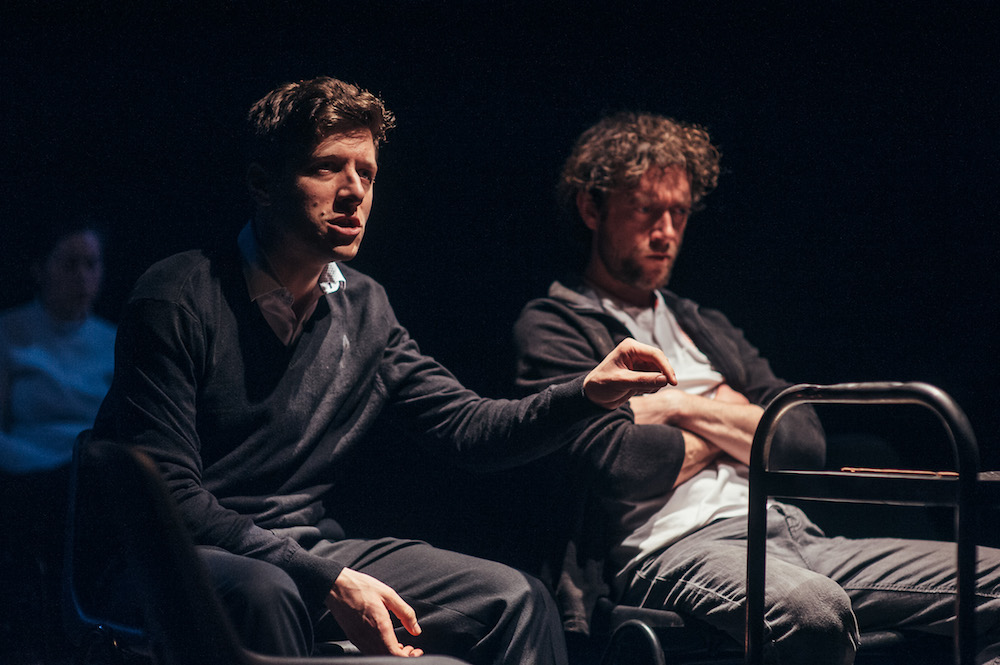
    Acclaimed musical theatre writer Stephen Clark, who died last year, penned this two-hander play as a vehicle for uber camp legend Julian Clary. The play concerns ageing architect Michael (Julian Clary) who is cooking dinner for a younger man (James Nelson-Joyce) who’s he’s picked up in the pub. As he slices, boils and fries the food in a functional on-stage kitchen he shares his thoughts on sex and death. Naturally. Once Tim arrives it’s not clear whether it’s sex or death that’s on the menu and who is in charge of the situation.

    Let’s get some important things out of the way first. Yes, Julian Clary can cook. To be fair, it’s a simple recipe, though. Shirley Valentine had to fry chips and egg. He just chucks a few things in a pan and rustles up a pasta sauce. Can he act, though? Partially. He manages to deliver the tight monologue that forms the first part of the ninety-minute play but once the action heats up he flounders a little. His character’s uptight and rigid persona suits his physical presence and makes the job an easier one.

    The main issue here is the play itself. It just doesn’t quite work and although mildly engaging it misses the mark more than it hits it. It’s a fairly relentless onslaught of thoughts about the death of celebrities. What should be sinister feels absurd and what should be absurd feels humdrum. What feels like a calculated move to shock comes across as tedious. It’s also, bafflingly, partly in rhyme and there’s a bizarrely intrusive soundtrack to the piece.

    On the plus side, the kitchen is stylish and attractive as is the young actor James Nelson-Joyce. Spoiler alert: expect full nudity. Julian Clary is an interesting spectacle and the faults of the piece aside it’s good to see him tackle something that’s different from his usual milieu.


    Le Grand Mort plays at Trafalgar Studios until 28th October 2017

  • THEATRE REVIEW | Late Company, Trafalgar Studios, London

    ★★★★★| Late Company

    THEATRE REVIEW | Late Company, Trafalgar Studios, London

    The title of a new play at Trafalgar Studios – Late Company – means that the family the Hastings invited over for dinner are late, and they are also late in apologising for the suicide of their teenage son.

    Debora (an amazing Lucy Robinson) and Michael Hasting (Todd Boyce) have invited Bill Dermot (Alex Lowe) and his wife Tamara (Lisa Stevenson) and their son Curtis (David Leopold) over for dinner to their fancy and art-inspired home. Curtis and Debora & Michael’s son Joel were friends in school, however, Michael committed suicide after being constantly bullied and taunted by the other kids in school (including Curtis) for being gay and a bit feminine. So Debora (and less so Michael) have invited the Dermots over for dinner on the one year anniversary of Michael’s death. It’s a dinner where Debora wants to have the ‘conversation’ – to get everything out in the open and to have an open and honest discussion with Curtis to determine the reasons and motive for doing what he did to Michael, and most importantly to find out why. But the dinner doesn’t go according to plan, it’s brought up bad emotions and feelings that Debora and Michael were trying to get over. But it turns out that Debora was never really there for Joel, and that Michael’s job as an MP took him to Ottawa a lot of the time, and Debora was always focusing on her art and not really on Joel, so Bill and Tamara subtly advise Debora and Michael that they missed the warning signs because they were too involved in themselves. But no matter who the finger is pointed to, Joel is gone forever, and no yelling or conversation will bring him back. And it’s mostly Debora who longs for closure, and perhaps she’s feeling a bit guilty over Joel’s suicide.

    Late Company throws heavy emotional dialogue at the audience right and left, and it’s delivered by an excellent cast. Robinson as Joel’s mom has the showiest part. She’s angry and upset and wants closure. Stevenson is also very good as the mother whose son is still alive, she just can’t put herself in Debora’s shoes but she is willing to do as much as she can to help ease the pain. And Leopold is a wonder as the son who doesn’t have much to say during the dinner but near the end, he comes into his own. Gay playwright Jordan Tannahill was only 23 when he wrote Late Company in the wake of a peer’s suicide, and he has written a timely and evocative play that’s very relevant today in a world of constant bullying and peer pressure and what seems like the lack of rules on social media. Late Company is a short 75 minutes but it packs a wallop during this time and at the end, you will find that your heart has dropped into your stomach. A must see!

    Late Company is playing at Trafalgar Studios until Saturday, September 16th.

  • THEATRE REVIEW | 46 Beacon, Trafalgar Studios, London

    ★★★★ | 46 Beacon

    It’s 1970 and for Robert, the air is heavy with the promise of straight, gay and even group sex as the hedonistic sixties leave behind a legacy of enhanced freedom for gay men.

    A suave and handsome British actor, Robert, has invited gauche teenage virgin, Alan, to his Boston hotel room for a drink and a chat (and hopefully an easy no-strings shag without his ‘room mate’ back in London finding out). The gin flows and it’s not just flesh that’s bared as they probe each other in more ways than one. Alan is overwhelmed, unsure of himself and his sexuality. Appearances are deceptive, though and Robert isn’t quite the carefree shagger he initially appears to be.

    This is a charming play that’s both warm and witty with plenty of wry humour and a touching message. The pace flags occasionally but picks up again. Overall it’s a resonant play touching on themes of alienation and feeling lost within the life you’ve made that I’m sure will be familiar to lots of us.

    The setting might be 47 years ago but as the saying goes: the more things change the more they stay the same. This is an incisive and fascinating glimpse of gay life that whilst humorous, I’m sure will make you wince at times as you recall your own past. Well worth 83 minutes of your time.

    46 Beacon plays at Trafalgar Studios until 29th April 2017

  • THEATRE REVIEW | BU21

    THEATRE REVIEW | BU21

    ★★★★ | BU21

    We’re bombarded every year with news of atrocities. We might try to avoid looking at the scenes on the news or alternatively seek them out with a ghoulish fascination. We might worry about it happening to us or think about how we’d cope with say a gunman opening fire or a bomb blast. The certain fact is that bad things happen in the world and we can’t avoid knowing that they do.

    BU21
    CREDIT: BU21

    ‘BU21’ looks at the human aftermath of a terrorist plane attack which causes mass causalities in suburban North London. It’s a wry and witty play that’s multi-layered and never predictable. Told as a set of interconnected monologues it’s a 100-minute ride with surprising humour as well as pathos.
    Graham has been elevated from van driver to national icon, having been one of the first to be filmed at the scene on the news and now finds this gives meaning to his life. Izzy learned that her mother had been ripped apart via Twitter and is trying to use her middle-class skills set to cope with this. Waitress Ana was horribly burned and maimed whilst sunbathing before her shift and is living life in a cold vacuum. Floss is seeing a dead man everywhere she goes. The thing is she was at the kitchen window and a man fell to earth in his plane seat and died looking into her eyes. City banker Alex’s flat was hit by wreckage which led to the unfortunate discovery of his girlfriend’s body welded to Alex’s best friend mid-shag. Finally,
    Clive is a devout Muslim. Raised with no religion he’s found comfort in Islam and wants to tell us about his side of the story.

    It might all sound unbearably grim and definitely like a play to avoid watching during a grey English January but this is where author Stuart Slade surprises tricks and teases. Slade’s characters are varying in their resilience, their surprising humour and their ability to get through. The play also turns its gaze upon society. Why do we want to watch this and what does our fascination with tragedy say about us as a society or as individuals? Slade plays with our prejudices too and laughs at and forces us to laugh at ourselves too. This is an alarmingly sad, hilariously funny and utterly pertinent play and is an experience you won’t stop thinking about for quite some time.

    BU21 plays at the Trafalgar Studi0 until Feb 18th

  • THEATRE REVIEW | Buried Child

    THEATRE REVIEW | Buried Child

    ✭✭✭ | Buried Child

    Buried Child
    CREDIT: Buried Child

    If you want to see Ed Harris sitting on a couch for close to three hours, then Buried Child is the show for you.

    Harris, film and television star, is excellent as Dodge, the father of two sons (dysfunctional doesn’t even come close to describing them). He lives in an old, ram shackled dilapidated house in Illinois with his wife Halie (Harris’ real-life wife Amy Madigan), who pops up in the first and third acts. Yes, this play has three acts, with two very quick ten-minute intervals between the acts. The last show I saw that had three acts, (The Intelligent Homosexual’s Guide to Capitalism and Socialism with a Key to the Scriptures), was very painful to sit through and felt a bit like Chinese water torture. Buried Child, playing at Trafalgar Studios, is not that bad but it still feels like a long show.

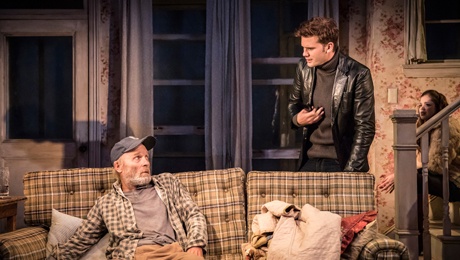
    Harris does spend the whole time on centre stage, on the sofa, and he’s even on the sofa before the show even starts. Dodge and Halie share their home, unwillingly, with their two grown up sons. They’ve obviously missed the financial gravy train and are unfortunately tethered to their poor lot in life. One son, Bradley (Gary Shelford), never left home, and who continues to bring into the house freshly dug up vegetables from no one knows where because there’s not a garden anywhere near the house. Tilden (Barnaby Kay), who used to live in New Mexico, has returned to the family homestead because of an incident that happened there. It’s up to Halie to be the sane member of the family, this is until their grandson Vince (Jeremy Irvine), son of Tilden, arrives in town with his girlfriend Shelly (Charlotte Hope). Immediately Shelly is uncomfortable in the house full of Vince’s miserable and depressed and sick grandfather, father and uncle. But there is a family secret that’s slightly mentioned which peaks Charlotte’s curiosity, and she wants to find out more. Meanwhile, Vince goes to the grocery store to buy booze for his grandfather because the bottle he had under the couch is missing, and while Charlotte is speaking to Bradley and wanting to know more about this secret and starts nagging a bit too much, he puts his hand into her mouth (at this point if I were her I would’ve run out of that house). But the secret that has doomed this troubled family is literally, and eventually, out of the bag, but not before Vince goes missing for the rest of the night and Halie returns home with the family pastor who’s just as uncomfortable in the house as Charlotte is. But it’s not until the final scene that leaves you with an image that you won’t soon forget.

    Buried Child is a very wordy play. perhaps a bit too wordy, but it being a Sam Shepard play, there is lots that is over dramatic, over the top, and bordering close to the unbelievable. Surely cutting out one act would’ve made this play more biting, sharper and dramatic instead of long-winded, but director Scott Elliott is able, just, to keep the drama and tension up, while maintaining, until the very end, the mystery of this family’s tragic existence on earth.

    Buried Child is now playing at Trafalgar Studios until February 18, 2017.

  • THEATRE REVIEW | Vanities: The Musical

    THEATRE REVIEW | Vanities: The Musical

    ★★★★ | Vanities: The Musical

    Imagine an afternoon Channel 5 film full of ‘women’s issues’. Or one of those novels that you take on holiday, read, instantly forget and then leave in the hotel room when it’s over. Syrupy sweet and wholesome but emotionally stirring on some levels. Predictable yet mildly intriguing and easy to digest but enjoyable nonetheless. That’s “Vanities” in summary. Oh, I almost forgot to mention: it’s also tremendous fun.

    Review of Vanties the musical
    CREDIT: Pamela Raith


    The story follows the friendship between three women through being High School cheerleaders in 1963 (yes, it’s American. Very American), living together in a sorority house at university in Dallas, reuniting in their late twenties in New York and finally meeting again as they are hitting 40 back in Texas. Joanne is traditional and wants to be a wife and mother, Kathy is driven and organised and wants a career as a sports teacher and Mary just wants adventure (a.k.a. sex and travel). There we have it in three handy female stereotypes: earth mother, career woman and bitch/whore. Naturally. There’s infidelity, hurt, alcoholism and nervous breakdowns plus the odd abortion, betrayal and blazing row. It’s soapy, light and watchable.

    There are, however, various qualities that elevate Vanities above this form. Firstly, the songs: they’re almost a parody, aping the girl groups of the 60s and 70s with tones of Bacharach, The Supremes and The Shangri-Las. Kirschenbaum’s lyrics are witty and amusing and although they’re not the most memorable riffs, they’re easy to listen to, raise a smile and work well in the context. Racky Plews’ choreography echoes the styling of the music and there are some moves worthy of a lip-syncing runner-up in RuPaul’s Drag Race.

    Secondly: the cast. Lizzy Connolly, Ashleigh Gray (a previous Elpheba in the Wicked U.K. tour) and the lovely Lauren Samuels (who was award nominated for ‘Bend It Like Beckham’) are all equally strong and carry the show with ease.

    Thirdly, the staging: the tiny space of Trafalgar Studios 2 is transformed into a shifting, overtly feminine space full of the cluttered paraphernalia of girlhood. The show works well at such close quarters, given the minuscule cast and scrutinised emotion.

    A 2009 sickly saccharine musical that was based on a 1974 Broadway comedy and that has never managed to hit this side of the pond? It may not sound like the best proposition for a good night out. Sit back, relax and this hollering, dancing all female group will show you just how wrong that assumption would be. Just don’t take your straight male friends. I’m not entirely sure that they’re going to ‘get’ this one. School of Rock or Groundhog Day, anyone?

    Vanities: The Musical plays at the Trafalgar Studios until 1st October 2016

    Follow Chris Bridges on Twitter

  • Rotterdam: A Gender-Comedy Interview

    Alice wants to come out as a lesbian. Her girlfriend Fiona wants to start living as a man. It’s New Year in Rotterdam, and Alice has finally plucked up the courage to email her parents and tell them she’s gay. But before she can hit send, Fiona reveals that he has always identified as a man and now wants to start living as one named Adrian. Now, as Adrian begins his transition, Alice must face a question she never thought she’d ask… does this mean she’s straight?


    But how a non-trans writer and actress approach portraying the trans experience for mainstream audiences? Transsexual writer and performer Sasha de Suinn interviews director Jon Brittain and actress Anna Martine in an informative, ground-breaking discussion.

    SASHA: Is Rotterdam primarily aimed at mainstream audiences unacquainted with gender fluidity? If so, is the show’s sub-text entry-level in terms of that subject, or is presuming some awareness of gender questions from an audience?

    Jon: I guess the answer to the first question is yes and no. It’s certainly accessible for audiences who are less informed and I made a conscious effort to make sure that was the case. However, at the same time I didn’t want to write something that had nothing in it for people who had first-hand experience of the subject matter. A lot of the writers and artists I admire find a way of unpacking complicated issues in a way that is satisfying for those in the know, but that brings the less knowledgeable along with them, and that was my aim too. I don’t want to be as trite as to say Rotterdam is for everyone, but I certainly hope that it doesn’t alienate anyone by presuming too much prior knowledge or, on the other hand, by presenting something that is too simplistic and familiar. I think we get into some interesting conversations throughout the play about gender, sexuality and the clash between our sense of personal identity and how others perceive us, but I think different people will get different things out of them.

    Anna: The response we had when we premiered at Theatre503 was incredible. I had people coming up to me after the show from across the board telling me how moved and connected they were to the play, this included people within the queer community, as well as people who were less acquainted with these worlds. Because although it deals with complex issues about gender and sexuality, its inclusive, there are different access points into the play through the four very different characters and with its humour it reaches out beyond these labels and specific identities and connects with the audience on a human level.

    SASHA:What is your artistic background and focus of interests as a writer / director? When did you first become interested in the notion of gender as a performative inquiry? What sparked the initial idea of Rotterdam?

    Jon: I actually only wrote Rotterdam, Donnacadh O’Briain directed it (and did a fantastic job, too). I’ve been working as a writer and director now in some capacity for the last seven years and have quite an eclectic body of work. I’ve written plays, sketches and cartoons, and I’ve worked as a director on my own shows and other people’s, as well as with comedians such as Tom Allen and John Kearns. As a result, I can’t really claim to have a focus, although I am always attracted to stories in which characters are their own worst enemies – I like to see people struggle against themselves as much as against other people. In terms of when I first became interested in gender and gender fluidity as a subject to write about, I’ve been interested in it for a while and I tried to write a few things about it when I was younger which were all well-intentioned but also quite bad! I had the idea for Rotterdam about six years ago after a couple of my friends had come out as transgender. I was struck by how few well-rounded (or indeed any) transgender characters there were in drama and comedy. At the same time, I had started to think about sexual identity and how it changes or stays the same over a lifetime. These two ideas sort of merged into one and Alice and Adrian popped into my head. The story of Rotterdam is about these two characters, their relationship and how they reconcile their sense of their own identities with their love for each other.

    SASHA:How are the actors involved approaching the notions of gender fluidity, and how does that shape and affect their performing process?

    Jon: Over to you Anna!

    Anna: I have a deep empathy and connection to my character – I identify as queer and so this play resonates with me on a personal level – the issues are aligned with what I care about personally and so I’m really excited to be exploring gender, identity and sexuality in this way. What’s brilliant is that throughout the development of the play the creative team had an open dialogue with people and organisations within the trans community, so when it came to approaching my character and his journey I felt confident and excited!

    There’s such a strong supportive online transgender community, so as well as talking to trans people within my community and researching online, I’ve also been exploring and observing gender expression out in the world: What it’s like to step inside the body and experience of a man compared with a woman and then these glorious, complex and interesting places in between and around these binary ideas of gender.

    SASHA:How do you feel about the debate, which is hotly contested in some quarters, that trans characters on stage, screen and television should only be played by genuine trans actors, as they’re hugely still hugely under-represented in terms of media visibility, and non-trans actors have a huge range of acting options available to them by comparison? For example, why, except for box-office reasons – was Eddie Redmayne cast in The Danish Girl? Trans actresses like Adele Anderson would, arguably, have brought a greater emotional weight to the role.

    Anna: It is definitely a debate that needs to be had. I feel we should also look towards an industry where gender doesn’t come into play at all, where roles are just as open to trans actors etc. I’m really passionate about gender neutral casting – i.e. removing gender as a divide or indicator of how best to play a character or tell a story – and look to more diverse casting choices across gender, race and class, like Phyllida Lloyds powerful all female production of Julius Caesar or Regent’s Park Open Air Theatres recent production of Henry V with Michelle Terry as the title role and her bride to be played by the male actor Ben Wiggins.

    Jon: It’s a difficult one for me personally because I was very passionate about trying to cast a trans actor in Rotterdam but although the people we saw were of a very high quality none of them quite fit the character. When Anna walked into the room, she did. I feel confident saying that we made the right decision because I know how fantastic and truthful the performance she gives is, but I can also appreciate how frustrating it must be to be a trans actor who’s seeing yet another trans role going to a non-trans person. I do think there needs to be a proactive campaign throughout theatre and TV to be more inclusive – both in front of and behind the scenes. I’ve met quite a few trans actors through doing Rotterdam and through the Gendered Intelligence trans acting course and I know how talented many of them are, but more opportunities need to be made available to them. As Anna says, an ideal world would be one where gender doesn’t come into it at all, I don’t know how realistic a possibility that is, but there are definitely things we can do in the here and now to make things better.

    SASHA: Do you think Rotterdam is artistically advancing theatrical notions of gender-variance on stage or simply trivialising genuinely ground-breaking issues? There’s a world of difference between the transgressive works of Nina Arsenault and Amanda Lepore and the awful, cosy and one-dimensional treatment of trans characters in soap-operas, where they’re often served up as exotic tokenism, or presented as arbitrary life-style choices with little real weight or consequence.

    Jon: I certainly hope I’m not trivialising anything. I became very aware, very early on, of the danger of creating something that did a disservice to trans people. I felt a keen sense of duty not to screw it up and to try not to fall into the traps that people who went before me, often with noble intentions, sometimes fell. The notion of the ‘cosy’ character is something I was very keen to avoid. Sometimes trans characters can be portrayed as faultless angels with no personality flaws – but who is like that in real life? Being trans does not mean that someone cannot be flawed, or funny, or difficult, or sarcastic, or inappropriate, or silly. With Adrian, as with all the characters, I strove to create a well-rounded, three-dimensional person whose gender identity is only one aspect of him. He’s not perfect – he sometimes gets things wrong or makes mistakes or pushes people away, but for me, that’s more interesting than seeing someone who has no lessons to learn and whose sole function is to teach other people tolerance. I can’t claim Rotterdam is as subversive or provocative as the work of Nina Arsenault or Amanda Lepore, but I certainly think there’s more than one dimension to it.


    SASHA: It’s evident that Rotterdam will be a comic and thought-provoking delight for mainstream audiences for whom it might be an eye-opener, but what do you think the show’s bringing to gay and trans audiences deeply acquainted with gender-fluid theatre? It’s quite sad that arguably the biggest, so-called gender-fluid theatrical show ever is the deeply reactionary Rocky Horror Show, which actually advocates sexual irresponsibility, blanket promiscuity and sexual predation without any sense or consideration of the emotional consequences for those involved.

    Anna: As part of the queer community I’m genuinely proud of this play; it’s funny and moving where the queer characters don’t die, go straight or end up crazy. It’s so refreshing to move away from these awful clichés that the queer community are used to seeing on stage and screen. We get used to cringing, not identifying with the narrative or saying “it’s good for a lesbian film’ or “yeah it’s not bad for a gay play” and we keep seeing a similar narrative play out on screen and stage that is often tragic. This play joyfully connects to people because and despite it being a ‘queer play’! It is both enjoyable and welcoming to new-comers but also joyfully familiar and better connected to the LGBTQIA+ community than I’ve experienced on stage before.

    Jon: Well, one thing I can say about Rotterdam is that it is very concerned with the emotional consequences of the characters’ actions (and inactions) as that is what drives most of the play. As for what it brings, I hope I’m not giving too banal an answer by saying it brings these characters and this story. There is a huge amount of diversity in the LGBTQIA+ community and the number of plays, performance pieces, comedy shows and one-person shows that could be created is infinite. With this play, I wanted to honestly, humorously and sensitively tell the story of the relationship between Adrian and Alice. As with any piece of theatre, you have a limited amount of time, and there are loads of interesting discussions to be had about gender-fluidity, the sexuality spectrum, and identity that I wasn’t able to get into in this show because they didn’t apply to these characters. But I think it’s good that there is a plurality of work being created, and that each piece can occupy its own space and talk about its own things. Rotterdam is a big hearted comedy-drama about a relationship between two people who are their own worst enemies. It won’t be for everyone, but I do hope that it will be as funny and emotionally involving for people well acquainted with the themes as it is for those new to them!

    Rotterdam is a new, gender-fluid comedy directed by Donnacadh O’ Brian running at Trafalgar Studios, Whitehall, London from Tuesday, 26th July to Saturday, August 27th. Box Office Ticket number: 0844-871-7632.


    Follow Sasha DeSuinn on Twitter

  • THEATRE REVIEW | The Maids, Trafalgar Studios

    THEATRE REVIEW | The Maids, Trafalgar Studios

    ★★★★★ The Maids | Two young maids are dressing up in their mistress’ clothes, shoes and jewelry.

    (more…)