Tag: Legal

Read the latest news and analysis of legal issues surrounding the LGBT+ community. Browse THEGAYUK’s entire archive on news on legal issues.

  • UK Supreme Courts rules that “gay cake” bakery did not discriminate on the basis of sexuality

    The UK’s highest court has ruled that Ashers Bakery did not discriminate against a customer because of his sexuality.

    gay cake, wedding,
    (C) Londondeposit Depositphoto

    Speaking on the ruling President Lady Brenda Hale said, “It is deeply humiliating, and an affront to human dignity, to deny someone a service because of that person’s race, gender, disability, sexual orientation or any of the other protected personal characteristics, but that is not what happened in this case.”

    “The bakers did not refuse to fulfil his order because of his sexual orientation. They would have refused to make such a cake for any customer, irrespective of their sexual orientation.”

    “The bakers could not refuse to supply their goods to Mr Lee because he was a gay man or supported gay marriage but that is quite different from obliging them to supply a cake iced with a message with which they profoundly disagreed.”

    Baroness Hale once called for a “conscience clause” for Christians who have anti-gay beliefs during a trial of anti-gay B&B owners, Peter and Hazelmary Bull.

    First, they lost, but appeal after appeal, finally success for Ashers Bakery

    The Asher’s Bakery row has rolled on since 2014 when the Christian run Ashers Baking Co. in Northern Ireland refused to make a pro-gay marriage cake, which featured a slogan “Support Gay Marriage – Queer Space Born 1998” with a picture of Sesame Street characters Ernie and Bert, because it says it clashed with the ethos of their company, saying,

    ‘We thought that this order was at odds with our beliefs, certainly was in contradiction with what the Bible teaches.’

    Queer Space is an organisation, which seeks to increase the visibility of the Lesbian, Gay, Bisexual and Transgendered (LGBT) Community in a positive manner to counteract the disregard, and negative images presented to the general public.

    “Discrimination Clash”

    Rhian Radia is a leading lawyer who specialises in discrimination cases, and a Director at Vardags. She said today, “A judgment of the Supreme Court today has found that a bakery in Northern Ireland did not discriminate against a gay man by refusing to bake him a cake with a message supporting gay marriage.

    “The bakers oppose the introduction of gay marriage on religious grounds. The Supreme Court’s decision found that the refusal to bake the cake was because of the message on the cake rather than the sexual orientation of the customer or his association with Queerspace, a volunteer-led organisation for the LGBT community. Sexual orientation and support of gay marriage were viewed to be two separate things. The judges decided that people of all sexual orientations can and do support gay marriage.

    “The judgment is being touted as a victory for free speech by those who believe that the bakers should not have been forced to bake a case with a message they disagreed with.

    “This is the latest in a line of employment law cases where types of protection from discrimination clash with each other, in this case religious belief and sexual orientation and political belief. But is baking a cake as part of providing a service to a customer really about free speech where the rights of a business beat those of an individual?”

    Time Line:

    JULY 2014: Gareth Lee reports that Ashers Bakery refused to bake him a gay which said “Support Gay Marriage”. The Christian Institute provided the bakery with legal support.

    MAY 2015: A UK court found in 2015 that Ashers Bakery had been unlawful in refusing to bake a cake for Gareth Lee. The bakery owners were ordered to pay £500 in damages.

    JUNE 2015: The bakery announces its outline for appeal

    OCTOBER 2016: Ashers loses it appeal at the Court of Appeal, which upheld the original judgement that the bakers had acted unlawfully.

    NOVEMBER 2016: Ashers announce it is to appeal again

    OCTOBER 2018: Ashers wins its case in the UK Supreme Court


    The McArthurs, who own the company, have insisted that the issue was never with Mr Lee’s sexuality, but with the message that he had requested on the cake.



  • PETER TATCHELL: Ashers “gay cake” verdict is a victory

    Leading human rights activist has said that verdict that the Ashers Bakery did not discriminate in refusing to make a “gay cake” is a victory for freedom of expression.

    Cake, Gay Marriage, gay wedding
    CREDIT: © ivonnewierink Depositphotos

    Peter Tatchell has described the act of same-sex marriage as a “political idea” and that no business should be forced to produce a product that they have a ‘conscientious objection” to. He stated that the verdict that the Ashers Bakery did not discriminate in refusing to honour an hour for a cake which had “Although I profoundly disagree with Asher’s opposition to marriage equality, in a free society neither they nor anyone else should be forced to facilitate a political idea that they oppose”.

    He added, “Businesses can now lawfully refuse a customer’s request to emblazon a political message if they have a conscientious objection to it. This includes the right to refuse messages that are sexist, xenophobic or anti-gay, which is a good thing”.

    Appeal after appeal

    The Asher’s Bakery row has rolled on since 2014 when the Christian run Ashers Baking Co. in Northern Ireland refused to make a pro-gay marriage cake, which featured a slogan “Support Gay Marriage – Queer Space Born 1998” with a picture of Sesame Street characters Ernie and Bert, because it says it clashed with the ethos of their company, saying,

    ‘We thought that this order was at odds with our beliefs, certainly was in contradiction with what the Bible teaches.’

    Queer Space is an organisation, which seeks to increase the visibility of the Lesbian, Gay, Bisexual and Transgendered (LGBT) Community in a positive manner to counteract the disregard, and negative images presented to the general public.

    They didn’t discriminate because the customer was gay…

    Tatchell continued, “Ashers did not discriminate against the customer, Gareth Lee, because he was gay. They objected to the message he wanted on the cake: ‘Support gay marriage.’

    “Discrimination against LGBT people is wrong. But in a free society, people should be able to discriminate against ideas that they disagree with. I am glad the court upheld this important liberal principle.

    “If the original judgement against Ashers had been upheld it would have meant that a Muslim printer could be obliged to publish cartoons of Mohammed and a Jewish printer could be forced to publish a book that propagates Holocaust denial. It could have also encouraged far right extremists to demand that bakers and other service providers facilitate the promotion of anti-immigrant and anti-Muslim opinions.

    “That would have set a dangerous, authoritarian precedent that could have been open to serious abuse.

    “Discrimination against people should be illegal but not discrimination against ideas and opinions,” said Mr Tatchell.

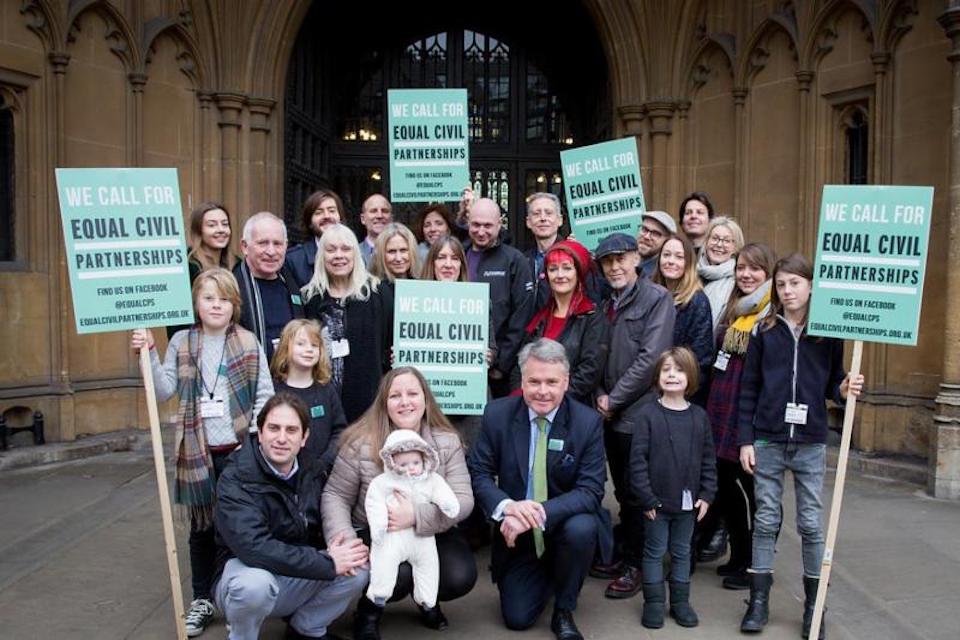
  • Civil Partnerships now available to opposite-sex couples

    Civil Partnerships now available to opposite-sex couples

    Civil Partnerships have now been greenlit for opposite-sex couples.

    The UK government has agreed to open civil partnership to heterosexual couples equalising the law for straight and gay couples. Speaking about the decision, Human Rights campaigner, Peter Tatchell said,

    “The planned opening of civil partnerships to opposite-sex couples is wonderful news. It is the successful culmination of a 14-year equality campaign that was begun in 2004 by myself and the LGBT+ organisation OutRage! When Labour first introduced civil partnerships but restricted them to same-sex couples we argued that this was discrimination. We campaigned for equal civil partnerships for all,” said human rights advocate Peter Tatchell.
    “We are delighted that Charles Keidan and Rebecca Steinfeld have continued this campaign and finally won this stunning result. They secured the backing of the Supreme Court in June this year, when it ruled that the ban on opposite-sex couples was unjustified and contrary to human rights principles. The government’s decision was a necessary response to the judgement of the highest court in the land.
    “We thank the government for listening to the judges, human rights law and the appeals of the many unmarried opposite-sex couples who want a civil partnership,” said Mr Tatchell.
    Civil Partnerships were first offered to gay couples in 2004 by the Labour government as a way for gay and same-sex couples to protect and formalise their relationship inline with traditional marriage. There have been over 60,000 civil partnerships in the UK since the law was introduced.
  • Sex between two consenting men is now legal in Trinidad and Tobago

    Sex between two consenting men is now legal in Trinidad and Tobago

    Laws in Trinidad and Tobago have been changed, not repealed, to allow consenting men to have anal sex.

    www_slon_pics / Pixabay

    Sodomy laws have been amended in Trinidad and Tobago to allow adult men to have sex with each other. Justice Devindra Rampersad gave a final ruling on legal challenges by LGBT+ activist Jason Jones, to amend the wording of certain sections of the Sexual Offences Act.

    Two sections underwent wording change.

    Wording has been amended in section 13, with the words “without consent”. The section now reads,

    “13. (1) A person who commits the offence of buggery is liable on conviction to imprisonment for twenty-five years. (2) In this section “buggery” means sexual intercourse “without consent” per anum by a male person with a male person or by a male person with a female person.”

    In section 16 the words “a male person and a female person” are deleted and replaced with “persons”

    “(1) A person who commits an act of serious indecency on or towards another is liable on conviction to imprisonment for five years.

    (2) Subsection (1) does not apply to an act of serious indecency committed in private between—

    (a) a husband and his wife; (b) “persons” each of whom is sixteen years of age or more, both of 

    whom consent to the commission of the act; or (c) persons to whom section 20(1) and (2) and (3) of the Children Act apply. (3) An act of “serious indecency” is an act, other than

    sexual intercourse (whether natural or unnatural), by a person involving the use of the genital organ for the purpose of arousing or gratifying sexual desire.

    In April 2018 those two sections of the Sexual Offences Act were ruled unconstitutional by judge Devindra Rampersad.


  • Gay sex now legal in India

    Gay sex now legal in India

    A law known as Section 377 has been overturned by the Indian Supreme Court.

    The court’s ruling reverses a 2013 decision that a colonial-era law, known as section 377, under which sex between two men is categorised as an “unnatural offence” would stay on the books.

    According to the BBC, “It is one of the world’s oldest laws criminalising gay sex, and India has been reluctant to overturn it”

    That is until now.

    Speaking about the ruling, leading LGBT+ rights activist, Peter Tatchell said,

    “This historic legal ruling sets free from criminalisation almost one fifth of the world’s LGBT+ people. It is the biggest, most impactful gay law reform in human history. I hope it will inspire and empower similar legal challenges in many of the 70 countries that still outlaw same-sex relations, 35 of which are member states of the Commonwealth.

    “Ending the ban on homosexuality is just a start. There are still huge challenges to end the stigma, discrimination and hate crime that LGBTs suffer in India.

    “Indian LGBTs now revert to the legal status of non-criminalisation that existed prior to the British colonisers imposing the homophobic section 377 of the criminal code in the nineteenth century.”

    Read the full story on BBC.com

  • Is the Gender Recognition Law ready for change?

    Is the Gender Recognition Law ready for change?

    Two solicitors, Craig Longhurst and Alex Watson from the leading law firm Fieldfisher write about the government’s plans to revisit the relevance of the Gender Recognition Act 2004 and some of the issues facing the transgender community today.

    vjohns1580 / Pixabay

    When it brought the Gender Recognition Act 2004 (GRA) into force on 4 April 2005, the UK became the first country in the world to allow a person to legally alter their gender without having had any surgical treatment.

    However, since coming into force, only 4,910 have been issued the Gender Recognition Certificate – which is required for a trans person’s new legal gender to be recognised. Given these figures and the concerning suicide and self-harm rates amongst the trans community, the issues are now being revisited by Government.

    The Government’s Equality Office is currently consulting on the legal gender recognition process and its effectiveness. The consultation (which commenced on 3 July 2018 and will close on 19 October 2018) is focussing on the possibility of removing an applicant’s need for a medical diagnosis of gender dysphoria before being able to apply for gender recognition.

    In acknowledgement of the complicated and contested nature of some terminology used in discussing matters, the consultation states that:

    “Throughout this consultation we have tried to use terminology that is generally accepted. No offence or omission is intended.”

    That also applies to this article and shall adopt the same definition of ‘Transgender/ Trans’ as adopted in the consultation:

    “Transgender / Trans: Umbrella terms used to describe individuals who have a gender identity that is different to the sex recorded at birth. Non-binary people may or may not consider themselves to be trans. This consultation document primarily uses ‘trans’.”

    The Law

    As it stands, for a person to legally change their gender, the applicant must be over 18 years old and must usually* meet the following “assessment based” requirements of the GRA:

    1. A medical diagnosis of gender dysphoria and a report from a medical professional detailing any medical treatment;
    2. Proof of having lived for at least two years in their acquired gender through, for example, bank statements, payslips and a passport (which can be changed without legally changing gender);
    3. A statutory declaration that they intend to live in the acquired gender until death;
    4. If married, the consent of their spouse;
    5. Payment of a fee of £140 (or proof of low income for reduction/removal of the fee); and
    6. Submission of this documentation to a Gender Recognition Panel, which the applicant does not meet in person.

    * N.B. there is a slightly different process for married/ civil partnered trans people who have socially and medically transitioned for at least 6 years prior to 10 December 2014 and for overseas trans people, which is outside the scope of this note.

    If a person is adjudged by the Gender Recognition Panel to have met the requirements, they will be issued with a Gender Recognition Certificate – which alters their birth certificate and (subject to a number of limitations) changes their birth gender to their newly-recognised gender. That person then assumes the legal rights of that gender, including: age of retirement, pension and marital rights.

    However, if a person is adjudged by the Gender Recognition Panel to have not met the requirements, his/ her birth gender shall continue to be that person’s legal gender and he/ she shall not have the right to appeal the decision, unless on a point of law. It is hard to see how it can be considered fair that an independent panel is able make such fundamental decisions regarding a person’s life without having actually met them and for an applicant to have no recourse if the application is unsuccessful.

    The view from the trans community

    The results of a recent LGBT Government Survey revealed that many trans people want legal recognition but feel that the current process is too bureaucratic, expensive and intrusive. Further, the Government feels that most trans people feel that the “assessment based” requirements detailed above are overly intrusive, humiliating and administratively burdensome and are denying people access to the legal recognition they are entitled to. More specifically arguments have been raised that:

    1. the requirement of the provision of a diagnostic psychiatric report perpetuates the false assumption that being trans is a mental illness – which both the Government and the World Health Organisation recognises is not the case (the latter has declassified ‘Gender Incongruence’ [i.e. dysphoria] as a ‘Mental and Behavioural Disorder’ in its International classification of Diseases);
    2. the trans person has to collect a range of personal documentation, including information about their medical history, finances and identity which they send to people who they do not meet who then make a decision about their gender identity; and
    3. The fee of £140 and associated costs are expensive and there is no right of appeal against the decision unless on a point of law.

    The Consultation

    Given the above, the Government’s consultation is focussing on many aspects of the GRA, including:

    1. The requirement for the trans person to provide two medical reports, one evidencing a diagnosis of gender dysphoria and the other outlining details of any treatment received;
    2. The requirement for the trans person to provide a range of documentation that proves they have lived in their acquired gender for at least two years;
      The requirement for the trans person to submit a statutory declaration of their intention to live in their acquired gender until death;
    3. The requirement for married applicants to obtain the consent of their spouse or end their marriage;
    4. The cost to the trans person of using the GRA process; and
    5. How the Act protects the privacy of individuals who have applied for a GRC.

    Comment

    Whilst we continue to await the results of the consultation, it is positive to see focus being placed revisiting legislation adopted 13 years ago with limited relevance to present day society’s approach to LGBT+ issues and it appears likely that legislative changes will make it easier for trans people to exercise rights to exist in the gender that they identify with.

    The consultation on the Reform of the Gender Recognition Act 2004 is open until 11pm on 19 October 2018 and can be located at https://www.gov.uk/government/consultations/reform-of-the-gender-recognition-act-2004

    Craig Longhurst and Alex Watson are from the leading law firm Fieldfisher

  • COMMENT | Banning “Gay Cure” therapy could drive it underground, so what can Government do to stop it?

    COMMENT | Banning “Gay Cure” therapy could drive it underground, so what can Government do to stop it?

    Making Prevention better than The Cure

    (C) BIGSTOCK

    The UK government’s LGBT Action Plan sounds like the blueprint for some upcoming wargame, rather than a 32-page, 75-commitment based document aimed at pulling down barriers for the LGBT community in both their public and private lives. Yet one promise causing the most interest appears to commitment to finally ban the so-called ‘gay conversion therapy’:

    “We will bring forward proposals to end the practice of conversion therapy in the UK. These activities are wrong, and we are not willing to let them continue. Led by the Government Equalities Office, we will fully consider all legislative and non-legislative options to prohibit promoting, offering or conducting conversion therapy. Our intent is protect people who are vulnerable to harm or violence, whether that occurs in a medical, commercial or faith-based context. We are not trying to prevent LGBT people from seeking legitimate medical support or spiritual support from their faith leader in the exploration of their sexual orientation or gender identity”.

    It is rarely the child who finds the problem with their own sexuality once they understand and accept it, rather it is those around them; those who would otherwise provide support. LGBT charities still exist to tackle those occasions when parents are unaccepting – if you want to appreciate the real scope, just take a glance at the homelessness statistics and the functions of the Albert Kennedy Trust. The government’s promise on introducing both legislative and non-legislative options to prohibit “promoting, offering or conducting conversion therapy” is an important and substantive change in tenor that should not be underestimated.

    The conversion therapy makes the fundamental assumption that sexual orientation is a psychological disorder that can be ‘cured’. Previously, while there was no general acceptance of it, the UK government’s position was that the regulation and code of ethics for any regulated practitioner would prevent LGBT individuals being offered or undergoing this treatment. The government would not legislate for the sake of it and nor would they criminalise the conduct.

    There is not harmony or unified thinking about this across either Europe or the rest of the world. Some countries, like Brazil and Argentina, and a few US states have banned it but great swathes still take no real affirmative action.

    How can the Government ‘Ban’ Conversion Therapies?

    The government has many tools in its war cupboard when approaching these. The big guns of the arsenal could be the criminalisation of the therapy itself, but it can just drive the practice further underground and some would argue that it is a practice which people ‘choose’ to undertake. Criminalising the promotion of it is another route, or introducing hefty fines for those practitioners caught conducting or condoning it. How would you regulate it though? Those who are professionals are already regulated by their professional body and who have already taken steps to prevent it.

    Some, including myself, have argued previously about how the government was simply burying their heads in the sand on this point and was failing vulnerable children who are not being taken to regulated professionals, but camps involving the most inhumane physical and psychological torment.

    Whichever way the government shapes this, a root and branch approach is going to be needed to get this from the core and strip it back to a fundamental understanding in all sections of society. Gender identity and sexual orientation already have incredibly high levels of suicide and depression amongst young adults and children. It is important that they see this change and the support that it brings them when society will step in and say, “This is not just wrong, it is abhorrent. This will not be tolerated in any form anymore.”

    For the most determined parent, could they still just take their children abroad? How can we protect and prevent this too without a wider consensus in foreign countries as well? I would hope the UK government has a plan to deter this from happening, but what safeguards can they put in place? Here we would hope to see non-legislative change, promoting better understand and LGBT education in schools, building relations with different parts of society and adding these forms of harm to child protection officers in schools and local authorities. The Church of England acknowledged this in 2017. Will other community leaders openly do so too?

    The LGBT Action Plan is a tome of information, statistics and ambitious promises. It highlights many other facts, such as disclosure of their sexual orientation at work and the high level of discrimination in the workplace that still remains. While we have legislation in this area already, the absence of real and substantive legislation or debate in the area of gay conversion therapy is astounding. Whether the government of the day decides to criminalise the practice, or place deterrents in some other form, this will be hailed by the LGBT community as a step towards not just equality but basic, human dignity.

    The more cynical side of my mind remains with a question though: will the government be able to create a robust enough system of ‘prevention’ which is better than the ‘cure’?

    Andrew Spearman is an award-winning lawyer and Director of A City Law Firm

  • This man is bringing a class action against Grindr for allowing racial discrimination

    “A breeding ground that perpetuates racism against gay Asian Men”

    A man is planning to sue the gay dating app, Grindr, for racial discrimination and is looking for co-plaintiffs across the US’s fifty states so that he can bring a class action.

    In a statement released on social media, Sinakhone Keodara, the CEO and founder of the Asian Entertainment Television company says that Grindr allows “white gay men to write in their profiles ‘no Asians’, ‘not interested in Asians’: or ‘I don’t find Asians attractive’,” which he says, leads to people feeling “offended, humiliated, degraded and dehumanised” by the app.

    Keodara says that anyone who is considering joining him must be a paying customer.

    In 2018, Grindr became fully owned by the Chinese gaming firm, Kunlun Tech Co.

    The dating app OKCupid recently analysed sexual racism among 1m of its male site users. The company found that compared to black, Asian or minority ethnic users, white users got more messages. White users were also found to be less likely to reply or match with users of a different race to themselves, and more likely to question interracial marriage.

    Recent research from Australia also found that 15% of gay men on the dating app Grindr included sexual racism on their profiles. This was more likely to be the case if the profile user was white, and if the user held broader racist views.

  • Former LGBT charity CEO given boardroom ban as a warning to others

    Former LGBT charity CEO given boardroom ban as a warning to others

    The former CEO and director of LGBT+ domestic violence charity, Broken Rainbow, has been given a three and half year ban on any boardroom activities.

    THEGAYUK.com was given notice by the UK’s Insolvency Service that former CEO of Broken Rainbow, Jo Harvey-Barringer who resides in Sussex, has been handed a disqualification on running any company or limited liability company for the next three and a half years. At the time Broken Rainbow was the biggest LGBT charity that served the victims and survivors of domestic abuse and violence.

    A disqualifications order as means that Harvey-Barringer will not be able to act as a director of a company, take part directly or indirectly in the promotion, formation or management of a company or a limited liability partnership or be a receiver of a company’s property.

    Harvey-Barringer was the CEO and director of LGBT domestic abuse charity Broken Rainbow which collapsed in 2016. The charity had failed to keep payments to the tax office in respect of its PAYE debt.

    The charity had several funding streams, however, the bulk of its money was provided by the Home Office. This revenue stream was not guaranteed and the charity had issued several yearly warnings that it would not be able to continue without the governmental funding.

    In addition, charity Trustees had serious concerns over how it could continue to deliver its services and sought advice from an Insolvency Practitioner.

    Following this, the charity was placed into creditors voluntary liquidation on 5 July 2016.

    Payments made to CEO but not HMRC

    Between December 2014 and May 2016, payments amounting to £143,671 were made to Jo Harvey- Barringer, at a time when only £3,490 was paid in respect of the PAYE liability incurred during that period. This included a single payment of £12,500 made to her on 08 April 2016.

    According to Buzzfeedthe charity received £1.4 million of public funds in grants from the Home Office. The National Audit Office reported that £34,000 was still owed to HMRC.

    Anthea Simpson, a Chief Investigator with the Investigation and Enforcement Services, of the Insolvency Service said,

    “This ban should serve as a warning to other directors, particularly to those operating in the charity sector, that Company directors have a duty to ensure businesses meet their legal obligations, including paying taxes.

    “Deliberate neglect of tax affairs whilst paying others is not a victimless action as it deprives the taxpayer of the funds needed to operate public services and if they put their own needs before them they could be investigated by the Insolvency Service and lose the privilege of limited liability trading.”

    On 6 June 2018, the Secretary of State accepted a disqualification undertaking from Jo Harvey-Barringer, after she admitted failing to make payments to HMRC, while continuing to make payments to herself and other creditors.

    Harvey-Barringer’s ban is effective from 27 June 2018 and lasts for 3.5 years and means that for the duration of the ban, she cannot directly or indirectly becoming involved, without the permission of the court, in the promotion, formation or management of a company or limited liability partnership.

  • “Victory for love and equality” Peter Tatchell celebrates Civil Partnerships for all couples

    The Human Rights activist, Peter Tatchell has praised the Supreme Court ruling that mixed-sex couples should be allowed to have civil partnerships.

    A straight couple, Rebecca Steinfeld and Charles Keidan, have won their legal case, which will allow them to have a Civil Partnership instead of a traditional marriage.

    Up until now, the only couples permitted to have CPs were gay and lesbian couples.

    It was a law introduced by the Labour government in 2004, before the Conservatives, under David Cameron were able to vote and pass Same-Sex marriage.

    Civilly Partnered couples are entitled to many of the protections offered by marriage including, inheritance, tax, pension rights and next of kin arrangements.

    Steinfeld and Keidan argued that the Civil Partnership act was unlawful before it was incompatible with the European Convention on Human Rights.

    Speaking about the ruling, leading Human Rights activist, Peter Tatchell said, “This is a victory for love and equality. It was never right to deny opposite-sex couples the option of having a civil partnership. In a democracy, we are all supposed to be equal before the law. It is wonderful news that the Supreme Court has ruled against the government and in favour of equal civil partnerships”.

    This ruling overturns a previous judgement made by the Court of Appeal made in February 2017.

    Peter Tatchell has supported Rebecca Steinfeld’s and Charles Keidan from the outset of their legal challenge in 2014.

    Indeed, he championed the right of opposite-sex couples to have a civil partnership from the moment Tony Blair’s government announced in 2003 that the option would be available to same-sex couples only, condemning it as “blatant discrimination based on sexual orientation.”

    Speaking about today’s victory in the Supreme Court, Mr Tatchell said, “The ban on opposite-sex civil partnerships was discrimination and a violation of human rights. It is outrageous that the government was unwilling to legislate equality and that this couple were forced to go to court to get a basic human right – the right to be treated equally in law.

    “It was never fair that same-sex couples had two options, civil partnerships and civil marriages, whereas opposite-sex partners had only one option, marriage,” said Mr Tatchell.

    In May THEGAYUK.com ran a poll of its readers which found that 62 percent of LGBT+ people who answer believed that Civil Partnerships should be open to all couples, while only eight percent believed that they should remain for just same-sex couples.

    Thirty percent believed that Civil Partnerships should be scrapped altogether.


  • Straight couples should be able to get Civil Partnership, Supreme Court rules

    Straight couples should be able to get Civil Partnership, Supreme Court rules

    Mixed-sex couples should be allowed to have civil partnerships, Supreme Court rules.

    CREDIT: ©-welcomia-Depositphotos

    A straight couple, Rebecca Steinfeld and Charles Keidan, have won their legal case, which could allow them to have a Civil Partnership instead of a traditional marriage.

    Up until now, the only couples permitted to have CPs were gay and lesbian couples.

    It was a law introduced by the Labour government in 2004, before the Conservatives, under David Cameron were able to vote and pass Same-Sex marriage.

    Civilly Partnered couples are entitled to many of the protections offered by marriage including, inheritance, tax, pension rights and next of kin arrangements.

    Steinfeld and Keidan argued that the Civil Partnership act was unlawful before it was incompatible with the European Convention on Human Rights.

    This ruling overturns a previous judgement made by the Court of Appeal made in February 2017.

    In May THEGAYUK.com ran a poll of its readers which found that 62 percent of LGBT+ people who answer believed that Civil Partnerships should be open to all couples, while only eight percent believed that they should remain for just same-sex couples.

    Thirty percent believed that Civil Partnerships should be scrapped altogether.