If you can’t get to pride – Pride will come to you.
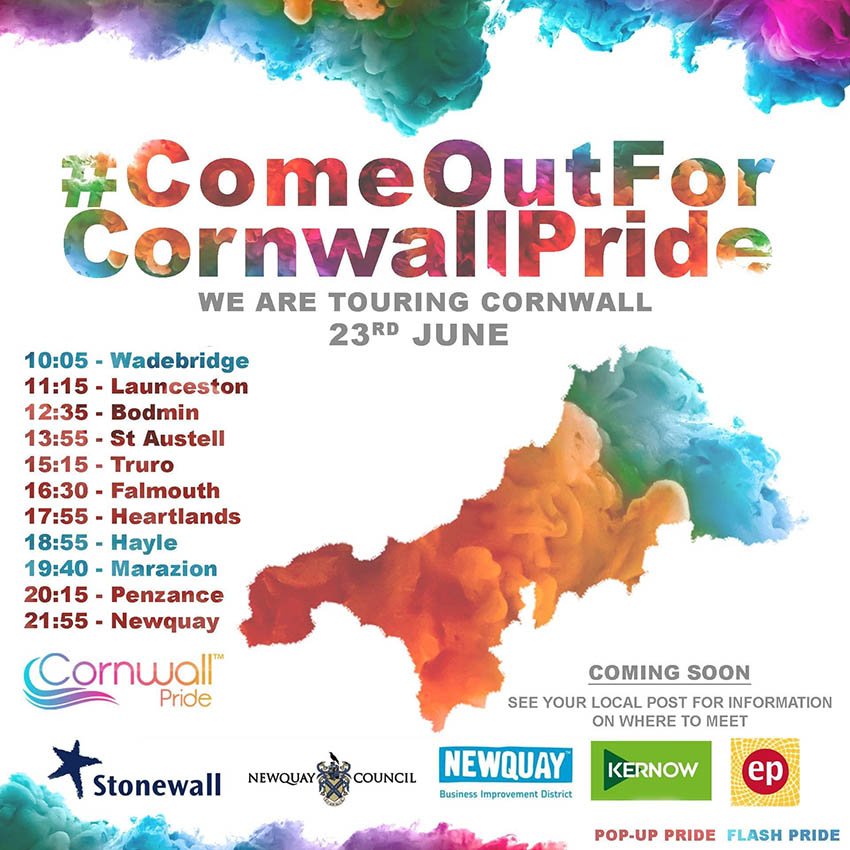
Organisers of have created an ingenious way of ensuring anybody and everybody who wants to get involved with a pride in their county, but can’t make to one central location, can now do so, because this pride is going on tour (and there’ll be drag queens – squeal!) It’s been called a pop-up pride and a flash pride.
The tour bus will be stopping off in 11 different locations on one day, the 23rd June. The stop offs include: Wadebridge 10:05 AM, Launceston 11.15 AM, Bodmin 12:35 PM, St Austell 13:55 PM, Truro 15:15 PM, Falmouth 16:30 PM, Heartlands 17:55 PM, Hayle 18:55 PM, Marazion 19:40 PM, Penzance 20:15 PM, Newquay 21:55 PM.
10.05 Wadebridge – Camel Trail nr. Lidl
11.15 Launceston – Launceston Castle
12.35 Bodmin – Town Council Court
13.55 St Austell – White River Place nr. the Cinema
15.15 Truro – Outside Hall for Cornwall
16.30 Falmouth – Prince of Wales Pier
17.55 Pool – Heartlands, outside the engine house nr. Red River Cafe
18.55 Hayle – Penpol Creak. Park outside Spar
19.40 Marazion – The Station House
20.15 Penzance – Harbour
21.55 Newquay – Killacourt
The event is being called, Come Out For Cornwall and will take place on Saturday 23rd June 2018 and will be a celebration of being proud to be you as we travel throughout Cornwall in our ‘Pride Bus for the day’, visiting most of the major towns to spread the word about Pride and what it means as well as enforcing the message that Cornwall is an inclusive and accepting place to live work and visit, no matter who you are. To find out more click here.
Wondering where the safest and friendliest places to celebrate pride in 2018?
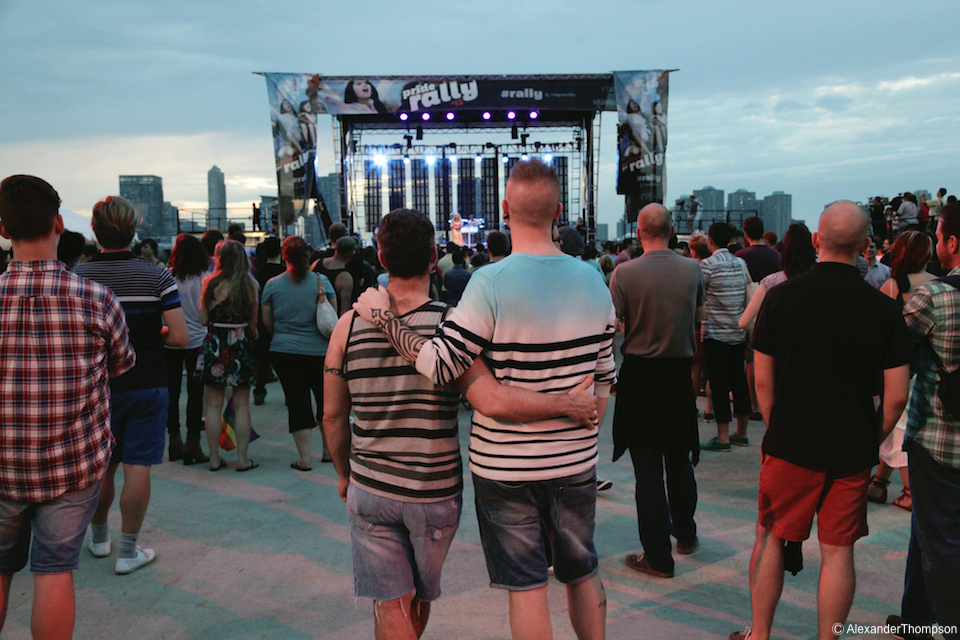
Pride Kickoff Rally 2013, Tribeca, Manhattan
Airbnbreveal the world’s top destinations for an unforgettable Pride this year.
Through a specially commissioned study conducted by ABCD in May 2018, the people-powered hospitality platform with a mission to create a world where anyone can belong anywhere has found out which destinations have the most to offer LGBTQ travellers.
The study looked at 100 cities with the highest Pride attendance worldwide and found out which of these fared best under five different LGBTQ categories, including nightlife and dating. Here are the winning cities and categories:
1. OVERALL WINNER – New York City
The Big Apple not only offers one of the biggest Pride celebrations, it also boasts a bustling nightlife, a busy dating scene, well-established marriage equality and impressive Airbnb stats: the city that sparked the gay Pride movement following the Stonewall riots will welcome over 27,000 guests on Airbnb during Pride Week.
Traditionally a mecca for LGBTQ travellers, it’s no surprise that London topped the ranking for dating. Using data shared with Airbnb by Tinder this May, they discovered that the British capital has the highest per capita usage of LGBTQ Tinder profiles worldwide (via Tinder’s More Genders feature).
Sydney places 9 in the Dating category so why not take your date to Priscilla Queen of the Desert, Australia’s most successful musical? On this Experience, bookable on Airbnb, you’ll get to go behind the scenes and take a sneak peek at the costumes, wigs and make-up from the production that usually only cast and crew get to see.
3. NIGHTLIFE WINNER – New York City
Looking at the number of LGBTQ clubs and bars, New York City is a top destination in this category too.
The city that never sleeps is closely followed in this ranking by 2. Los Angeles, 3. Tokyo, 4. Berlin, 5. Madrid, 6. London, 7. Mexico City, 8. Paris, 9. San Francisco, and 10. Barcelona.
4. PRIDE WINNER – São Paulo, Brazil
Image credit: Ben Tavener / Flickr – https://flic.kr/p/nupESZ
In terms of sheer numbers attending Pride celebrations, São Paulo tops the ranking in this category. Approximately 3 million visitors attended last year’s celebrations.
Liniker, a popular transgender musician from São Paulo, will take guests to some of her favourite local spots and end her experience with a private listening session of her upcoming album.
Airbnb also looked at their list of cities to find out which destinations pioneered LGBTQ marriage equality. In the Netherlands, same-sex marriage was made legal in 2001, making it the first country in the world to do so. This places the cities of Amsterdam, Rotterdam and Utrecht in joint first position.
The Dutch paved the way, but these countries and their respective cities followed closely behind:
6. TRAVEL WINNER – London
For this category, Airbnb looked at cities that had the highest year-on-year growth in Airbnb guest arrivals during Pride. They also identified which cities have the highest number of LGBTQ Experiences on Airbnb and where you can find Airbnb Guidebooks with the highest number of tips for LGBTQ travellers.
160K+guests are expected to check in to an Airbnb during London’s Pride Week
The top city in this ranking is London, followed by 2. Los Angeles, 3. New York, 4. San Francisco, 5. Tokyo, 6. Paris, 7. Montreal, 8. Amsterdam, 9.Berlin, and 10. Barcelona.
In Part two of Simon Sayers-Franklin’s Pride series, he explores the origins of Pride at the Stonewall riots and why we fly our Rainbow Flag!
How Did Pride Begin?
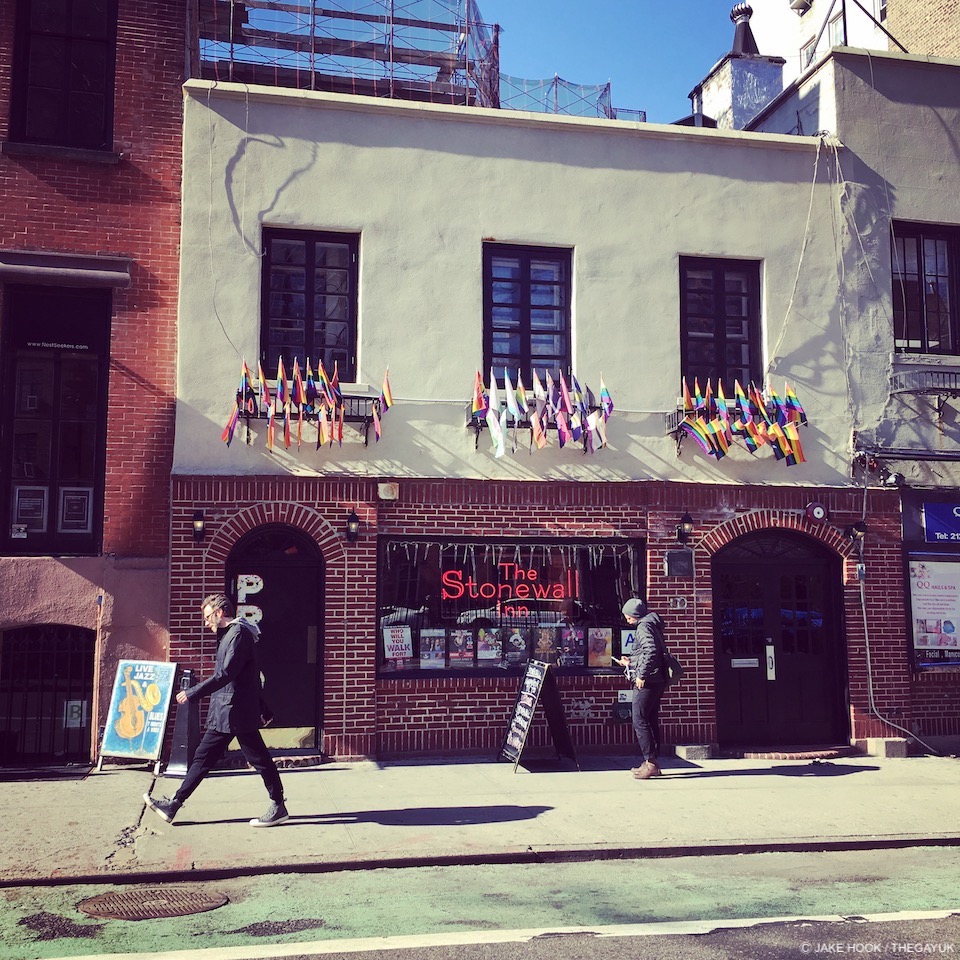
Pride originated on 28th June 1969. Back then police raids on gay bars, like the Stonewall Inn, were common. The authorities would come in, push people around, display violence, intimidate, bully and randomly arrest people. The arrests were frequently made for tiny, inconsequential things such as drag queens wearing more than one or two items of ladies clothing or being caught in compromising positions.
Often the bars, which were largely owned by the Mafia, would bribe the police to tip them off when raids were due to occur. The gay bars would often have two rooms – a bar in the front and a dance floor in the back. Dancefloor lights could be triggered from the bar to send a secret message to the people next door that a raid was about to happen. This allowed them to stop dancing or quickly find an opposite-sex partner if they wished to continue dancing.
It was in the early hours of the morning on June 28th 1969, that an LGBT friendly bar in New York was subject to a raid – something that was all too common in gay bars. This bar, however, was one of those owned by the Mafia and catered to transgender people, drag queens, effeminate men, sex workers and homeless people of many backgrounds. The bar in question was the Stonewall Inn.
This raid, however, was different from the beginning. Firstly, the owners were not tipped off, secondly, it happened very late; around 1:20 am. There had been rumours about a raid that night but it was dismissed as inaccurate information.
The night it all began, two undercover policemen and two undercover policewomen came in and gathered evidence while the rest of the team waited outside. When those who had gained entry called for backup the music died, the house lights came up and those who realised what was happening ran for the doors and windows in the bathrooms but were blocked in by the police.
There were reportedly over 200 people in the Stonewall Inn that night. Little did the police know, that this as not going to go the way they expected.
Usually, the police would line up the people, check ID and then the female officers would escort those wearing female clothing to the toilets, where they would be subject to physical checks and if men were found wearing female clothes they would be arrested. Not this night. This night everybody refused to produce their ID and those in women’s clothing resisted being taken to the bathrooms. This resulted in high tensions, only made worse by the police who became inappropriate while frisking some of the lesbian patrons.
The police had been sent to seize all of the alcohol, which was apparently bootlegged. While this happened, the people inside were made to wait in the line. Those who hadn’t been arrested were allowed to leave but they congregated outside. It wasn’t long for the crowd to grow – a mix of those who had been released and those who had seen the disturbance and joined out of curiosity. Those who were released exited the bar to rounds of applause and they bowed and posed and it was all very theatrical.
By the time the first police wagon arrived, the crowd had multiplied as much as ten times and as the Mafia were escorted out and put in the van people started shouting “Gay Power.” and others started singing. An officer pushed a drag queen who hit him with her purse. People threw debris at the wagon and that was when a woman, thought to be, Stormé DeLarverie, was dragged out in handcuffs. She kept escaping and fought four police officers. When she complained the handcuffs were too tight she was hit over the head with a baton and screamed: “Why don’t you guys do something?”
It was this moment that triggered the riots that would go on to last six days!
Who threw the first brick at the Stonewall Riots
The patrons of the bar had taken enough and were sick of being pushed around. It was reported that the drag queens and trans women of colour were among the first to fight back. It was Marsha P. Johnson, a black, gender non-conforming, sex worker, a founding member of Gay Liberation Front and a popular member of the New York gay and art scenes, who was apparently one of the first to kick off her heels and fight the police. It is, however, unclear what role Johnson played in the events that night. She disputed that she was the one to start the riot by claiming she arrived at 2 am when the place was already on fire – a fire she claimed was started by the police.
These riots were a major moment for LGBT people and Stonewall became an iconic image of rebellion and resistance. It stood for our strength and our refusal to back down.
It was the next year, 1970, that the first Pride march was held in New York on the anniversary of the Stonewall riots. From that moment we have continued to celebrate Pride in the month of June to honour those who kickstarted a revolution. We march to represent our strength and unity. Our community is strong together and Pride shows just that! In modern days it still has political undertones but these days in the western world particularly, our events stand for inclusivity, visibility, having fun and celebrating love and equality rather than fighting for it.
Why Do We Have a Rainbow Flag?
The flag was devised by artist Gilbert Baker after he was challenged by Harvey Milk (another hero and martyr for the LGBT community), to create a “symbol of Pride” to represent the LGBT community. It debuted at the 1978 Gay Freedom Day Parade and has been an icon of our community from that day.
The original rainbow flag as created by Gilbert Baker
There were originally eight colours in the rainbow instead of six:
Hot Pink represented sex/sexuality. It was taken out due to manufacturing issues after Baker approached a company to mass produce the flag. Apparently, the hot pink fabric was too expensive to make.
Turquoise, representing magic and art, was lost when the Pride Parade Committee wanted to fly the flag in two halves along both sides of the street for the 1979 Gay Freedom Day parade. Turquoise was dropped to leave six stripes, therefore, leaving an equal number to split.
Red is life.
Orange is healing.
Yellow is sunlight.
Green is nature.
Indigo is serenity
Violet is spirit.
A modern variation, created in 2017, added black and brown stripes to highlight the People of Colour within the LGBT community. There were a mixed reaction and a lot of controversies because of how the flag never represented “race” and was always meant to represent aspects of life that apply to everybody, regardless of ethnicity. It also caused upset by changing the artist’s original vision.
The Armed Forces, including representatives from the British Army, the Royal Navy, and the Royal Air Force, are set to join the York Pride Parade on Saturday 9th June.
This is the first time that representatives from any of the Armed Forces have been a part of York Pride. The British Army will also be having a stall at the Knavesmire where York Pride’s main event will commence following the Parade.
Greg Stephenson, Chair of York Pride, said, “We are delighted that the Armed Forces will be joining York Pride on 9th June and we are incredibly thankful for the support we have received from them so far. As a charity, we are committed to promoting LGBT+ inclusivity and fostering a supportive community spirit. We believe that having the Armed Forces marching in the parade symbolises the idea that as a society we should be supporting one another and advocating tolerance and not hate. It’s an incredible thing to see happen and is testament to just how much York Pride has grown over the last few years.”
Captain James Steel said, “It is an honour for me to represent the Army at the York Pride Parade. As a member of the Armed Forces, being able to fly the flag for our own LGBT+ community and the Army as a whole makes me immensely proud. It’s the first time the Services have been involved in this local Pride event, and I’m looking forward to marching alongside my colleagues from the Royal Navy and RAF.”
This year, York Pride will take place on Saturday 9th June. It will begin at approximately 11:45 am outside of the Minster, with the Parade setting off at around 12:00 pm. The main event on the Knavesmire will begin at 13:00 pm.
Pride season is finally here! It’s time to dig out the rainbow flags, the glitter and sequins!
In part one of this series on Pride, I’ll be exploring why Pride is so important to us as a community.
In recent years we have made huge progress worldwide in terms of LGBT+ rights. We can get married properly, we are protected in our workplaces and in everyday life. We can adopt or get surrogates to have a baby for us. We are accepted as true, legitimate families and Wales has recently announced that it is going to start teaching about LGBT+ relationships in schools to help children understand about same-sex relationships. We live in a wonderful time and that needs to be celebrated.
We also live in a time where we can be beaten up or murdered for so much as holding the hand of a loved one. We could die or be permanently physically injured or worse for daring to do something as innocent as love. Fair enough, it’s not as dangerous now as it was in the eighties when the AIDS crisis enhanced tensions and hostility towards the LGBT+ community but it’s still bad. It took a lot of work to get us to where we are now and there’s still more to do.
In parts of the Middle East people can be thrown off buildings for simply being suspected of homosexuality. In Russia, gay people are persecuted on a daily basis in the most brutal, horrific ways. In Chechnya, gay people flee for their lives or face being slaughtered by their own families in a “gay purge.” In Uganda, you can be imprisoned for life for being gay, or again, killed. Even Dubai, a glamorous holiday destination, adored by the West is a dangerous place for LGBT+ people. This is just a handful of examples.
Worldwide, LGBT+ people aren’t safe yet they defy their countries laws and hold Pride marches. In the countries mentioned before, and so many more, there are often devastating scenes of cruel attacks. These Pride marches are nothing like ours. Ours are a celebration of what we have and how far we’ve come, theirs are the complete opposite. They are life-threatening political performances where often the events are cancelled last minute for the activists’ safety. On the instances the very brave few go ahead, tragedy often follows close behind.
In 2015, Shira Banki was stabbed to death at a Pride march in Jerusalem by ultra-Orthodox Jewish man, Yishai Schlissel who had committed a similar crime ten years previously and served a decade-long prison sentence. He claimed he was “doing God’s work.” when he murdered Shira three-weeks after being released from prison. Shira was just sixteen years old.
Sadly scenes like this are too common.
This is why we need Pride.
Pride is a symbol of the fight our community have endured and the pain they have suffered to get us to this point. It is an important part of our culture and as we enter Pride season it is vital that we should remember and respect those who afforded us the celebrations we know and love now.
Throughout most of the Western world, Pride is an event where we can go and have fun with friends and family. We can enjoy music and entertainment and march through our respective cities with rainbow flags flying. We march hand in hand with our same-sex boyfriends and girlfriends and husbands and wives. We can freely identify ourselves as we wish and we do it with pride. We do it safely without fear of repercussion and stand in unity alongside people of all backgrounds, races and sexualities: Gay, bi, trans, straight. Pride is for all of us, of all ages and backgrounds to express ourselves honestly and authentically. Even our straight allies are proud to march with us in solidarity and that is a shining example of how far we’ve come. It wasn’t always the case.
In history, it was a criminal offence to be homosexual. If we were caught out for these “crimes” we could be imprisoned or forced to undergo “Conversion Therapy.” War hero, Alan Turing, who created the Enigma machine that helped us win the war was arrested in 1952 for “gross indecency.” He accepted chemical castration as an alternative to going to prison. After all he did for us, and he was treated like a criminal just for being gay. He was essentially tortured with cancer-causing drugs and eventually died a few days before his 42nd birthday from cyanide poisoning. While initial inquests ruled suicide, it has since been decided that his death was from accidental poisoning.
Homosexuality was eventually decriminalised in the UK in 1967 but it wouldn’t be until 2013 that Alan would be posthumously pardoned for his “crimes.”
This is why we celebrate Pride. We celebrate because we can. We do it because of these horrendous laws in the past that prevented LGBT people from being allowed to express themselves. We celebrate our right to exist in a world where we’re making progress and raising awareness of the troubles still faced by other in less fortunate regions across the world.
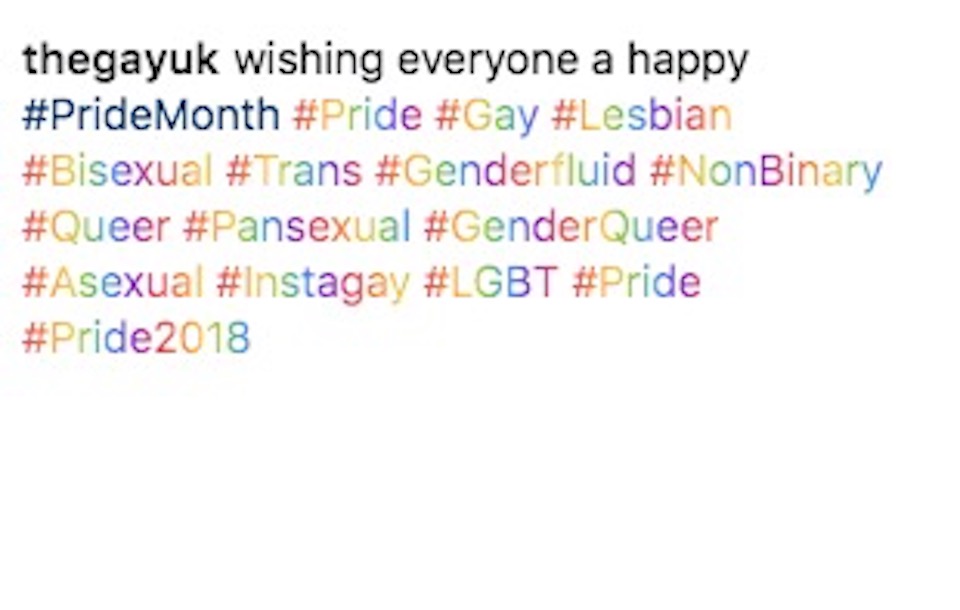
Apparently, the hashtags were approved by LGBT+ charity GLAAD. It’s just a part of the way Instagram is celebrating Pride Month – which is the entire month of June.
Today Primark announced it was releasing a brand new range of pride merch – with just 20 percent of the sale price going to Stonewall, but not to prides.
Primark has teamed up with Stonewall to sell pride merch, with famous pride cities, like Madrid, Brighton and London emblazoned across the products – but none of the profits are supporting prides.
The UK Pride Organisers Network has called out the scheme as disappointing for not supporting local prides, some of which are struggling financially.
We’re delighted to announce we will be working with @Primark on a new range! #ComeOutForLGBT this pride season, with 20% from full-priced Stonewall marked products donated directly to us, to support the work that we do to improve the lives of LGBT people: https://t.co/UvcpBbphdYpic.twitter.com/Adie72csS1
Stonewall, while attending many prides across the UK – except Pride In London this year, does not organise any pride events in the UK.
In a statement the UK Pride Organisers Network said,
“After being alerted by some members, the Network was disappointed to see that proceeds from Primark’s range of ‘Pride’ clothing and accessories, launched in time for Pride season, is not being donated to the Pride organisations that organise these events. Instead, it is being given to Stonewall who, whilst they attend some Prides, do not organise the events themselves.
“All Pride organisations are voluntary bodies that struggle every year to raise the funds necessary to hold these major public events, most of which are free to attend. In the last week, in one city where Primark will be selling these products, the Pride has announced it is scaling back its event due to a lack of funds. This is a daily reality for most Pride organisers.
“Stonewall have been critical of Prides in the past, and this is an insult to those Prides who sell their own merchandise to raise funds for their events. We urge everyone who wants to support their local Pride to do so by purchasing merchandise from them, or from stallholders at the event. And we call on Stonewall to work with us to reallocate the income they receive from this partnership so that it can be used to directly support Pride organisers who are driving the Pride movement for the good of all LGBT+ people across the UK.
“Finally, given Primark’s history, we seek reassurances from Primark that the production of these items is not taking place in any country where homosexuality is illegal.
“A full map of all UK Pride events can be found on our website at http://www.ukpon.lgbt/pridedates/ If you wish to make contact and support your local Pride, we are sure that any support would be most welcome.”
Every year, Gran Canaria plays host to one of the biggest LGBT+ pride events in Europe.
adamkontor / Pixabay When is Gran Canaria Pride 2018?
In fact, it’s so proud there are two, Summer and Winter.
The summer pride on the incredibly gay-friendly Gran Canaria takes place in from the 3rd to the 13th May. Nearly 100,000 people turn up to celebrate gay pride on the tiny island of Gran Canaria. Gran Canaria is a four and a half hour’s flight from the UK and remains one of the most popular getaways for the British LGBT+ community.
Next year’s pride will take place from the 2nd to the 12th of May 2019.
Winter pride takes place on the 5th till the 11th November 2019. This winter pride will be the fifth annual event and is one of the largest winter prides in Europe.
Want to book a hotel at the gay exclusive location, check out our listings here.
If you’re planning to go to Durham pride here’s everything you need to know before the 2018 event.
This year’s Durham Pride takes place on the on Sunday 27th May 2018 to celebrate the diversity of the LGBT+ community of Durham and surrounding areas. This year’s event will be the fifth in Durham.
What time does Durham Pride begin?
The Durham Pride parade officially begins at 1 PM until 6 PM.
Is there a parade?
Yes, the parade leaves from Palace Green from 1.15 PM. People taking part in the parade are asked to make sure they’re at the green from 12:30 PM.
Where is Durham Pride?
Durham Pride takes place at the Sands Durham, the official postcode for the venue is: DH1 1LH, with an official after party held at KLUTE Durham.
What does Durham Pride cost?
Durham Pride is free for everyone to take part in however you can purchase VIP tickets for the main stage tent. VIP tickets cost £10 and include, Access to VIP Bar/toilets and best stage views, Fast track entry to Afterparty at Klute Durham (before 8pm),
VIP tickets 18+ only for Afterparty. All proceeds go to Durham Pride and charity.
What entertainment will there be at Durham Pride?
This year the organisers have invited “Black Heart” hitmakers, Stooshe. Along with X Factor heartthrob Lloyd Daniels. There’s also the Northern Proud Voices choir, Mickey Modelle, Smashby, Tess Tickle and the Dragettes and Love Inc, featuring Simone Denny. The cast of Priscilla Queen of the Desert will also be singing hits from the show.
With just one day to go until Lancaster Pride, this year’s pride promises to be the biggest ever.
The incredible artwork created by the late Amy Winehouse’s tattoo artist, Henry Hate.
Lancaster Pride is an LGBT festival organised by Out in the Bay, a local charity providing support to Lesbian, Gay, Bisexual and Transgender people in the Lancaster area, as well as raising awareness for LGBT issues and campaigns.
Speaking about what Pride mean, Robert Mee, the CEO of Lancaster Pride said, “Pride is about everyone coming together to support each other to stand side by side to challenge hate and intolerance and to be able to build a better future of equality for all of us.”
What time does Lancaster Pride begin?
The Lancaster Pride parade officially begins at 11:00 AM until 12:00 PM.
Is there a parade?
Lancaster has a parade at this year’s event, and it will be the second in the pride’s history, with the parade taking place from Dalton Square.
The set off place for the parade is Dalton Square and will turn right on George Street and continue along Spring Garden Street. The procession will then turn right onto the A6 and proceed northwards in the right-hand lane.
The parade will then turn right into Church Street and once located inside the pedestrianised area will temporarily halt to allow the participants a breather and to allow the procession to reform.
The procession will turn right onto Gt John St and proceed up the left-hand lane. The procession will then turn left to finish in Dalton Sq.
Speaking at the parade will be Clive Grunshaw, the police and crime commissioner, Erica Lewis a Cat Smith representative, Kara from the multi-faith Church and Doctor Sweeney.
Where is Lancaster Pride?
Most of the day’s events will take place in front of Lancaster’s Town Hall. The postcode is: LA4 4AU.
What does Lancaster Pride cost?
Lancaster Pride is free for everyone to take part in.
What entertainment will there be at Lancaster Pride?
Performing at Lancaster Pride is the singer Whigfield, who you will remember had the massive, number 1 hit, “Saturday Night”. Also appearing is a slew of talent who will be appearing on stage from 11 AM until 6:30 PM in front of Lancaster’s Town Hall.
If you’re planning to go to Lancaster pride here’s everything you need to know before the 2018 event.
The amazing promo poster created especially for Lancaster Pride, by Henry Hate.
This year’s Lancaster Pride takes place on the on Saturday 19th May 2018 to celebrate the diversity of the LGBT+ community of Lancaster and surrounding areas.
Lancaster Pride is an LGBT festival organised by Out in the Bay, a local charity providing support to Lesbian, Gay, Bisexual and Transgender people in the Lancaster area, as well as raising awareness for LGBT issues and campaigns.
Speaking about what Pride mean, Robert Mee, the CEO of Lancaster Pride said, “Pride is about everyone coming together to support each other to stand side by side to challenge hate and intolerance and to be able to build a better future of equality for all of us.”
What time does Lancaster Pride begin?
The Lancaster Pride parade officially begins at 11:00 AM until 12:00 PM.
Is there a parade?
Lancaster has a parade at this year’s event, and it will be the second in the pride’s history, with the parade taking place from Dalton Square.
The set-off place for the parade is Dalton Square and will turn right on George Street and continue along Spring Garden Street. The procession will then turn right onto the A6 and proceed northwards in the right-hand lane.
The parade will then turn right into Church Street and once located inside the pedestrianised area will temporarily halt to allow the participants a breather and to allow the procession to reform.
The procession will turn right onto Gt John St and proceed up the left-hand lane. The procession will then turn left to finish in Dalton Sq.
Speaking at the parade will be Clive Grunshaw, the police and crime commissioner, Erica Lewis a Cat Smith representative, Kara from the multi-faith Church and Doctor Sweeney.
Where is Lancaster Pride?
Most of the day’s events will take place in front of Lancaster’s Town Hall. The postcode is: LA4 4AU.
What does Lancaster Pride cost?
Lancaster Pride is free for everyone to take part in.
What entertainment will there be at Lancaster Pride?
Performing at Lancaster Pride is the singer Whigfield, who you will remember had the massive, number 1 hit, “Saturday Night”. Also appearing is a slew of talent who will be appearing on stage from 11 AM until 6:30 PM in front of Lancaster’s Town Hall.