 By Newsdesk
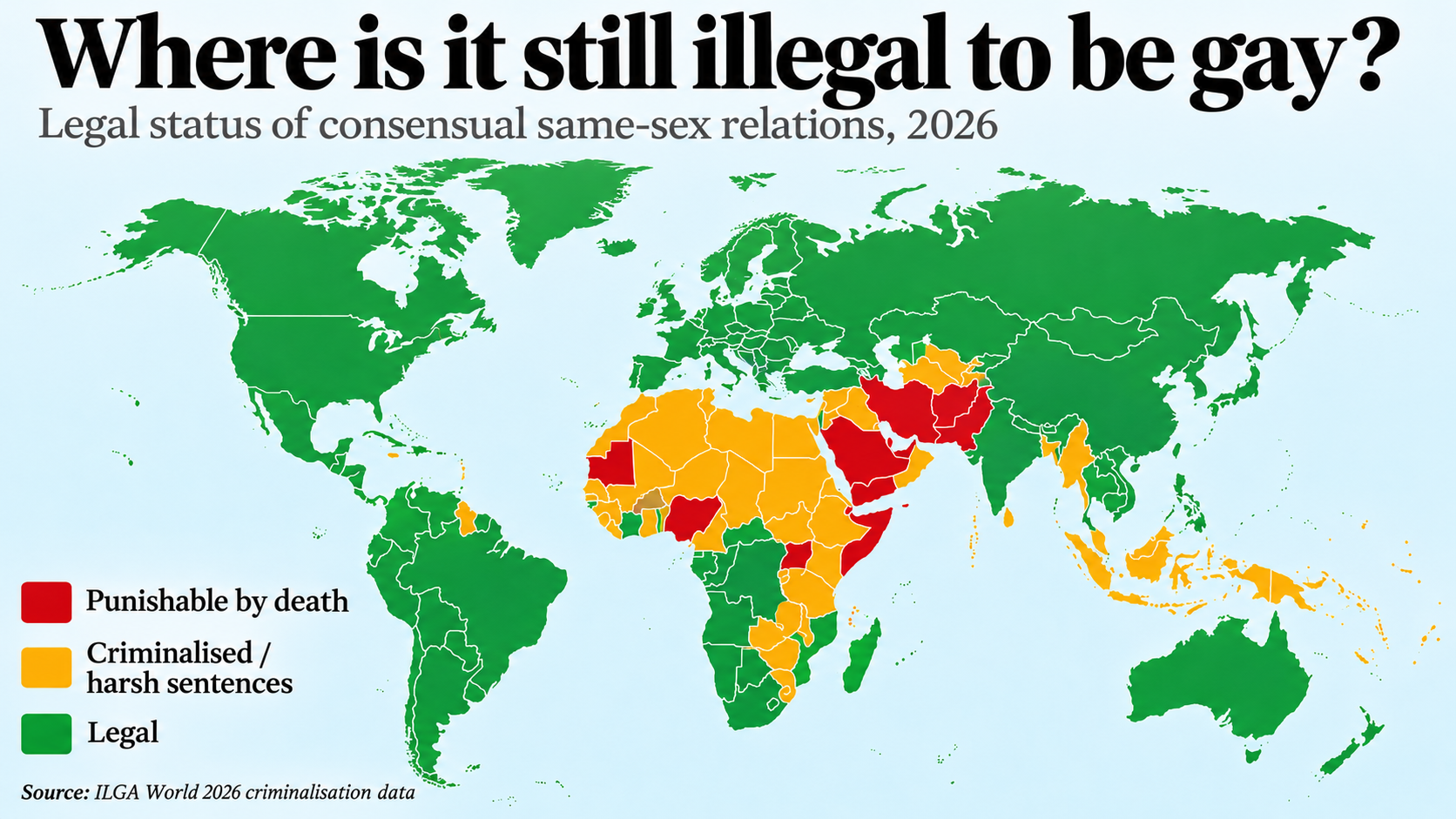
Dozens of countries still criminalise consensual same-sex intimacy. The penalties range from fines and prison sentences to flogging, life imprisonment and, in some jurisdictions, death.
In June 2026, ILGA World reported that 65 United Nations member states criminalised consensual same-sex sexual acts, including countries where authorities use other laws to prosecute people in practice. The legal picture has shifted since that snapshot. Niger’s new penal code explicitly criminalises same-sex relations, while Trinidad and Tobago’s final court of appeal struck down laws criminalising private, consensual same-sex activity between adults on 10 November 2026.
Many of these laws use terms such as ‘buggery’, ‘gross indecency’ or ‘unnatural offences’. Some criminalise intimacy between men specifically, while others also apply to women. The tables below cover penalties for consensual same-sex activity and flag where the rules vary within a country.
Where the death penalty is prescribed in law
ILGA World identifies seven UN member states where the death penalty is prescribed for certain offences involving same-sex sexual acts. Eligibility for a death sentence and actual enforcement vary by jurisdiction.
| Country | When the death penalty applies |
|---|---|
| Brunei | The Syariah Penal Code provides for death by stoning for certain acts between men, subject to strict evidential requirements. An execution moratorium is in place. |
| Iran | Certain sexual acts between men can carry the death penalty under the penal code. |
| Mauritania | The penal code prescribes death by stoning for certain acts between adult Muslim men. The country has a longstanding moratorium on executions. |
| Nigeria | In 12 northern states, Sharia criminal laws provide for the death penalty in certain cases. Federal law provides for imprisonment. |
| Saudi Arabia | Courts can impose the death penalty under the country’s application of Islamic law. |
| Uganda | The Anti-Homosexuality Act provides for the death penalty for the specific offence of ‘aggravated homosexuality’. The general offence carries up to life imprisonment. |
| Yemen | The penal code provides for death by stoning in certain cases involving sex between men. |
Five countries where the legal position is uncertain
ILGA World lists Afghanistan, Pakistan, Qatar, Somalia and the United Arab Emirates as countries where there is no full legal certainty about whether the death penalty applies to consensual same-sex acts. In Somalia, the legal position varies with territorial control. Human Dignity Trust reports that the death penalty has been implemented in areas under armed-group control.
Where same-sex activity can carry life imprisonment
Outside the death-penalty groups above, laws in Bangladesh, Guyana, Sierra Leone, Sudan, Tanzania, The Gambia and Zambia provide for life imprisonment in certain cases. In Sudan, life imprisonment can apply for a third conviction under the relevant law. The country removed the death penalty for the offence in 2020.
Criminalisation and penalties by region
The tables below give the reported upper prison terms or sentencing ranges for the relevant offences, with qualifications where local laws, court rulings or repeat convictions affect the penalty. The countries covered above appear again only where needed to explain the regional picture.
Africa
| Country | Reported penalty |
|---|---|
| Algeria | Up to 3 years and a fine |
| Burkina Faso | 2 to 5 years and a fine for a first offence. Repeat offences carry double penalties. |
| Burundi | Up to 2 years and a fine |
| Cameroon | Up to 5 years and a fine |
| Chad | Up to 2 years and a fine |
| Comoros | Up to 5 years and a fine |
| Egypt | Up to 3 years and a fine under laws used to prosecute same-sex activity |
| Eritrea | Up to 3 years |
| Eswatini | Imprisonment under common law, with no clearly specified maximum |
| Ethiopia | Up to 1 year for the basic offence |
| Ghana | Up to 3 years under the existing provision on same-sex activity |
| Guinea | Up to 3 years and a fine |
| Kenya | Up to 14 years |
| Liberia | Up to 1 year |
| Libya | Up to 5 years |
| Malawi | Up to 14 years, with corporal punishment also provided for in law |
| Mali | Up to 7 years and a fine |
| Morocco | Up to 3 years and a fine |
| Niger | Approximately 5 to 10 years and a fine, according to reports on the new code |
| Senegal | Up to 10 years and a fine |
| South Sudan | Up to 14 years and a fine |
| Togo | Up to 3 years and a fine |
| Tunisia | Up to 3 years |
| Zimbabwe | Up to 1 year and a fine |
Senegal doubled its maximum prison term for consensual same-sex acts from five to ten years in March 2026. In Niger, reported penalties of up to 20 years apply to separate offences, including same-sex marriage and certain roles in LGBTQ+ organisations. Human Dignity Trust’s Niger profile remains provisional pending access to the full penal code.
Asia and the Middle East
| Country or territory | Reported penalty |
|---|---|
| Indonesia | In Aceh, provincial law provides for up to 100 lashes or imprisonment for certain same-sex acts. A separate national law penalises sex outside marriage. |
| Iraq | 10 to 15 years |
| Kuwait | Up to 7 years |
| Lebanon | Up to 1 year under Article 534. Several courts have held that the provision does not cover consensual same-sex activity, but prosecution remains possible. |
| Malaysia | Up to 20 years and whipping |
| Maldives | Up to 8 years. An additional punishment of 100 lashes can be imposed under Sharia law. |
| Myanmar | Up to 10 years’ imprisonment. Section 377 also retains historical wording providing for ‘transportation for life’. |
| Oman | Up to 3 years |
| Palestinian territories | Up to 10 years in Gaza under an inherited criminal provision. The legal position differs in the West Bank. |
| Sri Lanka | Up to 10 years and a fine |
| Syria | Up to 3 years |
| Turkmenistan | Up to 2 years |
| Uzbekistan | Up to 3 years |
Indonesia’s national criminal code took effect on 2 January 2026. It provides for up to one year in prison for sex outside marriage. That provision can affect same-sex couples because they cannot legally marry in Indonesia. Aceh has its own explicit prohibition and has enforced it through public caning.
The Caribbean and South America
| Country | Reported maximum penalty |
|---|---|
| Grenada | 10 years |
| Guyana | Life imprisonment |
| Jamaica | 10 years with hard labour |
| Saint Vincent and the Grenadines | 10 years |
In Trinidad and Tobago, the Judicial Committee of the Privy Council ruled in favour of LGBTQ+ campaigner Jason Jones on 10 November 2026. The ruling struck down the laws as they applied to private, consensual sexual activity between adults of the same sex. A 2025 appeal ruling had previously reinstated criminal penalties.
The Pacific
| Country | Reported maximum penalty |
|---|---|
| Kiribati | 14 years |
| Papua New Guinea | 14 years |
| Samoa | 5 years |
| Solomon Islands | 14 years |
| Tonga | 10 years |
| Tuvalu | 14 years |
Several of these provisions were inherited from colonial criminal codes. Papua New Guinea, for example, retained offences drawn from the criminal law Australia administered before independence.
Why these laws still matter
Many criminal prohibitions date back to colonial rule. Others have been introduced or expanded recently, as in Burkina Faso, Mali, Niger and Senegal. Trinidad and Tobago’s November judgement shows how litigation can remove longstanding restrictions, even after an earlier victory has been reversed.
The maximum sentence tells only part of the story. Even where prosecutions are infrequent, criminal laws can expose LGBTQ+ people to arrest, blackmail and harassment. Countries can also restrict Pride events, LGBTQ+ organisations and public expression while allowing consensual same-sex intimacy in private.
Sources and further reading
- ILGA World’s June 2026 legal figures and global legal maps
- Human Dignity Trust’s criminalisation map and country profiles
- Human Dignity Trust’s history of criminalisation
- Privy Council press summary of the Trinidad and Tobago judgment
- Front Line Defenders’ analysis of Niger’s new penal code