American politics was filled with a sea of heterosexual faces, sometimes fiercely homophobic, but mostly irreverent towards the gay community, that was until Harvey Milk entered the political arena.
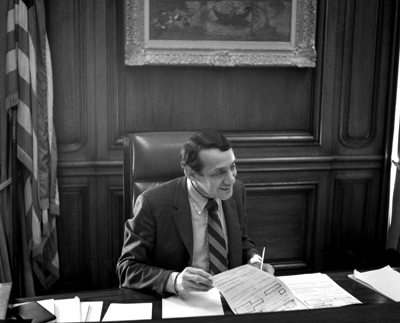
Harvey Bernard Milk was born in the cold and wet winter of 1930, his birthplace was Woodmere, a small, hard-working, middle class, close-knit hamlet in Nassau County in the state of New York. After graduating in 1951, Milk joined the United States’ Navy, during the Korean War, he served aboard a rescue submarine, the USS Kittiwake – and later transferred to San Diego to serve as a diving instructor. He was discharged from the Navy in 1955.
Harvey Milk could be described as one of life’s wanderers until he moved to San Francisco he was a teacher, an actuarial statistician, a researcher, and a presidential campaigner, he worked in investments and for a theatre company.
He was a drifter, moving from California to Texas to New York and back again, without a steady job; eventually, Milk with his then-partner Scott Smith opened a camera shop on Castro Street in San Francisco with their last $1,000.
He moved from New York City to San Francisco in 1972, amid a mass migration of gay men to the Castro District. The gay’s growing political and economic power ensured that people like Milk could take advance to promote their interests.
Initial political aspirations
Milk ‘s initial reception by the already installed gay political establishment could be described as cold, Jim Foster who had been active in gay politics for ten years resented Milk asking him for endorsement to becoming a City Supervisor, Foster told Milk,
“There’s an old saying in the Democratic Party. You don’t get to dance unless you put up the chairs. I’ve never seen you put up the chairs.”
Undeterred Milk won the support and endorsement of local gay bars and business owners, who had become disillusioned by the slow-moving pace of the already visible gay political movement.
Milk had an inimitable political style; his exuberant speeches and his astute media skills earned him significant press during the 1973 election, however, he failed to win.
Although Milk was a newcomer he had shown flair for leadership, he was starting to be taken seriously as a candidate and decided to run again as a City Supervisor and started using his camera store as a centre of activity in the Castro neighbour. The community rallied around Milk and voluntarily helped run his campaigns for him.
This time round Milk came 7th in the election, just one place away from earning a Supervisor seat.
First openly gay commissioner in the US
Milk became the first openly gay commissioner in the United States after the newly elected Mayor George Moscone appointed him to the Board of Permit Appeals in 1976 where he worked just 5 weeks in the job before running for the California State Assembly.
Milk was described as a man of mixed temperament and of disorganisation. His campaign volunteer database comprised of just scraps of paper and his campaign manager’s assistant was an 11-year-old girl.
His accounting was erratic, reportedly grabbing fistfuls of cash from his store’s cash register. He was prone to amazing outburst of momentary temper before shouting excitedly about something else. Described as manic, one could not fault the man for his dedication and general good humour.
In 1977 his last campaign to become a City Supervisor, Milk’s showboating, handshaking and manic campaigning tactics won him a position, but with his victory came the distinct threat of assassination. He began to record his thoughts for preservation in case he was killed, stating, “If a bullet should enter my brain, let that bullet destroy every closet door”.
Headliner
As the first openly gay, non-incumbent man in US history his swearing in as City Supervisor made national headlines, giving the gay community a positive visibility that it hadn’t enjoyed before. He started in office sponsoring a civil rights bill that outlawed discrimination based on sexual orientation, it was met with no opposition apart from Dan White, who Milk had increasingly bad relations with after Milk switched his vote in supporting a health facility for troubled adolescents be placed in White’s District.
His personal life at the time was one filled with sadness; he had long split with Smith and had begun a relationship with a man 18 years his senior; Jack Lira who hanged himself after being consumed with sadness with the anti-gay campaigns of Anita Bryant and John Brigg.
The John Briggs Initiative known as Proposition 6 would have made the firing of any gay teacher or public school employee who supported gay rights mandatory. Brigg’s stated that gay teachers wanted to recruit and molest children; Milk refuted this with statistics compiled by law enforcement that most paedophiles were identified as heterosexuals.
Brigg’s campaign came off the back of singer Anita Bryant’s “Save Our Children” campaign in Florida which repealed a law which ended discrimination based on sexual orientation.
During the summer of 1978, gay pride marches found their attendance level rise, with over 250,000 people attending San Francisco’s Gay Freedom Day Parade. This is where Milk gave an impassioned ‘Hope Speech’
“On this anniversary of Stonewall, I ask my gay sisters and brothers to make the commitment to fight. For themselves, for their freedom, for their country … We will not win our rights by staying quietly in our closets … We are coming out to fight the lies, the myths, the distortions. We are coming out to tell the truths about gays, for I am tired of the conspiracy of silence, so I’m going to talk about it. And I want you to talk about it. You must come out. Come out to your parents, your relatives.”
Even though Anita Bryant’s campaign had been successful in Florida, Brigg’s initiative failed by more than a million votes. In San Francisco alone 75% voted against the proposition.
Who was Dan White?
Embed from Getty ImagesOn 10th November 1978, Dan White resigned stating that the yearly salary of $9600 was not sufficient to support his family, days later he asked Mayor Moscone for his resignation to be withdrawn, although the Mayor initially agreed, after further consideration and consultation with the other city supervisors, Moscone was persuaded to install someone who represented White’s district which was growing in ethnic diversity.
On 27th November 1978, Harvey Milk would wake for the last time, in his beloved adopted town of Castro.
Half an hour before the press conference in which Mayor Moscone was to announce White’s replacement, White entered City Hall with a gun undetected and made his way to the Mayor’s office. Witnesses recall hearing shouting, between the two men followed by four gunshots.
White had shot Moscone once in the shoulder, once in the chest and twice in the head.
After reloading his gun, White intercepted Milk – an argument ensued, followed by more gunshots as he emptied 5 hollow-point bullets into Harvey Milk’s head and body.
The President of the Board of Supervisors, Dianne Feinstein found Harvey Milk and identified both bodies.
It was Feinstein, who announced to the press,
‘Today San Francisco has experienced a double tragedy of immense proportions. As President of the Board of Supervisors, it is my duty to inform you that both Mayor Moscone and Supervisor Harvey Milk have been shot and killed.”
Milk was 48 and Moscone was 49.
Milk’s legacy is still felt to this day, in the last year of his life, he empowered gay people to be more visible; to help themselves to end the discrimination and violence against them. In his final statement during the taped prediction of his assassination he said,
‘I cannot prevent anyone from getting angry, or mad, or frustrated. I can only hope that they’ll turn that anger and frustration and madness into something positive, so that two, three, four, five hundred will step forward, so the gay doctors will come out, the gay lawyers, the gay judges, gay bankers, gay architects … I hope that every professional gay will say ‘enough’, come forward and tell everybody, wear a sign, let the world know. Maybe that will help.
Although his time in politics was relatively short, Milk’s untimely death at the hand of Dan White, ensured that Harvey Milk would forever be held up as one of the most powerful and iconic men of politics the world has ever seen.