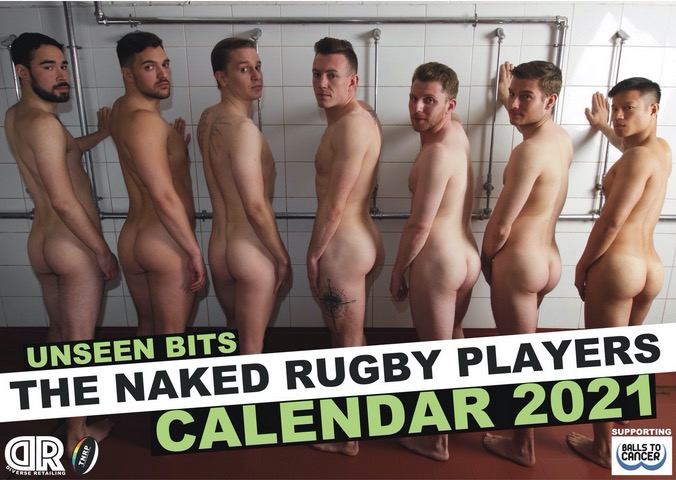
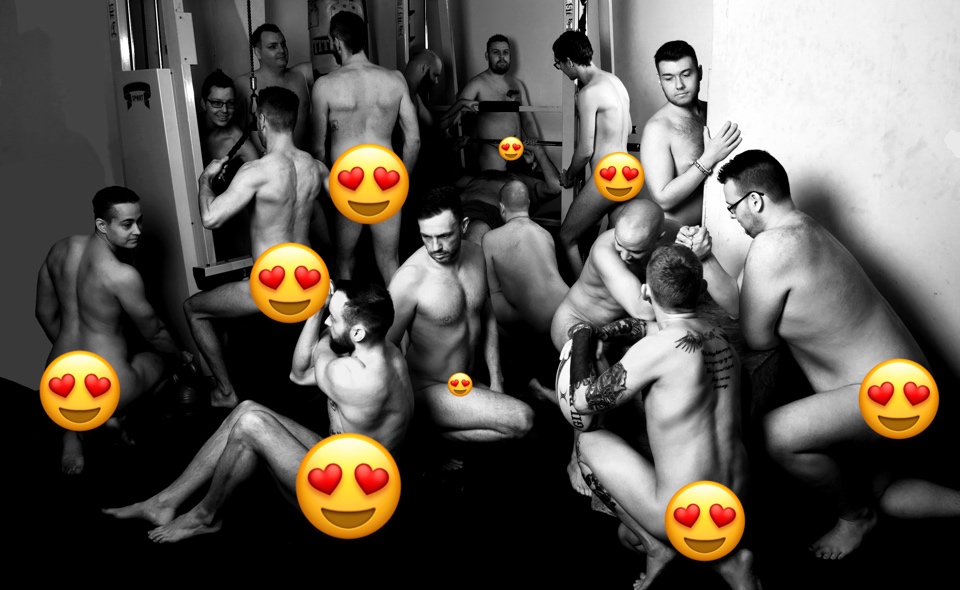
Facebook, which owns the Instagram platform has apologised after numerous images, which complied with its nudity policies were removed from The Naked Rugby Player’s profile.
The two pictures in question featured no actual nudity and were cropped inline with Instagram’s no genital policy.
“We’re sorry for this mistake.”
(C) FACEBOOK
Speaking to THEGAYUK.com, a spokesperson for Facebook said, “Every day we’re inspired by the millions of people using our platforms to connect with, and raise money for, meaningful causes. This content was removed in error and has now been restored. We’re sorry for this mistake.”
The Naked Rugby Players have released a calendar every year since 2018 with the aim of raising money for Balls To Cancer and LGBT+ Inclusive Rugby Clubs.
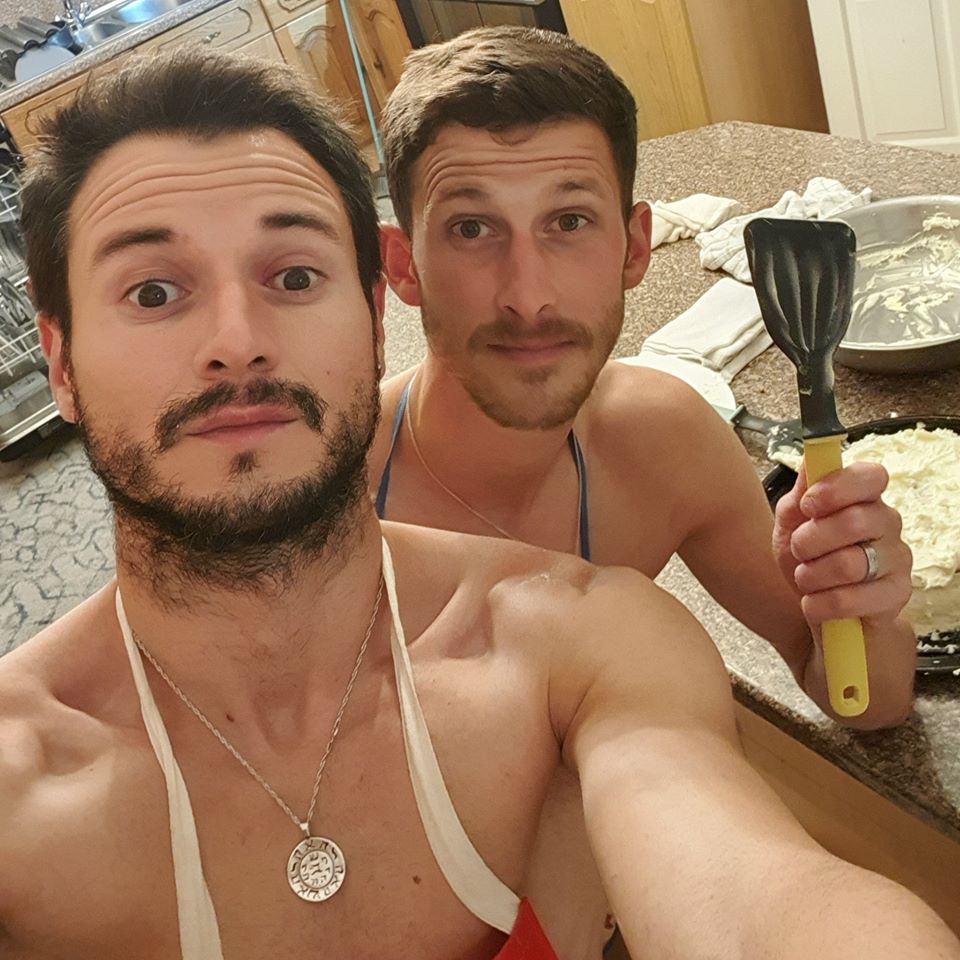
Husbands Matthew and Nathaniel Kenworthy-Gomes went nude (almost) on a marathon baking session on Facebook live yesterday night to raise money for Cornwall Hospice Care.
The hunky duo, who are usually behind the scenes preparing to stage Cornwall’s only Pride, garnered thousands of viewers and hundreds of comments and likes from friends and fans who cheered the couple on as they attempted to cook the perfect cake.
The plan was to go completely nude, but anyone who knows about Facebook’s nudity policy will know the pair would have been knocked off the platform very quickly if they had actually bared butt.
However there was still plenty on show for thirsty fans of the couple.
Matthew and Nathaniel, who run Cornwall Pride are trying to raise £1000 for the Cornwall Hospice Care (click here to donate) and currently have raised nearly a third of their target.
The husbands swigged multiple glasses of red and white wine during the epic three-hour session and were even joined by Matthew’s mum, who chinked glasses with the pair.
The hilarious antics are available to catch up with on Facebook. Take a look and get donating, if you can!
Social media is everywhere. If we’re not updating our connections about where we’ve been or what we’re seeing, we’re no doubt uploading a photo of the delicious meal we’re about to eat. The popularity of sharing our experiences via social channels can’t be denied, with an estimated 2.77 billion social media users globally, and it plays a significant role in our lives – both at work and at home. But has our need to keep people updated on our every move or thought gone too far?
An often debated benefit of social media is that it reduces isolation by connecting people all over the world, as you are able to track what your friend in New Zealand is up to, without needing to stay up late to Skype. However, in many ways, this connectivity can be a ‘false reality’ – simply a window through which you see just a snapshot of another person’s life – you don’t know what they’re really thinking or feeling, emotions which can only be delved into during a conversation.
Additionally, this snapshot is often carefully choreographed, and portrays the subject at their best, without realities to impair the moment. As a result, when seeing these pictures of perfection, it’s natural to envisage their perfect life and compare their experiences to yours, which may not live up in comparison. It’s not surprising to learn that a recent study by researchers from the University of Houston in Texas has shown that social media is contributing to depression due to users comparing themselves to others.*
So, bearing this in mind, is it time we put down Snapchat, deleted Facebook or disabled Instagram for a while, to give us not only a break from the perfect lives of others, but also to regain perspective?
If you’re considering taking a social media holiday, bear the following in mind:
Suspend your accounts – suspending them for a week means you can take a break without the temptation to check for any new notifications.
Take the time for face-to-face – cutting down on virtual messaging may free up time to meet your friends in person. This not only allows you to have a proper catch up, it also fills the void in terms of knowing what’s going on
Regain your focus – how many times have you missed a crucial moment on TV due to checking someone else’s holiday photos? Not having these distractions will help you tune into the moment more freely.
Get an alarm clock – it’s easy to use your phone as an alarm clock, but this encourages you to look at it as soon as you wake. Try a conventional alarm clock and turn your phone off overnight. The blue light used by phones disrupts sleep**, so it may help your sleep quality too by switching it off completely.
Rather than going cold turkey it’s best to start small and build up to something. Why not start by turning off notifications for an hour, then two, building up to a whole day, or even a week at a time? Check out apps designed to block sites at certain times of the day. This helps to avoid that mindless checking and re-checking we all fall victim to!
Taking the plunge and giving up social media for a week or more can be an incredibly refreshing experience. It lets you live in the present, and remember memories in real-time, instead of via a camera lens. Technology has made it so easy for us to stay connected and to know our friends’ ins and outs, but it shouldn’t replace face-to-face contact as this is not always the healthy or desirable option.
Experiencing stress and mental health challenges is a normal part of many people’s lives – for additional support, visit AXA PPP healthcare.
Is your relationship on the rocks? Was 2019 a tough year, research has shown that people are rowing about what their other after is posting online!
Just under half of all Brits admit they have secretly checked their partner’s Facebook account and one in five went on to row about what they discovered, new research has revealed.
One in seven said they had contemplated divorce because of their other halves activities on Facebook, Skype, Snapchat, Twitter or WhatsApp.
People are angry at the amount of posting their partners do
CREDIT: monkeybusinessimages-bigstock
Nearly a quarter or the 2,000 married Brits asked, said they had at least one argument a week with their partner because of social media use and 17 per cent said they rowed every day because of it.
The most common reasons for checking their partner’s social media accounts was to find out who their partner was talking to, to keep tabs on them, to check who they were out with and find out if they were telling the truth about their social life.
While 14 per cent said they looked specifically to identify evidence of infidelity.
The research was commissioned by family law specialists Slater and Gordon who have seen an increase in the number of people citing social media use as a cause of divorce year on year.
Andrew Newbury, head of family law at Slater and Gordon said:
“Social media can be a wonderful way of keeping in touch with family and friends, but it can also put added strain on a relationship.
“Five years ago Facebook was rarely mentioned in the context of a marriage ending, but now it has become common place for clients to cite social media use, or something they discovered on social media, as a reason for divorce.
“With more than 556 million people using Facebook each day, the way we live our lives, and our marriages, has drastically changed. We are finding that social media is the new marriage minefield.
“Social media, specifically pictures and posts on Facebook, are now being routinely raised in the course of divorce proceedings.”
It wasn’t just what their partner was doing on social media but also how long they spent on it that was likely to cause marital problems with Facebook usage topping the list of reasons couples argued over social media.
Arguments were also caused because of contact with an ex-partner, sending secret messages and posting inappropriate photos.
One in twenty even complained that their partner didn’t post any pictures of them together which made them upset.
Fifteen per cent of Brits considered social media to be dangerous to their marriage, with Facebook considered the most dangerous, followed by WhatsApp, Twitter and Instagram.
But one in ten admitted they hid images and posts from their partner, while eight per cent admitted to having secret social media accounts.
A fifth of respondents said they felt uneasy about their relationship after discovering something on their partner’s Facebook. 43 per cent said they confronted their spouse immediately about this, but 40 per cent said it took them some time before they felt comfortable to raise it with their partner.
While a third said they kept their social media log-in details a secret from their partners, 58 per cent said they knew their partner’s log-in details, even if their spouse wasn’t aware they knew them.
Andrew Newbury, head of family law at Slater and Gordon said:
“Social media can also make a divorce more difficult. Divorce is already a stressful time for everyone involved and what is being posted on Facebook can antagonise families and make a speedy resolution more difficult to achieve.
“We are now actively advising our clients to be cautious when it comes to using Facebook and all forms of social media because of its potential to damage relationships.”
Five social media tips that could save your relationship.
1. Don’t post in anger.
Your post will be seen by all your friends, family and potentially millions of others. Even if you later delete your post, the damage will have been done.
2. Be respectful.
Don’t complain about your partner or other family members online.
3. Be transparent.
Check with your partner before you post images or information.
4. Check your privacy settings.
You might think someone can’t see a post when they actually can.
5. Take a break and enjoy the moment.
You don’t need to post everything on Facebook, Instagram or Twitter.
Use of social networking sites and the prevalence of anxiety and depression is on the rise worldwide.
But, is there a connection between social media and mental health concerns? Dr Shazia Bhatti, General Practitioner at the private GP clinic London Doctors Clinic is here to break down the facts.
How can social media impact mental health?
With smartphones in the pockets of almost every person in the UK, our lives are now full of; posts, followers, subscribers, likes/dislikes and comments.
We live in an age where communicating has evolved to far more than just the spoken word. Social media has changed how we talk and share information with one another – ultimately impacting how we live our lives.
The positive side of social media
In many cases, this is a blessing. Social networks are breaking boundaries, allowing us to communicate and get information from different countries and communities instantly! We have immediate access to breaking news and the story can go viral within minutes. As the name suggests, social media can be used to socialise. We can keep up to date with both old and new friends, helping us remain in contact with people we may have otherwise lost touch with. We are able to explore the world via the internet, learn new skills and for some people it has even become a full-time career! Aside from this, social media can also provide people with a sense of place, helping people find different communities of like-minded individuals with similar lives or backgrounds. Here people can learn about their health and mental health and seek advice from those who have gone through similar situations via support groups. This can help people to find suitable support, even if they do not feel comfortable expressing their worries or concerns to friends or relatives.
The negative side of social media
On the other hand, though, research has also found that social media could be detrimental for mental health. Much of the evidence which suggests that social media could be harmful to mental wellbeing is related to cyber-bullying. This could include online ‘trolling’, name-calling, creating a fake profile to intentionally damage another’s reputation or continuously harassing and threats of physical harm. One of the most common forms of online bullying is posting negative comments on someone’s profile, which can be about any aspect of their life, such as social status, appearance, family or job. What makes this type of bullying so harmful is that the bullies can be anonymous, meaning they rarely receive negative repercussions, but the posts can be seen by the whole world.
For someone experiencing cyberbullying, it can lead to a whole host of negative implications for their health, in particular, their mental health. They may be left feeling alone, rejected, ashamed, humiliated and afraid which can result in stress and anger. In their personal and professional life, this might be shown through an increase in days off work, increase in mental health issues, reduced self-esteem, suicidal ideation, and poor physical health which may lead to tobacco, alcohol drug and other substance abuse.
In most cases, social media is a highlights reel for many people’s lives, with posts that are shared often being manipulated in order to look perfect and ‘bad’ days rarely (if ever) shared. While these photoshopped images of people with perfect bodies may be aesthetically pleasing, they can be harmful and promote negative messages. This is because they can affect our body confidence and how we perceive our appearance.
Recent studies have found that there is a link between viewing images of perfect bodies online, on Instagram, Facebook pages and developing personal body dissatisfaction.
The craze of displaying altered manipulated photographic images via Photoshop and Lightroom program creating a false, unachievable and unrealistic digitally edited body image. This can, intentionally or not, send the message that people should not feel good about their looks unless it matches the images that social media culture promotes. This then lends itself to the rise in trolling, bullying, and body shaming those who do not fit in with that unrealistic image.
The pressure from social media to have an unrealistic, ideal and perfect body is may lead to the increase in eating disorders, poor self-esteem, relationship issues, negative self-image, anxiety, depression, Body Dysmorphic disorder, self-harm and suicidal ideation.
It is very important to encourage people to develop Digital Resilience to be able to understand that these perfect body images are often digitally enhanced and only showcasing someone’s best side. It is important to also learn how to be kind to yourself, to find things you like about yourself to create a more positive perception of yourself.
What should you do if you or someone you know is struggling with their mental health?
The negative effects of social media have often been associated with various mental health ailments, such as; anxiety, loneliness, fear of missing out (FOMO), low self-esteem, poor self-image, depression and suicidal ideation.
It is very important to recognise the early signs of social media fatigue or mental health issues and seek help if you are concerned.
Some of the signs that you should look out for include:
Feeling isolated
Being bullied and harassed
Receiving threats or abuse
Security attacks such as hacking, identity theft and viruses
If you feel targeted by hate groups
Constant low mood and feelings of depression
Feelings of anxiety when looking at social media comments
Difficulty in sleeping due to the constant need to check social media
If you have experienced any of the above you should speak to someone that you trust, such as a family member, friends, a helpline or join a support group and ask for help. This will help to give a deeper understanding of how social media can affect your mental wellbeing and health and give advice on how to overcome it.
Fortunately, awareness is now being bought to these issues and it is very encouraging to see brave people, celebrities, parents and family members who had dealt with negative effects of social media sharing their stories. This raises awareness, helps to form support groups and gives hope and guidance to others who may be experiencing these issues.
The positive effect of Social media is that support groups and campaigns are helping the users to ignore and report the abusive messages they receive from online trolls as part of a new campaign to stop the spread of hateful content.
The campaign group ‘Get Safe Online’ and the new charity ‘The Centre for Countering Digital Hate (CCDH)’ has published advice on how to best to deal with abuse. Social media users are encouraged to resist the urge to respond back and instead block the troll’s account immediately. It is also encouraged that messages received if they could be seen as containing criminal content, such serious trolling should also be reported to the police.
Dr Shazia Bhatti, General Practitioner at the private GP clinic, London Doctors Clinic
Social media is everywhere. If we’re not updating our connections about where we’ve been or what we’re seeing, we’re no doubt uploading a photo of the delicious meal we’re about to eat. The popularity of sharing our experiences via social channels can’t be denied, with an estimated 2.77 billion social media users globally, and it plays a significant role in our lives – both at work and at home. But has our need to keep people updated on our every move or thought gone too far?
An often debated benefit of social media is that it reduces isolation by connecting people all over the world, as you are able to track what your friend in New Zealand is up to, without needing to stay up late to Skype. However, in many ways, this connectivity can be a ‘false reality’ – simply a window through which you see just a snapshot of another person’s life – you don’t know what they’re really thinking or feeling, emotions which can only be delved into during a conversation.
Additionally, this snapshot is often carefully choreographed, and portrays the subject at their best, without realities to impair the moment. As a result, when seeing these pictures of perfection, it’s natural to envisage their perfect life and compare their experiences to yours, which may not live up in comparison. It’s not surprising to learn that a recent study by researchers from the University of Houston in Texas has shown that social media is contributing to depression due to users comparing themselves to others.*
So, bearing this in mind, is it time we put down Snapchat, deleted Facebook or disabled Instagram for a while, to give us not only a break from the perfect lives of others, but also to regain perspective?
If you’re considering taking a social media holiday, bear the following in mind:
Suspend your accounts – suspending them for a week means you can take a break without the temptation to check for any new notifications.
Take the time for face-to-face – cutting down on virtual messaging may free up time to meet your friends in person. This not only allows you to have a proper catch up, it also fills the void in terms of knowing what’s going on
Regain your focus – how many times have you missed a crucial moment on TV due to checking someone else’s holiday photos? Not having these distractions will help you tune into the moment more freely.
Get an alarm clock – it’s easy to use your phone as an alarm clock, but this encourages you to look at it as soon as you wake. Try a conventional alarm clock and turn your phone off overnight. The blue light used by phones disrupts sleep**, so it may help your sleep quality too by switching it off completely.
Rather than going cold turkey it’s best to start small and build up to something. Why not start by turning off notifications for an hour, then two, building up to a whole day, or even a week at a time? Check out apps designed to block sites at certain times of the day. This helps to avoid that mindless checking and re-checking we all fall victim to!
Taking the plunge and giving up social media for a week or more can be an incredibly refreshing experience. It lets you live in the present, and remember memories in real-time, instead of via a camera lens. Technology has made it so easy for us to stay connected and to know our friends’ ins and outs, but it shouldn’t replace face-to-face contact as this is not always the healthy or desirable option.
Experiencing stress and mental health challenges is a normal part of many people’s lives – for additional support, visit AXA PPP healthcare.
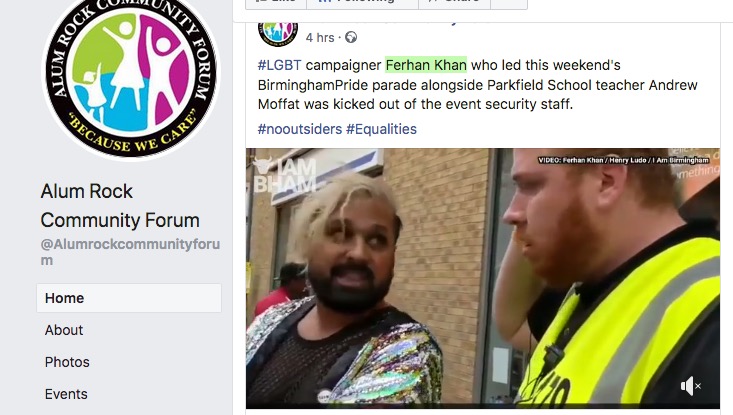
Alum Rock Community Forum, a Facebook community which filmed the anti-No Outsiders protests outside Parkfield Primary school is filled with vile homophobic abuse.
However, comments from viewers and members of the group have been widely homophobic and moderators of the Facebook group have as yet, failed to remove any of the vile comments, allowing it to become a breeding ground of hateful bigotry.
The video currently has around 55 comments, with the majority of the comments calling the activist homophobic names, such as fa***t, “drama queen” and many questioning Khan’s gender.
One commenter even went as far as to say that security should have battered him.
Another called upon the “Almighty” to “destroy all gays”.
The group, which has just under 10,000 users describes itself as “a non-profit organisation that provides a platform for the residents of Alum Rock to share their ideas and work together for a better future”.
The group first uploaded the video with the following remarks, “#LGBT Muslim campaigner Ferhan Khan who led this weekend’s BirminghamPride parade alongside Parkfield School teacher Andrew Moffat was kicked out of the event security staff. Is this the #love #nooutsiders #Equalities being promoted?”
It then edited the statement to, “#LGBT campaigner Ferhan Khan who led this weekend’s BirminghamPride parade alongside Parkfield School teacher Andrew Moffat was kicked out of the event security staff. #nooutsiders #Equalities”
The group has now removed the video as well as all the comments.
*This story was updated on the 29th May 2019 to reflect the fact that the group had removed the video and all associated comments.
Milo Yiannopoulos has had his Facebook and Instagram pages removed from the social media giant.
The removal of his account coincided with the removal of other right-wing personalities including Alex Jones, Laura Loomer and Paul Joseph Watson.
Speaking about the banning of various personalities Facebook said that the banned accounts had violated its policies on “dangerous individuals and organizations”, according to The Independent. The platform also said it banned people from praising or supporting proscribed individuals.
Paul Joseph Watson tweeted that he had the “the best media lawyers in London looking over the Facebook issue. I am not an “extremist” or a “dangerous person” and won’t be defamed as one.”
I have the best media lawyers in London looking over the Facebook issue. I am not an "extremist" or a "dangerous person" and won't be defamed as one.
In an article, Watson wrote, “Conservatives and anyone who challenges the leftist orthodoxy are being deplatformed” and asked his followers to support him.
Before his page went offline, Milo Yianouslous was able ask his followers to subscribe to his email mailout.
Facebook’s policy on Dangerous individuals and organisations
This is Facebook’s policy:
“In an effort to prevent and disrupt real-world harm, we do not allow any organisations or individuals that are engaged in the following to have a presence on Facebook:
Terrorist activity
Organised hate
Mass or serial murder
Human trafficking
Organised violence or criminal activity
We also remove content that expresses support or praise for groups, leaders or individuals involved in these activities.
You could be missing out on loads of stories from THEGAYUK if you are a follower on Facebook. This is how you can always get the latest updates from us.
You may be aware that Facebook changed the way it delivers news from pages, like ours, on your timeline. Last year the platform said it would decrease the amount you’d see from pages you’d like despite the fact you’ve made it clear that you want to hear from us.
But, there is a way to ensure that we always remain on your timeline. Just follow these simple steps.
Facebook’s over-eager censorship tools have caused the Naked Rugby Players page to be banned from Facebook.
One of the UK’s top 5 charity calendars, has been banned from the social media giant, Facebook. The owners of the Naked Rugby Players charity calendar were banned this morning (16th December) and given the explanation that the picture uploaded to the platform contained genitals, sexual activity, explicit language or female nipples, despite the picture cleverly hiding every player’s genitals.
The Naked Rugby Players calendar is a national calendar which aims to raise money for cancer charity, Balls To Cancer and LGBT+ inclusive rugby as well as bring awareness to testicle cancer and LGBT sports.
However, the “offending” picture that was uploaded does not contain genitals, female nipples, sexual activity or sexually explicit language.
In an explanation, Facebook told the page’s owners that the post went against their community standards and banned the page from commenting or posting for 24 hours.
However, in a cruel double standard, Facebook hasn’t decided to delete other user’s content. Kim Kardashian-West’s page, which has over 27 million fans has dozens of naked women, which displays at least one fully naked frontal picture of a woman.
The calendar’s Creative Director, Jake Hook said, “We take a huge amount of time on photo shoot days to ensure that everybody is comfortable and making absolutely 100 per cent sure that nobody’s genitals are on show. In fact, it is in our agreement with the clubs that take part that we make sure that no one’s genitals will be visible.
“Facebook’s ban is obviously disappointing. We are so proud of this calendar and the message that it gives. Be proud of your body, be proud of your sexuality and be comfortable in your own skin”.
Facebook’s Sexual Purge
Facebook has come under fire recently for its brand new community standard’s policy. The policy which is named the “sexual solicitation” policy has been branded as “horrifying” by critics and it could adversely effect LGBT+ users on the platform.
The policy could potentially ban gay, bisexual and transgender users from discussing whether they are top or bottoms on the site as it seeks to ban “sexual hints such as (the) mention of sexual roles, positions or fetish scenarios”.
The platform says it is now “drawing a line” when any conversation leads to a “sexual encounter between adults”.
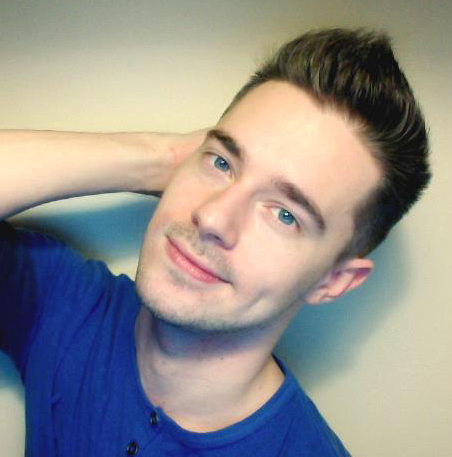
Chris “Leave her Alone” Crocker has deleted his Facebook social media profile following on from the news that the social media platform has introduced a raft of puritanical bans on sexual talk.
The policy could potentially ban gay, bisexual and transgender users from discussing whether they are top or bottoms on the site as it seeks to ban “sexual hints such as (the) mention of sexual roles, positions or fetish scenarios”.
“Demonizes sexuality”
Chris, who is an internet star, turned adult performer took to Twitter to say that despite the fact he had 4 million followers on Facebook, he would no longer “contribute content to a site that demonizes sexuality”.
I had 4 million+ followers on @facebook and I deleted.
I will never contribute content to a site that demonizes sexuality:
Facebook’s community standards say, “Do not post content that engages in implicit sexual solicitation, which can be identified by… using sexual hints such as mentioning sexual roles, sex positions, fetish scenarios, sexual preference/sexual partner preference, state of arousal, act of sexual intercourse or activity (sexual penetration or self-pleasuring), commonly sexualized areas of the body such as the breasts, groin, or buttocks, state of hygiene of genitalia or buttocks.”
The policy change comes just a day after blogging site Tumblr said it was going to remove all adult content from its site.