For petrol heads alike, Wheeler Dealers returns this month, well today to be precise with the likeable motoring geeza Mike Brewer, the one who buys and sells the cars with easy on the eyes mechanic and very good with his hands, Ant Anstead who does the fixing of whatever Mike has plunged deep into his pockets and bought.
This series we see the following:
o 1972 Fiat 124 Spider
o 1973 Toyota Celica
o 2002 Mercedes Benz E55 AMG
o 2004 BMW M3
o Volvo Amazon 122
o Toyota Land Cruiser
o 1985 Merkur XR4Ti
o Ford Bronco
o 1982 Porsche 911 SC
That’s 6 European, 2 Japanese and 1 American. Now you might be wondering what a Merkur XR4Ti is when clearly the Bronco is the American hero of the show. The Merkur (not really a name that promotes motoring romance I have to say, is your actual Ford Sierra XR4i. It’s just very much Americanised.
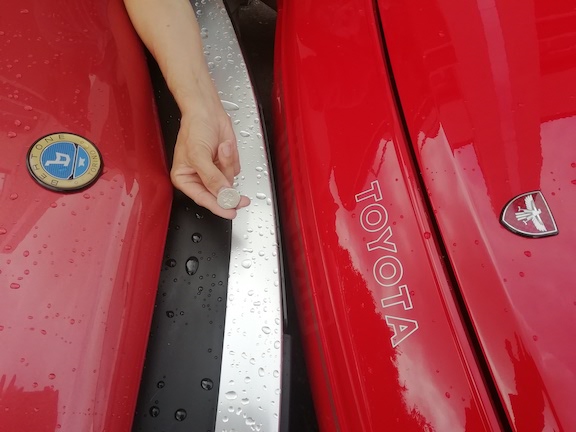
You’ll find more in that in episode 6 of 9 though for my money I’ll be glued to the screen with the phone off the hook for episode 4. This is where Mike finds a 1972 Fiat 124 Spider. It’s all-original, but the driving experience leaves a lot to be desired. Mike gets crafty on the interior while Ant fixes a leaky differential and replaces a carrier bearing and axle seals.
Wheeler Dealers has been with us for many years and in that time Mike and the team have travelled across Europe and the globe to find cars to return to the garage for repairs. As is in the real world, you rarely buy a car and do nothing to it. In this series, the boys return to America to do their buying and selling. And why not, I look out to my garage and in the bleak cold damp of March, I envy the thoughts of opening the garage doors and letting in the sun.
DISCOVERY TV
So tune into Discovery channel over the next nine weeks to find out more on how Mike holds out his hand and Ant gets greasy.
For as long as time has begun, from the ’70s to be exact, the Fiat X1/9 has always been compared to the TR7. And this is true of the classic press too. Wedge-shaped with pop-up headlights, that is where the similarities end. The X1/9 comes out well in these tests but I fear this is because there are many that disliked BL’s wedge or the agro that went with it.
The TR7 died in 1981. The X1/9 carried on, unchallenged until 1984 when suddenly you could hear the X1/9’s market share fall apart much like what happened to the car itself after its first winter.
Launched in 1972, the X1/9 saw very little development. The main changes came in 1979 with larger US federal style bumpers and a 1500cc engine from the Strada. There were some changes to paint schemes and specs but overall, very little changed.
Suddenly, Japan enters stage left. It comes to the party with its MR2. A dinky looking 2 seater with a rev-happy 1600cc engine packed with 16 valves and twin cams. It was what the X1/9 had been calling out for.
Toyota’s new car was a runaway success. What it lacked in practicalities over the X1/9, it more than made up for it by keeping up with the new hot hatches on the block. There was even competition in-house from the Corolla GT-i 16. Basically the same engine dressed in a 3 door hatchback style. It was competent and reliable but didn’t set the pulse racing with its Corolla looks.
The X1/9, having surpassed the128 3P and still going strong considering Fiat’s Strada Abarth offering, it had finally met its match. Back to back, in everyday situations, both cars are similar. The engine sits behind you and both are vocal. In those traffic light Grand Prix trials, it’s quite fun. On a run, it can be both tiring. Both cars come with low gearing though it feels like the MR2 has the lower set of ratios. Using the Fiat Strada engine and gearbox, the X1/9’s are just a little bit taller all round.
Those lower ratios are no bad thing though. The MR2, with its 16 valve engine has 3 stages of power delivery like boiling an egg. 1-3000 it’s all gentle, warm, nothing really happens. 3-4000 andsomething is happening. There are bubbles at the bottom of the pan and it’s getting hot. 4000 and beyond and it’s boiling. Stomp on the throttle and you feel a shove from the 128bhp engine that will happily spin up to the red near 8000rpm.
There is no such gauge to be had from the X1/9. It’s 85bhp is way off what the Toyota has. All is not lost though. Despite its twin choke carb fed single cam unit, it develops all of its 87Ib/ft of torque lower at 3200rpm. This makes the X1/9 a more flexible car than you would expect and feel the more rapid in the twisty bits. It’s far easier to keep the power on.
With maximum bhp’s coming up high on both engines, it’s where the torque is that counts. The X1/9 doesn’t have to have the engine singing loudly to get where it wants too quickly. In contrast, the MR2 needs to be spinning at 5000rpm to get its 105 Ib/ft. The downside to the 16valve engine is that it needs revs to get the power.
You’d expect the handling to be similar for both cars too. Well no. They differ in quite a lot of ways and both are winners and losers. Where overall comfort comes into it, it is the X1/9 that wins. Its ride from the all-round MacPherson struts is soft and comfortable. This makes it the more civilised cruiser over long distances despite its cramped cockpit and close to the controls driving position.
On the other hand, the cornering safety goes to the MR2. Approaching its limits, it will gently understeer and the steering wheel will communicate this back to the driver effectively. The X1/9 has no such virtue. Instead, you can be caught between a rock and a hard place. It’s near-neutral handling is great. The steering loads up and its adhesion with the road is lost. Be quick though because the steering is not as quick in the rack as it is in the MR2, nor is it as light. And this issue is down to 1 factor alone. The MR2 wears wider 185 section tyres with a lower sidewall. The Fiat’s 165 sections cannot compete with 185’s.
So who did it better? Both have plus sides over the other. At its limit, the X1/9 will try and kill you. You can’t drive it without 100% concentration all the time. The MR2, on the other hand, will allow you to be foolish and reward you without going backwards into a ditch unless you are really stupid.
It’s like the Minogue sisters, you can’t, apparently, like them both. The MR2 is like Danni. It can be a little bit diva and a little bit pop in as much as it will satisfy you no matter what your mood. The X1/9 is Kylie. It’s full-on disco diva, 100% of the time. Just don’t show it her years with Deconstruction records. It gets messy, much like its handling can.
Which would I choose? I’ve had a liking for both since I was a child. I just happen to own the Fiat. Having now driven both in almost all driving situations, (the MR2 I did manage to get on the Silverstone racetrack) would I change my own X1/9 for the MR2? If I had the chance to use it more, I would. The MR2, despite its lack of luggage carrying ability, is the more useable car. It’s both fun and easy to live with. It doesn’t feel as delicate as the X1/9 and that also goes for all-round weather ability.
It’s just that my X1/9 tends to spend a lot of time looking at me from the garage, not broken I might add, and much like its handling on the limit, its looks are a killer!
Many thanks to Toyota GB’s Graham Bothamley for the loan of the MR2 from their heritage fleet.
Volvo are on full assault for every market they can reach with their current range of saloons, estates and SUV’s. Their keyword is premium and they arrived here quite quickly. Very soon they are to be joined by their premium Polestar brand that’s above premium with prices to match.
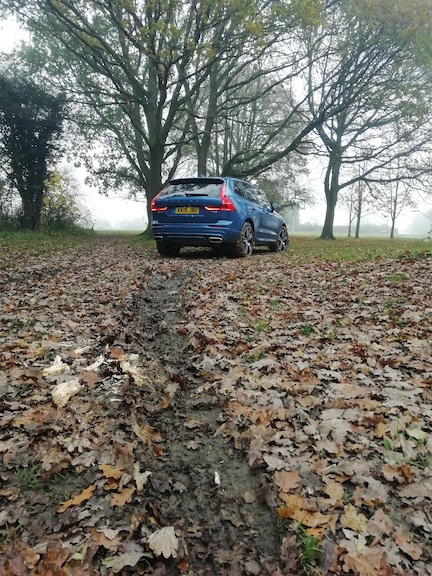
In the meantime, I’m here with their XC60 T6 R-Design AWD from their SUV range. It’s a petrol 4 cylinder producing 310bhp mated to an 8-speed automatic gearbox.
Quite often you’ll find motoring journalists bemoan about the lack of difference, if any, between the drive modes. The XC60 gives you five. Eco, Comfort, Individual, Dynamic and Off Road. All five feel different and the last two offer notable differences in road height.
The difference comes at a cost and it isn’t perfect. Comfort is your standard set up though with the plethora of onboard options and set-ups Volvo gives you, any of the drive modes can be set as your preferred reset choice the moment you turn the ignition key.
I’ll start with the niceties first and that’s the ride. Body control is controlled well. In Comfort mode, you will have little problem with the serenity it affords you even on its largish alloy wheels. The quietness in the cab is eerily quiet like an electric vehicle. It almost makes a mockery of Volvo’s own hybrid drive systems for silent running. It becomes taught and lower in dynamic and it allows the large bulk of the XC60 to be driven with some serious gusto. And thankfully it does and you’ll discover why next.
My problem is with its T6 drive train. It kicks you all the time unless you are gentle with the throttle. Its 310bhp comes in from 5700 rpm but this isn’t where we have a problem. It’s the 400Nm of torque. It just doesn’t feel like it’s there when you press the throttle. Considering it’s available from a lowly 2200rpm, its prowess is also thwarted by a hesitant gearbox. It takes the gearbox a noticeable amount of time to respond. Dynamic mode does go some way to eradicate it but it doesn’t totally vanish. Instead, it makes it a little more snappy. The two combined don’t make for a fluidity and serenity that the XC60 gives you in its ride.
The inside is all very Volvo. The interior fit and finish are above the expected and there are nice silver accents around to lift the dark R-Design interior. I can’t really enthuse any more than I have previously about the XC60 range so I’ll go straight to another area that Volvo does really well.
The home screen of the infotainment system is pretty standard stuff. Swipe left and depending on your options, you are greeted with lots of safety equipment to switch on and off. These can be moved around to suit your own preferences for items you need to select quickly like parking assistance.
Swipe down and you get another set of options and these allow you to further adapt and personalise the vehicle set up to your requirements. These are then saved and won’t revert unless there is a system reset.
That in itself is an area many manufacturers don’t think about. There is nothing worse than setting up a car and then having to do it all again after the ignition has been switched off.
Volvo set out to make their range feel premium and many little things that further make it a car that feels like a quality product. Puddle lights set in the door handles dim down in sync with the sidelights when you lock it on the remote.
The XC60 R-Design does a lot of great things in the popular market of the sporty SUV where it seems acceptable to compromise the ride quality. The XC60, however, is more than acceptable in its ride set ups with its differences being noticeable.
It might come as a surprise that I’ve been quite harsh with handing out my stars to this XC60. Considering we gave the XC60 D4 Momentum Pro 5 stars, I just cannot rave about this XC with the T6 engine and gearbox. It doesn’t do what it says on the box and ruins an otherwise splendid vehicle.
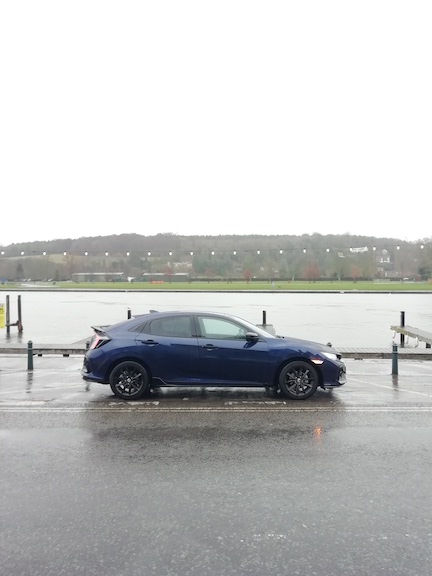
Honda has been busy evolving their tenth-generation Civic in an attempt to keep it abreast of the new challenges it faces within the competitive, if sometimes over-looked mid-sized hatchback segment.
Changes for the new 19MY Civic include smoother front and rear bumpers and changes to the plethora of grills that dress them. The new model we came to try is being called the EX Sport Line. There also comes a new rear spoiler.
The new car is being marketed as a sort of cheaper alternative to the highly acclaimed Type R. A Civic that is worshipped better than the Sermon on the Mount by Jesus [citation needed] Except with the Type R, it’s more about how immoral it is.
The EX Sport Lines on offer for testing were fitted with either the slick 6-speed manual or new CVT gearbox. This CVT replaces the conventional automatic with its confusing push button selector. Instead, the new CVT is fitted with a standard stick shift as you’d find in a normal automatic.
Driving
Fitted with a plucky 3 cylinder petrol that pushes out a respectable 126 PS from a 1-litre capacity. Now this engine might not be what you would be expecting to see fitted considering the Sport Line is a type of Type R alternative but let us just remember that this is a Civic that mixes everyday drivability without the heart attack.
Torque outputs alter retrospectively between the 2 transmission types with the manual having 20 Nm more at 200. On paper at least you could say you shouldn’t notice with outright performance figures being so close. That said, it did feel like the CVT was a little lethargic to shift unless you selected |sport| mode and then it would alter.
Inside
Inside sees changes to some textured panelling on the dashboard and the supportive seats. Racy red stitching is used to further heighten the racing appeal of the Sport Line.
Where major changes have been made is within the new climate controls and stereo system. Main changes are the addition of buttons to help navigate the often criticised complicated screens. These now allow the most used sub-menus to be reached with one button.
It is just a shame that the satnav detailing isn’t up to spec. Thankfully this can be avoided with Apple Car Play and Android Auto. I used Android and it worked very well.
Living With It
It really comes down to what type of driver you are. The Civic is a car that comes highly recommended and you’ll find it has a legion of fans out there no matter what model they drive.
So if you are a more enthusiastic driver then the manual will whet your curiosity to explore a random B road to its limits. The CVT won’t disappoint that much but you will have to work it that much harder and it’s not that rewarding to do so. As a competent commuter car that will sit in the daily grind of the A-B traffic, it will be of great comfort that the cog swapping is left to the machine.
Verdict
The majority of the changes Honda has carried out haven’t really altered much to the Civic and there really wasn’t any need to do this anyway. The Civic has always been an accomplished car as both a driver’s car and a striking visual.
We did ask about the change to a CVT gearbox. Honda was quick to point out its economy benefits and value for money in being able to offer an auto system cheaper than the system used previously. That aside, I personally feel it is a step backwards when Honda has progressed the Civic forward with the MY19 model.
With that in mind, you will find this Civic being recommended, but just think about what type of driver you are before parting with your money.
VW has just launched Passat 8.5. In a market packed with over-inflated SUV’s, you could be forgiven for thinking the Passat was no longer with us. Truth is, it’s still an important model to VW and has been with us longer than the Golf.
This mid-sized saloon hasn’t had the greatest starts in life if you include it past DNA and in that I’m talking about the ill-fated 411 and 412. VW couldn’t let go of that rear-engine layout and as a result, made a car that was out of date before it even started back in 1968.
Europe was changing and it was all about engines at the front and luggage at the back.
VW fought back with the purchase of NSU and Audi. Soon the Audi 80 was badged as the Passat and in 1973 in an array of models similar to the Audi, the Passat was born. Unlike the Audi, the VW had a fastback look about it in a hatchback configuration.
In 1981 the B2 MK2 Passat was born. Unlike its stablemate from Audi, the B2 80 had been born much earlier in 1978. What VW was to do was to take the style of the 80’s sporty sibling, the GT coupe and turn it into their new Passat. Somewhat cheeky it has to be said but what this meant for the VW driver was a car that looked like the Audi Quattro rally weapon with all the practicalities of a Golf. The hatchback body remained and was only available as a Volkswagen.
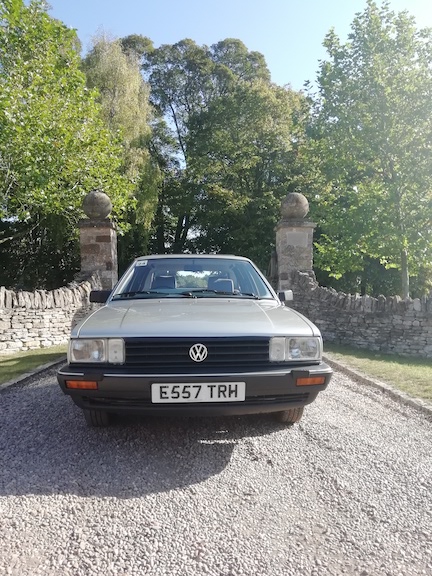
Fitted into this Passat and here for us to look at today is the 5 cylinder 2-litre engine. This 1988 GL5 model was packed with innovative ideas made it top of the range. The 5 cylinder, fitted with fuel injection meant performance and power. It developed 115bhp at a thundering 5400rpm. Torque was a useful 164Nm at 3200rpm. And this figure would plague you because this all-conquering model was mated to a 4+E gearbox.
The Audi That’s A Volkswagen
This gearbox was Volkswagens attempt at making the car economical on a run. 4th being an overdrive and 5th being even more of an overdrive lowering the engine revs to an all-time low. This really did make 5th a gear a cruising gear. And it worked. On the urban cycle, it would return a normal 25.9 miles per gallon. Absolutely nothing to shout about but at 56mph you could get 47.1mpg and that meant you could travel some great distances on one tank of fuel.
Sadly you wouldn’t get close to that figure for one reason with that 5 cylinder engine up front. Forget the screaming sounds of V8’s or the silky feel of a V6. The straight 5 in the VW sounded like a budget Audi Quattro. The same Audi Quattro that you would hear on BBC’s Grandstand rally reports spitting fire. It was a sound that blew you away and in the Passat GL5, it blew you away even if it didn’t go quite as fast or spit fire from the exhaust. You see, it sounded fast. The engine felt amazing and it made you feel great.
The drive and handling were set more for a luxury liner than a sports car. Spirited driving wouldn’t give you the full point and squirt of the Quattro and this is where your Quattro Passat ends but it’s also where Passat starts. The Passat GL5 was about distance cruising and it managed to do that well. Back to back with German cars of the time, this Passat has a distinctive French feel about it. It floats and cossets you like a Citroën. There is a massive amount of Germanic harshness missing. Its like has never been seen again from Volkswagen.
Was it expensive in that way Volkswagens were in the ’80s? Considering its relatively scarcity back then, it really wasn’t any more costly to buy that the top sellers in the market. For your £9356 you could save a grand and buy a Vauxhall Cavalier GLS or for about the same money, buy a loaded up Ford Sierra Ghia. Now, this was the problem for the Passat GL5. CAR magazine told you to buy the Cavalier. They said it was the better car but we all knew the GLS was the tops. It even came with alloy wheels and tinted glass. The Sierra rubbed its horse brass in your face with the badge of Ghia. A badge that stood for the top of the range.
Introverted German Style
VW didn’t really shout out about their conservative Passat. The only car they did shout about was the Golf GTI and even then that didn’t quite get the fanfare it was worthy of. Volkswagen liked to keep it quiet, almost introverted. In the words of a Victoria Wood burger sketch from her one-off show, An Audience with…, “the introverts burger, it’s just a serviette but they don’t like to say anything”
This was VW’s way. And a shame because despite the lacking of glitz and glamour, the inside of the Passat GL5 was steeped in plush velour everywhere. The carpets had a quality shag about them and it felt solid. And the inside niceties didn’t stop there. You had all-round electric windows with ergonomically challenging switches on the door or centre console. Fitted like an afterthought, the switches were at least taken from the modern VW switchgear. The rest of the switchgear was dated clicky switches from the last generation of Volkswagens.
The Passat has continued to shine as a product for VW and all generations have retained some element of DNA from this very model. The one thing, thankfully, they haven’t taken is the awful offset steering wheel. Perhaps that’s why VW didn’t want to shout about the Passat?
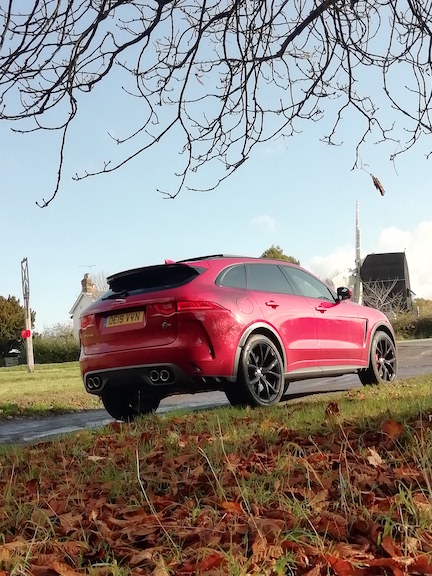
Jaguar’s Special Vehicle Operations (SVO) has taken their spanners to the all-important and top-selling Jaguar F-Pace. Looking through the model options on the F-Pace, it would seem that the V6 S we tested back in May 2018 has now gone, replaced by this all-new SVR model.
On paper alone, it doesn’t sound like much progress has been made from replacing the 375PS supercharged V6 with a 550PS supercharged V8. You might be thinking “hold on Stuart…” because these figures alone are impressive. I’ll grant you that they are. What it lays down on the road doesn’t exactly look like much in terms of the 0-60 second sprint. Just 1 second is knocked off the S models 5.1 second time.
Where the fun lies is in the top speed that you’ll never achieve on the public road of 176mph and the massive increase in torque delivery you will get when you put your foot down. Now you have 680Nm from 2,500 – 5,500rpm. We don’t need to consider the old model anymore.
Development
It feels like SVO has done some work on the iQ-Al (D7a) modular platform that is shared with the enjoyable XE saloon. And that work feels a little more than a mild tweak and a tap with a hammer. Finally, the F-Pace has the handling that enables it to keep up with its greater power outputs. It can still plough on but this time you can encourage the rear end to catch up far quicker than before. There is no doubting that the extra grunt in useable lowdown torque helps to attribute to this vastly and enjoyable improvement.
What this also means is it can all get a bit messy and a lot of fun. It makes for a big car that feels less nervous. Even on moist roads, the traction is all there and exploitable. Now we have a car that gets a bit twitchy on the rear when confronted with coming out of fast roundabouts if you so wish for it to do so.
And all of this happens before, and by accidentally, that you select S on the gear stick. I’ll be a little unprofessional here and say I did scream and cry at the same time as it shot down the road like a stone from a catapult. What felt like a fast vehicle suddenly became even faster with more response from throttle inputs and manual inputs with gear changes.
Legally you can’t use this outrageous amount of power all the time. There comes a time where you need to be civil to other road users. Sometimes that means shutting off the snarling exhaust sound system controlled by a system of flaps and baffles.
On a normal kind of drive or commute, the F-Pace SVR is a gentle giant. Its interior on this press model, were rather cosseting and the though the seats didn’t visually lend themselves to look comfortable, did a good job.
Attention To Details
Inside the F-Pace, there is an absence of race materials. Instead, Jaguar has opted for leather and soft-touch materials where it is needed. It’s fit and finish are OK though they would struggle to match those from BMW and Mercedes and its looks are a little dated now.
And this is a shame because this is Jaguar and it’s a premium brand of car. But it fails in a few areas of neglect that niggle a bit if you go looking for them. The glovebox, for instance, has some unrefined sharp edges around it and then we get to my visual dislike in a Jaguar interior. Namely in the ambient illuminations set in the doors. Personally I’ve never liked blue lighting. It’s a harsh light so add this to the black and red leather interior and you do wonder who at Jaguar is in charge ofmaking this decision. Other interior colours are available in black with cream or tobacco or all black.
And this is the main problem for the F-Pace. It’s 4 years old in 2020 and dated inside because of this. Thankfully for £210, you can tick a box that gives you a choice of 10 colours. Keep it white as standard and you wouldn’t need this.
All this extra doesn’t come cheap and that’s before you’ve added your own essentials. You’ll regret not adding such items like the ‘driver assistance pack’ at £3100 so you can kiss the reasonable list price of £75,335 goodbye. Add the options that we have here and it tips the scales at over £83k.
Can I justify this to you? If motoring is on a budget then no, this F-Pace is not for you but you might find what you want lower down the range. That said, if a fast SUV vehicle with a kick is what you want, you’d find a lot of the competition out there quite lacklustre. There aren’t that many as accomplished and as outrageous as this and that’s why I’m rather taken by it.
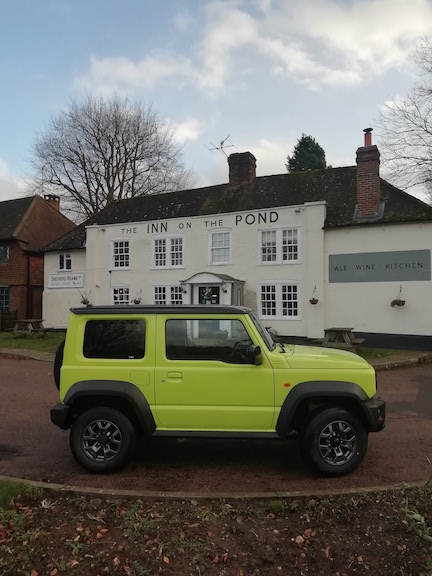
The 80’s yuppie years were good to Suzuki’s little go-anywhere-carry-cart. Young 20 year olds with red braces and mobile phones the size of a house brick would go off to Majorca for 2 weeks to get some sun. To get around they would hire a car and more often than not, the Suzuki with its allure of open top motoring would be hired. This translated into sales in the UK when they got home and soon the Suzuki SJ was as much a part of the 80’s landscape as a Porsche 911 Turbo and naked girls in a Duran Duran video.
Open top jeep type little fashion accessories suddenly popped up in music videos and TV consumer programmes but not always for the right reasons. Bros used Luke’s Jeep in their video ‘I Owe You Nothing” It wasn’t an SJ but a big American Jeep CJ. It was a 1979 model and by 1988 it was old and dated. 5 Star were hustled along in a Citroen Mehari. One-hit wonder Spagna had a Suzuki SJ come to her rescue. Open-top jeeps were a wanted thing for the city dweller and Suzuki had caught the British imagination.
The SJ had three things in its favour. Relatively cheap to buy, very cheap to run and could, if you wanted to, go almost anywhere. This wasn’t just a vehicle to pose on in the pub carpark. It also had one major failing. It was ruddy awful to drive at anything over city speed limits. The live axles suspended by cart springs did nothing for the handling or day-to-day running. Not that this stopped the public buying them and the subsequent two generations that came afterwards.
As a footnote for the history nerd out there, the Suzuki 4×4 has been with us for 50 years and seen only 4 generations of change. Its life has been longer than that of the VW Golf and seen just half the development changes. In fact if you look at the icons of the 20th century, the Jimny has outlived the much loved Mini and 2CV and yet it is hardly mentioned when people talk about the ‘World Car’. And it’s quite significant and only beaten by the VW Beetle if you include the 25 years where it wasn’t officially available in Europe.
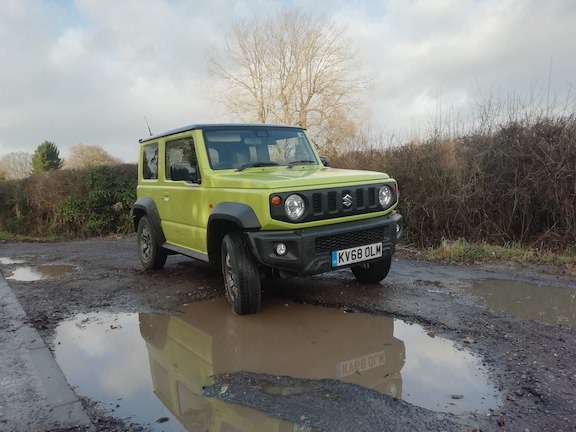
New Jimny by comparison to the old is a revelation. Ride quality isn’t as bad as it once was. Gone are the cart springs and instead it now sits on 4 coil springs. Considering its diminutive wheelbase and angles of articulation afforded to the Jimny because it is a proper little off-roader, it felt quite muted. It didn’t crash in a spleen adjusting kind of way over some of the worst roads I traveled on.
Ditch In – Dig Out
The same applaud can’t be given to the handling. It really isn’t the best. At worst it will oversteer with little effort, at best you can use the capable 4WD system to get yourself out of the ditch. Used appropriately and you won’t have much trouble. The 1.5 petrol engine sort of sees to that anyway. Its maximum powers arrive high up in the rev ranges and because of the Jimny’s agricultural configurations, it voices these well through the chassis and into the cabin.
Transmission noise was something I’ve not heard of in a long time but you will need to get used to it. There is much of it should you wish to push on.And push on you will especially when confronted with a hill when at speed. Above the national speed limit, he 100hp engine runs out of puff in 5th and the change down, through the long throws of the gear lever, are easy. Stick to 70mph and it shouldn’t cause much of a problem.
The steering is of the muted kind. It doesn’t give a lot of feel though I never found this much of a problem unless I harassed the Jimny into doing something I shouldn’t have. It feels quite low geared and when you do provoke it to kick out, you need to twirl your arms quickly if only to keep the momentum. That is at the extreme because off road, it translates to very little kickback and the one thing you don’t want is thumb breaking kick back from a rapidly correcting steering wheel.
Acceptable But You’ll Love It Anyway
Equipment and price feel a little on the high side. There are better cars out there for less but they are less capable of getting rough and dirty. Equipment on this top of the range SZ5 model is generous. Climate control, cruise and limiter are standard. It also includes auto dim/dip headlights and forward collision mitigation alarm. Infotainment is the standard as expected with DAB and in-built Satnav. It’s just a shame the screen isn’t user friendly with its flat universal positioning and not angled towards the driver.
Real world usage makes this a 2 seater with luggage or 4seater and nothing else. The boot really is non existent. 85 litres of luggage at minimum is smaller than you think. Where it plays its ace card is its adaptability of moving, folding and reclining the seats. To fit 6 ft planks of wood inside proves to be rather easy. 2 air mattress on top of the folded seats and you have yourself a large double bed.
And there lays a Tardis type of a problem. Shoulder width is huge for such a small car and rear seat leg room, more adequate than many city cars I’ve travelled in. And yet it is totally useless in the rear from most aspects.
You Can’t Be Harsh To It.
So to the new Jimny of 2019 and the big question. Is it any good? To answer that we need to remember what this is, what it does and do we care enough and what us motoring journalists have to say about it. Ask any owner of the previous model and they won’t really care what we say.The Jimny is a cute looking box that does what you expect it to do.
With this in mind, the answer is it isn’t very good. But I don’t care enough to pick holes in its faults of which there are plenty. I’d gladly take one and be happy with it and chances are you would too. It has a lot of anthropomorphism in it that combats its failings. It’s just a shame there is a waiting list of over a year and no canvas top model in the pipeline.
With Christmas just gone I look back to the winter of 1981 where my driving career started.
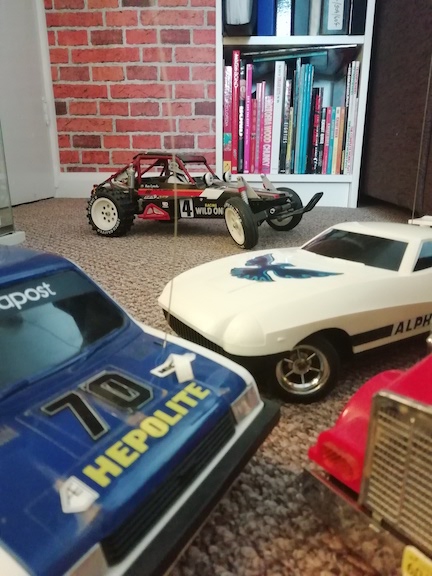
I’ve been rather fortunate with a recent eBay purchase that I hadn’t actually gone looking for and to be honest, I’m not sure what made me look for it or how I found it. The reason for this utter astonishment from me when sober was because the item in question doesn’t really have a memorable name. What I have managed to do is find my first 3 radio controlled cars.
The toy pages of the Gratham autumn/winter catalogue became a mass of dog eared pages. I had eyed up the Corgi racing Golf. Being all of 6, I did still believe in Santa. I was expecting a racing Golf. Alas the Golf never happened. So let me take you for a drive on my first 3.
LaTrax Alpha RCX
I’ve been searching for this ad-hoc for several years but I’ve never really been able to find it because its random name was totally lost on me. How the hell could I remember that mix of exotic sounding words?
For a start there is the design. I could have sworn it was a 1967 Mustang fastback. It does look a bit like that at the rear but now I’m looking and I note it’s more Datsun 240Z at the front. It really was a nothing car. A random selection of designs thrown together. There were 4 Mustangs 2’s on the box. I remember that.
There were other things I remembered too about this. Despite not quite remembering the controller having a steering wheel, I do remember the push buttons for the forward and backward motions.
Looking at the RCX today, it really was a thing of advanced engineering. It had proportional steering and a floating rear axle. It drove quite quickly through the one rear wheel. I remember hearing it crash against the wall the night before Christmas and shouting down to my parents only to be told it wasn’t what I had screamed.
Sadly the RCX was to be short lived. Like several minutes. It broke. What was to come afterwards was MUCH better.
Likto Truck
This was the absolute nuts of a toy to me. It was huge and had blazing yellow lights. The trailer could either be a flat bed with detachable ramp or articulate box. This was 18 wheels of goodness although 16 of those were pretend double wheels but let’s us not split hairs of tyres here. It wasn’t just a truck and trailer though. Based on a Kenworth, this was your all out American big rig. I was part of the convoy. I was right there with Rubber Duck. That was until the gun firing. I wasn’t going to have my big rig damaged.
The Likto truck had the added bonus of being able to dismount the trailer at the touch of a button. It was almost fully interactive. The game was then to reverse up to and hitch the trailer to the truck. You could say it taught eye-hand co-ordination. Not that you’d think it did if you ever see me playing computer games. I’m quite hopeless.
The technology didn’t just stop there. For a toy, it had a complex drive and clutch system with 3 gear ratio set ups. Slow or fast in all directions but it also gave the option of fast forward and slow reverse at the flick of a lever underneath.
Alas all good things must come to an end. I remember being almost inconsolable when it stopped working. I loved that truck.
Corgi Mini Metro
Now here was peak Corgi toys. Back in 1983 Corgi had you covered for all things a young budding motorist required. TV detective cars, big scale, small scale and electric cars that you didn’t even need to push around the living room. That last statement can’t actually be applied to Corgi’s RC toys. They were a bit rubbish.
The Metro lived up to the hype of its British Leyland roots. It wasn’t that great and it was unreliable. Discovering the magic powers of a screw driver, I took mine apart. It was like looking into the void of a glossy wrapped box with a sparkling bow in the corner next to your name. It wasempty apart from the cheapest circuit board you have ever seen.
It took all these batteries to give it 6 volts of magic. It could have done with around half of that. So simple and not very effective, it had cheap magnetic controlled steering. That 6 volt of power did not translate to scintillating speed to chip the lead paint from the newly painted skirting boards around the house. It wasn’t what you could call a carpet racer despite its fetching Datapost livery.
What I do remember was the hate I had for my sister when it came choosing the 70 or 77 numbers. She suggested 70 because I was 7. Shut up Jackie. She know nothing about race cars. We all knew the higher the number, the faster it goes right?
It died a painful death in my hands and I can’t say what I did to it was deliberate. It just died. Its Super Cover warranty had expired along with the car.
Rise of the Big Boys
It wasn’t until Christmas 1985 when I kick started my long affair with the real boys toys. Those from Tamiya with their Wild One. And as for the Golf, I found one and to be honest I wasn’t missing out. It was the same as the Metro, just as naff but clothed in a Volkswagen body. Thankfully nothing was as unreliable as a Corgi VW Golf except for a Metro.
2019 was a busy year for us at THEGAYUK motoring section and I’d like to thank all the manufacturers and PRs who helped make it possible. We could not do this without their continued support.
It was easy to pick my joker card for the car I’d have if I had the funds this year. It will comes as a surprise but I’ll explain why later. The number 2 position proved far more difficult for me to select. There were many cars to choose from with a few manufacturers making it more difficult because they had more than 1 in the firing line. You couldn’t see the carpet in the library for all the pictures.In the end I settled it over a vodka based cocktail and a blast of Mel and Kim F.L.M.
So let’s start with The Gay UK’s New Years Honours list.
3 Citroen Berlingo £24,925
It had to happen and I’m sure you all expected this so don’t start rolling your eyes at me for this. Simply put, there isn’t a vehicle out there that can match the Berlingo for space and comfort for 5 or 7 with the extra length model at this price.
That space also has added visibility to swallowing huge loads and the low boot lip is a boon over an equivalent SUV. There is a compromise with the Berlingo and that comes from its van origins. You can’t escape these and it shows in the handling. Not that you’d think this was a problem judging by how fast you see the van piloted around.
Add it all together and it makes for a satisfying long distance cruiser that can also become everything you can think it could and it will.
2 Lexus LC500 £87,885
This was the tricky one and in the end, I wanted to feel a million dollars without actually having to fork out a million.
V8 5 litre petrol power, growling exhaust, the ability to cruise in comfort and its looks are what those on the outside will see. Those fortunate to see inside will be well placed in a cockpit meticulously put together by Lexus Takumi masters.
A large small volume coupe is a difficult car to make and manufacturers have to go all out like Audi and new comers Polestar and they then also charge you a fortune for it.
Here the Lexus LC500 manages it so well and despite it costing almost £88,000, it is great value without the cost cutting compromise. It would be so easy for Lexus to fit switchgear from its parent company and it hasn’t.
The extra cost option that comes with the Lexus as standard is that people will let you out in traffic. You can’t put a price on that.
1 Suzuki Jimny £19,149
The Suzuki caused a bit of a riot and ruined my otherwise planned honours list. Arriving as it did at the end of 2019, I didn’t expect to be sitting here, just after I’d written awful things about its flaws saying that it’s my number 1 choice for 2020. But there we go, nowt queer as a gay motoring journalist!
And why? Its possesses human qualities that make the Jimny almost become anthropomorphic. You can’t help but melt at its cute looks and this makes you talk to it. You are never alone in a journey in a Jimny.
It never lied either at what it was and with that, it never pretended to be anything other than an honest little workhorse that would give you all it can and then some to get you were you needed to go.
It’s the classic Grant Mitchell look. Heavily flawed with good intentions but cover him in the right clothes and he’s a winner.
If It Was My Money
My must have is the Jaguar F Pace SVR. It only had one competitor with us this year and that was from Alfa Romeo. While the Stelvio Quadrifoglio was a mighty beast to drive, it was on the go all the time. And when it wasn’t, the cockpit quality let it down. This made the F Pace SVR all the better. To use both cars gung-ho powers all the time isn’t possible. About 80% of your time would be just normal driving and it’s that 20% of wild fun that gets over thrown by a cockpit and luxury feel that won the day.
And let’s not think the F Pace SVR is all about looks. What it lacked over the Stelvio in power prowess, it more than made up for it with being an absolute scream to drive at its limit and then beyond when the screaming gets louder.
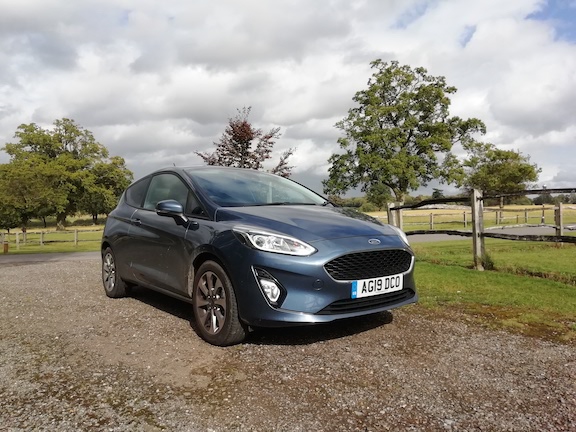
Cars are complicated pieces of machinery so Ford have selected a Fiesta model with simplicity its main focus point.
And this model, the 3 door Fiesta Trend was a hit with the reviewers at the recent SMMT drive it day and I’ll tell you why.
Driving
I hadn’t read the spec sheet for this new Fiesta. At times I like to just jump in and go to see if it wows me. And I can say that it did.
The simplistic appeal to this Fiesta comes from its 1.1 litre 3 pot engine. Just when every little engine in a biggish car is fitted with a turbo, this little engine leaves that at home on the table.
Performance figures are amiable and with just 85PS of power from a free revving engine, it manages to trundle along quite nicely. With no turbo, throttle inputs are met with immediate action except when nearing its peak of performance or when there is a hill to climb.This will also be why there are only 5 gears.
With the chassis being very communicative, making it a fun car to drive, hustle it through the gears to keep the engine at its peak and it’ll reward you with a dash that is both driver licence safe and exciting.
Inside
From the drivers point of view, the Fiesta Trend has all that you could want in a nippy city car. The 8” touch screen was easy to use, reasonably quick to function at the touch of the finger and the graphics are easy on the eye.
Plastics feel good quality and the choice of seat fabrics is both sophisticated and business like. For such a base model, it would in this case, seem out of place. Trend is its name but Trend it does not set. I don’t think a little funk would go a miss in here with a smattering of colours to lift the well fitted cabin.
Living With It
Fords NCAP pack comes as standard. This gives you extras like lane keep assist, speed limiter and tyre pressure monitoring. The electronic stability programme also comes with hill assist. So it all stacks well in its favour as a reasonable specced car for the money.
Is being a 3 door a hindrance? Not really. The front seats fold forward enough to allow easy entrance and a 3 door hatch always looks sporty over the 5 door.
The Verdict
The Fiesta Trend was a bit of a runaway hit at the SMMT drive day. There were not many bad words to be said about it. It was universally liked. And you can see why. It’s well put together and for a small car of £15,995, you weren’t left feeling short changed.
The drive is both engaging and without sounding detrimental to Ford, so simple and uncomplicated, that it makes it a drivers car without it costing the earth.
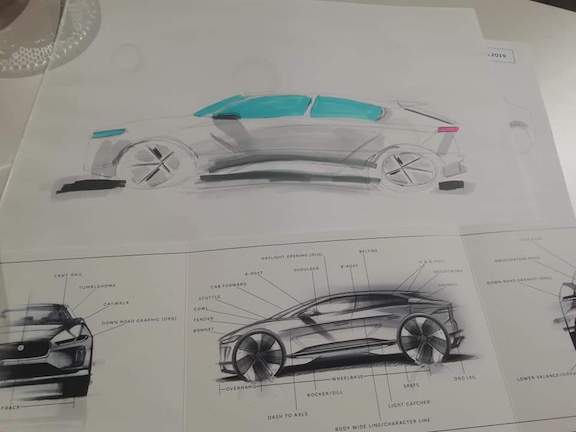
Jaguar UK invited THEGAYUK to the Design Museum in Kensington for an exclusive “interactive exploration of designing an electric car” before opening it to the public.
In essence it was popping into Kensington and having a nosey around the new Jaguar i-Pace in both metal and clay forms. It also gave us a chance to interact with the design teams involved.
Sam Day Photo
Before the jollies commenced with the sweat and anguish of picking up a pencil and drawing a Jaguar, I got to look close up around the clay models. I’ve only ever seen them in books and often wondered if they clay was set. The answer is no. It pretty much stay soft for most of its life. And this gave me an opportunity to have a go with the sculpturing tools. If you do see an i-Pace with a gouge in the near side rear door, that will be my work and you can thank me when you see me.
Directors of designer, Alister Whelan (interiors) and Dominic Najafi (exteriors) were on hand giving out advice as we all sat down to draw an i-Pace. It’s safe to say that the last time I sat down to draw in a school like setting was during my GCSE art and that too was the last time I also picked up a pencil to sketch.
Apparently it’s not in the wrist but the arm. Alister and Dominic were able to tell who didn’t heed their advice and drew from the wrist. I tried. It’s harder than you’d think.
Add some shade, depth in details, swoop here, swish there and you have an i-Pace. Or in my case, a Toyota Prius.
We were then asked to draw a car close to us like a first car or a dream car. I chose a Seat Terra. It’s a van based on the Seat Terra and apart from the wheels, it lacks curves so I should be OK.
Sam Day Photo
It just so happened that it wasn’t that bad. We all had to put our scribblings up on a wall and have Alister and Dominic comment and see if they could identify the car. For my effort and the only van drawn, they scored me an 8 out of 10. They guessed it as some sort of Fiat derived product and I can’t really split hairs. It pretty much was.
Sadly I wasn’t able to stay for the interaction with the panel on discussions on how new technologies, sustainable materials and changing customer desires are impacting the future of car design. Judging by the press pack that arrived after the event, it was well attended.