Search results for: “ ”

  • INTERVIEW | Simon Adkins

    We got the chance to catch up with one the West End’s brightest newcomers , Simon Adkins. He gives us the inside gossip on Viva Forever.

    Q. At what age did you start performing and where did you train?
    I was born in the dance studio really, as my mum was my dance teacher when i was younger. So i began dancing at about 2/3 yrs old at the Susan Taylor Dancing Academy, Banbury, and never looked back. I use to do a lot of amateur dramatics whilst i was at school, and then it wasn’t until 1998, when i went to Bird College to do my degree, that i began singing and acting more seriously.

    Q. When you first heard about the auditions for ‘Viva’, what were your initial thoughts about a musical based on the Spice Girls work?
    My initial thought was, great subject matter, the biggest girl band of all time. Got to be a hit really hasn’t it? I wasn’t sure until i started auditioning if the book would be a biographical based storyline or if Jennifer would write an original story. Also the fact that Judy Craymer was producing, I knew it would be the talk of the town, following on from her global success with Mamma Mia.

    Q. When you started the workshops/rehearsals, was there an opportunity for your own creative imput with the role of Leon?
    Absolutely. The creative team were very generous in letting us suggest things for our characters. Thats the beauty of creating something from scratch, there are no right or wrong answers so we were allowed to try different things along the way and throughout the whole process. A luxury an actor wouldn’t be allowed in most other shows.

    Q. How was your first meeting with the Spice Girls and Jennifer Saunders?
    I first met Jennifer at my last couple of auditions for the role actually. I was told she would be there and obviously being the Ab Fab fan that i am, i kinda s**t myself a little bit!! The feeling of walking into a room and having to be funny in front of the writer is a little daunting, especially when its Jennifer Saunders sat opposite you. Luckily i managed to make her laugh and get the job. I’d met two Spice girls previously to Viva, I actually worked with Emma Bunton as one of her dancers in her music video ‘Maybe’ back in 2003 i think. I’d also met Victoria when i was in Jersey Boys as her family love musicals. But the first time we met them on Viva was firstly at the Sitz Probe (band call) when Mel C, Emma & Geri came to watch us sing through the songs of the show with the band for the first time. And then i met them all on opening night obviously, which was such an incredible night. I never thought i’d ever be on stage with all five Spice Girls let alone chat to them all afterwards. Very special times!

    Q. 8 shows a week must be exhausting, how do you keep yourself fit and healthy?
    It is a busy week, but i guess we actors get use to the stamina of doing 8 shows a wk after a period of time. I make my week even longer by teaching musical theatre twice a week at Performers College. All this keeps me quite but i do have to try and eat as healthy as possible because when you’re busy its so easy to just grab something convenient and not necessarily healthy.

    Q. Recently Bertie Carvel has been leading a campaign aimed at Equity and the Society of London Theatre’s, against the proposed settlement for the West End in 2013 including a clause that would allow two Sunday performances. Is this something you would support?
    This is a tricky one, as the Sunday performance clause is just one part of the new Equity agreement being negotiated at the moment. Obviously Sundays are the majority of people’s day off who work in this business and i completely understand how important weekends are to those with families especially. I’m not convinced however that theatre producers would find it financially viable to do two performances on a Sunday as the costs they incur to put on the shows would be astronomical. Having done a Sunday show on a previous job i’m not sure they would find two audiences in London on a Sunday, especially the evening performance. I will be interested to see how this is settled in the not to distant future.

    Q. What advice would you give to someone starting out in the industry now?
    I’d give them the same advice as i give my present students, there is no point in being a one trick pony in this business anymore, triple threats are what casting and producing teams are looking for nowadays. Everyone needs to be able to act, sing and dance. But if it’s something that you are passionate about doing, 100% follow your dreams and stick with it as its not an easy business to be part of.

    Q. Equity runs a campaign called ‘I wont pretend’ aimed at LGBT actors to enable them to feel more confident when coming out to their employers in the entertainment industry. Have you yourself ever seen/experienced any discrimination towards LGBT performers in the industry, or would you say its the opposite?
    Personally I have never seen it in the last 12 years that i’ve been working. Thats not to say however that it doesn’t happen. I’m sure people get judged on their sexuality all the time in this business, especially when being cast for roles, but it shouldn’t be the case. Why can’t a gay guy play a straight role or vice versa? But as i said I have never witnessed discrimination first hand which is a good thing in my eyes.

    Tickets for VIVA FOREVER! are available until 29 June 2013

    Interview by Becky Harper

  • RIP | Viva Forever to close in June

    West End Musical Viva Forever is set to close at the end of June

    In a statement from the producers of Viva Forever:

    Producer Judy Craymer announced that VIVA FOREVER! the new musical, inspired by the songs of the Spice Girls, has posted closing notice at the Piccadilly Theatre for 29 June, 2013. Anyone wanting to join in the fun is urged to book tickets now and get down to the Piccadilly Theatre in the next eight weeks for a fabulous, feel-good night out.

    In a press statement issued this morning, Ms CRAYMER, said

    “It is with a heavy heart that we’ve had to make this very difficult decision to post closing notices for this original show which is blessed with one of the most brilliant casts currently on the West End stage. We set out to create a contemporary story that truly reflects our time; to take a satirical look at the underbelly of a TV Talent show and the chaos that ensues for a mother, her daughter and their friends, a theatrical event to embrace all generations both on and off the stage. Testament to that achievement is the standing ovation at every performance from an audience of families and friends all enjoying a great night out. The show has evolved since we first opened and is now brighter, lighter and funnier, but despite the wonderful audiences and extremely positive feedback we just can’t make it work. I’m so proud of everyone involved in this production. VIVA FOREVER! may be taking it’s leave for now in the West End but the legacy of Spice Girls will never fade.”

    Writer Jennifer Saunders added:

    “It is disappointing the show is to close. I am particularly sad for the cast and crew that have worked so hard to produce a wonderful show.”

    The Spice Girls said

    “We want to thank the cast and all the fans for their support, and although Viva Forever won’t continue in the West End we are thrilled that the thousands of people who came to the show had as much fun as we did.”

    VIVA FOREVER! is a feel-good musical comedy with a book by Jennifer Saunders inspired by the music of the SPICE GIRLS. Charting the trials and tribulations of wannabe girlband Eternity, the musical tells an original story as it hurls the audience headfirst into the final rounds of TV talent show Starmaker, where a panel of fame vultures passes judgment on our wannabe heroines while desperately clinging to the limelight themselves.

    VIVA FOREVER! is directed by Paul Garrington and choreographed by Lynne Page. The production is designed by Peter McKintosh, with lighting design by Howard Harrison, sound design by Bobby Aitken and musical orchestration by Martin Koch.

    VIVA FOREVER! is produced by Judy Craymer in association with the Spice Girls, Simon Fuller and Universal Music.

    Tickets for VIVA FOREVER! are available until 29 June 2013

  • Gay Vices Survey Results

    This month we’ve been discussing Vices on TheGayUK and at the beginning of the month we invited readers to take a survey to reveal what the gay community vices were.

    In our snapshot survey, porn topped the list of vices of gay men of the United Kingdom, with 42.4% of those polled owning up to viewing porn at least a few times a week (30%), watching it on a daily basis (28%), and over a quarter admitting to watching the bad boy stuff a few times a day.
    Other vices topping the list were Drinking 34% Sex 32% and Smoking 19%.

    Only 1.7% of people revealed that gambling was their vice.


    In order (respondents could choose more than 1 vice):

    Porn 42.4%

    Drinking 33.9%

    Sex 32.2%

    Smoking 18.6%

    Chocolate 16.9%

    Working 15.3%

    Drugs 11.9%

    Shopping 11.9%

    Fast Food 10.2%

    Cruising 5.1%

    Adultery 3.4%

    Gambling 1.7%
    Just over half said that they would consider giving up their vice, with 50% of all respondents saying that their addiction wasn’t a problem for them.

    Is the gay community actively looking for help or booking into the Priory any day soon – don’t bet on it, only 13.6% said that they had sought any kind of professional help in dealing with their vice or addiction.

    59.3% of those questioned said that they had been addicted for over 10 years – and openly discussed their issues with their peers (66.1%)

    If you need to talk to someone with anything that concerns you call the London Lesbian And Gay Switchboard on 0300 330 0630 or visithttp://www.nhs.uk/conditions/Addictions/Pages/Introduction.aspx for more details.

  • COMMENT | Can Anyone Really Be “Mr Perfect”?

    Can someone ever have no vices? Be so flawless that they seem perfect? And if so, is perfection what we seek? In this article, I’ll share an experience I had a few years ago; along with a realisation I had about aspiring to be perfect.

    I met this devilishly handsome guy online. We exchanged a few messages and decided to meet up. I took all the usual precautions when meeting up with someone from the online world: I arranged to meet him in a public place (a well-known coffee shop), let a friend know who I was meeting and what time I’d call in safe.

    He was one of those people that look even more stunning in real life than in their profile pictures. He had short-cropped hair, deep hazel eyes, a five o’clock shadow and his fitted tee a showed off a taut body. Our first coffee date went well and I established that he wasn’t an axe-wielding murderer.

    We shared a few dinner dates, a cinema date and even a countryside walk with a picnic date. I discovered that he didn’t smoke and rarely drank. When he did have an alcoholic beverage, he’d only have one or two. He told me that he liked to go to the gym three to four times a week and easily got his five-a-day in one meal.

    When my friends asked how it was going between us, I referred to him as Mr Perfect. I explained that I couldn’t find a single vice or flaw that he had. Comparing Mr Perfect with myself gave me a twinge of inadequacy. I had plenty of vices; I smoked and liked the occasional alcohol-fuelled night out. On top of these I was a chocoholic; lazy at times and could only manage to eat three of my five-a-day.

    Mr Perfect had noticed my vices and flaws. He was too polite to point them out, but did suggest that I try to cut down on the amount I smoked and offered to sign me in as a guest at his gym.

    Then one day I had an eureka moment; I realised that Mr Perfect’s vice was aspiring to be perfect. That he spent all of his time trying to be flawless. Mr Perfect wanted every aspect of his life to be perfect including his potential boyfriend: me.

    I grew up with Disney films that showed me that the ideal man, Prince Charming is handsome and flawless. And I thought that’s what I wanted; until I had Mr Perfect sat opposite me. We had a conversation and decided not to date anymore.

    I realised that as much as Mr Perfect aspired to be perfect, whatever his definition of that was, that he’d never achieve it. As every time he gets close, he’ll move the goal posts further away. Perfection is an unachievable goal, like trying to live for eternity.
    Through my experience with Mr Perfect I discovered what I want in a man. I want a man that has vices and flaws; as these are part of what makes us unique, diverse and multi-faced individuals. Remember – those who truly love us, accept us for our whole selves, flaws and all.

    Opinions expressed in this article may not reflect those of THEGAYUK, its management or editorial teams. If you’d like to comment or write a comment, opinion or blog piece, please click here.
  • BOOK REVIEW | Strange Bedfellows by Rob Byrnes

    Strange Bedfellows by Rob Byrnes is a crime caper story that is an addictive read. Grant Lambert and Chase LaMarca are introduced on a job to rob a store.

    As the scene unfolds they have to pretend to be mannequins in the shop window as the Police have turned up, which is an hilarious scene and just the start of this fantastically funny book.

    Grant & Chase are partners in life as well as crime, and when the offer of a well paid job comes along they can’t turn it down; even if it is from hustler Jamie Brock.

    Austin Peebles is an adorable democratic congressional candidate who has sexted a rude photo of himself that has found it’s way into the hands of June Forteene a rightwing blogger.

    Grant & Chase’s job is simple: steal the photo (as well as any copies) off June before she exposes it on her blog and ruins Austin’s political prospects. They complete the job; but enraged June soon posts a cropped version of the rude photo along with an ultimatum: the unnamed political candidate must withdraw himself as a candidate and provide her with compensation. Austin’s campaign manager Kevin Wunder refuses to pay Grant & Chase as they haven’t have completed their job correctly.

    Grant & Chase are convinced that they completed their job and that there’s something more going on. So they hatch a plan, recruit a team and set about making everything right. Along the way we get to know grumpy Grant and likeable Chase. Both characters were multifaceted like real people and the use of description by Byrnes gave a strong sense of the different characters.

    Byrnes used a number of close calls and twists to weave a fascinating plot that is perfectly paced. He used his unique writing style to engage the reader and packed the story full of funny, believable and entertaining scenes. Byrnes got the balance between showing and telling the story spot on for the reader. Strange Bedfellows had a satisfying conclusion that will leave the reader wistful for another of Byrnes‘ stories.

    What let’s Strange Bedfellows down was it’s cover. The topless man gives a misleading impression, as does the image of the Whitehouse. The topless man is like none of the characters described in the book; and implies some sexual scenes of which there were none. The Whitehouse gives the impression of a political story; but even non-Americans will fully understand the story as Byrnes explained what the reader needs to know and besides the story isn’t really about politics.

    Please don’t be put off by the cover, Strange Bedfellows by Rob Byrnes is a captivating read that will have you craving more of Rob Byrnes stories.
    Available from Amazon

  • OPINION | Ages of Ignorance

    Although the ‘yoots’ of today are feared by much of the majority culture, it is often believed that it is the older generations who hold ‘outdated’ homophobic views.

    But are the young really more liberal? Do Generations Y and Z hold more enlightened beliefs when it comes to sexual orientation and (trans)gender diversity?

    With the announcement this week that Paris Brown, Youth Crime Commissioner for Kent Police, will escape criminal prosecution I can’t help but question whether she is simply a misguided, isolated individual or worryingly representative of her demographic. Were violent, racist, homophobic and drug endorsing rants on Twitter really just “showing off”? Using homophobic language such as “fags,” the 17-year-old also tweeted that she wanted to “cut” someone.

    Despite a welcomed apology and publicly denying she is homophobic, it is her excuse which leaves me concerned.

    Brown insists she “can’t imagine that [she is] the only teenager to have done this.” Even Kent Police’s local Crime Commissioner Ann Barnes defended her, going so far as to suggest “many young people go through a phase during which they make silly, often offensive comments and show off on Facebook and Twitter.”

    Really? So we should expect and excuse this? If that is the expectation of a police commissioner then what hope do we have for other ‘average’ young people? Do we really think it is common and acceptable to make offensive and aggressive comments on social media or indeed in schools, the street – at work? Especially as she wasn’t simply teenager in their room on a computer or smartphone; she was paid to support and represent the diverse communities that Kent, and other forces, serve. She was in a position of responsibility.

    Was this behaviour just typical of the young as dismissed by her lawyers and employer? I really hope not as it means we have an even harder task on our hands. Indeed Stonewall’s annual Equality Walk taking place again in Brighton this year will need to raise even more money if Brown is your average teenager.

    The walk aims to raise awareness and funds to help tackle homophobic bullying in schools, an institution that produces many average teenagers, many just like Brown. It is truly timely and necessary work they are doing. But to reach this group is it not pertinent to represent them, much like Kent police attempted to do with Brown in the first place? How many school-aged, young people are actually designing the ways which Stonewall and teachers engage with them? To catch a monkey you need to think like one (and it’s not always slowly).

    At the Stonewall Equality Dinner last week Deputy Chief Executive for Stonewall Laura Doughty highlighted that “[h]omophobia remains a huge problem in Britain’s schools… We know we face a huge challenge in making homophobia thing of the past.”

    The event was supported by several key figures in the LGBT and wider community – but how many were from this target, younger generation? Although integral to the fight for equality there needs to be more resilience amongst the fundraising elite.

    Where is the next generation of campaigners at these events? Sir Elton John, Graham Norton, Gok Wan and Clare Balding but no sign of anyone actually part of the young communities they are also seeking to support. I should imagine that Ian McKellen doesn’t need protecting from homophobic bullying in school anymore.

    Active support from straight allies such as MPs John Bercow, Nick Herbert and Diane Abbott is not mirrored by heterosexual supporters amongst the next generation. Although I appreciate this event is a fundraiser – and perhaps prices out the younger audience – its press coverage sends a message that can appear disproportionate and unrepresentative.

    Looking forward it is important not to dismiss the young as naive and ignorant. They are the next leaders and agents of socio-political change. We cannot afford to ignore the misdemeanours of those in power but we also cannot forget who is next into those positions of responsibility and influence. So as Paris goes back to her average life who is the next Youth Commissioner? Will we have higher expectations of this one? But also, who is next on the invite to the Stonewall awards or popping up in schools to talk to people of their own age?


    Opinions expressed in this article may not reflect those of THEGAYUK, it’s management or editorial teams. If you’d like to comment or write a comment, opinion or blog piece, please click here.

  • Gay Movie Looking For Crowd Funding

    In order to raise money to film the ‘Vignettes’ they are crowd funding – using a company called ‘Indiegogo’.

    It’s a relatively new way of raising money to produce independent work and you can donate at the following link:

    http://www.indiegogo.com/projects/four-play-movie-the-vignettes.

    There are a series of perks available upon donation. It’s not simply giving over money.

    A target has been set at £2000 – but this is the bare minimum the ‘Vignettes’ can be produced with.

    The aim is to overshoot this target.

    The best way for these campaigns to work is by having continual activity in the funding. Whilst massive donations are greatly appreciated – they definitely are – having a constant amount of smaller donations raises awareness of the campaign.

    The campaign ends on the 17th of May and then the ‘Vignettes’ shoot the weekend of the 18th and 19th of May.

    You can also follow on Twitter @FourPlayMovie

    And like the official Facebook page:Facebook.com/FourPlayMovie

  • Stolen Soho Bombing Victims’ Plaque Replaced

    Stolen Soho Bombing Victims’ Plaque Replaced

    The missing original plaque dedicated to the three victims of the Soho nail bomb attack in April 1999 has been replaced ahead of memorial event tomorrow evening.


    We reported yesterday that the plaque dedicated to the memory of Andrea Dykes, John Little and Nick Moore had gone missing from St. Anne’s Gardens in Soho, London ahead of the memorial event planned for the 30th April – which will be the 14th anniversary of the attack.

    The nail bomb, which went off on the 30th April 1999 in the Admiral Duncan was aimed at the gay community in Soho. It was the 3rd of three attacks planned and orchestrated by David Copeland who is currently serving six concurrent life sentences and in 2007 the High Court ruled that he must serve 50 years.

    A replacement plaque has been ordered and will be on display at tomorrow’s memorial event held in Soho.

    Cllr Ed Argar, Westminster City Council cabinet member for city management, said:

    “I find it appalling that anyone would steal the memorial plaque remembering those who died and were injured in the horrific Soho bombing of 1999.

    “We have moved swiftly to get a replacement memorial delivered and installed ahead of the 14th anniversary of the Soho bombings tomorrow (Tuesday 30th April), having been alerted to its removal, and we hope it will be in place later today.”

    The new plaque has cost £260, with half being paid by Westminster City Council and 17-24-30.org paying the other.

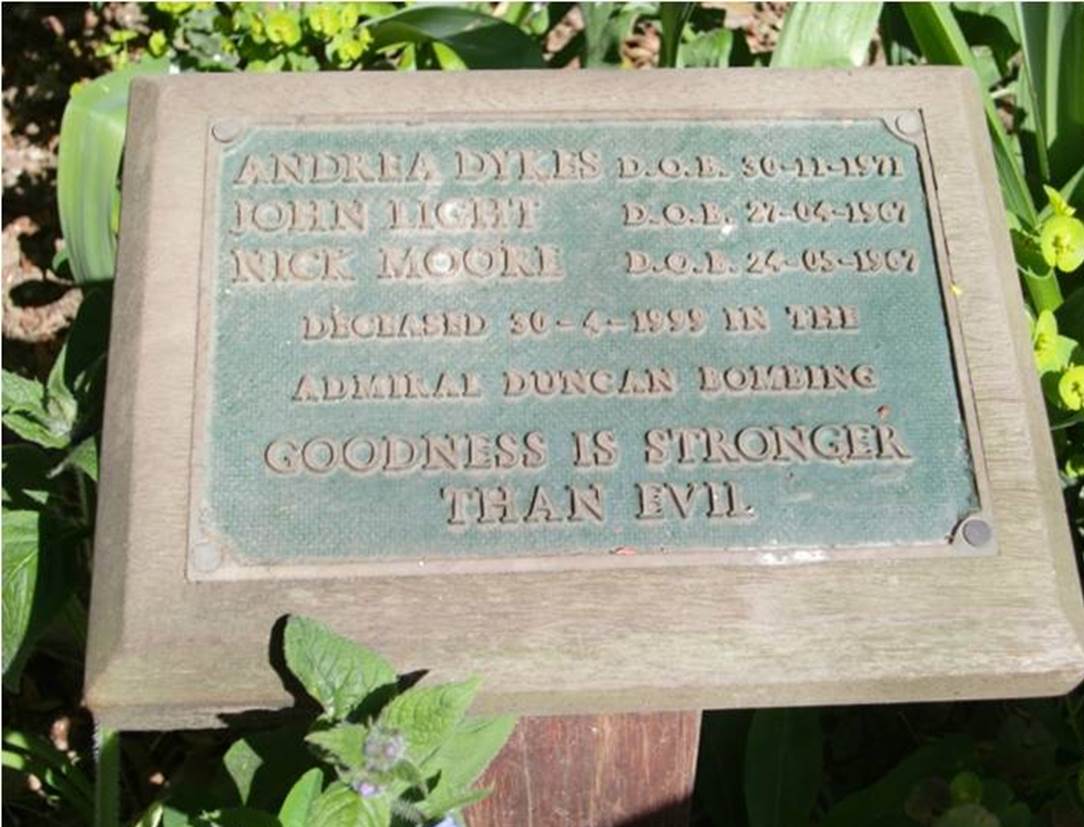
    The replacement plaque will be installed this afternoon and reads:

    Andrea Dykes D.O.B 30-11-1971

    John Light D.O.B 27-04-1967

    Nick Moore D.O.B 24-05-1967

    Deceased 30-04-1999 in the Admiral Duncan Bombing

    Goodness Is Stronger Than Evil

  • SCENE: The Clubs We Have Loved And Lost

    You no doubt think I’m a bit old to be going clubbing these days, and you’re probably right (though actually I only hung up my gogo jock last year), but there was a time when I was out every weekend, and it was not uncommon for me to visit three or more clubs in the space of a weekend.

    I won’t deny that this marathon was only achieved with a certain amount of chemical assistance, nor that my memories of it are now somewhat blurred. I do remember, however, that I had a fantastic time.

    I was a bit late coming to the club scene, and this reminiscence is very much from a personal point of view, so apologies to all those clubs I’ve missed out. For much of my twenties and thirties, I thought clubbing rather frivolous, and, to be honest, I had very few gay friends. Consequently, I rarely hit the scene. There were occasional visits to Heaven (very different from it is now, and, in those days, more reminiscent of the set for a 70s porn movie, with a couple of pool tables in the bar. I’m pretty sure it was men only when it first opened), but that was about it, and also to Bang, which was held in the same club in Charing Cross Road, where G.A.Y got started. G.A.Y itself became a huge success for Jeremy Joseph and eventually moved into the Astoria (I once appeared there in the musical “Grease”) until the Astoria was pulled down to make way for Crossrail.

    For a long time Heaven and G.A.Y. (odd, then, that Heaven is now home to G.A.Y.) were the only clubs I really knew about and stories I’d heard about the likes of Trade terrified me. All that changed when I took my first E. I was in my 40s, would you believe. Maybe I’d been thinking life was passing me by, maybe the landmark decade was to blame, but one weekend a friend and I decided that we were going to try E, and that was the beginning, or the end, depending on how you look at it. I remember we went to Love Muscle at the Fridge in Brixton. Love Muscle was a raunchy gay night, which first opened at the Fridge in 1992, and ran pretty much every Saturday night till 1998. After that Love Muscle nights became increasingly infrequent, till it stopped altogether, though it did have one brief revival on 31 December 2008. It doesn’t figure hugely in my club going, but there is no doubt that for many years it was enormously successful, and I know many who have great memories of it. Brixton was always just that little bit too far away for me, and, truth to tell, by the time I discovered clubbing, Love Muscle’s heyday was (just) over.

    So, a perfect weekend for me those days would probably have started at Crash on a Saturday night. Very occasionally I’d have made Fiction at the Cross on a Friday, but that would have made for an even longer weekend than usual, and even I had my limits, so Crash in Vauxhall (now Union) it would be. Back in those days there was very little else in Vauxhall – no Fire, no Area, no Bar Code, no Chariots, and the only other gay venue was The Hoist. Vauxhall was not the gay mecca it subsequently became. Crash (promoted by Wayne Shires) was dark, sexy and underground, and was where international DJ, Tom Stephan first made his mark. This was not elegant, sophisticated clubbing. This was a place to get down and dirty, though it wasn’t a sex club, and there was no play area. At its peak it would be rammed with sexy, shirtless men, grinding away to the tribal sounds for which it was famous. I managed to acquire one of the highly prized black membership cards (don’t ask me how), which gave me and a guest free entry and queue jump on any night. I’d just march down to the front of the queue, flash the card, and I’d be allowed straight in. Ah, those were the days!

    They were also the days when promoters, though in competition, would be careful not to tread on each other’s territory, and would often collaborate in the realisation that they each fed each other. It was this happy state of collaboration, which allowed clubbers to buy their tickets for Trade at Crash before making their way to Clerkenwell to continue their night. Fortunately, or maybe unfortunately, Trade’s home, Turnmills, was literally only a couple of minutes’ walk from my flat, which meant that I could go home, freshen up, and amble over to Trade just as the queues were dying down, and by which time the club would be in full swing.

    Infamous, notorious Trade is a name that even younger clubbers will no doubt recognise. The first after hours in London, it was started by Lawrence Malice back in 1991, when the only way it could get a licence was by providing food, which it did in the upstairs café. It was not licenced to sell alcohol, though the resourceful could usually find a way of acquiring it, and till very late in its residency at Turnmills, used to officially only sell soft drinks, and also tea and coffee in the upstairs café. Mind you, who needed alcohol to carry on dancing through Sunday morning. Everything you’ve ever heard about Trade is probably true, the drugs, the muscle boys in the fittingly christened Muscle Alley, the trannies. Madonna was even known to put in the occasional appearance. Simon Patrick, who was manager from 1995 till 2008, recalls one occasion when he was called over to the platform that overlooked the dance floor by a bouncer, with the nickname of “The Mortician”. Simon looked out over the dancers wondering what it was he was looking for. “Just wait,” said the Mortician, and, sure enough, after a few minutes a lone female figure leapt up out of the crowd, visible for just long enough to be identifiable as Bjork.

    From a single room, when it first opened, Trade expanded until every square inch of the building was in use, including Gaudi, the restaurant. And indeed Gaudi was the reason for the intricate iron work on the staircases and the colourfully tiled bathrooms. Another of its famous features was the installation of the awe-inspiring lasers somewhere around 1994. As Crash faded, Trade would become my first club of the weekend. I would have an early night on Saturday and get up early on the Sunday morning. My friends would all come over for a quick breakfast, usually just a coffee and a pill, and off we would go, fresh and rested and raring to party. We would descend into its caverns, as others would pass on their way to church, hearing only the thud of the music and noting the steam escaping from the air vents. No doubt a they would consider it hell. To us it was paradise.

    The Trade sound became famous worldwide, and many DJs made their name there, principal amongst them being Tony de Vit, who tragically died of AIDS-related bronchial failure in 1998. Other names associated with Trade, include Smokin Jo, Pete Wardman, Alan Thompson, Malcolm Duffy, Gonzalo, Steve Thomas and Lisa German.

    However, when Beyond opened at the Coliseum, Trade revellers began to drift away. Maybe the desire for hard house was coming to an end. I do recall one morning, sitting on the stairs chatting to a good friend of mine, and becoming aware of the racket emanating from the DJ booth. “What the hell are we doing here?” he said, “That’s not music.” Whatever the reasons, its popular peak was over and Trade ceased its weekly residency at Turnmills in 2002, though it continued to put on occasional one off parties, which were invariably packed out. Then it was announced that Turnmills would close its doors forever in 2008. Trade would hold its last ever event there in March. Its fame was so widespread that people came from all over the world to bid farewell to the club they had so many great memories of. I was there with all my old friends, of course, and, though we had determined to stay until the last record was played, by about four in the afternoon we were exhausted and had to leave. Pete Wardman played the final track ever to be played at Turnmills, (Schoneberg by Marmion) at 5.45pm on 16 March 2008.

    Trade continues to stage occasional events in various different venues, but for me, as for so many others, Trade is Turnmills, now just a pile of rubble prior to the building of a new office block. I feel a twinge of regret each time I pass it.

    There are others I remember fondly of course, likeSalvation, once monthly on a Sunday evening at the suavely sophisticated Café de Paris, Action at what is now known as the Renaissance Rooms, Thursday night’sDiscoteq at The End, Factor 25, which, if memory serves me right, changed venues and nights quite a few times, and a few others whose names escape me, but there is one that, for me, reigned supreme.

    On a Sunday night in November 1999, the usually quiet area around Smithfield market was besieged with crowds of people queuing to get into a new club. New super club Fabric had opened a week or two before, and the queue on this Sunday night snaked all the way from the front door of the club to Farringdon tube station. For weeks the gay papers had displayed two-page ads with the single word Addiction, but the word on everyone’s lips was DTPM.

    DTPM (which stood for Demens Trelirium Post Meridien) had originally opened on an afternoon in April 1993 at Villa Stefano in Holborn, and was started by promoter Lee Freeman to cater to the clubbers leaving Trade, who wanted to carry on partying. As the club became more popular, it moved to Bar Rumba in May 1994 and then to The End in January 1995, when it also moved to an early evening time slot. When it finally left its residency at The End, there was a three-month hiatus before it re-opened at Fabric, this time as a late club (10pm to 5am). Lee had filled the three-month void with expectation, and, in all my years, I don’t think I’ve ever come across a night filled with such excitement and buzz. Fabric was still brand new and there seemed to be a problem with security that night, as we had to wait for a long time before finally being admitted, and only then after a group of suited men carrying clipboards were seen to leave the building. Once inside, though, we were thoroughly amazed by what we saw. This was a huge venue, expensively and glamorously decked out. There were three rooms, each with its own sound system and featuring a vibrating floor in Room One: known as a “bodysonic” dancefloor, sections of the floor are attached to 400 bass transducers emitting bass frequencies of the music being played. Many people shook their heads, opining that the club wouldn’t last, the venue was too big, there wouldn’t be enough people to fill it weekly on a Sunday night, especially as it went on till 5 in the morning. Well they couldn’t have been more wrong. DTPM’s run at Fabric lasted an amazing, incredible 8 years. I should know, I spent almost every Sunday night down there for every one of those years! I suppose its proximity to where I lived was my downfall. Sunday evenings could be so boring, and, however much, I might tell myself that I was going to stay in, come 10pm, my resolve would disappear. “Maybe just for a couple of hours,” I’d tell myself, but invariably I’d find myself stumbling home at five in the morning, usually with some young thing in tow.

    So what was it that made DTPM so special? Well it was a combination of all the elements coming together to create that total experience. First and foremost among them, as also with Crash and Trade, was the music, something that too many promoters seem to forget these days. Many of DT’s DJs, such as Smokin Jo, Alan Thompson and Steve Thomas were also Trade stalwarts, but the music they played at DT was very different, deep and funky. There was planning to the music too, so that, by the end of the night, you felt you had been on a journey. Room one was my favourite haunt and a perfect evening would find me getting in the mood with Miquel Pellitero, flying with Alan Thompson and finally getting on down with Steve Thomas. When Alan Thompson left to live in Sydney, DTPM took a while to settle down and fill that middle slot, but eventually, Mark Westhenry was a great replacement. So, having got the venue and music right, the rest was down to attracting the right crowd. From day one, Lee had stressed that the club was polysexual, not gay or straight, but anything you wanted it to be. Though the vast majority of clubbers were gay, there was a good cross-section of all types. I remember an elegantly dressed woman, who used to come down with her son and all his gay friends. Plenty of big names attended too, amongst them George Michael, Robbie Williams, Jason Orange, Rupert Everett and Liza Minnelli of all people. The fabulous Kerry, who at one time, controlled traffic in the downstairs loo like a sergeant major, tells a story of one famous diva (I can’t, of course, mention names) who turned up with a deal of pomp, fuss and ceremony at the front entrance, only to be carried comatose out of the back one five minutes later.

    On bank holidays and other special days, the club would stay open until seven in the morning, and, even then, the place would still be packed, until the last song had played out, the crowds applauding and screaming for more. In the notes accompanying the second DTPM CD release, celebrating 10 years of DTPM, Lee Freeman stated,

    “The hard core of customers are very loyal and come back regularly, receiving a warm welcome from the long-standing staff and promoters, who take a genuine and personal interest in the club. A family has been created and this is a large contributing factor, which has helped to sustain the success of DTPM.”

    I guess I was one of those hard core customers, and they certainly made you feel welcome. I became a member a couple of weeks after their first night at Fabric and remained one until they eventually left. Membership was well worth it too. For a very reasonable annual fee, you got reduced entry, four free tickets on your birthday, and, most prized of all, queue jump. I remember asking which queue I should join on the first occasion after becoming a member. “You don’t,” said Mark, aka Edna, “You just present your card at the barrier and security will let you straight in.” I can’t tell you how valuable that was. At its peak, even on a normal Sunday, the queue for entry used to snake round the building towards Farringdon station. It may seem hard to believe now that a Sunday club could attract that many people, but it did, I can assure you.

    Eventually though, and, like all good things, it came to an end. There were many reasons for its demise. The drugs people used changed and the club, which had always had a very relaxed attitude, had to become more vigilant. Hardly surprising when clubbers were regularly passing out on GHB and GBL, and ambulances were often seen outside the venue. Also, a certain promoter had decided that rather than join in the general air of collaborative rivalry that existed between promoters, he would do his utmost to kill them all off. His tactics worked and personally I think the club scene became the poorer because of it.

    DTPM tried a couple of revivals (I remember a particularly fabulous New Year’s Day party at the Café de Paris), but its heyday was over and it seems safe to say that DTPM is now just part of history, particularly as Lee Freeman now has a new (and very successful) project, The Kennington gastro pub in Oval.

    With the demise of Trade and DTPM, my clubbing days virtually came to an end. If I do go out these days, it will probably be to XXL, which seems to defy the passage of time, and is now doing better than ever in its fabulous new home, Pulse, or I will go to Hard On, run with burning zeal and energy by its indefatigable promoter Suzie Krueger. Suzie is, without doubt, a survivor. She started Hard On’s forerunner, Fist, back in February 1994. Fist was a strict fetish club; leather, rubber, uniform – no trainers or jeans (unless worn under chaps), and that rule persists to this day. With a huge play area, the club has never made any secrets about the crowd it is attracting, though you might be surprised to find out how social it can be.

    Not everyone goes to have sex. Many just enjoy the dressing up. Unfortunately, the homophobic local police managed to get Fist closed down in January 2002. Unfazed, and determined not to be beaten, Suzie started a new club called Hard on, in September 2003, at Cynthia’s, a swingers’ club in London Bridge. This time it was strictly members only, and it was not possible to join on the door. Applications had to be received in advance. Probably an administrative nightmare, but somehow she managed it and the first night was absolutely packed. Since then the club has moved around a bit, enjoying a 5 year run at Hidden in Vauxhall (a nearby church managed to get Cynthia’s closed down). It is now very comfortably housed in Union, formerly Crash, also in Vauxhall and, if my last visit is anything to go by, is enjoying something of a revival. When Hard On left Hidden, its clientele seemed to be shrinking, but recently the club has been packed again. In addition to the leather, rubber, uniform code, sports kit is now allowed (though not just trackie bottoms) and this may have contributed to bringing in a younger crowd. What’s more, when I was there last week, the music (provided by DJs Brent Nicholls, and Hugo’s land) was pumping, the crowd were social and friendly and the bar and dance floor just as busy as the play areas.

    All in all, it was a great night, so it is good for me to be able to end on a positive note, with a club we have loved and still love; Hard On!


    Opinions expressed in this article may not reflect those of THEGAYUK, its management or editorial teams. If you’d like to comment or write a comment, opinion or blog piece, please click here.

  • Soho Bombing Victims’ Plaque Missing

    The original Soho Bomb memorial plaque has gone missing according to Mark Healey, the founder of the anti-hate campaign 17-24-30.org, from its position in St. Anne’s Gardens in Soho, London.

    Soho Nail Bombing Victim Plague

    The memorial remembers the three victims who lost their lives in the blast which ripped through the popular Soho pub, the Admiral Duncan in April 1999, killing Andrea Dykes, John Light and Nick Moore.

    The Soho nail bomb was the 3rd of three attacks planned and orchestrated by David Copeland. He planted the other two bombs in Brixton (17th April 1999) and Brick Lane (24th April 1999).

    He is currently serving six concurrent life sentences and in 2007 the High Court ruled that he must serve 50 years.

    In a statement from 17-24-30 the organisers of the Act Of Remembrance which is to take place on the 30th April have said that, ’17-24-30 have agreed to help cover the costs so that it can be ordered straight away and hopefully in place ready for the service on Tuesday 30th April – marking the 14th anniversary of the attacks.’

    The new plaque will cost £260 and it is hoped that it will be delivered and installed before Tuesday’s service.

  • COLUMN | I Told You I Was Ill

    My hypochondria is legendary. Actually, I don’t call it hypochondria. I call it being ill but you can make up your own mind on that one.

    have a different ailment for each day of the week and am never too far from a packet of over the counter pain killers, anti-sickness drugs or non-prescription sleeping pills. Nothing herbal though. I prefer a chemical. You know where you are with a chemical. Pills are so pretty at times. They come in such lovely colour palettes. My migraine pills are lilac and pink, which is inspired. I like the names too, such poetry; Tramadol, Temazepam andTrimethoprim sound like strange and lovely holiday resorts to me.

    I have pills in all my bags, my desk drawer, my bedside drawer and in the overflow pill drawer. Not to mention my TENs machine, heat pack and various lotions which I keep a good supply of. I take an extra toilet bag on holiday, just for pills. I never leave the supermarket without 32 Paracetamol. Why only this week I’ve had a small melanoma, a pleural fluid collection and a nasty bout of spondylosis. They’ve cleared up now, luckily but I had the right pills to hand in case they turned nasty.

    I was always a delicate, sickly child, prone to headaches and abdominal pain, plagued by hay fever and recurrent temperatures and a bit of mild asthma. I was fantastic at car sickness and could hurl for England too. I was also rather good at the accidental injury, being a clumsy boy; the fall downstairs, the crash landing on the t.v. after slipping on a discarded novel and famously the swallowed rosary beads and the fishing hook in the back of my head which necessitated trips to Accident and Emergency.

    My mum always seemed to notice us more when we were ill and to give her credit, would have made a superb nurse. She believed in the school of a pill for every ill and would hand out Junior Disprins like they were Smarties. She always had some Buttercup Cough Syrup handy and was a dab hand with a cold compress for the fevered brow. My mum also set a fine example by never leaving the house without a handbag stuffed with prescription drugs. She was generous and shared her stash with me too and doled out vitamins and herbal remedies by the handful. I may not be able to ride a bicycle or drive a car but I can swallow two Paracetamol dry. It’s a handy skill.

    One of my favourite games was playing grownups, with a glass of Dandelion and Burdock as my sherry, a few sweets as my pills and a candy cigarette clamped in the corner of my mouth. I was learning well.

    I have happy memories of the 1970s, propped up on the brown settee, in the brown and orange living room, under a brown and orange duvet. I’d lay down, happy to be off school, with an Enid Blyton, a glass of Lucozade and a single boiled egg for lunch. Lucozade was considered expensive and only allowed to be drunk as medicine during a bad feverish bout. I loved its sickly taste and sugar overload and the crinkle of the orange cellophane coming off would rouse me to prop my pitiful form up on my elbows and let a few drops be placed on my tongue.

    There were down sides to being sickly too, of course. I was often unpopular when a nasty headache meant an abortive day trip or my poor mum had to take time off yet again. The painful headaches weren’t fun and although I got used to vomiting and sweating out fevers, I never really liked it. Who would? I must confess that I did have a toy hospital, though. It had little doctors and nurses and pallid patients in their beds with the alpine temperature charts on the ends. Endless fun.

    During my teenage years I progressed to hideous migraines, vertigo, nervous tension and a lingering bout of glandular fever which left me weak and watery for months on end. I’ve managed to get both Salmonella and Campylobactor and more Norovirus than I care to mention.

    I’ve managed to have most of my organs imaged and investigated, though not through choice really. It just seems to happen. No one would choose the camera up the bladder, believe me. I’ve had MRI scans, ultrasounds, endoscopes and enough blood taken to transfuse a small elderly lady. Naturally, I’m always mostly normal.

    I’ve managed to go temporarily blind for a month, be crippled by a slipped disc, laid up in hospital with a testicle the size of a hearty jacket spud and develop a sinister limp. I’ve been prodded and poked by urologists, ophthalmologists, neurologists and gastroenterologists. I’ve paid good money to physiotherapists, osteopaths and hypnotherapists. Let’s not even mention the mental health professionals’ input. They’re too numerous to list.

    I very briefly had a fling with a G.P. which was terrible for me. Any foreplay always set me wondering. I’d be lying there thinking “Is he caressing my side or palpating my spleen? Why is he looking into my eyes? Has he seen a cataract?” He didn’t help matters by once breaking off during a session to comment on an irregular mole on my abdomen. I finished it not long after that.

    Maybe I’m what they used to call “the creaking gate”. I hope so, as my rusty old hinges have a lot more noise to make yet.

    Visit Chris’s blog at www.ramblingsofagayman.com