Search results for: “ ”

  • Is Cristiano Ronaldo about to unleash a naked shoot?

    In one of his latest shots on Instagram, Cristiano didn’t leave too much the imagination… but he’s also been leaving his fans thirsty AF hints of something more to come.

    So what’s coming our way…

    Enjoy…

    https://www.instagram.com/p/BS_GXbUlPqB/?taken-by=cristiano&hl=en


  • LGB community share their experiences with cancer care

    A number of lesbian, gay and bisexual people with cancer have taken part in a groundbreaking project to expose their experiences and highlight the differences in their care.

    © Esbenklinker Depositphotos

    The University of Manchester, funded by Macmillan Cancer Support, have just launched a video website, which shares the experiences of LGB people who have cancer. It was created with the intention of providing NHS staff with a valuable resource in learning and understanding some of the difficulties and differences experienced by their gay and bisexual patients.

    Dr Nagington said,

    “LGB people with cancer often experience services which are heteronormative (designed for straight people).  For instance this can include advice on hair loss or makeup which is targeted at making women look particularly feminine when this may not be the way they usually present, whilst not offering any such services to men.

    “Some of the people we spoke to told us how advice about the effects of cancer and treatment on sex was designed for heterosexual people and the professionals they spoke with weren’t able to address their concerns or were reluctant to go into much detail.”

    The website includes video testimonies from men and women of a variety of ages.

    One of these, Lesley who has ovarian cancer, said, “It’d be nice if people wouldn’t make assumptions about your husband coming in to visit.”

    Another, Greg who had prostate cancer, said,  “They said you might experience blood in your wee, but they don’t tell you about how that affects sex.”

    There are several sections to the site covering, sex, homophobia and bereavement and also supporting information which health professionals and patients can use.

    Despite the issues they’d encountered, most people interviewed didn’t think specific LGB support groups were the answer, although they may be helpful. Instead, people felt more recognition of their needs as LGB people would be helpful as they went through treatment.

    Dr Nagington added,

    “Our interviewees often approached misunderstandings about their sexuality with humour and were very brave and honest in telling their stories. I think their overall advice would be that professionals should remember that not all patients are straight and sometimes what fits one group isn’t appropriate for all.

    “I hope to expand the site in the future to give more detail on the sexual challenges that lesbian and bisexual women can face, as well as interviewing trans* people about their experiences.”

    The videos, which were filmed during 2016 by lecturer in nursing, Dr Maurice Nagington, are designed to help people understand the thoughts and feelings of LGB people with cancer and their own experiences of care.

    The site https://lgbcancer.wordpress.com/ is designed for NHS staff as a resource to guide their contact with this group.

  • Ollie Locke says he was ridiculed and judged for saying he was bisexual

    Ollie Locke says he was ridiculed and judged for saying he was bisexual

    In a recent interview TV star Ollie Locke has admitted that he felt “judged” and ridiculed for coming out as bisexual rather than gay.

    Ollie Locke
    CREDIT: Channel 5

    Speaking in the latest issue of OK Magazine, the Made In Chelsea star said that before he came out as gay, he struggled with defining his sexuality.  In the

    In the interview, he revealed that he felt resentment, which left him feeling judged for saying that he was bisexual rather than gay.

    He told OK Magazine,

    “The ridicule I got from not saying I was gay immediately was unreal. It was judged highly. It wasn’t fair.”

    He also hinted that the national conversation regarding bisexuality had progressed saying,

    “Bisexuality wasn’t talked about in the same way six years ago. People didn’t understand it and people didn’t particularly like it.

    Before his stint in Celebrity Big Brother in 2014 he explained that he was constantly being misidentified as gay, and told to come out of the closet, despite saying he had never slept with a man.

    He said,

    “The whole country thinks I’m gay. I get so many tweets every day telling me to come out of the closet. If I could, then I would. But I’m just not there, I’m really not. I am not lying to anyone, I am not gay. I still have amazing relationships with women.”

    “Bisexuality is me and that will always be the case. I’ve tried to push myself to be gay, but then a beautiful woman comes up to me and wants to have sex with me, and I can’t say no! It’s a hard life.”

    Ollie Locke came out as gay in July 2016 saying, after living with a woman for two years. After they broke up he told The Sun,

    “That’s it now, I think I’m now gay’.”


    Read Ollie’s full story in this week’s OK! Magazine – out today (April 18).


    If you have issues surrounding coming out, defining your sexuality or ridicule you can call Switchboard, the LGBT+ helpline on 0300 330 0630


  • COMMENT | A Question For The Future Generations Of Gay People

    COMMENT | A Question For The Future Generations Of Gay People

    I was out in town drinking with my friends the other weekend (as you do when you’re semi-young and live in London) and several pints/wine glasses/shots in we got to talking about the gay scene.

    We discussed various different bars, club nights and clientele, and we laughed about our favourite nights and spat bile over our worst ones. We also conversed about the future of the gay scene in Soho. Now, this might strike you as an odd discussion for a group of half cut guys on a Friday night, but it was a strong topic of interest for us. Why is that?

    Well, the primary reason that I’ve been able to discern for this repeated discussion is a semi-unconscious, underlying concern between all of us that the Soho gay scene, as we know it, is dying. Ok, so this might be an extreme reaction, but the gay scene in London is forever changing, and it was back in the 1980s that Soho came into its own as a gay destination, so change is to be expected after nearly 40 years. However, this article is not about the future of Soho, but about a question that came to me as part of the aforementioned discussion.

    This question is fairly divisive, but I feel it’s something that should be discussed in our modern society. I know from previous experience that people don’t necessarily react well to this question, so it’s potentially a brave move to discuss it, but that’s what this website is all about, right? Good. Therefore, without further ado, the topic of today is as follows:

    ‘Do we still need gay bars, clubs and villages/scenes in modern society?’

    Ducks under table and hides from the angry shouting and flying projectiles

    Now I know that there are some very ardent supporters of the gay scene who will happily scream and shout about the importance of the gay scene, but there is also a growing collective of people who question whether our self-enforced isolation is sensible in this day and age. They are challenging the old stereotype and querying whether we are damaging our cause by hiding away from the people that we need to support us in our fight for rights. Therefore, this article has been devised as an opportunity to give a voice to both parties, and, for once, I’ll leave you to make up your own mind on the situation:

    1. Safe Spaces:
    The primary claim regarding the need for gay bars is the fact that they offer a safe space for anyone who wants to express themselves in an alternative way that might be frowned upon by wider society. This has been an essential requirement of gay bars since time began, and there is still, to an extent, a need for this safeguard in this day and age. Gay people still require the freedom to express themselves however they like, and this needs to be protected for future generations. Now primarily this is done by bouncers ensuring that people or groups of people, who would inhibit this right are kept out of gay venues. However, there appears to be an increasing danger that gay bars are taking this too far.

    A large number of people that I’ve spoken to believe that there is an increase in the number of gay bars and clubs introducing reverse discrimination against potential visitors in the name of ‘protecting’ their status as gay venues. Now I’m fully aware that this isn’t a London thing, as frequently shown by complaints coming out of Canal Street, and this issue could potentially serve to damage our reputation amongst the heterosexual community. I’ve witnessed first-hand gay friends being rejected from Heaven as they ‘weren’t a regular’ (which they were) or the bouncers didn’t like the fact that they were in a suit, and it’s been exactly the same with groups of girls, and single straight men. In addition, this behaviour isn’t just limited to clubs, and has been witnessed at gay bars and pubs throughout the UK.

    Yes, we need to protect the fact that gay bars are a safe space for anyone that falls under the all-encompassing rainbow banner, but it is being increasingly argued that we must accept that if we want to be accepted by wider society then we must be accepting of it as well. As one friend put it, “Supporting an admission policy which serves to perpetuate the divide between the LGBT community and their heterosexual friends is bad for the cause and bad for our image”. If we want to be seen as inclusive, is the need for safe spaces still important in this day and age?

    2. Meeting boys:
    A second claim regarding the need for gay bars is the fact that they offer people a chance to meet like-minded people in a safe environment. Back in the 80s and 90s, this was the case – there weren’t hundreds of different dating websites, location-based apps and networking services to choose from, and the gay scene was one of the only places to meet people. To a lesser extent, the same is true today. For those who don’t live in bustling metropolises, gay bars offer the chance to meet people that you might not find on Grindr or walking down the street. In these cases, there’s something to be said for the continued involvement of small town gay bars and their ability to introduce people to each other. However, some argue though that once you hit the big cities, this isn’t the case.

    You’ve no doubt heard it said a thousand times that everyone is always ‘busy’ in London, but it might not necessarily be how you think. In this day and age, gay men are seemingly tied to their smartphones thanks to the plethora of dating apps available to them. No matter where they are, they can find someone, somewhere, who is looking for the same thing as them.

    ‘Great, so what’s the problem’ I hear you cry. Well, that’s just it – what this means is that there is always an underlying sense of looking for the next Mr Right, meaning that people have become less open to meeting strangers in bars, primarily as it’s potentially far more awkward and embarrassing than saying ‘hey’ and being ignored on Grindr. Unfortunately, this has meant that it seems increasingly less likely that people will meet outside of the apps, creating thousands of missed opportunities and venues where people only talk to their friends. Surely this means that one of the main requirements of a gay bar is now defunct? After all, why do people need to go to a specifically gay bar to ignore other gay people?

    3. Representation:
    Following on from the argument in point one, another friend noted out that although we are at the strongest level of representation and acknowledgement within society that we have ever been asa group, this has not been without the support of heterosexuals. The majority have supported our fight for rights, recognition and equality for many years, so it seems strange that as a group, we are now looking to isolate ourselves from them now we have, in a sense, “got what we wanted from them”.

    Surely if we are looking for inclusion, we must be willing to include them in our own social activities? If not, how can we expect them to support us, as and when we need them again? Should we be looking to dismiss the idea of specifically ‘queer’ bars and look to create a range of ‘whatever’ bars, whereby the idea is to be yourself and have fun, no matter who or what you are? Perhaps this is something that future generations of gay people should be considering in the future…

    4. Is it because I’m gay:
    Another argument that was made was the fact that it’s usually very rare to discuss whether or not society “needs” a niche bar or venue, except for when it’s for a minority population like LGBT people. He, therefore, argues that this proves to an extent that gay bars are still necessary, as in any other situation, the bar wouldn’t be judged on whether it’s necessary, but on whether or not it makes money as a venue – a fairly valid argument in the financially focused society that we live in.

    These are only a few of the arguments that surround the future of gay bars and scenes in current society, but it gives you a taste of the views being expressed on an increasingly regular basis. As I said at the beginning of this article, I’m not making a conclusion for you about this. This is a topic that is extremely divisive, and there is no way to appease everyone. What I will say though is that as a group, we are now at the strongest level of representation and acceptance that we have been able to achieve to date. We are now in a position to be able to fight for people’s rights in other countries, and we should take this opportunity with both hands. What concerns me is that as a group, we run the risk of moving in one of two directions through our separation.

    The first is that we will steadily lose the support of people by staying isolated, whilst the other is that we will preserve a unique group and location for people to join when they’re ready. I am uncertain which direction this will go, and I am also uncertain that either option is the best for our group as a whole. I guess only time will tell…

    This article was originally posted in Novemeber 2014

    Opinions expressed in this article may not reflect those of THEGAYUK, its management or editorial teams. If you’d like to comment or write a comment, opinion or blog piece, please click here.
  • CAR REVIEW | Golf GTE

    ★★★★★ | VW Golf GTE Advance 1.4 TSI 150 PS 6 speed DSG 5 door

    There’s A Kind Of Hush All Over Wolfsberg Tonight…

    Volkswagen has teased us with alternative fuelling since the 70s. Back them they fitted 860kg of batteries to a VW T2 panel van. They also played with a hybrid system consisting of 11 batteries in and around the cabin in a T2 taxi. Thankfully battery technology has evolved and we can now get far more from so little.

    In the early 90s alternative fuel and efficiency became less of the buzz work since the fuel crisis of the 70s and more emphasis was placed on environmental issues. Reluctant as we were to give up our four wheels, people wanted greener cars. The diesel car was sold as the greener alternative to petrol, this was when petrol engines were equipped catalytic converters and diesels still filled the air with heavy clouds of sotted pollutant.

    The Golf went through a phase of being battery powered. There was the CityStromer. It gave about 30 miles to a charge making it as good as a milk float. Remember the 30 miles though. It’s a magic number. However, in 1990 there was work on a diesel hybrid Mk2 Golf. VW was on to something. I remember it well. A white Mk2 with big bumpers and garish yellow, orange and red stripes. And then it all went quiet.

    Fast forward 27 years and the electric buzz is back at Volkswagen. There is a new hybrid Golf and the technology isn’t just staying on the Golf. We’ll have it on a lot of other VW’s.


    THEGAYUK was invited to attend the launch of the updated Golf Mk7 and it was the GTE I was most interested in trying. Having recently become a convert of the hybrid, l wanted to see how Volkswagen had executed the package. More importantly, I wanted to know how they transferred the power to the wheels.

    I am glad to say it is impressive. They use their DSG gearbox. This is an electronically controlled dual-clutch multiple-shaft manual gearbox that either changes like a conventional automatic or you can use manual inputs should you wish. Having tried this gearbox on many VW’s over the years I can say it works well unless the car has been modified. Then it becomes quite snatchy.

    There were no such issues. This thing was magic. What it does do is overshadow Toyota’s efforts and puts them in the dark ages where hybrid technology has evolved to. The main reason is the choice of drivetrain. In other words, this isn’t a CVT gearbox.

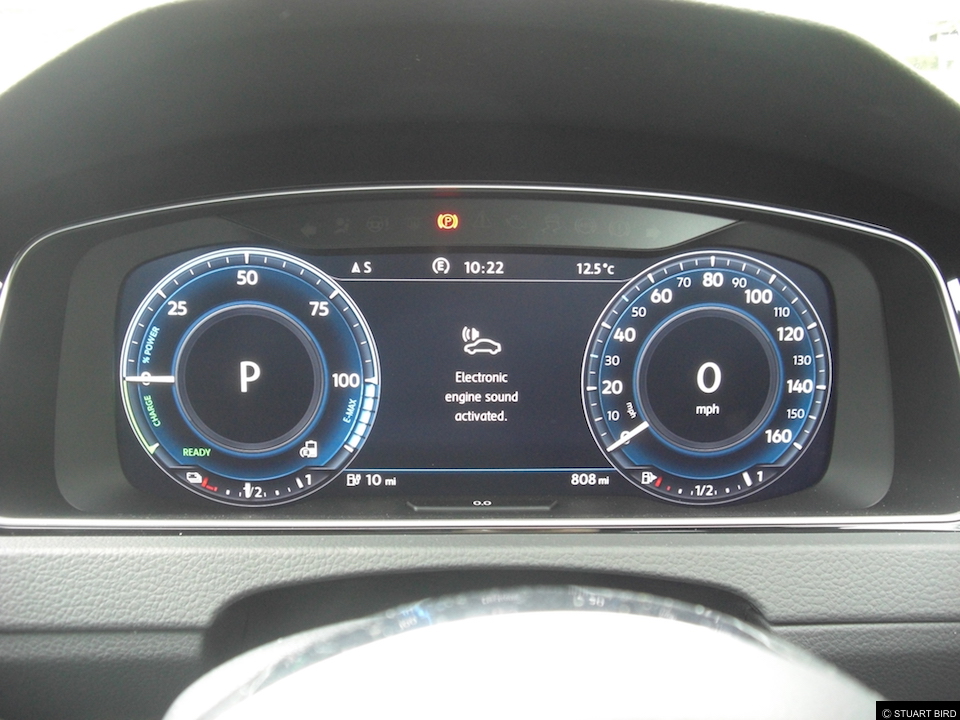
    I don’t know if it was the engineers having a laugh or not but the sound button on the centre console did make me chuckle. Press the sound button and it would emit an audible noise. Apparently, pedestrians are being hit or surprised by hybrid cars. I think having the choice of sound would be quite fun. I’d like a low flying aircraft.

    Enough of my rambling thoughts and back to the GTE. Unlike “conventional” hybrids, the Golf can be selected to drive in any of its three drive modes. Full electric, hybrid or full petrol. The electric is a plug-in type that can be around 80% charged in about 30 minutes. The engine used is the 1395cc petrol unit making 150ps at 5000-6000rpm. The electric motor makes 102ps at 2500rpm.


    In full battery mode, you’ll get that magic 30 miles on a charge. Fear not of running out of power because the petrol engine will jump in and help regenerate power. Likewise, should you floor it and need acceleration, again the petrol engine will jump into life. Unlike a CVT gearbox, the DSG will surge away in utter refinement. All this dashing around can achieve a 0-62mph time of 7.6 seconds. Put into perspective, the 2 litre 310ps Golf R will do the same in 5.1 seconds. This is no hybrid to sniff at. As a matter of fact when all systems are powered up it is pushing out 258Ibs ft of torque. That’s 22 less than the Golf R.

    On the move it was phenomenal. It was quiet. Admittedly the gravel tracks around the Woburn estate could be clearly heard. Once on the main road, it was amazzzzzing. I used some of the test in full battery mode to see what it would do. It behaved like a petrol car except there was a silent surge forward from the instant power the electronic motor gave out. I couldn’t stop smiling.

    In engine and battery power kicked in silently and effortlessly in hybrid mode. It was totally fuss-free. Competent, powerful, had the ability to assist in power delivery for overtaking and all safe in the knowledge that both power systems worked together for maximum efficiency,

    In petrol only mode you were given a Golf that would do what Golfs have done for the past 43 years and that is carry you in a well-made car. Longevity was a key feature mentioned at the launch. A 12 year body protection warranty is proof alone that the Golf will be sticking around.

    Warranty is however always a worry for batteries. VW offer an 8 year/99,360 mile one on them. Why it is 640 mile short of 100,000 miles I do not know.

    There is a down side. It’s the price. Basic price is £31,480. That Golf R and all its crazy power has a starting price of £31,510. Despite the GTE being quick and able to achieve amazing things, it doesn’t do it in the way of the almost same priced R. That said it also doesn’t give you the same head rush as the R and maybe now and again I prefer my car a little less hooligan.

    That in mind a quick look at the recently tested Toyota C-HR was £28,000. In my mind it seems to now be making the Golf R seem like the bargain buy that it shouldn’t be. It’s a quandary that I am in. I liked both Golfs. One that I can justify is the 1 litre TSi. Perhaps l should just have that and add a few stickers to the outside.

    Likes

    Choose the power supply manually
    Transmission of power to the wheels via the DSG gearbox
    Ride quality

    Dislikes

    The price
    Only available in a GT sporty package (at present)
    Questionable combined fuel figures

    The Lowdown
    Car – VW Golf GTE Advance 1.4 TSI 150 PS 6 speed DSG 5 door
    Price – £32,135 (as tested)
    MPG – 156.9 mpg (combined)
    Power – 258bhp
    0-62mph – 7.6 seconds
    Top Speed – 138 mph
    Co2 – 38 (g/km)

  • 10 LGBT films you definitely need to stream on Amazon

    Looking for something to watch today? Amazon Prime has the biggest selection of LGBT films and TV programmes of all the streaming services.

    Here are our 10 favourites from Amazon Prime. To see all LGBT films available on Amazon click here.

    Read our top choices for Netflix.

    A Single Man

    Drama centres on the day in the life of a gay college professor who is coming to terms with the death of his long-term lover. Highly rated on IMDB and Netflix, this film stars Colin Firth and Julianne Moore.


    Carol

    In the film Carol, Rooney Mara and Cate Blanchett play two women who fall in love at a time when it was not accepted and actually frowned upon. Blanchett is magnificent as Carol, who risks losing her daughter yet has strong feelings for a much younger woman. Mara is even more superb as Therese, her innocence and naivete in full display. Both actresses are excellent, yet it’s Mara who ups Blanchette in the acting arena. The movie basically revolves around Therese and her coming of age not just with her career but with her sexuality as well. REVIEW: Tim Baros


    Dallas Buyers Club

    The very scary fact thing about watching Dallas Buyers Club is always knowing that this is sadly a very true story. These clubs like Woodroof’s (there were others in other cities) which provided drugs to those who contracted HIV, played an important role alongside the wonderful ACT-UP movement to continually put the FDA on notice, and without their unceasing pressure, demands and activism so many of the drugs that would eventually help with people with AIDS would never have been made available in time. REVIEW: Roger Walker-Dack


    Gays In Prison

    Gays in Prison is a documentary featuring Latrice Royale, the popular star of RuPaul’s Drag Race, as she reveals her own experiences in jail and explores the stories of other former and current LGBTQ prisoners, who face special challenges, violence and discrimination in the criminal justice system. The documentary is a joint production of Rogue Culture and Logo TV.


    The Imitation Game

    Based on the real life story of legendary cryptanalyst Alan Turing, The Imitation Game portrays the nail-biting race against time by Turing and his brilliant team of code-breakers at Britain’s top-secret Government Code and Cypher School at Bletchley Park, during the darkest days of World War II. The script is actually very funny as well as being poignant and thrilling. This is a must see film of this autumn/winter. REVIEW: Chris Bridges


    I’m A Porn Star

    Filmmaker Charlie David‘s light-hearted rambling review of the burgeoning gay pornography takes us through the history of porn from the 1930s. The documentary focuses on four of the most successful performers today. All of David’s subjects are very affable men and happy enough to candidly share their views on controversial topics such as barebacking, HIV, social stigma, fetishes and escorting. The whole question of gay-for-pay was also discussed by them and not always in a positive manner. REVIEW: Roger Walker-Dack 


    Milk

    Powerful, heartfelt and a strong testament to a force with that was Harvey Milk, the first openly-gay political powerhouse that ran for major in San Francisco in the late 70s. It is easy for us of a certain age, to forget or not to acknowledge those who went before in the equal rights cause and I say films like this need to be produced more and more, so that we never forget, how and why we are able to live in the western world freer that we’ve ever been able to. REVIEW: Jake Hook


    Please Like Me (seasons 1-4)

    You need to discover this gem of an Australian comedy, created by out actor, writer and comedian Josh Thomas. Follow Josh as he comes out as gay finds his first (second and third) boyfriend and discovers the joy of cooking, dog handling and straight-roommate disciplining. One of the best shows to come out of Australia in years. Fresh and full of heart. REVIEW: Jake Hook


    Rock Hudson’s Home Movies

    From his days as an obscure contract player to the revelations about his “gay life style,” the film provides an innovative and exciting look at the life of a legend: Rock Hudson.


    Transparent (seasons 1-3)

    When the Pfefferman family patriarch makes a dramatic admission, the entire family’s secrets start to spill out, and each of them spin in a different direction as they begin to figure out who they are going to become. Brilliantly thoughtful and wonderfully acted from all quarters.

  • THEATRE | Fancy Chance is coming back to Soho Theatre

    This April, Soho Theatre audiences are set to embark on an extraordinary journey courtesy of one of London’s most celebrated and versatile cabaret performers: Fancy Chance.  Her debut autobiographical show Flights Of Fancy runs for 5 nights from April 25-29 following sell-out previews in 2016. 

    c. Bodhan Cap

    A globe-trotting, time-traveling mini-spectacle with turbulent polemics and unexpectedly poignant stop-offs, Flights Of Fancy tells the true story of the artist’s journey from Korean refugee to international cabaret performer. In-flight entertainment includes offbeat humour, songs, and scenarios, written and performed by the artist herself and developed and directed by Nathan Evans.

    Fancy Chance says,

     “For years I’ve wanted to put together something long-form that allows me to expand on themes I’ve explored in shorter work, such as feminism, racism and body politics, using my own experiences as a starting point. Which isn’t to say it’ll all be serious, but there may be tears amongst laughter”.

    Fancy’s own travels started prematurely when as an abandoned baby, her life took an unchartered turn: “To this day I know nothing of my birth parents or birth name. If I hadn’t been adopted into a white family from the USA in the 1970’s then found home in London’s cabaret scene, who might I have been?  This show is used to explore the politics of identity and migration, the ethics of interracial adoption and global gentrification and to leave the audience questioning their own privileges and perspectives”.

    Fancy Chance’s work incorporates comedy, burlesque, drag, circus, cabaret and live art. Having made London her home she is consistently working and travelling. From Las Vegas (Caesar’s Palace no less..) to Latitude, and from Gothenburg to Glastonbury, cities as far afield as New York, Helsinki and Dubai have played host to Fancy’s multiple skills and personas.  In 2009 she was crowned the Alternative Miss World by national treasure Andrew Logan after hanging by her hair from the rafters of the Roundhouse and in 2016 Fancy collaborated with Marisa Carnesky in Carnesky’s Incredible Bleeding Woman prompting positive reviews.  She regularly performs at London’s Wonderground, Royal Festival Hall, Royal Vauxhall Tavern, Leicester Square Theatre and The Box.

    ‘Twisted. Sick, even. But that’s the point.’ The Independent

    ‘Politically charged social critique with powerful feminist undertones.’ Exeunt

    ‘Consistently hilarious.’ The Stage

    Nathan Evans is a writer, director and performer whose work in theatre and film has been funded by the Arts Council, toured by the British Council, broadcast on Channel 4, archived by the British Film Institute and awarded a few statuettes. Previous shows for Soho Theatre include 7 Deadly Sins with The Tiger Lillies, Unplugged with David Hoyle and I Love You But We Only Have Fourteen Minutes To Save The Earth with Fancy Chance. www.nathanevans.co.uk 

    Listings:

    Date: 25-29 April 2017

    Time: 7.30pm 

    Title: Flights of Fancy

    Credits: performed by Fancy Chance, directed by Nathan Evans

    Venue: Soho Theatre, 21 Dean Street, London W1D 3NE

    Tickets: £10-15

    Booking: www.sohotheatre.com 

    URLS: facebook.com/fancychances

    TWITTER: @fancy_chance 

  • THEATRE REVIEW | How to Succeed in Business Without Really Trying, Wilton’s Music Hall, London

    THEATRE REVIEW | How to Succeed in Business Without Really Trying, Wilton’s Music Hall, London

    ★★★★ | How to Succeed in Business Without Really Trying

    Wilton’s Music Hall in the East End has another hit on its hands.

    How to Succeed in Business Without Really Trying is their fun and superb new show now playing at the historic venue. And it’s got the right cast to succeed without really trying to be a hit!

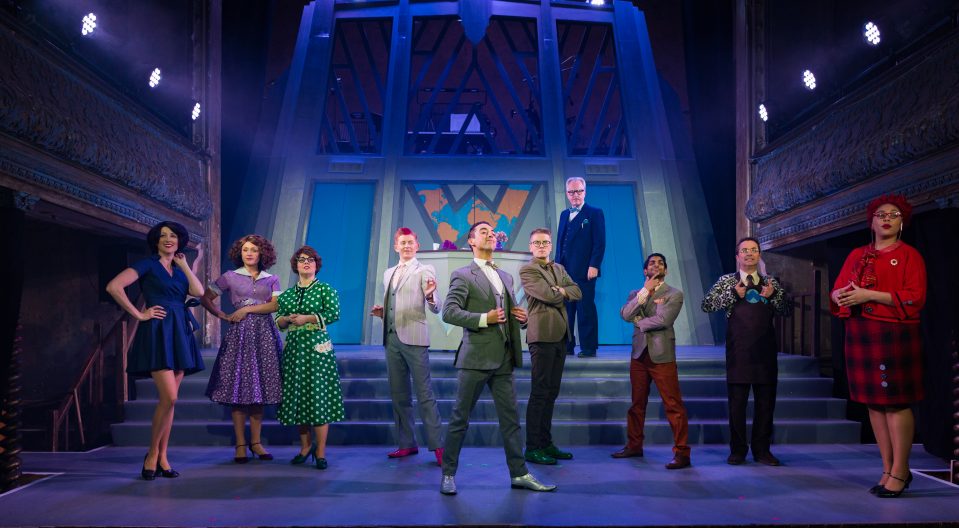
    Mark Pickering plays J. Pierrepont Finch – an ex-window washer who cleverly climbs the corporate ladder by taking tips from a book called ‘How to Succeed in Business Without Really Trying’ (obvs). His first step is to get a job, so he starts in the mail room at World Wide Wicket Company, working with Bud Frump (a very good Daniel Graham) – the nephew of CEO JB Biggley (Andrew C. Wadsworth). Company secretary Rosemary Pilkington (Hannah Grover) takes a liking to Finch, but Finch has more climbing the ladder to do, and soon enough he’s a junior executive. In the blink of an eye, he’s promoted to run the advertising department. And eventually, Finch will be after Biggley’s job, who has employed in the company his mistress Hedy La Rue (an excellent Lizzii Hills). She’s stacked but not too bright, and unfortunately, she gets enlisted in Finch’s new advertising campaign where she gives away the clues to a company competition, which could possibly lead to hers, Finch’s, and the company’s downfall. It’s a story told in laughs and colourful songs.

    The cast is perfect and the staging particularly brilliant. Especially good are Pilkington (great voice and timing) Hills (great comedic wit), Graham (perfect for the role as the spoiled nephew who doesn’t quite get what he thinks he deserves – with great facial expressions), and Matthew Whitby as the HR Director. Excellent direction by Benji Sperring brings this production, which is based on the 1952 book and the 1961 Broadway musical (and which has not been seen in London since 1963 when it played at the Shaftsbury Theatre). It’s pretty much as relevant today as it was when it was originally produced. And the very last song – “Company Way” – where Maisey Bawden finally comes into her own and belts her heart out, leaves the audience wanting more.

    How to Succeed in Business Without Really Trying plays at the Wilton’s Music Hall, London until April 22.


  • Drag Race just got renewed

    Drag Race just got renewed

    Hip hip!

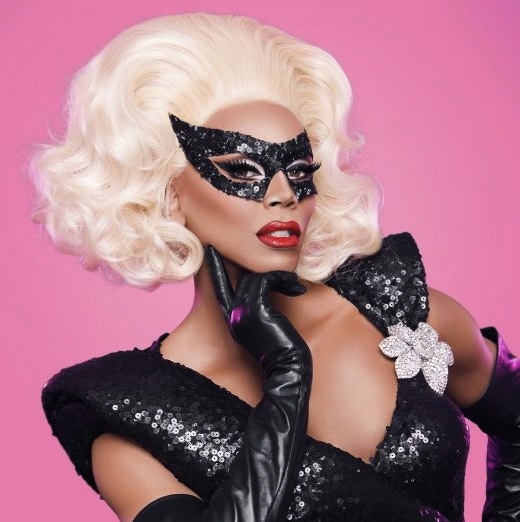
    RuPaul’s Drag Race just got greenlit for 10th series, making it the most popular LGBT TV programme ever. The show will start from March 2018.

    The show’s popularity has not waned at all, in fact, the producers have said that series 9 of the show was “breaking rating records”. The show also won RuPaul an Emmy.

    Speaking about the renewal RuPaul said,

    “As we celebrate a Decade of Drag, we’ll continue to tell universal stories of the tenacity of the human spirit,

    “Now more than ever, we rely on the power of love, laughter and creativity to combat fear and darkness.”

    Chris McCarthy, President of VH1, MTV and Logo said,

    “It’s been amazing to see the show get its highest season ever on a whole new night on a whole new network,”  “We brought in a whole new set of audience that is loving the show.”


  • Russia is no longer part of Eurovision

    Russia is out of Eurovision after the host nation, Ukraine said it would refuse entry to the Russian contestant.

    Russia will not be taking part in Eurovision 2017 after the Ukraine banned its entry, Julia Samoylova from entering the country. According to the EBU two solutions were offered to Russia’s Eurovision broadcast partner, Channel One and both were vetoed. Russia first performed at the Eurovision in 1994. This will be the first time it has not taken part in the competition.

    In a statement, the EBU said that Julia could take part via satellite or change their chosen artist to one that could legally travel to the Ukraine for the competition.

    The EBU stated,

    “Sadly both proposals have been rejected by Channel One and they have now announced they do not intend to broadcast the Eurovision Song Contest 2017. Unfortunately this means Russia will no longer be able to take part in this year’s competition. We very much wanted all 43 countries to be able to participate and did all we could to achieve this”.


    Why Did The Ukraine Ban Russia’s Eurovision Entry?

    Ukraine law forbids entering Crimea in order to perform. According to sources around 140 other Russian artists have been blacklisted by the SBU following the annexation of Crimea last year. Julia Samoylova is one of those artists as she had previously travelled to Crimea to perform.

    Russia and Ukraine have been in dispute since the annexation of Crimea and the fighting in east Ukraine.


    Frank Dieter Freiling, Chairman of the Eurovision Song Contest Reference Group, the event’s steering committee, said,

    “We strongly condemn the Ukrainian authorities’ decision to impose a travel ban on Julia Samoylova as we believe it thoroughly undermines the integrity and non-political nature of the Eurovision Song Contest and its mission to bring all nations together in friendly competition. However, preparations continue apace for the Eurovision Song Contest in the host city Kyiv. Our top priority remains to produce a spectacular Eurovision Song Contest with our Member UA:PBC in May.”

  • DVD REVIEW | The Pass

    DVD REVIEW | The Pass

    ✭✭✭✭ | The Pass

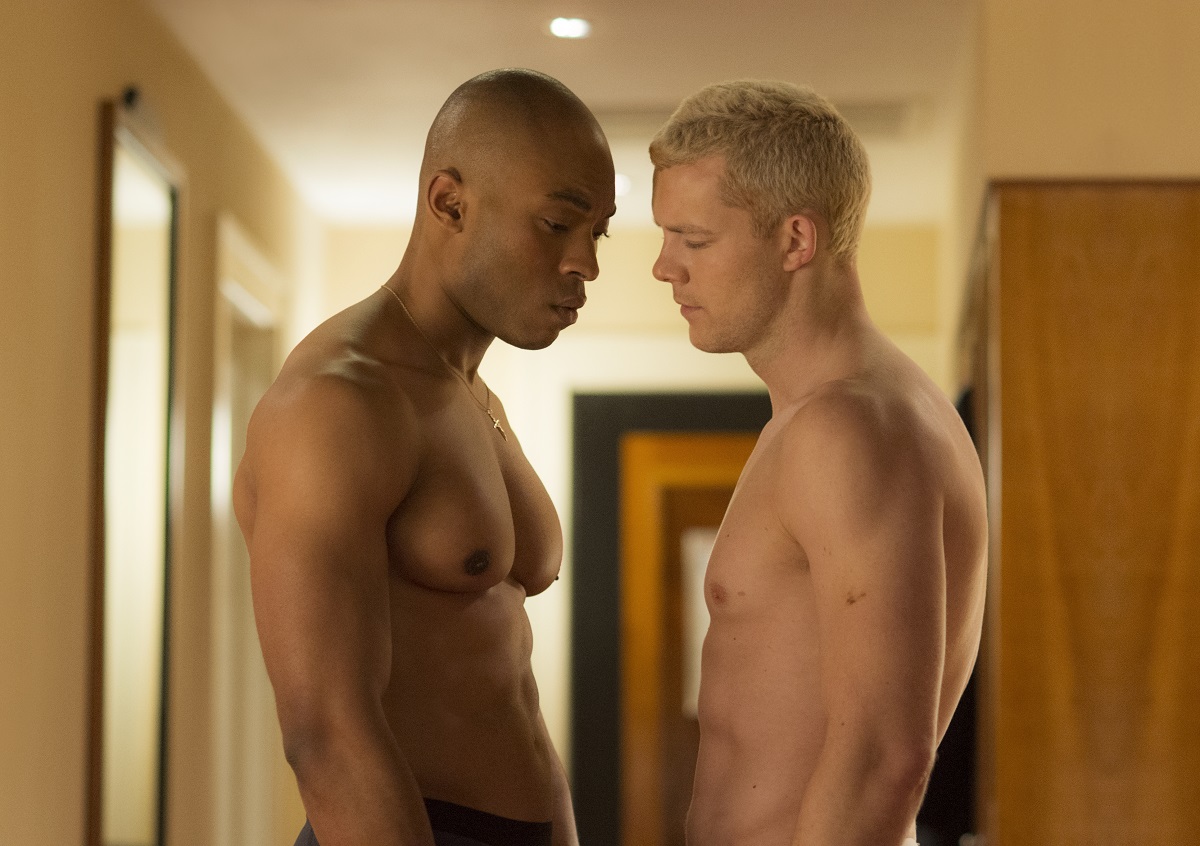
    Two footballer players end up scoring with each other in Ben A. Williams feature film debut The Pass which is now out on DVD.

    The Pass take place in a ten-year time span which tracks the relationship between two Premiership football players. There’s always been some kind of chemistry and attraction between James (an electric and very good Russell Tovey) and Ade (Arinzé Kene – Hollyoaks – also very good). We meet both of them while they’re sharing a hotel room in 2006 in Bulgaria right before one of their first big matches. They’re both very young, and they’re also both very fit, masculine and extremely sexy, and they spend the first third of the movie in their tight white underwear. James and Ade are talking lads stuff, having a laugh about other players, and watching a video that was taken of another player having sex. The sex talk continues, and the banter goes something like ‘getting as hard as your sister sitting on my face.’ They’re playing around with each other; it’s hot, it’s erotic, it gets brutal and homophobic, plus, we find out later, it leads to more than just talk.

    The Pass takes us beyond the hotel room to tell us the story of the relationship between these two men, but especially about the relationship James has with himself. He’s all man, a star footballer, with all the trappings of stardom; money, women, celebrity, and eventually a wife with two kids. But he’s also battling with his sexuality, and even though he buys whatever, and whomever, he wants when he wants it, the thing he wants most is out of his reach. And when he’s questioned about his sexuality by a woman who has been paid to videotape having sex with him, he wants to go through with it, just to prove to the world (and obviously to himself) that he’s not gay. He’s a man who is not able to accept who he is and who he really wants to be with.

    The Pass is 88 minutes of purely charged up adrenaline. It’s a movie that’s full of dialogue, dialogue that goes from playful banter to sexually-charged hi-jinks, up to and including the final third scene of the movie, which involves a hotel bellboy that’s a bit over the top. But it’s not to take away from a movie that brings up a real issue – that there is not one out gay football player in the game now. Let’s hope this film opens up the dialogue that it’s fine for a player to come out of the closet. Originally produced for the Royal Court Theatre in 2014, The Pass makes an excellent transition to the big screen. Kene brings a real toughness kindled with a bit of softness to his role, but it’s Tovey who owns the movie. He’s never been better; his James is battling with his sexuality while at the same time trying to uphold his image. Tovey is electrifying and is at the top of his game (he will soon be seen at The National next month in the play Angels in America). This is one pass that you will want to catch.

    The Pass is available to stream and buy from Amazon and iTunes