Category: Coming Out

  • Dad asks the internet for advice after seeing his son kiss his “best friend”

    Dad asks the internet for advice after seeing his son kiss his “best friend”

    After seeing his son kiss another lad in town, one dad took to Reddit to ask on how he should speak to him about it.

    He laid out the situation like this,

    “I saw my son (16) kissing his “best friend”. I didn’t tell my wife because she will probably hate him because of it but how could I? I really love him he’s my son after all and I don’t mind him being gay.

    My question is how can I help him when he comes out and should I tell him to hold it back with his mom?”

    VIA

    Well, let’s just hold on a minute there as we refreeze our melted hearts. This guy might be up for dad of the year award.

    Never ones to fail, guys of the AskGayMen forum, did not hold back on their advice.

    Don’t confront…

    With one suggesting that the dad didn’t “confront him” and that the boy would “tell you when he’s ready… but maybe you can work it into a conversation that you’re okay with it”

    While another suggested that being subtle was everyone’s friend, “just be a lot more subtle than you initially think. It’s probably front and centre in his mind, so he will be very sensitive to the subject”.

    While another echoed. “If I were your son I wouldn’t want to be confronted (that’s just me tho) if I’m not ready to come out I don’t want others outing me, imo you should create a supportive environment and low-key and subtly let your son know that you are lgbtq+ supportive”.

    Confronting the homophobes

    man wearing eyeglasses making a toast
    Confronting homophobes and homophobia in a public setting was suggested by the commentators, to show that he was supportive of the gay community.
    Photo by fauxels on Pexels.com

    On the subject of his wife, one user suggested that the dad should “confront people who say homophobic things or at the very least say you disagree and explain your position. This will show your son that he doesn’t have to be afraid of talking about these kinds of things with you.”

    The dad replied, “I never said anything against it. But I’ll definitely do it the next time.”

    Total. Winner.

  • COMMENT | There are thousands of men just like Phillip Schofield, waiting to come out and that shouldn’t surprise us

    COMMENT | There are thousands of men just like Phillip Schofield, waiting to come out and that shouldn’t surprise us

    The past was deeply homophobic. It drove would be out gays, lesbians and bisexual people deep underground and now is their time to walk, heads held high into the light.

    When I used to volunteer for an LGBT+ helpline, our extensive training outlined how to help young people navigate their coming out experiences at college or how to tell mum and dad that, actually, they weren’t a daughter but a son. We were told that we’d get a lot of these types of calls, but in reality, every shift I volunteered for, I would have at least one, if not two, men of a certain age, grappling with the fact that they had lived a life of lies.

    The story these men would tell would have a regularity to it… They were out walking the dog and another man in the bushes piqued their interest, or while browsing porn online they stumbled upon the GAY button and it opened the floodgates.

    “But why now?” would be the question…

    “What about AIDS?” would often be another question.

    Their concern would also be couched in terms like, “but I’m not gay, I have a wife” – although further conversation would reveal that they had been in a sexless marriage for the best part of twenty years and even when they were in the throes of passion, they felt it never “really clicked”.

    Men in their 50s, 60, 70s and 80s grew up with intense social and legal pressures to be normative.

    It was illegal to be gay in this country until 1967. The AIDS epidemic hit the gay/bisexual community hard from the early 80s. The World Health Organisation only declassified homosexuality as a mental illness in 1992 and the patriarchal nature of our world means only a certain type of man makes it to the top.

    It must have seemed safer to stay in the closet.

    The idea that Phillip Schofield would have had a hint of the success that he’s enjoyed during his career had he come out during his time in the Broom Cupboard is to be dismissed right away. You can imagine the Daily Mail and Sun headlines now.

    It must have seemed safer to stay in the closest.

    The societal changes to reflect the legal and health changes has taken decades and, worryingly still isn’t fully ingrained.

    Every day, hundreds of mostly unreported homophobic hate crimes happen on the streets of the UK. We only hear of a few of them, which leads people to have an overriding sense that “everything is okay, nothing to see here”.

    It’s not true.

    Back to the phone room, at first when I was taking these calls from men in their 50s and above what I got was a sense of self-loathing, uncertainty but excitement. Something had been uncorked. The genie was out and it was never going to be stuffed in again.

    At first, I was surprised that the number of calls I’d answer – in amongst the “wank calls” (that’s another story), but with each shift, I began to understand that these men all hailed from a truly toxic age. They felt they had to be strong, get married, father children and provide. The only time you could cry and not be called a poofter was when England lost the World Cup.

    Our issues as a community haven’t just started. It’s been decades. Actually it’s been centuries in the making.

    …Coming out after 30 years of marriage doesn’t just affect one person. Spouses are often forgotten in the blaze of support that can surround someone’s coming out.

    I also understand that someone coming out after 30 years of marriage doesn’t just affect one person. Spouses are often forgotten in the blaze of support that can surround someone’s coming out. It must be incredibly lonely for them. Their emotional response must feel very limited, less they are seen as a homophobe.

    We need to find tools to help both people. The person coming out and the person feeling that their entire adult life has also been a lie.

    Phillip Schofield isn’t the first man to come out later in life. He won’t be the last and instead of the hype that surrounds that revelation, maybe we need to question why they felt they needed to wait so long.

  • I came out to my parents via email, and it wasn’t wrong to do it that way

    I came out to my parents via email, and it wasn’t wrong to do it that way

    It’s not wrong to write – tell the world your truth in your own way

    Free-Photos / Pixabay

    I’m not much of a talker. Never have been. I mean sure, get a few glasses of prosecco inside me and I’m yap, yap, yap – dispensing Kenneth Williams-style asides like there’s no tomorrow. But that’s all fun and games. When it comes to the ‘real’ stuff, I clam up. Words get stuck. My mouth turns drier than a bedsheet whilst fluster’n’flummox levels rise, flashing red in my mind with a big ‘EVACUATE!’ warning. So I write things instead. Because that’s something I can do.

    When I was 18 a few (ahem) years ago, I wrote my parents an email telling them I was gay. Invariably that detail comes up in conversation with people, everyone likes a coming out story. And when I say I emailed them with such important news, as opposed to talking to them, I generally get some sort of reaction, ranging from shock to even once having it called the ‘c’ word – cowardly. But I’m here to say that it wasn’t cowardly then, and that it still isn’t cowardly now to write something instead of saying it.

    It’s time to change that view for good.

    We’ve probably all heard words to the effect of, “it’s better to do it face-to-face”. Now for some things that’s true. Kissing, for example, is incredibly hard to do in written form – those little x’s don’t quite hit the spot. But for most other things I vehemently disagree.

    Who said it was better? Why is it better? It isn’t better, it’s just a different kind of communication.

    You might have also heard the line, “If you really respect them, you’ll tell them in person”. Poppycock! Twaddle! Absolute tommyrot! All that does is heap another dollop of shame on top of you, thanks very much. The mode by which you tell someone anything – including telling them you’re gay – has absolutely nothing to do with respect. Writing is respectful. Writing takes time, thought, consideration. It’s a skill, just like talking. And some of us are better skilled at one than the other.

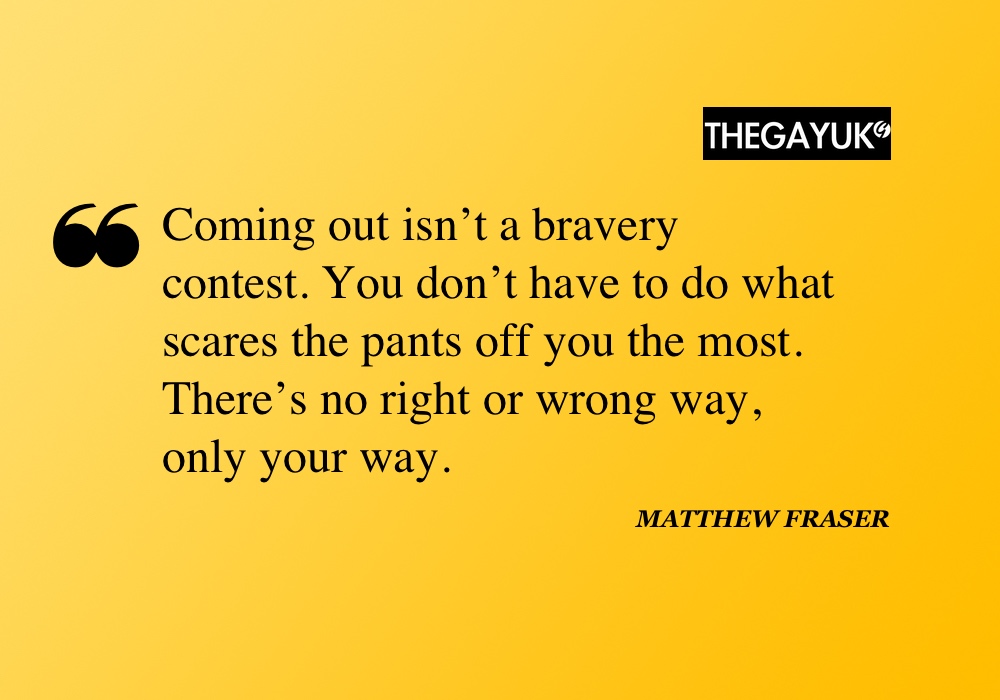
    In terms of coming out specifically, for me it was a no-brainer. But for you, if you’re reading this and are perhaps on the cusp of wanting to tell somebody, and you just don’t think you can manage the words verbally – please, please consider writing it if that comes more naturally to you. It’s not disrespectful, and it’s not cowardly. Coming out isn’t a bravery contest. You don’t have to do what scares the pants off you the most. There’s no right or wrong way, only your way.

    For what it’s worth, I’ve never even once had any regret over the way I told my parents I was gay. I think, given that the whole thing came as a bit of a shock to them, that writing it down was for the best. It gave them time. Time to read, then time to think, time to order their thoughts. For coming out to anyone is a two-way street, and the oncoming traffic may have a reaction. Spoken words can come snapping from mouths in an impulsive, thoughtless rush. The written word gives time.

    So write, or talk, whatever suits you best. Just remember – there’s no shame in any of it.

  • COMMENT | The Only Goal Football Needs is to Support its LGBT Players

    Newspaper The Sun has reported that a premier league footballer has ‘paid to keep his male lover quiet’.

    There is almost always talk of a footballer being gay. In 2018, we still don’t have a premier league footballer that is out and proud. Of course, there are some footballers that have announced their sexuality, but it comes after retirement when they’re no longer at the top of their game.

    And that’s a problem.

    According to The Sun, the premier league star who has not been named, offered to pay his fashion worker lover to keep quiet. The sum offered is rumoured to be £10,000. The Sun goes on to say that the footballer in question has a child with a female partner, and is bisexual. The male lover in question is said to be a 21-year-old fashion worker, who has also remained anonymous.

    Instead, the 21-year-old chose to speak anonymously to raise awareness of the continued homophobia and taboo surrounding male football players. He has said: ‘It isn’t the players that are the problem — although he is guarded with who knows. It is because of the backlash from the fans that he is terrified of it coming out.’

    The football player has reportedly told close friends, some of who are footballers themselves, and has been greeted with support, but he is terrified of the fans, of the heckle calls being shouted from the stadium.

    In 2018, should we not be more focused on the ability of a footballer’s talent to score goals, to win for their team, than their sexuality?

    Unfortunately, whilst that is what we should be focussing on, it seems fans have another agenda. In a 2013 dossier, Brighton fans reported hearing these chants: ‘You’re from a town full of gays and we hope you all die of AIDS.’

    It doesn’t make ‘juicy gossip’ to hear of a male footballer coming out as gay. I’ll admit, it is interesting, and it’s natural to want to know who that man is. But the pressure he must be under tells us that forcing him out is wrong. Instead, the attitude towards gay men on the pitch needs to change.

    It isn’t as though that isn’t happening. In 2013, the first LGBTQ fans group for a major football group – in this case, Arsenal – was set up. Since then, there are more than 30 LGBTQ groups offering support to both fans and in the closet football players.

    Meanwhile, Welsh Rugby player Gareth Thomas, who came out as gay after retiring from the sport, said that if a footballer were to come out today, they would be ‘walking into the unknown’.

    Whilst the FA are maintaining they are encouraging their players to ‘be themselves and support their teammates to do likewise’, we are still lacking any prominent out and proud football players that are still at the top of their game.

    The problem, of course, is not with the footballer player themselves. They are surrounded by men who are telling them to conform, to play the game and are idolised by men all across the world. In some countries where these footballers play, it is illegal to be gay, with some countries allowing a death penalty. Whilst not all of the football audience are homophobic, trolling chants about gay men can appear to be incredibly daunting. Surveys have shown that three-quarters of football fans don’t care if a player is gay or bisexual.

    What is also the problem is no one wants to be first. Peter Tatchell, a gay rights campaigner, said: ‘To allay the anxieties of individual players, the Professional Footballers Association should organise a simultaneous coming out by several stars. That way, no single player would have to deal with the media and public reaction. There would be safety in numbers.’

    With rumours in the past linking Ashley Cole to another player, a rumour he distanced himself from publicly and assuming the player in recent reports is someone entirely different, there would, of course, be enough players to come out together. The problem with this happening is internal struggles.

    We live in a society where an open, gay football player would be what we need. An influential man with a following of both straight and gay football players would really do wonders. LGBTQ groups would feel included, and awareness could be raised to the industry of football as a whole, and the problems that need to be dealt with and overcome.

    It’s easy to say that a footballer should lead the way in coming out, but it’s easy to forget the internal struggle of coming out.

  • COMMENT | Do we really live in a world where you can be gay in a football game, but not in real life?

    The computer game, Football Manager is to feature gay players. I find this one of the most refreshing and liberating moves of 2017.

    Although it also angers me that it’s taken until 2017 for it to happen. And it’s so shocking that modern male British football is still waiting for its first openly gay player.

    I find it incredibly weird that homosexuality still seems to be a problem in football. It’s absolutely crazy that in this day and age, we are still in a world where people can’t be themselves.

    I’m hoping this computer game will be a massive boost in combating homophobia that stems from football fans. Especially the young teenage fans who will be playing football manager.

    From what I’ve read about this game, I feel it will create a really a positive message. Yes, there are some amazing footballers who also happen to fancy men. Now let’s move on.

    This is what shocks me. The statistic that 8 percent of football fans said they would stop watching their team if it had a gay player. WTF! That shocks me to my very core.

    I’ve got a message for you 8 percent. I’m sure your teams won’t miss you or your homopnarrow-minded minded, bigoted support.

    I look forward to the day when anyone involved in football feels 100% comfortable with sexuality. Of course, I’m not naive enough to believe that this computer game is the answer to the problem. But at least it’s a start in normalising homosexuality in football.

  • COMMENT | I’m coming out… again

    Around 4 years ago I went back into the closet. This was at the time of moving home to a new area and a new job.

    A recent stirring in the nether region suggests to me it is time to come out again. No one said it has to be a once in a lifetime event. The best part of all is that no one from my new life suspects, it would be a total shocker. Sacrilege I know but there is almost something divine about a second coming!

    I know myself so well now. I am older and more confident, resilient to rejection and just plain, “don’t give a sh*t!” This feeling of inner self-worth comes from the security of having a foundation of family and old friends who I came out to more than 30 years ago. In making light of my situation I am not trivialising the ordeal it must be for first timers who will rock their world to the core with the revelation.

    My planning is involving all the things you should never do for a first coming out:

    1. It is going to be on a special day, so everyone remembers this is the day he did it (again).

    2. High camp and outrageous clothes are a definite.

    3. Perhaps a theme, would “The Wizard of Oz” be too over the top?

    4.  I’ve spent a lifetime being a friend of … Is this my time to be Dorothy? Though 18 stone of middle-aged hairy arsed womble clutching Toto and clicking his heels may stretch the boundaries of belief.

    5. Music, darlings you can’t have a party without music. Coming Out has been immortalised by Divas from old Burly Shassy and Diana Ross to the modern day pretenders to the crown; there is something for everyone.

    6. A soirée for a select few, only those who will be entirely shocked! There is no point in doing this if there isn’t melodrama.

    7. A big drunken speech thanking people who have contributed nothing, plenty of gushing.  A coming out event has to have  tissues and tears

    8. To finish karaoke with just show tunes. Or is it all just a little to Fay Wray?

    On second thoughts it may be too much effort. I might just lay back on the chaise, massage my temples with some soothing liniment and have a quick rub down with a warm pasty.

  • #NationalComingOutDay – Every experience is different

    Coming out of the closet is a different experience for everyone and it may not always be as positive as the Diana Ross song.

    For most people, you’ll end up coming out more than once – which people don’t really tell you about. Sure, the first time is the hardest and most nerve-wracking but as long as you’re meeting new people and you don’t have an I’M GAY tattoo scrawled across your forehead, you’re going to end up coming out… a lot. Like most things, it gets easier over time and those two simple words will end up flowing out of your mouth almost habitually. But it’s that first time, that one moment where you break it to the people closest to you – be it your immediate family, best friends, whoever – that seems to swallow up the spotlight.

    I’ve met people who openly talk about their coming out experiences with warm, knowing smiles. On the other end of the argument, I’ve also met people who refuse to conform to this notion that we as gay people owe anyone but ourselves a need to self-label. Personally, talking about how I came out makes me uncomfortable. Because that’s the reality – or my reality, rather. I wasn’t sat down opposite my parents with my fingers entwined with my boyfriend’s on my eighteenth birthday, I wasn’t at an emotionally happy place to be able to merrily own my label, I was a shivering wreck and I’m pretty sure I blubbered the words out inaudibly at first. That glorified moment of self-empowerment, of owning my sexuality and confronting my traditional parents, was eclipsed with awkward mumbling, a permanently nauseous feeling in the pit of my stomach and enough tears to drown a whale.

    At the forefront of this day, October 11th, coming out is celebrated for the extreme bravery that it takes to leave that dark, damp closet and step into the light. But that’s an over-simplification of something that’s just not as black and white as saying “I’m gay” or “I’m bi” or “I’m whatever letter of the LGBTQIA+ community”. There is validity behind the argument that by coming out you’re fulfilling this necessary quota before you can officially call yourself an out and proud queer person (and I’m using queer as an umbrella term here).

    As a community that has been ostracised, marginalised, called every pejorative name in the book, beaten and even made illegal, we are taught to hate ourselves. That we’re going to Hell. The relationship between teenagers who commit suicide and their sexuality or gender identification is alarming.

    Homophobia isn’t as dead as some people want to believe and it isn’t a matter of being a social justice warrior, these heartbreaking facts that plague our community with exceptionally high numbers of homelessness and violent prejudice warrant wanting days like these. For civil awareness and to discuss issues in our community.

    Coming out seems like a meagre thing when you compare it to the more pressing matters that we face. If I’m safe and comfortable with myself, why do I need to come out? Why should I directly have to express my sexual orientation to those around me to prove that I am, in fact, not straight? Judith Butler, a philosopher and gender theorist, argues that coming out does not protect oneself from oppression or discrimination. A lot can change from coming out, perhaps you won’t feel as alienated, perhaps you’ll be able to be more in touch with yourself and other around you, perhaps you won’t have to hide away a part of yourself that you’ve been purposefully repressing.

    While, in that sense, coming out can bring you closer to your friends or your family if there’s one thing you take away from reading this I want it to be what follows: You don’t owe anybody anything. There’s no plausible situation where you have to come out or disclose your sexual identity if you do not want to. There are people in this world who will love you unconditionally and accept you without question, I’m not denying that. But at the expense of sounding cynical, there are also people who won’t do either of those things. And yes, it’s unfair, and yes, they’re assholes, and yes, they don’t understand what it’s like but you don’t gain anything from coming out that you won’t already have if you know who you are and you love who you are.

    The pressure that we receive, especially as young people (hi, I’m seventeen), can feel overwhelming, can feel overpowering. There might be people you look up to who say that if you don’t come out, you’re lying to yourself, or that you owe it to be a role model and come out so that people know it’s okay to be who you are. I know that that’s definitely been the case for me multiple times. The only reason my heart was beating so fast on the day I came out, on the 17th of October in 2015, was because I was afraid. Not that I wouldn’t be accepted, I knew they wouldn’t take it well. But my fear came from outside – from the reaction of others – I knew who I was a long time ago and I had come out to myself way before I came out to others.

    Like everything in life, this day is filled with contrasting emotions; I am happy that I took a leap of faith and came out to my parents two years ago, but I am also saddened by the fact that some people can’t come out or feel the need to do so prematurely because everyone’s telling them they should. I wrote down my coming out experience because I wanted to remember it. I said, “They cried, I cried, we hugged, a lot was said. Too much to mark down. But it was one of the scariest things, but also one of the bravest things, I will ever have to do in my life.”

    To my fifteen-year-old self, to anyone who hasn’t yet, I just want to tell you that this day is a day of celebration. Not for coming out to the people around you, but for coming out to yourself. I was wrong when I wrote down that coming out to my family was the scariest and bravest thing I will ever have to do – coming out to myself, first and foremost, was. No one has the right to demand a label from you, or that you label yourself, but what I will ask of you is that you love who you are regardless of what anybody says. Anyway I try to finish this will be unoriginal and cheesy so I’ll end with this:

    You matter and you are never, ever alone.

    With love,

    Lee.


    Opinions expressed in this article may not reflect those of THEGAYUK, its management or editorial teams. If you’d like to comment or write a comment, opinion or blog piece, please click here.

  • COMMENT | Discovering I was different

    What was I?

    Getting information was difficult in the 1970s. It was all so confusing. My point of reference was the tabloid press. It was what my father and grandfather read and the only available resource. I knew I couldn’t ask them.

    When an actor or pop singer was in disgrace for an unmentionable act with a member of the same sex, it was all so vague. I thought I knew that couldn’t be me though as I couldn’t act or sing and had no desire for the attire and makeup of the glam rock era.

    In the playground, I heard the same derogatory remarks slung at boys from each other “you’re a bummer, a wanker, a homo and a queer.” The narrative had an intent to offend and insult, but I didn’t know what the words meant. Did one of those words describe me?

    The narrative had an intent to offend and insult, but I didn’t know what the words meant. Did one of those words describe me?

    It was about 2.45pm on a Wednesday afternoon in the early summer of 1974. I was 11 years old. Taking the Environmental Studies class was Miss Barker a temporary teacher. It was her first day and our first lesson with her.

    She was a  pretty young woman in her early to mid 2os. Casually dressed in jeans and a white T-shirt with a v-neck. Her cleavage was pert and visible. The colour of the clothing and bra beneath did nothing to conceal that she had nipples like Tractor stater buttons.

    One of my friends suggested he would like Miss Barker to run her fingers down his spine. He shivered as if the thought of it had made him tingle all over. The other boys we were sat with all eagerly joined in expressing similar opinions.

    I knew I did not want her to touch me. Geoff the boy at the front who was athletic, having experienced a pre-teenage explosion of testosterone would be my choice.

    I don’t know why but I didn’t share it with the others. I knew it meant I was different but I did not have a name for it; or anyone I could talk to about it. In that instant, I had learned something about me and I knew it would be my secret for some time into the future.

    It would be nearly 5 more years before I found out, I was not one of those playground taunts; but that I had hit the jackpot and was all of them!

  • COMMENT | We need to stop saying “I already knew” when someone comes out

    We Should Applaud Those Brave Enough to Come Out, Not Tear Them Down…


    Seeing the trolls was obviously disappointing,but not surprising.

    Discovering that many of the trolls were other gay people was even more disappointing…


    With the news that Olympic athlete Colin Jackson has come out as gay, I logged on to Twitter to see what people were saying about it. Although there were some congratulatory tweets and well wishes, the majority of the comments I saw were putting Jackson down and criticising him for only coming out now, having spent years denying his sexuality.

    Seeing the trolls was obviously disappointing, but not surprising. Discovering that many of the trolls were other gay people was even more disappointing, but again not surprising at all. That’s because we live in a world where trolls regularly tear people down online. These days I’m more surprised when someone is nice.

    It’s not just Colin Jackson who has been in the firing line recently. You only have to look at Aaron Carter’s coming out to see an example of people saying hateful things instead of being more understanding and supportive. The same can be said of Barry Manilow’s coming out earlier this year.

    I think the thing that disappoints me most about all the negativity that gay people write about famous people coming out is when they say that they already knew, or it was hardly a secret, or even that they are coming out for publicity. Maybe, just maybe, it’s actually because they now feel comfortable enough to come out. It’s easy to see how difficult it must be for them, given the reactions of other gay people when these famous folks do pluck up the courage to be open about who they are.

    Much of the issue that people are taking with Colin Jackson coming out is that he has denied being gay in the past. That may be true, but that shouldn’t detract from the fact that he now feels able to be open about who he is. I’m guilty of denying my own sexuality in the past due to fear of being rejected and attacked for being gay. I have no doubt that countless other people have also hidden or denied their sexuality for the same reasons.

    The common theme among the trolls tweeting about Aaron Carter was the opinion that he is probably gay and just saying he is bisexual to soften the blow.

    In Aaron Carter’s case, the stigma around being bisexual is huge. The common theme among the trolls tweeting about Aaron Carter was the opinion that he is probably gay and just saying he is bisexual to soften the blow. Others were saying that he is coming out as bisexual to resurrect his career. It’s this kind of biphobia that keeps bisexual people in the closet. That stigma attached to being bisexual is the reason why there is such a lack of bisexual visibility, although the fantastic Bi Pride UK team are about to change that. As the Stonewall saying goes, some people are bisexual… get over it!

    What’s clear to me is that because someone is famous, they are somehow fair game when it comes to mocking and judging them when they come out. However, we need to be mindful that those famous people are human too. They are just like the rest of us and go through the same struggles as we do. We all have our own journey and so do they.

    What I’d like to do is call for more kindness. I applaud Colin Jackson, Aaron Carter, Barry Manilow and anyone else who feels brave enough to come out and be who they are. I just wish other gay people would be more supportive of that. With LGBT+ people facing so much hatred in many countries around the world, we should all be sticking together. This infighting and putting each other down does a disservice to those who fought and continue to fight, for our rights.


    Opinions expressed in this article may not reflect those of THEGAYUK, its management or editorial teams. If you’d like to comment or write a comment, opinion or blog piece, please click here.

  • COMMENT | My Coming Out Reactions

    COMMENT | My Coming Out Reactions

    I’m out to everybody. These days I rarely need to come out and say that I’m gay, but it wasn’t always like that. Over the years I’ve come out to family, friends, work colleagues and even my GP. There have been mixed reactions from people when I’ve told them that I’m gay, but most have been positive. In this article, I’ll share some of the most memorable with you.

    keeping company, social gathering,
    CREDIT: bigstock / Rawpixel.com

    Family
    Coming out to my mum was one of the best things I ever did. I knew she would be supportive, as one of her best friend’s is gay. She acted as a proxy, telling other members of the family and family friends that I was gay so I didn’t have to. Some years later she did tell me that she was worried that I would have a more difficult life as a gay man as ‘people can be so cruel.’

    The funniest reaction from a family member was when my mum told my Granddad. He told her that I ‘just haven’t met the right girl yet.’ This wasn’t homophobic, just a lack of understanding and naivety of the gay world. This naivety is wonderful and one of the many reasons I love him immensely. He used to work on the tills at what has been dubbed The Gay Sainsbury’s in Manchester. He never realised (and still hasn’t!) that all the gay couples are actually together.

    When I came out to my older Brother, a sporty lads lad, he said: ‘You’re still my brother. And I still love you.’ This acceptance from him meant the world to me and it still does.

    Friends
    My friends and I don’t really remember me coming out. That means that it wasn’t really a big deal. It was said, accepted and then we moved on. But there’s always that one friend isn’t there? When I came out to him, he said: ‘Me too.’ We’re still friends today and our same sexuality helped to build the bonds of a lifelong friendship.

    Work Colleagues
    I’ve had many work colleagues over the years, all in different settings and the vast majority coming out has been done by answering the questions: ‘So how was your weekend? What did you get up to?’

    However I did have one Born Again Christian work colleague who said: “I accept that this is how you feel, but it’s not part of god’s plan. It says so in the bible.” This was a face palm moment and I rarely spoke to him after that.

    At one workplace a closeted lesbian work colleague saw the overwhelmingly positive reaction to me as an out gay man and this gave her the courage to talk about her life and her partner openly. Prior to me arriving she had avoided conversations about anything personal, but after seeing how our work colleagues reacted to my talk of gay pride and my relationships she became more open at work and seemed happier for it.

    GP
    I had gone to see my family GP, an older Asian man, about something and decided to disclose my sexuality to him. I think I was at the stage in coming out where you want to tell the world that you’re gay. He said: ‘it’s unnatural.’ And then resumed talking about what I had gone to see him about. This hurt. Said by a supposed non-judgemental professional. Whenever I hear someone say ‘unnatural’ it takes me right back to that consultation room and makes me feel really uncomfortable.

    My coming out reactions have been in the vast majority positive. I have been accepted for who I am. But that’s not always the case. Gay people coming out face the fear of rejection, actual rejection and in some cases abuse or violence. If someone can’t accept you for who you are and recognise that your sexuality is an important part of who you are, you have to ask yourself a serious question: do you really want this person to be a part of your life? I know what my answer would be.


    Opinions expressed in this article may not reflect those of THEGAYUK, its management or editorial teams. If you’d like to comment or write a comment, opinion or blog piece, please click here.

  • OPINION | Trans people: It’s time to come out of the shadows

    Over the past few years, transgender visibility has improved greatly with a number of trans people becoming very public through the media and I was even featured on Match of the Day‘s Premier League football show recently.

    So why do we still need a Transgender Day of Visibility?

    Unfortunately, that visibility has also brought an increase in abuse and bigotry, following my appearances on the BBC the online trolling I received escalated to the point where I received death threats via Twitter.

    The fight for freedom from bigotry isn’t over yet and it won’t be until every trans person can walk down the street, use the toilet of their choosing and express their identity free of fear.

    For so many trans people our overriding aim is to ‘pass’ or to achieve invisibility, to go about our lives as if our transness never existed, we want other people to accept us in our chosen gender without question or judgement.

    But is this actually doing us all a disservice?

    My self-confidence and self-acceptance greatly improved when I let go of the concept of passing. The fear of being ‘read’ and the fear of people discovering that I wasn’t a ‘real’ woman.

    It’s now more important to me to be perceived as a woman, even if logically people see a slight anomaly. It’s important to me to be authentic to myself.

    That doesn’t mean that I don’t want to be the most beautiful, feminine version of me possible and I do love it when people call me Miss, but I’m not scared of people realising that I’m trans, in fact, I’m very open and forthright about it.

    In the same way that gay rights and acceptance improved greatly after they stopped hiding in the shadows and stood up to express their pride is it now time for us to proclaim that we are trans and proud of it.

    Gender dysphoria can be a terrible thing that takes a huge emotional, mental and social toll on people, do those of us that have reached the stage of feeling comfortable with ourselves and our condition owe it to those that are still struggling to show that there is a light at the end of the tunnel?

    Do we owe it to ourselves (and our younger, more scared selves) to stand up and fight for our rights to be recognised as valid members of society?

    Transphobia seems to be the form of social hatred and bullying that is still, if not accepted, ignored by society. Whilst racism and homophobia are abhorred by all but the very narrow-minded few trans people still get the sniggers, tranny jokes and, as happened to me last week, outright abuse.

    We go through hell to finally be our authentic selves and we should be proud of the fact that, even if we haven’t quite won the battle yet, we’re on the road to liberation.

    Why, just at your moment of self-realisation would you come out of one closet only to lock yourself in another, yet again in fear of being outed.

    So perhaps it’s today that we put on our best face, most amazing outfit and strut, proud as hell down our local High Street.

    I’m here, I’m trans and I love who I am, and no one’s petty minded bigotry is going to take that away from me!

    P.s. It’s just been confirmed that there will be an event today at 2pm at New Steine in Brighton including speeches (I’m one of the speakers) and music, all welcome.

    Opinions expressed in this article may not reflect those of THEGAYUK, its management or editorial teams. If you’d like to comment or write a comment, opinion or blog piece, please click here.