Category: Motoring

  • CAR REVIEW | Volkswagen Golf R (2017)

    VW Golf R | ★★★★

    It might not be the best GTi out there but the Golf GTi does all things to all men and it is where manufacturers set the benchmark. So when you make the most emulated GTi out there, what do you do?

    What you do is not redeveloped your current GTi and make it the best, instead you make another GTi and call it the R. For £32,110 as tested, you also make it compellingly cheap compared to the current GTi at just £4000 more.

     Golf R review

    Let’s get the basic stuff out of the way first. Inside the Golf R it is all very much as the rest of the Golf range. It’s an ergonomic delight and everything feels built to last. Now though in the relaunched Mk7 we have new larger infotainment screen and adaptive dials too. The quality of fittings, while not all improved have had some VW engineering work carried out on them. It has moved Golf up higher in quality feel over its rivals.

    Everything is to hand. The dials are easy to read and with the new active info display graphics, it’s still as easy to read but this time you are given extras. The ability to allow the sat nav display within the fascia is a keen selling point for me. It allows split second glances and all the information you require is there. This is also true for the speed you are travelling at. In the Golf R it is something you need to keep a keen eye on. The display itself has 4 user settings. I’m not sure if this is a good or bad thing with a shared car. Sometimes you want to keep your driving styles when alone a secret.

    Golf R Review

    In the R model, we are treated to supportive seats with cloth inserts. I find cloth a much better option to have in view of leather being a bit slippery on hard cornering. In the Golf R you don’t want a loss of traction between your bottom and the seat when the cornering G’s are rising fast!

    There are little touches around the cabin to remind you that you are in the R model. Little touches that make it very distinctive. These also stretch outside too with blue being the colour choice instead of the GTi’s red that blends into the headlights.

    Back to the nitty gritty and £4000 of anyone’s money sounds a lot and if truth be told, the Golf range with any street cred isn’t cheap these days. You can get all the fun of having a Golf GTi with the £10,000 cheaper GT. What you don’t get though is a Golf R.

    The Golf R is a serious road warrior. I opted for the longer test route VW had set out during the relaunch of Golf 7. There were a few moments where l had to slow up the fun for the head rush was something else. The magic of the Golf R is that it does all this while also retaining a sense of normality. I’m not sure how Volkswagen has managed this but it is deep within the DNA of Golf.

    The GTi we tested had this ability to be humble to its basic principle and then a savage monster. It’s just that in the Golf R it is, even more savage when you want it to and it sounds it too.

    Now don’t think that being 4 wheel drive makes this an agricultural tractor. Remember the VW group have an enviable developments history with all-wheel drive systems. The 4 motion 4 wheel drive system adds about 119kg in weight and it doesn’t hinder its go fast forward motion. I’d go as far to say that the extra weight in the rear from the differential makes it a far more balanced chassis.

    With this in mind, the Gold R really can handle the power And that power is increased from the GTi’s 230 PS to 310 PS. That’s not just a bit more power but a bloody bucket full of moist making power.

    There is also no penalty either. While all this fun comes in at higher up the rev range, the pulling power of torque comes in much lower and lasts for what feels like it will never end starting from a lowly 2000 to 5400 rpm. It does it quickly but it has almost 1000 rpm more of a power band over the GTi to make it so worth while. 0-60 time is also smashed to just over 5 seconds. Remember then that this is all in a 5 door family hatchback! Or a 3 door hatchback and now in a very practical load-lugging estate!

    So as you can see then I am taken by the Golf R and that extra £4k is making sense. And it does. It’s blisteringly quick. Will put a MASSIVE smile on your face and then it will settle back to do the daily commute and sit in traffic like butter wouldn’t melt in its mouth.

    Would I have one? It’s a difficult six million dollar question but the answer is no. I’ll keep my £4k and go with the GTi. It’s less frenetic when it needs to be but also feels more in keeping with being a hot hatch. Somehow the Golf R with its 4 wheel drive and beautiful weight distribution just feels like I am cheating a bit.

    Likes

    Ability to drive like a bat out of hell or a commuter car
    Practical hatchback or estate
    Ride quality

    Dislikes

    Not enough exterior differences to make it look different to the GTi
    Comes in estate form too. Absurd. (I’m clutching at straws to make a list of 3 here)
    Too many choices of body (That’s actually a good thing too)

    The Lowdown
    Car – VW Golf
    Price – £ 32,110 (as tested)
    MPG – 37.7 mpg (combined)
    Power – 310 bhp
    0-62mph – 5.1 seconds
    Top Speed – 155 mph
    Co2 – 180 (g/km)

  • CAR REVIEW | Toyota Hilux

    ★★★★ | Toyota Hilux

    Toyota Hilux review

    Hi Ho, Hi Ho, it’s off to work I go with Loadsa Unadulterated Xpression.

    OK, that is a crap intro for a vehicle that is anything but. This thing can seriously take a lot of it. This vehicle really is the king of the pick-ups.

    I was in a bit of a quandary when I took delivery of Toyota’s new Hilux. I’d trapped a nerve in my shoulder and the prospect of a harsh ride associated with pick-ups didn’t feel me with much joy.

    I can say that THEGAYUK covered 200 comfortable miles in the Hilux. It’s not luxurious by any stretch of the imagination. In fact, the front and rear behave like Dr Jekyl and Mr Hyde. The front is soft and composed. The rear is a bit jiggly. That’s how it is with a fully functioning pick-up truck.

    I like trucks but in the everyday sense of the word, the Hilux isn’t the best as a poser mobile. The Nissan Navara does that better. The Hilux is a working vehicle. Take a look at any worldwide disaster and you’ll see plenty of Hilux’s new and old on both sides of the law doing what they do best and that is carry whatever is needed to wherever they need to get to. There are many “classless” vehicles out there but non-so-classless as the Hilux.

    You see despite my little moan about it not being the best in cold harsh terms, it is. Toyota has two particular things in this segment of the market that are essential and that is reliability and dependability.

    That reliability just cannot be matched. Think of the original Land Rover. It was simple to put together. It did the job. Sadly it got complicated. A working vehicle needs to be fit for purpose including abuse beyond all limits. Despite not being filled with the latest gadgets for the price, the Hilux isn’t basic. The interior looks and feels purposeful to the job. The stitching on top of the dashboard gives a sense of craftsmanship when in fact it is moulded plastic. The door cards are plastic panels with a token of luxury with a fabric insert on the arm rest. You could put your garden sprinkler on in this to wash it down. It would still work.

    The Hilux also has dependability. That go-any-place skill hasn’t come overnight. It has taken 49 years and now 8 generations to get here. If in those 49 years of being a load lugger, you become too complacent and don’t meet the expected needs, a reputation for failing then spreads quite fast.

    People LOVE the Hilux. A friend has the last generation model. She will not part with it. I’m not sure if that is good news for Toyota or not that she won’t upgrade but it shows the admiration she has for her Hilux. She works with horses and needs to cross some pretty awful terrain and hills. Her previous 4×4 spent more time in the repair shop than on the farm. We now see her once a year for the Hilux yearly service.

    The service intervals are short. 10,000 miles or annual service. Quite short when compared to some in this segment. Servicing on a regular basis as is seen on my friends truck proves dependability of her truck.

    I didn’t get the chance to take the Hilux off-road. I did find a badly rutted path made by a muck spreader. I didn’t realise it was a muck spreader until l got home. The air lingered that night in the Avenue. That still didn’t stop me poking my nose underneath. This press vehicle has seen some action. The belly pan showing sign of doing what it does best and that’s protecting vital mechanical items. It’s a testament to Toyota then that despite this evidence the rest of the undercarriage looks up to the task and despite being a new vehicle showed no signs of damage. Vital items such as prop shaft and electrics are high out of the way. Only the exhaust is vulnerable and having sensors built in for monitoring emissions it’s anyone’s guess how well these items are protected.

    On the road, it was surprisingly easy to drive. Navigating it around the lanes where l live and in town was quite easy. The auto box doing all that was needed. There was a little turbo lag from rest that l wasn’t too keen on. That moment’s hesitation can sometimes be annoying. What it didn’t do however was lift the inside rear wheel when pulling out from junctions. Something l have noticed other pick-ups doing too easily. So on the Hilux, there was no need to select 4 wheel drive. There is something to be said about a limited slip rear differential in an unladen pickup.

    Motorway driving was effortless. Because of the isolation of rear wheels in the cabin, there were only 2 wheels that were able to transmit road sounds inside. I didn’t notice any. And the engine itself, all 2393 of diesel cubic capacity making 148bhp at 3400rpm and 400Nm of torque from 1600 to 2000rpm was subdued unless pushed. Torque is the key figure here and it’s torquey. On the motorway, it will thunder along quietly at legal speeds barely going outside of this range and for overtaking it’ll pick up speed and motor. The in-line 4 will become vocal when pushed during kick-down of the 6-speed auto box and then settle down to a whisper when cruising again.

    It’s a big vehicle. The rear bed of the Hilux has increased making it even longer than the last model. Unlike the cheaper Navara, Toyota doesn’t have 360-degree cameras or reversing sensors fitted to this vehicle. It needs it. The reversing camera fitted is OK. The yellow lines do line up, it’s just that the extremities do get a little lost. It didn’t, however, stop me parking within an 1 inch from the bumper of my bus.

    I’m not in the workman trade so for me, there is little to recommend the Hilux for use as an everyday vehicle unless that is I want something that has a reputation that exceeds that of all the other trucks out there. 18 million Hilux’s have been sold around the world. Yep, that’ll do it. SOLD.

    Love

    Economy
    Reputation
    Ease of driving

    Loathe

    Quite expensive
    Lack of equipment
    Noisy when worked hard

    The Lowdown
    Car – Toyota Hilux Invincible D/C 2.4L
    Price – £32,645 (as tested)
    MPG – 36.2mpg (combined)
    Power – 0-62mph – 12.8 seconds
    Top Speed – 106 mph
    Co2 – 204 (g/km)

  • CAR REVIEW | Abarth 695 Biposto Record

    ★★★★★ | Abarth 695 Biposto Record

    THEGAYUK were quite privileged to have tested the Abarth 695 Biposto Record. This was number 118 of 133 made for the globe. It’s quite a rare machine. Why 133? It’s to mark 133 records Abarth hold. Is this then the reconstruction of Abarth instead of it being badges stuck to a Punto side skirt? Hell yes!!!

    Externally it looks like my old 500. This model still uses the older style lights unlike the rest of the range but this is probably because it was launched in 2015. The boot opens the same way as mine. Speaking of the boot, there is tons of space available compared to the standard 500. The rear seats appear to be missing and have been replaced with a cargo net and 3 bar roll cage of titanium by Poggipolini.

    And then you notice other “items” missing that make you suddenly realise this isn’t just an overdressed 500 with 35 section tyres and red Brembo brakes screaming from behind lightened O.Z 18 inch anthracite wheels with a 1400cc turbo engine. Or underdressed if you like lots of bits like door armrests and a radio. You get little red fabric loops and yet, strangely enough, you also get electric windows. As for the missing radio, the hole you get does give good acoustics to your smartphone’s speaker. It’s not a 500. It’s a 695.

    All this visual and tactile assessment was gained just by moving it around the car park at work so on showroom appeal alone you might be thinking that you are not getting a lot for your £36,000. For a small car, the turning circle was also a bit below par. That then will be because of the limited slip differential.

    Before you even drive it you notice a growl from the Akrapovic titanium twin exhausts and this is before you press the sports button that stiffens the steering and makes throttle inputs more responsive. It feels like a small adjustment but when the crazy gets crazier it all comes together like surfing a tsunami.

    Abarth 695 Bisporto Record

    I drove it before I had a chance to look up the spec sheet. I had in fact asked for a much lesser Abarth so I wasn’t quite expecting a machine that was so visually striking in Modena yellow while being quite acceptable on the road. Its behaviour is impressive. The Sabelt bucket seats clad in carbon fibre felt perfect for both comfort and support on the road or on the track. Potholes aside, it handled the city commute with aplomb. It didn’t behave like a track day ready car or make you wish for softer springs. Even the clutch was as simple to operate like that in the lesser 1200cc 500

    Sadly it attracts two kinds of wrong attention. Firstly you get idiots in de-badged Corsas always wanting a traffic light grand-Prix which you let them win because the comparison is so unfair and then you get GTi drivers wanting to prove a point to you and the pint-sized rocket to which you greet with enthusiasm. Sometimes it can be over very quickly and in your favour too. The 0-60 time of 5.9 seconds catches them out from the car weighing only 997 kg. It really doesn’t weigh a lot.

    I’d like to say the 695 is all about raw power. As you can see though it isn’t. It’s quite useable. In normal mode, it’ll attack the asphalt cleanly and quickly. There is a little hesitation from the throttle response but this prevents you making errors in the bumper to bumper city traffic.

    Press the sports button then and my word does it change. Instantly and before the facia panel has changed its digital display to show G forces and gas inputs, you notice it’s growling snap from inputs and the gentle increase in steering weight. Press on and the turbo now vocalising its induction and the exhaust snaps and cackles. It sounds like a modern day supercar.

    Thankfully the limited slip differential does wonders at reducing torque steer and with 190 horses at full gallop at 5500rpm, you need it. Thankfully it doesn’t totally eliminate it so you still get that “feeling alive” craziness you should from a mighty power pack in a car this size. Press the TTC button (Torque Transfer Control) and it does wonders in keeping it in a straight line while also reducing some understeer when really pressed. And press it I did. Unlike the 208 GTi we’ve tested, lift off mid corner and there is no sudden oversteer. The stripped out insides make this an enjoyable road ferret.

    It goes some way to show what the 500 shell is capable of. That rear end is very light. In theory, I expected it to become a little unbalanced during weight transference around corners and under hard braking. Even when braking really hard which you can do quite easily, the ABS system is rapid in firing its pulses to stop you. There is no fuss from the pedal. No annoying ABS pulse feel. The 4 pot Brembos up front stop you. Sadly the hazard lights flash during hard braking. I was always putting on the hazards.

    The suspension is also amazing. Shox provide the vital parts fitted to the standard cars front wishbones and solid rear beam. That is when you realise the potential the normal car has give or take the other thousands of pounds worth of kit the Abarth has added to it. That £36k is money well spent.

    So what have we got here than in steel and precious metals? It’s a toy really. A bit of a play thing. At any price, the Bisporto assures exclusivity. It’s there for the person who wants to go fast, fuss free and not have trouble parking it in the city, unlike the Ferrari. It’s also there for a little track day fun. There is also carbon fibre. It’s real carbon fibre. This is the kind of car that looks good with it. And it’s economical too. I managed 29mpg during my test.

    Abarth 695 Bisporto Record3

    I wouldn’t have a Bisporto. Even if you can find the limited run Record model, It’s too much for me. I like my sports cars to be a little bit more cruiser than skateboard. It’s fast. It’s rapid. It demands respect from the moment you pull away because you can go very fast very quickly. Respect I give anyone who buys one. To hell with it, I’ll have 2, It’s fabulous.

    Likes

    The ridiculous asking price
    The amount of race names associated with it
    The Performance

    Loathes

    The sensitive hazard lights
    Idiots in Vauxhall Corsas
    Making GTi drivers unhappy. No, seriously I am… NOT

    The Lowdown
    Car – Abarth 695 Bisporto Record
    Price – £36,610
    MPG – 45.9 (combined)
    Power – 190bhp @ 5500rpm
    0-62mph – 5.9 seconds
    Top Speed – 143 mph
    Co2 – 145 (g/km)

  • MOTORING REVIEW | Kubota K008-3

    Boys will be boys they say and that saying is still applicable now even as we get older. When we were young we had thrust upon us the football to play with, expected to fix a puncture on our BMX and we were given a toy digger.

    There is something about a digger that was always so macho to me. A simple machine that men used to dig things and erm, dig things. Having watched a lot of Dempsy and Makepeace in my childhood (who didn’t have a thing for Michael Brandon?), used by bad people for all sorts of things outside of digging.

    A man friend of mine called Dave was doing some excavation work at home in preparation of a garden makeover with a difference. He said I should come round and try this new toy he had hired for THEGAYUK. It was in his words “BRILLIANT”

    Not to be put off from getting one’s hands dirty, I donned a hard hat, butch boots and a hi-viz vest. All totally pointless in a private setting with no foreman but I wanted to experience the Kubota K008-3 appropriately attired. If it meant having to don a bow tie, I would have.

    The machine looked simple enough. To help with weight-saving there were no doors fitted and the cabin was sparse. In fact, it was more sparse than the recently tested Abarth 695 Bisporto we tested. Thankfully money has been spent on a comfortable seat. Good really considering you could be here for quite some time if you decided to travel the length of a modest garden in suburbia.

    Start up was simple. Turn the key and the little diesel engine spluttered into life. It was very quiet as it powered up hydraulics and gave it enough gumption to propel itself forward on rubber caterpillar tracks to a top speed of about walking pace. Once that is you had mastered the controls. there were 6 levers and 2-floor pedals. Quite different from the Britains toy digger I was given at 4!

    We were still not quite sure what the pedal on the left did. Possibly throttle. It didn’t give much of a clue. Like a Toyota Hilux, this thing can still work while being broken. The pedal on the right moved the floor shovel and stabiliser up or down.

    The two big levers did the magic bits to the digging part. Left lever swung the arm left or right. It also moved the arm furthest away from you up and down.

    The big lever on the right moved the arm closest to you up and down while also opening and closing the bucket. have you managed to grasp all that?

    If you have then you’re better than me. If I was at the 02 arena on stage to Kylie singing then I’d have looked great. I’d spin left. I’d spin right. I’d move the arm up and out. It was “Traveling Light Years” meets “Spinning Around” I span around and it felt really fast. I’d attempt to dig some soil but all I could manage was no more than the amount you’d get in the bucket you keep under the sink. However with perseverance, trial and many errors, I managed to better than a bucket of mud. I’d managed about three.

    Dave made some suggestions on how to get the best out of the Kubota K008-3 but to implement those into someone with undiagnosed dyspraxia was going nowhere. I say dyspraxia but if truth be told, I’m just kack-handed.

    So we carried on some more, trying my best not to fall down the trench he had already dug, Safety first for the Kubota driver is a lap belt and a roll cage over the front. With no seat belt alarm going off, I decided to drive by the seat of my pants albeit hard-hatted like the construction worker of the Village People.

    Once I had managed to feasibly master the controls I was let loose with the performance of the engine. The middle levers do the forward and back motions. Forward for forward and you get the rest. What you needed to be aware of was that both levers have to go the way you want to go. You won’t snap your neck on the breathtaking 0-walking pace speed but you might when you want to turn left or right. It’s reverse of what you actually want to do. For my kack-handed ability, this wasn’t a problem.

    It was fun, it was dirty. It separates the men from the queens. I think I’ll stick to driving pick-ups for my macho kicks and leave this digging lark to the real men. Now, where is my Britains digger?? I’m going to make a hole for a daffodil bulb.

    Likes

    You can dig up things
    Many different attachments available
    Quiet operation

    Loathes

    Poor dashboard instruments
    A bit too open to the elements
    Not very fast

    The Lowdown
    Car – Kubota K008-3 digger
    Price – £10,000 approx
    MPG – Either a lot or not man (combined)
    Power – Has lots.
    0-62mph – Do me a favour, you’d be lucky to get 6mph out of it.

  • CAR REVIEW | Citroen C3 Flair S&S BlueHDi 100

    ★★★ | Citroen C3 Flair S&S BlueHDi 100

    They were not wrong about the new C3 being eagerly waited for.

    Last year THEGAYUK reviewed the outgoing model. A model I didn’t really care much for in the beginning. By the end, it was a different story. It had taken Citroën about 14 years to get it right and just when they did they decided to start all over again. So is the new C3 better than the old or have Citroën got to start all over again?

    If there is one thing you can be assured of, it is that Citroën has not failed in making the new C3 ready for improvements. The C3 I was given was pleasant enough. It did everything right. The engine was the wrong one. If it had been fitted with their 1.2 three cylinder petrol engine as in the old C3 we tested, I would probably have been happier. The diesel just didn’t hit the right spot for me. It lacked the verve and excitement of the little petrol unit. That little unit is thankfully available in this Flair model and for over £1000 less. Buy the petrol engine.

    Now that my biggest moan is out of the way, is the new C3 good. Thankfully it is. The car has grown in size which I don’t know if that is a good thing or not. The joys of a city car are that you can go anywhere and park it anyplace. The new C3 has one disadvantage over its slightly larger cousin the Cactus, and that’s the bumpers. More lack of them. The C3 sports Citroën’s cool airbumps on the side but lacks anything on the bumper corners. Instead, it leaves the headlights low and vulnerable. Thankfully it is fitted with big plastic wheel arches.

    Quirky kit aside, the inside is ok. It’s built to a price and does the job. There are some nice carry over pieces from the cactus are included like the door handles. and contoured door cards reflecting the opposite of the airbump. This model also came with the £150 red ambience option. It’s not to my liking. Less so when the outside was duck egg in colour. What you do get on this new model is ConnectedCAM. It allows you to take pictures as seen from the front of the car and send them to your friends. A little gimmicky but we like gimmicks. Sometimes there just isn’t enough of them in any car we test.

    What I couldn’t find on the options list was the enlarged front screen into the roof as fitted to the Picasso models. It made for a bright airy interior. What I didn’t like on the inside was the brightness of the infotainment system. It was too bright and didn’t seem to alter with the lights unlike the facia panel. Until I found the setting I was having to turn it off.

    On the move, the 1560cc diesel engine did a great job if a little harsh and with complaints. This is a first for me to moan about a French diesel engine. They usually behave like petrol engines. Sadly this 110hp unit ran out of puff. It might produce all of its power at a lowly 3750 rpm and this then returns in rapid gear changing and hoping the high torque of 151 Ib.ft at 1750rpm will carry you on. It felt lacklustre. I couldn’t engage with it. It annoyed me and more-so because I wanted to like the new C3.

    On the move, the suspension was compliant with most undulations. It did, however, reveal a harshness that was absent from the previous model. It was wobbly Citroën with Germanic crashing. At first unsettling but you grow accustomed to it. Like the handling. That was fun. It handles rather well when thrown about. Due to the engines dynamics, you need to alter your driving style considerably to get the best out of it. It was still better than the DS3 Cabrio I tested.

    There are many things about the new C3 that I do like. It looks ok. Actually, it looks brilliant. Thankfully Citroën are now able to make their vehicles reflect the brand and C3 now sports the new corporate Citroën front. Cactus tested the waters and it is now the approved face. It grows on you because it is so different. It sort of reminds me a dolphin. They are cute and like the C3 they have personality.

    The price is also rather good too. It is now cheaper than the outgoing model. All this new development and the add-ons costs £18,845 as tested.

    There is a lot to like about the new C3. I can’t say love about it because I didn’t feel it this time. Perhaps because I wanted it to be so much better. It’s not. It’s no worse, it’s just that l don’t like the engine. Buy the petrol.

    Likes

    Build quality

    Specification and equipment

    Cute shape with likeable face

    Loathes

    Constantly having to go through the menu to switch off stop-start

    Engines lack of puff at speed

    Infotainment systems brightness

    The Lowdown

    Car – Citroen C3 Flair S&S BlueHDi 100

    Price – £18,845 (as tested)

    MPG – 76.3 mpg (combined)

    Power – 100 bhp

    0-62mph – 10.6 seconds

    Top Speed – 115 mph

    Co2 – 95 (g/km)

  • CAR REVIEW | Alfa Romeo MiTo

    ★★★ | Alfa Romeo MiTo

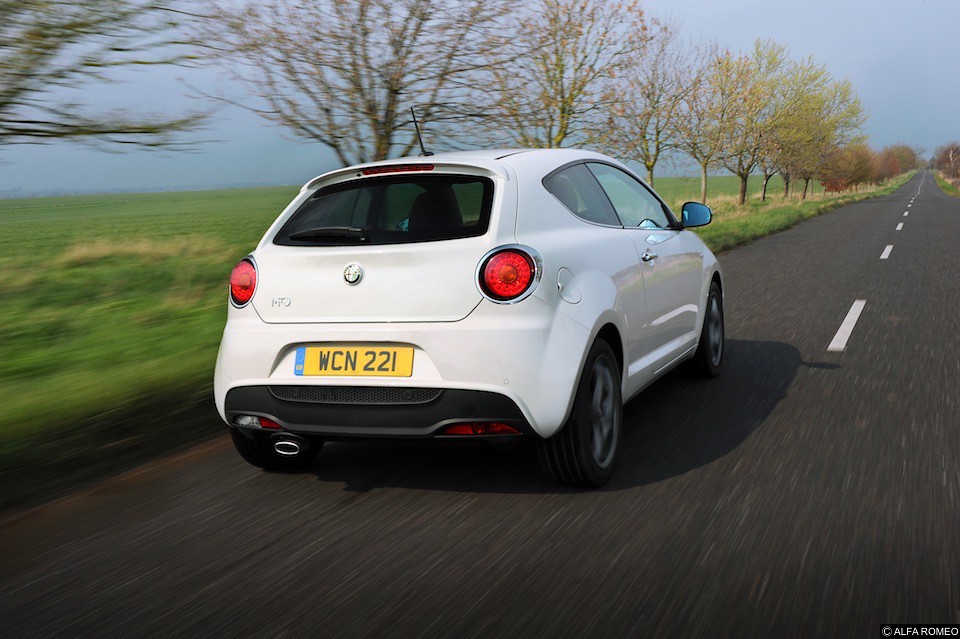
    I always wanted a MiTo. It’s the cheapest and easiest way into Alfa Romeo ownership. Unlike years ago, it won’t fall apart. I almost bought one but university called and so the idea was put on the back burner. When I had finished uni I bought a camper van with the funds instead of the Mito. Was I right to have done so thus not getting another Alfa Romeo?

    Alfa Romeo Mito Car review

    If you want a small three-door hatchback with extreme exclusivity then take a look at the Alfa Romeo MiTo. The MiTo is now some nine years old and still a rare sight on the road. In the time I had one I saw three others. Sadly on all but one occasion, I was driving other cars so I was unable to share the love with an approving wave or a convoy.

    It’s not a great car by any stretch of the imagination. What it is though is an Alfa Romeo, so you can forgive it quite a bit for its flaws. Actually, you forgive it quite a lot. Design wise it is a bit lost. It is a sort of squashed down Giulietta. The result makes it look a bit like a small jacket potato. All is not lost as the potato design is making a comeback. It’s just that the MiTo missed the boat all those years ago.

    Alfa Romeo has a way in making cars. If you want clunk-click every trip then you don’t buy an Alfa Romeo and you certainly wouldn’t upgrade your Polo for one. That changes if you just want to be a little bit different. And the MiTo will fit the bill.

    Some of it in this revamped third face lift model is a bit old school still. The heads up display is red and almost dot matrix in style. The digital expressions of the MiTo coming towards you and away when you turn the key are quite nice touches to have on an older design. You start to like the MiTo. The inbuilt 5” screen satnav with Bluetooth, DAB and all the other things you expect today comes in at an extra £750.

    That’s a lot for 5” of screen but an essential part of the package. You would be a fool not to add it.

    The driving position is quite comfortable. Elbow room is in abundance and it’s no longer the long arm, short legs of previous Alfa Romeos. What isn’t available is oddments space. There just wasn’t the space available that I had become accustomed too.

    The first shopping trip proved rather eventful. The boot is deep. It just goes down and down and down like Mary Poppin’s carpet bag. Ideally, it needs a second floor. It’s not ideal in the day to day. It does give it almost class leading depth though.

    On the road, the little 1.3 diesel engine gives all it can. It’s not the worst out there. It’s quite a likeable unit and belies the 95bhp power that’s available. 200nm of torque at 1500rpm helps. It’s this torque figure, that when combined with the DNA switch in ‘Dynamic’ makes all the difference. In ‘Normal’ mode it felt out of depth. In ‘All terrain’ mode it was hopeless. DNA, now you understand what it stands for. Quite clever marketing really. Dynamic makes it more alive and responsive. To be honest I attempted very little motoring in N or A. A is mainly for atrocious conditions.

    Handling was quite up to spec for an older design. It’s easy to start liking the MiTo when you start to motor along. It lives up to the badge ever so slightly when you hustle it along. It never leaves you breathless but likewise, it never tried to put you in a ditch. The disc brakes on each corner being up to the job.

    It’s a likeable car while also being a bit less successful in many areas. Above all, it’s an Alfa Romeo. The doors are frameless and there is no way you can disguise the fact that in photos you will look great next to frameless doors with the windows down. Strike a pose, there is quite literally NOTHING like it… MiTo MiTo MiTo.

    Love

    Frameless doors
    Design
    Exclusivity

    Loathe

    Deep boot floor
    Price
    DNA switch to normal mode

    The Lowdown
    Car – Alfa Romeo MiTo 1.3 JTDM-2
    Price – £ 17,200 (as tested)
    MPG – 83.1mpg (combined)
    Power – 95bhp @ 3500
    0-62mph – 12.5 seconds
    Top Speed – 112 mph
    Co2 – 89 (g/km)

  • A Day Spent At The Golf Club

    A Day Spent At The Golf Club

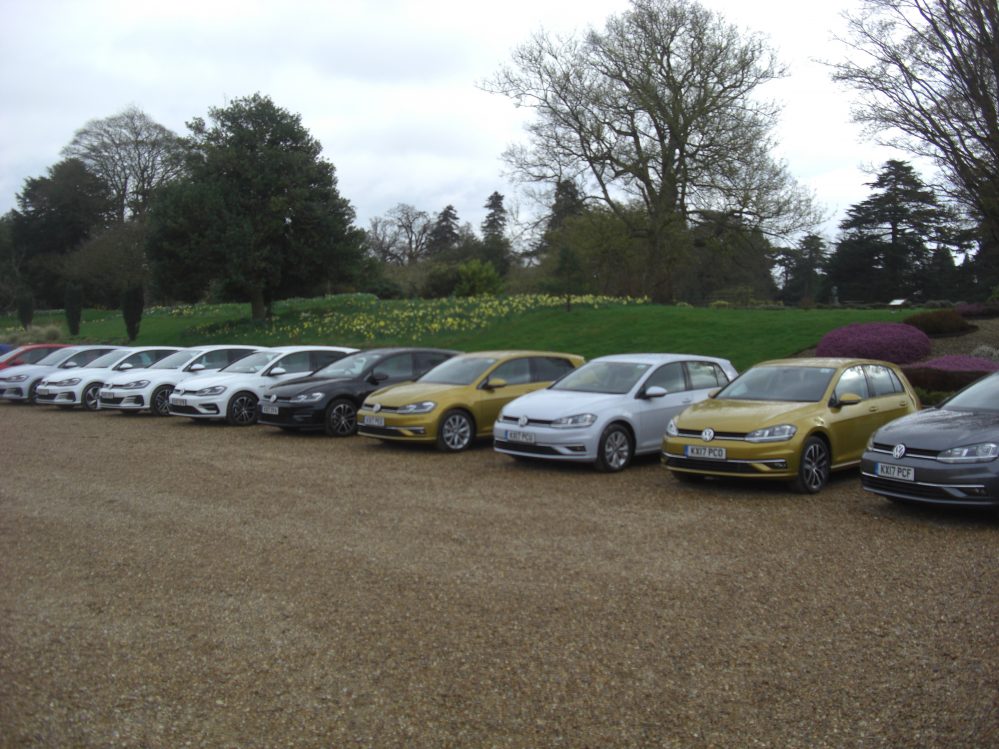
    TheGayUK were fortunate enough to have been invited to the launch of the Mk7 Golf. It wasn’t exactly a new launch but more an update of an existing model. Ever since the Beetle, VW have had a tendency to bring in updates as and when to make a product better. Let’s put it this way, there were more than enough updates to cause a relaunch.

    © Stuart M Bird

    Changes visually were down to lights and bumpers. It’s the technology that lives under the skin that was the main focus. Good news for the Golf driver was prices were down around £650 on average per car.

    We met with Mike Orford, VW’s head of press and public relations. He gave us an over view of what Volkswagen were doing at the time. VW are going full steam to gain buyer confidence in the face of Dieselgate. So far 560,000 cars have gone through the recall, that’s just about 50%. To be honest, with the continuing sales of VW products, you would think Dieselgate was accent history. The reason being for continued European sales is that Volkswagen do make a good product.

    © Stuart M Bird

    Mike talked about new cars coming our way. Some made specifically for overseas markets. A shame really because a couple looked fine and dandy. What l did find puzzling was Volkswagens focus on being less German. If l got that right then l am perplexed. I own 2 Volkswagens myself because of the Germanic quality. This also runs true for Audi.

    Being the biggest car company in the world you can guess one thing. The Golf is the biggest seller. It’s the car every manufacture has tried to emulate. Some have bettered it in places but none have ever made a car as good overall. One of the key facts is its build quality and longevity. This was born true with my old Mk2 still in its prime parked in and amongst the shiny new examples.

    Did you know that there are now 113 different variants of Golf to be had? Basically that means there is now a Golf to suit everybody with prices starting from £17,625 for the 3 door 1 litre TSI to £33,935 for the 5 door, 7 speed R. These are prices without extras. It’s the extras that soon add up as the following reviews to be posted will show. For example the R model l tested was £455 cheaper than the GTE hybrid at £38,175. That GTE really is a car. I was more excited about that one than any other on the day.

    © Stuart M Bird

    In total l managed to test 4 models. The 2 already mentioned plus the Alltrack estate and a 1 litre SE Nav. It gave me a good example of what Golf now offered. Put it this way, when my Golf was new there were about 12 models available. The market has changed.

    So while l take it all in, try and put it into words, here are some pictures of the event with reviews to follow…

    © Stuart M Bird


    © Stuart M Bird
  • CAR REVIEW | Golf GTE

    ★★★★★ | VW Golf GTE Advance 1.4 TSI 150 PS 6 speed DSG 5 door

    There’s A Kind Of Hush All Over Wolfsberg Tonight…

    Volkswagen has teased us with alternative fuelling since the 70s. Back them they fitted 860kg of batteries to a VW T2 panel van. They also played with a hybrid system consisting of 11 batteries in and around the cabin in a T2 taxi. Thankfully battery technology has evolved and we can now get far more from so little.

    In the early 90s alternative fuel and efficiency became less of the buzz work since the fuel crisis of the 70s and more emphasis was placed on environmental issues. Reluctant as we were to give up our four wheels, people wanted greener cars. The diesel car was sold as the greener alternative to petrol, this was when petrol engines were equipped catalytic converters and diesels still filled the air with heavy clouds of sotted pollutant.

    The Golf went through a phase of being battery powered. There was the CityStromer. It gave about 30 miles to a charge making it as good as a milk float. Remember the 30 miles though. It’s a magic number. However, in 1990 there was work on a diesel hybrid Mk2 Golf. VW was on to something. I remember it well. A white Mk2 with big bumpers and garish yellow, orange and red stripes. And then it all went quiet.

    Fast forward 27 years and the electric buzz is back at Volkswagen. There is a new hybrid Golf and the technology isn’t just staying on the Golf. We’ll have it on a lot of other VW’s.


    THEGAYUK was invited to attend the launch of the updated Golf Mk7 and it was the GTE I was most interested in trying. Having recently become a convert of the hybrid, l wanted to see how Volkswagen had executed the package. More importantly, I wanted to know how they transferred the power to the wheels.

    I am glad to say it is impressive. They use their DSG gearbox. This is an electronically controlled dual-clutch multiple-shaft manual gearbox that either changes like a conventional automatic or you can use manual inputs should you wish. Having tried this gearbox on many VW’s over the years I can say it works well unless the car has been modified. Then it becomes quite snatchy.

    There were no such issues. This thing was magic. What it does do is overshadow Toyota’s efforts and puts them in the dark ages where hybrid technology has evolved to. The main reason is the choice of drivetrain. In other words, this isn’t a CVT gearbox.

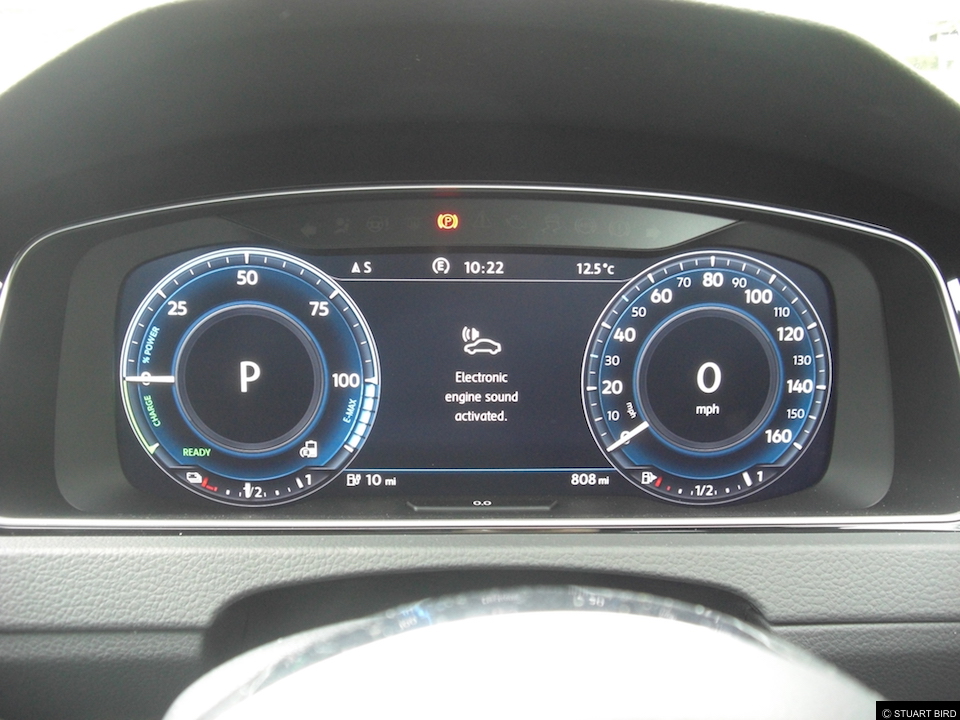
    I don’t know if it was the engineers having a laugh or not but the sound button on the centre console did make me chuckle. Press the sound button and it would emit an audible noise. Apparently, pedestrians are being hit or surprised by hybrid cars. I think having the choice of sound would be quite fun. I’d like a low flying aircraft.

    Enough of my rambling thoughts and back to the GTE. Unlike “conventional” hybrids, the Golf can be selected to drive in any of its three drive modes. Full electric, hybrid or full petrol. The electric is a plug-in type that can be around 80% charged in about 30 minutes. The engine used is the 1395cc petrol unit making 150ps at 5000-6000rpm. The electric motor makes 102ps at 2500rpm.


    In full battery mode, you’ll get that magic 30 miles on a charge. Fear not of running out of power because the petrol engine will jump in and help regenerate power. Likewise, should you floor it and need acceleration, again the petrol engine will jump into life. Unlike a CVT gearbox, the DSG will surge away in utter refinement. All this dashing around can achieve a 0-62mph time of 7.6 seconds. Put into perspective, the 2 litre 310ps Golf R will do the same in 5.1 seconds. This is no hybrid to sniff at. As a matter of fact when all systems are powered up it is pushing out 258Ibs ft of torque. That’s 22 less than the Golf R.

    On the move it was phenomenal. It was quiet. Admittedly the gravel tracks around the Woburn estate could be clearly heard. Once on the main road, it was amazzzzzing. I used some of the test in full battery mode to see what it would do. It behaved like a petrol car except there was a silent surge forward from the instant power the electronic motor gave out. I couldn’t stop smiling.

    In engine and battery power kicked in silently and effortlessly in hybrid mode. It was totally fuss-free. Competent, powerful, had the ability to assist in power delivery for overtaking and all safe in the knowledge that both power systems worked together for maximum efficiency,

    In petrol only mode you were given a Golf that would do what Golfs have done for the past 43 years and that is carry you in a well-made car. Longevity was a key feature mentioned at the launch. A 12 year body protection warranty is proof alone that the Golf will be sticking around.

    Warranty is however always a worry for batteries. VW offer an 8 year/99,360 mile one on them. Why it is 640 mile short of 100,000 miles I do not know.

    There is a down side. It’s the price. Basic price is £31,480. That Golf R and all its crazy power has a starting price of £31,510. Despite the GTE being quick and able to achieve amazing things, it doesn’t do it in the way of the almost same priced R. That said it also doesn’t give you the same head rush as the R and maybe now and again I prefer my car a little less hooligan.

    That in mind a quick look at the recently tested Toyota C-HR was £28,000. In my mind it seems to now be making the Golf R seem like the bargain buy that it shouldn’t be. It’s a quandary that I am in. I liked both Golfs. One that I can justify is the 1 litre TSi. Perhaps l should just have that and add a few stickers to the outside.

    Likes

    Choose the power supply manually
    Transmission of power to the wheels via the DSG gearbox
    Ride quality

    Dislikes

    The price
    Only available in a GT sporty package (at present)
    Questionable combined fuel figures

    The Lowdown
    Car – VW Golf GTE Advance 1.4 TSI 150 PS 6 speed DSG 5 door
    Price – £32,135 (as tested)
    MPG – 156.9 mpg (combined)
    Power – 258bhp
    0-62mph – 7.6 seconds
    Top Speed – 138 mph
    Co2 – 38 (g/km)

  • CAR REVIEW | Vauxhall Cascada

    Vauxhall Cascada… Tonight we can be Glorious

    It’s been a long time coming. Not since the Mk2 Astra GTE of 1986 have I really paid any attention to Vauxhall. I liked the Astra GTE so much that I even drew a picture of one, sent it to Scalextrix and asked them if they would consider putting it in their next lineup. I got a letter and special badge for my efforts.

    Since then, many Vauxhalls have come and gone so it was about time I reacquainted myself with the Griffin and what better than to try the Cascada. You may be wondering what the hell this is? If truth be told so was I when l saw it in the catalogue. It’s a convertible Astra J series. What that means is underneath it is the last generation of Astra but seriously don’t let that put you off. It’s actually quite good and I’ll tell you why.

    I was given the 2 litre 170ps diesel Elite model. For a diesel, it is remarkable for being rattle free. In fact, it made no noise at all which might account for me stalling it on too many occasions to count. Hood up or down, I would say it was as quiet as a Mercedes. I can’t. I tested a Mercedes GLE recently and the Cascada is quieter. Vauxhall has thrown everything they can making the Cascada feel better than it actually is in refinement. Even riding on massive 20-inch rims has done nothing to harm the refinement of the car. It’s quite remarkable.

    Going back to the engine, it is a pleasurable unit to pilot around. According to the spec sheet, it really is the only engine option to go for. The 1.6-litre petrol engines will only better it in top speed and 0-60. That said a 0-60 time of 9.6 seconds isn’t exactly bad. It’s no sports car so these figures are quite on par with the sector.

    It is only when you realise that behind all the glitz, shine, open air motoring and 20-inch rims that this isn’t a sports car you appreciate it even more. It’s a serious cruiser. I only had it for a weekend so on a calm night in March I tootled along some nice roads near me and headed to the coast.

    Through the countryside with the roof down, Sara Cox on the radio, I noticed that the long legs of the gearbox and the reliable torque of the engine made it either essential to change gears or leave it in 4th and enjoy the power surges when needed. Refinement again was very evident here.

    The handling of the Cascada was also better than I thought it would be. Roof down it showed no body flex in fast cornering as is quite acceptable in a car with no roof. Strangely on first acquaintance, it felt like there was more flex with the roof up than down. It covered ground quicker than you’d think.

    I can’t say there were no problems. There were, but these were more annoyances to me. First up was the parking sensors. I’ve never come across a car so paranoid about parking. I was all of 70 cm away from the car in front that the siren alarmed. And it kept alarming. Even when stopped and the handbrake on it still alarmed. Get out, come back and no sooner was the ignition switched on that the alarm about the car in front was screaming. It is utter nonsense for a system to be this hyperactive. Thankfully there is a switch to shut the thing up. Alas, EVERY TIME you step back into the car, the system becomes operable again.

    It’s these private settings as I call them, that annoy me. If I set a system to not alarm I expect it to not alarm until I order it too. This was also evident for the auto lights that tended to be on all the time and the Eco stop-start system.

    What I did like was the roof’s operation. Let’s face it, you buy a soft-top for the open air experience. It was amazingly quick to erect, and could be done so at up to 30mph. You can also do it from the key remote. Step out of the house, lock the door and all while you activate the hoods disappearance. It was cool. In fact, the Cascada got the thumbs up from the yoof of the street. I was even complimented by a teenager and it does attract a lot of attention.

    I don’t mean this in a detrimental way but what makes the Cascada acceptable is that despite its million dollar looks, it’s a Vauxhall. It’s cheap enough not to attract the wrong attention so you can park it up with the roof down. It’s an affordable luxury.

    Roof down and even without the wind deflector it is quite draft free and this remains so up to high speeds. It is strangely a little too noisy for my liking with the roof up.

    The Cascada did have a magic trick up its sleeve. Roofs take up a lot of room. The boots are often useless or no more than a letter box. Push up the box in the boot and it reveals a big boot that also stretches into the cabin with the folding rear seat. It makes it quite a useable car.

    Now here is my real problem with the car. It’s the name. It might mean waterfall in Spanish but it is also the name of the 2013 Eurovision German entrant. Nothing wrong with that. Her song was “Glorious” however, the name of the car isn’t. If I had one, I and I have to say l would, I’d just have to remove the badge from the rear and replace it with Astra.

    Love

    Refined

    Design

    Price

    Loathe

    Paranoid parking sensors

    The name

    Noise with roof up

    The Lowdown

    Car – Vauxhall Cascada Elite 2.0 170ps Blueinjection

    Price – £32,810 (as tested)

    MPG – 57.6mpg (combined)

    Power – 0-62mph – 9.6 seconds

    Top Speed – 135 mph

    Co2 – 129 (g/km)

  • CLASSIC CAR REVIEW | 1992 Alfa Romeo Spider

    Think Alfa Romeo Spider and you instantly think of a gawky Dustin Hoffman and a sexy siren that is Anne Bancroft. The Spider, like Ms Bancroft aged gracefully with very little input from science or cosmetics. Here we take a look at a 1992 Spider that is some 25 years into the production run.

    Alfa Romeo Spyder 1992 review
    CREDIT: Stu Bird

    Launched in 1966 the Pininfarina Duetto as it was then known was built on a very shortened Giulia chassis. While the Giulia exhibited some fine body architecture in its details, it was upright and square and built around a typical 3 box design saloon. It also spawned the very handsome Bertone penned GT coupe models and then came the pretty open top tourer.

    It won praise from the motoring press. For its time it was sophisticated in its underpinnings and no matter what the engine size was, it liked to be driven hard. From the humble 1300cc to the very latest 2 litres with injection, it had the much enthused about twin cam from Alfa Romeo. All the UK could offer at the time were leaky MGB’s and shoddy build quality.

    The Italians have always been good at getting sports cars just right the first time. And ‘the time’ is the essential downfall for them too. It was perfect. So perfect that Alfa Romeo decided to halt development almost immediately after it was launched and close the book on it.

    There were some changes made over its 26-year production run. The stylised boat tail of the early ones was sheared off and made square for the series 2. Then following US regulations where the Spider was an important big seller for Alfa Romeo, it was endowed with big impact bumpers and a rubber spoiler that was literally stapled on it for the series 3. The final model as seen here was developed again out of regulations and fitted with fuel injection and those building girder bumpers were smoothed out. The rear end was also treated to another new look and in some ways looked more like a modern take on the boat tail.

    The main criticism for the UK lover of Alfa Romeo was that the Spider was available only in left-hand drive. Again another classic “qualunque cosa” or ‘whatever’ from Milan. UK importers did, however, offer right-hand drive conversions on the series 4.

    All this didn’t matter. It was an open-topped Alfa Romeo. There is something very passionate about Alfa Romeo and until you have owned one you never fully get to understand them. While they are not quite so thrown together as they were back in the 60s and 70s, they exude an unrivalled following.

    CIMG2227

    Driving one today is a bit of a culture shock. This year sees the 50th year of the Spider. It’s hard to believe that it really is 50 years since it was exposed to the world. In this series 4 model, we are also granted power steering. Something I am told by owner Nigel that is essential. It certainly feels nicely weighted if a little indirect to gentle inputs. The Spider might have been a sports car five decades ago but like over cooked pasta it has gone a bit soggy on the edges when pushed to the limits.

    The driving position is very Italian. Read any old reviews on anything from Italy and you often would read about the long-armed, short-legged driving position you needed to adopt. It isn’t that bad. Again the passion for an Alfa Romeo by its owners is that they will put up with it just because it’s an Alfa Romeo. And don’t be put off by the gearstick that protrudes high up from the dashboard. It looks unnatural though in practice it works a treat.

    CIMG2226

    Treated as a weekend cruiser for pub excursions or showing off how wonderful your life is then the Spider makes sense. The 2 litre injected engine is eager though sadly because of the injection it loses the roar of the carburettors and the rasp in its exhaust note. It will keep up with modern traffic with a recorded maximum speed of 120mph. Not too shabby even by today’s standards.

    Roof off motoring is what the Spider is all about. With the roof up it really is a bit ugly like someone knocked up the roof in a shed so you’ll always want to lower it as often as possible. Roof lowered and it comes alive. The rush of air around you on a balmy early autumn day brings out the giddy grin in your face that makes you more excited than that day you got offered your first dance on a balcony in Sitges by a handsome man in a linen suit and exotic cologne. It’s refreshing.

    On the drive around town owner, Nigel did tell me off for changing up the gears too early. “Why are you in forth? Put it back into second and enjoy the sound” he said. Perhaps I was being a little mechanically sympathetic to someone else’s car but true to his word I did just that and lazy low down torque was replaced once again by the eagerness of the twin cam on tap and mechanical music.

    Owner Nigel has had the car for around 8 years. In that time it has seen a repaint and the wheels have been replaced by retro looking originals from the earlier Spiders. They look fantastic. Wife Helen was less impressed with the hit the bank balance took for them. Some mechanical dramas have been averted thanks to a fantastic network of support for old Alfa Romeos. He still has work that he wants to do it but at the moment she’s a keeper and Italian car nut Nigel wouldn’t be without it.

    I’d certainly have one. The pretty looks and Alfa Romeo engine are a pleasure to all the senses. Despite its visual faults, I’d have a series 3. I just happen to like a bit of tacked on ugliness and an underdog.

  • CAR REVIEW |  Toyota C-HR Excel Hybrid 1.8 CVT

    CAR REVIEW | Toyota C-HR Excel Hybrid 1.8 CVT

    ★★★★ | Toyota C-HR Excel Hybrid 1.8 CVT

    Never before has a car arrived into the avenue and caused quite a stir like that caused by the new Toyota C-HR.

    Next door has been looking to trade in the BMW 3 series for one while those opposite are also considering one to replace their Nissan Duke. 

    Prepare to see more of them because they are good and I’ll tell you why.

    The C-HR arrived brandishing the ‘Hybrid’ moniker and I had a few grumbles. Mainly that it would have a CVT gearbox and like the Prius, it would be noisy. It’s not a Lexus so I wasn’t expecting Lexus levels of serenity.

    On the first drive home, I ate some humble pie through a closed cake hole. It was surprisingly quiet even down to road noise. With the exception of rough and worn out roads, you would struggle to hear more than a gentle tyre roar.

    That drive home also happened to be on a horrendous Friday night. It was dark, wet and everyone was rushing to get home while trying to avoid the fouled up M25. The C-HR was a safe choice that evening. For your £28,885 it had all the usual pieces of kit that you would want. Adaptive cruise, blind spot alert and lane assist.

    This serenity heightened the enjoyment of driving the C-HR.

    I was summonsed to my sisters over the weekend and the 2 hours drive each way was an enjoyable experience. It’s not the most engaging car to drive. Handling at first is a bit of a puzzler. It plays it too safe. Fundamentally, it understeers first and scrabbles away any excess speed in corners if pushed. At first, it feels a bit lacklustre. That is until you look at the speed you approached the corners in. It travels faster than you think it actually going so you become thankful that the C-HR is a little safe.

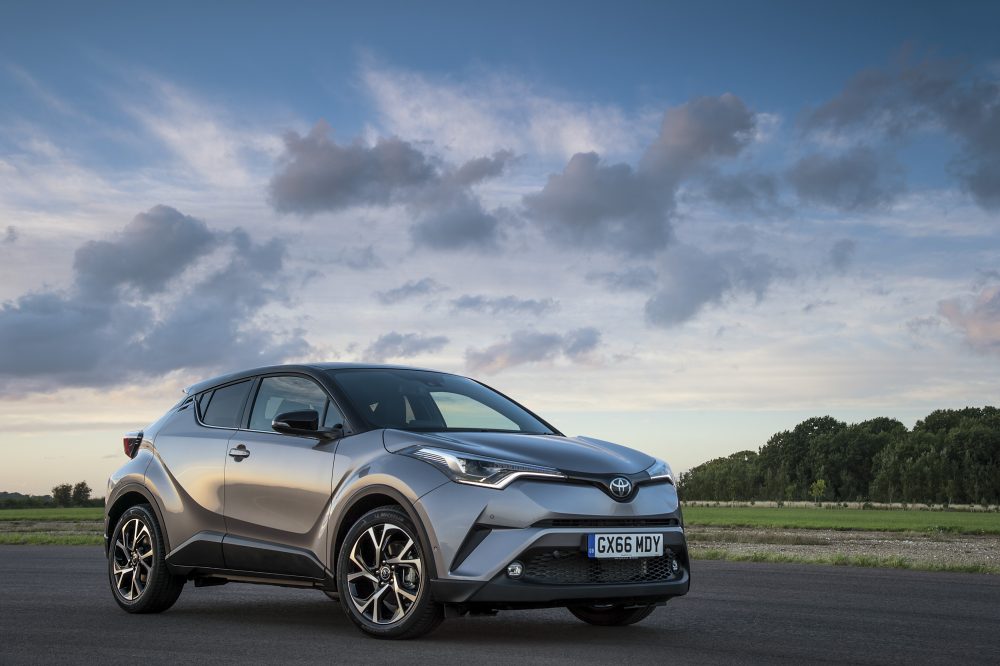
    These gemstones and fluid surfaces of the body make a bold statement. Toyota is pinning a lot on this kind of architectural visual, love it or hate it. In the current climate of grey designs of similarities, it visually hits you. To quote Toyota, “C-HR’s combination of faceted, gemstone-like shapes with fluid surfaces and elegantly integrated detailing creates a delicate balance of precision and sensuality”. 

    Now I am perplexed at that description. Cut through all of that and just say the exterior architecture shows it to have muscles, angular poise and function. In the real world, its striking visuals don’t add up. It isn’t sporty despite its coupe-esque looks on top of a crossover.

    I like the door handle position. In a normal position, it would look out of place. What l don’t like though is the rest of the rear door. The large pillar within the door and the handles placement all make for a really small rear door window. Sitting in the spacious rear with surprisingly good headroom that belies the shape, your view of the outside world is somewhat limited. Large C-pillars and black colours make for a claustrophobic environment for those in the rear. What you do notice from the rear seat is the architecture of the headlining. I’ve never paid any attention to it in any car this side of a 70’s Rolls Royce Camargue.

    What I did absolutely love the most about the interior was the large infotainment screen. What made it even better is that it’s angled more towards the driver. It’s only ever-so-slightly done by a few degrees, making the screen very easy to read very quickly. A quick glance at the screen is all that is needed to find what you wanted to look at. The dashboard display is also typical Toyota and made to be easily read at a glance. 

    Most screens are centralised in a position to accommodate left and right-hand drive models. Let’s hope more start to do this.

    The ride is compliant and smooth. It restored my faith in the Toyota brand that they can make a hybrid that is quiet. The stereo is a little quiet too. Even on the loudest settings it wouldn’t blast out a Kylie tune. 

    My real quibble here though falls to the CVT gearbox. I just don’t like how they work. It’s not their working per se because in normal usage it works well. What ruins it is the moment you become the press-on motorist in a hurry. 

    The 1798cc engine does a great job in propulsion. Maximum torque of 142Nm is there at a useful wide range from 3600 to 4000 rpm. It’s just that you don’t really need to hear all of it and its 97 horses galloping at a higher 5200rpm as it spins away. Why Toyota can’t fit a step up or down system as fitted to the Lexus belies me. Or why they couldn’t give it a better automatic is beyond me. Always a better way Toyota say, a 9-speed auto would be better.

    I’m being hyper critical really and for a good reason. I don’t want to award the C-HR well and not warn of this pitfall. Try it and you might think I am talking rubbish. It’s a good car. I’d have one. It’s well thought out in design. It will carry you in the grimmest of weather on the foulest of days. There will be no fuss made. There are cars out there for more money that can’t do what this Toyota did for me on that Friday. It had me won over within the first 10 miles and it will you too.

    Love

    Ergonomics

    Economy

    Design

    Loathe

    CVT gearbox

    Small rear windows

    Stereo isn’t loud enough

    The Lowdown

    Car – Toyota C-HR Excel Hybrid 1.8 CVT

    Price – £28.885 (as tested)

    MPG – 72.4mpg (combined)

    Power – 120bhp @ 5200rpm petrol (bhp 90 for electric motors)

    0-62mph – 11 seconds

    Top Speed – 105 mph

    Co2 – 87(g/km)