I wrote recently about Volkswagens Passat. I said it was a nice car. Indeed it is. Nothing nasty about it. All quite nice.
I almost mentioned what Passat had done to offend the UK buyer – delete the hatchback option. Unlike our European cousins, we Brits do love a hatchback. So when it was discontinued in 1988 many suburbs of England tutted loudly with disgust. The result was those who wanted a hatchback for tip runs and garden centre expeditions went over to Ford and Vauxhall to get their fill of the lift back.
VW now want to rectify that by giving us the Arteon. Is that how you say it? Art-e-on? Ar-Teon? Air-ton? It was said to me in as many different ways as there are languages in the world. However you pronounce it, it is a car to puzzle over.
NEXT: Inside The Car
Inside the cockpit, it is pretty much pure Passat. The usual three time clocks to look at in the front, none in the rear. Switchgear and controls etc are all pure Passat. Even on the move, it is Passat with that nice feel about it.
Thankfully it is a little more than Passat nice. For a start, the designers have given it pillar-less doors. For some reason, a pillar-less door adds some sex appeal. And the front has been given a more purposeful look with both upper and lower grills integrated into one massive mouth. Sadly from some angles, it can look a little Audi-ish.
All the fun for the British buyer is at the back. Forget the massive amounts of legroom you now get over the Passat sibling for the moment. Your prayers have been answered, you have a boot that lifts up high. High up into the sky to reveal a load capacity of epic size and all in a hatchback style body that VW would rather you refer to as an avant-garde fastback saloon style. It is deceptive. Design wise you do expect it to be another saloon. It was only when l went to lift the boot that l realised something was wrong. It’s a big heavy door to lift. It took me by surprise at first. The ‘nice’ was being eroded.
You don’t really associate Land Rover with wind-in-the-hair motoring unless you’re a farmer with a Defender 110. Sadly for the farming industry, the Defender was pulled from the production lines in 2016 and as of yet there is no serious replacement.
For those needing an open aired Land Rover, there is always the Range Rover Evoque convertible. Admittedly it isn’t as rugged as the old defender and with prices from £53,000, you’re also not likely to throw a poorly sheep into its leather covered upholstered cabin either. In actual fact, you’ll be glad this isn’t as rugged as an old Defender. I’ve been wanting to test one of these since I saw it so come on Barbie, let’s go party!
OK, let us be honest, no one is seriously going to buy one of these for the day to day running of a farm. If you yourself are however looking for a 4 seater SUV styled car with a missing roof then this could be the car for you. In fact, it’s not exactly got much competition. Come to think of it there isn’t much out there at all in the drop-top segment except roof chopped hatchbacks from the Germans. So the Range Rover Evoque wins. Put the roof down, let’s go home.
Not so fast. This still has to please the buyer. Ask a group of road testers and this single car will divide a group. Call it Marmite if you will, you’ll either love it or hate it. There doesn’t seem to be any in-betweens. I am happy to say that this tester, in particular, was pleased as punch with it. I rather liked it. Actually, I liked it a lot.
For a start, it is a full convertible. Press the button and everything overhead disappears into the boot area leaving just the windscreen in front of you. Everything else is gone. Annoyingly all the windows disappear too. I’ve never worked out why manufacturers think we all want the windows down when the roof comes off? Range Rover has thoughtfully given us a switch to override all the window buttons and make the main switch lift or raise all the windows in one go.
On the open road with the roof down not only does it open the cabin to the elements but also your senses. I’d forgotten how you suddenly hear everything around you. It’s like driving with your hearing turned to 11. Your senses will also pick up on on the dynamic change of the vehicle when compared to its hardtop sibling. Its over two tons of weight are evident though, not without good reason. There is thankfully very little scuttle shake.
Suddenly I noticed that the buffering over the shoulder you get from most convertibles was missing. Any car that has a roof missing often results in a cold draft coming over you from behind. On a hot day, it is quite cooling. On a day like our test day, it wouldn’t have been. It was cold and wet. In actual fact, it was VERY wet. The small wind deflector did a good job.
Cabin controls are nicely laid out and it didn’t take long to work out where the heated seat and heated steering wheel buttons were.
Along with the more than adequate heating and all its vents, it was easy to drive with the top down in the coldness. This was a great comfort for what happened next.
Now that 2017 is out of the way and those new year’s resolutions that sounded so promising at 00:03 on January the 1st 2018 have all but faded we now need to look at 2018. What better way to kick-start a fresh fitness regime in February than on two wheels.
There is a lot of buzz about the London built Brompton bicycle. Everyone who owns one loves them. Some people have more than one. It’s almost as iconic as the Fiat 500 or Citroën 2CV.
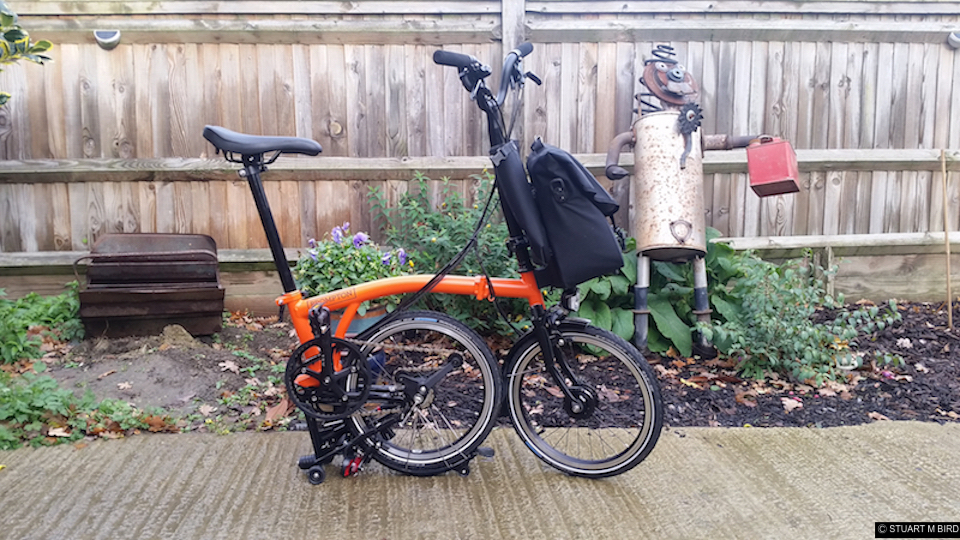
The one we have for testing is the H6L Black Edition with an orange main frame. Made with various components painted black for a sleek urban look, it is available, in a choice of four colours and only available at selected dealers worldwide.
For its £1340 asking price, you don’t feel like you get much for your money. To be fair I choked a little on that myself. It was only when I started using it that I discovered that it makes for good value for money. The most obvious plus is that you can take it with you almost everywhere. It folds neatly and can go under the table. And at 12.3 kg, it is hardly weighty. In simple terms, it’s 12 bags of sugar or two of my nieces at birth.
Seems I am a little out of touch with bicycle purchasing these days. The last time I bought one back in 1996 it was a red mountain bike, 21 speed, alloys. Done. The Brompton has an options list to rival that of the Jaguar XF, well sort of. These bicycles are not your standard run of the mill ‘off the shelf’ at your local bike shop variety. Buy one from eBay and what you save in a few pounds you lose in personalising. For me buying a Brompton would be personalising it for me. It’s a personal purchase.
The bonus of the Brompton is its folding ability into medium sized hand luggage. Folding bikes are not new. However, the way the Brompton folds up makes it ideal for the city commuter and for those with limited space. It means you don’t have to leave it locked up at the train station where inevitably you’re likely to get bits removed or worse still, the entire thing stolen, meaning you have to walk home alone in your spandex.
The actual folding is genius. If you believe the joyous craziness of Anna Rampton played by Sarah Parish on BBC 1’s brilliant W1A you’d be thinking it was a feat of high IQ just to fold it up. In actuality it is no more than a tug, two clamps, an unfold and a pull. It’s all mainly down to the seat post that holds it all together, absolutely, yes, genius, no, there we go. Amazing. In a W1A kind of way.
I was so exciting taking it out of the box for this review that I almost forgot that I had to ride it. Now here comes the crux of the problem. I’ve not ridden a bike for about four years. Admittedly you don’t forget how to ride one. What you do forget is that it takes lung capacity and leg power to make the thing go forward.
After the initial “oh my Christ my LUNGS”, shock and getting past the first ‘burn’ it is actually quite easy to ride. Far easier than my 21-speed mountain bike. Over the course of the week doing around 4 miles a day, I got better and better. The 6-speed gear option for £175 is money well spent. There are two, and 3-speed options and should your commute be based in central London then the saving of £70 might be advisable. As it is, I have various degrees of terrain where I live so the six was more than ideal.
The gears consist of three main gears in the rear Sturmey-Archer hub with an extra choice of two on the geared cog making it 1-3 and 4-6. I found 2 and 5 were best suited to me with one being more than ideal when I wanted to be both lazy and slow. It’s mostly suited for hill climbing.
Other options abound include splash guards. I do recommend the large £55 set. They did a great job in preventing mucky spray up my back and over my trainers. Riding through puddles was quite fun. Just watch out for those potholes. The one Achilles heel is those small wheels. For all their benefit of manoeuvrability tighter than a London Taxi, they are somewhat susceptible to jolting you when you hit the pots. Thankfully its seat is quite well padded and cushioning of one derrière. You’ll be surprised at how much energy is wasted with a seat that is too soft. Your thigh muscles altering all the time make for early fatigue.
There are 13 different types of bag to go with your Brompton. I was sent the reflective O bag for £220. It’s an expensive option I’ll grant you. Cycling shouldn’t just be for health and commuting.
It is immensely practical and big enough to carry more than you’ll need for a picnic in the park. I managed to load it up with all I would need for a party in the park. When it comes to storage, this bag was like that of Mary Poppins. It also doubles up as a shoulder bag with two open pockets to the side. Ideal for quick access to refreshments or baguette carrying.
With all the personalisation that you can spend on the Brompton, I do have one problem with it. Ergonomically their set up might be for the best but I for one like my brake levers just a little more horizontal. To do this will prevent it from folding up and besides, there isn’t enough slack in the gear and brake cables to allow this. The folding tolerances like the build quality are tight and precise.
It’s nicely put together and the skill and engineering that goes into each and every one made shows this is more than just a posh bike with a designer price tag.
The Brompton will never replace the mountain bike. The Brompton isn’t designed to do that. It does make for an ideal city tourer bicycle. It’s difficult to explain this next bit because it doesn’t take much effort to propel it forward. It’s quite relaxing to use and this makes it ideal as a work commute machine. Nothing worse than getting into work with a sweat on. It might not, however, fit under the boot of your midlife crisis sports car as I discovered, though it will fit into the boot of any hatchback so there is no need to fit a boot suspended bike rack.
I’m sold on the idea of the Brompton. It’s small storage requirements are a boon. It fits into your life quite easily. There is even a good network for spares and repairs and a huge cult following. It doesn’t take long to get to know others with one. It’s just that price tag I have a slight problem with. If they were that cheap however then everyone would have one.
Oh hang on, they do. And that tells you something. They really are THAT good.
This Jaguar F-Type is a welcomed departure from grand slam GT cars available. Its styling takes some elements of the old E-type to give it a romance of a time long forgotten. A time when Jaguar’s sports car was the fastest thing on the road and turned heads.
The F-type isn’t all that though. It has a problem, and that problem comes from in-house at Jaguar. I was fortunate to test identical powered coupe and convertible models back to back with one being the clear winner.
Let’s start with the styling. It’s not quite the pin-up poster your father would have had on his bedroom wall back in the day. Forget all about being seduced by this pussycat. It will still fill you with giddy excitement not only because the door handles pop out when you press the remote, but the looks are pure aggression. This femme fatale will scratch your mind and soul with a longing to go out with her again.
It’s amazing what the Jaguar engineers have done to this engine. The four cylinder Ingenium 2 litre turbo has a broad spectrum of uses and can be found in many of the models offered by Jaguar and sister company Land Rover. In the F-type, it has been tweaked and prodded to suit its new sporting clothes. And it’s all quite good. A 155mph two-seater sports car that can achieve around 40mpg.
What’s not to like?
The power outputs sound great on paper. In practice, it is somewhat different. And here is where the F-type either excels or fails. It’s just not that fast. Don’t get me wrong, it’s fast, but for a car dressed to kill in sports car clothing with a 0-60mph dash in 5.4 seconds, it just isn’t fast enough. The problem is those pesky hot hatchbacks. They can be just as quick and for less money. Jaguar does offer more powerful F-types but you will need to pay extra for that, and we are, already up to £50-60k. What the Jaguar has up its sleeve is grand touring luxury.
Inside you are treated to a snug cockpit. Everything falls to hand. And to the hand, you notice items that are there in other Jaguars and Range Rovers. No bad thing in real world terms as this does keep costings down. The one problem I have with the F-Type is the facia in that it is the same as plenty of others in the JLR range. The car is so different in so many ways that it needs to look different. And so too should the heater controls. At this price, they are just a little on the cheap side. This itself goes against the grain of the luxury feel you get from the seat leather and build to how it all moulds together.
And so back to those performance figures. One of the problems with the F-type is in its construction. The all aluminium framed car makes it a heavy vehicle. Added to this the fittings that are well engineered to fit without rattling and more weight is added thus giving the illusion of luxury that is as mentioned, there in abundance.
On the road then and how does it feel? It feels amazing. I’m a sucker for a smooth engine and sweet exhaust note and added to the 8-speed automatic gearbox it feels well suited to everyday use. Here is where it excels. For its few faults and out and out performance, it all adds up to make this a sports car that can be used to pop to the corner shop on a Sunday for a pint of milk and a Sunday paper albeit the long way around. It’s nice and easy to drive, and it looks the business. No one will really know that it’s the slower of the models Jaguar offer.
Pulling out of junctions in wintry wet roads doesn’t end up with the wheels spinning and you looking like an idiot. It pulls away fast and has no trouble putting its power down. It feels quicker than it actually is. On today’s congested roads with mobile cameras popping up all over the place, perhaps feeling faster than it is, isn’t such a bad thing after all.
The sound is quite intoxicating which heightens the sense of urgency. You can switch it off if you like unless you opt for the ‘Dynamic’ setting in which case it is there all the time. Normal mode is pleasant enough. The Coventry cruiser then is a pussycat. Select ‘Dynamic’ and its all noisy roar and claws for what it is. The burble and roar from the exhaust will make you smile.
Handling too will also make you smile. It’s pretty much easy going all the time regardless of the setting you choose. This again adding refinement to a sports car looking package. It’s not bad if I am honest. For everyday use, the F-type is actually rather nice. Unless you are looking for an out and out sports car to do stupid things in, you wouldn’t be too disappointed with the very few shortcomings it has. For what I want in a car like the F-type, it doesn’t fail me, it excels. I want my fast car to be a bit lazy like me and easy going when I want to not think too hard about the road ahead.
So here comes the problem I mentioned at the beginning. What is it to be? Closed coupe with average boot space or a drop top with even less boot space? That’s easy to answer.
That accolade goes to the convertible. The £10,000 more of your cash is a lot to ask for straight out of the showroom. Keep the car for three years and that extra cash paid out will vanish with the joy the snug fitting, but mostly missing roof will have given you.
With my choice made up, I’ll just have to send to the luggage ahead. Hoy hatch performance or not, they don’t quite have what the F Type has. And you remember me telling you about the sound of the exhaust? With that just over your left shoulder, it is pure evocative mechanical magic and I couldn’t get enough of it. Let the wheels roll, the south of France is calling.
Likes
Driving dynamics
Engine sound
Luxury refinement
Loathes
Interior looks a bit dated
Fascia lacks a sporting identity
Handling not exploited with this power.
The Lowdown Car – Jaguar F-Type 2.0L RWD Price – (from) £49,900 Coupe / £59,085 Convertible MPG – 39.2mpg (combined) Power – 300 bhp 0-62mph – 5.4 seconds Top Speed – 155 mph CO2 – 163 (g/km)
You can’t fault it really. From its rusty ashes as the 1968 411, it has grown and with Audi’s influence, VW’s people’s car for the executive has become a staple for the rep about the motorway service area who wants a quieter life than the four roundel sister cars.
And that ladies and gentlemen is the Passat’s problem. It’s too quiet and yet its family timeline to start with was anything but.
Volkswagen CEO Kurt Lotz, from 1968 – 71, had a bit of a task ahead of him. His greatest success was the purchase of NSU along with its water cooling experience. Wheels were in motion for VW’s greatest change. It’s safe to say Lotz would have been proud of the Passat today and as an owner, you would be too.
The GT we tested, left you wanting for nothing. It had all the toys you could wish for. The meagre money VW charges for it (£29,000 starting price), it is a lot of car for your pound. Add the essentials and it soon adds up but the end result is still a great value car. There wasn’t one moment when I wished for more. Actually, I did and I’ll get to that if I haven’t convinced myself that I don’t want it by the time I am finished.
For a start, the petrol engine is quite simply an amazing power unit. It’s by far not the most powerful in the Passat range. The 180ps 1.8 was subtle in the way it delivered the power. While the engine gets into its gallop between 5100 – 6200 rpm with the 236 Ibs ft of torque that kicks in across the 1450 – 3500 rpm rev range. It gets going with a lovely subdued growl. Like drinking the smoothest Baileys with a dollop of extra cream followed by an intense espresso.
The compliant ride adds to this fluid quality feel that you have come to expect from Volkswagen. It smoothed out almost all surfaces and road roar was limited to a mild hum.
The driving experience of the Passat was always a joy and never a chore. Even with the manual gearbox, it didn’t feel like I was being put out because I had a third pedal to press. Clutch controls were nicely weighted to the other controls. VW spend a lot of time on this and they get it right.
It all sounds quite lovely. You can though, push Passat if you’re feeling a little asphalt frisky. the handling is safe and visibility is good. It glides around fast S bends and will mildly understeer if you push it beyond the capabilities of the tyres. Traction kicks in and restores your faith. It’s safe fun. Yet look at its performance figures and you’ll see it’s no slow coach.
A 0-62mph time of 7.7 seconds isn’t too shabby and I’ve no doubt that it will eventually get to the claimed top speed of 144mph.
It’s just that when it does, you’ll have no idea you are going that fast until you see the blues and twos coming up behind you.
Interior quality is second to none. As much as Volkswagen is a premium brand, you have to remember that this isn’t the premium brand from VAG. That is Audi’s job and yet apart from a little too much black around the inside and not enough glitz to break it up, it was well and truly above par.
VW’s sale figures for the Passat astonished me. Despite the Passat being in a small yet aggressive market, there wasn’t as many sold as I thought and yet you see so many on the roads. One wonders if BMW, Mercedes and Audi drivers looked at the values of the Passat that more would be sold. That said for the out and out performance car, it isn’t quite what the Passat image is about despite there being a Passat R.
The dashboard layout benefits from the new system being adopted by VW that has moved the goal posts yet again. Being adaptive in its information allows you to get the best from the car and its calming qualities that all add up to make Passat a nice place to be in. And to make sure you are never late, VW has included three clocks up front. Why? I do not know. Two digital and an analogue one in the centre of the dashboard. I am surprised they haven’t added one in the rear.
With regards to the toys, the Passat is packed with them. The adaptive cruise which I like to see and lane assist. Volkswagen’s system doesn’t cut power off immediately when it notices the driver is going autonomous. It does figure out quite quickly that you are not putting in manual inputs. The alarm sounds to alert you to take control. If you insist on ignoring this, it briefly and yet not dangerously life-threatening to those driving behind you, jabs on the brakes for a split second. It’s most unpleasant. You then tend to not do that again
It all adds up to a nice car. A car for all reasons. You could adorn it with ribbons and use it as a wedding limousine. The bride and groom wouldn’t think you had turned up in a repster mobile. The bride wouldn’t kick off. There would be no drama. And that’s the problem I have. There is simply no drama with the Passat. It’s not like there isn’t room for a drama button on the centre console amongst the blanks on this model.
For £3k more the 2.0-litre models may well give you this but then you lose the sense of great value for what is a very nice car. And only three stars I know seems harsh. It just needs to kick you in the teeth! Sadly for Passat, when you park it up you can walk away, mind rested and soul intact. You’ve arrived.
Love
Nice
Good specification
Value
Loathe
Not as boring as I might have made it sound
Drab in the rear
It’s too nice to add a third thing l don’t like
The Lowdown Car – Volkswagen Passat GT TSI 180ps Price – £35,070 (as tested) MPG – 47.9mpg (combined) Power – 0-62mph – 7.7 seconds Top Speed – 144 mph Co2 – 136 (g/km)
Volkswagen has been busy over the past few years. The needs of the motorist are expanding and their demands are greater than ever before. There once was a time when all you had to do was choose between a saloon, a hatchback or an estate.
Late to the party, VW is now making up for lost time by entering the smaller side of the sports utility vehicle or SUV for short with the recently launched T-Roc.
They are not quite so new to this segment though, their big Touareg has been on the market for the past 15 years. So have they learned from their past.
I’ll try and hide my sort of dislike for SUVs. Unless it is four-wheel drive, I find them nothing more than jacked up hatchbacks on which they are based. The T-Roc being the Golf equivalent. If you look at market shares, the SUV is the fastest growing sector and expectations are growing. People want SUVs for several reasons. One of the main advantages is the view. You sit that little bit higher in one – giving a better command of the road. There is also a sort of status with an SUV. It says “we have a lifestyle that demands this go-anywhere-vehicle” in a way the Chelsea tractor did for those yummy mummies in the 90s and 00s
If truth be told, most SUVs on the road are mainly front wheel drive. VW themselves predict over 75% of sales to be for the FWD platform. They also predict the 1.0TSI SE to be the biggest seller so that’s what we tested first.
VW have done their homework. The four model choice allows the T-Roc to be made to suit the needs of the individual. There are choices not only for the alloy wheels but SE and Design models also get the choice of wheel colour. There are four choices of roof colour to be had and the Design model also allows you to spec the dashboard trim to contrast with the exterior colour. Exposed bodywork within the cabin, even in the higher spec models breaks up the monotony of blacks and greys.
Attention has been made to the inside too. It’s all very Volkswagen and well put together. Everything is where you expect it to be. Seats are comfortable and if it wasn’t for the hard plastics on the dashboard and door trims it would be all rather tactile. It isn’t though. The use of hard plastic is something VW has said the market expects at this price, from this brand at least, you don’t.
It’s fitting for an SUV in that it is rugged but it isn’t the usual VW style I was expecting.
Thankfully there is joy to be found in the little 3 cylinder 1-litre engine. I said this before when I was swept away by its brilliant ability in the Golf. It gives you all it can in a pretty short spread of torque. 148 Ibs/ft is available from 2000 – 3500rpm. After that, the horses take you up to 5000rpm where a gear change is needed. You will, of course, change much lower down with the amount of power available.
What will become apparent however is front wheel tramping if it ever tries to put down all that power from a standing start. It’s quite disconcerting at first. I know the torque figure isn’t massively high in numbers yet this wasn’t noticed in the other models we’ve tested before.
The ride was surprisingly composed for what is a jacked up hatchback. It was a bit floaty in some areas and this added to the urgency of the little 3 cylinder engines excitement. It definitely added an element of ‘sports’ to its SUV title. Care and attention have been given to the T-Roc’s driving dynamics and this is evidenced when you drive it. The T-Roc felt light and spritely on the open country roads around Aynhoe and down fast A roads. Comfortable too from both the driver’s seat and passengers were observed.
The T-Roc is good but not the best. It carries VW into the small SUV market with another car that they will sell confidently in high number. I’m just not sure I agree with them that the best seller will be the 1.0 TSE SE. For me at least I’d prefer to splash out another £2000 and have the 1.5 TSI Design. Some detail changes made it feel nicer as personal transport goes and the engine is so much the better. For a start, the 1.5 with 185 Ibs ft of torque spread across a far greater rev range was better distributed to the driving wheels with far less tramping.
The T-Roc is all new and shiny, VW as we know never sit on their laurels. I’m sure changes are afoot already to make the good car even better. It’s what VW do.
Love
Boot space with split level floor practicality
Ride
Personalisation
Loathe
Dashboard plastics
Front wheel tramping
Interior not as vibrant as its urban looks suggest
The Lowdown Car – Volkswagen T-Roc Design 1.0 TSI Price – £24,385 (as tested) MPG – 55.4 (combined) Power – 115hp 0-62mph – 10.1 seconds Top Speed – 116 mph Co2 – 117 (g/km)
The Lowdown Car – Volkswagen T-Roc Design 1.5 TSI Price – £26,430 (as tested) MPG – 53.3 (combined) Power – 150hp 0-62mph – 8.3 seconds Top Speed – 127 mph Co2 – 120 (g/km)
What a year 2017 has been. Some launches, some vehicles with a difference and now to the top three.
The Almost Ran
There are things l like and then there are a few things l really dislike. I’m talking about the Fiat 124 Spider.
Compared to the Mazda MX-5 that it shares its platform with, it is more expensive. What’s more, the engine needs you to work it to get the best from it. The Mazda (in 1500cc form) was on the boil all the time and the MX-5 is cheaper and with the limited slip differential that Fiat only gave you on the Abarth 124, it made the handling safer and more surefooted.
What l can’t forgive it though is Fiat using the MX-5 dashboard. Such a silly mistake to make. And lazy too. Even the fitments of a different facia binnacle would have been better than this.
So how has this made it into the almost ran if I dislike it so much? I’d go out and buy one tomorrow. Unlike the MX-5, it is dressed in a very stylish suit that makes you look back and admire its style. Admittedly the handling is more twitchy and it’s this that makes it more alive and risky. Get some rear end out action going to work and you can wait until lunchtime before your first coffee. It’s the adrenalin rush it gives you.
And the dashboard? When you’re going fast, you don’t look at it anyway.
And so to my top 3 of 2017.
Dacia Duster. £ 14,990
It’s cheap and cheerful execution actually made this a joy to have for the week. What’s more, it’s an SUV and yet l don’t really like SUVs. Certainly not faux SUVs in 2 wheel drive form anyway. So what is it doing on my New Years Honours list? Its looks are a bit like an estate car and l like estate cars, they ooze practicality. The Duster though is available for not a lot more with a proper 4 wheel drive system. Win win.
New engines available have also made it reach up to today’s standards of performance and economy. Just as it’s about the be replaced by a new model, it was given a brief new lease of life.
There is nothing pretentious about the Duster in any way even in the midrange Lauréate trim level. And yet what surprises, is the way it was put together. Admittedly it isn’t even up to Renault’s standards of today and yet that’s OK.
It’s a Dacia, It’s no-nonsense transport for you and whatever you throw at it. At this price, you will throw everything at it without a care in the world. Not because you won’t actually love it, you will. It will do all that is expected. It’ll be because it feels it can just handle it.
Ford Mustang Convertible. £43,095
Again this is another car that exudes a bit of cheapness. It’s not up to European standards. The fit and finish inside aren’t as tactile as in the new Fiesta and yet for about the same as the highest spec Focus RS, give or take £6000, you get a V8 muscle car with a retractable roof that can light up the tarmac without too much of a problem.
It’s also a car to pose around in. The V8 under the hood rumbles away like a good old Yankee V8 should except this time it’s not as bad for the environment and now fitted with green bits like catalysts and an engine management system keeps tabs on the nasty stuff that comes out of the back. Your grandmother will love it.
Ford thankfully have addressed the rear end and made it a little more acceptable to European standards. It’s now all multi-linked with wishbones and anti-roll bars of a sort and manages to go around corners albeit with a little naughty fun if you so wish it to.
It also has those classic Mustang looks. It makes the car unmistakable from any angle or in any light. You can never mistake it for a…There you go. There is nothing that looks like it apart from an older style mustang.
What is not to like? The Ecoboost engine that’s what. Avoid it. No one wants to hear a muscle car sound like a Fiesta.
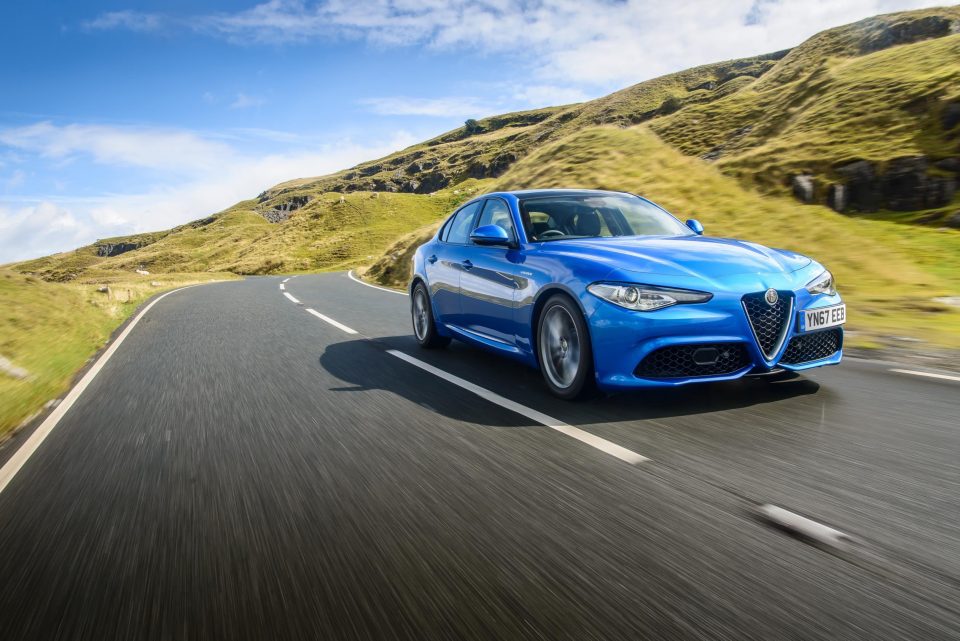
Alfa Romeo Giulia Voloce. £ 39,205
What a car. A car that pipped my proposed number one from the entire list that we had back in the summer. It did everything right. Then we got the Alfa Romeo. And this isn’t if l am honest the best car overall that we tested this year. It is, however, the best driver’s car, with the best seat in the house. It’s so good, that I had to put £30 of my own money into the fuel tank. I couldn’t stop driving it!
Every so often some manufacturers allow their engineers to forget the bean counters and go against the tide of normality to make a car that is available for every man (or woman) to be great to drive. It’s a car that puts the driver first. It isn’t cheap, then again it isn’t the most expensive of the drivers’ cars out there. You’ll be needing deeper pockets for something similar from BMW or Audi.
Stories will unfold about the thing breaking down and it will have its faults. If it didn’t then it wouldn’t be an Alfa Romeo. A car company built with passion over precision of the finer things like a stupid switch working with fluidity. Passion isn’t built into a car, it comes from within. You just can’t manufacture it in a laboratory. It makes you spiritually aware. It has a human touch and quality to it.
The Giulia is a return to form for Alfa Romeo that hasn’t been seen for over 2 decades. The crime is it shouldn’t have happened in the first place so this return should be celebrated and for this l award it THEGAYUK car of the year 2018.
Alfa Romeo has been missing from the compact executive car market since the axe fell on the 159 in 2011. You’d hope then that over the last six years the Italian manufacturer might have got its new car right. If you have read the hype elsewhere, believe it!
Thankfully the Giulia isn’t perfect, and there are still some questionable bits here and there. It’s the sort of things you’d not accept from an Audi. If Alfa Romeo had made it perfect, then it wouldn’t be an Alfa Romeo at all. The world would have stopped spinning on its axes and we would all be engulfed by a burning sun.
Okay so that might be a little dramatic. I for one however do like a bit of drama from my car. In an Alfa Romeo with its rich history of successes and failures you still expect it to be good and bad with a bucket load of enthusiasm. It makes you feel alive when behind the wheel of the new Giulia Veloce.
I’ll start with the enthusiasm side of the car. It’s a great car to drive. The Veloce model is second to end in a five model line up. Only the ferocious Quadrifoglio (Green Cloverleaf) beats it on all levels of driving dynamics. That said the Veloce, at £22,000 less, is by no means less of a car as a commuter saloon/play thing that will make you happy.
You will be happy.
(C) Alfa Romeo
Before you even get into the Giulia, you’re confronted by a classic design in the making. From the front at least. Its tall grill and side vents add a purposeful look which is then given some Alfa flair with the licence plate mounted to the side. What isn’t so successful is the rear. It’s not like Alfa Romeo don’t have any in-house designs from the past that they can work from. The rear is a bit too BMW for my liking.
The first thing you notice when you get inside the Giulia is the steering. It’s phenomenally direct. The smallest inputs translate to so much on the tarmac. You’ll notice this within about 200 meters of driving in a car park. It sets up the DNA of the cars sporting character.
Speaking of DNA (this is the smoothest transition I have come up with yet!) there is the standard DNA switch on the centre console. On the model tested it was the basic switch for Dynamic, Natural and Advance efficiency. You can spec the car for Alfa’s adaptive suspension set up too. As it is, I found it very engaging to use in motion. In basic terminology it alters the parameter workings of the throttle, steering and gearbox responses. In A it is supposed to make it a little more fuel efficient. I’ll put my hand up and say I didn’t notice any difference on the readout because I didn’t try to get green credentials from my week with the Giulia. There simply wasn’t enough time and I was having far too much fun.
D and N are where you will mostly keep it selected. In D it really does make the throttle responses snap-happy. This will frustrate you in its behaviour while pondering life while stuck in city traffic. Switch the N and normality will ensue. The magic in this switch is that you can select its position when on the move and its responses are pretty much instant. See the opportunity, select it and grasp the enjoyment.
Another return to form for the Giulia is being rear wheel drive. Perhaps it has something to do with Ferrari technical director Philippe Krief coming to Alfa Romeo’s rescue has made the Giulia a true driver’s car in almost every sense. The driving is where the pleasure is.
After years of lacklustre attempts at making a fast car with the wheels pulling it forward, Alfa Romeo has put power back to the rear and set the chassis up with a near 50:50 weight transfer balance. Sounds great on paper and on the road it is even better. Where the previous model would scrabble and understeer when pushed, the Giulia will pilot its way around handsomely. Push it and the traction system kicks in sometimes thwarting the fun but not excessively.
Handling when pushed hard is safe. Having gone pleasure bound for four hours along my favourite road full of all sorts of situations, the A259 from Folkestone to Bognor, and in a mixture of weather, it proved itself to be sure-footed. Push it in the right situation and you could get it into a gentle four-wheeled drift. It doesn’t last long because the grip is phenomenal.
You would expect a car set for the sportier driver to ride have a harsh ride and sometimes become unpleasant. It’s not the worst I have tried. Not being adaptive means it stays in that sports set up all the time. The only problem with this is it’s too engaging and encourages you to be a tad more naughty whenever you can get away with it.
With all the goings on in how it rides I almost forgot to talk about the engine. It’s not a lusty Alfa Romeo V6 (that you’ll find in the Quadrifoglio) It’s a 1995cc four-cylinder turbo unit. It makes 280hp and will throw the Giulia down the road from 0-62mph in 5.7 seconds. The way it does it is with little fuss and no turbo lag anywhere within the rev range. The eight-speed automatic gearbox steeps up and down with minimal intrusion. It also has a subdued growl that is more vocal when switched to Dynamic.
In a time when gearshift paddles are getting smaller, Alfa Romeo has bucked the trend and given you two big cold metal shifters to play with. It all boils down to giving you more places to position your hands on the steering wheel to select the gears. The coldness of their metal construction is quite provocative in a way. Their shaped contours felt pleasant to the touch. It’s just another sensual input that makes it feel like a driver’s car.
There are a few problems. Remember this is an Alfa Romeo. For a car with aggressive yet civilised credentials in being all things on the road to man and beast it has a slightly fluffy feeling brake pedal. It doesn’t feel as responsive or as sharp as the rest of the car’s snap-happy weighted inputs and temperament. Thankfully they are more than capable of stopping the car quickly on all surfaces. It’s not often you get to try a car on snow-covered tracks. The ABS stops you with minimal fuss.
The fuel gauge in relation to how much is left never made any sense at all. I lost 140 miles in one 30 mile trip. The battery cover in the boot was poorly fitted and Alfa has decided to redesign the wiper switch with a butterfly design on the stalk. Let’s just say these are the eccentricities of Alfa Romeo and leave it there.
What I am sad to see missing are the three round gauges pointed towards the driver for oil and water temperature and a clock. With this return to form this good I really would have liked to have seen this little nod to the Alfa Romeo’s I was brought up with.
There is absolutely no doubting Alfa Romeo’s commitment to return where they should be in the sporty saloon segment. Sadly it is in a market that is packed full of German machines that continued to evolve with each model change getting better and better year after year. Alfa Romeo has a big job ahead of them if they are to entice the saloon driver away from the German marques. For my money I’d take a chance on the Alfa Romeo. The motoring press is not wrong in what has been said about the new cars driving appeal so repeat after me; I own an Alfa Romeo.
Now doesn’t that make you feel great!
Loves
Handling and road manners
Large gear paddles on the steering wheel
Engine response
Loathes
Some trim fit was poor
No traction off switch
Fuel range less than accurate
Lowdown
Car – Alfa Romeo Giulia Veloce
Price – £39,205 (as tested)
MPG – 46.3 (combined)
Power – 280 bhp
0-62mph – 5.7 seconds
Top Speed – 149mph
Co2 – 141 (g/km)
Welcome to Running w-Heels. A monthly or some such column of the woes and joys I face running an ageing fleet of metal from Italy and Germany. So far the fleet consists of….
Barry. The 1976 VW camper van.
Jelf. The 1991 Mk2 Golf (with Jetta front) GL Auto
Tempra. The 1993 Fiat Tempra
Roberto. The 1982 Fiat X1/9
The X1/9 has been declared SORN and now off the road for winter. An 80’s Fiat full of Italian steel is not known for longevity over a British winter. My local council started to salt the streets early.
The Bus has finally gone off to the painters for a refresh. It’s only taken nine years since I bought it to get to this stage – eventually. More on the renovations another time.
The Fiat Tempra with its partial galvanisation has suddenly been thrust into carrying out the daily commute because the Mk2 Golf has once again decided to a bit bing-bong wrong. The Fiat I might add has been a solid example of reliability compared to the Golf.
I can wax lyrical about the virtues of an old Golf. Volkswagen PR would be happy with the enthusiasm I could spread about the ageing car. Ageing, however, is what the thing is doing and fast.
With the bus out of the workshop, I had planned on attending to a bit of rust l had noticed on the floor and sill by the driver’s side wing. This wasn’t to happen. The water pump had decided to shed its main bearing resulting in a noisy pump that could fling its pulley off at any given moment.
Replacement parts for the Golf are still readily available from most motor factors, and VW does stock some parts though I have discovered that Gates supply them with new cambelts, so that’s what I’ll be using next time and saving in the process too.
What’s so difficult about a water pump on an mk2 Golf? Nothing if I am honest. Nothing that is if the 4 Allen key bolts come free from the main crank pulley. The use of a spline drive bit needed to be hammered in to bite the four rounded Allen key bolts. A few choice words and some grunts and all was free.
Those who will know the wonders of the simplicity of the Mk2 Golf engine will be wondering why I was doing a cambelt as well when the water pump is run of an auxiliary belt. The answer lays in an oil weeping intermediate shaft oil seal. No mean feat and thanks to the Haynes book of lies and Barry Mc Gowan on YouTube, that job was a piece of cake. Also, the cambelt is now four years old and releasing the tension on a belt that is both stretched, and over 30k miles needs replacing. It’s good practice. After all it all that stands between the top and bottom of your engine meeting in the middle.
This isn’t the first time I had done a cambelt I might add. The first was some 20 years ago on a Ford Orion Ghia. That was so simple to do. Even the tensioner was a piece of cake to set.
What I hadn’t taken into account was the plethora of markings on the VW pulleys. I failed if l am honest in timing it up correctly. My fault. Hands up. I did, however, mark it up to using my own marks, so it should have worked. What I hadn’t taken into account was the intermediate shaft being as loose as the Calvin Klein underwear of a rent boy from Kingscross. So the timing went out.
Thankfully I had marked the sprocket so all should have been easy. Not so. Unlike some cars where “special manufacturing tools” are required to lock bits into place, the intermediate shaft had a tendency to rotate a groove or two when lining up the cambelt.
After some more choice words, finding VW’s timing marks and about three attempts later I had it sorted. The belt was on, the tensioner set and to hell with it, I turned the key, and it started.
All bits were put back on, the crank pulley needed drilling and tapping on one of the four bolts because it stripped and the Golf was back to running again.
When I say running again, it wasn’t quite that simple. Six weeks in the sick bay have rendered it a bag of old spanners. It isn’t a car that likes sitting around so not the best car to own when I have others cars (or bicycles) to test over the year. The auto choke unit has now decided to throw over fuelling to the wind, but I feel this is caused by eight weeks of incarceration in the sick bay.
Doing the work myself has saved me a bit of cash. The Mk2 Golf is as simple as a frying pan. It’s been a faff to do all this, but at 110,000 miles it’s no spring chicken of a car. It is, however, developing a pattern of having a major strop at least once a year. This one has cost me £90 in parts. It doesn’t, however, cover the rear brake rebuild, wheel bearings and front brake calliper needed over the year of 2017.
All added up, it does still make for cheap running, but a Citroen Berlingo Multispace with sunroof is getting closer to being on the drive. It’s just that the three on eBay at the time were all red. I’ve two red Fiat’s and a new blue front door. I like coordination so brace yourselves for the shrieks from the TGUK workshop when a blue Berlingo goes for sale anywhere in the country.
With all of its extras, £59,000 worth of Jaguar sits on the drive. It sounds a lot except its starting price is just £42,000.
Just don’t tell anyone.
Sat there in its big blackness of black paint, black wheels and privacy glass, it attracts attention. It attracts compliments. It is safe to say that on the road the compliments are equally forthcoming.
There is something about a Jaguar that you don’t get with any other premium brand car. There is a lot of acknowledgement and a lot of admiration. Perhaps it’s because of its inherent Britishness that does it. Perhaps it’s the drama that has surrounded the Jaguar brand.
Since being taken over by the Tata Group in 2008 the changes at Jaguar were slow and steady at first. Within 8 years they started getting it together. Add a couple of years on top of that and Jaguar now have a bigger range of cars than ever before and the brand is now as desirable as it was in the 60s.
It’s not to say that the 80’s and 90’s Jaguars were not desirable, it’s just that they were questionable in terms of reliability, build quality and resale.
It’s not all good news though. The XF R-Sport I tested failed me in one area. I’m being picky, probably more so than I usually would be but only because I saw it, it annoyed me. The top of the boot area under the parcel shelf lacks a cover. You wouldn’t see it. I can’t quite explain it. It’s just missing. It’s an area that gets missed by many. To me, it’s like the final piece of the boot lining jigsaw.
What isn’t missing is driver enjoyment. From the outside, the big cat is very attractive. Sleek headlights and integral grill now replace the tired retro look they tried. The looks work. It makes for an elegant design. The lines flow from bonnet to boot. There are no tricks.
Driving the XF R-Sport AWD is made easy thanks to the parking assist pack with surround cameras. An option worth having. The cameras show the front wheels making parallel parking a breeze. There is now no excuse to scuff the alloys on a curb.
Adopting a perfect driving position is very easy with almost infinite adjustment available on the memory seats. Handy to have should you wish to car share with a significant other. This then sets you up to enjoy anything you want to throw at the XF R-Sport. I wouldn’t want to be a passenger in the XF. It’s not that you don’t get enough space to stretch out or comfort, it’s just that driving the Jaguar is where you enjoy it the most.
Together the car flows along. The 250ps turbocharged 2 litre Ingenium engines power delivery is smooth and progressive in its application of power making the XF R-Sport a pleasure to drive. It lacks some out and out slam-you-into-the seat throttle reactions but that would only remove you from the linear feel of the cars flowing progress. If you want that from your XF you can always opt for the S model. Don’t think that this XF won’t get out of the way of its own shadow. With a 0-60 time of 6.2 seconds, it isn’t slow. And all this with a commendable low Co2 output.
All this power gets transmitted via an 8-speed automatic gearbox. The ratios are nicely spaced. If pushed it will hold on to the gear which can be a minor inconvenience. Pull out hard and fast and then come off the throttle would often result in a sudden jerk in the ride where the gearbox had held onto the low gear. The price you pay for all that power and the 0-60 time.
The big structure of the shell is in aluminium and this helps make the XF feel light yet being of light construction does not in any way feel like it flexes. It is a taut chassis and good job too. The handling of the all wheel drive system fails to fail you. It holds on with immense grip. Adaptive Surface Response (AdSR) along with adaptive dynamics make split-second changes to the car’s behaviour. It works well. There were times when you could feel it change from soft barge to sports saloon and its job of keeping you on the road was good. I can’t say I went out of my way to provoke it but I tried a couple of times and I can say it sort of left me feeling a little flat.
It’s not that it is a bad thing in any way. All the gizmos go someway to make the big cat very safe if a little too safe. It keeps the car planted to the road and while it makes you feel like the king of the road, unlike some power saloons, it won’t try and kill you. I can live with that.
There were a few things that to me didn’t quite work. The cruise control seemed a little finicky to set at first. There are many switches on the steering wheel. What I expected to find was adaptive cruise. For such a big and powerful car I expect to find this standard equipment for anything that comes with cruise control.
The Jaguar illuminated kick plates were a nice touch. I’m not a fan of blue lighting though. What would have been nice was illuminated steps in the rear. ‘XF’ set in these would have looked quite nice.
I can forgive it the kick plates and boot trim. However, the XF does go some way in making a luxury barge a great British barge. Driving dynamics aside It’s not quite up there with the Germans in interior tactility. It’s very close though and what would look better on the drive? A Jaguar or a Munich motorway muncher? I’ll tell you this for nothing, I’ll have the Jaguar thanks. For a start, people let you out in traffic.
Love
Price
Smooth progressive engine
Economy
Loathe
Lack of adaptive cruise control
A bit too safe in the handling department
Trim tactility
The Lowdown Car – Jaguar XF R-Sport 250ps AWD Price – £58,860 (as tested) MPG – 40.9 mpg (combined) Power – 0-62mph – 6.2 seconds Top Speed – 147 mph Co2 – 159 (g/km)
Sometimes the annoying happens. For some time now I’d wanted to try a Duster and when l managed to get hold of one I was told that it was due for replacement in 2018 but would l still like one anyway?
This got me thinking and with the Duster already being good value for money if you just take its list price as a guide only, I wondered if it would make even better sense to buy one as a run out model or just buy one now?
If you are looking for an SUV type vehicle but feel you need to steer clear of Dacia’s offerings because it seems ridiculously cheap and looks a bit gawky then more fool you. In the days where cheap cars from the Eastern Bloc really were dreadful except for the price and a warranty, then I’d understand your viewpoint. What you need to do is not only take my word for it but also judge for yourself by the number of awards, praise and accolades the Duster has achieved since its UK launch in 2012.
The advertising campaign used for the Duster is a good one too. All multitude of people from all walks of life singing “another one buys a Duster” ending with “hay, why don’t we get one too” and you should.
What you can disregard from the previous models are the engines. The £14,990 Duster Lauréate sitting on my drive came with the 1.2 TCe 125hp engine and not once did l complain. The 205Nm of torque available from 2000rpm was enough if you didn’t mind the occasional cog swap when you wanted to overtake. The little engine was incredibly sweet. Smooth and quiet. It wasn’t what l was expecting if l am honest.
The range starts from £9500 for the basic 2wd Access model that comes with no radio, through a 5 model range topping at a heady £18,400. We were given the midrange Lauréate model in 2wd. You can’t help but notice where the savings have come from and why these are such good value.
It’s pretty much a 2010 Renault Clio inside. No such bad thing to be honest. It’s tried and tested and works. You also notice a massive dial to the right on the dashboard for altering the headlight angles. Something very French and I’ve not seen in a car since the 1980s. Crude, sort of, but immensely effective. And that is the key to the Duster’s success. It’s an immensely effective vehicle.
Renault switchgear aside, the ergonomics are not. The inbuilt satnav and infotainment screen was awkwardly placed and visual information from the screen during a navigated journey would have resulted in eyes coming off the road, adjusting and then back to the road again. The talking part of the satnav works far better in practice and the commands were clear and concise. The 6-speed gearbox was a welcome standard feature if only because in 5th gear, the stick fouled against my lanky resting leg.
That is annoying for one reason, the Duster gets into its stride quite easily and on the fast roads, it is easy to relax and let the satisfactory engine performance do the rest. Fifth is a gear that isn’t needed often except for the most arduous inclines. This then makes the cruise control easier to use.
Load space is plentiful. In a car this cheap you wouldn’t be too picky about throwing everything at it. And good job too. I like to see the odd token of body colour here and there except in the boot where the load edge is uncovered and the inner of the tailgate painted. It wouldn’t take long for this to get scratched. It would infuriate me because l like the car and I’d want to look after it. Speaking of looking after it, it is ok in the put together department too. At this price, it isn’t outstanding but there was nothing I’d be too miffed about. It’s another thing the Duster does to you, you start to appreciate its no-nonsense approach to human transport.
Ride and handling are an odd balance. It’s quite French in its ways. In actuality, it’s quite old-school French. It rides with such a lovely subtle ride that pretty much caresses the irregularities of the road. This also endows it with is a lot of bump steer and corner lurching when you get busy in the S bends. Being slightly jacked up in its SUV format, this exaggerates the motion. For this alone, I would remove the ‘sports’ tag from the SUV. It will carry you great distances in comfort. Used as a load lugger or commuter car is where it is best. A sports car it is not.
It is a pretty sizeable car inside. I put it to good use in collecting some bits for a project. The rear section swallowed a whole camper van door and there was still space for other items. Folding the rear seat was simple and there are some neat locators in the trim to get the seat belts out of the way. With the seats folded they do not give a flat floor area.
Look through the options for the Duster and you’ll be surprised at how well you can spec it up. As it is, the model tested would have done me proud. For little over £2000, you can have all the individual extras available. Some of them are available in packages too. Probably the best package is the extended warranty. For £850 you get 7 years or 100,000 miles of peace of mind motoring as long as you adhere to the terms.
I’d take the Duster as it is, right now, even before the new model arrives. I don’t know about ‘another one buys a Duster’ but I’ve got brass in my pocket and I’m going to use it.
Love
Price
Comfort
Ease of access to service items including lights
Loathe
Exposed paint in the boot area
Infotainment screen position
Ergonomics
The Lowdown Car – Dacia Duster Lauréate TCe 125 4×2 Price – £14,990 (as tested) MPG – 46.3 mpg (combined) Power – 0-62mph – 10.4 seconds Top Speed – 109 mph Co2 – 138 (g/km)