Matthew McConaughey deservedly won an Oscar a couple years back for his portrayal of an AIDS victim in the film Dallas Buyers Club. He definitely won’t win one for his new film Gold.
Gold is the true story of American Kenny Wells – a man so intent on following in his father’s footsteps that he’ll do anything to succeed. His father, played by Craig T. Nelson, founded a mining company, and Kenny wants to keep the company going strong. So he goes in search of gold, a commodity that he hopes is easy to find and which he hopes will make him extremely rich. He teams up with geologist Mike Acosta (Edgar Ramirez), and with Mike’s expertise in knowing where exactly to mine for gold (it is in the unchartered jungles of Indonesia), they easily, perhaps too easily, find gold and become very very rich. Their company goes public and the stock goes up and up and up. Other larger companies start circling around them like vultures trying to buy them out, with investments bankers ready to seal the deal to become rich themselves. It’s all about money and who can trump who, but it comes at a cost. Wells gets malaria in the Indonesian jungle and almost doesn’t survive, his long-term girlfriend Kay (Bryce Dallas Howard) doesn’t like the man he’s become, and to top it off, is Acosta the man he appears to be? It’s basically The Wolf of Wall Street all over again. And if you remember McConnaughey’s excellent cameo in that movie (as a rich and successful banker mentor), well in Gold he is playing a similar character. It’s fine for a few minutes of showmanship but for more than two hours it gets to be a bit too much.
McConaughey, who put on the pounds for this role (he lost the pounds for Dallas Buyers Club), overacts and overacts. Gold, which is set in the eighties, shows Wells as a man who gets everything he wants, and method actor McConaughey plays it over the top. Howard is much much better as his girlfriend – all she wants is a simple life and does not care for nights at the Waldorf Hotel or expensive meals. The standout in this film is Ramirez. He’s charismatic and extremely believable as Well’s business partner, a man who knows his business and can charm both the men and the women. Ramirez was also the lone standout in the awful The Girl on a Train as Doctor Kamal Abdic. Make him a leading man already! Directed by Stephen Gaghan (Traffic and Syriana), in Gold, there’s no excitement, no feeling of happiness or sadness when the characters go through their ups and downs. And the soundtrack is just god awful – the music just doesn’t go with the scenes in the film – it’s tepid at best but belongs in an old cowboy western movie.
Originally scheduled to open wide on December 25, 2016, it was pushed back to open on January 27, with the December 25 release staying a limited release in order to qualify for awards. The film’s limited release was then pushed back to December 30, 2016, four days after its presumed date. Gold has not been nominated for any awards, it doesn’t deserve any.
We looked into Jeremy Corbyn‘s voting record on gay issues to see how LGBT friendly he is.
Since entering the House of Commons as an MP for Islington North in 1983, Jeremy Corbyn has consistently voted pro-gay in laws relating to equality.
During his time as an MP he has voted to reduce and equalise the age of consent for gay men, he voted to allow gay people to become adoptive parents, he voted positively for civil partnerships and for same-sex marriage. He was absent on the vote to repeal Section 28.
However, in 2003 he was absent for the vote on repealing Section 28 “Local Government Bill — Maintain Prohibition on Promotion of Homosexuality (Section 28)”
This article was updated on the 28th May, 2019 – to reflect Jeremy Corbin’s absent vote on Section 28.
Ian Howley has been confirmed as GMFA’s permanent Chief Executive Officer. Ian has been with GMFA/HERO since 2010 and took over as Interim Chief Executive in August 2016.
Alan Palmer, Chair of Health Equality and Rights Organisation (HERO), the parent organisation of GMFA said,
“I’m delighted that the Board has confirmed Ian Howley as Chief Executive. Since being appointed as Interim Chief Executive, Ian has demonstrated the values, knowledge and commitment needed to lead this organisation. He has managed a hugely successful relaunch of FS as The LGBT Fact Site, enabling HERO to build on our achievements in providing accurate information to gay and bisexual men to ensure that we can do the same for the wider LGBT communities. Under Ian’s leadership, HERO has had its best ever World AIDS Day campaign, raising vital funds to help us continue our work into and beyond our 25th year.”
Ian commenting on his appointment said,
“I am delighted to have been confirmed as Chief Executive of GMFA/HERO after a successful interim period. When I first joined GMFA in 2010 I knew I was part of something special and have given my all to make sure that GMFA and HERO makes a difference to LGBT people. In the last seven years, we have worked hard to help GMFA make a difference in the community. While we are still in uncertain times, and there will be challenges ahead, I promise that GMFA and HERO will fight to help and support LGBT people to create personal and social change in their own lives and community. As GMFA enters its 25th year of existence, we need a focused and united approach to LGBT health inequalities such as the high rate of suicide in gay and bisexual men, mental health support, HIV prevention and sex and relationship education – all of which are important issues in the LGBT community. I’m proud to lead a team that’s dedicated in achieving this.
“There is more to HIV prevention than just telling gay and bisexual men to wear a condom or just take PrEP. How we view ourselves, our self-esteem and self-worth all plays a part. We are also entering a mental health time bomb. Suicide is at its highest it’s ever been for gay men. Chemsex and the affect it has on gay men’s mental health is also becoming an issue. The battle for health equality is still ongoing and we here at GMFA and HERO promise to try our best to create personal and social change for gay and bisexual men and in the wider LGBT community.”
The Labour leader, Jeremy Corbyn seems to think that gay people “chose” their sexuality after he made a speech at LGBT History Month event.
Jeremy Corbin Garry Knight England CC
Opps. Jeremy Corbyn seems to think that the LGBT community has chosen its sexuality in a gaffe at the launch of LGBT History Month.
During his launch speech, he said,
“We’re with you, we’re in solidarity with you,’ he said. ‘Your triumphs are our triumphs.
“Our defence of you is a defence of all of humanity and the right of people to practise the life they want to practise, rather than be criminalised, brutalised and murdered, simply because they chose to be gay, they chose to be lesbian, they were LGBT in any form.”
The video was shot by PinkNews who shared the video via their Facebook page. According to The Sun, the CEO of PinkNews, Benjamin Cohen said the remarks “were being taken out of context”.
A spokesperson for Jeremy Corbyn said to PinkNews,
“Jeremy clearly doesn’t believe that being gay is a choice.
“Jeremy obviously meant people should be able to choose how they live their lives.”
“Obviously” seems to be a strange word in this context… because obviously, the video evidence seems to suggest something else.
People on social media were quick to condem his choice of words, with one saying that his words had “crumbled” her heart.
Here in the UK, we are privileged to have a vast array of such wonderful theatres. We have the bright lights of the West End with its huge productions and international box office smashes, the incredible array of regional theatres producing their own very high quality shows and providing venues for wonderful touring productions and those little community theatres which provide immense pleasure for those both performing and viewing the amateur productions and the more off-beat shows.
So, given the gift of theatre that we are given, is it really so hard for people to behave in a manner befitting? I have increasingly noted that theatre etiquette is sadly lacking, which is a shame when you have paid a not insignificant amount of money for your ticket, only to have the joys of watching a live performance tainted by the severely lacking social skills of those around you. Only last night at the theatre, I had to engage in my now regular pastime of telling audience members around me to please be quiet. I am quickly developing into a habitual “shush-er”, when really, I shouldn’t have to engage in such a disruptive and unpleasant activity.
So, following a frustrating evening listening to the old woman three seats down talk about how her neighbour had slipped a disc (yes, really – this was an actual discussion taking place during the performance) and listening to the guy two rows behind singing along with every musical number, I have written this cut out and keep guide to theatre etiquette. There are seven simple steps to take to ensure that everyone has a pleasant evening.
Rule 1 – Keep it buttoned. There is absolutely no need to talk during the play or show. If you want to have a night out with your friends and have a good old chin-wag, then instead of spending £35 each on a theatre ticket, spend it on booze in a pub, where you can chat away to your heart’s content.
Rule 2 – Keep it in your pocket. There is a reason why, at the start of every performance, there is a request to turn off your mobile phone. Even if it is on silent, it doesn’t prevent you from annoying the people around you by checking your Facebook, twitter, emails or texts every five minutes. Seriously, if you cannot live for two hours (or even an hour if you know that the interval is coming up) without checking whether your friend’s status has changed or to see if someone has posted a hilarious picture of a kitten in a wine glass, then you either need to stay in your home indefinitely or obtain some therapeutic intervention.
Rule 3 – Keep ‘em still. Tapping your feet to the musical numbers is a terrific compliment to the composer, but there is no need to use your feet to rhythmically tap out each bar to the song on the seat in front of you, much to the annoyance of the theatre goer occupying your impromptu percussion instrument. Equally, there is no need to announce to the four rows around you that “Oh…I like this one”, when the opening bar of a song is played.
Rule 4 – Keep your vocal chords in check. Just because you think you sound great singing along to your Grease soundtrack CD in the shower doesn’t mean that you can undertake an encore performance in the middle of the theatre. People have come to hear the performers sing, not listen to your out of tune caterwauling. So, you know some of the words to the songs – well done – but please don’t feel the need to demonstrate your lyrical knowledge.
Rule 5 – Keep it real. Just because you once performed in an amateur production of Sweeny Todd, it doesn’t mean that you have to recite the script with the actors on stage, tell your companion how your scenes were done differently to the ones on the stage or hum along to the music. Also, just because it is an amateur production and you have only paid a few quid for your ticket; it does not negate the need to be respectful to those around you. Equally, with amateur productions, just because you vaguely know one of the cast members because she is your next door neighbour’s best friend’s babysitter’s dog walker doesn’t give you the right to talk all the way through the show.
Rule 6 – Keep it on time. It’s not that difficult to get somewhere on time. If the show starts at 7.15pm, then aim to get to theatre for 7pm. Distracting the audience by making a kerfuffle arriving late and disrupting an entire row of people to get to your seats in the middle of the row halfway through the opening number is very off-putting.
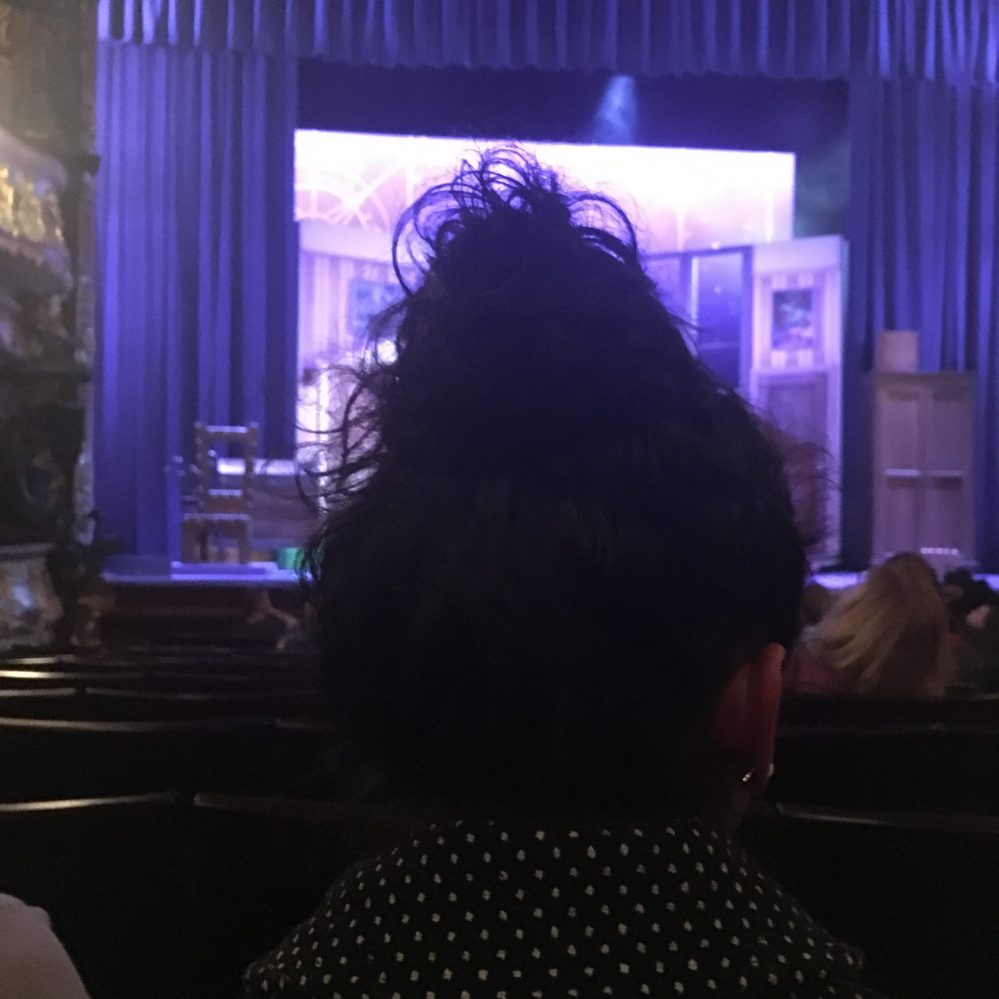
Rule 7 – Keep it in the seat. Leaning forward in your seat, especially in the Balcony, simply blocks the view of the person behind you. That leads to them having to lean forward, blocking the view of the person behind them…. and like ripples on the surface of a pond caused by a stone being casually tossed into the still water, the effect spreads out until the majority of people have a blocked view. Also, if you are tall, as I am, be mindful of the person behind you. It doesn’t hurt to sit a little lower in your seat. After all, no one has come to the theatre to see a performance by the back of your head.
Rule 8 – Don’t have a top bun…
It’s not hard, is it? Please note that the majority of this guide applies equally to the cinema as well.
Joking aside, it is a case of common courtesy both to the performers on stage and those around you. I know an increasing number of theatre goers who share my frustrations. The thing is, everyone’s experience is enhanced by a little courtesy and those who chat their way through the show may actually find they enjoy it even more if they actually sit and watch it, instead of tweeting, emailing, and texting before engaging in a four minute conversation by asking their companion what they have just missed!
In this article, we look at the history of marriage in the UK. Our history starts at 410AD, as before this time there were no written records of the history of marriage. Before written records, history was passed down orally from the older generation to the younger one, unfortunately, over time this oral history has been lost.
410AD – The Anglo-Saxons and Other Tribal Groups
For many people, marriage is strongly associated with religion, but this wasn’t always the case. Straight marriages at this time were about peace and prosperity rather than religion. Marriages encouraged good diplomatic relations and the development of trade between two (or more) tribal groups.
It was the fathers who decided who their daughters married and the wishes of the couple were seen as irrelevant.
12th Century – Consent
In 1140 Decretum Grantiani wrote a canon textbook where he introduced the concept of verbal consent to straight marriage and the requirement for a couple to consummate their union to validate their marriage.
In the 12th century, the Roman Catholic Church made verbal consent and consummation necessary for the church to view the straight marriage as legitimate. Some Roman Catholic writers at the time also describe marriage as a spiritual experience tied to God’s presence. While this is not surprising, prior to this very little mention of marriage as a spiritual experience.
1549 – The Vows
The tradition of vows came from Thomas Cranmer’s Book of Common Prayer. Although the book was updated, later on, many of Thomas Cranmer’s words are still used in religious ceremonies today.
These vows laid the foundation for how the Roman Catholic & Protestant churches viewed straight marriage at the time as a partnership.
Thomas Cranmer must have reflected the views of the mainstream population about marriage at the time; otherwise, it would have been unlikely that the church institutions would have accepted and taken on these views.
Roman Catholic Priests at this time were still delivering marriage ceremonies (as all other religious services) in Latin.
However, the Protestant’s began delivering their services in the English language. This is significant as English was the common language and this change made marriage ceremonies (as well as all other religious services) accessible to all.
Today, Protestantism is one the most popular religions practised in the UK. Many historians believe that changing the ceremonies to English played a huge part in making Protestantism a dominant religion.
1563 – Sacramental Marriage
The Roman Catholic Church officially declared that straight marriage was one of the seven sacraments in this year; meaning that it was something undertaken in the presence of god. The other sacraments are: Baptism, Confirmation, Holy Communion, Confession, Ordination and Last Rites.
The Protestant Church didn’t see straight marriage as a sacrament at this time.
1753 – State Involvement
The Clandestine Marriage Act (1753) set out what the state expected in order for a straight marriage to be seen as legal. It required the couple to get married in a church by a minister and issue a formal marriage announcement or to obtain a marriage license.
1836 – Civil Marriages
In 1836 it became legal for straight couples to get civil marriages, which were generally held in Register Offices. This was to accommodate both the religious and nonreligious.
For the religious, it meant that they could get married in a neutral place if for some reason they couldn’t get married in their church. For the nonreligious, it gave them a place void of religion. Prior to this, nonreligious straight couples had to go through a ceremony in a church and undertake practices & traditions that they didn’t believe in.
In 1837 the civil registration of straight marriages started.
1837 – It’s All About Straight Love
Between 1837-1901 it was the Victorian Era. It is said by contemporary historians that the Victorian Era is when marriage became about love, but still only the love between a man and a woman. Gay people weren’t treated well in the Victorian Era in the UK, with laws against sexual acts.
Oscar Wilde – widely regarded as one of the most talented writers of all time; was accused of sodomy by the father of his male lover. He lost the trial and was sent to prison. It was rumoured that he could have escaped to France, but he didn’t. Once he’d served his sentence, he moved to France.
1858 – Divorce
Between the 17th – 19th Centuries there were 300 cases of people wanting to end their marriages. The only way to do this was for an Act of Parliament for each marriage, as there was no accommodation for divorce in marriage law. So in 1858 the government of the time finally made divorce a legal process.
The legal process that meant those who wanted or needed a divorce could have one. But it also signified a shift in the focus of marriage from being a lifetime commitment – for better or worse, to a commitment that could be changed if life’s circumstances changed.
19th Century – Birth Control
By the 19th Century, both the Roman Catholic and Protestant Church’s had promoted procreation as the main reason for straight marriage. But as more children survived childhood, families got bigger and there was a need to use some form of contraception.
In the 1930s the Protestant Church accepted contraception, viewing it as necessary and not a sin or something God would be unhappy with. But the Roman Catholic Church has remained against any form of contraception, as they continue to see the procreation of children as a fundamental aspect of straight marriage.
2005 – Civil Partnerships
In 2005 the first gay civil partnerships took place, a year after The Civil Partnership Act came into law.
It allowed gay people to have legally recognised relationships, which granted them the same rights, protections and benefits of a married straight couple. This included legal rights, such as being one another’s Next of Kin; rights related to their partner’s children and the benefits including those of taxation reductions.
In terms of the actual act, the gay couple could have a civil partnership ceremony that could consist of anything they wanted (within the law). This could be vows, the exchange of rings, their choice in music, etc.
The Civil Partnership Act included a legal process for those gay people who may want to end their civil partnership. It is called ‘dissolution’ and works on similar legal principles to divorce.
This was the first time that the state in the UK legally recognised gay relationships. In the first five, there were 42,778 gay civil partnerships.
Peter Tatchell (Gay Rights Activist), as well as others, criticised The Civil Partnership Act, saying that it wasn’t complete equality as it excluded straight people from being able to be civil partners.
2013 – Gay Marriage
Last year The Marriage (Same Sex Couples) Act has been passed in England and Wales. The first gay marriages are expected in March 2014.
Stonewall said of The Marriage (Same Sex Couples) Act:
‘This is an historic moment for lesbian, gay and bisexual people, their families and their friends. This Act will mean that, for the first time, children growing up to be gay in England and Wales will have full equality in law. We can now proudly claim to be a beacon to the world for gay equality.’
In ancient history, marriage had nothing to do with religion but helped tribes to live and thrive together. Then Christian institutions (both Roman Catholic & Protestant Churches) influenced the definition and meaning of marriage. In the last century, the state has got involved for marriage, allowing marriage to be more flexible and much more inclusive.
Marriage as a concept has evolved to meet the needs and desires of society. Currently, there is some debate as to what role the churches and state play within marriage. It is likely that over the next century the Churches will continue to reside over the spiritual aspect of marriage, whereas the state will continue to be involved with the legal and administrative side of marriage.
Antony Simpson, Writer of this article would like to acknowledge the following sources that supported putting together this article based on fact:
BBC – Ten key moments in the history of marriage
http://www.bbc.co.uk/news/magazine-17351133
Office for National Statistics – Civil Partnerships Five Years On
http://www.ons.gov.uk/ons/rel/…rd/…/ard-pt145-civil-partnerships.pdf
Office for National Statistics – Video Summary: What does the Census tell us about religion in 2011?
http://www.ons.gov.uk/ons/rel/census/2011-census/detailed-characteristics-for-local-authorities-in-england-and-wales/video-summary-religion.html
Peter Tatchell – A setback for equality
http://www.petertatchell.net/lgbt_rights/partnerships/Straight-civil-partnerships-defeated.htm
Stonewall – Equal Marriage to become law – Thank You!
https://www.stonewall.org.uk/what_we_do/parliamentary/5714.asp
Stonewall – Get Hitched! A Guide to Civil Partnership
Star Trek’s George Takei has a stark warning for Donald Trump if he signs an anti-LGBT discrimination order.
“My people protest HARD” is the war cry from George Takei this morning after it emerged that a leaked and unverified anti-LGBT executive order has surfaced. The EO would effectively end LGBT protections in the US as we know it. It could place religious beliefs over LGBT rights and equality. It’s an EO that would climb into almost every part of American gay, lesbian, bi and transgender people’s lives, from housing to the procurement of goods and even medical care.
If Trump signs that exec order authorizing LGBT discrimination in the name of religious freedom, he'll regret it. My people protest HARD.
The document, which has not been yet been verified, stirred George Takei into fighting talk. Taking to Twitter he said,
“If Trump signs that exec order authorizing LGBT discrimination in the name of religious freedom, he’ll regret it. My people protest HARD.”
The tweet has already been retweeted nearly 5000 times and has been liked 17,000 times.
The White House issued a statement earlier this week to say that Donald Trump was “proud to have been the first ever GOP (Republican) nominee to mention the LGBTQ community in his nomination acceptance speech”, the statement also pledged to “protect the community from violence and oppression”.
National Children’s counselling helpline, Childline is receiving around 21 calls a day from children concerned about coming out, acceptance and gender dysphoria and being transgender.
Children’s charity says it’s received a 47 per cent soar in calls from children worried about LGBT matters.
In 2015-16 the charity carried out 7729 counselling sessions with children.
Fear of stigmatisation still a real concern for children between the age of 12 and 15.
Children’s charity NSPCC which runs the national helpline, Childline, has revealed that calls to their counselling service have risen by nearly 50 per cent from children who have concerns about coming out, acceptance, gender dysphoria and being transgender. The charity’s CEO Peter Wanless said, that children as young as 12 fear stigmatisation and anti-LGBT bullying which could leave to serious mental health issues.
He called upon adults such as parents, teachers or relations to encourage young people to “speak out” and to make them feel confident in speaking openly about sexuality or gender identity.
He said,
“Talking about sexuality and gender identity can be daunting for anyone, but especially for children and young people who are still trying to find their place in the world. Fear of being stigmatized or subjected to bullying can force many to bottle up their thoughts and feelings which can leave them feeling isolated, and can trigger serious mental health issues.
“It is vital children and young people feel confident and supported to speak openly about sexuality or gender identity without fear of negative reactions and abuse. Adults, be it a parent, relation, teacher or friend, have a key part to play by helping them navigate these difficult and confusing issues, encouraging them to speak out, if not to them, then to peers or Childline.”
12-15-year-olds were most likely to contact Childline online or over the phone to talk about issues including coming out, self-acceptance and gender dysphoria and transgenderism. In a quarter of counselling sessions about sexuality and gender identity issues, the young person told Childline they had not previously confided in anyone else, many told us they found it difficult to talk openly with peers and family members.
Homophobic bullying was mentioned in almost 450 counselling sessions and can stop young people from speaking out about sexuality or gender identity. In almost a quarter (24%) of counselling sessions about sexuality or gender identity, young people said they suffered from depression, low self-esteem, self-harm or suicidal thoughts.
Dame Esther Rantzen, President of Childline said,
“I have met young people who were desperately unhappy because they couldn’t talk to anyone about issues regarding their sexuality and I am so pleased that they do feel able to talk to Childline and reveal their feelings without being judged or stigmatised. It is not helpful that children use the term ‘gay’ as a common term of playground abuse.
“Furthermore, for years the adult world has created a taboo around these issues which effectively imprisoned young people and in some cases has even led to depression and suicide. Childline is calling upon the adult world to listen sensitively and support young people and protect them from this profound unhappiness and loneliness.”
Any child or young person who wants to talk about sexuality or gender issues can call Childline on 0800 1111 or visit www.childline.org.uk
After being nominated for 7 Dorian awards, Moonlight has been named Best Film of the Year by the Gay and Lesbian Entertainment Critics Circle (GALECA).
This coming-of-age drama set in Miami over a span of 20 years was also voted LGBT+ Film of the Year, and won awards for Barry Jenkins for his direction and screenplay. Mahershala Ali was named Best Actor, while Trevante Rhodes, who plays the adult version of the film’s main character, was voted the Rising Star Award.
Viola Davis won Best Actress for her role in Fences.
The late Carrie Fisher was awarded Wilde Wit of the Year (honouring a performer, writer or commentator whose observations both challenge and amuse) while John Water was named Timeless Star ((honouring an actor or performer whose exemplary career is marked by character, wisdom and wit).
GALECA is comprised of more than 170 film and TV critics and entertainment journalists across the US, Canada and the UK. The awards cover both film and television.
The winners will be honoured at a special ‘toast’ ceremony to be held on Saturday, February 18th in Los Angeles.
Here is a complete list of the winners:
Film of the Year
Moonlight (A24)
Director of the Year (Film or Television)
Barry Jenkins, Moonlight (A24)
Film Performance of the Year – Actress
Viola Davis, Fences (Paramount)
Film Performance of the Year – Actor
Mahershala Ali, Moonlight (A24)
LGBTQ Film of the Year:
Moonlight (A24)
Foreign-Language Film of the Year
The Handmaiden (Amazon Studios)
Screenplay of the Year
Barry Jenkins, Moonlight (A24)
Documentary of the Year (theatrical release, TV airing or DVD release)
O.J.: Made in America (ESPN Films)
Visually Striking Film of the Year
La La Land (Lionsgate)
Unsung Film of the Year
Christine (The Orchard)
Campy Film of the Year
The Dressmaker (Broad Green/Amazon Studios)
TV Drama of the Year
The People v. O.J. Simpson: American Crime Story (FX)
TV Comedy of the Year
Transparent (Amazon)
TV Performance of the Year – Actor
Jeffrey Tambor, Transparent (Amazon)
TV Performance of the Year – Actress
Sarah Paulson, American Crime Story: The People v. O.J. Simpson (FX)
TV Current Affairs Show of the Year
Full Frontal With Samantha Bee (TBS)
TV Musical Performance of the Year
Kate McKinnon, “Hallelujah,” Saturday Night Live (NBC)
LGBTQ TV Show of the Year
Transparent (Amazon)
Unsung TV Show of the Year
The Real O’Neals (ABC)
Campy TV Show of the Year
RuPaul’s Drag Race All-Stars (Logo)
We’re Wilde About You! Rising Star of the Year
Trevante Rhodes
Wilde Wit of the Year (honouring a performer, writer or commentator whose observations both challenge and amuse):
Carrie Fisher
Wilde Artist of the Year (honouring a truly groundbreaking force in the fields of film, theatre and/or television) (tie)
Kate McKinnon
Lin-Manuel Miranda
Timeless Star (honouring an actor or performer whose exemplary career is marked by character, wisdom and wit)
John Waters
Now, I’m not one to rain on anyone’s parade and I’m the first to shout out a resounding YES to the fact that we have marriage equality. I’m stunned that I’ve seen so many changes in societal attitudes since my teenage years 20 plus years ago. I’m all for liberty, equality and freedom of expression. Except when it comes to bad taste.
There’s just one issue in this whole thing. I may now get more wedding invites and I bloody hate weddings. I dodge, feign illness and fake deaths (including my own): just to avoid these often-horrible things. They’re just not my thing at all. One sniff of a fat uncle dancing with a small child to ‘Come on Eileen’ or the oily drip of a 99% oil chocolate fountain and I’m running for cover.
Here’s my top five wedding don’ts for those planning to tie the knot:
1) Eskimo/Native American/Self-penned love poems.
OK. We get it. We know you’re quite fond of each other but we do not want to regurgitate our lunch. If you need to recite little poems to each other then there’s a time and a place…maybe just before you are both put to death by lethal injection for mawkish bad taste? Is that a crime punishable by death? I hope so.
2) Bizarre Outfits.
OK, so your mother’s cousin’s milkman’s best friend was Scottish or at least he once shared a lift with someone from Perth, but this is no reason to wear a kilt, especially if you haven’t got good knees. Cummerbunds, tuxedos, matching suits, pastel shades: they’re fine as an ironic statement but not to have in photographs that we’re quite frankly all going to be wincing at before we’ve even recovered from our hangovers.
3) The Chocolate Fountain
Unless this is a euphemism for some nefarious sexual practice that you and your guests will all enjoy then no. Just no. OK? It’s dirty, unhygienic and just plain oily.
4) Wedding lists.
Save up for it like the rest of us. The world doesn’t owe you a living. Have you not heard of payday lending and credit cards or just getting a job? Maybe you could sell a kidney or take to the streets with a bowl? It’s a more honest form of begging. I recently went to a wedding where the list contains items such as wide screen TVs, washing machines and a shed. I kid you not.
5) Bankrupt your guests.
OK, You’re getting married. That’s lovely. We’d love to come. Oh, the wedding is in Lapland? We have to attend a weeklong stag do in Borneo? We need a minimum £50 gift spend, not to mention the new outfits and the stint in rehab after that stag do? That’s fine. We’ll shelve those plans to move out of our hovel/ever own a home/ have a decent holiday. It’s not like the divorce stats are 50/50 is it? We’ll play along and don’t worry about that new hip we were planning on buying.
Apart from all that. Have a great day, whatever your wedding.
Opinions expressed in this article may not reflect those of THEGAYUK, its management or editorial teams. If you’d like to comment or write a comment, opinion or blog piece, please click here.
★★★★ | A modern farce that delivers ounces of emotion, comedy and suspense. A full platter!
(Photo credit: Robert Day)
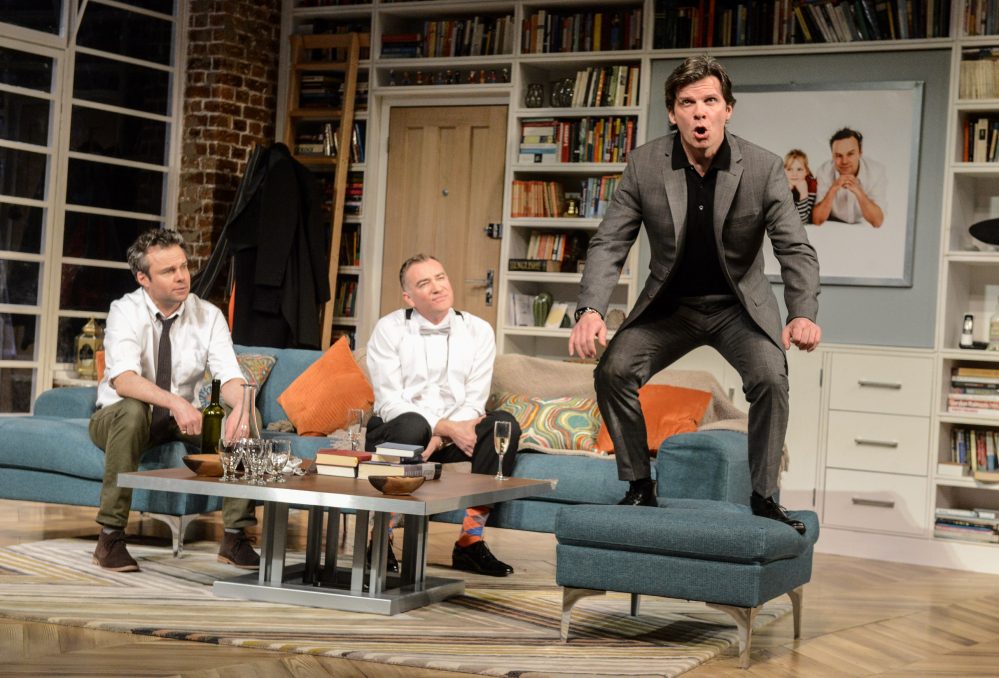
What’s In A Name, written by Alexandre De La Patellière and Matthieu Delaporte, stages a dinner party packed with many surprises and twists that kept you on edge, and slightly edgy, while holding your belly for laughing. It is set in London, and the story centres itself around the name of Adolphe which Vincent jokes about calling his son when he is born. The story then darkens as secrets are revealed within each of the five guests.
Sarah Hadland, who most would remember as Stevie in Miranda, stole the show with her multi-emotional portrayal of Elizabeth. Sarah was completely natural and every line and action was delivered with sheer dexterity and conviction. I was so happy to see Sarah aka Stevie up close, and to not see her as Stevie at the same time, which was something I really enjoyed. Raymond Coulthard was magnificent as Carl, and was great to see him back at the Birmingham Rep after watching him in King’s Speech. Carl carried the biggest secret and Raymond played the audience well, never giving any of it away. Nigel Harman, Eastenders, was formidable as Vincent, Elizabeth’s younger brother. Nigel conveyed him with such energy and natural flair that one could not help but be drawn every time he spoke and moved. Jamie Glover was excellent with his cross-examining scenes as Peter, challenging Vincent and others to prove a point. He made the set appear like it was his own home with the way he perched on or leaned against features in the front room signalling natural familiarity. Olivia Poulet as Anna was a great ingredient to turn the drama on its head with coming in quite late and revealing a hidden secret. Olivia was charismatic and held her own against the other theatrical titans.
I seriously suggest everyone go and see this as it draws you in with the clever humour and sophisticated drama – you just didn’t know what you were going to get!