Tag: HIV

Read the latest news and analysis of HIV in the UK and abroad. Browse THEGAYUK’s entire archive on news about HIV.

  • Ground-breaking HIV testing campaign ‘Me. Him. Us.’ returns to the streets of London.

    Ground-breaking HIV testing campaign ‘Me. Him. Us.’ returns to the streets of London.

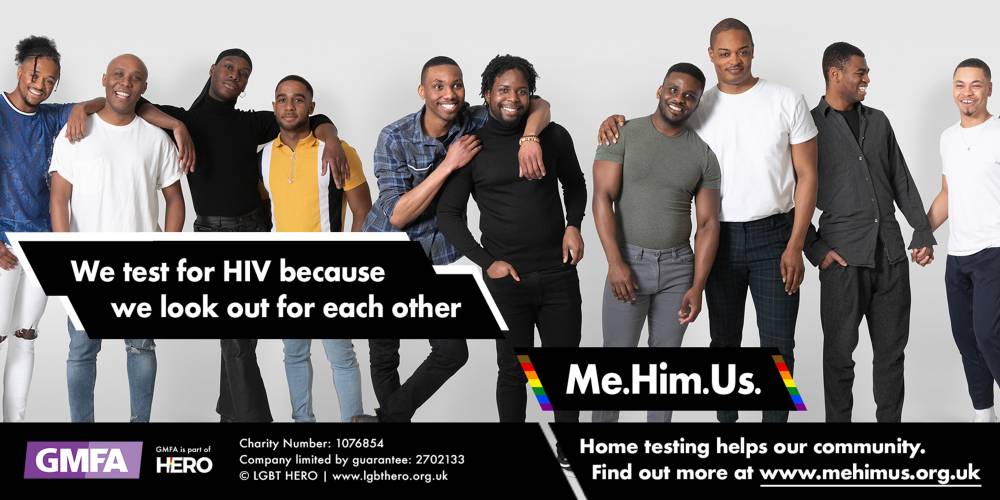
    The campaign by GMFA, which was developed by and for black gay and bisexual men, will appear on a digital billboard in Lambeth and on digital advertising hubs across East London.

    After the incredible impact of the original Me. Him. Us. campaign in March 2018, GMFA – the gay men’s health project has launched a second phase of the campaign, focusing on community, representation and home HIV testing.

    GMFA brought together 17 young black gay men to lead in the latest iteration of the campaign and to effect a positive change in their community, as well as making sure that black gay men are properly represented in sexual health campaigns.

    Marc Thompson, Co-Editor of BlackoutUK, who worked as an advisor on the campaign, explains why he came back to the project: “The reason I took part in Me. Him. Us. again was to build on last year’s success. The first Me. Him. Us. campaign focused on the role of the individual, but with the new campaign we have a larger group of men, so it was really about stressing the importance of community involvement and how we can all play a part in ending HIV.

    “The day of the photo shoot was powerful and moving. We had 17 black gay men who came together to make a difference in their community. They wanted to make sure that their diversity was represented. It highlighted that the needs of black gay men, and the fact we are disproportionally effected by HIV, is still at the forefront of the work we do. Leading these campaigns and being represented is still incredibly important.”

    Activist and writer, Phil Samba who starred in and helped develop last year’s campaign said, “It’s important for us black men to take care of our sexual health and get tested regularly because sadly we are disproportionately affected by HIV.

    “We deserve to have the sex we want, which is right for us, with the least amount of harm. If other queer men are the main source of sexual health information for queer men, it is extremely vital that we all teach ourselves and others about all the preventative tools available today, how they work and how to access them. Black queer men especially need to be able to have open and honest conversations destigmatising sexual health among themselves and their friends from different backgrounds.”

    Gus, 24, one of the men to lead this year’s campaign, told us why he wanted to take part in Me. Him. Us. “I originally wanted to do the campaign because it’s something fresh and new. You don’t see it every day. It’s nice to finally be represented in a positive way. Usually you don’t see black men in a photo shoot or a campaign when you’re walking down the street. It’s refreshing to be shown in a positive way too, and not just seen in a negative stereotype. It’s something beautiful to be a part of, knowing that we are helping to effect a change.”

    Tre, 19, said: “It was empowering to be surrounded by so many young gay black men who are so passionate about spreading awareness of HIV testing. Everyone who took part in the shoot came from a variety of different backgrounds and it’s powerful to see the representation of people from the gay black community from all different parts of the country as well. I think it’s really important for young gay black men, especially for people who might be struggling with their own identity, to see people that look like them on billboards and social media, talking about the important of getting tested.”

    Ian Howley, Chief Executive of LGBT HERO, the parent organisation of GMFA said: “When Me. Him. Us. launched last year we saw something I have never seen in HIV prevention. There was a movement behind Me. Him. Us. black gay men felt emotionally connected to this work and helped us spread the campaign’s important message about looking after your own health, your partner’s health and your community’s health to over five million people. So, I was delighted that we were able to continue this important work in partnership with black gay and bisexual men. These men deserve more than one-off campaigns or to be involved in a tokenistic way without any say. And they deserve to create work that is by them, for them, and empowers their community. I hope that through GMFA, LGBT HERO can continue this successful partnership for years to come.”

    The Me. Him. Us. campaign will feature on billboards and digital hubs in London and online over the course of the summer.

  • With effective treatment HIV risk is zero in gay men

    European study of nearly 1,000 gay male couples who had sex without using condoms – where one partner was HIV positive and on suppressive antiretroviral therapy (ART) and the other HIV negative – reports no cases of within-couple HIV transmission over 8 years.

    PrEP pills
    (C) marcbruxel Depositphotos

    A European study of 972 gay male serodifferent couples, in which one partner was on suppressive antiretroviral therapy (ART), has found no cases of HIV transmission within couples over 8 years of follow up.

    The observational study, which is the largest of its kind and published in The Lancet, provides conclusive evidence that having an undetectable viral load (less than 200 copies/mL) on ART means that the virus is untransmittible.

    Over 8 years of follow up in the study, 15 HIV-negative men became infected with HIV, but none of the viruses screened in the newly infected partner were genetically linked to the HIV virus that had infected their main partners, ruling out any within-couple HIV transmissions.

    Importantly, the researchers estimate that effective ART prevented around 472 HIV transmissions during the 8 years of the study.

    Regular testing is still important

    The authors emphasise the importance of regular monitoring and supporting people with long-term adherence to therapy and caution that the effectiveness of ART in preventing HIV transmission is dependent on ensuring that the virus remains undetectable in the blood.

    The results support the international U=U (undetectable equals untransmittable) campaign, that has been endorsed by more than 780 HIV organisations in 96 countries, to raise awareness of how scientific evidence shows that effective ART means people living with HIV can have sex without fear of transmitting the HIV virus to others.

    “Our findings provide conclusive evidence for gay men that the risk of HIV transmission with suppressive ART is zero,” says Professor Alison Rodger from UCL, UK, who co-led the research. “Our findings support the message of the international U=U campaign, that an undetectable viral load makes HIV untransmittable. This powerful message can help end the HIV pandemic by preventing HIV transmission, and tackling the stigma and discrimination that many people with HIV face. Increased efforts must now focus on wider dissemination of this powerful message and ensuring that all HIV-positive people have access to testing, effective treatment, adherence support and linkage to care to help maintain an undetectable viral load.” [1]

    The new study, PARTNER2, assessed the risk of HIV transmission between serodifferent (one partner is HIV-positive, one is HIV-negative) gay male couples not using condoms. The results add to an earlier phase of the PARTNER study, which found that HIV transmission risk for serodifferent heterosexual couples was zero.

    The first phase of the PARTNER study, which took place between September 2010 and May 2014 and was published in 2016, recruited and followed up 1,116 serodifferent couples who were not using condoms. Of these, 888 couples, both heterosexual (548 couples) and gay men (340 couples), provided 1,238 eligible years of follow up from 14 European countries. The second phase of the study (PARTNER2) included gay male couples only.

    Between September, 2010 and July, 2017, 972 gay couples were recruited, of which 782 provided 1,593 eligible years of follow up—the main reasons couples weren’t included in the analysis were because no condomless sex was reported, they had used pre-exposure or post-exposure prophylaxis (PrEP or PEP), or HIV viral load or HIV test results were not available.

    Couples had frequent follow-up (every 6-12 months) to complete confidential questionnaires on their sexual behaviour, to test HIV-negative partners for HIV, and to measure plasma HIV-1 viral load in the HIV-positive partner. If HIV-negative partners became infected with HIV, genetic testing was done to see whether the virus was genetically similar to their study partner’s virus, or was acquired from another sexual partner.

    At the start of the study, the couples had already been having sex without condoms for a median of 1 year, and the HIV-positive partners had been on ART for a median of 4 years, with high adherence (98% participants reported 90% adherence).

    During an average of 2 years follow-up (per couple), couples had anal sex without condoms a total of 76,088 times (equivalent to about once a week).


    Bru-nO / Pixabay

    During the study, over a third (37%; 288/777) of HIV-negative men reported having sex without a condom with other partners. Around a quarter of HIV-positive (214/779) and HIV-negative (185/779) men reported at least one STI such as syphilis and gonorrhoea (table 2) since their last visit. Only 5% (37/779) of HIV-positive men reported missing ART for more than 4 consecutive days.

    The authors note several limitations, including that most HIV-negative gay men were white with an average age of 38 years—yet most HIV transmission occurs in young people aged 25 years or younger. Additionally, the majority of HIV-positive partners had been on suppressive ART for several years, so the authors had limited data on transmission risk during the initial months of ART.

    Commenting on the implications of the findings in a linked Comment, Dr Myron Cohen from the UNC Institute for Global Health and Infectious Diseases, USA writes: “These important results serve to inspire and challenge us. Timely identification of HIV-infected people and provision of effective treatment leads to near normal health and lifespan and virtual elimination of the risk of HIV transmission. Yet maximising the benefits of ART has proven daunting, especially for men who have sex with men It is not always easy for people to get tested for HIV or find access to care; in addition, fear, stigma, homophobia, and other adverse social forces continue to compromise HIV treatment. Furthermore, diagnosis of HIV infection is difficult in the early stages of infection when transmission is very efficient, and this limitation also compromises the treatment as prevention strategy…The results of the PARTNER2 study provide yet one more catalyst for a universal test-and-treat strategy to provide the full benefits of antiretroviral drugs. This and other strategies continue to push us toward the end of AIDS.”

  • London’s PrEP trial to be boosted by 60 per cent

     Places for London’s PrEP trial to be boosted by 60 per cent.

    PrEP pills
    (C) marcbruxel Depositphotos

    Today (Friday 12 April) London Councils has announced that an agreement has been reached to increase places on the PrEP trial by over 4,000 places.

    The news comes as over two-thirds of sites in London are now closed to gay and bisexual men. The boost still leaves the capital lagging behind many other parts of England which have agreed to double places on the trial.

    “Withholding access is simply not an option”

    Embed from Getty Images

    Debbie Laycock, Head of Policy at Terrence Higgins Trust, said, “Finally the stalemate on PrEP has been broken and some leadership is being shown. This is a welcome step in the right direction that will provide some relief to those in the capital who have been denied access to the trial. We welcome the acknowledgement by London Councils that PrEP must be available to everyone at high risk of HIV exposure and as such withholding access is simply not an option.

    “However this increase is still far short of the doubling of places we were promised by the Health Secretary Matt Hancock over 70 days ago and it won’t be long before we’re once again seeing gay and bisexual men being unable to access PrEP in the capital.

    “‘London continues to outstrip every other part of the UK in the number of new HIV diagnoses each year so it’s critical a sustainable solution for PrEP is found. Today’s news is progress but this remains a job only half complete as places must be doubled to address the high demand seen for PrEP. We need urgent leadership on this from NHS England, the Department for Health & Social Care and councils across the capital because no one at risk of HIV should be turned away.”


  • Doctor who help thousands of gay and bi men access PrEP has died at the age of 44

    A doctor who was instrumental in making PrEP accessible in the UK has died at the age of just 44.

    Doctor Mags Portman was just 44 when she died from a rare form of cancer, according to Buzzfeed News. The doctor became a hero of the gay and bisexual community by making access to the HIV-preventative drug, PrEP easier for those who needed it. She was an HIV consultant at London’s Mortimer Market Centre, one of the capital’s busiest sexual health clinics.

    She leaves behind a husband and two young children. She died in the early hours of Wednesday morning in her hometown of Leeds, at a hospice. She had been receiving treatment for mesothelioma, a cancer which affects the lining of the lungs.

    The Terrence Higgin’s Trust, the UK’s leading HIV charity called the doctor a pioneer, saying “All of us at Terrence Higgins Trust are deeply saddened by the passing of the brilliant Dr Mags Portman.

    Before adding that they pledge to “continue the fight for PrEP in her memory”.


    In October 2018 Mags took to her blog to write about her life with cancer and the treatment she received, in a post she titled, “Dancing With Death and Depression”. In the emotional post, the doctor documented how she lived with anxiety and unbearable pain. About anxiety, she wrote, “It reared it’s ugly head so quickly. I was taken completely unawares until was right in the middle of its grip, smothered by it. Rendered completely incapable. The “I can’t” voice in my head persisted, became louder and more repetitive. I would sit and wring my hands, rub my face and head, stand up and then sit down again over and over.”

    She revealed that she managed to get help for her anxiety, writing “Thankfully, one of the GPs rang back within an hour and was absolutely great with me. He suggested starting medication (which I was glad about and ready to accept). He suggested Mirtazepine (which I was glad about too, because it also helps with sleep and appetite, and I was hoping for this). He also referred me to the Young Persons Support Team at St Gemma’s Hospice as a lot of my anxiety was around the boys and how we would get through the summer holidays with my deteriorating health.”

  • The Government want to end new HIV transmission in England by 2030

    The Government want to end new HIV transmission in England by 2030

    The Government says it is committed to seeing the end of new HIV Infections in England by 2030.

    CREDIT: tashatuvango-bigstock

    The UK’s government will today say it is committed to ending new HIV transmissions in England by the year 2030. Speaking at the HIV/AIDS Summit in London, Secretary of State for Health & Social Care, Matt Hancock MP is expected to say,  “So today we’re setting a new goal: eradicating HIV transmission in England by 2030. No new infections within the next decade. Becoming one of the first countries to reach the UN zero infections target by 2030.”

    The Department for Health & Social Care has confirmed that an expert group will now be established to develop an action plan over the course of this year. They have said that prevention will be at the heart of this commitment, alongside measurable action points for each group who are at risk of infection, including gay and bisexual men, Black African and minority ethnic (BAME) groups and for all other heterosexuals, and extensive monitoring of progress.

    This news follows the UK meeting the UNAIDS 90-90-90 targets in November 2018, ahead of the 2020 deadline, with 92% of people living with HIV diagnosed; 98% of those on treatment; and 97% of those have an undetectable viral load, which means they can’t pass on HIV.

    “Government has shown decisive leadership on HIV”

    Ian Green, Chief Executive of Terrence Higgins Trust said, “Today’s commitment is a seminal moment in the fight to end new HIV transmissions in England. In becoming one of the first nations to make such a commitment, the Government has shown decisive leadership on HIV and we applaud them for making this pledge.

    “We now have the tools to end HIV transmissions. Through regular HIV testing, condom use, access to Pre-Exposure Prophylaxis (PrEP), prevention information and advice, and effective treatment which means people living with HIV cannot pass on the virus, we can stop HIV in its tracks. That’s why Terrence Higgins Trust has been vocal in our call for this ambitious but achievable commitment.

    “For England to reach zero new HIV transmissions, the Department for Health & Social Care, Public Health England, alongside local authorities, must now urgently work in collaboration to address some of the most pressing HIV issues. These include stepping up HIV testing to ensure the 8,000 people who remain undiagnosed can get onto treatment, immediately adding more places to the PrEP trial and ensuring sexual health services are properly funded. Without these actions, this commitment simply won’t be achievable.

    “The clock has now started ticking towards the end of HIV transmissions in England. Today’s commitment demonstrates that the Government has listened to our demand for a bold vision on HIV. Now it must act upon our call to ensure services and interventions are urgently put in place to ensure that by 2030 this pledge is made a reality.

  • What does the Red Ribbon used for World AIDS Day mean?

    What does the Red Ribbon used for World AIDS Day mean?

    Every year on the 1st of December many people start wearing a red ribbon for World AIDS Day, but what does it mean and who designed it?

    Why is the Red Ribbon used for World AIDS Day and who designed it?
    ArtsyBee / Pixabay

    The Red Ribbon symbol has become the defining icon for the awareness, fundraising and determination to beat HIV and AIDS. It is a strong vibrant red symbol that has become synonymous with every 1st December and it was designed in 1991.

    A decade after AIDS began its stranglehold, decimating communities, a coalition of 12 artists gathered to devise a plan to raise awareness for Visual Aids, a New York arts organisation which raises awareness of HIV.

    The 12 people consisted of photographers, painters, filmmakers and costume designers. After a short collaboration they came up with the striking, but the simple idea of the red ribbon, inspired by the yellow ribbons tied on trees at the time, to denote support for US military fighting in the Gulf war.

    Pink and rainbow colours were rejected because of their association with the LGBT+ community, and the designers were keen to show that HIV went beyond gay people and could potentially affect everyone.

    The red ribbon logo became recognisable across the globe.

    Signify Awareness and Support

    OpenClipart-Vectors / Pixabay

    In our interview with David France, director of How to Survive A Plague told us,  “In one of the worst moments we ever faced we rose above it. We took care of each other. It was extraordinary and beautiful”.

    The ribbon is worn to signify awareness and support for people living with HIV.

    According to WorldAIDsDay.org, “When the artists sat down to work on this project, their aim was to get people talking about HIV. This was at a time where HIV was highly stigmatised and people living with HIV were suffering behind closed doors, some too scared to even tell their loved ones they were living with the virus. The artists wanted to create a visual expression of compassion for people living with, and affected by, HIV.”

    At handmade ribbons where distributed in New York

    Back in 1991 a group of artists created the red ribbon. The first batch was handmade and given out on the streets of New York.

    In the very beginning, the artists made the ribbons themselves and distributed them around New York. “Within weeks of the red ribbon idea being born, world-famous actors starting wearing the red ribbon to high-profile award ceremonies such as the Oscars and talking about why it was important. The media also cottoned on, and within a short space of time the red ribbon symbol became universally recognised.” Explains the website.

  • HIV Infections in gay and bi men plummet by 31 percent since 2015

    HIV Infections in gay and bi men plummet by 31 percent since 2015

    New figures, published by Public Health England (PHE), show a 17% decrease in HIV diagnoses in the UK in 2017 and a drop of more than a quarter in the last two years (28%).

    CREDIT: tashatuvango-bigstock

    However, the new statistics also show that 42% of people with HIV were still being diagnosed late; with heterosexual men and individuals aged 65 and over the most likely to experience late diagnosis.

    HIV diagnoses in gay and bisexual men have dropped by 31% since 2015 and this decline is particularly focused in parts of London. This represents one of the most significant advances in HIV prevention since the beginning of the epidemic, but now we need to ensure we see the same declines in other groups.

    Ian Green, Chief Executive at Terrence Higgins Trust, said, “Today’s drop in new HIV diagnoses among some communities in the UK clearly shows we have the tools to end the HIV epidemic in this country. But, rather than patting ourselves on the back, we need to redouble our efforts, work harder and get to zero HIV transmissions.

    “There is continued progress among some gay and bisexual men, particularly in London, with a 31% fall since 2015. This follows on from last year’s numbers where we saw the first ever decline in new diagnoses among gay and bisexual men.

    “This turnaround in one of the groups most affected by HIV shows what can be achieved by utilising everything we’ve got in the fight against HIV. That includes the widespread availability of condoms, a range of ways and places to test for HIV, early diagnosis and access to treatment, and increasing the availability of HIV prevention pill PrEP. It also shows that initiatives like National HIV Testing Week are working.

    “But we need to work harder and look more broadly to make sure the decline in new diagnoses reaches other groups affected by HIV in all corners of the UK – not just in London and the South East.

    “For example, rates of late diagnosis remain worryingly high with 42% of all those diagnosed being diagnosed late, which is after the immune system has already been damaged. Among black African heterosexual men rates of late diagnosis are now 72% while in those 65 and over it’s 60%, which is unacceptably high.

    “For the first time, there has been a drop in the number of diagnoses reported among heterosexuals not from black African or black Caribbean communities with a fall of 20%. This is welcome news but more needs to be done to understand what’s behind this decline and lessons learned to ensure the number of new diagnoses continues to fall.

    “We welcome the inclusion of women only data tables for the very first time. But while around a quarter of new diagnoses continue to be among women, more needs to be done to ensure women are invisible no longer when it comes to HIV and properly included in HIV prevention campaigns. Similarly, this year we also have trans-specific data for the first time, which is so important in ensuring we have an accurate picture of how this group is impacted by HIV.

    “We must also ensure Relationships and Sex Education has a strong emphasis on sexual health and HIV when it becomes compulsory in schools in England from 2020. Currently, more than one young person a day is diagnosed with HIV in the UK and that’s one too many. We have the tools to prevent HIV but we need to ensure our young people know what they are and how to access them.”

    On the reason for this continued decline, Ian Green added, “HIV treatment has undoubtedly played a significant role in this decline. Now, when someone is diagnosed, they are encouraged to start treatment as soon as possible. This enables them to more quickly achieve an undetectable viral load, which means HIV can’t be passed on.

    “Testing options have also improved in recent years and now HIV self test kits, where you test at home and get a result within 15 minutes, are sold on the high street. We’re also offering these tests for free to people from the communities most affected by HIV. But testing at home isn’t for everyone and it is vital we have fully funded and easily accessible sexual health services for those who want or need a face to face service.

    “PrEP is a game changer for HIV prevention and almost 100 per cent effective when taken as prescribed. PrEP’s portrayal in the media means it is all too often seen as something only for gay men – but that certainly isn’t the case and we need to ensure it is fully utilised by all groups affected by HIV, including both black African people and trans communities.

    “Although PrEP is available on the NHS in Scotland and via an uncapped pilot in Wales, it is only available in England as part of a 10,000 place trial and we know that many sites have filled all their places for gay men and are having to turn people at risk of HIV away. In light of today’s data, we’re continuing to strongly call on NHS England to play its part in getting to zero HIV transmissions by making PrEP available to all who need it on the NHS in England.”

  • Gay and bi guys who are lonely are most likely to have bareback sex

    Gay and bi guys who are lonely are most likely to have bareback sex

    Gay, bi and queer men are 67 percent more likely to have unprotected anal sex.

    Madeinitaly / Pixabay

    A recent study from China has found that lonely gay men are most likely to have condomless sex. Of the 507 men that took part in the study, those “who reported feeling lonely were more likely to have had condomless receptive anal intercourse in the past 6 months.”

    The same men also said that they felt “hopeless for the future” and reports of higher levels of internalised homophobia.

    The study showed that gay and bi men in China are suffering from high rates of depression and loneliness, of the 507 who took part, 26.8 and 35.5% reported moderate-to-severe symptoms of depression and feeling lonely, respectively. Despite homosexuality not being illegal in China LGBT people are subject to severe societal pressures.

    The aim of the study was to help demonstrate that gay/bi and queer men with negative mental health in high-income countries were at risk of HIV infection. “We sought to describe depression and loneliness and identify their correlates among Chinese MSM”.

    Without protection, like condoms or access to PrEP, men who have bareback sex are more at risk of contracting HIV than those who use condoms or who are on PrEP and who test regularly.

    (C) BIGSTOCK

    Chances of passing on HIV are Zero if you’re on effective treatment

    A recent study found that there is ZERO chance of passing on HIV if an infected partner was on effective treatment.

    The PARTNER 2 study results found no cases of HIV transmission between men when one partner had HIV but was on effective treatment. This finding offers further confirmation that an undetectable viral load prevents sexual transmission of HIV. This understanding is frequently expressed as Undetectable equals Untransmittable, or U=U.

    The 14-country study found no transmissions between gay couples where the HIV-positive partner had a viral load under 200 – even though there were nearly 77,000 acts of condomless sex between them.

    China’s LGBT rights

    China has a chequered history in LGBT rights – same-sex sexual activity has only been legal since 1997, whilst the country does not recognise gay relationships or marriages. Same-sex couples are not permitted to adopt and there is no legal statute to protect gays from discrimination. However, trans people are legally permitted to change their legal gender.

    Homosexuality was removed from the Ministry Of Health’s list of mental illnesses in 2001.


  • The chances of passing HIV to a partner is ZERO when you have an undetectable load

    The chances of passing HIV to a partner is ZERO when you have an undetectable load

    “We’re as confident now that undetectable gay men pose no risk of HIV transmission as we already were for heterosexuals,” researchers say.

    The PARTNER 2 study results found no cases of HIV transmission between men when one partner had HIV but was on effective treatment. This finding offers further confirmation that an undetectable viral load prevents sexual transmission of HIV. This understanding is frequently expressed as Undetectable equals Untransmittable, or U=U.

    CREIT: © garyphoto Depositphotos

    PARTNER 2 is an extension of the PARTNER study, which in 2014 indicated that people with an undetectable viral load do not transmit HIV. Gay and bisexual men were included in the previous study, but PARTNER 2 was added on to the earlier study to ensure that this finding was at least as certain for gay men as it was for heterosexuals.

    It had been speculated that because HIV is transmitted more easily via anal than vaginal sex, the results might not hold for gay men. PARTNER 2 now tells us that U=U holds just as strongly for gay men (and for anal sex) as for heterosexuals.

    No transmission of HIV in nearly 77,000 acts of bareback sex

    (C) BIGSTOCK

    The 14-country study found no transmissions between gay couples where the HIV-positive partner had a viral load under 200 – even though there were nearly 77,000 acts of condomless sex between them.

    A detailed analysis of the research findings is available on NAM’s website, www.aidsmap.com

    PARTNER, together with another study, Opposites Attract, have between them not found a single case of HIV transmission in 126,000 acts of condomless anal sex between partners of differing HIV status.

    This new data adds further strength to the U=U Campaign, whose consensus statement has been signed by NAM and hundreds of other organisations around the world, including the International AIDS Society, which runs the International AIDS Conferences.

    Dr Pietro Vernazza, author of the 2008 Swiss Statement, which first affirmed that viral suppression meant that HIV could not be passed on, commented at an earlier conference session, “Those who say that HIV can be transmitted should be able to provide evidence of it.” No study has identified a case of sexual transmission from someone who is virally suppressed on treatment.

    NAM’s Executive Director, Matthew Hodson, commented, “This is the moment when science trumps stigma. This is the moment when facts must conquer fear. The knowledge that when we are undetectable we can’t pass the virus on to our sexual partners has the power to encourage people to test and to remain adherent to their treatment. Just as importantly it can have an impact on the way that people with HIV think about themselves, removing some of the stress and fear that many in our communities experience.”

    Matthew Hodson continued, “The preventative impact of effective HIV treatment underlines the importance of expanding access to treatment and of improving treatment uptake and adherence for all people living with HIV worldwide.”

  • Daily Mail columnist schooled over PrEP inaccuracies

    The National AIDS Trust just had to school one Mail Online columnist over a story published in which he peddled “misinformation, myths and stigma” over PrEP usage.

    PrEP pills
    (C) marcbruxel Depositphotos

    In the article, Mail Online columnist Ross Clark, reveals that after a recent visit to his GP for a suspected hernia, the doctor was unable to refer him to have an operation or to a specialist due the fact that he wasn’t in pain and didn’t have any heavy lifting in his job, the GP told him he “wasn’t bad enough to qualify for funding under new NHS guidelines”.

    However, later on in the article, which the Terrence Higgins Trust has blasted as fuelling misinformation, myths and stigma, he draws comparisons between what the NHS could pay for and what they couldn’t. PrEP and transgender surgery was, it seems, central to his argument.

    He wrote, “There is the £22 million a year being spent on transgender surgery, at a cost of £20,000 per patient. There is £730 million a year being spent pumping drug addicts full of Methadone — a heroin substitute which is supposed to help wean people off that drug, but which is itself addictive.

    “The NHS has started, too, to prescribe PrEP — a drug which cuts the risk of HIV transmission in gay men who have sex without a condom.

    “It is prescribing the drug —which costs £400 a month for a single patient — in spite of warnings that it will be encouraging risky behaviour, and it could increase other infections such as syphilis and gonorrhea [sic], against which PrEP offers no protection.”

    “Not One Thing accurate”

    Well, the Twitter team at National AIDS Trust had to put him right – and point out exactly why his article is so wrong.

    “Trying to create a Twitter storm”

    The columnist Ross Clark then accused the National AIDS Trust of trying to start a “Twitter Storm” saying, “You are trying to create a Twitter storm based on something I haven’t written, knowing that most who retweet won’t actually bother to read the piece”.

    Losing Advertisers

    Recently the MailOnline lost a number of high-profile advertisers when companies started to pull out of contracts with the publication after a successful awareness campaign by pressure group, Stop Funding Hate. Eventually, the newspaper removed advertising from many of its columnists including Richard Littlejohn.


  • Terrence Higgins Trust slams the Daily Mail for misinformation, myths and stigma around PrEP

    “we’d love to have a cuppa to explain”

    PrEP pills
    (C) marcbruxel Depositphotos

    Ooo the sass coming from the Terrence Higgins Trust’s Twitter feed, the UK’s leading HIV charity, was palpable and we love it. In the tweet, they slam the Mail Online for fuelling misinformation, myths and stigma surrounding the use of PrEP.

    So far the journalist who worked on a story nor the publication itself has replied to have a cuppa with THT.

    In the article, Mail Online columnist Ross Clark, reveals that after a recent visit to his GP for a suspected hernia, she was unable to refer him to have an operation or to a specialist due the fact that he wasn’t in pain and didn’t have any heavy lifting in his job, the GP told him he “wasn’t bad enough to qualify for funding under new NHS guidelines”.

    However, later on in the article, he draws comparisons between what the NHS could pay for and what they couldn’t. PrEP and transgender surgery was, it seems, central to his argument.

    He wrote, “There is the £22 million a year being spent on transgender surgery, at a cost of £20,000 per patient. There is £730 million a year being spent pumping drug addicts full of Methadone — a heroin substitute which is supposed to help wean people off that drug, but which is itself addictive.

    “The NHS has started, too, to prescribe PrEP — a drug which cuts the risk of HIV transmission in gay men who have sex without a condom.

    “It is prescribing the drug —which costs £400 a month for a single patient — in spite of warnings that it will be encouraging risky behaviour, and it could increase other infections such as syphilis and gonorrhea [sic], against which PrEP offers no protection.”

    “Cost-effective”

    Speaking to THEGAYUK.com Liam Beattie, PrEP policy lead at Terrence Higgins Trust, said, “There’s no place in the media for articles filled with misinformation, myths and stigma-fuelling. Ross Clark’s piece on PrEP is highly inaccurate and we would love him to come in to Terrence Higgins Trust to find out more about the realities of PrEP. Because there’s nothing controversial about PrEP – it’s highly effective at preventing HIV, cost effective and will ultimately stop many, many people from becoming HIV positive.

    “Currently PrEP is available in England via a 10,000 place trial but we want to see a national PrEP programme in England to ensure it’s made available to all who need it”’

    There’s been no evidence to suggest that users on PrEP are being any more “risky” than those who currently aren’t on PrEP.

    Losing Advertisers

    Recently the MailOnline lost a number of high-profile advertisers when companies started to pull out of contracts with the publication after a successful awareness campaign by pressure group, Stop Funding Hate. Eventually, the newspaper removed advertising from many of its columnists including Richard Littlejohn.