Tag: Mental Health

All the latest breaking news on mental health and the LGBT+ community. Browse The THEGAYUK’s complete collection of features and commentary on mental health issues.

  • What can you do if Christmas is ruining your mental wealth?

    What can you do if Christmas is ruining your mental wealth?

    gracinistudios / Pixabay

    But it’s okay to do.

    Talk about your feelings

    MabelAmber / Pixabay

    Many people will expect you to be in great spirits at Christmas but don’t necessarily take into account why you may appear to be down. For those of us who experience negative thoughts or feelings at Christmas, it can be hard to admit that at such a festive time of the year that you don’t share in the delight of the holidays. However, more people are struggling than you think. Making the decision to talk about your feelings and share them with those around you can improve your mood and make it easier to deal with the tough times – especially when you discover that many of the people around you may find themselves in the same position!

    Be picky with social engagements – they are not obligations!

    kliempictures / Pixabay

    It’s extremely easy to get burnt out over Christmas and New Year. Between work parties, spending time with friends, the intensity of family gatherings and then the pressure of New Year, many people are sucked into giving away too much of their free time and ending up extremely tired, lethargic and blue. Make time for the people you care most about, but ensure that you take enough time for yourself to recover and relax.

    Give SAD the sack

    Embed from Getty Images

    The weather influences the way in which we behave every day – it dictates the food we eat, the clothes we decide to wear, and to some extent where we decide to go. However, for millions of people in the UK, the short, dark days around Christmas and New Year can have a disastrous impact on health and wellbeing, triggering the onset of a depression known as seasonal affective disorder, or SAD.

    There are, however, plenty of ways to alleviate the symptoms of SAD. Getting regular exercise, eating a balanced diet and exposing yourself to as much sunlight as possible are of course extremely important, but you could also consider other options such as light boxes and dawn simulators to help regulate your circadian rhythms.

    SAD is also closely linked with a lack of vitamin D which your body naturally produces when exposed to sunlight – given that sunlight is in fairly short supply in the UK at Christmas, it may be worth getting your vitamin levels checked – using vitamin D supplements could certainly help to resolve any deficit you may have. 

    Reduce alcohol consumption

    http://gty.im/159602791

    For the heavier drinkers, those trying to cut back, and people who perhaps have a poor relationship with alcohol, my suggestions for remaining sober and in control at Christmas are as follows:

    • Take your favourite non-alcoholic drinks to any parties or gatherings, for example soda water, ginger beers or lemonade. This will help you to blend in with a glass in your hand, you’ll feel less conspicuous, and will likely avoid being asked for a drink every few minutes
    • Plan activities that will get you out of a setting in which you would typically find a drink in your hand – for example, winter walks, going to the cinema, family activities at home, etc.
    • Be assertive: a lot of people will likely question you on your decision not to drink. Some will be genuinely interested; others may just enjoy poking fun. However, if you ensure you come prepared with a short but effective summary or spiel as to why you’re deciding not to drink, this will really help you to avoid peer pressure and take ownership of your decision.

    Stay Active

    Embed from Getty Images

    It’s very easy to become inactive and sedentary at Christmas. The food, the presents and the time spent with close ones can compound with the often poor weather to make the prospect of exercise daunting. However, regular exercise can boost your self-esteem (especially for those who enjoy the chocolate at Christmas), and will also help you to sleep better and get the rest that so many of us look forward to in the run up to Christmas.

    If you’re having difficulty during the fesitve season and have no one to talk to, you can reach out to Samaritans or the LGBT+ helpline, Switchboard
  • 11 ways to reduce stress in your life

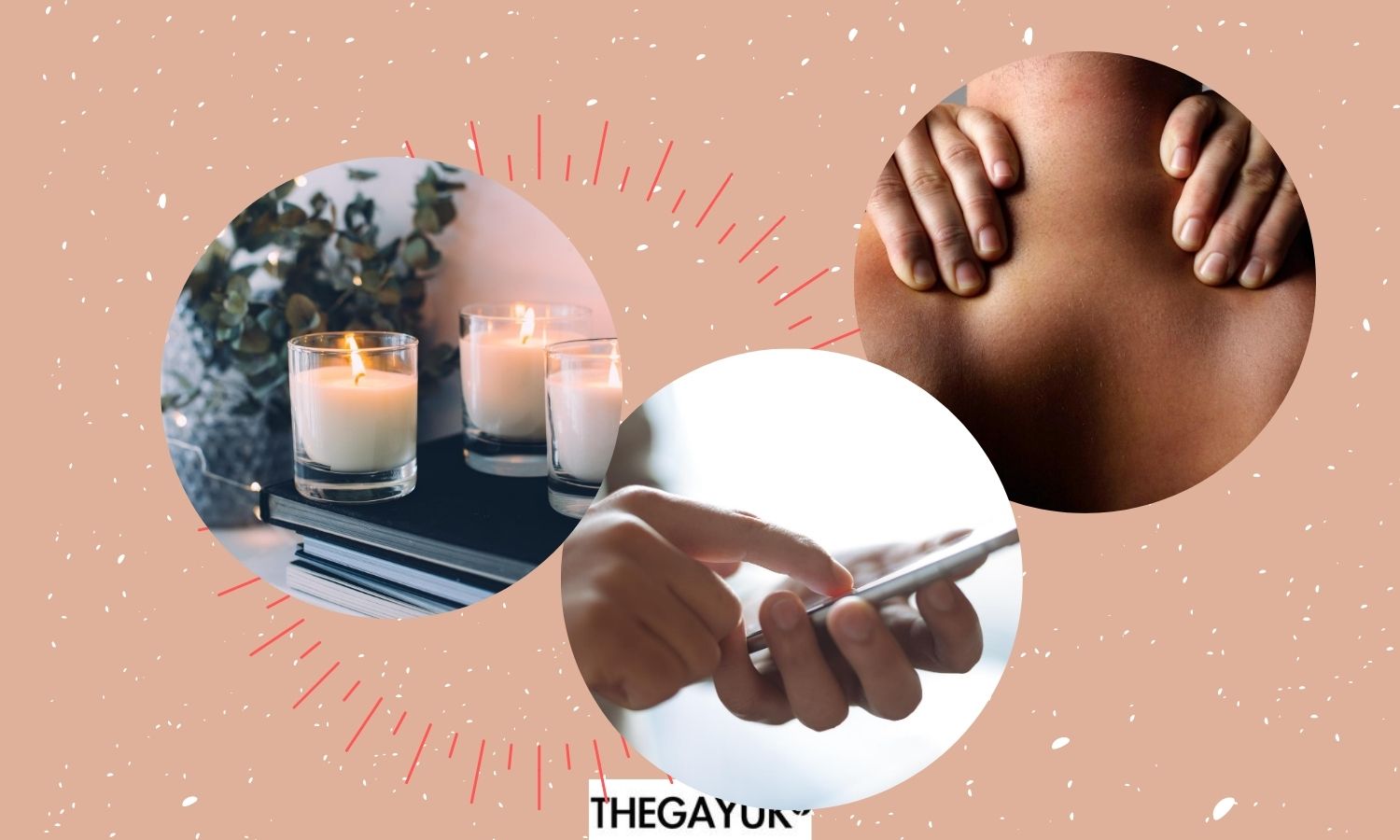
    11 ways to reduce stress in your life

    Handy for anyone getting pre-Uni jitters, going to a job interview or wanting an excuse to have more sex!

    1) Breathing

    It sounds silly as we do it automatically every few seconds of every day. I guess because if we didn’t then we wouldn’t have any stresses at all to worry about! Though I still often hear the phrase, “don’t forget to breath” and why because when we panic we take short little breaths which can make us feel tight and agitated. So when you find yourself in a stressful situation do two things for me. One – Close your eyes. Two – Take in a deep breath to at least the count of six or seven, then control your out-breath to a count of ten or eleven. Then repeat. IF YOU START TO FEEL DIZZY STOP! The closed eyes will allow you to focus on your breath and your breathing will help slow and calm the body allowing you to regroup to tackle any problems.

    2) Go for a walk

    If you’re in the office then leave your desk and take a walk around the office, be it to the coffee machine or to the toilets. If you’re on a lunch break then try to leave the building. Fresh air and a different surrounding will really help to take away any work-related stresses. Even if you have a deadline approaching a quick five mins walk can help save more time in the long run when you come back refreshed.

    3) Hot Bath & Candles

    Sounds like a cliché but really can do the trick. I love a hot bath filled with your favourite bath oil or soak. Light a couple of tee lights and turn the lights off. Breath in for six and out for ten, let your mind be free to wander. Breathing. In and out. Stresses of work, relationships, family will try to take over your clearing head as you breathe in and out. In and out. The best advice I was ever given was, when a thought enters your head don’t worry about it appearing, just let it drift away as it drifted in. Breath in and out. Let your thoughts evaporate into the steam of the bath. In and out. You have no worries. You have no stresses. You are enjoying the simplicity of life. Enjoy.

    4) Ditch the phone

    Mimzy / Pixabay

    Having yourself available for contact 24hrs a day is not good for your health. You need ‘you time’. Switch off the phone for an hour in the evenings and treat yourself to spending some time with yourself or a loved one. When a phone is switched off you don’t have to worry about life outside of you. If it’s important they can leave a message. I also urge to ditch the phone whilst sleeping. Turn it off and leave in another room, or if it’s your alarm clock then put it as far away from you in the room. Give the brain some time to relax from the positive energies of the phone that still engulf a room when not in use.

    5) Drink

    Most of us like a good drink now and then. If anything we all think we may drink a bit too much. I know I do, yet I try to convince myself it’s to help me unwind, to help me relax. True, in moderation! If you’re drinking a bottle of wine a night then it’s likely you won’t be getting a good nights sleep and feel groggy in the morning. Tonight why not ditch the bottle and have a peppermint tea instead? It has no caffeine so won’t keep you awake!

    6) Sex

    gay men having sex, gay couple
    CREDIT: ©-Lopolo-Depositphotos

    Yes, it can be a great relaxant. A good steamy session or even some quality alone time can help muscles to relax and relieve some tension from the body. However please be careful as sex can also cause a lot of stress to your life if you’re having it unprotected and with people you don’t know. A trip to the GUM clinic is not going to help you achieve a more relaxed you!

    7) Chocolate

    Yes I know I said chocolate and fizzy drinks are bad, but only if they are replacements for your main meals. A little nibble of chocolate (though for me if it’s open, it’s gone!) can give you a little life buzz. It’s these little buzzes that help us to enjoy life.

    8) Smiling

    It’s true! If you smile you instantly feel better. Go on try it now and prove me wrong. Think of anything that makes you smile. For me there’s a whole bank of ‘smile moments’ in my life, mostly at the expense of family members, sometimes at myself, such as the time I walked into a glass door whilst trying to enter a bar in NY. I may have had a bit to drink and missed the sign that said push but nose-first I left an imprint like an owl does when it’s hit a window at night. My eyes were certainly as wide!

    9) Massage

    CREDIT: Wavebreakmedia-Depositphotos

    Having someone else rub oils all over your body and rub all the built-up tension dirt from inside your muscles away is fantastic. I love it. Then again I just like being touched and It can sometimes be a great lead up to tension-busting tip number 6. However not everyone is as free with their bodies, so if you hate the idea of someone else’s sweaty palms prodding you all over then try this. Take a tennis ball and place it on the back of a chair and roll your back over it. This also works for rolling your feet over it to relieve any foot stresses.

    10) Eating

    CREDIT: mythja-bigstock

    What are you eating and when? Try not to skip meals like breakfast or lunch. Starving the body means it will fight for your attention and when you have a boss fighting for your attention also you don’t need the extra stress of a flagging body! When you do eat try to have something balanced. A good bowl of fruit and cereal for breakfast then a pasta lunch will do you wonders. Don’t replace meals with fizzy drinks or chocolate snacks as they’ll give you a five-minute rush then you’ll feel more tired than you started.

    11) Self Love

    silhouette photo of man leaning on heart shaped tree
    Photo by Rakicevic Nenad on Pexels.com

    If you can’t have sex with someone else, or that just isn’t yourself then turn to masturbation. There’s a lot of research to show that having a handy shandy can relieve a variety of ailments because it boosts endorphins, reduces stress, improves sleep, improves immune system functioning, and can help with menopausal symptoms.

    UK sex therapist Kate Moyle, for LELO told us,  “The function of pleasure is to make us feel good; and self-pleasure and masturbation can have positive benefits for our health in a variety of ways, including the release of the hormone oxytocin which can lower cortisol levels, getting to know our bodies better, and building sexual self-confidence.

  • COMMENT | “I have a weird relationship with London. It’s the place that I began to discover myself, but it was also the place where I started to have problems”

    COMMENT | “I have a weird relationship with London. It’s the place that I began to discover myself, but it was also the place where I started to have problems”

    Bright Lights, Big City: Columnist Al Jenning confronts his past, with a trip to London

    We all have that one place that we love to visit, but it always stirs up some unwelcome memories. Whether it be a bar where we saw the bloke, we fancied necking somebody else, or whether it is the place where something traumatic happened to us. These places can be anything. I mean we all have these cruxes. For me, mine is the city of London.  I have a weird relationship with London. It’s the place that I began to discover myself, but it was also the place where I started to have problems with my mental health which drove me to a nervous breakdown.

    I was eighteen when I moved to London from a small town in East Yorkshire. I enrolled on a three-year Musical Theatre course at a university, and I thought I had made it already. I was so happy to get out of the town that I felt stifled and trapped in for so long and finally I could finally live my life. I had so many dreams for the future. I thought I would move to London, sail my way through a course I thought I was going to love, meet incredible life-long friends and finally meet that Mr Right that I had been longing to meet – naïve right? I guess at eighteen years old we are all slightly naïve. We have dreams and expectations that are completely unrealistic, and we have nobody there to give us a reality to check.

    The first few weeks were hard. I couldn’t imagine how homesick I would be, to the point where I used to cry myself to sleep at night because I just wanted to cuddle my dog and spend time with my family. I made an effort for the first few months not to visit home, and try to cut everything off and start fresh, and it was hard. When my parents came down to visit me for the first time after being there for three months, I was so excited. I settled in eventually and my first year was really enjoyable. I made some great friends, and I met a guy who I liked, and it felt like it might go somewhere. Alas, it wasn’t to be. He passed away from a short illness in early 2012.

    Coming back in the second year was even worse. When I moved back, it was as if something had changed, and I wanted to be anywhere else but there. I wasn’t enjoying the course as much as it was and I guess, I kind of put myself on the outs. I didn’t want to socialise. I wanted to be alone all the time. I wanted to put in as little effort as possible. Turn up, do what I needed to do then get out and go back to my flat. I couldn’t work out what was wrong with me. I kept missing lectures and classes, and I just didn’t want to do anything. My sleeping patterns were all over the place, and it felt that like I was missing out on so much of my friend’s lives and I wanted to be a part of it.

    During this time, I lost the guy I guess I fell in love with. The pain was unimaginable, and I felt that I had nobody to talk to. I didn’t tell my family, because they hadn’t met him, and they didn’t know that was seeing somebody. I had put myself on the outs with my course mates and I don’t think that any of them knew what was going on. It got to a point where I needed to speak to someone professional and I booked an appointment with a doctor to talk to them about it. I got to the appointment and I bottled it. I felt like I was a failure. That day I went back to my apartment and opened a bottle of vodka and had a good old drink. Thinking that I might find the answer to my problems at the bottom of the bottle. I didn’t. I just found myself spewing up violently for hours and my flatmate trying to help me into the bathroom. If that wasn’t a cry for help, then I don’t know what was. I knew at that point that I had hit rock bottom and that I needed to escape.

    I looked for every possible way out. I knew I didn’t want to go back to East Yorkshire, and I would be damned I was going to go back with my tail between my legs as a failure. I applied for so many jobs in London but couldn’t find anything. I failed the second year of my course, and I guess that was it. I was going back to the north. I wanted to have one more mad night out though. Me and few people I knew went for one more night out in Soho and ended up dancing in HEAVEN till 5 am. I went back to my flat and saw an email from TUI advertising positions as Event Hosts in the Mediterranean. Somehow, I got the job and I flew to Spain a few weeks later.

    I’ve had a distant relationship with London since. I’ve only visited for day trips or some event or show. It feels weird now.

    It feels like every time I go back, I open a door to my past, and suddenly I’m this carefree eighteen-year-old again. I have a nickname given to me by a very close friend; Sally. That’s because I have this strange relationship from the character of Sally from the Sondheim musical, Follies. She is one of the central characters in the show, which is about a reunion of showgirls, where an unrequited love story takes place. Throughout the show, Sally becomes more helpless and fragile from confronting her past and Ben, the man she once loved but ended up marrying her best friend. It’s a strange connotation to make you might think but I can relate to it. When I’m in London it’s as if movies from my past play through my mind and I can remember all those thoughts, the feelings that I went through, now 10 years go. I see it all. The good. The bad. The ugly.

    I made a decision last year to try and put a few of those ghosts to bed. I booked a few nights in a hotel just down the road from where I used to live, and I went to look at some of the places that I used to frequent as that naïve kid I once was. It was a really weird experience, and I didn’t like it, but ten years I felt strong enough to put myself through it. I saw a couple of people from university in the Broadway that I knew from uni, but I kept my distance. I wasn’t quite sure whether I was ready to have a conversation with them. I wanted to remain invisible.

    It was a good thing for me to do, but I now have to make a conscious effort to focus on making new memories, so I’m doing just that. I’ve been writing this column whilst hurtling down the East Coast mainline. I’m on my way to London to visit a friend who is celebrating his ninetieth birthday this weekend and whilst I’m there I’m determined to make new positive memories. I’m going to do things I’ve never done before like take a river cruise up the Thames.

    With just a few minutes to arrival, the anxiety is growing. I’m scared that as soon as I get off this train I’m going be that person I was all those years ago, or I’m going to see him around every corner. I have to remind myself that I’m not that person anymore and I’m stronger, wised and a hell of a lot more resilient. I’m always going to have that person in a box somewhere in my head, and I’ve come to accept that. I’m not going to be ruled by him, but it would be nice to see a little bit of him again.

    Wish me luck!

  • Is it time to pick up and learn a musical instrument?

    Is it time to pick up and learn a musical instrument?

    88 per cent of us use music to manage our moods!

    A poll of 2,000 UK adults who play an instrument found a huge 89 per cent think playing music keeps them mentally balanced.

    More than a quarter report a ‘sense of clarity’ when practising their instrument of choice, while 56 per cent feel a deep sense of relaxation.

    And 36 per cent even said playing music gives them a sense of purpose in life – while they’re playing.

    The research was commissioned by Spotify to mark the music-themed episode of its wellness-focused Where is My Mind? podcast, whose host Niall Breslin said, “The great thing about music is that it has a way of connecting us so simply and yet in a very powerful way.

    “We wanted to explore why music is so powerful. What is it about music that makes it such an incredible therapist for us when we need it the most?”

    The podcast episode will feature the ‘Lockdown Ukulele Rockdown’ – a special track created with more than 400 amateur ukulele players, who were gifted instruments to play while shielding.

    Band member Emma Cooke said: “Learning the ukulele was such a challenge, but not thinking about the news or being attached to social media was hugely satisfying and gave me a sense of purpose.

    “I will definitely continue playing and would encourage anyone who finds themselves in isolation and facing challenges with their mental health to do the same.”

    A great way to de-stress

    music, cassette tape, cassette
    Photo by Pexels on Pixabay

    The research also found those who play an instrument will typically spend an average of two hours and 50 minutes practising or jamming each week.

    But while more than a third believe they’ve ‘mastered’ their instrument of choice, 47 per cent admitted they are yet to reach that level of expertise.

    And 16 per cent of those polled via OnePoll believe it’s not possible to fully master an instrument, and there will always be something new to learn.

    Three quarters use playing music specifically as a way to de-stress, while 74 per cent said that just picking up their instrument – with no intention to even play it – can make them feel better.

    More than half (54 per cent) will have a playing session to decompress after a hard day at work, while a fifth have used music to help after a breakup.

    Other times music lovers turn to their instrument when they’re feeling stressed include worrying about money (34 per cent) or dreading an upcoming event (30 per cent).

    On average, instrument playing adults can go just under a week without playing something before they think their mental health starts to deteriorate.

    A separate study of 2,000 UK adults also found 88 per cent listen to music regularly to help manage their moods, while 40 per cent would share music with a friend or family member to help with their mental health or lift their mood.

    More than a third also spend time listening to podcasts when they want a boost to their mental health – with 15 per cent even saying true crime is their genre of choice to feel better.

    Niall Breslin added: “The Where is My Mind? podcast explores different coping skills for the ever-changing, always-on, challenging world we’re now living in.

    “We operate in a culture that rewards only doing, pushing harder, working more, training more, and being more.

    “There’s no room for simply being. We are all chasing some moment of enlightenment, that thing that will finally make sense of the world, that will finally make us happy when so often, happiness is right under our noses.

    “This series, I wanted people to come on a journey with me, as we look at how we can slow the hell down and literally rewire our brain with the power of what’s right in front of us.

    “Music existed for me when words failed. More importantly, Music has always been my therapist when no one else knew how, and I believe this is also the case for so many people; whether it’s playing or listening to music.

    “And it’s a really rewarding thing to do, to learn a musical instrument.”

  • Gardening. It’s Good For The Soul

    Gardening. It’s Good For The Soul

    Remembering John Slavin 1988 – 2018

    We are told that gardening is good for our wellbeing but more importantly, our mental health. Several community gardens have popped up over the past few years with this in mind and thanks to Gardeners World, it has highlighted the important impact of these and in someways championed them. They have become popular. BBC’s Gardeners World has also been mentioning the importance of gardening on our mental health almost weekly over the 2019 season.  

    On the 21st June 2019, I was watching Gardeners World with Joe Swift interviewing musician Will Young at his Cornwall home. Will was particularly open and candid about how his garden had helped alleviate his suffering from his anxiety disorder and how gardening grounds him with its sensory pleasures and the patience and nurturing it requires to help nurture himself. He went on to say that gardening and nature are brilliant healers. Will deliberately puts some form of gardening into his daily routine and he was more excited about his dahlia coming back than his first number 1. And quite a feat because dahlias can be fussy flowers demanding care and attention. 

    Is there is a link to health and wellbeing within the garden? If you’ve never been keen on gardening, find it boring, slow-paced, a bit shit, a thing your grandmother did, then you probably won’t understand the importance or get it. I’ll speak candidly about myself here and say that from a personal point of view, since having a garden I feel much more at ease with myself and the world around me. Now, this could also be because I started gardening when I turned 40 with a house move. Prior to this, I was in a flat, we had grounds but it was just grass. I never really found time to switch off when at home. I was always on the go. So it was quite a shock what happened when I got my own plot of dirt.

    Now I’m not sure what happened but there has always been a nagging voice in my head called anxiety. I’ve only suffered from one serious panic attack and I can tell you, it wasn’t pleasant. I was shopping at the time and suddenly out of nowhere, I HAD to get out. I wasn’t in danger and I didn’t feel violated. I just needed to get away from the people. It took me ages to work out why my supermarket club card didn’t work for some time afterwards. I’d dumped the trolley and the scanner and legged it!

    That has been my most extreme. I’ve had moments when I’ve had to return home to check the front door or most recently, the cooker. Going to my GP to discuss these symptoms and my keen interest at just going to bed and not waking up again resulted in a relatively long talk, a blood test and the offer of NHS counselling. I’ve been here before and it took over 6 months to get an appointment. That was back in 1992 and the waiting list is now much longer. 

    One question I was asked was “What stops you from ending it?”

    Quite a finite question and to be honest, I’ve got too much to live for. And one of those things is my garden. I enjoy watching things grow. Nurturing a plant to give its fullest in its season, cutting it back and then watching it all start again in spring is quite joyous.       

    Evidence has shown that just 2 hours a week in the garden or a green space is good for you. Two hours. That’s not a lot of time. I can do more than that in a day on social media. Broken down, it is just 15 minutes a day. Now I can tell you, as a new gardener with a garden the size of 4 cars in length and 3 cars wide, I can spend more than 15 minutes a day in there even when there isn’t much to do.

    The joy of gardening comes from experimenting and never being afraid to mix plants up, move them around or be aggressive with them. My loosestrife is an absolute bully and needs to be kept in check otherwise it’ll take over four other plants near it. And pulling out the wayward growth might be extreme and not in-keeping with well being, but in doing so I am looking after the others around it like my banana plant and daisies. 2019 saw the daisies shine with me taking control.

    And this goes someway with your mental health. Taking control of a situation, no matter how insignificant it might be at the time, can have massive benefits in its outcome. Likewise, tackling the ongoing battle you have when you grow lilies with lily beetles. I wasn’t going to let them decimate my flowers and so I went to battle. I have since dug up the bulbs and moved them to pots. Again it is that going headstrong into the problem, coming up with a solution and controlling it as best you can. 

    But never fear to try something in the garden. It doesn’t always work. I’ve lost several plants over the years and two plants needed to be moved three times before I found their spot. Now the hypericum thrives and the bees love its bright yellow flowers. How ironic then that Hypericum (St John’s Worts) is used to support a healthy nervous system and yet here it is growing in my garden and giving me visual pleasure in all that it now does.

    Ⓒ Sylvia Slavin

    On January 2nd 2018, we lost motoring journalist John Slavin to suicide. He was struck by a train. He was just 30 years old. John had succumbed to his own inner demons and mental health issues. Long-standing battles with depression had started in puberty and there were many crisis episodes where John had felt suicidal. Never wanting to burden others, John had developed skills to hide his depression from those around him. I sadly never got to meet John but I remember the day well thanks to Twitter and it has stayed with me. I can’t explain it other than I could feel empathy for him and his family. It also wakes you up a bit too about your own mortality and your own health of mind, body and soul.

    John loved sunflowers and following his death, motoring Journalists and friends of John, Simon Harris and Adam Binnie started up a sunflower challenge game called the John Slavin Sunflower challenge with money raised going to the CALM charity. CALM Campaign Against Living Miserably. Offers support and information to people when they need it. They exist to prevent suicide which takes 18 lives everyday and is the single biggest killer of men under 45 in the UK.

    CALM were unable to respond to a request regarding statistics from their call centre but the Samaritans website shows a dark picture when you look at the statistics.

    Since I started to write this piece we have now been under lock and key by the Coronavirus outbreak. As a keyworker, I have the ability to legitimately leave my home and go to work but for those who don’t, not being able to do those things we took for granted can be harrowing for most but more so if you feel isolated and alone. And that’s when having someone to talk to on the other end of a device or phone is important.

    Ⓒ Stuart M Bird

    Now here is the fun part. I’m told by John’s mother, Sylvia, that he wasn’t much of a gardener and preferred to grow decaying motorbikes in the soil but he did enjoy growing things especially edible produce. And that’s all that is needed. A little bit of enjoyment from seeing something grow from seeds. Gardening is all about growing and nurturing. And there is a reward at the end. Like nurturing yourself, you can be rewarded with great blooms, misshapen peppers that you won’t find in the shops but taste 50 times better because you grew them yourself. And sunflowers are the perfect way to get quite a lot from not much so why not try.

    And the growing doesn’t stop there. For John, he is remembered with growing sunflowers and sunflowers are one of the easiest things to grow. They also grow really tall from one seed so they give you so much. What’s more, sunflower seed sowing starts in April and can be done indoors from a window sill. And despite the lockdown, you can still buy sunflower seeds online so there really is no stopping you.

    As for me, I’ve sort of cheated. From last year’s growth I’ve had random sunflowers start popping up around the garden. You’ll be amazed just were the seeds end up but that hasn’t stopped me starting from ground zero again. 

    Ⓒ Simon Harris

    So far the John Slavin Sunflower Challenge has raised £3,453. Come and join in the fun and the remembrance of John for 2020 here at Adam’s Just Giving page. Proceeds going to www.thecalmzone.net. 

    Share the link on your social media and get others on board. It’s easy to do.

    https://www.justgiving.com/fundraising/johnslavinsunflowerchallenge2018

  • 5 Ways to Make Working From Home Easier

    5 Ways to Make Working From Home Easier

    Not everyone can work from home and for those who are on the frontline of the current public health crisis; you have my thanks and my respect. But for those who have to work from home, whether they are social distancing, self-isolating here are a few things which can help to make it a little easier. Here are THEGAYUK’s top 5 tips for getting through the working week.

    Give Your Day Structure.

    It’s great to roll out of bed at one minute to nine and pick up the computer to log on and start work, but don’t be tempted to fall into that trap, otherwise, work-life and home life will simply merge into one. Get some structure in your day. Get up at your usual time, undertake your usual morning routine, have a shower and, most importantly, get dressed. As tempting as it is to slouch on your sofa all day in your PJ’s or underpants if you get dressed, it adds structure to your day and helps you to differentiate between your work life and home life.   

    Pages: 1 2 3 4 5

  • Maybe it’s time to meditate. Here’s what you need to know

    Maybe it’s time to meditate. Here’s what you need to know

    Breathe In… Breathe Out…

    If you read my previous piece on Witch Influencers and New Wellness Trends, then you know my thoughts on how essential it is to take time out for yourself and switch off from the social media age, in which we live.

    In this week’s feature, I’m aiming to build on this notion of self-preservation and reflection. So I sat down with Matt Boyles from Fitter Confident You, to discuss the importance and benefits of meditation. If you’ve ever been curious about whether meditation is or isn’t for you? Then read on and I’m pretty sure we can convince you to give it a go. We promise you won’t regret it!

    What is meditation?

    Meditation is one of those things, that although I kind of understood the basic concept of what it was. I never really understood it. Essentially every time someone mentioned meditation to me, I just imagined myself cross-legged with my eyes closed humming. So I wasn’t really inspired to do it. Mainly because I thought it was a waste of time.

    What Matt from Fitter Confident You explained to me though, is that meditation essentially is just the act of obtaining a moment of peace in your head. There’s no right or wrong way to do it and people achieve this moment of peace, in a way unique to them.

    Being in 2019, he stressed that our lives are getting more and more hectic with every passing year and by taking 5 to 10 minutes a day to meditate, everything just seemed to be on a more even keel. This sense of stability would aid a sense of calm and wellbeing. 

    He started meditating about 18 months ago and he hasn’t looked back. Opting to stay away from apps like Headspace, he started noticing an overall sense of calm after the first week.

    What are the benefits?

    Apart from the sense of calm and wellbeing in ourselves, meditation does seem to lead to a whole range of other physical and emotional benefits. Physically it helps to maintain testosterone levels, by keeping our cortisol (stress hormone) level at bay and aids us in achieving a more regular sleeping pattern.

    Apart from the physical manifestations/benefits of meditation, there is a whole range of emotional benefits to consider. As we said it helps regulate our cortisol levels and what this does is reduce the amount of stress and anxiety, that we experience on a day to day basis. It helps you concentrate and as such achieve what you want to, day by day, gaining perspective on situations where you would just normally react. All of which results in you being kinder not only to those around you but also yourself. Not beating yourself up over a deadline, that really could wait till tomorrow or worry about that email you sent rashly. You gain a sense of clarity in these situations and this results in an overall calmness in yourself.

    Meditation techniques

    As we said before, there really isn’t a right or wrong way to meditate. It is just the experience of achieving a moment of peace within your day and it’s entirely up to you how you do this. Matt did outline a few of the methods he uses though and so we’ll run through these now.

    Breathing exercises

    One of the ways in which Matt meditates, it by doing breathing exercises. This is basically the act of focusing on your breath and how the intake and exhaling of oxygen make your body feel. 

    A good way of doing this is counting the inhalation and exhalation of your breath. Roughly counting 5 seconds on the inhalation and 7 seconds on the exhalation. Focusing just on how your body feels and moves with the pressure of each breathe. Noticing any tension or aches/pains but not focusing on them, just letting them be and letting your body relax.

    Eyes open, eyes closed it really doesn’t matter here. Tailor these exercises to yourself, in how you find it easiest to focus. If you’re a visual person, then close your eyes to aid the focus but by no means is it a requirement. These exercises are all about just noticing how your body feels and are an excellent starting point for meditation. 

    Guided meditation

    Another technique Matt incorporates into his daily life is guided meditation. Essentially this form of meditation, involves a soothing voice guiding you through various breathing and thought exercises. Kind of like a gym class for meditation.

    So again similar to the breathing exercises we discussed before, there is a heavy focus on how your body is feeling but most guided meditation also employs some kind of thought exercise. A common example is letting your mind wander. To let it do what it wants and move your body how it wants but then to bring your focus back to your breathing. This type of exercise helps emphasise the importance of focus and being able to let go of outside thoughts. To just bring our attention back to our bodies and what they are telling us.

    How long should I be meditating?

    Similarly to the technique, there is no right or wrong answer here. It’s all about finding the right balance for yourself, in order to gain this moment of peace and clarity. As a starting point, Matt would recommend spending 5 to 10 minutes in the morning each day. Just taking some time out and seeing what works best for you. I recommend setting a timer too, as during my first couple sessions I did start to nod off. It definitely relaxed me for sure!

    Final thoughts

    So what to take away from this? The general message is just to try and make time in your day for yourself. To just step back from the world and focus on your body, how it’s feeling and just gain some clarity for the coming day. Remember there’s no right or wrong way to do this but it’s important that we do. 

    If you’d be interested in seeing more of Matt and the amazing work he does with Fitter Confident You, then make sure to check out his socials linked below. We’ve also done a short audio clip to give you a little introduction into a guided meditation. Let us know how you find it and it would be great to hear, what works for you in finding that moment of peace in your day. Matt assures me, that my previous method of eating cake is probably not the best way of doing this.

    https://soundcloud.com/thegayuk/meditation-with-matt

    Instagram @fitteryouglobal

    Twitter @fitteryouglobal

    Facebook https://www.facebook.com/groups/1857669824451809/

  • Could a social media detox be good for the soul?

    Could a social media detox be good for the soul?

    Dr Mark Winwood has revealed that leaving social media could help your mental health – here’s how.

    Simon / Pixabay

    Social media is everywhere. If we’re not updating our connections about where we’ve been or what we’re seeing, we’re no doubt uploading a photo of the delicious meal we’re about to eat. The popularity of sharing our experiences via social channels can’t be denied, with an estimated 2.77 billion social media users globally, and it plays a significant role in our lives – both at work and at home.  But has our need to keep people updated on our every move or thought gone too far?

    An often debated benefit of social media is that it reduces isolation by connecting people all over the world, as you are able to track what your friend in New Zealand is up to, without needing to stay up late to Skype. However, in many ways, this connectivity can be a ‘false reality’ – simply a window through which you see just a snapshot of another person’s life – you don’t know what they’re really thinking or feeling, emotions which can only be delved into during a conversation.

    Additionally, this snapshot is often carefully choreographed, and portrays the subject at their best, without realities to impair the moment. As a result, when seeing these pictures of perfection, it’s natural to envisage their perfect life and compare their experiences to yours, which may not live up in comparison. It’s not surprising to learn that a recent study by researchers from the University of Houston in Texas has shown that social media is contributing to depression due to users comparing themselves to others.*

    So, bearing this in mind, is it time we put down Snapchat, deleted Facebook or disabled Instagram for a while, to give us not only a break from the perfect lives of others, but also to regain perspective?

    TheHilaryClark / Pixabay

    If you’re considering taking a social media holiday, bear the following in mind:

    1. Suspend your accounts – suspending them for a week means you can take a break without the temptation to check for any new notifications.
    2. Take the time for face-to-face – cutting down on virtual messaging may free up time to meet your friends in person. This not only allows you to have a proper catch up, it also fills the void in terms of knowing what’s going on
    3. Regain your focus – how many times have you missed a crucial moment on TV due to checking someone else’s holiday photos? Not having these distractions will help you tune into the moment more freely.
    4. Get an alarm clock – it’s easy to use your phone as an alarm clock, but this encourages you to look at it as soon as you wake. Try a conventional alarm clock and turn your phone off overnight. The blue light used by phones disrupts sleep**, so it may help your sleep quality too by switching it off completely.
    5. Rather than going cold turkey it’s best to start small and build up to something. Why not start by turning off notifications for an hour, then two, building up to a whole day, or even a week at a time? Check out apps designed to block sites at certain times of the day. This helps to avoid that mindless checking and re-checking we all fall victim to!

    Taking the plunge and giving up social media for a week or more can be an incredibly refreshing experience. It lets you live in the present, and remember memories in real-time, instead of via a camera lens. Technology has made it so easy for us to stay connected and to know our friends’ ins and outs, but it shouldn’t replace face-to-face contact as this is not always the healthy or desirable option.

    Experiencing stress and mental health challenges is a normal part of many people’s lives – for additional support, visit AXA PPP healthcare.

  • Admiting that you have dark feelings is difficult at Christmas

    gracinistudios / Pixabay

    But it’s absolutely okay to do.

    Gerard Barnes, CEO of mental health treatment specialists Smart TMS gives THEGAYUK five tips on how to “safeguard” your mental wellbeing this holiday season.

    Talk about your feelings

    MabelAmber / Pixabay

    Many people will expect you to be in great spirits at Christmas, but don’t necessarily take into account why you may appear to be down. For those of us who experience negative thoughts or feelings at Christmas, it can be hard to admit that at such a festive time of the year that you don’t share in the delight of the holidays. However, more people are struggling than you think. Making the decision to talk about your feelings and share them with those around you can improve your mood and make it easier to deal with the tough times – especially when you discover that many of the people around you may find themselves in the same position!

    Be picky with social engagements – they are not obligations!

    kliempictures / Pixabay

    It’s extremely easy to get burnt out over Christmas and New Year. Between work parties, spending time with friends, the intensity of family gatherings and then the pressure of New Year, many people are sucked into giving away too much of their free time and ending up extremely tired, lethargic and blue. Make time for the people you care most about, but ensure that you take enough time for yourself to recover and relax.

    Give SAD the sack

    Embed from Getty Images

    The weather influences the way in which we behave every day – it dictates the food we eat, the clothes we decide to wear, and to some extent where we decide to go. However, for millions of people in the UK, the short, dark days around Christmas and New Year can have a disastrous impact on health and wellbeing, triggering the onset of a depression known as seasonal affective disorder, or SAD.

    There are, however, plenty of ways to alleviate the symptoms of SAD. Getting regular exercise, eating a balanced diet and exposing yourself to as much sunlight as possible are of course extremely important, but you could also consider other options such as light boxes and dawn simulators to help regulate your circadian rhythms.

    SAD is also closely linked with a lack of vitamin D which your body naturally produces when exposed to sunlight – given that sunlight is in fairly short supply in the UK at Christmas, it may be worth getting your vitamin levels checked – using vitamin D supplements could certainly help to resolve any deficit you may have. 

    Reduce alcohol consumption

    http://gty.im/159602791

    For the heavier drinkers, those trying to cut back, and people who perhaps have a poor relationship with alcohol, my suggestions for remaining sober and in control at Christmas are as follows:

    • Take your favourite non-alcoholic drinks to any parties or gatherings, for example soda water, ginger beers or lemonade. This will help you to blend in with a glass in your hand, you’ll feel less conspicuous, and will likely avoid being asked for a drink every few minutes
    • Plan activities that will get you out of a setting in which you would typically find a drink in your hand – for example, winter walks, going to the cinema, family activities at home, etc.
    • Be assertive: a lot of people will likely question you on your decision not to drink. Some will be genuinely interested; others may just enjoy poking fun. However, if you ensure you come prepared with a short but effective summary or spiel as to why you’re deciding not to drink, this will really help you to avoid peer pressure and take ownership of your decision.

    Stay Active

    Embed from Getty Images

    It’s very easy to become inactive and sedentary at Christmas. The food, the presents and the time spent with close ones can compound with the often poor weather to make the prospect of exercise daunting. However, regular exercise can boost your self-esteem (especially for those who enjoy the chocolate at Christmas), and will also help you to sleep better and get the rest that so many of us look forward to in the run up to Christmas.

    If you’re having difficulty during the fesitve season and have no one to talk to, you can reach out to Samaritans or the LGBT+ helpline, Switchboard

  • Young LGB+ people are more likely to experience mental health issues

    Young LGB+ people are more likely to experience mental health issues

    nancydowd / Pixabay

    New research, published in The Lancet Child and Adolescent Health, has found that adolescents from sexual minorities (those attracted to same-sex or both sexes) in the UK are more likely to experience mental health problems, adverse social environments and negative health outcomes in contrast to their heterosexual counterparts.

    The research aimed to rectify the lack of contemporary UK data in Generation Z (people born between 1995 and 2015) regarding the disparity in adverse outcomes faced by sexual minority young people who have grown up in this Century – a time of advances in rights for sexual minorities.

    10,000 adolescents 

    In order to gain a better understanding of these outcomes researchers from the University of Liverpool and University College London analysed information on almost 10,000 adolescents born between 2000-2002  who are taking part in the Millennium Cohort Study (MCS).

    The researchers analysed mental health (e.g. depression, self-harm), social (e.g. victimisation, bullying), and health-related outcomes (e.g. weight perception, substance use) in sexual minority (629) versus heterosexual (9256) adolescents at age 14 years. They also estimated the number of co-occurring difficulties in each group.

    Findings 

    The researchers found that sexual minorities were around five times more likely to experience high depressive symptoms (54% vs 15%) and self-harm (54% vs 14%). They also had lower life satisfaction (34% vs 10%), lower self-esteem and were more likely to experience all forms of bullying (i.e. peer bullying 27% vs 10%) and victimisation (i.e. sexual assault/harassment 11% vs 3%) .

    Sexual minorities were also at increased odds of trying cannabis (16% vs 6%) trying alcohol (67% vs 52%), perceiving themselves as overweight (49% vs 33%), and dieting to lose weight (66% vs 44%).

    Sexual minorities experienced more negative outcomes at the same time. For example, sexual minorities experienced 1.4 out of 3 mental health difficulties on average whereas heterosexual adolescents experienced 0.4 out of 3 on average. Overall cumulative difficulties experienced were 9·4 out of 28 for sexual minority youth versus 6·2 for heterosexual youth. 

    Implications

    The lead author, Rebekah Amos, said: “Our current study provides much needed population-based estimates indicating pronounced differences in mental health, social, and health-related outcomes between sexual minority and heterosexual adolescents in the UK. We find that sexual minority adolescents are five times more likely to be depressed and self-harm and 2-3 times more likely to be bullied and be victimised, illuminating the scale of current adversities this group of adolescent are facing.”

    Dr Praveetha Patalay, study co-author, said: “The study exposes the vast disparities in a range of outcomes between sexual minority and heterosexual young people, highlighting the need for further prevention efforts and intervention at the school, community and policy level to ensure sexual minority adolescents do not face lifelong adverse social, economic and, health outcomes.”

    Dr Ross White, clinical psychologist and study co-author, said: “The study findings highlight the need for mental health professionals, teachers, parents and young people to work together to co-create systems of support that will allow young people to flourish irrespective of their sexual orientation. An important aspect of this work will be to foster societal attitudes that celebrate diversity, recognise common humanity and nurture compassion for one-self and others.”

    Rebekah Amos added, “Despite high profile policies such as the legalisation of same-sex marriage in 2013 in England, Wales and Scotland and the introduction of sexual orientation as a protected characteristic during these adolescents’ lifetime, the evidence presented here indicates that large inequalities in social and health outcomes still exist for sexual minority adolescents growing up in the 21st Century.”

    This is a report based on a press release sent from the University of Liverpool.

  • DRAMA TRIANGLE: Hero, Villain or maybe you’re neither?

    DRAMA TRIANGLE: Hero, Villain or maybe you’re neither?

    One thing you may all of noticed in your lives is that when someone wrongs you (in whatever way) they aren’t shunned by their friends or family, they often carry on with their lives and, depending on the scenario, will continue to have people give testimony to what a ‘good person’ they are.

    This, often but not always, seems to only add fuel to the fire and riles us up further as to how there is no justice in the world. I mean, how can this be so?

    How can someone that has done something so despicable in your eyes that the world can see them still as the ‘good guy’?

    Well, in short, that’s because the world varies rarely deals in absolutes, contrary to what many people today would have you believe. The world is various shades of grey and there isn’t a ‘universally agreed’ rule book on behaviour everyday behaviour. What you see as something despicable others may well not see as that bad. They may even see you as the villain and this other person the ‘hero’.

    Anxiety, depression and general mental health struggles are a big problem in our modern-day society, therefore while this article can’t cure those things, I wanted to share with you a couple of survival tips I have learnt over the years through my experiences and my struggles with Depression.

    Drama Triangle:

    One of the most powerful things I learned was about the drama triangle. It is a model that most soaps and dramas are based on and is pretty much everywhere in social life – especially amongst the gay community!

    The way it works is that in any given scenario there are always at least 3 ‘roles’. Person 1, from their point of view, may be claiming to be the ‘victim’. “This person is giving me a hard time at work” or something like that. Something is happening to them or has happened to them that they feel is ‘wrong’. To validate that belief, they will seek a witness (person 3). Someone who will be told their tale of woe and will be expected to give them sympathy and by doing so, validate their position as the victim and this other person (person 2) as the perpetrator.

    At the very same time, the person being accused of being the perpetrator or ‘attacker’ of the victim (person 2) may also be feeling attacked by the person claiming to be victim, which may be why they have been defensive or stand-offish to the person 1. In their mind, the roles are very different from how person 1 sees it. To them, they are the victim, person 1 is perpetrator and person 3 is the witness given sympathy and validation (someone who could very well be the same exact person that was the witness to person 1).

    This triangle is always chopping and changing as events and the ‘drama’ unfolds. And unfortunately, once you are in it, it is very difficult to get out of it.

    This is why I have found, albeit extremely painful at times, it is best to always be on the lookout for this triangle in effect and to try and put yourself into the ‘adult’ or ‘observer’ category outside of the triangle and able to see each angle and element to draw your own conclusions (or not). It means you are also able to see that what someone may need is not a sympathy validation of being the victim, but instead an opportunity to break the cycle and take control of their own self-awareness and mental state.

    Communication:

    One of the biggest things I have found in all aspects of life is that communication is paramount and can be a tricky thing to master. I’ve witnessed relationships (any relationships not just romantic ones) completely fall apart because of too little communication, too much communication or over-engineered communication.

    Too little communication is one of the biggest causes of issues. Things like “I assumed they wouldn’t mind”, or “I thought they might react badly, so I kept quiet” are just 2 views that you hear every time something goes wrong.

    I’ve seen romantic relationships where they have mutually ‘agreed’ to be open, but that mutual agreement might exist in one person’s head, but not the other. One has one view of what that means and another view. Both come with their own sets of rules and are often worlds apart from each other. Whereas all it takes is a little courage to speak your mind on what the rules could be and mutually agree them have actually talked about them. We make such large decisions on the basis on assumption, are we really surprised when it then comes tumbling down? Assuming really does make an ‘Ass’ out of ‘U’ and ‘Me’.

    On the flip side, of course, too much communication can be just as harmful. One example would be that we all look at the world around us and make unconscious judgments on what we see. We filter as to what is relevant to us at that moment and what isn’t. And seeing a beautiful face while walking and proceeding to spend 5 minutes talking about how that face made you feel may not be what your romantic partner wants to hear. You’ve assumed they would want to hear about it because you would want to and that could be how you communicate or did communicate with friends and previous lovers.

    Cracking the communication nut is difficult but you can’t crack communication if you communicate nothing. So, talk to your loved one, friend, family member etc and see where it takes you. Even talk to someone you consider an enemy; you might find you learn something, and communication is restored (I refer you back to the drama triangle).

    Self-awareness:

    Self-awareness is a great and useful thing, but it is also extremely dangerous and is not to be confused with things like body dysmorphia or a form of anxiety that makes you overly aware and critical of your actions.

    Self-awareness, from my experience, is about being able to not only be aware of yourself but also to be aware of what is going on around you and your influence and impact over it.

    I’ve learnt to ask why someone does what they do. What have you ‘come for me’ or ‘betrayed me’ or whatever it might be? Is it something I have done? could it be something I didn’t do? Is my action or lack of action right now having a positive or negative effect?

    If someone has walked a path I wouldn’t dream of walking, then there is something going on that I don’t know about. Genuinely ‘evil’ people are rare, and certainly not a common as the press and social media would like you to believe. People, instead, do the best they can with what they have around them at the time. The decisions they make, although questionable to outsiders, at that moment and given the choices they had, may have been the most logical or ‘best’ to them, their values and their view of the world.

    That’s something I have struggled to come to terms with and it has taken me a few years to accept it. It is a challenging thing to accept but once you start living it and making part of how you think, you learn to see the world from a far bigger picture.

    I don’t claim to be an expert on social interaction, far from it, I’ve had my fair share of mistakes, attacks and ‘dramas’ and some of that will never change. But what has changed in recent years is how I respond to them. How I chose to take part in the drama triangle or how I chose not to, let the emotion go and try, instead, to do the right thing for me. Which is what any of us can do.

    If you want to learn more about how to communicate and increase your self-awareness, I am a firm believer in Neuro-Linguistic Programming (NLP). You can find details from the Association
    of NLP
    including any local practitioners and local groups that can help you.

    Find UK-Based gay and LGBTQ+ Therapists here