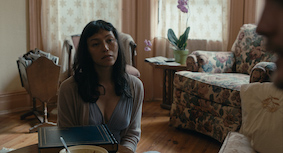
Linga Franca follows the story of an undocumented Filipina transwoman Olivia (Isabel Sandoval) in Brooklyn’s Brighton Beach Russian neighbourhood.
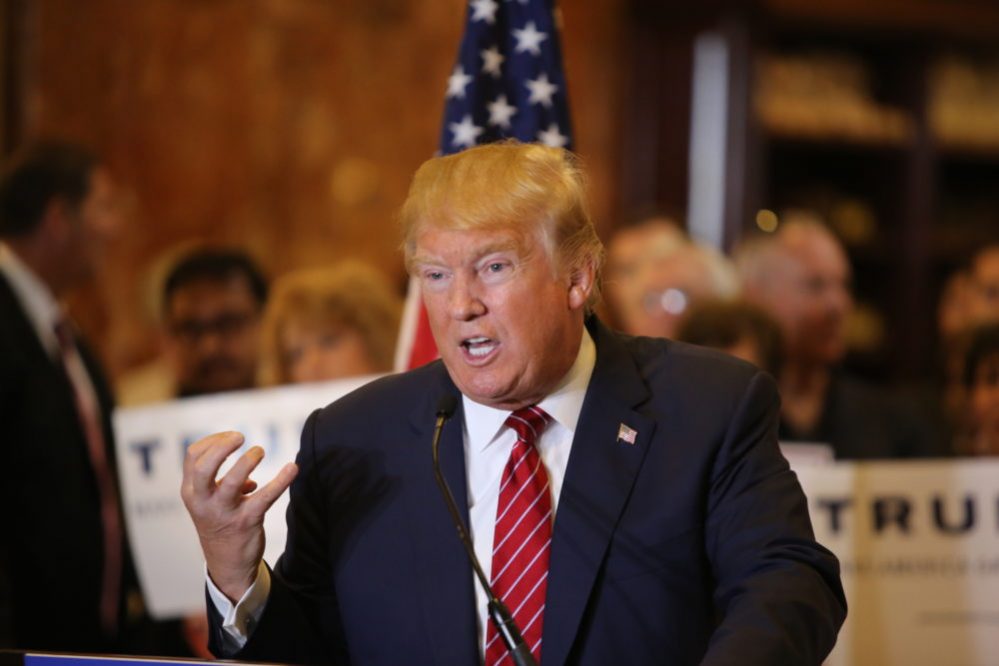
Olivia is the live-in caregiver for elderly feeble Russian Olga (Lynn Cohen – remarkable). Olivia has yet to get her green card, and she’s vulnerable to getting kicked out of the country in Donald Trump’s fetish for kicking out illegal aliens – it’s his rhetoric and voice that permeates in the background of the film. Olivia’s best friend and fellow Filipina transgender friend Trixie (Ivory Aquino) has found happiness with a good-looking American man and is more or less guaranteed a green card.
One day Olga’s Grandson Alex (Eamon Farren) returns from being away for a year – he’s the black sheep of the family. He stays with Olga and Olivia in Olga’s house and gets a job in a meat factory owned by his uncle.
Sure enough you can guess what happens next. Alex is attracted to Olivia and perhaps all too suddenly they fall into each other’s arms and make love. But is this what Olivia really wants? She had just been dumped by a guy who promised her the world, and Olivia, who was at a loose end and desperate, should’ve welcomed this new man in her life, but she doesn’t. We never really get to understand what makes Olivia tick and what will indeed make her happy.
While Lingua Franca is a very sensual and provocative film, we never really get to the heart and soul of Olivia. And the love affair between Olivia and Alex is a bit too easy. And while the direction and writing by Sandoval herself are delicate and moving, she brings us into an already chartered territory (it’s hard to top 2017’s ‘A Fantastic Woman’).
Lingua Franca may frustrate you a bit but it’s saved by terrific acting – especially by Cohen (she played Miranda’s housekeeper in ‘Sex and the City‘), who unfortunately passed away earlier this week.
The history of actors, who don’t identify as trans, playing trans characters is decades old.
The argument against non-trans actors taking these parts have made headlines over and over. Is it right for cis-gender actors to play the parts of trans characters?
Warning this article may contain spoilers to various films.
The 1950s – 70s
Daniel Davis, Glen or Glenda, 1953
Glen or Glenda was released in 1953 starring Ed Wood – who was actually credited as Daniel Davis in this film. It’s a semi-autobiographical film, considered one of the worst films of all time. However, it is considered a plea for tolerance.
Tim Curry, The Rocky Horror Picture Show, 1975
Probably one of the most famous films to feature a “sweet transsexual”. TRHPS has gone on to become a cult hit and recently had a remake filmed and it starred Laverne Cox in Tim Curry’s part of Dr Frank N. Furter.
The 1980s – 90s
Michael Caine in Dressed To Kill, 1980
In 1980 Michael Caine played a murderous trans woman in this erotic thriller. For his part in the film, Mr Caine was nominated for a Golden Raspberry Award for Worst Actor.
Jaye Davidson in The Crying Game, 1982
A drama which explores themes of race, gender, nationality and sexuality with the troubles of early 80s Northern Ireland as a backdrop. The trans character in this film is actually one of its great surprises, which is considered a “shocking twist”. Jaye Davidson was nominated for a Best Supporting Actor for the role.
Terrence Stamp in Priscilla Queen of the Desert, 1994
One of the most successful LGBT films of all times was released in 1994 is in the top 40 grossing gay and lesbian films of all times. Terrence Stamp’s Bernadette Bassinger is a carefully studied character, played respectfully.
Mary Sean Young, Ace Ventura: Pet Detective, 1994
Possibly one of the most offensive portrayals of a trans person in film – which uses the trans character as a comedy mimic.
Julie Hesmondhalgh in Coronation Street, 1998
Coronation Street made history in 1998 when they introduced the first trans character to a British soap. It wasn’t until 2015 that EastEnders made further history by having a trans actor play a trans character. Julie Hesmondhalgh has been praised for her portrayal of a trans person and she is a huge advocate for the LGBT community. In 2017 she called on TV companies to employ trans people in trans roles.
One of the most tear-jerking LGBT films of all time. Hillary Swank was truly remarkable in the film which was based on the true story of murdered trans man Brandon Teena. The film was nominated for 57 awards and won 37 of them including, Best Actress (Oscars and BAFTAs) for Swank.
The 00s to 10s
John Cameron Mitchell in Hedwig and the Angry Inch, 2001
One of the only musical films featuring a trans character in the central role. John Cameron Mitchell wrote and directed this film. It features in the top 100 LGBT films.
Felicity Huffman was widely praised for her role in TransAmercia as a pre-operative male to female transgender person. This was an unusual casting decision as usually male to female trans parts are played by males rather than females.
Rebecca Romijn was another female who was cast in an M2F role in the comedy TV series, Ugly Betty. She appeared midway through the first season and left in season 3.
The 10s to 20s
Chloe Sevigny in Hit And Miss, 2012
Hit And Miss was a TV series which followed the life of a transgender contract killer. It ran for one series.
Jared was awarded an Oscar for his role in Dallas Buyers Club, however, his casting in this film and subsequent acceptance of the Oscar with a full beard was criticised by some in the trans community. Laverne Cox recently said, “as brilliant as Jared Leto is, and all these actors who play trans women, when people who don’t know anything about trans folks and trans women see the very sexy Jared Leto and his beard accepting an Oscar for playing a trans woman, the message that it sends is that trans women are really men”
Jeff Tambor in Transparent, 2014
CREDIT: kathclick-bigstock
Amazon was praised for the production of Transparent starring Jeff Tambor who plays a trans person coming out as trans later in life. The show has won awards and much love from the critics for its sensitive portrayal of a family dealing with and accepting transition.
Eddie Redmayne in The Danish Girl, 2015
Eddie Redmayne played the part of Lili Elbe, acknowledged as the first trans woman to go through sex reassignment surgery. Despite it being widely praised there was only one Oscar win out of four nominations. The film was banned in a number of countries including Qatar, the UAE, Oman, Kuwait and Malaysia.
He later apologised to the transgender community saying, “To the Trans community. I hear you. It’s wrenching to you see you in this pain. I am glad we are having this conversation. It’s time.”
Have we missed something? Is there an error? Please use the comments below to help expand this article.
Donald Trump‘s administration allegedly sent out a memo, detailing how officials might spot a transgender person, in order to identify them if they were to try and gain access to Government-funded homelessness shelters. Specifically, the memo was looking to demonstrate how a federal employee might be able to determine if a person, standing in front of them, trying to gain access to a woman’s homelessness shelter, was a transgender woman or not.
In a highly controversial move, the memo included information which might help an employee determine a person’s biological sex rather than gender identity. It outlined features such as height, facial hair and whether the person in question had an Adam’s apple and characteristics which “when considered together, are indicative of a person’s biological sex”, according to Snopes.com.
According to the site, the memo was released in July 2020 and listed physical characteristics, “in order to identify incoming transgender people at federally funded homeless shelters”.
The memo was a 29-page documentary, titled, “Making Admission or Placement Determinations Based on Sex in Facilities Under Community Planning and Development Housing Programs.”
Cornwall Pride wrote to all of the UK’s MPs to express concerns over the Gender Recognition Act and the delays to “gay cures” in the UK.
“Very concerned over backtracking on trans rights”.
The team that runs Cornwall’s only Pride event, Cornwall Pride has written to all of the UK’s MPs to outline their concerns about backtracking on transgender rights in the UK.
They also criticised the Government for “failing in its commitment to formally respond to the Gender Recognition Act consultation by repeatedly delaying publication of the review”
It continued,
“However, we are also disappointed to see the leaks of selected sections of the report without proper communication by the Government. This has caused significant distress and anxiety among trans people and wider LGBT+ communities here in Cornwall and the UK. We believe trans women are women, trans men are men and non- binary identities are valid.
“We, therefore, state our support for trans people’s right to self-identification.”
As it stands,to obtain a Gender Recognition Certificate (GRC) in the UK, transgender people require a medical diagnosis of Gender Dysphoria, implying that being transgender is a mental illness – a view not recognised by the World Health Organisation.
“They must also live in their “acquired” gender for a minimum of 2 years and must pay a fee of £140.
Cornwall Pride adds, “The Government’s own research acknowledges that this process is bureaucratic, expensive, and humiliating for many transgender people. We believe the Government should respect the consultation, demonstrate a consideration for transgender people’s safety and dignity, and continue to explore ways of reforming the GRA”.
“Perturbed to restrict trans women’s access to services and facilities”
The letter also states,
“We are particularly perturbed by the reported proposals to not only scrap any reform to the GRA, but to restrict trans women’s access to services and facilities in the guise of “safeguarding” safe spaces for cisgender women. One of our supporters has worked in the Violence Against Women and Girls sector, including in a refuge, for more than 13 years and believes such restrictions for trans women are unnecessary and unethical.
“We will be dismayed if the rights of transgender people, both with and without a GRC, are dismantled to appease a “vocal few”.
Reddit has purged a huge amount of forums recently. Yesterday it banned numerous subreddits, many of which were gender critical, trans-exclusionary or part of an anti-transgender movement.
Reddit is one of the largest forum websites in the world. It has hundreds of thousands of pages dedicated to thousands of topics, with millions of users.
As part of an ongoing clean up of its website, Reddit banned numerous forums yesterday (10th July), which homed thousands of threads of conversations with regards to the validity of transgender identities and gender expression.
Here’s the list of subreddits that were banned that Reddit said had broken its guidelines on “promoting hate”.
The ban included LGB specific reddits. Some of the LGB groups think that the T should be dropped from the LGBT+ acronym, very much like the Get the L out campaign which disrupted Pride In London in 2018 or the LGB Alliance on Twitter.
r/LGBDropTheT
r/TrueLesbians
r/GetTheLOut
r/UncensoredLGBT
r/gendercritlesbians were all part of the ban.
Detrans is a forum that was initially banned for around an hour but was later reinstated. Its purpose is to give those people who detransition a forum to talk about their lives and journies.
A week ago, Reddit made headlines after it deleted dozens of forums for hate speech.
It is thought that Reddit has now deleted around 2000 of its forums.
The BBC published, redacted and then re-published with a clarification a comment which infers that gay men are transphobic for not wanting to date men who are transgender.
“And this discrimination also extends to transphobic preferences in the world, from cisgender gay men not wanting to date trans men and the routine fetishisation of trans women”.
The original article from the BBC, which was scraped by Yahoo News.
In the original article, the comment was not added as a quote, so either seemed to be a statement of fact or the opinion of the BBC journalist who wrote the piece.
It now reads,
“And this discrimination also extends to the dating world, according to York. They cite cisgender gay men not wanting to date trans men and the routine fetishisation of trans women, as examples of “transphobic dating preferences.”
The clarification in the next paragraph adds an explanation from GLAAD .
“Many would disagree that such dating preferences can be described as transphobic, and say same-sex attraction is not related to gender. When asked for their view on these dating issues, leading LGBT advocacy group GLAAD told the BBC that they echo the “leading advocacy, medical, political, and psychological organizations that assert trans women are women”.
THEGAYUK reached out to Glaad for further clarification on its statement.
No clarification until today
The article was criticised by some on social media and the paragraph was amended omitting that paragraph on the BBC website. However, no signifier or clarification was left on the page to show that the original piece had been edited.
THEGAYUK reached out for comment to the BBC to ask if the stance was editorial policy or whether it was normal practice to amend piece without clarification.
Today the BBC told us,
“Clarification and update 6th July 2020: An earlier version of this article cited cisgender gay men not wanting to date trans men as an example of transphobic preferences in the dating world. However some readers took this to be a statement of fact, rather than the view of Asanni York, and so these comments were removed. They have since been re-added, in context, along with some additional reaction from LGBT advocacy group GLAAD.“
The article now reads with the statement that gay men are transphobic for not wanting to date trans men as being a quote from Asanni York, the founder of For The Gworls – a black trans collective that raises money for gender-affirming surgery and living costs.
The Father Ted creator has been suspended from Twitter after apparently tweeting about transgender people.
The author, who Tweets a lot about gender issues, has been apparently suspended from Twitter, just a week after he briefly had his Blue verification tick removed, which was in response to accusing an LGBT+ group of “grooming”. However, Twitter said the removal of his verification was a mistake and later restore it.
His account now has been removed from Twitter entirely, like the suspension of Katie Hopkins, who was removed from the platform entirely early this month.
Linehan’s account suspension comes after he allegedly tweeted “men aren’t women tho”, a response to the Women’s Institute, who wished all their trans members a happy pride.
The WI is a place which welcomes and celebrates all women. As we near toward the end of #PrideMonth, we would like to wish a Happy Pride to all our transgender members.
— Women's Institute (@WomensInstitute) June 25, 2020
Linehan revealed that he been locked out of his account numerous times and “forced to delete tweets” in order to gain full access to his account.
The writer has submitted an appeal with Twitter and the Better Business Bureau.
A post, purportedly from Lineham on Mumsnet, said,
“Recently, I keep being locked out of my account and forced to delete tweets to get back in. The latest tactic by trans rights activists is to run a search for any time I’ve used the word ‘groomer’, a phrase Twitter recently decided was Not Allowed
He continued,
“Twitter has a high percentage of trans-identified employees and for some time has been silencing feminists and their allies who run afoul of its absurd ‘misgendering’ policies. The one good thing about my situation is that I’m in great company–Claire Graham, Meghan Murphy, Skylar Gwynn, Miranda Yardley, GNC Centric and many more, important feminist and critical voices who have been silenced for fighting a dangerous ideology that tells children it’s possible to be born into the wrong body.”
Twitter confirmed that Linehan’s account “has been permanently suspended after repeated violations of our rules against hateful conduct and platform manipulation”.
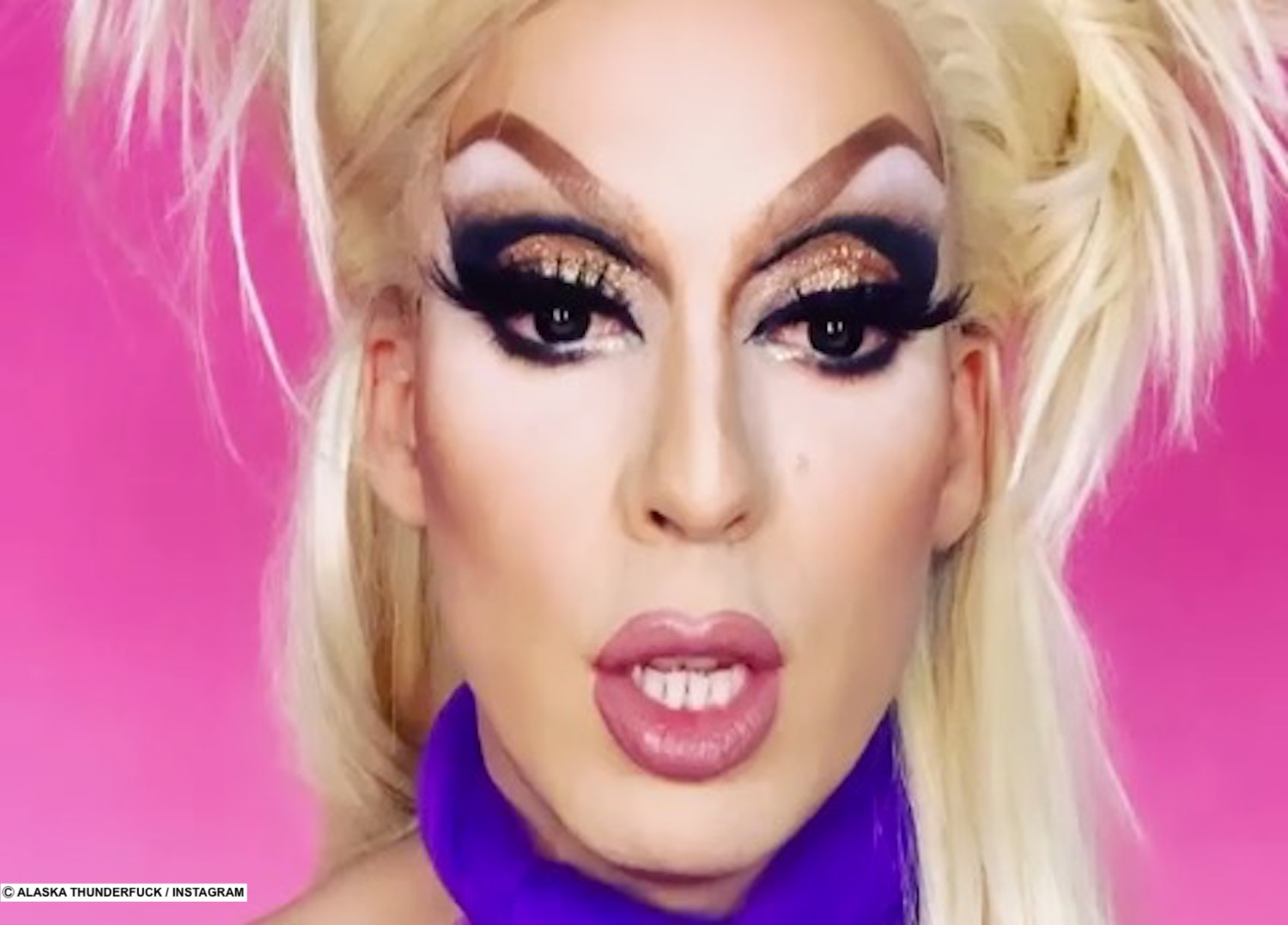
Drag Race favourite Alaska Thunderfuck has issued a statement in which she addresses her past actions including jokes about sexual assault, trans issues and race.
In the statement on Twitter, the performer admitted that although it was never her intention to cause harm, her intention was not important adding, “it was my privilege that allowed me to only get away these things but be applauded for them”.
Alaska rose to fame during the 5th series of RuPaul’s Drag Race, where she placed runner up. Since then she has amassed a worldwide audience of over 2 million on her social platforms, including Instagram and Twitter.
“I used racial and transphobic slurs and made jokes about sexual assault”
“In past performances, I used racial and transphobic slurs and made jokes about sexual assault. I have also used racist imagery in past looks”.
She continued, “I apologise. I’m deeply sorry for the hurt and damage that I caused in making these stupid harmful negligent choices.
“I take full responsibility for everything I have done in my past. I have learned that is essential to use my art and my privilege and my platform to make people empowered, uplifted and strong”.
I know, when popstars come to writing their second album it’s often referred to as the “difficult second album”. Who would’ve thought I’d have that problem when it came to be writing this little column for you all?
I suppose, I would like to start by saying – Thank you! I have received a lot of love on social media about it, and I think it’s done the job I wanted it to do by making people ask questions as to whether they are doing enough to help support their local communities. It’s important now, more than ever, that we continue to invest in our safe spaces and show them some appreciation. This lockdown and epidemic has been tough on everybody and we’re all bound to be anxious over what this new normal is going to be, and how we will have to adapt to a socially distant society. We all need to show a bit of love, support and understanding, and show we care.
The best thing to come out of having this column, is having a voice within the community – which, is a little strange to me, because for a long time when I moved to London, I didn’t feel like I really belonged to the community.
Deep down, I knew I was gay when I was in my early teenage years, but I didn’t have a role model or any form of support to help support me. I’d never been to a gay bar before I moved to London. To this day, I can remember my first proper night out on the Gay Scene in London. I’d been in London for a couple of weeks at that point, and I was so eager to experience all the very thing I had spent my summer researching. It wasn’t even a conventional night out with my university course mates. I met a bloke on Grindr one Saturday afternoon and he’d invited me to meet him for a few drinks in Soho and he offered to show me around. He was a nice enough guy, I didn’t fancy him, and there was nothing sexual about it. He was just a few years older than me, and it was really nice to meet someone who was happy to show me around and introduce me to the scene.
It was painfully obvious to me that night that I would have a problem really fitting in with the “scene”. I knew I was different to everybody else. I knew that my size was going to hold me back. Being a fat guy, it almost labels us automatically as being unattractive and unworthy of attention. I remember being on the dance floor in Heaven that Saturday night, both having an incredible night in a space that felt safe, and yet feeling completely alone.
There were so many six-packs and chiselled bodies and then there’s me, in an oversized top from Primark and comfortable jeans, trying to hide just enough of my body that I felt comfortable. So, even from the start of my journey of self-discovery it really felt like I was fighting an uphill battle with myself. I look back now and wish at the time I made that conscious decision to make that change when I was younger. Instead, I continued to eat my feelings and I made no attempt to lose weight.
It wasn’t until my mid-twenties when I started to feel that I was letting myself down and I had to make that change, because I felt I was missing out on important life milestones because I couldn’t find happiness in a relationship.
It’s clear to me now, that the problems I had stemmed back to my childhood. I was born in 1992, into a middle-class working family, in a very conservative, stuck in the past community. I was at school towards the end of when Section 28 was still in effect and I was heavily bullied as a kid – teachers couldn’t really stop that. Sure, they could reprimand someone for calling me fat, or specky four eyes. But if someone called me a faggot or a queer, which happened quite often, they couldn’t do anything. That really hurt me, and it still does today. They knew that it was wrong, but there weren’t in a position to really combat it.
The repercussions of Section 28 put young queer kids at risk for not having a sex education that was relevant to them. They didn’t have any understanding or advice as to what a healthy relationship was the for them.
Some developed worrying behaviour that could put them in danger, such as excessive alcohol and substance abuse as well as sex with much older men, which could sometimes result in a sexually transmitted disease or a positive HIV test result. Teachers now have a duty of care over young people to educate them, and some people still feel a bit angry to this day that they weren’t supported and let down during a crucial and pivotal part in their development and education.
I guess, I kind of fall into this remit. I was never taught about same-sex relationships in school. It was brushed under the carpet. We were never exposed to that as kids so – we really didn’t understand what these relationships looked like. Our only real understanding of it was from the limited access to queer representation on television.
We were reduced to watching programmes such as Queer as Folk, which were truly ground-breaking at the time to show such explicit material, under the cover of darkness with the volumes on the lowest possible settings on the TV sets. Representation has improved over recent years, with more and more openly gay people visible on television, and more openly gay character in the mainstream media, paving the way for education for younger generations. It’s put pressures on TV Shows and the Media to show them in a positive and healthy way, to help fight the comeback following section 28.
We have come a long way since then, but we’ve got a long way to go. LGBT+ characters in mainstream television are often thought as an afterthought by creators, with producers and directors ticking through diversity checklists to make sure there is representation. We exist and we are a part of normal society – represent us as who we are. We’re not all butch lesbians and raging bitchy queens.
June is Pride Month, and for the first time since the Stonewall riots we are unable to march and celebrate Pride in the way we’ve done in the past. Even in 2020, we see people questioning Pride Month. Sadly, I’ve seen a number of comments on social media from people asking we don’t have a Straight Pride. To me it’s a ludicrous argument.
When have white heterosexual people ever been discriminated against? When was it illegal to kiss their partner in public? When were they forced from their homes into refugee camps for being straight? When were they killed for being straight? Well, we all know how that turned out when they tried that in America. They don’t have Straight Pride – but they do, however, have International Clown Week – maybe they can attend that?
The British based charity, Stonewall, posted some statistics online in early 2020 stating which I found to be staggering and pretty upsetting. Stonewall posted statistics stating that; 26% of lesbian, gay or bisexual people alter their behaviour to hide their sexual orientation in order to avoid becoming the victim of a hate crime. 48% of trans people under the age of 26 said that they had attempted suicide, and 30% of those had done so. A staggering 59% said that they had considered doing so, and finally – a quarter of the world’s population believes that being LGBT should be a crime – and although we’ve come a long way in sixty years – shows that there is a long way still to go in our fight.
Relationships are something that should be taught in schools, and children have a right to understand that same-sex relationships are a perfectly normal thing. It should be taught that it’s normal to have two mummies or two daddies. Having an LGBT-inclusive education ensures that those with LGBT families see themselves reflected in what they learn. It also will encourage all young people to grow with inclusive and accepting attitudes. It will also teach them about what a safe and healthy relationships look like and how to have them. Better reflecting the world in which we live in, and subsequently covering important issues like consent and online safety.
Having this understanding from a younger age, can only help to stamp out homophobia. It’s not going to be a cure, but I hope it goes a long way.
There has been no evidence, that I have been able to find, to suggest that predators have used the provisions of the Equality Act 2010
To further our movement, we have to continue to call out bigotry, homophobia and hypocrisy when we see it. A Tory MP posted a message on social media to celebrate Pride Month – immediately, its hypocrisy was called out. If there is one thing in this world, I cannot stand is a double standard. You cannot show messages of support for our community, when your government is actively looking to roll back Trans rights by scrapping a review of the Gender Recognition Act. It just doesn’t work that way! Trans people have been using toilets, or trying on clothes in changing rooms, accessing domestic violence support, and getting on with their lives as for as long as single-sex spaces have existed.
There has been no evidence, that I have been able to find, to suggest that predators have used the provisions of the Equality Act 2010 to gain access to women’s spaces. If there was, then it would be shouted from the rooftops by anti-transgender lobbies.
Trans men are men, Trans women are women. The same government promised to ban Gay Conversion therapy two years ago – and yet we’re still waiting.
So, whilst I’ve got this voice, I am going to use it as a platform to help forward our movement in any way that I can. We’re also going to keep it light and entertaining. You’ll get to hear some of my crazy overseas stories, find out what makes me tick and what rubs me up the wrong way.
I want to give you an honest reflection of my life – share some of my experiences and tell you more about my disastrous attempts at finding love. I hope you enjoy the journey!
A reader asks our agony uncle whether he’s normal for wanting to dress up in women’s clothing when he has sex.
Dear Uncle
I’m a man who likes the idea of dressing up in women’s clothes during sex. I’m not trans and I’m happy with my body, but the idea of wearing feminine clothes whilst having sex with another guy a turn on. Do you have any advice on cross-dressing for fun? Is it normal?
Mike, 28
Dear Mike,
The question isn’t really whether it’s normal – if it’s what you want to do and you’re with someone else who’s digging it then who gives a flying monkey if it’s “normal”?
There are plenty of guys out there who want to crossdress and there’s also plenty of guys out there who are into that as well – you’re not alone.
Get an online profile
First off set up a profile on your hook up app/website of choice setting out your preferences and the parameters of what you’re looking for. Are you just looking for NSA sex or are you wanting a relationship?
Are you looking for guys to only see you in your feminine attire or do you want people to know you as a whole?
Maybe add a photo and some details about what you’re looking for and offering.
I would say that it’s best to let people know what you’re into first rather than spring it on them after a number of dates.
Just like any pre-meet chat, it’s pretty typical and good to be kept informed on what they want and expect and, of course, visa versa. Dropping into the conversation that you want to try cross-dressing will mean that others can decide whether they’re into it as well, that way they’ll be no crossed wires.
Another suggestion is the dating site https://tvchix.com/ , which welcomes, “all TV’s, CD’s, TG’s, admirers, their partners and friends”
Real-world experience
You could also check your local gay sauna to see if they have any cross-dressing or trans / CD nights where you can dress up however you want. Some venues offer this service so it’s worth checking them out.
And then, of course, you could also seek the services of a professional. Sir Dave, one of the UK’s foremost Fetish specialists told us, “Over the years I have had many clients with an interest in cross-dressing visit me. Many have never dressed in front of anyone before and it is so important to me that they feel comfortable and respected and given a safe space in which to explore their interests and fetishes. Cross-dressing is done for so many different reasons, some times just to explore the feeling.
“Whatever their reason for it, I provide a safe, discreet space for them to enjoy and build their confidence.”
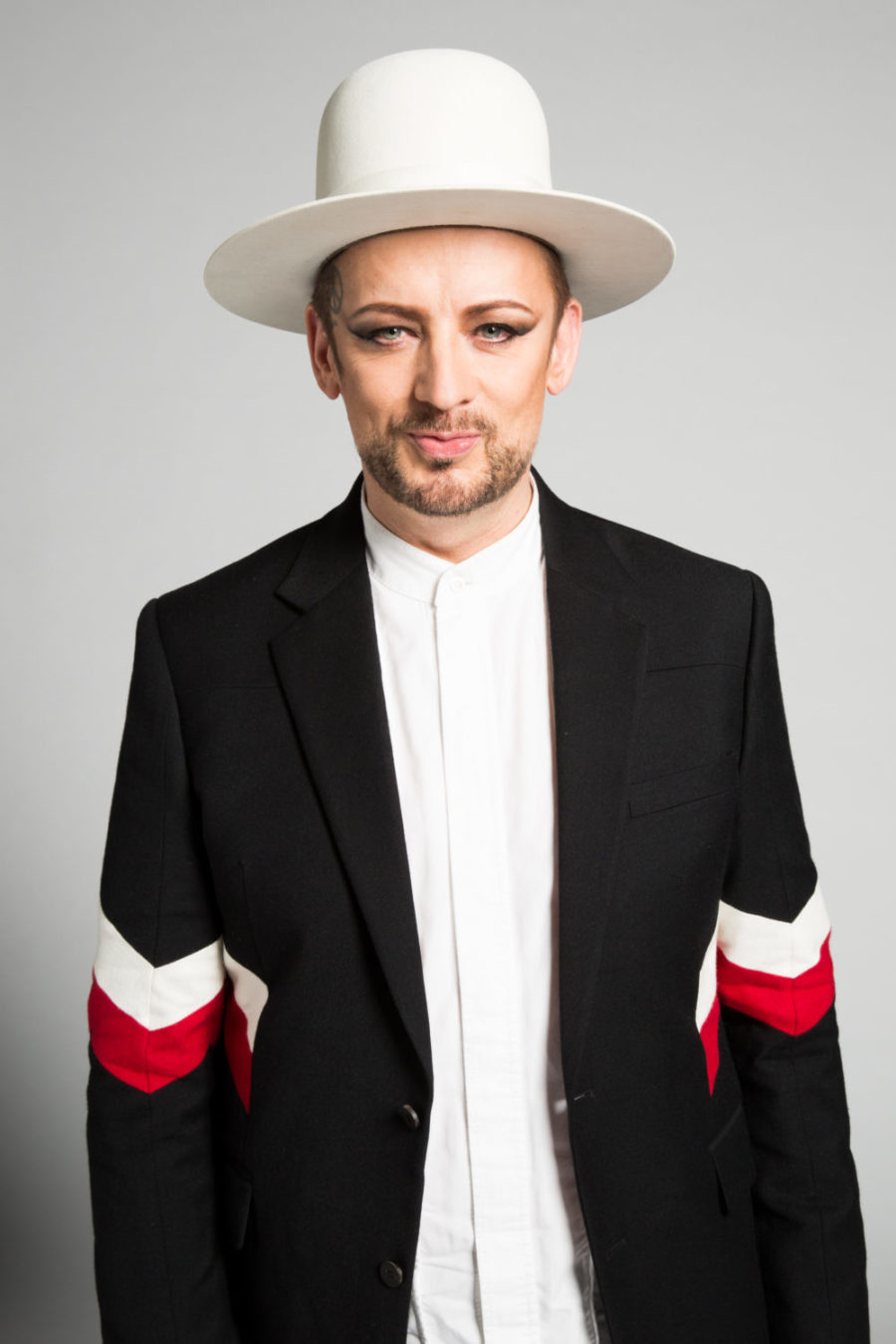
The superstar, Boy George, has caused controversy with trans and non-binary advocates after suggesting that preferred pronouns should be left out of the conversation.
Boy George has lit a match under the “preferred pronoun” conversation and is currently under fire for suggesting that pronouns should be “left at the door” to further compound the issue, he went on to call it a “modern form of attention seeking”
Fans of the 80’s hitmaker told the star that he should “respect people’s preferred pronouns” while some called the singer “transphobic” for his comment.
In response to a question about not using someone’s preferred pronouns, Boy George replied, “Thanks for that but I have eyes and can mostly describe what I see!”
Former Pink News journalist, Benjamin Butterworth responded, by tweeting, “Then we’ll stop calling you your attention-seeking identity “Boy George”, and use your real identity of George O’Dowd, convict who falsely imprisoned and beat a man with a metal chain.”
Ego Boost?
Others were quick to applaud the singer for his stance. One fan wrote, “Every venomous, deranged tweet I come across has a pronouned [sic] bio attached to it” while another added, “Pronouns are nothing more than ego boosters for people who use them”.
One user said using, “compelled pronouns was ridiculous”