Tag: Diesel Car Review

The latest reviews for diesel cars. Find out which are the smoothest, quietest, most economical and cheapest diesel cars on the market.

  • MOTORING REVIEW | Kubota K008-3

    Boys will be boys they say and that saying is still applicable now even as we get older. When we were young we had thrust upon us the football to play with, expected to fix a puncture on our BMX and we were given a toy digger.
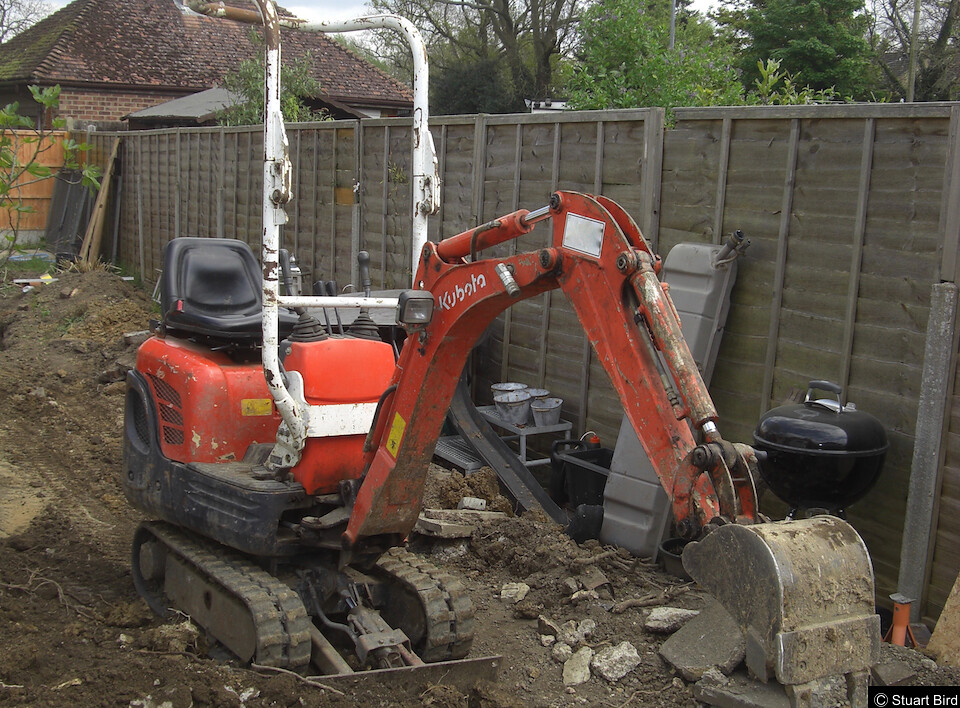
    There is something about a digger that was always so macho to me. A simple machine that men used to dig things and erm, dig things. Having watched a lot of Dempsy and Makepeace in my childhood (who didn’t have a thing for Michael Brandon?), used by bad people for all sorts of things outside of digging.

    A man friend of mine called Dave was doing some excavation work at home in preparation of a garden makeover with a difference. He said I should come round and try this new toy he had hired for THEGAYUK. It was in his words “BRILLIANT”

    Not to be put off from getting one’s hands dirty, I donned a hard hat, butch boots and a hi-viz vest. All totally pointless in a private setting with no foreman but I wanted to experience the Kubota K008-3 appropriately attired. If it meant having to don a bow tie, I would have.

    The machine looked simple enough. To help with weight-saving there were no doors fitted and the cabin was sparse. In fact, it was more sparse than the recently tested Abarth 695 Bisporto we tested. Thankfully money has been spent on a comfortable seat. Good really considering you could be here for quite some time if you decided to travel the length of a modest garden in suburbia.

    Start up was simple. Turn the key and the little diesel engine spluttered into life. It was very quiet as it powered up hydraulics and gave it enough gumption to propel itself forward on rubber caterpillar tracks to a top speed of about walking pace. Once that is you had mastered the controls. there were 6 levers and 2-floor pedals. Quite different from the Britains toy digger I was given at 4!

    We were still not quite sure what the pedal on the left did. Possibly throttle. It didn’t give much of a clue. Like a Toyota Hilux, this thing can still work while being broken. The pedal on the right moved the floor shovel and stabiliser up or down.
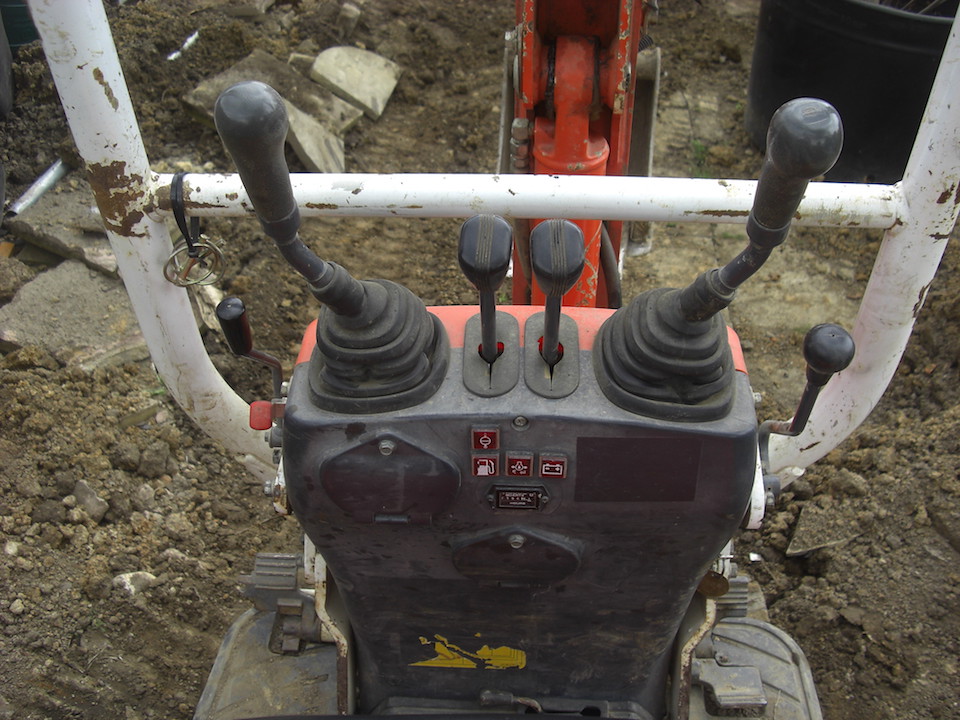
    The two big levers did the magic bits to the digging part. Left lever swung the arm left or right. It also moved the arm furthest away from you up and down.

    The big lever on the right moved the arm closest to you up and down while also opening and closing the bucket. have you managed to grasp all that?

    If you have then you’re better than me. If I was at the 02 arena on stage to Kylie singing then I’d have looked great. I’d spin left. I’d spin right. I’d move the arm up and out. It was “Traveling Light Years” meets “Spinning Around” I span around and it felt really fast. I’d attempt to dig some soil but all I could manage was no more than the amount you’d get in the bucket you keep under the sink. However with perseverance, trial and many errors, I managed to better than a bucket of mud. I’d managed about three.

    Dave made some suggestions on how to get the best out of the Kubota K008-3 but to implement those into someone with undiagnosed dyspraxia was going nowhere. I say dyspraxia but if truth be told, I’m just kack-handed.

    So we carried on some more, trying my best not to fall down the trench he had already dug, Safety first for the Kubota driver is a lap belt and a roll cage over the front. With no seat belt alarm going off, I decided to drive by the seat of my pants albeit hard-hatted like the construction worker of the Village People.

    Once I had managed to feasibly master the controls I was let loose with the performance of the engine. The middle levers do the forward and back motions. Forward for forward and you get the rest. What you needed to be aware of was that both levers have to go the way you want to go. You won’t snap your neck on the breathtaking 0-walking pace speed but you might when you want to turn left or right. It’s reverse of what you actually want to do. For my kack-handed ability, this wasn’t a problem.
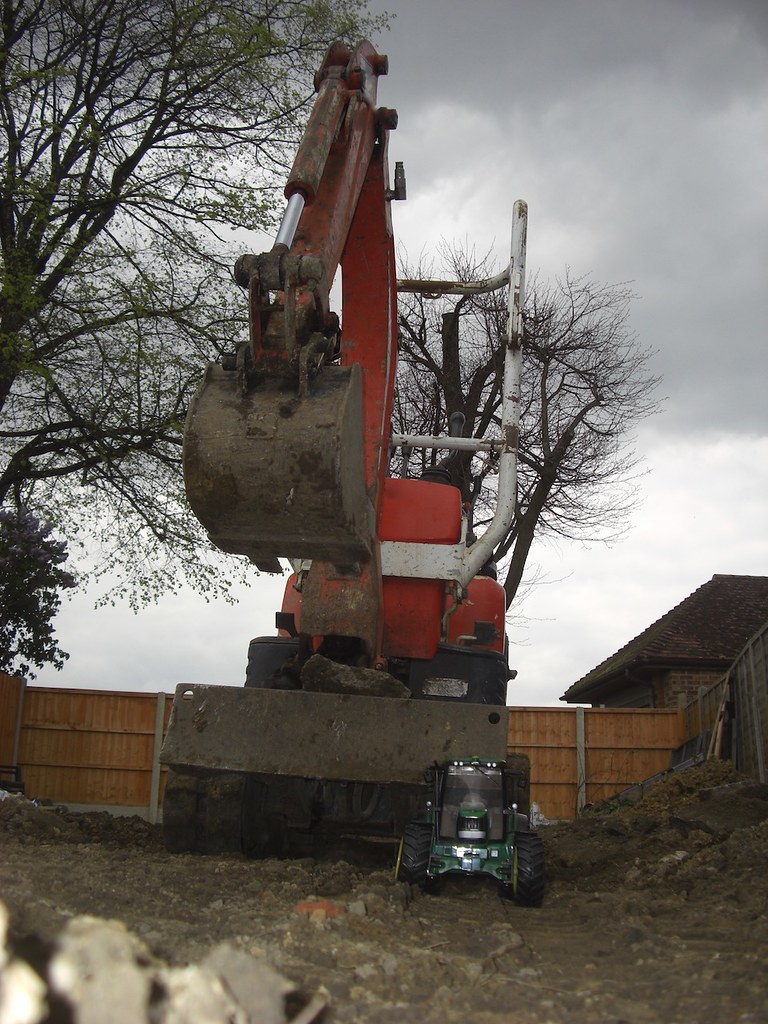
    It was fun, it was dirty. It separates the men from the queens. I think I’ll stick to driving pick-ups for my macho kicks and leave this digging lark to the real men. Now, where is my Britains digger?? I’m going to make a hole for a daffodil bulb.

    Likes

    You can dig up things
    Many different attachments available
    Quiet operation

    Loathes

    Poor dashboard instruments
    A bit too open to the elements
    Not very fast

    The Lowdown
    Car – Kubota K008-3 digger
    Price – £10,000 approx
    MPG – Either a lot or not man (combined)
    Power – Has lots.
    0-62mph – Do me a favour, you’d be lucky to get 6mph out of it.
  • CAR REVIEW | Citroen C3 Flair S&S BlueHDi 100

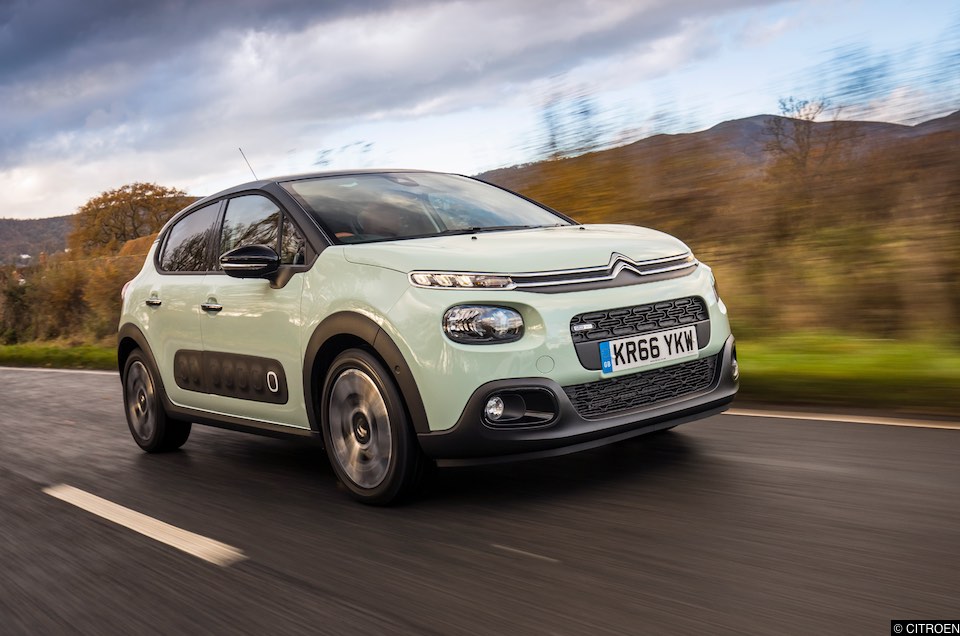
    ★★★ | Citroen C3 Flair S&S BlueHDi 100

    They were not wrong about the new C3 being eagerly waited for.

    Last year THEGAYUK reviewed the outgoing model. A model I didn’t really care much for in the beginning. By the end, it was a different story. It had taken Citroën about 14 years to get it right and just when they did they decided to start all over again. So is the new C3 better than the old or have Citroën got to start all over again?

    If there is one thing you can be assured of, it is that Citroën has not failed in making the new C3 ready for improvements. The C3 I was given was pleasant enough. It did everything right. The engine was the wrong one. If it had been fitted with their 1.2 three cylinder petrol engine as in the old C3 we tested, I would probably have been happier. The diesel just didn’t hit the right spot for me. It lacked the verve and excitement of the little petrol unit. That little unit is thankfully available in this Flair model and for over £1000 less. Buy the petrol engine.

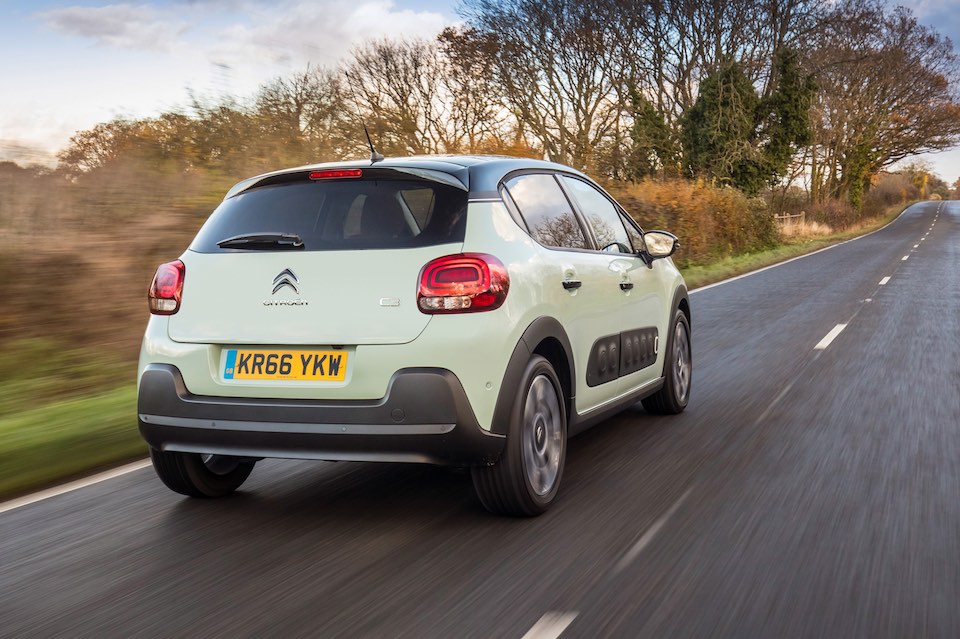
    Now that my biggest moan is out of the way, is the new C3 good. Thankfully it is. The car has grown in size which I don’t know if that is a good thing or not. The joys of a city car are that you can go anywhere and park it anyplace. The new C3 has one disadvantage over its slightly larger cousin the Cactus, and that’s the bumpers. More lack of them. The C3 sports Citroën’s cool airbumps on the side but lacks anything on the bumper corners. Instead, it leaves the headlights low and vulnerable. Thankfully it is fitted with big plastic wheel arches.

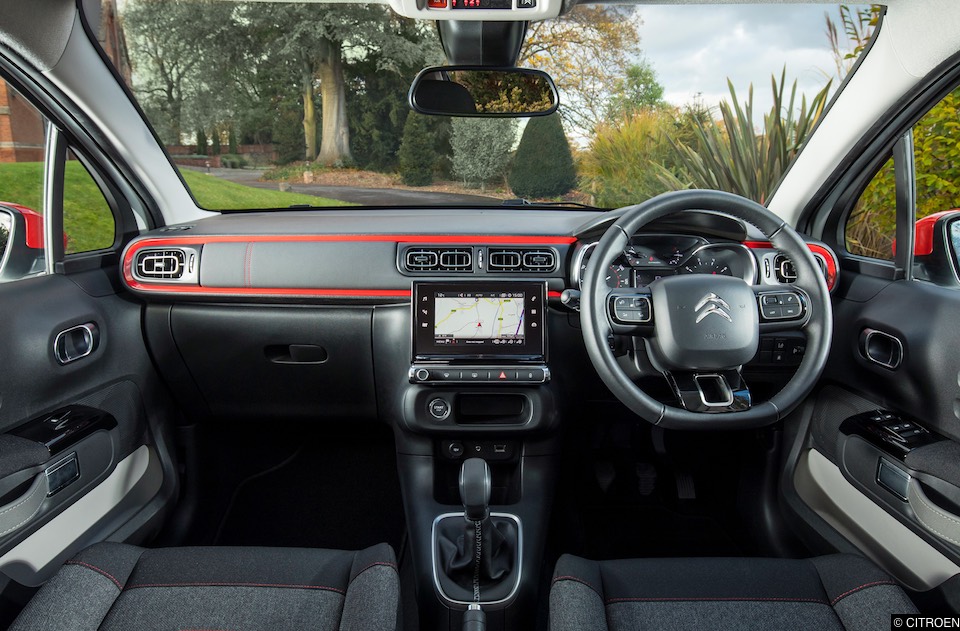
    Quirky kit aside, the inside is ok. It’s built to a price and does the job. There are some nice carry over pieces from the cactus are included like the door handles. and contoured door cards reflecting the opposite of the airbump. This model also came with the £150 red ambience option. It’s not to my liking. Less so when the outside was duck egg in colour. What you do get on this new model is ConnectedCAM. It allows you to take pictures as seen from the front of the car and send them to your friends. A little gimmicky but we like gimmicks. Sometimes there just isn’t enough of them in any car we test.

    What I couldn’t find on the options list was the enlarged front screen into the roof as fitted to the Picasso models. It made for a bright airy interior. What I didn’t like on the inside was the brightness of the infotainment system. It was too bright and didn’t seem to alter with the lights unlike the facia panel. Until I found the setting I was having to turn it off.

    On the move, the 1560cc diesel engine did a great job if a little harsh and with complaints. This is a first for me to moan about a French diesel engine. They usually behave like petrol engines. Sadly this 110hp unit ran out of puff. It might produce all of its power at a lowly 3750 rpm and this then returns in rapid gear changing and hoping the high torque of 151 Ib.ft at 1750rpm will carry you on. It felt lacklustre. I couldn’t engage with it. It annoyed me and more-so because I wanted to like the new C3.

    On the move, the suspension was compliant with most undulations. It did, however, reveal a harshness that was absent from the previous model. It was wobbly Citroën with Germanic crashing. At first unsettling but you grow accustomed to it. Like the handling. That was fun. It handles rather well when thrown about. Due to the engines dynamics, you need to alter your driving style considerably to get the best out of it. It was still better than the DS3 Cabrio I tested.

    There are many things about the new C3 that I do like. It looks ok. Actually, it looks brilliant. Thankfully Citroën are now able to make their vehicles reflect the brand and C3 now sports the new corporate Citroën front. Cactus tested the waters and it is now the approved face. It grows on you because it is so different. It sort of reminds me a dolphin. They are cute and like the C3 they have personality.

    The price is also rather good too. It is now cheaper than the outgoing model. All this new development and the add-ons costs £18,845 as tested.

    There is a lot to like about the new C3. I can’t say love about it because I didn’t feel it this time. Perhaps because I wanted it to be so much better. It’s not. It’s no worse, it’s just that l don’t like the engine. Buy the petrol.

    Likes

    Build quality

    Specification and equipment

    Cute shape with likeable face

    Loathes

    Constantly having to go through the menu to switch off stop-start

    Engines lack of puff at speed

    Infotainment systems brightness

    The Lowdown

    Car – Citroen C3 Flair S&S BlueHDi 100

    Price – £18,845 (as tested)

    MPG – 76.3 mpg (combined)

    Power – 100 bhp

    0-62mph – 10.6 seconds

    Top Speed – 115 mph

    Co2 – 95 (g/km)

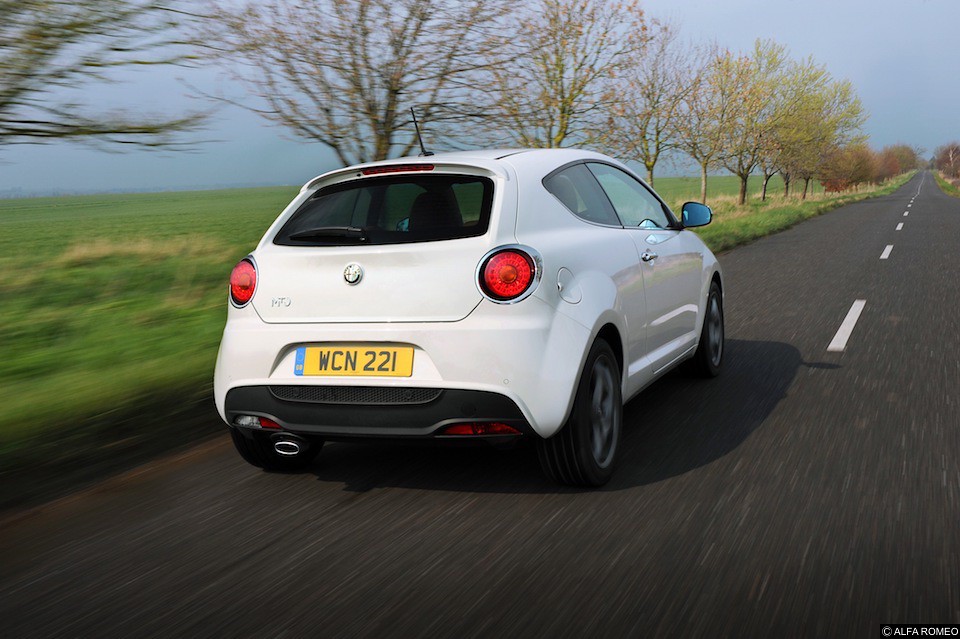
  • CAR REVIEW | Alfa Romeo MiTo

    ★★★ | Alfa Romeo MiTo

    I always wanted a MiTo. It’s the cheapest and easiest way into Alfa Romeo ownership. Unlike years ago, it won’t fall apart. I almost bought one but university called and so the idea was put on the back burner. When I had finished uni I bought a camper van with the funds instead of the Mito. Was I right to have done so thus not getting another Alfa Romeo?

    Alfa Romeo Mito Car review

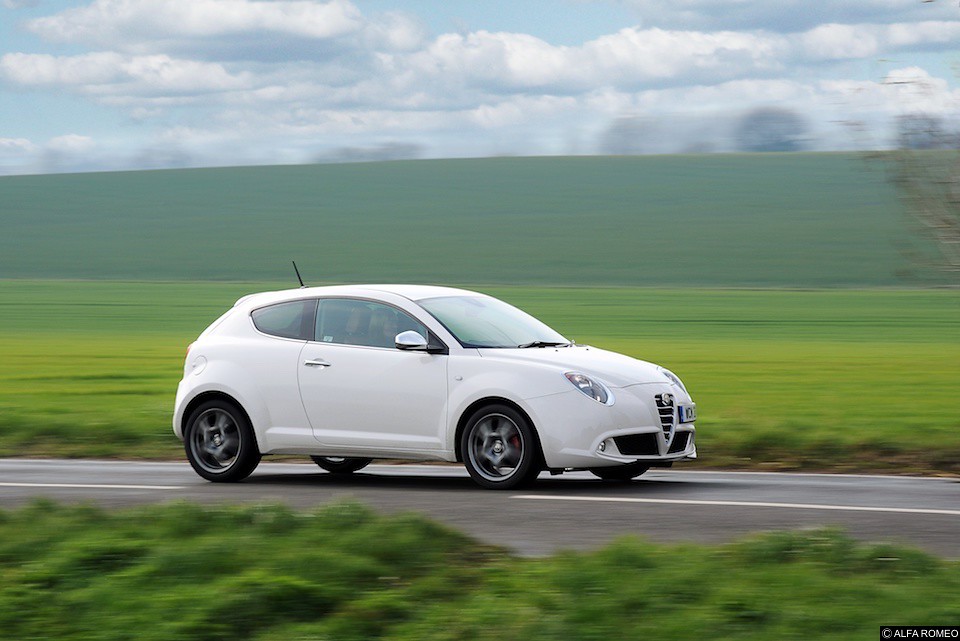
    If you want a small three-door hatchback with extreme exclusivity then take a look at the Alfa Romeo MiTo. The MiTo is now some nine years old and still a rare sight on the road. In the time I had one I saw three others. Sadly on all but one occasion, I was driving other cars so I was unable to share the love with an approving wave or a convoy.

    It’s not a great car by any stretch of the imagination. What it is though is an Alfa Romeo, so you can forgive it quite a bit for its flaws. Actually, you forgive it quite a lot. Design wise it is a bit lost. It is a sort of squashed down Giulietta. The result makes it look a bit like a small jacket potato. All is not lost as the potato design is making a comeback. It’s just that the MiTo missed the boat all those years ago.

    Alfa Romeo has a way in making cars. If you want clunk-click every trip then you don’t buy an Alfa Romeo and you certainly wouldn’t upgrade your Polo for one. That changes if you just want to be a little bit different. And the MiTo will fit the bill.

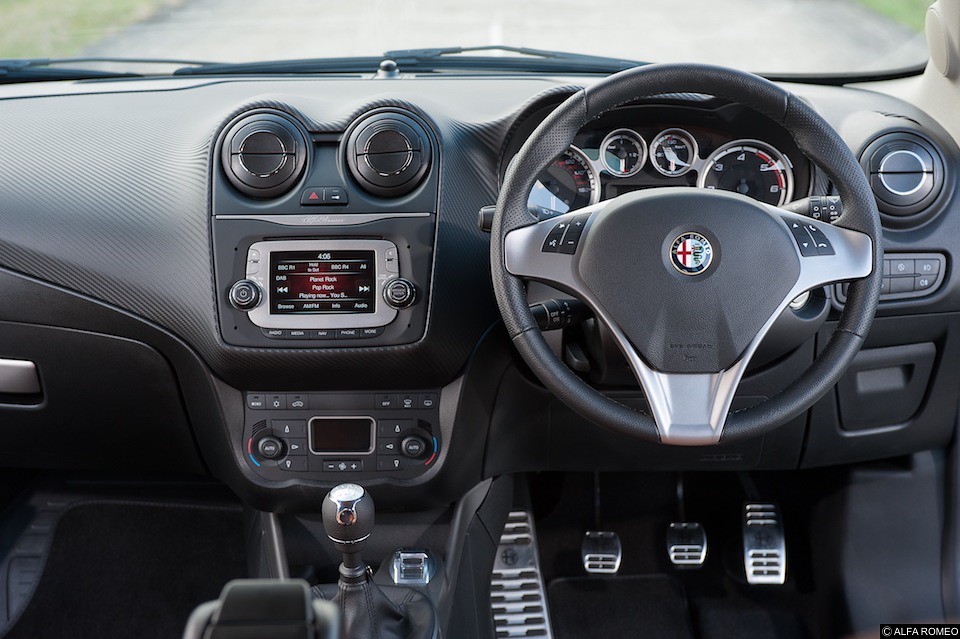
    Some of it in this revamped third face lift model is a bit old school still. The heads up display is red and almost dot matrix in style. The digital expressions of the MiTo coming towards you and away when you turn the key are quite nice touches to have on an older design. You start to like the MiTo. The inbuilt 5” screen satnav with Bluetooth, DAB and all the other things you expect today comes in at an extra £750.

    That’s a lot for 5” of screen but an essential part of the package. You would be a fool not to add it.

    The driving position is quite comfortable. Elbow room is in abundance and it’s no longer the long arm, short legs of previous Alfa Romeos. What isn’t available is oddments space. There just wasn’t the space available that I had become accustomed too.

    The first shopping trip proved rather eventful. The boot is deep. It just goes down and down and down like Mary Poppin’s carpet bag. Ideally, it needs a second floor. It’s not ideal in the day to day. It does give it almost class leading depth though.

    On the road, the little 1.3 diesel engine gives all it can. It’s not the worst out there. It’s quite a likeable unit and belies the 95bhp power that’s available. 200nm of torque at 1500rpm helps. It’s this torque figure, that when combined with the DNA switch in ‘Dynamic’ makes all the difference. In ‘Normal’ mode it felt out of depth. In ‘All terrain’ mode it was hopeless. DNA, now you understand what it stands for. Quite clever marketing really. Dynamic makes it more alive and responsive. To be honest I attempted very little motoring in N or A. A is mainly for atrocious conditions.

    Handling was quite up to spec for an older design. It’s easy to start liking the MiTo when you start to motor along. It lives up to the badge ever so slightly when you hustle it along. It never leaves you breathless but likewise, it never tried to put you in a ditch. The disc brakes on each corner being up to the job.

    It’s a likeable car while also being a bit less successful in many areas. Above all, it’s an Alfa Romeo. The doors are frameless and there is no way you can disguise the fact that in photos you will look great next to frameless doors with the windows down. Strike a pose, there is quite literally NOTHING like it… MiTo MiTo MiTo.

    Love

    Frameless doors
    Design
    Exclusivity

    Loathe

    Deep boot floor
    Price
    DNA switch to normal mode

    The Lowdown
    Car – Alfa Romeo MiTo 1.3 JTDM-2
    Price – £ 17,200 (as tested)
    MPG – 83.1mpg (combined)
    Power – 95bhp @ 3500
    0-62mph – 12.5 seconds
    Top Speed – 112 mph
    Co2 – 89 (g/km)

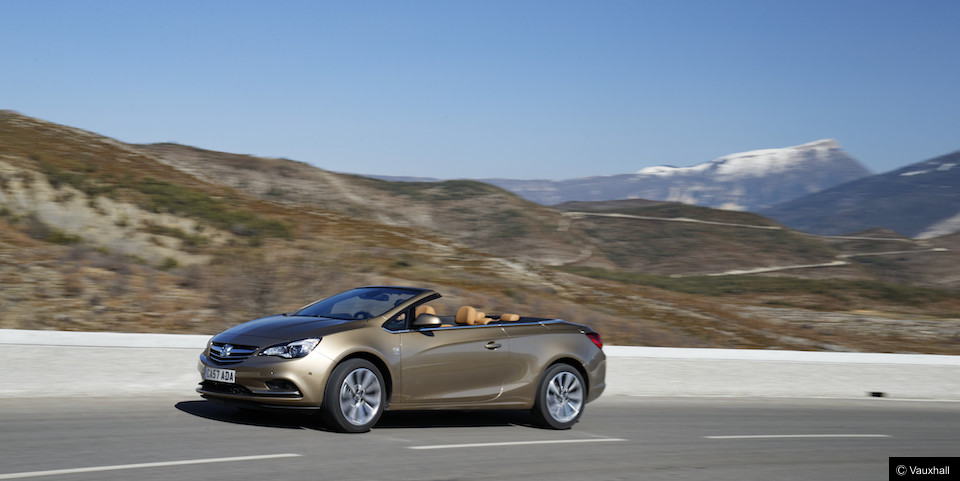
  • CAR REVIEW | Vauxhall Cascada

    Vauxhall Cascada… Tonight we can be Glorious

    It’s been a long time coming. Not since the Mk2 Astra GTE of 1986 have I really paid any attention to Vauxhall. I liked the Astra GTE so much that I even drew a picture of one, sent it to Scalextrix and asked them if they would consider putting it in their next lineup. I got a letter and special badge for my efforts.

    Since then, many Vauxhalls have come and gone so it was about time I reacquainted myself with the Griffin and what better than to try the Cascada. You may be wondering what the hell this is? If truth be told so was I when l saw it in the catalogue. It’s a convertible Astra J series. What that means is underneath it is the last generation of Astra but seriously don’t let that put you off. It’s actually quite good and I’ll tell you why.

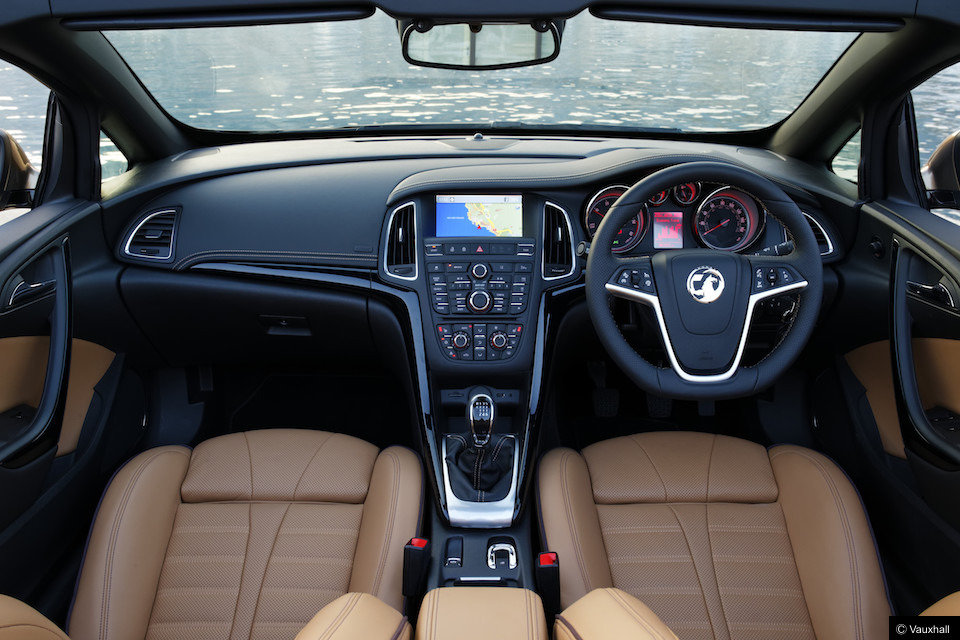
    I was given the 2 litre 170ps diesel Elite model. For a diesel, it is remarkable for being rattle free. In fact, it made no noise at all which might account for me stalling it on too many occasions to count. Hood up or down, I would say it was as quiet as a Mercedes. I can’t. I tested a Mercedes GLE recently and the Cascada is quieter. Vauxhall has thrown everything they can making the Cascada feel better than it actually is in refinement. Even riding on massive 20-inch rims has done nothing to harm the refinement of the car. It’s quite remarkable.

    Going back to the engine, it is a pleasurable unit to pilot around. According to the spec sheet, it really is the only engine option to go for. The 1.6-litre petrol engines will only better it in top speed and 0-60. That said a 0-60 time of 9.6 seconds isn’t exactly bad. It’s no sports car so these figures are quite on par with the sector.

    It is only when you realise that behind all the glitz, shine, open air motoring and 20-inch rims that this isn’t a sports car you appreciate it even more. It’s a serious cruiser. I only had it for a weekend so on a calm night in March I tootled along some nice roads near me and headed to the coast.

    Through the countryside with the roof down, Sara Cox on the radio, I noticed that the long legs of the gearbox and the reliable torque of the engine made it either essential to change gears or leave it in 4th and enjoy the power surges when needed. Refinement again was very evident here.

    The handling of the Cascada was also better than I thought it would be. Roof down it showed no body flex in fast cornering as is quite acceptable in a car with no roof. Strangely on first acquaintance, it felt like there was more flex with the roof up than down. It covered ground quicker than you’d think.

    I can’t say there were no problems. There were, but these were more annoyances to me. First up was the parking sensors. I’ve never come across a car so paranoid about parking. I was all of 70 cm away from the car in front that the siren alarmed. And it kept alarming. Even when stopped and the handbrake on it still alarmed. Get out, come back and no sooner was the ignition switched on that the alarm about the car in front was screaming. It is utter nonsense for a system to be this hyperactive. Thankfully there is a switch to shut the thing up. Alas, EVERY TIME you step back into the car, the system becomes operable again.

    It’s these private settings as I call them, that annoy me. If I set a system to not alarm I expect it to not alarm until I order it too. This was also evident for the auto lights that tended to be on all the time and the Eco stop-start system.

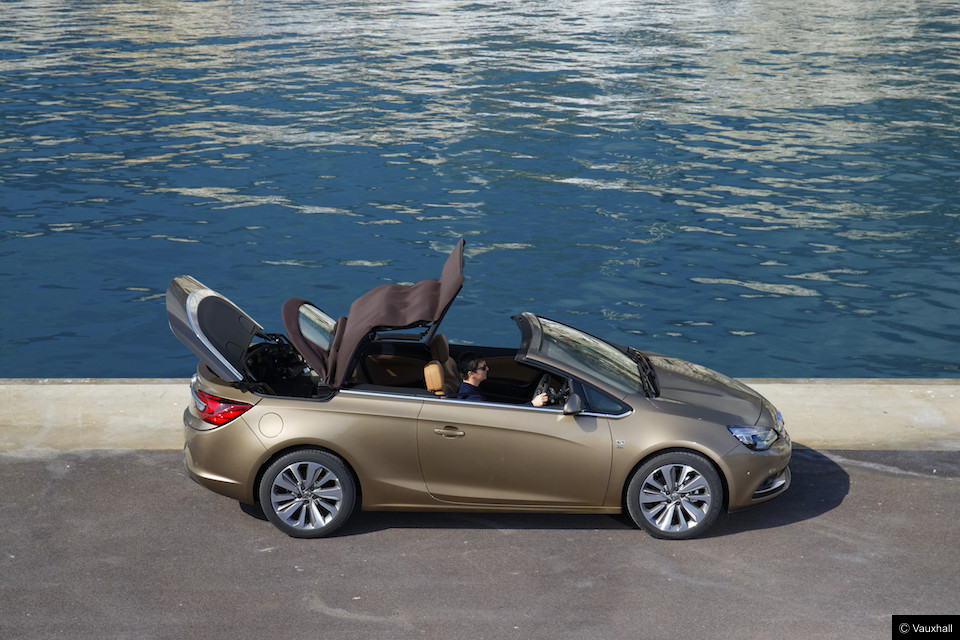
    What I did like was the roof’s operation. Let’s face it, you buy a soft-top for the open air experience. It was amazingly quick to erect, and could be done so at up to 30mph. You can also do it from the key remote. Step out of the house, lock the door and all while you activate the hoods disappearance. It was cool. In fact, the Cascada got the thumbs up from the yoof of the street. I was even complimented by a teenager and it does attract a lot of attention.

    I don’t mean this in a detrimental way but what makes the Cascada acceptable is that despite its million dollar looks, it’s a Vauxhall. It’s cheap enough not to attract the wrong attention so you can park it up with the roof down. It’s an affordable luxury.

    Roof down and even without the wind deflector it is quite draft free and this remains so up to high speeds. It is strangely a little too noisy for my liking with the roof up.

    The Cascada did have a magic trick up its sleeve. Roofs take up a lot of room. The boots are often useless or no more than a letter box. Push up the box in the boot and it reveals a big boot that also stretches into the cabin with the folding rear seat. It makes it quite a useable car.

    Now here is my real problem with the car. It’s the name. It might mean waterfall in Spanish but it is also the name of the 2013 Eurovision German entrant. Nothing wrong with that. Her song was “Glorious” however, the name of the car isn’t. If I had one, I and I have to say l would, I’d just have to remove the badge from the rear and replace it with Astra.

    Love

    Refined

    Design

    Price

    Loathe

    Paranoid parking sensors

    The name

    Noise with roof up

    The Lowdown

    Car – Vauxhall Cascada Elite 2.0 170ps Blueinjection

    Price – £32,810 (as tested)

    MPG – 57.6mpg (combined)

    Power – 0-62mph – 9.6 seconds

    Top Speed – 135 mph

    Co2 – 129 (g/km)

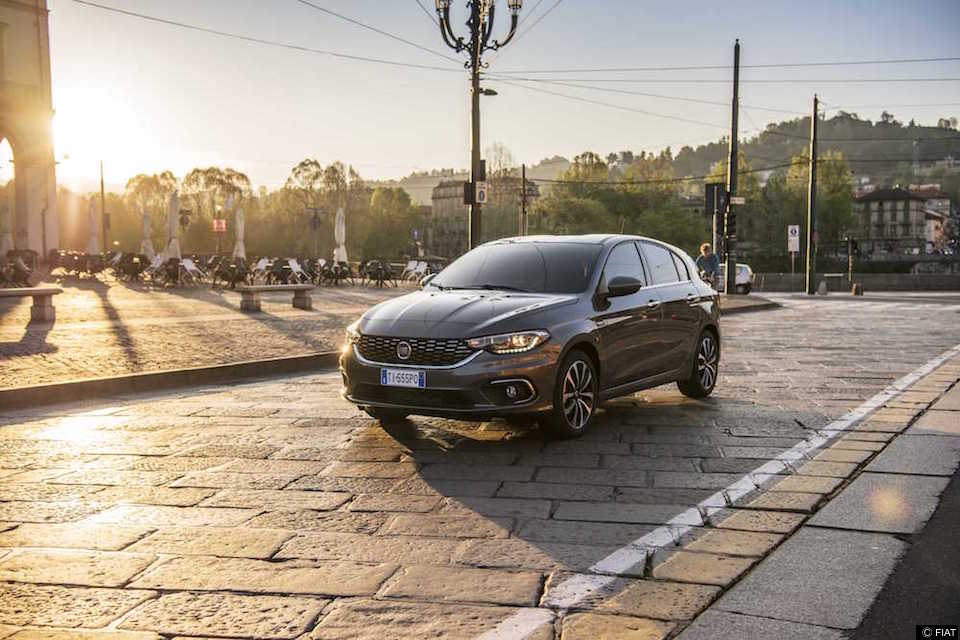
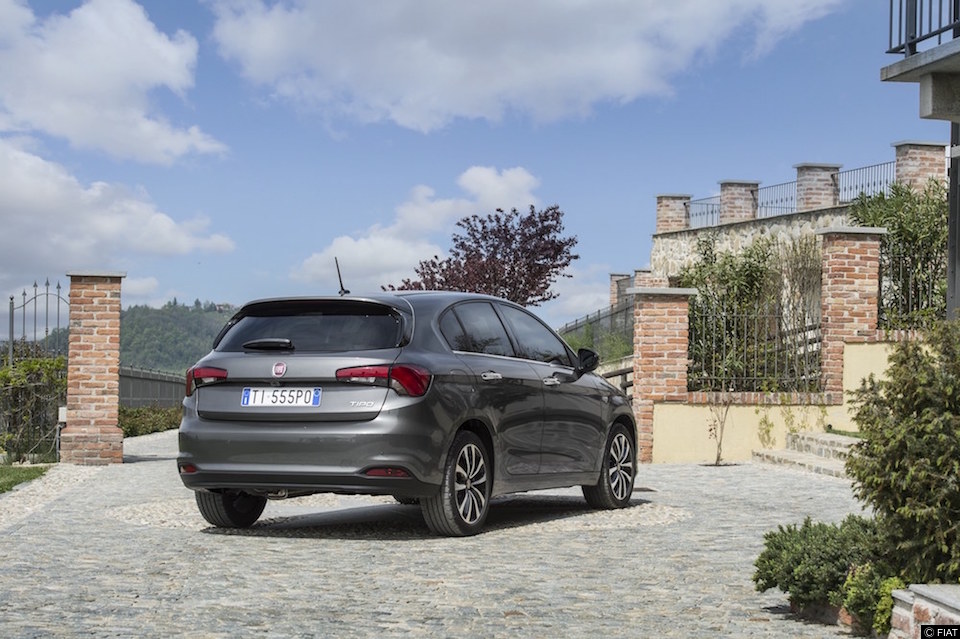
  • CAR REVIEW | Tipo MultiJet 120hp Lounge

    ★★★★ | Tipo MultiJet 120hp Lounge

    Finally, Fiat is coming back. The recent launch of the brilliant 124 Spider set the wheels in motion and now we have the Tipo. Admittedly it is a name from the past of a car that did great things for the Italian maker. Above all, though it is NOT a new form of 500.

    Tipo MultiJet 120hp Lounge

    I liked the original Tipo. It looked like nothing else out there. Square and boxy like the box it arrived in. It had some funk too with the top of the range models starting the digital dashboard era of displays that have now become commonplace. Above all, it didn’t fall apart.

    This is the trouble when you resurrect an old name. Some will remember the past product for reasons good or bad. I remember it for the good so naturally, I got excited about the arrival of the new Tipo.

    Visually it doesn’t fail to impress. Front on it looks rather nice. It’s not like the white elephant in the room of the original which some will say is good. The rear, however, does look a little like most hatchbacks out there.

    Since Tipo 88 (Car of the Year 1989, it was that good) Fiat haven’t really been able to keep up in this fierce segment. Bravo/Brava missed the boat by miles and the Stilo, while it looked good at the front, had a fat backside and wasn’t very good. So I am glad to say that on first acquaintance with new Tipo I am a happy chap. There was a time when Tipo 88 could match the build of Volkswagens Golf Mk3. New Tipo can now hold its head up high once again.

    Fiat has rightly or wrongly not aimed Tipo at the Golf driver. There lays the huge problem most manufacturers have come across. Your product needs to be bloody good to entice the Golf driver away. Instead, they have gone for the more lower-priced market segment. With prices ranging from £12,995 to £18,995 Fiat have priced it very competitively.

    The one thing you will notice is how well it is painted. The boot is large and missing a cargo net so I was forced to place some shopping under the boot carpet. It was here that I noticed that Fiat had painted the bits you don’t see or care about. Even the paint around the boot shut area was smooth and glossy. A lot of manufacturers these days tend to miss these areas. To be honest you probably won’t even notice it. To me, it is these little touches that show Fiat are trying hard to win back some of the market it lost. Even the engine bay is painted well.

    I’ve started doing a centre console rub. You’ll be amazed at how well or not this area is put together by manufacturers. The jigsaw pieces used on Tipo were well fitted together. No harsh edges to be felt.

    It has nothing special on it as far as the lighting goes. No expensive HID bulbs or swivelling headlights. Instead, the engineers have relied on making them good in the first place. Driving down country lanes where l live, the Tipo makes easy work of lighting my way.

    A good driving position was easy to obtain with multi adjustments within the seat and steering wheel that cater for rake and reach. What wasn’t so successful was the centre armrest. It fouled the operation of the handbrake. Something that blighted Tipo 88 so it was nice to see another consistency of old meets new.

    The Tipo was easy to live with too. Again nothing special or outlandish like a one-touch keyless entry or starting buttons. A simple key with remote buttons did the trick. A little touch l did like was the angle of the ignition keys entry. More 45 degrees instead of the usual 90. It doesn’t sound much, however, there was no scrabbling to find the key hole.

    It’s these egonomics that really are hit and miss around Tipo. The front window switches on the driver door had the front window switches too far forward. Numerous occasions I kept opening the rear windows. This is something l am sure will annoy those in the spacious rear. Like Tipo 88, new Tipo also has better rear passenger space than you would think.

    One other thing that infuriated me more than anything was the preselected text reply messages. There was no way to by-pass them and she liked to say everything and tell you everything. The software is out there to better this. For the convenience that it offered it was a little too distracting.

    The saving grace of the infotainment system was its ease of use. The DAB pick up was good and station selection impeccable.

    The 120bhp Multijet diesel engine was a strong puller. 320 Nm of torque available at 1750rpm made rapid progress through the gearbox. The useable power band mostly used was within 1750 to 4000rpm. By 3750rpm all the horses had done their bit. One downside to the engine when standing outside and scrapping the ice off the screen was that it seemed a little too clattery from cold. From inside you could be hard pushed to notice it.

    Italian cars are famed for their handling. Tipo 88 spanned the seductively fast Sedicivalvole. The chassis could handle this. In new Tipo, it needs a tweak or two from Abarth. As it is in the 120hp Lounge model it is more than adequate but not the best. A combination of subtle spring choices has taken the edge away from that foot down powerhouse hot hatch feel. It’s a move I am seeing more off as manufacturers revert away from the Teutonic tautness of the Germans and about time too

    I like Tipo. It’s not perfect in every area. It is easy to live with and on the eye, it does have good looks with crisp lines that aren’t fussy. Inside is accommodating and it has a good strong well built feel to it. Something Fiat haven’t had for a long time. With that in mind, the Tipo didn’t fail to impress me over the week I had it.


    Likes

    Build quality particularly attention to detail
    Price
    Big boot

    Loathes

    Engine clattery when cold
    Armrest fouling handbrake operation
    Preset mobile phone reply messages

    The Lowdown
    Car – Fiat Tipo MultiJet 120hp Lounge
    Price – £18,545 (as tested)
    MPG – 76.3mpg (combined)
    Power – bhp 120 @ 3750rpm
    0-62mph – 9.8 seconds
    Top Speed – 124 mph
    Co2 – 98 (g/km)

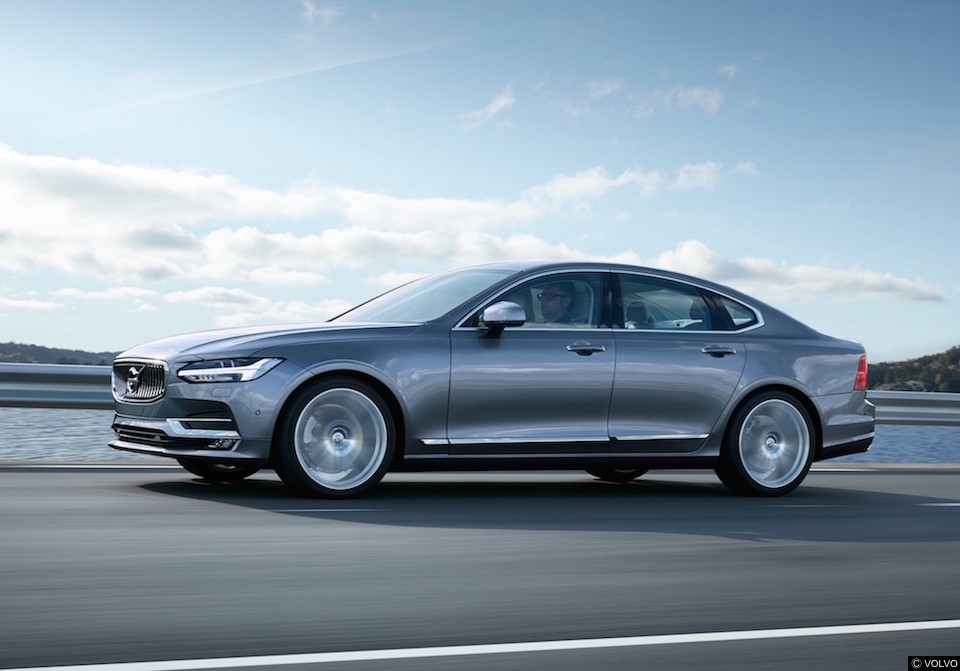
  • CAR REVIEW | Volvo S90 D4 Inscription

    ★★★★ | Volvo S90 D4 Inscription

    CAR REVIEW | Volvo S90 D4 Inscription

    For the sheer quantity of the steel, this is quite a cheap car but don’t let that put you off. List price for the Inscription starts at £35,555.

    On first acquaintance, I thought “I can’t drive this. The seat is too low” So low that I couldn’t actually see over the bonnet. Thankfully the seat has many adjustments and the £350 premium for this, is, money well spent.

    We have a problem in the UK when it comes to large executive cars. We buy German. The French, Italians, the Japanese – for all the manufacturers there are, don’t send their luxo barges here anymore. We are to blame. So Volvo is hoping to take a slice of the action with their new S90 model. This could be reflective in their very competitive pricing and realistic sales forecast of around 2000 units a year. So don’t expect to see many in the carparks.

    That in itself is a shame. Even in its light metallic blue colour, it is a handsome car. Executive cars tend to look their best in darker shades. The S90 is a well-proportioned design. Something Volvo has done a great job on because the S90 is a big car.

    Everything is large in the S90. A trip to the Swedish flat-pack store revealed just how big it was. There was no need to fold down the rear seat. I experienced being a passenger in two places. First in the boot. It’s big enough for 2 bodies. The floor is flat and below the floor is the spare wheel and tools.

    Rear seat room is also more than generous. Probably over generous if I am honest. The low-slung body belies the amount of headroom in the rear too. The rear seat is sadly lacking in under-thigh support for long legs. That said, leg room with me as a driver is more than ample.

    The weather turned cold during my test. What did surprise me was the lack of a heated front screen yet the sonar for the car’s secondary safety features within the screen does have a heated element. It is a big screen to scrape on a cold day. Thankfully the S90 comes equipped with heated seats and steering wheel.

    While I enjoyed the auto brakes in traffic, the auto handbrake has one massive annoyance. Unless you clunk click on the seat belt, it won’t let you drive off. This caught me out several times. Just moving the car on the drive resorted in wheel spin and a dragging of rear wheels. It just wouldn’t let go. Switch that system off and it doesn’t bother you.

    The startup was quick if a little noisy. The 1969cc 190bhp diesel made you aware when it was cold. Once warm the usual diesel noises became subdued. Thankfully they became very subdued. Switch the optional £3000 Bowers and Wilkins speakers off and any noise would become apparent. It was eerily quiet, just what you would expect for this type of car. A nice feature for the stereo is where it put the sound. For most of the time, I had it set for driver enjoyment.

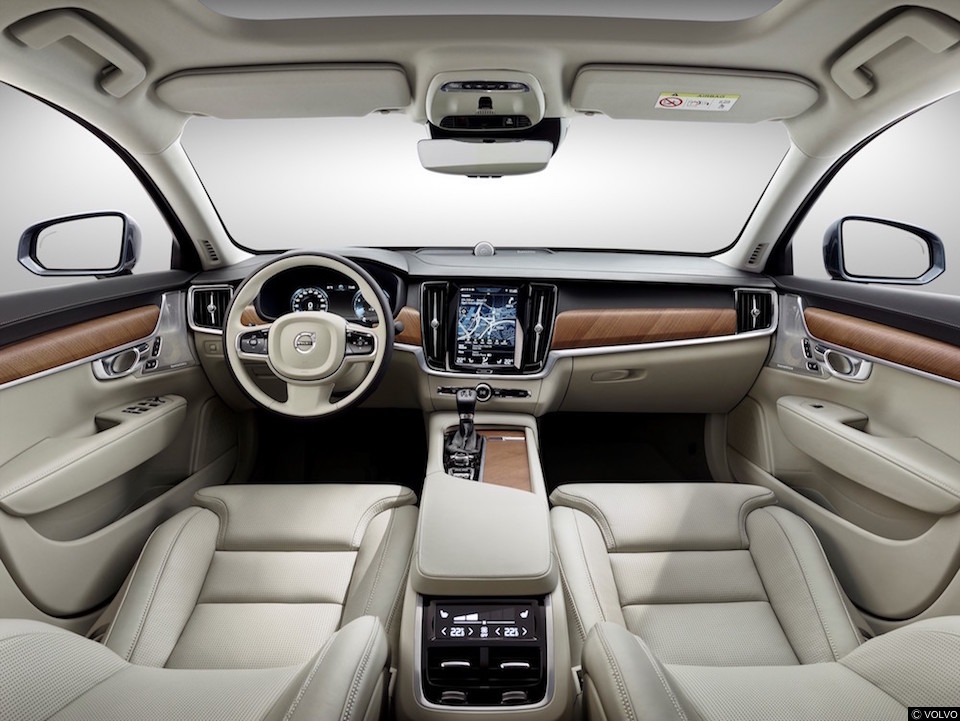
    Driving the S90 is a pleasure. I covered quite a few miles during my test and I have to say it is a nice place to be. The ambience has been well thought out. Gentle lights within the doors just add something special to it. The polished aluminium trim is nicely set off by the wood coverings. It’s not over the top. It’s just right. At night time it is rather beautiful.

    The S90 belies its modest 2-litre engine. That 400Nm of torque is available within a short rev range low down from 1750rpm. There is no turbo lag and put into ‘dynamic’ mode it heightens the throttle response making a rapid car feel more wild and feral. On the go this is marvellous, however, it does flag up a problem when stationary. That low down torque arrives quickly meaning pulling out in traffic is safe albeit a little messy with sudden wheelspin which is then curtailed by the traction control system.

    The ride and handling are worlds apart from one another yet they compliment. The ride is supple and soothing. Never too harsh and certainly not Germanic. That in itself is quite refreshing. The handling, however, is not poised or crisp. The S90 is not a sports saloon in the BMW M5 guise. Don’t be fooled into thinking it is despite its ability to cover miles very quickly. What you do get is an overall pleasantness that is like driving with your Zen turned up to the max. I liked it very much.

    Parking the Swedish barge is not a problem. It comes with assisted parking, reverse camera or 360-degree camera. All very easy to operate. The park assist is a clever bit of wizardry. A tight space in my road was child’s play for it both getting in and out. Now for all its techno toys it comes with crash prevention in its various forms, what did surprise me was that it wouldn’t stop during these manoeuvres. You had to hit the brakes.

    The touchscreen infotainment system also adds to the nice feeling. It does pretty much everything from heating, stereo and satnav. The problem some systems have is they are too small for everything they have to cover. The S90 has a screen almost as big as an iPad and very quickly you find yourself navigating it without taking your eyes off the road. If I could award the car five stars I would on this beautifully thought out piece of kit.

    Sadly it all goes wrong with the tactility of one important item. The outer door trims. For this loaded to the max S90 at £47,380 I didn’t expect to feel a harsh moulding line within the door frame trim. Now if only a little bit more time was spent on this trim. Not that this is going to be too much of a problem for the S90. The Swedish police who are very strict about their choice of police cars are about to take delivery. Now if it’s good enough for them, it’s more than good enough for all of us.

    Like

    Ease of system
    Ambience especially at night
    Comfort

    Dislike

    Some trim finish
    Reverse camera angle
    Won’t let you drive off without a seatbelt on when auto handbrake is selected

    The Lowdown

    Car – Volvo S90 D4 Inscription
    Price – £47,380 (as tested)
    MPG – 64.2 (combined)
    Power – 190 bhp
    0-62mph – 8.2 seconds

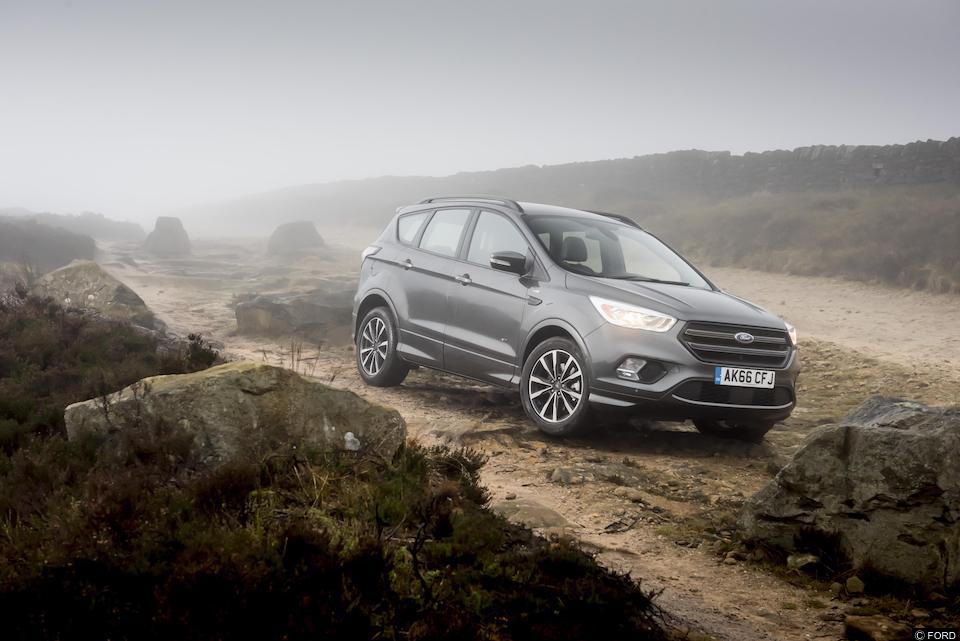
  • CAR REVIEW | Ford Kuga Titanium X Sport 2.0 TDCi

    Ford seems to have tried making a premium SUV, but gave up half way in and threw in a load of plastics and cheap technologies to get it finished. Of course, it looks good and should be reliable, after all, it is a Ford.

    CAR REVIEW | Ford Kuga Titanium X Sport 2.0 TDCi

    The MK2 Kuga is a vast improvement on the old, it has sharp styling and from the outside has a very strong whiff of a premium brand. The model tested was a Titanium X Sport with the 2.0 TDCi 180ps manual with AWD. Now, in this trim the car looks brilliant, we had ours in Deep Impact Blue and it was gorgeous. The big 19″ alloys, silver trim and roof rails made it look like it came from the class above. The bodywork is curvaceous yet sharp and looks very sporty. However, you only get this look on the Titanium Sport or higher, anything less and you get cheap black plastic trim all around the outside. That is where Ford has made a mistake.

    Our test car was fitted with the very comfortable leather seats, well, more like armchairs. Heated as well non the less. The rear seats were also just as comfortable with plenty of leg room and the option to recline the seats. This is more or less where the positives for the inside end. The infotainment system is appalling and looks like it was designed to be used by babies. It is slow, dim-witted and clunky with hard to reach buttons and a poor layout. What can I expect, Ford have never done very well with infotainment. Look at the current Fiesta, nearly 9 years into production and they have barely changed the inside once.

    What makes this even more shocking is this is a whole new infotainment system, only in cars from April 2016 onwards.

    The problems continue. On a car this size and shape you would expect to have a massive and fully usable interior, after all it is a Sports Utility Vehicle. The rear seats don’t even lay completely flat. One of my biggest bbugbears Nothing ruins the back for me more than on a car with tall and wide with so much potential, to be hampered by a step in the load area. The little things. My other issue is more of a suggestion. Under the two front seats we have on offer a very large space, could it not be an option to have under seat storage? It will be great to hide valuables in. Although the glove box is big, it can get filled up quickly with the manual, CDs and in my case, my change pot.

    Apart from those niggles and issues with the inside, it is a pleasant place for a long journey. The electric sunroof is a nice touch, it brings in a lot of light into the cabin, although it sits rather annoyingly in the center of the roof with over half a foot gap on both sides. It doesn’t sound like much but when you want to look out the roof from the rear seats you have to strain over to one side. I won’t get too bogged down with the negatives, because at the end of the day the ride is smooth, the seats are comfy, it is quiet and the air-conditioning works sublimely. Everything you need for a cruise down the motorway in the summer sun.

    So we have established the outside looks great and the inside needs improving, now it is time for an under the bonnet critique. The engine in this car, a 2.0 180bhp diesel works well.

    First gear is almost non-existent and proves to be no use, I often took to moving away in 2nd gear as it got off quicker. Apart from 1st, the rest of the gears are lovely and the transmission is smooth and the gear lever feels connected. The AWD system is a useful, but fuel consuming, bit of extra safety and reassurance.

    For a Ford it coped very well with a bit of light off roading. The suspension is also very good at soaking up bumps, not to mention you can really chuck it at the corners. I was surprised at how smooth the ride was, considering we were riding on 19″ alloys.

    The safety kit is also useful, if not a little unsettling and confusing. It was not until after contacting Ford about the City Stop active breaking that we found out it doesn’t work for people…

    The lane keeping assist works and isn’t too intrusive. Some cars have been known to pull you back over, whereas the Kuga goes for a more “vibrate the steering wheel so violently you lose blood flow in your hands” approach. I also got to test out for the first time park assist. It is a very useful bit of kit, if not a little weird to get used to. Even in the pitch black at 11pm at night I didn’t hit anything.

    Overall it is a good car, nothing to rave about, but I wouldn’t tell anyone not to get one. There are similar cars available which I would suggest, the Mazda CX-5 and Hyundai Tuscan to name two. If you are looking for similar sized cars but with a different budget in mind, the Dacia Duster is a phenomenal car for your money, whereas the BMW X1 gives you a lot more class for your cash.

    Likes:
    Styling
    Comfort
    Drive

    Loathes:
    Infotainment system
    Acceleration
    Fuel economy

    Car – Ford Kuga Titanium X Sport 2.0 TDCi 180 AWD Manual
    Price – £36,115 (as tested)
    MPG – 54.3mpg (combined)
    Power – 177bhp
    0-62mph – 9.2 seconds
    Top Speed – 126 mph
    Co2 – 135 (g/km)


    Find out more at http://www.ford.com/

  • CAR REVIEW | Jeep Cherokee M-Jet 11 Limited

    WOW. That’s how I will start the review for the new Jeep Cherokee. It has a lot of visual impact. There are shapes within shapes and then there are questionable things you point at. Then you wonder where the headlights are? They are not quite in the place you would expect them to be. They are thankfully there and present and on the front. They say it has a fresh and aggressive look. It’s not that aggressive. Fact is, the front is pedestrian hitting friendly and slung low. Quite the opposite.

    The LGBT community is known for standing out from the crowd so this car really does feel at home with me. I spent almost 9 hours behind the wheel of this Cherokee in its Limited spec and it was a nice place to be. Those hours ended up feeling quite effortless. It is loaded from bumper to bumper with goodies, it has driver aids and a less wobbly ride than you would expect.

    I don’t think anyone would have thought this would ever be said about an American car but with the help of Fiat, the Americans have finally made a vehicle worthy of Europe and the UK. It’s not brash and it doesn’t beep at you for random to no significant reasons. Always an annoyance in an American car.

    It all sounds good so you’d expect me to keep enthusing about it but I’ll briefly stop here. Some of those driver aids are a bit much. The Cherokee shares platform software as fitted to the Renegade and I don’t know if it was because the Cherokee is a bigger car, but when the lane assist kicks in during lane changes on the motorway it fights with a firm tug. Indicate and the system is switched off. It caught me out several times.

    Don’t get me started on the door mirrors. They are good in their operation. They contain blind spot indicators that proved useful. What they don’t do however is fold in when on the move! Anything more than 10mph and they fold open. A vehicle of this size and with off-road potential needs to have retractable mirrors on the move. Replacements are not cheap.

    That’s my moaning done. The rest of the Jeep works very well. The engine, 2.2 turbo diesel, is smooth. A little harsh in a few places but nothing that makes you wince from feeling you are being mechanically unsympathetic. These noises are only heard with the windows open anyway. Outside the idle is subdued with a muted diesel clatter. It doesn’t sound like a tractor anymore.

    On the move, the 197bhp power unit mated to the 9-speed auto will propel you forward to 60mph in 8.5 seconds. It’s not the quickest I will grant you so you will be happy to know it suffers no turbo lag and that gearbox of 9 cogs will instantly select one to aid your momentum up to the claimed speed of 127mph I am sure.

    I did question if 9 gears were needed at all. Surely 5 or 6 are ample. Those 9 make for a seamless move through the gears. Apart from coming out of first, I struggled to detect the next change up. You soon learn when it will change up. At around 1500-2000rpm is when it happens. Sometimes however when you play with the manual override you discover it’s jumped 2 cogs. It’s best left to the box to do its thing and you concentrate on driving.

    Inside you are greeted by sumptuous leather-covered seats that offer heated or cold air options. The materials chosen are the best Jeep have fitted to almost any of their vehicles to date. Areas that require touching are made to feel like you have spent your money on something very special. The ergonomics felt right once you had learnt where some of the minor controls were. It took me some time to grasp the concept used for the front wipers. A multi-clicked turn on the stalk activated them from about 4 types of intermittent wiper to normal slow and fast. It was almost over 180-degree turn. In a hurry when you want them it’s a bit of a bind.

    Thankfully on board, this model has the advance brake assist. It worked well when a little hatchback decided to stop abruptly for no reason during a left-hand turn. It also has a neat feature to prevent you reversing into things by slamming on the brakes. Marvellous I said. It did make reversing a doodle and the Jeep went back without a scratch on the bumper.

    The infotainment system is one of the best I have used. The DAB radio is by far the easiest I have yet come across. Everything is easy to find and the display shows almost all and everything you could wish for. I just wished it was angled a little more towards the driver. So many manufacturers get this wrong.

    What I do question is its off-road ability. Unlike Cherokee’s of the past this one lacks a decent ascent and descent angle. The overhang from the front and rear bumpers being to low. Cherokee once displayed a great advert about the bridge missing so having to use the dried river bed. You’d want to get that bridge fixed with this one.

    If you can come to terms with the looks you would be happy with the Jeep. Some will point and stare, others will run and hide. I would give you the thumbs up. I enjoyed my time with it. For that week I had it, it did everything I wanted in a calm manner and did it effortlessly. And who cares what it looks like, from the driver’s seat you don’t have to look at it anyway.

    Likes

    Driving
    Infotainment system
    Refinement

    Loathes

    Folding mirrors
    Limited off-road by bumper overhangs
    Overly powerful lane assist assistance

    The Lowdown
    Car – Jeep Cherokee M-Jet 11 Limited
    Price – £37,245 (as tested)
    MPG – 49.6mpg (combined)
    Power – 197 bhp
    0-62mph – 8.5 seconds
    Top Speed – 127 mph
    Co2 – 160 (g/km)

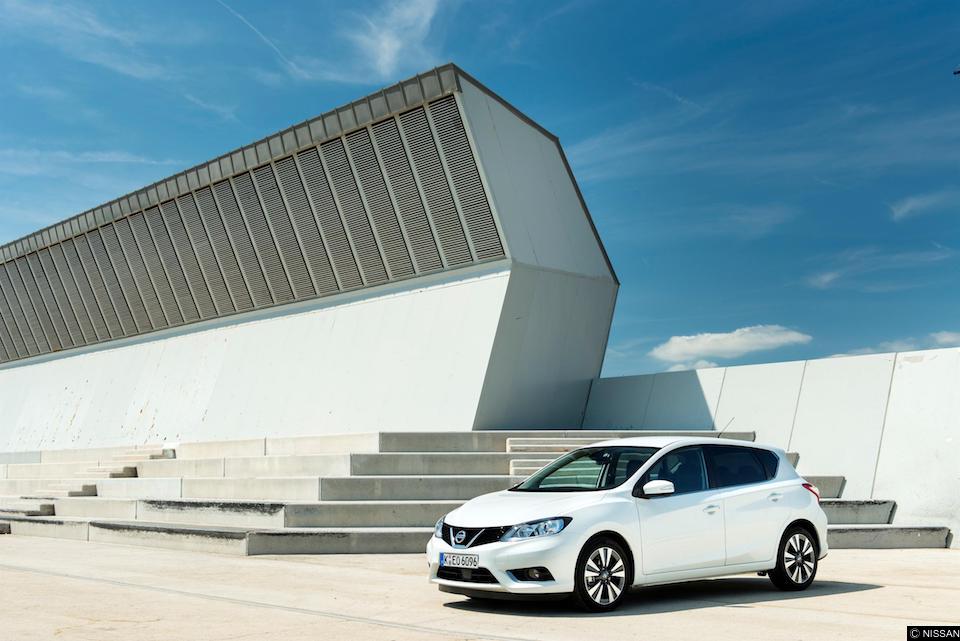
  • CAR REVIEW | Nissan Pulsar Tekna DCi 110

    I can’t believe I am going to say this, however despite its relative absence on the road, the Pulsar isn’t that bad a car. Manufactures don’t really make dreadful cars anymore, they just make them indifferent to others that supposedly set the benchmark.

    CAR REVIEW | Nissan Pulsar Tekna DCi 110

    There were some perceived flaws with the Pulsar that I had from the start. It’s not as well thought out in terms of toys as in the Qashqai. I was expecting more. That said what I was given satisfied my needs.

    Ok so it doesn’t sound great from the start but stick with it and the Pulsar will get better. For passengers, there is an abundance of room. The rear seat leg room with me behind the wheel cannot be matched in this class. Even cars in the next class up will struggle to match it. If I were given the chance of shotgun with the driver or lounging in the back I’d opt for the rear seat.

    Up front as a driver you are offered a few touches of norm for this kind of car. The displays can be altered according to what information you require. The econograph was quite fun to play with. At one point I had the 1.5 DCI 110 humming along to an estimated 74mpg which I think is quite impressive for a car this size. Admittedly that was at a leisurely 62mph with the cruise control on. The average managed over the 200 mile test was 54mpg with my best being 67. I can’t however credit that to the nonintrusive stop start system that saved me 0.20gm of CO2. If you spend more time in traffic you could save more.

    Another nice touch is the easy to use satnav that actually gives you the option to use daytime colours at night and adjusted brightness to suit. I could kiss Nissan’s engineers for this. And this is the thing with the Pulsar, it is some of the little things that make it a better car.

    Sadly the Pulsar suffers two of my pet hates which are poor switch gear illuminations on the doors and pointless carbon fibre trim. This time the trim that gets a mention in the spec sheet is below the rear bumper. Park the car in such a way that you don’t have to look at this and all is good in the world. Goodness also comes in the padding on the door armrest. It’s as soft as a pillow. Boney elbows will not complain. In fact I doubt anyone will moan about the driving position in the Pulsar. It’s all very Nissan and all very matter of fact to the job it has to do.

    Take to the controls and you will see why Nissan has always been easy to drive. In the past they have been a bit woolly, a bit learner driver and tended to appeal to the beige brigade. The gear change is wrist flicking quick and the clutch, while not being the lightest, has a very short pedal travel that further quickens changes both up and down the 6-speed box. If I have one criticism here is that the gate is very close together and until I had learnt to gauge its feel I was slipping it into the wrong gear. 4th became 6th and at one point 5th being 3rd. Thankfully the engine tolerates a lot of revs.

    The steering was nicely weighted. It felt heavier than a lot I have tried but this wasn’t a problem. Again for me, it is these little differences that made the Pulsar likeable.

    What was puzzling was the handling. The traction control system thwarted any kind of fun but pushed hard it could get a little crazy at times, yet switching it off and its road manners improved. It went from a disco bunny on poppers to Kylie to meeting your mother at church on Sunday when switched off. It would kick in when it felt it was at its set limits but the improvements in handling were noted for the better.

    Another nice touch was the stereo increasing in volume as the speed increased and instead of a little, it was noticeable and I liked that. And then there was the 360-degree parking cameras. If you are from the Grand Theft Auto generation that played it from the over the top view you’ll appreciate this. Why more cars don’t have this I do not know. It takes some time to get used to it and what it is interpreting, though once mastered it made for ease of parking without really having to look in the mirrors.

    The nice to use Pulsar is a difficult one to sum up and here lies the problem. It does nothing that makes it stand out from the crowd. It doesn’t annoy you in any way. It’s like a faithful friend who listens to your problems, rubs your shoulders, soothes your elbows and then drives you to get cheesecake. It will never leave you standing alone at the disco. If only it could have some drama to excite it, it might just start to be a major player in this sector of the market.

    Likes

    Price

    360-degree camera

    Rear seat space

    Loathes

    Lacks excitement

    Rear cargo area doesn’t flatten

    Bit austere inside

    The Lowdown

    Car – Nissan Pulsar Tekna DCi 110
    Price – £ 22,245.(as tested)
    MPG – 78.5 mpg (combined)
    Power – 110 bhp
    0-62mph – 11.5 seconds
    Top Speed – 118 mph
    Co2 – 94 (g/km)

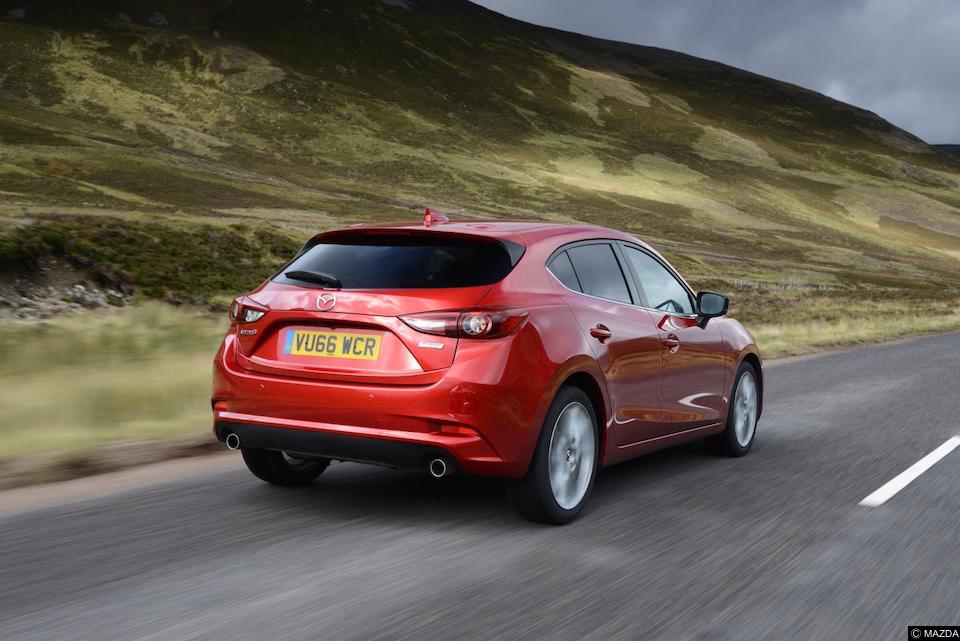
  • CAR REVIEW | Mazda 3 1.5 105ps Sport Nav Diesel

    Think Mazda and you instantly think Wankel engines, RX8, MX5 and porridge.

    CAR REVIEW | Mazda 3 1.5 105ps Sport Nav Diesel

    Mazda has a lot riding on their new Mazda 3 model and after my enjoyment with the MX5 l had high hopes for it too. Like other Japanese manufacturers, they changed the way cars were built in the 70s when reliability on a cold wet morning was more important than looks and parts availability across Europe.

    40 years later does the offering from Mazda still do today what the 323 from the 70s did back then?

    The 3 has grown up with the rest of the class reasonably well. Mazda have always made a good solid mid-sized family car that appeals to everyone but the young. They have never had that “go get ‘em” look. From behind it morphs into an everybody every manufactures hatchback. And this is a shame because the front is very bold and striking. The grill opens wide like a gaping mouth ready to eat all those in front of it. When everyone is making their shapes smooth and round, Mazda come along with a mixture of sharp edges and contoured flicks that blend it together. And then they slap the licence plate right in the middle of it all.

    The overall feel of the Mazda 3 is of one that is well put together. Everything works with a mildly notched smoothness that allows the senses to know where a certain switch is unlike some out there where the fluidity of the switch gear feels too floppy and loose. The standard centre control knob that allows for movement around the heads up infotainment system works well. So well that it is pointless trying to use the touch screen. Its reactions to inputs are either overly sensitive or  not working at all. At one point I thought I was going to push my finger through the screen! On the move it doesn’t allow the touch screen to be used anyway.

    Sadly it doesn’t get any better the further you dig inside. The cabin lacks so much of the expected norm these days like illuminated window buttons and door handles apertures. Scrabbling for window switches and mirror controls literally went out in the dark ages but still, Mazda feel there is no need for this touch of expectancy. And then there is that ruddy awful carbon fibre trim! I disliked the stuff in the 2000s and it is now out of date on a 2016 hatchback. Mazda though seems to love it and fit it to most of their range.

    There are other areas where the Mazda 3 falls flat on its face in the interior and that is around the column stalks. The moulding lines are more clear than on a plastic toy in a Kinder egg. It gives you in one hand and then takes it away in the other. There is great opposition out there in this segment that the Mazda 3 has to take on and it is cost cutting bits like this that kick it to the ground.

    Thankfully the engine and dynamics underneath can more than makeup for this give and take interior. The diesel engine is a wonder of refinement. The smoothness in the 1.5 DOHC 16 valve engine made me question on more than one occasion if I was actually driving a soot wagon. It pulls from the moment you’re on the move too well beyond its maximum in power. Its behaviour more reminiscent of a petrol engine. All this smoothness then came with the added bonus of a possible combined 74.3mpg economy and it got better and better with its well spaced 6-speed manual gearbox. All the actions were light and positive. The seating was beyond ‘just’ right that it made for a driving position that fitted the car to you with no compromises. This made the Mazda 3 feel right.

    The fittings of what held the wheels to the body have such positivity that it feels this is where the pocket-money of the Mazda engineer has been spent. Don’t be fooled into thinking the “Skyactiv” sticker is anything to do with wi-fi, Bluetooth or other such entertainment add-ons. It’s all to do with the construction. It’s a lightish car with a taut body. And this adds extra handling characteristics to aid the driver. Sure it would roll in a corner and you would pull off the power before it would with the traction control system. The back could become mildly wayward if you pushed it hard or did silly things like backing off the power abruptly mid corner but you had to provoke like a stick to a snake for this to happen.

    The Mazda 3 isn’t such a bad car. It has failings in many areas mainly inside but on the bits that make it go it does it so very well indeed. As a car to clock up the miles you could do far worse than this. It will take you from A-Z with a willingness to visit P-Q-R and S just for the fun of it on the way. For a car that will satisfy your desire in terms of making you feel special, it misses the target so badly. And that’s a shame because it has the potential to be so much more than it is allowed to be. Thanks, Mazda.

    Thanks, Mazda.

    Likes

    Driving dynamics
    Engine
    Refinement

    Loathes

    Carbon Fibre trim
    Some cheapness in places
    Lack of cabin illuminations

    The Lowdown

    Car – Mazda 3 1.5 105ps Sport Nav Diesel
    Prive – £22,485 (as tested)
    MPG – 74.3mpg (combined)
    Power – 105 bhp
    0-62mph – 11 seconds
    Top Speed – 115 mph
    Co2 – 99 (g/km)

    Find out more at www.mazda.com

  • CAR REVIEW | Mercedes-Benz CLA Shooting Break

    The Mercedes-Benz CLA Shooting Brake is a bit of a mixture. Based on the A-Class Hatchback, the normal CLA is a four-door saloon with the swooping roofline and dramatic looks you’d expect from a coupe. So what does the Shooting Brake bit mean? This is an old term that has come to mean an estate car that puts style on an equal level of importance to practicality. Think of it as a four-door coupe with room for a short dog.

    From the windscreen forward, you can clearly see the Shooting Brake is based on the A-Class; not necessarily a bad thing. From the windscreen back, the roof sweeps gently down as it approaches the tailgate which itself is heavily raked. Despite this and a narrow opening, there is a decent amount of space in the boot however back seat passengers may feel a little claustrophobic. Taller occupants in the rear may feel their head brushing against the roof too.

    Up front there are no complaints. Despite this being towards the lower end of the Mercedes range, fit and finish is excellent with everything laid out in a logical and easy to understand manner. Some may find the steering wheel column mounted stalk that controls the seven-speed automatic gearbox a little odd (it took some getting used too), but this is normal for Mercedes.

    Not only is the interior well put together, it’s a fantastic place to spend time in. Even after a few two hour journeys with plenty of traffic, I was still more than happy to jump back in the Shooting Brake. The infotainment system proved easy to use with its rotary controller although it could be a little slow to respond to inputs at times. The menus were clear and attractive while the sat-nav worked faultlessly though.

    A range of petrol and diesel engines are available but I decided to try the most powerful diesel, the 220 d. It’s the same size as the lower powered 200 d at 2.1 litres but here produces 175 bhp to give a brisk 0-62 time of 8.3 seconds. Coupled to a fast acting seven-speed auto, it felt a lot quicker than those numbers suggest. Not only was it quick, it proved capable of around 50mpg on a long trip if you were careful with the throttle.

    It was under gentle loads the diesel engine felt most at home. Should you demand hard acceleration, the gearbox could sometimes prove a little too keen to change down a few gears revealing a coarse edge to the diesel motor. It was pretty loud too. There was a ‘sport’ mode but this tended to leave the car in too low a gear which exacerbated the problem. In the end I just left it in ‘eco’ and enjoyed the low to mid-range torque rather than let the engine rev.

    As for the handling, the Shooting Brake cornered quickly with little roll but never felt like it was happy to be hustled along. Ride comfort was good on smooth motorways but elsewhere it was less impressive. Despite being fitted with the smallest available wheels, rough surfaces and big bumps caught the suspension out causing a rough ride. I would have happily traded some of that roll resistance in corners for a softer ride.

    There’s a lot to love about the CLA Shooting Brake. It’s a good looking take on the estate car while the interior really is quite special. That Mercedes could combine such potent performance with a lack of thirst is impressive too. Unfortunately, while I could live with the narrow boot opening and occasionally noisy engine, the tuning of the car’s suspension really lets it down. At nearly £31,000 before options, it’s also pretty expensive. Even so, I’d still be tempted.


    LOVES

    Looks

    Economy

    Cabin ambience

    LOATHES

    Expensive

    Noisy

    Crashy ride

    LOWDOWN

    Car – Mercedes-Benz CLA 220 Shooting Brake

    Price – £30,930

    Power – 175bhp

    0-62mph – 8.3 seconds

    Top Speed – 142mph

    Co2 – 108g/km

    Find out more at Mercedes-Benz