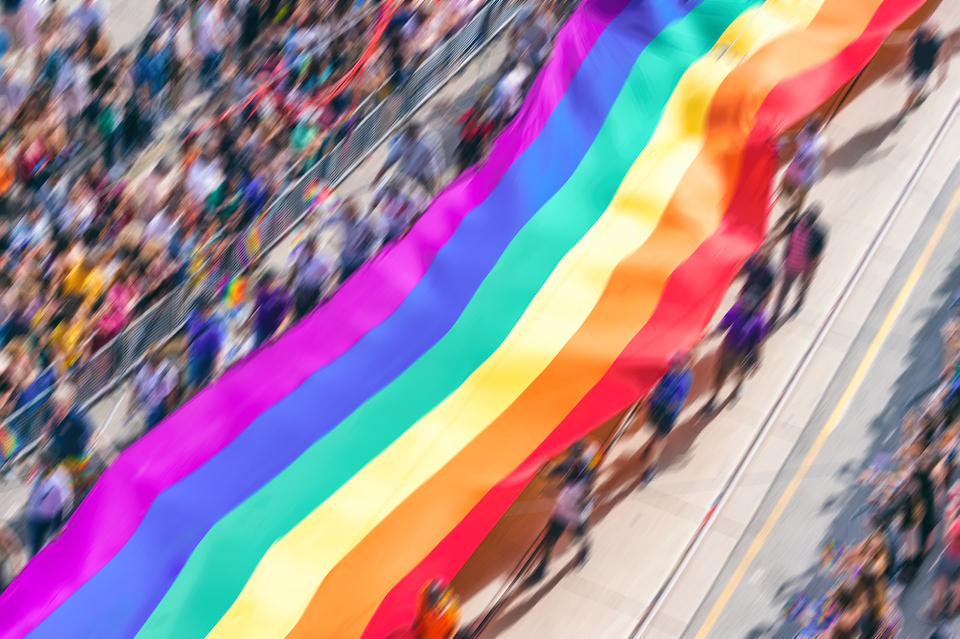
The number of people who identify as lesbian, gay and bisexual in Northern Ireland is a hotly debated subject, with no clear answer, but here will look at all the available stats.
(C) BIGSTOCK
There has long been a widely-held belief that around 10 per cent of the population is gay, lesbian or bisexual or who identify as non-heterosexual. This is probably the most accurate of all the figures – as more and more people feel comfortable to come out about their sexuality.
The most up-to-date statistics from healthcare company Euroclinix show that six per cent of people identify as homosexual while seven per cent of people identify as bisexual. This equates to 13 per cent of the population identifying as either gay, lesbian or bisexual. EuroClinix surveyed 2,000 people around the UK to find out more about the sex lives of Brits.
The current population in Northern Ireland is estimated to be 5.405 million people, which means that there are over 702,650 gay, lesbian or bisexual people in Northern Ireland if you take that 13 per cent statistic.
Other sources:
The ONS (Office of National Statistics) says that in a survey of people in the United Kingdom it found that 1.5 per cent of people identified as LGB. This result was arrived at by extrapolation of data collected. However, these statistics were disputed for not being accurate or showing the full picture. By their estimations, this would mean that there are only 81,075 LGB people in Northern Ireland.
However, in 2005 the HM Treasury and the Department of Trade and Industry of the UK estimated that nearly 6 per cent of people were LGB after studying the economic impact of civil partnerships and same-sex marriages. By their estimations, this would mean that there are 324,300 LGB people in Northern Ireland.
In 2008 the Guardian newspaper reported that 8 per cent of the population were LGB in 2014 the same newspaper group conducted another survey and found that the figures were still consistent. By their estimations, this would mean that there are 432,400 LGB people in Northern Ireland.
There are some of our readers, who are now into adulthood, who weren’t even born when Britney Spears‘ first music video, “…Baby One More Time” was filmed or released, but the video has turned 20-years-old.
The video accompanied the hit single, which went on to launch Britney into a career that would span the late ’90s, ’00s and ’10s – becoming one of the most successful female artists of all time.
Britney took to Instagram herself to write, “Can’t believe the “…Baby One More Time” video has officially turned 20… I still remember filming this like it was yesterday!”
The song was a mega-hit across the globe going number 1 (back in the days when that actually meant sales) in at least 18 countries, selling in excess of 1.5 million copies.
Since releasing “…Baby One More Time” Britney has released 9 studio albums and 42 singles.
A young handsome man from Essex travels to the Big Smoke and encounters unusual situations in the new film Postcards from London.
Harris Dickinson, who was so sexy and memorable in last year’s critically-acclaimed film Beach Rats, is again sexy in this new role, a role where he again plays a gay character.
Dickinson is Jim who winds up in, of all places Soho, where he falls into a crowd of male escorts, but these are not the typical kind of escorts one would encounter in any big city – these escorts are of an artistic bend. They, strangely, have a thing for the paintings of Caravaggio – paintings that are all so homoerotic and sexy. And Jim becomes, for one of his paying clients, a character right out of one of Caravaggio’s paintings. But It’s a premise that’s very unusual, including the fact that Jim seems to have some sort of hallucination of planting himself in the paintings, it’s a premise that just doesn’t work.
A film called Postcards from London should show part of London, especially Soho and all its nooks and crannies.
But Postcards from London was shot on a soundstage, so there’s actually very very little (just in the beginning) shots of the city it’s named after. And while most of the other actors are good, and while Dickinson does his utmost best to try to keep a straight face, I guess the only reason to watch this film is because most of the actors are scantily clad most of the time.
Postcards from London is available to pre-order now.
This month legal expert, Matt Parr tells us everything we need to know about wills and inheritance – especially if you’re lesbian, gay, bisexual or transgender.
Members of the gay community face many of the same dilemmas as opposite-sex couples when it comes to estate planning, wills and their potential exposure to inheritance tax.
According to figures recently issued by the Office of National Statistics, there were 190,000 same-sex families in the UK in 2017 and the majority of those were co-habiting couples as opposed to being married or in a civil partnership. In this situation, those couples or family units face the same issues as co-habitants of the opposite sex. Therefore, there are some important points that they should be aware of.
Co-habiting partners do no automatically inherit assets which were held in their partner’s sole name. In the same way that there is no such thing as “common law husband/wife” there is no such thing as a “common law civil partner”. With this in mind, if you aren’t married or in a civil partnership it is extremely important that wills are prepared to ensure that the surviving partner is adequately provided for after your death.
This can prevent family feuds, confusion over your wishes and costly legal action.
If you’re not married or in a civil partnership and you have no children of your own, then the law dictates that your parents will inherit your estate. Unfortunately, rifts are not uncommon amongst families of the gay community and there are many instances of parents being unwilling to accept their son’s same-sex partner into the family.
The thought of a parent inheriting a share in a property you own as tenants in common with your partner may fill you with dread – is there any possibility your parents would wish to co-own a property with your partner? If the answer is no, your parents could insist on selling the property, forcing your partner to move. Preparing wills would prevent this situation from arising. When property is owned as joint tenants as opposed to tenants in common your partner will inherit your interest in the property regardless of whether you have a will or not.
There is no form of inheritance tax relief for co-habiting couples of any sexuality. Consequently, only the first £325,000 of your estate, otherwise known as your Nil Rate Band (NRB) will be tax free – the balance over and above this will be taxed at a rate of 40 per cent. Therefore, even if you did decide to leave your entire estate to your co-habiting partner, they could be left with a hefty inheritance tax liability. Married couples and those in civil partnerships can leave their estates to each other and benefit from a total exemption for inheritance tax purposes, meaning on first death at least, there will be no inheritance tax to pay.
Unlike married couples and those in civil partnerships, cohabiting partners are unable to transfer their unused NRBs between them. Consequently, many gay couples make use of trusts in their wills to try and avoid an inheritance tax liability by giving them access to the funds without necessarily increasing their own inheritance tax exposure. The use of trusts to control the way funds are inherited, by whom and when, is particularly helpful when one or both of you have children from a previous relationship to whom you would wish to leave your estate, without compromising your surviving partner’s rights to live in your joint property after you have died. Advice should be sought as to your options in this scenario in order to ensure the trust is drafted correctly and in accordance with your wishes.
Gay couples who have taken the plunge and married or entered into a civil partnership can benefit from the same legal rights as opposite-sex couples, including the right to receive a statutory legacy together with a certain proportion of the balance of their partner’s estate if their partner dies without making a will (intestate). Ideally, however, the intestacy rules should not be relied on and my advice would always be to prepare a will specifying how you wish for your estate to be distributed.
Members of the gay community enter into polyamorous relationships in the same way as those in the heterosexual community. Whilst still not necessarily subject to a wider understanding by the public, it is impossible to deny that these forms of relationships exist and therefore it is right to encourage those who enter into them to seek advice on their rights and obligations to one another.
According to UK law, it is illegal to enter into more than one marriage or civil partnership. How members of a polyamorous relationship choose to protect each other’s interests is, therefore, more difficult – but not insurmountable. Again, the use of trusts in wills can prove extremely helpful in ensuring a degree of flexibility and afford a level of protection for the assets within the trusts. This is often required when three or more people wish to co-habit or enter into a relationship with each other.
Seeking advice about your options in this regard can be tricky. The fear of judgment and lack of understanding can deter you from gaining an insight into your options, but there are advisers equipped with the knowledge to help and offer a non-judgmental ear in complete confidence.
Transgender dimension
Currently, under UK law it is not possible to self-define your gender without a formal diagnosis of Gender Dysphoria and a successful application to a gender recognition panel for a Gender Recognition Certificate (GRC). This process can be lengthy and painfully intrusive. But once you have a GRC, what are the legal implications for estate planning and inheritance purposes?
It is important to consider the fact that wills prepared post-4 April 2005 which claim to gift assets to, for instance, “my sons” or “my nephews”, will exclude an individual who has obtained a GRC and who now identify as female. The beneficiary would need to apply to court to alter the disposition in order to rectify a failed gift because of a change in their gender means they no longer align the gender stated in the will. This application could become expensive and lengthy if other beneficiaries take objection to the change being made if this will adversely impact their own share of the estate.
Any will prepared before 4 April 2005 which purports to gift assets in this way does, however, continue to be effective despite a GRC having been issued to the beneficiary.
Members of the transgender community should be aware of the fact that family members may need to amend their own wills to take into account this change in the law and to avoid any uncertainty around the wording of such a gift.
With the growing number of gay couples living together, marrying, entering into civil partnerships and starting, fostering and adopting families of all different sorts, the gay community is just beginning to grapple with the same issues that heterosexuals have faced for centuries. Yet, some of these issues are easily overcome with the right advice.
Ultimately, the worst thing you can do is bury your head in the sand when it comes to discussing what can be tricky and sensitive matters with your family and planning ahead, where possible, is always the best course of action.
The hymen is part of the female anatomy, which can get broken when a female loses her virginity. So do males have something similar?
(C) BIGSTOCK
The hymen is a thin membrane that covers part of the external vaginal opening in females. Weirdly, it doesn’t seem to have an actual use, according to Wikipedia, that suggests, “the hymen does not seem to have a specific physiological function and has few, if any, nerve endings”
But it can cause pain when and if it’s ripped. It can be ripped by inserting a tampon, injury or by having sex – although not always. Many women complain of a sharp pain and blood spotting when the hymen is ripped, however, some women don’t feel it. It may, or may not cause bleeding when it is ripped.
So do men have a hymen?
So medically biological men (sometimes referred to as cis-gender men) don’t have a hymen – and there’s nothing that males have is biologically similar to a female’s hymen – however, if men have anal sex, or engaging in pegging, discomfort may be caused during the insertion of a penis or dildo for the first time – it may even cause a rip in the anal opening – which is why lots of lube is recommended and taking lots of time in order to have penetration.
However, trans men, those who were born with female anatomy but have transitioned to men could very well have a hymen if they haven’t had lower surgery.
Want some tips on bottoming for the first time? Check out these ideas from five guys who give their best suggestions for anal sex.
Sharing a throwback picture, RuPaul shares a rare leggy picture that even Mariah Carey would be jealous of.
(C) BIGSTOCK
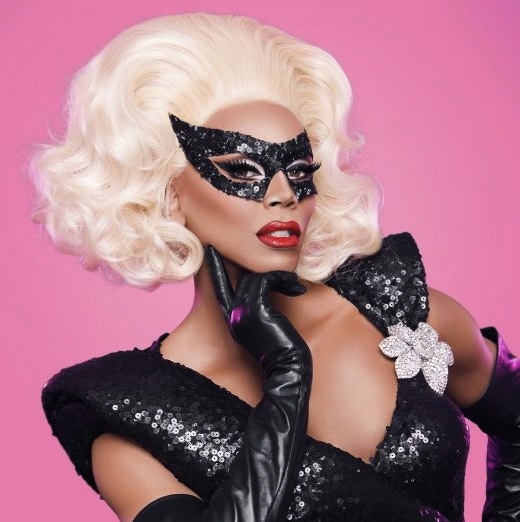
It’s not often that RuPaul shows off her legs, but in an Instagram picture, the queen of queens posted a rare leggy shot – revealing an incredible pair of pins – that would leave most women utterly jealous.
RuPaul was wearing nothing but a bra and a pair of killer 5-inch heels in the knock-out picture, showing off her incredibly toned legs.
Usually, on RuPaul’s Drag Race, the queen’s legs are hidden beneath a glamorous ball-gown, so it’s incredibly rare to see her in a short skirt, shorts or like this – in nothing but underwear.
RuPaul’s usual look includes a full-length ball-gown for her show, RuPaul’s Drag Race.
Fans of the iconic queen shared their enthusiasm for the picture with it gaining over 137,000 likes in just 10 hours. One fan claimed that they needed the picture framed, while another wrote: “legs for days”.
Another said that haters would say that the candid shot was photoshopped.
RuPaul was advertising a RuPaul popup shop in Hollywood.
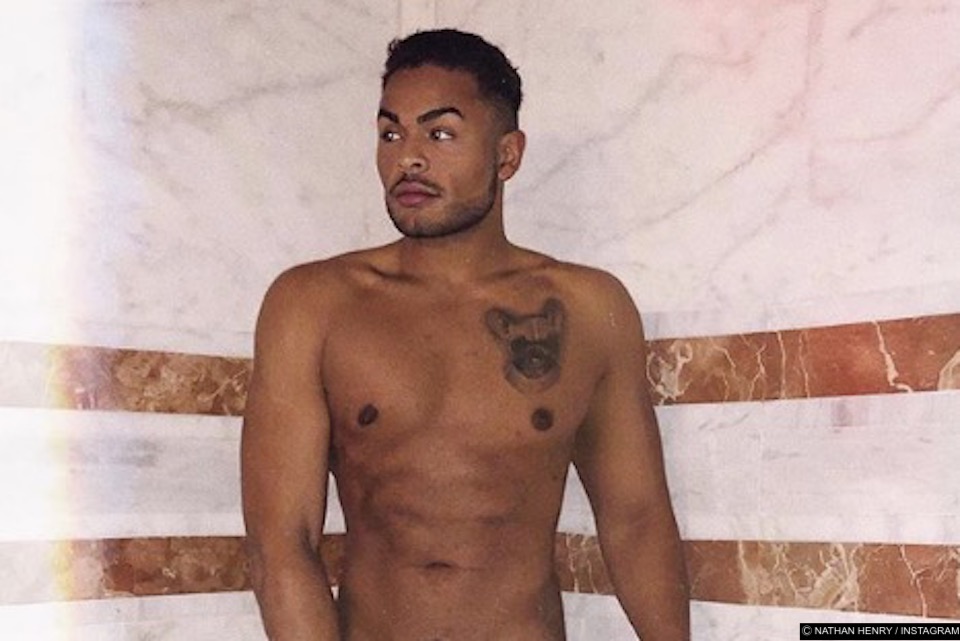
Geordie Shore star Nathan Henry is getting his fans thirsty AF with these hot pictures from his Instagram.
Doing a spot of advertising – and y’all know that sex sells, Newcastle lad, Nathan Henry, who came out as gay in 2015 got completely starkers not once but twice to promote products on Instagram. One to promote beautiful designed stainless steel water bottles the other to promote teeth whitening products.
In both pictures Nathan used the products in question to cover his manhood, leaving some of his fans frustrated, but most complimented the reality star on his body.
One of the pictures, where the star used a water bottle to cover his penis was liked by his fans over 63,000 times while the teeth whitening picture received 11,600 times.
This isn’t the first time Nathan has taken on a naked shot. He once made a naked tribute to Kim Kardashian and also did a cheeky remake of Rihanna’s naked GQ cover, wearing nothing but a leather jacket and superimposing a moustache tattoo on his chest.
Bangkok offers a wealth of experiences and as this was my fourth time in the city, I thought that I should spend eight days away from the tourist trail and seeing the sites and instead soak up the other indulgences that the city has to offer.
Apparently, in such a city as Bangkok, you are spoilt for choice when it comes to where to stay, you can find something that will cater to even the most unusual or exacting tastes, but as a general rule, there are three areas of the city that make for a great base. Whichever you chose it is best to ensure that there is a BST station nearby. A single trip is only 58 pence and trying to navigate the Bangkok traffic via a taxi ride can really ruin your day.
Three great areas to stay in Bangkok
Sukhumvit is popular with visitors; it is a mix of bars and restaurants, and more residential areas and contains both some of the richest and poorest districts giving you a broad glimpse of all aspects of the city.
Silom is the closest Bangkok gets to Wall Street and contains many cultural and historical attractions. It is a quieter district but makes a perfect base from which to visit the hustle and bustle of the city without being surrounded by it when you want to relax.
But for me it is all about Siam as this is the heart of the city’s social scene, shopping, nightlife, food, and fun and with the tourist trail all ticket off via previous visits, this area was perfect for my needs this time around.
Gay-friendly hotel in Bangkok
I chose The Aspira Skyy as my home for the duration and no matter what the nature of your stay or the budget you are working with, this hotel chain, which are found all across the city and beyond, have something that will match your needs. And even the cheapest end of the options will result in the height of luxury.
My own room I found to be clean, spacious and perfect for an eight-night stay. The room includes all mod-cons, a large television, Wi-fi and mini-bar, hair-dryer, air conditioning, complimentary bottled water, bathrobes, and safety deposit box. But the highlight had to be the walk-in shower! The room does come with a balcony, but I found that it didn’t get used, after all why sit out in the humid air when you can relax in a temperature controlled room?
Overall it was a deluxe three-star hotel with a service more in keeping with a four-star location. More than adequate for my purposes.
Breakfast at the hotels was also adequate but uneventful though that doesn’t matter as it gives you the perfect excuse to check out the myriad street food stalls and restaurants that are within easy distance of the hotel. And of course, you are only ten minutes gentle stroll from the BST for when you want to really explore the city.
The number of people who identify as lesbian, gay and bisexual in Wales is a hotly debated subject, with no clear answer, but here will look at all the available stats.
(C) BIGSTOCK
There has long been a widely-held belief that around 10 per cent of the population is gay, lesbian or bisexual or who identify as non-heterosexual. This is probably the most accurate of all the figures – as more and more people feel comfortable to come out about their sexuality.
The most up-to-date statistics from healthcare company Euroclinix show that six per cent of people identify as homosexual while seven per cent of people identify as bisexual. This equates to 13 per cent of the population identifying as either gay, lesbian or bisexual. EuroClinix surveyed 2,000 people around the UK to find out more about the sex lives of Brits.
The current population in Wales is estimated to be 3.113 million people, which means that there are over 404,690 gay, lesbian or bisexual people in the UK if you take that 13 per cent statistic.
Other sources:
The ONS (Office of National Statistics) says that in a survey of people in the United Kingdom it found that 1.5 per cent of people identified as LGB. This result was arrived at by extrapolation of data collected. However, these statistics were disputed for not being accurate or showing the full picture. By their estimations, this would mean that there are only 46,695 LGB people in Wales.
However, in 2005 the HM Treasury and the Department of Trade and Industry of the UK estimated that nearly 6 per cent of people were LGB after studying the economic impact of civil partnerships and same-sex marriages. By their estimations, this would mean that there are 186780 LGB people in Wales.
In 2008 the Guardian newspaper reported that 8 per cent of the population were LGB in 2014 the same newspaper group conducted another survey and found that the figures were still consistent. By their estimations, this would mean that there are 249,040 LGB people in Wales.
The number of people who identify as lesbian, gay and bisexual in Scotland is a hotly debated subject, with no clear answer, but here will look at all the available stats.
(C) BIGSTOCK
There has long been a widely-held belief that around 10 per cent of the population is gay, lesbian or bisexual or who identify as non-heterosexual. This is probably the most accurate of all the figures – as more and more people feel comfortable to come out about their sexuality.
The most up-to-date statistics from healthcare company Euroclinix show that six per cent of people identify as homosexual while seven per cent of people identify as bisexual. This equates to 13 per cent of the population identifying as either gay, lesbian or bisexual. EuroClinix surveyed 2,000 people around the UK to find out more about the sex lives of Brits.
The current population in Scotland is estimated to be 5.405 million people, which means that there are over 702,650 gay, lesbian or bisexual people in Scotland if you take that 13 per cent statistic.
Other sources:
The ONS (Office of National Statistics) says that in a survey of people in the United Kingdom it found that 1.5 per cent of people identified as LGB. This result was arrived at by extrapolation of data collected. However, these statistics were disputed for not being accurate or showing the full picture. By their estimations, this would mean that there are only 81,075 LGB people in Scotland.
However, in 2005 the HM Treasury and the Department of Trade and Industry of the UK estimated that nearly 6 per cent of people were LGB after studying the economic impact of civil partnerships and same-sex marriages. By their estimations, this would mean that there are 324,300 LGB people in Scotland.
In 2008 the Guardian newspaper reported that 8 per cent of the population were LGB in 2014 the same newspaper group conducted another survey and found that the figures were still consistent. By their estimations, this would mean that there are 432,400 LGB people in Scotland.
The number of people who identify as lesbian, gay and bisexual is a hotly debated subject, with no clear answer, but here will look at all the available stats.
(C) BIGSTOCK
There has long been a widely-held belief that around 10 per cent of the population is gay, lesbian or bisexual or who identify as non-heterosexual. This is probably the most accurate of all the figures – as more and more people feel comfortable to come out about their sexuality.
The most up-to-date statistics from healthcare company Euroclinix show that six per cent of people identify as homosexual while seven per cent of people identify as bisexual. This equates to 13 per cent of the population identifying as either gay, lesbian or bisexual. EuroClinix surveyed 2,000 people around the UK to find out more about the sex lives of Brits.
The current population in the UK is estimated to be 66.02 million people, which means that there are over 8.58 million gay, lesbian or bisexual people in the UK if you take that 13 per cent statistic.
Other sources:
The ONS (Office of National Statistics) says that in a survey of people in the United Kingdom it found that 1.5 per cent of people identified as LGB. This result was arrived at by extrapolation of data collected. However, these statistics were disputed for not being accurate or showing the full picture. By their estimations, this would mean that there are only 990,300 LGB people in the UK.
However, in 2005 the HM Treasury and the Department of Trade and Industry of the UK estimated that nearly 6 per cent of people were LGB after studying the economic impact of civil partnerships and same-sex marriages. By their estimations, this would mean that there are 3.96 million LGB people in the UK.
In 2008 the Guardian newspaper reported that 8 per cent of the population were LGB in 2014 the same newspaper group conducted another survey and found that the figures were still consistent. By their estimations, this would mean that there are 5.28 million LGB people in the UK.